



|
|
|
|
 |
 |
   |
The
greatest Pakistani batsman, but... The cricket
coaching assignment is about to be taken up A coach
cannot produce world-class players! The state of
play in Pakistan: It's in a mess
Let this be a new beginning, a new dawn Selection of
the coach: Ask the players!
Being skipper and main source of inspiration for his boys, Inzamam shares the greatest responsibility for the World Cup debacle By Waris Ali It was almost a ridiculous statement that the retired captain of Pakistan cricket team Inzamam-ul-Haq could still play another cricket series for his country. According to media reports,
this was said by former bowling great Wasim Akram. Inzamam should have retired in April 2005, soon after the Pakistan team's tour of India. The logic that his presence would be a source of inspiration for his crewmen is not strong enough; he could inspire the cricket team members while sitting out of the field, exactly as cricket legend Imran Khan and bowling great Wasim Akram are doing. The assertion that Inzamam-ul-Haq is the greatest batsman Pakistan ever produced is absolutely right. On the statistics tables, he stands with the Pakistani batting greats Javed Miandad and Zaheer Abbas; Javed Miandad's average of 41 runs is made up of just 218 ODI innings while Zaheer Abbas's innings average of 47 runs spans over just 60 One-day Internationals. It means that Inzamam's batting average of 40 runs per innings, though lower than his two countrymen, is a greater achievement in view of the fact that Inzamam played 380 One-day International matches, at least six times more than those played by Zaheer Abbas. And if Inzamam had retired soon after the Indian tour in 2005, he would have enjoyed a higher batting average and a permanent image as a non-controversial batting legend of Pakistan cricket. Inzamam's greatness suffered a steep fall during the last cricket seasons of his career; while statistically his average fell sharply, morally he failed to inspire his boys. From the Pakistani team's tour of Australia in December 2004 to their South African tour in March 2007, Inzamam-ul-Haq played 83 innings during the 12 series ó including all Test, ODIs and triangular series. While he can boast of 28 marvelous innings with a record of seven centuries and 21 fifties, and 16 of those innings during which he remained not out, he must be ashamed of the 29 innings during which he could not reach a score of 20 runs. In five of these 29 failed innings, he was awarded a duck while 11 of these innings ended up just before his reaching a double figure score. Still in 16 other innings, while he was able to score more than 20, he remained below the figure of his own average of 40 runs per innings. Further, there is no sane justification that the Pakistan cricket team may ever present for the Caribbean World Cup debacle; they played too badly to advance to the Super Eights stage, thus their ouster was a logical result of their own inabilities, and claiming a role of bad luck or mischance is a lame excuse. And being the skipper and the main source of inspiration for his boys, Inzamam shares the greatest responsibility for the insult to the nation; the former world champions of World Cup 1992 had to be deported to their homeland for being unable to qualify for the cricket world's greatest tournament and they watched the mega event in their TV lounges like their fans. And Pakistani cricket fans watched the championship competition like aliens, exactly as they watched the Fifa World Cup 2006; in both the World Cups, none of their national teams was playing. Indeed, it gives me much pain to criticise such a great batsman of the world; while the statistics of his career are much impressive for a cricket fan, his matchless batting qualities make him one of the best batsmen of the world. But that is only one side of the picture, the other side comprises some unpleasant facts. First, he must bear a major responsibility for the Caribbean World Cup debacle; in all three matches he played during the mega event, he could score just 74 runs and that he badly failed to devise a strategy to lead his crew to Super Eights stage, at least. His exit from the cricket world must be a very painful episode of his life. While the whole nation agrees that Inzamam was dominantly responsible for the debacle, the Pakistan Cricket Board (PCB) itself could not help raising a finger at him for the team's failure in the world championship event. The PCB inquiry into the country's shocking first-round exit held Inzamam responsible for the humiliation, accusing him of acting like a dictator. The inquiry committee head Ijaz Butt said in his report, "Inzamam's attitude was haughty and that of a dictator and more than one incident proved that... Inzamam should have been removed from the captaincy. As a player, he was world-class but his attitude was haughty during and before the tournament. "When the PCB sent a selector with the team on tour to South Africa in January-February this year, Inzamam did not involve the selector in team selection," the report said. Secondly, Inzamam is alleged to have played a key role for the ouster of the speedster Shoaib Akhtar from his cricket career. Shoaib was excluded from the 17-member Pakistan cricket team selected for West Indies tour in May 2005, because of fitness problems. Earlier, he was called back from Australia, apparently because he broke down with a hamstring injury during the third Test in Sydney. But, in fact, he was accused of 'indecent practices' for which he was fined by a PCB inquiry committee. There was talk that Shoaib's exclusion from the team and inquiries on one pretext or another was resulted by his differences with Inzamam. Inzamam, however, made it clear he had nothing personal against the fast bowler. Shoaib had complained that the board, selectors and team management had given contradictory statements regarding his ouster from the team. Earlier, the greatest speedster Shoaib Akhtar had suffered 'special treatment' during both the crickets eries in Pakistan and in India. In the earlier series in 2004, he had been charged with feigning injury during the Rawalpindi Test against India. He faced a PCB-appointed medical commission that failed to punish him after a Shaukat Khanum Cancer Memorial Hospital report on his bone scan was made public. Further, the charges could not be proved well enough to satisfy the cricket fans. And then he was altogether dropped from the India tour.
Former New Zealand player, John Wright, who had coached India previously, was also linked with the Pakistan job but no progress was made in his case By Muhammad Shahbaz Zahid It was a sad day in the history of world cricket when Pakistan's coach, Bob Woolmer, died on 18th March this year in Kingston, Jamaica, a day after his team was knocked out of the World Cup by minnows Ireland after suffering successive defeats -- the first of them against hosts West Indies in the quadrennial tournament's opener. Investigations were made
into his untimely death. Some speculations pointed out But then a sudden twist of change was witnessed with reports being published that after all these events, it would be finally proved that Woolmer wasn't murdered nor he was poisoned; he died a natural death. Whatever the reasons are one would like this matter to be solved as soon as possible. For the time being, Pakistan is playing without a full time coach. And that that they don't have a proper coach at the helm hasn't hampered their progress towards glory days again. Pakistan got off to a flyer in international arena after being embarrassed in the World Cup. They had to play a three-match One-day International (ODI) series against World Cup runners-up Sri Lanka at Abu Dhabi last month which they won convincingly. After hammering the Sri Lankans in the first two one-dayers, Pakistan though lost the third match, there were acceptable excuses from the team that they had to test young players on the tour as well and give them a chance which was clearly seen in the third tie. But that wasn't much of a concern for the team management, the Board and fans back home as they returned with the winning trophy. But the question still stands that for how long the team will remain with out a coach? Pakistan, these days, is being looked after team manager and interim coach Talat Ali. But he hasn't got the permanent job as team's coach; neither will he be appointed nor, I guess, will he accept it. It hasn't been finalised yet (till the filing of this article) as to who's going to be appointed Team Pakistan's new coach. There have been a lot of names lined up for Pakistan's top post, though. The interesting part came when Pakistan advertised for the job on their cricket board's website. According to some pundits, it was a very poor approach to find a new face for the coaching assignment. And the criticism proved right as nothing much happened in a positive way to search Woolmer's replacement. The cricket board had set a deadline of 15th May for all the people who were interested in applying for the job. The cricket board, meanwhile, said that it has received several applications from countries like England, Australia and the West Indies. Several home-grown coaches have also applied for the job. Bangladesh's now gone coach, Dav Whatmore, was the most likely candidate and talked about person to take up the job here. But the former Australian player didn't show much interest and is now being touted to take up our neighbouring team, India's, coaching assignment. Indian team, like all other Asian cricketing nations including Bangladesh and Sri Lanka, are with out a coach too after former Australian great Greg Chappell left the post after a disappointing World Cup campaign where India, like Pakistan, were knocked out of the World Cup in the first round after defeats at the hands of Sri Lanka and Bangladesh. Former New Zealand player, John Wright, who had coached India previously, was also linked with the Pakistan job but no progress was made in his case. English county Leicestershire's coach, Tim Boon, also emerged as a strong candidate to take over as the next Pakistan coach. According to newspaper reports, the Pakistan Cricket Board (PCB) has placed Boon on top of the list of coaches who have so far applied for the job. The Englishman is a qualified coach and is also computer-savvy, as required by the PCB. Boon, who has a rich experience of playing first-class cricket, also fits the description of PCB who according to some will appoint a young coach hungry for international success rather than going for a big name who might disappoint them in the end. Boon is 45. Besides Boon, another unknown name to have been linked for the coaching role is of Steve Rixon. According to reports, the PCB have contacted former Australian Test cricket for the job. But Rixon, 53, who played 13 Tests for Australia as a wicket-keeper, has however made it clear that the unexplained death of Woolmer had left him in doubt whether he wanted the job and he has not officially applied. He said whether he put in for the Pakistan position might depend on what police uncovered about Woolmer's death. But unlike above mentioned players who seem interested in the job offered by the PCB or vice-versa, there are some who have opted against applying for the job as well. And those people, surprisingly, are former Pakistan Test cricketers. Javed Miandad and Intikhab Alam, who both have been former coaches and captains of the national team, decided against applying for the job. Intikhab criticised PCB's method of advertising for the post and said that it was a technical position and putting it through the website was not the best method. Miandad, who has been appointed as the coach on no less than three occasions, agreed with Intikhab's remarks and termed the advert as a casual approach towards the game by the PCB. But this entire searching saga might come to an end and by the time this piece is printed, a new coach might be at the helm of up and coming Pakistan team. PCB officials last week had said they would meet in Lahore this week to shortlist the candidates for the post. The committee, formed by the PCB to help it out in the appointment of a new national coach, was to discuss the issue. The officials of the committee, which comprises of three members including Zakir Khan, Mudassar Nazar and Imtiaz Ahmed, said they had received several applications for the job. If several applications were the case PCB officials explained, there must have been one application missing and that of legendary pacer Wasim Akram. Wasim, who is these days looking after young and emerging pacers of the country as well as the present lot, has counted himself out of contention for the job because of lengthy international commitments as a sport commentator. Wasim, though, commented that Pakistan urgently need a good coach who can guide the team in a professional manner. But Wasim's comments came contrary to what Pakistan all-rounder Shahid Afridi had said a few days ago that Pakistan does not need a full-time coach. But whatever Afridi said doesn't seem to be happening as Pakistan are likely to hire a coach soon if they haven't till today (Sunday). And they would make sure the previous consequences don't occur again -- where there always was a difference of opinion between the captain of the team and the coach; where the captain was the only boss and he did what he liked to do and imposed it; where the coach was just a dummy though he had all the experience of managing a world class side at international level; where there was a small lobby working against the decisions of the coach and of all where there was lack of communication between the players and the coach. Whoever is appointed for the job will have to do his homework before starting his tenure. Pakistan cricket team's coaching job isn't the most easiest task in the world and a man of some stature, who has all the capabilities to treat and guide the most talented group of players around the globe, has the patience to look after a team who has the most emotional fans to back up who can deteriorate any time if the team suffers a loss and has the tactics up his sleeves to convert the side into a winning combination should only be selected by the PCB or vice-versa. The writer is a staff member at 'The News' Karachi, shehnu@gmail.com
A coach cannot produce world-class players! Pakistan's former captain and bowling great Wasim Akram has ruled out a permanent coaching role with the national team By Khurram Mahmood Coaching in any
field needs experience, knowledge and command. Even sports A job of a cricket coach demands specialisation in the game of cricket, especially if you are a coach of a sub-continental team, you will face an extra pressure. There is a lot of difference in coaching any sub-continent teams or England and Australia, basically its mainly the cultural difference. Cricket is not only a game for India, Pakistan and Bangladesh spectators; sometimes it becomes a matter of life and death for passionate people. All other things are left behind when a match is being played between Pakistan and India. The pressure is not only on the players but the coach also feels the heat and sometimes the captain and coach lose their jobs after loosing the series. Pakistan, India and Sri Lanka have their different styles while Bangladesh are learning to understand what style suits them best. These days all four teams of the sub-continent -- Pakistan, India, Sri Lanka and Bangladesh -- are 'coach-less'. Pakistan coach Bob Woolmer died after the Pakistan defeat against newcomers Ireland in the West Indies while Greg Chappell (India), Tom Moody (Sri Lanka) and Dav Whatmore (Bangladesh) resigned from their post. In search of a new coach, the cricket boards of four nations are negotiating with different coaches. The Pakistan Cricket Board (PCB) published advertisements in April loking for a national team coach. In the advertisement PCB was clear in saying that the appointment would be for an initial period of two years starting from June 2007 and that terms and conditions were negotiable. In response of the ad only 13-15 applications (including Pakistani candidates) were received but no well known coach applied for the post. The one reason for not showing interest was the PCB condition that the applicant must have the experience of playing first-class cricket. PCB Chairman Dr Nasim Ashraf without mentioning their names confirmed that he had short listed five foreign candidates for the national team coach. On the one side Nasim Ashraf wants a young, dynamic, energetic and qualified foreign coach who also has computer knowledge. But on the other hand he has tried his best to engage the experienced Tom Moody and Dav Whatmore. But Tom Moody turned down the PCB request and gave preference to go back to Australia and sign up with Western Australia while Dav Whatmore has been showing more interest for the Indian team's coaching. Whatmore accepted that he is contesting for the high-profile coaching assignment of the Indian team. Now the PCB has most probably two choices, one is Lancashire coach Tim Boon and Steve Rixon, the former Australian wicket-keeper. If the management thinks that a foreign coach will convert this team into a world beating unit, it is wrong. With the foreign coach first, most of the players will face the language problem as in the past, how many players can speak and understand English properly and when a coach can't explain his lesson to the players completely how will they learn and even Whatmore not applied and not interested in the Pakistan team's coaching. The PCB has still not lost hope and are waiting for the Indian board decision -- if the BCCI does not enter into a contract with Whatmore, then definitely he will be Pakistan's first choice. Dav Whatmore, a former Australian batsman, has an excellent track record as coach. He led Sri Lanka in the 1996 World Cup when nobody considered the islanders as favourites. In the recently concluded World Cup in the West Indies, his side Bangladesh not only qualified for the Super Eights group after beating India, but also defeated South Africa in the last round. Pakistan's former captain and bowling great Wasim Akram has ruled out a permanent coaching role with the national team, excusing himself that his other international commitments did not allow him the luxury of a long-term job. Only former Pakistan captain and coach Javed Miandad is ready to take responsibility 'in national interest' while he didn't apply for the post. He is ready to give serious thought to coaching the national team again if the board offered him the job. Javed Miandad, 50 this month, has coached senior team in three different terms but was removed or resigned on all occasions before completing his tenure. He last worked with the team in 2004 and stepped down after lost a home series against India after which Bob Woolmer replaced him. When Bob took over as coach, Pakistan were in the lower levels of both ICC Test and ODI rankings. It was a demoralised side. Bob initially worked to boost the morale and performance of the team. He was an innovative coach with modern techniques to improve performance on an individual and team basis. Former West Indian great Sir Viv Richards has also praised Miandad's services and said that Miandad could be the best choice to succeed Bob Woolmer and revive Pakistan's fortunes. "Every time I have met him I have been impressed by his desire to see a successful Pakistan team. Javed has seen and done pretty much everything in the game and is a strong character. No one knows more about Pakistani cricket than he does," Richards said an interview. According to Richards the only other person after Miandad who can convert the split talent into a fighting unit is Imran Khan, the former Pakistan captain. But obviously neither Imran Khan has any interest to work with the Pakistan team nor the PCB will offer him on political reasons. It's time to make a good strategy and planning and appoint a good and experienced coach on a long-term basis and provide better ground facilities to the players from the domestic level. Except a few players most of the Pakistan team members have a lot of experience of playing international cricket and they are not in the age of learning that how to hold the bat or ball or how to run between the wickets. A coach can improve the performance and technique of a player who wants to learn but can't produce a world-class batsman/bowler without talent and interest. The writer works in the art department at 'The News on Sunday' in Karachi, khurrams87@yahoo.com The state of play in Pakistan: It's in a mess The people in charge are burying their heads in the sand. 'This is just a cycle we are going through,' they claim, but it seems Pakistan has been going through this particular cycle for a long time now By Dr Nauman Niaz Pakistan cricket is in a mess, and the most worrying aspect of our ongoing national decline is the fact that no one with the power to change things is ready to acknowledge this basic fact. Many ex-players, men with outstanding careers behind them who are motivated entirely by a deep affection for the game, are expressing concern at the poor standards in our domestic competitions because they know that we will never be a major force at the Test level until we create circumstances which foster the development of exceptional talent. The reality is that there are no top-quality players coming through the system, and things are not likely to improve until the authorities face up to the situation. As with an alcoholic, nothing can be done to achieve a cure until the patient admits that the problem exists. Unfortunately, the people in charge are burying their heads in the sand. "This is just a cycle we are going through," they claim, but it seems to me that Pakistan have been going through this particular cycle for a long time now. It would not be fair to say that nothing has been done, because a number of committees and commissions have investigated the state of the game, but none has actually produced anything worthwhile. There was a committee in 2003, when cricket didn't do comparatively well in the World Cup, and now another one shifting the entire blame of Pakistan's disastrous performances on Inzamam-ul-Haq in the post 2007 debacle. No doubt all those involved did their best to improve things, but largely it has been a question of tinkering with the various tournaments, a matter of tentatively shuffling the same deck of cards in the vain hope of finding a winning hand; to some these committees were simple eyewashes. This is not exactly a surprise, because I honestly feel that all these commissions lacked the sort of expertise that could have been offered by distinguished men, not only the top cricketers but dealing with all other aspects of the game. I know Dr Nasim Ashraf well and like and admire him. He is obviously a brilliant man doing justice to medicine as a nephrologist for twenty years and now associated with human development commission and cricket, his knowledge of the game is intense and deep but in the broadest sense he is limited when it comes to understanding the politics and intricacies of the country's cricket. He needs to understand the psyche of the players, the limitations and mindset of people with vested interest. He is doubly in trouble as he is required to cleanse the stagnating environment plus creating a sports culture and also to identify player pathways. It must be a great challenge. The committee reports all well and good they may have been in the past, but all the members of the public to whom one spoke thought the recommendations were so difficult to put in practice in our culture they couldn't work them out. Inevitably, in the past the implementers turned their back on the blueprint, too. So why should it be thought so readily that someone like Dr Nasim will not have problems putting cricket back on the right path? Indeed, it is perfectly easy to demonstrate that many mistakes have been made. One's concern today is that the obsession with preparing players for relatively few important engagements is counter-productive. It's high time we should making World Cups as the benchmark. All international cricket is as important as the prestigious ICC tournament that falls once every four years. Today, players are very good at training in the sense of enhancing agility and speed over the ground, so there is no doubt that the standard of fielding has improved tremendously (though Pakistan's fielding may well be the worst on the international chart) but still it is a lot better than what one watched in the 1980s and 1990s. Our first-class cricket has been wrongly criticised. There is a recent talk of ending the departmental cricket and changing it with a regional face. One must reinforce the claim that departmental cricket actually helped Pakistan competing with the top teams in the world under Imran Khan's totalitarian captaincy in the 1980s. There are numerous examples of good cricketers in the 1980s and 1990s who played hardly any Test cricket yet were better players than anyone in the current Pakistan team. People such as Masood Anwar of Rawalpindi and Ghulam Ali of Karachi were glaring examples. Masood scored hundreds of runs as an opener for Rawalpindi and Agricultural Development Bank of Pakistan (ADBP) but could not force his way past Mohsin Khan and Mudassar Nazar. Abdur Raqib was a top left-arm spinner. He represented one's ideal as a professional because all he wanted to do was bowl-bowl in matches and then practice bowling in the nets. He had a very hard introduction in first-class cricket. When he joined the staff at Habib Bank he found himself busy from morning until night. He was required to bowl to the senior players in the nets in the morning before taking part in the junior nets in the afternoon. Finally, before going home to bed, he bowled in the nets in the evening to the members who turned to untimely practice. In the final analysis, of course, that demanding routine stood him in very good stead, building up his mental strength to the point where he could keep going virtually all day. No one heard Raqib ask for a rest. When his captain wanted him to bowl, he bowled, and, as a matter of record his number of wickets (643) in first-class cricket, an impressive total of balls bowled (34820) being exceptional for the period. For a comparison in terms of wickets between Raqib's era and the modern day players, one needs to understand that bowlers with mediocre performances have been picked on the Test teams. Today's cricketer suffer problems with their attitude, waiting for things to come easy and this reflects when they advance to the Pakistan team. One remains convinced that anyone who looks objectively at the situation will agree that the level of skill in Pakistan cricket stands at an all-time low. Thus we have to face the most important question: How can we hope to create a strong, successful national team from such relatively shoddy material? It is, of course, impossible under current circumstances. First-class cricket, in the shape it is now, is the only breeding ground for emerging talent. It provides the opportunity for young cricketers to extend the range and depth of their ability, and incidentally, it is also the medium through which general interest in the game can be encouraged. Thus, it is absolutely vital that Pakistan Cricket Board realises what is happening. There is an acute shortage of star quality, the factor which above any other attracts the public through turnstiles. Currently there is very little to capture the imagination -- just a group of genuine, enthusiastic, ordinary lads who love to play cricket. Effectively we are devoid of spinners, seamers are thin on the ground, and far too much batting is workmanlike. For once, the Pakistan selectors were safe from criticism when they named the party for the Abdu Dhabi series against Sri Lanka; they were hard-pressed to find sixteen decent names for the trip. We possess a hard core of thirteen or fourteen who represent the best available, and anyone who follows the game would pick them automatically. Only four players were omitted -- Younis Khan, Danish Kaneria, Rana Naved-ul-Hasan and Inzamam-ul-Haq. Inzamam has already retired from One-day International cricket and the rest are playing county cricket in England. There was a little debate concerning the relative merits of Fawad Alam and Najaf Shah. One thinks, both deserved their chance. Their selection hardly amounted to an issue of great importance. More to the point, the selectors could not even find a third opening batsman or a high calibre alternative to Inzamam. With the greatest respect, I hardly think Sri Lanka spent many sleepless nights worrying about the three-match series with only Pakistan to play. South Africa and India had earlier opted out due to their packed schedules. It is, therefore, quite clear that we do not have in Pakistan a sufficient number of quality players to sustain numerous first-class teams. The minimum requirement is for around 200, which, even then, allows for fewer than twenty per team, the majority of whom ought to be good enough to engage in meaningful competition. The undisputed evidence that we can raise nothing like the necessary numbers cast a long shade on Pakistan cricket's future. It is vital to have a keen competitive edge to force players to fulfill their potential and to provide a worthwhile spectacle for the selectors and future of country's cricket. If the legislators could put the first-class cricket on a healthier footing, it would stretch the up-and-coming youngsters and better prepare them for the greater demands of international cricket. A relaxed, easy going competition without the departmental teams in which most sides have little to play for makes it possible for anyone with reasonable ability to drift along doing enough to justify his existence, sometimes encouraging false hopes. Nothing illustrates the pitfalls better than the careers of Imran Nazir and Saleem Elahi, who scored heavily in first-class cricket. They earned the highest praise from the most discerning of cricket commentators, even being compared to the best. Embarrassingly, a number of domestic teams proved too ready to spread the field once they established themselves, offering a succession of easy singles to get them away from the strike. This approach gave Imran and Elahi and their admirers a misplaced sense of security, for immediately they stepped up a level to experience the unrelenting hostility of the international attacks, they failed to make the expected impact. As a consequence, they never really established themselves in the Pakistan side, despite their demonstrable class. Certainly, in the 1980s and early 1990s they would have faced a more searching examination of their technique long before they entered the international arena. An international sportsman has to face up to the best the opposition has to offer and prove himself and the rest of the world that he has what it takes. Modern Pakistan cricketers are denied those opportunities in domestic cricket and, to make matters worse, the marketing men at the PCB are steadily promoting the idea that international cricket is the only thing that matters. The PCB needs to realise that the domestic teams are to be supported. If they do, fine; ways and means must be found to help the first-class sides stand more firmly on their own feet. Certainly, those supporting a significant shift in the scheme of things should understand that without a proper championship they will be unable to put a respectable Pakistan team on to the field. Whatever the marketing people might claim, first-class and Test cricket go hand in hand and their long-term futures are inextricable linked. Apart from boosting first-class cricket and for that shifting from departmental cricket to the regional format is not going to help, the PCB also needs to identify young players and hone their skills under the patronage of people like Mudassar Nazar and Aaqib Javed at the National Cricket Academy, resolve the administrative problems and making things simple. At the PCB, changing the designations will not give solutions, we may well have to change the faces too.
Let this be a new beginning, a new dawn Afridi should just concentrate on his cricket and let the issue of coach to be handled and taken care of by the board as this is their prime responsibility By Muhammad Akram Chohan It is very unfortunate that some of our
so-called superstars have indulged themselves one after the other in
unnecessary acts. In the recent past Shoaib Akhtar and Younis Khan avoided
taking part in the series against Sri Lanka on the basis of fitness and
county commitments ignoring the importance of the event as On the other hand Shoaib showed keen interest in playing the Afro-Asian series, it was another thing that he was dropped on fitness grounds, the reason which he used while refusing to play for Pakistan but anyhow the Pakistani team managed to win in his absence but, after the conclusion of the series, Shahid Afridi gave two back to back statements, one in the UAE capital and the second one after landing in Pakistan that the Pakistan team was in no need of a coach. This is all very irresponsible as we all know that the Pakistani team is going through a rebuilding phase and in this process youngsters are too and would be coming in to demonstrate their skills at international level to be recognised and in this scenario one does feel that a competent coach is very essential to guide the upcoming lot of budding cricketers and also to correct the technical flaws of the existing players. The win against Sri Lanka can't hide the fact that our middle order and openers were not in their best of touch as our most prolific batsman Mohammad Yousuf displayed a lacklustre performance after the non availability of Younis Khan and retirement of Inzamam although the tracks which were prepared for the series offered little support to the bowlers and were considered batting strips, our batting line crumbled against the much weaker bowling of Sri Lanka. A coach or a mentor can't prepare a player but he can give the confidence and technical support a player needs whether he is a new player or an established one who is going through a lean patch. But in Afridi's opinion this is not the case with the current Pakistan squad and he is of the view that by defeating the Sri Lankans they have touched those heights of technical brilliance which even the Australians can be proud of. We all know that Shahid Afridi always gave a deaf ear to the suggestions and instructions (which were given to him to perform up to his potential as he is a very handy player) whether it was from the coach, captain or even from legends like Imran Khan and wasim Akram. The late Bob Woolmer made all out effort to bring a change in the attitude of our players so they could improve themselves technically and remove all technical flaws with his help and he also emphasised a lot on the importance of physical fitness but it all went in vain so PCB should bring a strong-nerved person who can take a stance on his way of working and never show any sort of flexibility and compromise on his principles because in our part of the world after performing in one or two matches every one considers himself a legend and start avoiding taking part in physical or technical sessions. The importance of a coach can be gauged from our neighboring country's board's hectic efforts that they are running from pillar to post and utilising all their contacts to have a qualified coach who can look after their team affairs and in this connection we saw that the top brass of BCCI flew from India to Bangladesh to have negotiations with the outgoing coach of Bangladesh Dav Whatmore and they may have succeeded in hiring his services too. The Sri Lankan board is also finalising and short listing the list of candidates for their team although their batting line up and spin department consists of one of the biggest names of modern day cricket but they are thorough professionals and well aware of the fact that an able coach will transform their teams into a formidable bunch of players. Sachin Tendulkar before arriving in Bangladesh for the series spoke to his childhood coach to take some tips as he was not feeling his technique correct and also for confidence restoration as he looked his shadow during the World Cup and the result -- two centuries in two Test matches and he was declared man of the series. On an England tour when a bowler of Wasim Akram's stature was finding it difficult to control the swing he called Imran khan all the way who was in Pakistan at that time to take a piece of advice. When legends like Sachin and Wasim do not feel hesitation in getting guidance to perform for their countries then why is Mr Shahid Afridi afraid of this, I could not understand. He should just concentrate on his cricket and let the issue of coach to be handled and taken care of by the board as this is their prime responsibility. On the other hand our national selection committee is having ample time to look for the raw talent across country because in the past we have witnessed a situation where our national selectors used to sit in air conditioned rooms and never take time from their busy schedule to visit any of the grounds where matches of the domestic season were played. You could say they were then working on an honorary basis, but now this time we have a paid selection panel who are drawing lucrative amounts so they should keep a close eye on the English cricket season where some of our youngsters are playing. They are in the hope that PCB and selection committees who have promised to induct fresh blood in the coming season would not neglect their efforts and performances and they will have at least one chance to prove themselves. A very constructive and positive step which the board has taken is that they have invited Wasim Akram to have a look at the available resources among emerging young pacers and he is quite optimistic about our future in cricket and also in pace department and one would also like to acknowledge and appreciate the board's timely decision and planning for arranging a conditioning camp which is going to be held in Abbottabad from June 12-26 in the supervision of experts and will provide the invitees an ideal opportunity to prepare themselves mentally, physically and technically for the coming season. The forthcoming season is very hectic and competitive as the coming assignments of Team Pakistan are very demanding and in the end it will be the players who will have to look after themselves in the remainder of the season and should train rigorously to be able to take up the coming season's challenges because the series against Sri Lanka is not the end of the road, it is the beginning, a new dawn for every cricket lover in Pakistan after the nightmare which we had during the World Cup and we would love to see that this last for long. Selection of the coach: Ask the players! We have to change our attitudes regarding our adjustment and camaraderie with people in a working environment. If we think we are flawless that does not mean that the opinion of someone else is flawed By Syed Ahsan Ali Failure to accommodate with the role of coach, whether a foreigner or local, in international cricket on our part does not make the idea of having a coach an excess baggage at all. Teachers, trainers, advisers, attorneys, friends, motivators and people with mirrors in their hands are required by even the best of minds and supreme of intellectuals. Overlooking our own inefficiencies to adjust with different personalities cannot make coaching unnecessary with international playing eleven. A coach is part and parcel of any professional, thinking unit. There is no point denying its significance in an age which is highly competitive and heavily scheduled regarding the amount of cricket being played all round the cycle of earth. We have to change our attitudes regarding our adjustment and camaraderie with people in a working environment. If we think we are flawless that does not mean that the opinion of someone else is flawed. Cricket is becoming a mind game with every iota of time at our hands. It is no longer a game of bat and ball played under the bright sun with uncontrollable wills of 22 individuals. The ever exceeding number of cricket contests is increasing the role of trainers, physiotherapists, computer analysts and coaches. No single captain of even the highest intellect can keep a track of what is happening all around the cricketing world, and then take out what can be used as an advantage when playing against a particular opposition or player. A coach can play a role in identifying certain weaknesses of particular oppositions or some of their players. You cannot know from the outset that a particular individual in a certain team possesses this and that which can be utilised for your own advantage. We all remember the needle between Shoaib Akhtar and Matthew Hayden in the second Test between Australia and Pakistan at Sharjah in 2002-03. The giant Aussie batsman scored 119 when the Rawalpindi Express tried to corner him through some unprovoked sledging. Hayden has only one problem that he can tear any bowling attack apart. Otherwise he is a fine fellow. But he has one main facet which can be understood if you play against him or if someone experienced tell you so and that he does not like arrogant, talking cricketers especially bowlers. Staring and fuming bowlers spur him up which usually go against the men with ball in their hands. Shoaib can tell you a thing or two about it. This can be learnt either through experience or extensive study or through wise head sitting beside you during nets. A a young captain like Shoaib Malik definitely needs someone who can give him a helping hand in devising certain game plans, improvising strategies, exposing weaknesses and probing strengths of the opponents. He is new in the field who wants sometimes to get acquainted with the prime job. He likes to listen to his colleagues which he manifested in the Abu Dhabi ODI series through his incessant consultation with his vice-captain Mohammad Asif and senior pro Shahid Afridi. If he likes to go about in this fashion then we need to provide him with a coach who can guide him unconditionally. Another reason for bringing in a coach is the way we human beings operate. We seldom know the areas where we falter. Sometimes you cannot decide where you are going wrong. This is where we usually need a person who can give us his unbiased opinion, a view that is backed by experience, knowledge and prescribed techniques. Cricketers don't become cricketers by reading books about the art of playing cricket. They do it because they like to do it. In that case, when they get bogged down they need someone to pull them out of that problem. Recently, Imran Nazir brought some major changes in his batting technique such as avoiding across the line shots which he described as because of the help of Mudassar Nazar at a camp. Some need technical help whereas others need motivational help which can be provided by a person who can understand the root cause of the whole problem. Secondly, an individual who is specifically there to facilitate and iron out problems which can hamper any player in the ground during his performance can perform better than any other who you think as friend and closer allies in team because your friends or team-mates are not there to sort out your maladies. You need a trained specialist who has credentials to listen to your problems. Shahid Afridi expressed his insistence on not having a coach for Pakistan because minor flaws cannot be rectified on the tours because of mental blocks and inadequate time. But who devised the theory of a late-order Afridi instead of an opening Afridi? It was formulated by the late Bob Woolmer because he thought Afridi could play a vital role in the death overs. We all know that the alteration made Afridi completely over-hauled and far more successful. These minor changes which are in fact bigger changes can make you a better team which can be initiated by a person who is there to take care of fine tuning. We all know that you cannot become a different player under anybody's coaching but coaching is there to discover problem areas and then find its panacea. A foreign coach or a local one? We definitely need a coach who can forward proper plans to the skipper before each and every match which will be executed by the captain at the ground after looking at all options. Foreign coaches form their exclusive cliques in the team that works for coaches as a support system, lack of understanding of our culture and barrier of language. Local coaches bring in all the previous knowledge of specific players based on players' associations, ethnicities, relations and attitudes which can work against certain players, lack of professional requirements and same arrogance that says that what I am saying is right only and everything else is not good enough. Both options have their headaches but we should ask players what they need as the BCCI is asking their players in India. They can well-define the description of what they think as the best option. Afridi said it in a TV interview recently that a coach has to be good at heart. It means that they are looking for some specific qualities in a coach. Let's start gathering information because they (of course the players!) are the ones, who will develop a relation with new coach not the chairman PCB or any other individual. All in all, we need a coach who can take our cricket forward.
|
|
 Analysed in the context of a continuing conversation on the spot, the
statement may be a casual compliment by Wasim Akram, to the great Pakistani
batsman Inzamam for his batting abilities. But analysed in context of the
batting statistics of Inzamam-ul-Haq, the seriously disappointing performance
of Inzamam during the Caribbean World Cup tournament is sufficient, even for
a casual cricket fan, to conclude that he retired from the international
cricket too late.
Analysed in the context of a continuing conversation on the spot, the
statement may be a casual compliment by Wasim Akram, to the great Pakistani
batsman Inzamam for his batting abilities. But analysed in context of the
batting statistics of Inzamam-ul-Haq, the seriously disappointing performance
of Inzamam during the Caribbean World Cup tournament is sufficient, even for
a casual cricket fan, to conclude that he retired from the international
cricket too late.  that he was strangulated; the others terming the death as a result of Woolmer
being poisoned. The coroner involved in the murder probe had presented his
version that Woolmer was strangulated and his death was not a natural one.
Theories came on and on with few suggesting that a snake's venom might have
been used to kill him; one suggested that Woolmer might have died after
drinking wine that was presented to him by team's bowling coach at that time,
Mushtaq Ahmed. The former Pakistan leg-spinner, himself, admitted that he had
presented two bottles of wine to his coach.
that he was strangulated; the others terming the death as a result of Woolmer
being poisoned. The coroner involved in the murder probe had presented his
version that Woolmer was strangulated and his death was not a natural one.
Theories came on and on with few suggesting that a snake's venom might have
been used to kill him; one suggested that Woolmer might have died after
drinking wine that was presented to him by team's bowling coach at that time,
Mushtaq Ahmed. The former Pakistan leg-spinner, himself, admitted that he had
presented two bottles of wine to his coach.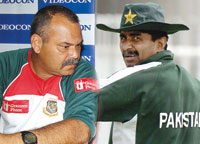 coaching requirements are changing day by day. In the age of computer,
managements prefer a person who has computer knowledge and be familiar with
the modern techniques of coaching.
coaching requirements are changing day by day. In the age of computer,
managements prefer a person who has computer knowledge and be familiar with
the modern techniques of coaching. the Pakistani outfit was badly in need of a win and if it came up against the
World Cup finalists, then what could have been better to keep the interest
and confidence of cricket lovers intact as the first round exit spread a wave
of pessimism across the country and cricket enthusiasts were lamenting and
burning the effigies of their loved ones but the duo of Younis and Shoaib
didn't realise their responsibility as senior players.
the Pakistani outfit was badly in need of a win and if it came up against the
World Cup finalists, then what could have been better to keep the interest
and confidence of cricket lovers intact as the first round exit spread a wave
of pessimism across the country and cricket enthusiasts were lamenting and
burning the effigies of their loved ones but the duo of Younis and Shoaib
didn't realise their responsibility as senior players. 