


|
|
|
|
 |
 |
  |
tribute review Fat
food and capital greed Soul
with classical music
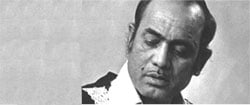
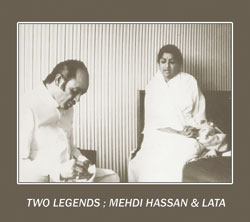
tribute Mehdi Hasan who
died last week was a ‘sahib e tarz gawaiyya’, for he changed the way the
ghazal was sung. Born in 1935 in a village
Loona near Jaipur, his forebears, well-known musicians, had been associated
with the numerous courts of the states in what is now Rajasthan. His father
Azeem Khan and uncle Ismail Khan too were court singers. He was trained by
his father and uncle but the most definitive influence was that of his elder
brother Pandit Ghulam Qadir. The changing political
situation and the uncertainty regarding the future of the princely states
made the musicians who were patronised by the courts to look for other
avenues for performance. Radio had extended opening for these musicians as
well as the film, and the recording companies. But the last two institutions
were too attuned to popular taste and the vicissitudes of the market. Mehdi Hasan started to
perform at a young age and the first concert with his elder brother of
dhrupad and kheyal is reported to have been held in Fazilka Bungla near
Ferozepur. He then came to Lahore and for a time took up employment with the
Shori Film Company but, at Partition, with the fast deteriorating law and
order situation, he went back to the ancestral village before formally
migrating to Pakistan with his family and settling down in a village in
Chichawatni near Montgomery (now Sahiwal) where one of his aunts resided. After the assimilation of
the princely states, only those musicians survived who were truly
outstanding or had adapted themselves and their singing style to the new and
changing taste. Poverty and lack of opportunity to perform made Mehdi Hasan
to work in a small cycle shop where he was able to make two ends meet. After
about a year, he went again in quest of establishing himself as a singer. He had continued with his
riyaz and worked on building his stamina with breath exercises but failing
to make a breakthrough became an apprentice motor mechanic in a workshop. He then shifted to
Bahawalpur and set up his own workshop. But he wanted to be a singer — and
he again came back to Lahore seeking a breakthrough. Failing once again, he
worked the land in Sargodha which belonged to an acquaintance — but
continued with his riyaz relentlessly. He was finally made an offer to sing
for the film ‘Shikaar’ (1953, released in 1956) at the Eastern Film
studio in Karachi. For music directors Asghar Ali and Muhammed Hussain, he
sang the following composition: Mere khawb o kheyal ki dunya
liye huae Phir aa giya kooee rukh e zeba liye huae After ‘Shikaar’, he
sang in ‘Kanwari bewa’ for Qadir Fareedi, then for ‘Maska paalish’
and ‘Insaan’ for Deebo Bhatacharya. His first ghazal was
‘Aik bus tu hi nahin’ by Farhat Shahzaad and, as he was being recognised
as a singer with immense potential, he was invited to perform for Lahore
Radio where his first ghazal was Ghalib’s ‘Arze niaaz e aishq ke qabil
nahi raha’; followed by ‘Jo thake thake se they hosele wo shabab bun ke
machal gai’. He also sang in Lahore for
films and that too with Noor Jehan for Rasheed Attre in ‘Qaidi’, ‘Aik
diwane ney is dil ka kaha maan liya’; then for Hasan Latif in ‘Susraal’,
‘Jis ne mere dil ko dard diya’; for Khurshid Anwar in ‘Ghoonghat’,
‘Mujh ko aawaz dey tu kahan hai’ and in ‘Jaag Utah Insaan’ for Lal
Muhammed Iqbal ‘Duniya kisi key piyaar main jannat sey kum nahin’. And in a private concert
when he sang Faiz’s ‘Gulon main rung bhare’ in 1959 his talent was
fully recognised — and as this ghazal was broadcast on the radio at some
later date, Mehdi Hasan became a star. He developed a completely
new style of singing. Since he was from Rajasthan, he brought with him the
ang of the very rich tradition of the Jaipur gaiki. By integrating the maand
— a folk form — he created an ang which was rendered with a constricted
throat that went well with the recording and microphone technological
limitations as the very fine and subtle nuances were captured. Mehdi Hasan brought the
ghazal gaiki to a new level and totally moulded its singing into raags while
restraining to give a broader meaning to the lyrics. His singing was not
illustrative, but did not go much beyond illustration to assume a totally
abstract form either. Ghazal in the earlier
phase was sung more like a geet. Its rhythmic pattern was uniform and the
singer had the freedom to add and subtract from the text. Many of the early
singers felt obliged to weave the metrical pattern of the ghazal into the
rhythmic scheme of the composition. Both these were very limiting factors
where music was concerned. Then, since ghazal was popular in the salons of
dancing girls, the musical form too developed as subservient to the
complexities of dance. Many of the ghazals of the
middle phase were mere adjuncts to the entire ethos of dance. This mujrai
ang was again an inhibiting variable in the growth of ghazal as an
autonomous form of music. Ustad Barkat Ali Khan was successful in liberating
the musical form from the metrical design of the poetry. He infused it with
the freedom of a thumri gaik without losing the thread of the poetical
content altogether. Mehdi Hasan capitalised on
his rigorous training as a kheyal and thumri gaik. By paying due importance
to the lyrics, he struck the right balance between the melodic and poetic
content. As a ghazal singer, he shot to fame in the 1960s with ‘Gulon main
rung bhare’. As his genius was spotted, he went on to sing in rapid
succession a number of ghazals that have now become classics of the genre.
He has sung Mir, Ghalib, Faiz and Faraz with great sensitivity but at the
same time a number of other poets not-that-well-known but are now popularly
recognised because of his rendition. However, he has been very
careful in selecting the kalams of good poets and not necessarily popular
poets, many of whom made a name for themselves as film lyricists. The development of the
ghazal as a form of music owed a great deal to the cultural imperatives of
identity Pakistan. In the last 50 years, ghazal has emerged as a very
popular form of singing in Pakistan and some of the most outstanding
exponents have reached the apex of this scale, making in the process
significant contributions in the evolution of this particular style. This
imperative of identity helped in promoting the ghazal in the new state for
it was premised that the ghazal represented a cultural continuum that was
closer to the Muslim identity. In poetry, since ghazal
had grown from the interaction between the Persian and local traditions and,
since most of the practitioners were Muslims, it was owned by the
establishment of the new state as the foremost musical expression of
Pakistan. Ghazal was patronized, and it basked in its appeal to the
middle-class urban audience. His famous ghazals Gulon main rung bhare baad
e nau bahaar chaley Kuch din gar zindagani aur
hai Patta patta buta buta haal
hamara jane hai Dekh to jee key jaan sey
uthta hai Ghazab kiya tere wade paey
aitabaar kiya Phool he phool khil uthe
marey paimaney mai Na ganwao nawake neem kash
Nawik andaaz jidhar deeda
jana hoan ge Aaye
kuch abr kuch bahar aaye Rung pairahan ka khushboo
zulf lahraney ka naam Dil main
aab yoon tere bhoole huwe ghum aate hain Aage barhe na kissai ashqe
butaan se hum Koo ba koo phail gai baat
shanasaee ki Ranjesh hee sahe dil hi
dokhane ke liye aa Charaghe toor jalao bara
andhera hai Roshan jamale yaar sey hai
anjuman tamaam Go zara see baat sey
barsoon key yarane gaye Dile nadaan tujhe huwa
kiya hai Chalte ho to chaman ko
chaleye Aa ke sajda nasheen qais
hua mere baad Baat karni mujhe mushkil
kabhi aise to na thi Wo dil nawaz to hai leikin
nazar shanaas nahin Kaisey chopaoon raaz e
gham His popular film numbers Dunya kisee ke piyaar me
jannat sey kum nahin Zindagi main to sabhi
piyaar kiya karte hain Piyaar bhare do sharmele
nain Kase Kase log humare Mujhe tum nazar se gira to
rahe ho Shikwa na kar gila na kar Ik husn ki devi se mujhe
piyaar huwa tha Mera iman muhabbat Mujhko awaaz do Hum se badal giya wo Rafta rafta wo meri hasti
ka samaan ho gaye Yoon zindagi ke rah main
thukra giya koi Tere bheege badan ki
khusboo Qyoon hum se khafa ho gaye Bhooli bisri chand umedeen Ik khalish ko hasile umre
rawan rehne diya Sholaa tha jhal uthan hoon
Taaza hawa baahar ki dil
ka malaal ley gai Muhabbat karne wale kum na
hoonge Jub us zulf ki baat chale
If one could have
access to a painter’s mind, it might be useful to examine the thoughts of
an artist who is diligently depicting detailed views of villages, semi-rural
areas, old parts of cities with narrow alleys, crumbling houses and
congested bazaars. Landscape painting is rooted in tradition and is still
popular. Most landscape painters,
interested in documenting the actuality of a site, select scenes which
correspond to their ideal notion of local landscape. More than its apparent
visual appeal and value, it relates to the issue of identity in art. By
presenting views of identifiable places, the artist contributes towards
constructing a notion of ‘larger’ identity; especially for a nation that
is still groping for it. Here the role of an artist assumes a greater
significance because he provides tangible samples of identity that have a
history, which can be traced back to our glorious past. Some of these
painters — while proclaiming to paint reality of their existence — are
reverting to a vision of the past, with their canvases of green and fertile
fields, trees, bushes and plants, all indicating the agelessness of these
views. However no place in this
world remains unaffected by time. Thus the classic and archetypal image of
landscape from this region is quite modified now, with the introduction of
latest agricultural tools and the preference for new building materials in
the settlements near these fields. But these changes remain unacknowledged
in these painters’ vision of the landscape. They are determined to select
and reproduce areas and sites which correspond to a projected notion of
heritage and cultural character. One can not blame these
artists for their choices because, not only in art but in other spheres of
culture, we are trying hard to establish our identity. Thus the historic
references, either Mughal or regional, in monuments and indigenous
landscapes are a means to affirm or forge that special character, which we
desperately seek. But a painter who deviates
from this prescribed path and is not attracted to the seduction of ethnic
representation and regional attributes is unique: Temptations which are
sometimes connected to commercial necessities but are more often linked with
artists’ aspiration to preserve heritage are hard to resist. Yet we find,
in our brief history of art, that some artists refused to become cultural
ambassadors or cultural producers of their region. Zubeda Javed in her work
has explored this aspect of how to transcend from narrow notion of a place
to a sublime destiny of art which may have local references but is not bound
to regional or cultural constraints. In her paintings, Zubeda
Javed moves from familiar sites and everyday experience to the purity of
art. She translates, transforms and transposes trees, fields, animals,
houses, streets or buildings into patches of colours, which are passionately
placed to evoke visual sensation and aesthetic experience. Her decision in
favour of a pictorial experience, instead of a regional recognition, must be
acknowledged because it is not about the formal choices in our conditions
and contexts. It is a brave gesture against the teaching practice of Anna
Molka Ahmed, the founder head of Fine Arts Department at the Punjab
University. Being an outsider, Ahmed was more involved in recording the
activities and in reproducing residences of vernacular population. Zubeda
Javed has adapted a different direction in her work so, instead of being
allured by the popular scheme, she has chosen the essence of art, in terms
of its basic and bare elements: colour, shape, form, line and texture. What Javed has achieved
through her canvases of personalised version of scenes of city and its
surrounding areas is an act of liberating art from its local baggage. In her
work, one can glimpse traces and links to certain areas but the work is not
about representing these specific sites. It moves to the realm of senses,
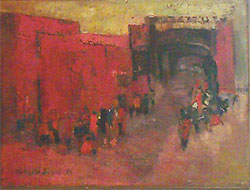
where a man may be looking at an image of railway station but he is enjoying
the painter’s act of adding numerous layers and coats of red colour on a
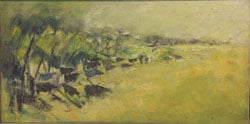
small canvas. Likewise, when he is seeing a landscape, he is not aware of
the geography but the shades and shapes that suggest simple contours of
buffalos, basic outlines of houses and the elementary layout of fields. The strong and bright
chromatic palette of Zubeda Javed is probably one reason for her deviation
from the identity issue because, to a painter, colour is the first calling,
and Javed has responded to that in a positive manner. In this, she is like
Mussarat Mirza who has also moved away from representing localities and
regional ties; both the artists have shown other possibilities, negating the
pressure from general audience and persuasions from collectors who feel a
level of comfort at spotting something familiar and historic in a work of
art. One must pay a huge
tribute to Zubeda Javed for staying true to herself as a painter and
declining the impulses from outside. Her alma mater, the College of Art and
Design at the Punjab University, did so by organising a seminar on her art
and arranging her small retrospective at the Anna Molka Gallery on June 5,
2012.
Why have we become
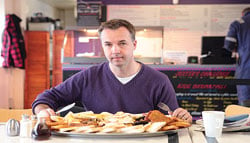
so fat? That is the question explored by Jacques Peretti in a three-part BBC
programme being broadcast this month. The programme is called ‘The Men Who
Made us Fat’ because it suggests that people in western societies have
been propelled towards obesity by the actions of various lobbies within the
food industry, most notably the sugar lobby. According to Peretti the
reason we are fat is because what has changed in our lives is “the food we
eat. More specifically the sheer amount of sugar in that food, sugar we are
often unaware of.” Peretti says that the
story begins in 1971 when Richard Nixon was facing re-election, he needed
food prices to go down or he would not be re-elected, and for that he needed
the cooperation of a very powerful lobbies — the farmers. He got an
agriculture expert named Earl Butz to persuade the American farmers to go
into a new industrial form of production, farming one crop in particular:
corn. Increased corn production fattened cattle, “Burgers became bigger.
Fries, fried in corn oil, became fattier. Corn became the engine for the
massive surge in the quantities of cheaper food being supplied to American
supermarkets: everything from cereals, to biscuits and flour found new uses
for corn.” But by the mid-1970s there
was a surplus of corn, so Butz initiated the mass development of high
fructose corn syrup (HFCS), also known as glucose-fructose syrup. This was
very cheap to produce and soon it was being pumped into every sort of food;
bread, pizza, meat, sauces, soft drinks... everything. Although these
changes to food took place on such a large scale the general public was kept
ignorant of the modifications. The sugar lobby became so
powerful that when the question of what caused heart disease and how to
prevent it came up, researchers who cited sugar as a major factor in heart
disease were rubbished and discredited: “ An American nutritionist called
Ancel Keys blamed fat, while a British researcher at the University of
London Professor John Yudkin, blamed sugar. But Yudkin’s work was
rubbished by what many believe, including Professor Robert Lustig, one of
the world’s leading endocrinologists, was a concerted campaign to
discredit Yudkin.” The result was that fat,
not sugar was widely cited as a major factor in heart disease and the food
industry was able to profit massively from the launch of a new type of food:
“low fat” foods which promised to be better for people’s health, but
actually contained high levels of sugar to keep them tasty. ‘Low fat’
became a lucrative industry, but despite the food’s ‘healthy’ claims,
people became fatter and their general health deteriorated. One of the people who
spoke to Peretti is David Kessler, the former head of the American Food
Agency (the FDA) and “the person responsible for introducing warnings on
cigarette packets in the early 1990s.” He believes that sugar is highly
addictive, that it is “hedonic” or highly pleasurable and that “when
you are eating food that is highly pleasurable, it sort of takes over your
brain.” Another researcher, Dr Tony Goldstone says that what often happens
in obesity is that a hormone called leptin stops working, and this is the
hormone that is produced by the body to tell you that you are full and
should stop eating. In obese people this hormone often becomes severely
depleted and “it is thought that a high intake of sugar is a key
reason.” ‘The Men who Made us
Fat’ is both revealing and disturbing. It throws light not just on how
lobbies within a capitalist democracy can exert undue influence and turn
into monstrous mafias protecting their profits at any cost, but also exposes
the tangled, often dubious, relationships that exist between the food lobby
and governments, and between lobbies and so-called scientific researchers. The men who made us fat
also made themselves and their friends very, very rich. But the more we
learn of this whole story the more it assumes the dimensions of a criminal
enterprise. The bitter truth is that we are fat and sick because we were
used. We were the fuel that powered the matrix of profits that enriched a
powerful lobby; we were the human fodder of corporate greed. Food for thought.... Best wishes, Umber Khairi
Soul with
classical music After completing
its first year, there were still some doubts about the continuity of Lahore
Music Forum. But the concert held last week at Lahore’s Hast-o-Neest
confirmed that the Forum has a life longer than that of a year. The continuity of Lahore
Music Forum depended on the results achieved in the first year and this must
have restored some faith in this initiative of the eleven concerned members,
some living outside Pakistan who contribute on a regular basis to this noble
cause. They have agreed to do so for another year and it is hoped by others
that it will be backed by tenacity and patience to see it successfully
through a long haul. Hast-o-Neest has been set
up by several young enthusiasts who realise painfully that much has been
lost due to discontinuity with our past. It is housed where the Croweaters
Gallery was situated, but sadly after the tragic death of its owner Minoo
Bhandara in a car accident in China it had to be wound up particularly. The major fund of our
knowledge is in Persian and Arabic but the colonial interlude with its
emphasis on English redirected the discovery of the sources of our knowledge
and culture. Mostly what we know of our past is twice removed because we get
acquainted with it through translation in a European language, preferably
English by a foreign scholar. Hast-o-Neest is an attempt
to discover our past and to link it to the quest of tomorrow so as to make
our entire effort credibly rooted in our own tradition. It was well within
its larger mandate that a music programme was held by an organisation which
shares this avowed aim. Lahore Music Forum too was set up to discover the
soul of classical music which gets trampled between the overemphasis on
craft and the desire to be popular. Its concerts have been held at venues
like the Alhamra, National College of Arts, a few restaurants and now at
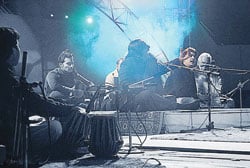
Hast-o-Neest. The three performers of
the evening were Ustad Shafqat Ali Khan, Akbar Ali Khan and Ahmed Raza Khan.
All three have performed earlier on this platform and the idea has been to
assess whether some difference in their music according to the general guide
lines of the Lahore Music Forum had taken place. Since the younger vocalists
and instrumentalists have been the focus of this initiative, they were made
to perform after a reasonable interval more regularly. According to the
organisers they have seen some shades of change, positive change in the
performance of the youngsters over this period and are hence hopeful. Ustad Shafqat Ali Khan has
reached a level where he performs with a great deal of consistency. The
response from the audience or an inspired moment can also flower in a great
performance. Usually the expectation of the audience, particularly of
classical music, is the display of virtuosity. In the kheyal, the various
parts are treated separately instead as a whole. After the vilampat lai
performance ,taan and laikaari are considered to be the crowning moment of a
performance, as the virtuosity of the performer is judged in isolation from
the impact of its gradual build up. Shafqat Ali Khan’s many
performances in the past have been the victim of this crowd expectation and
the overemphasis on the craft have not been properly integrated into the
overall flow of the performance. But when he knows that the audience’s
expectation is not so then he paces the unfolding of the raag properly and
greater composure. The awareness and
appreciation of classical forms of music has become restricted to a small
minority of experts but the desire or the pressure has been to appeal to a
larger segment of the population. This has created a discrepancy and it
seems that true appreciation of music and its mass appeal are not on the
same page. In a democratic age with means of communication enhanced million
times over by technological breakthroughs, and a new world order in culture
based on the coming together of cultural expressions of the regions , indeed
continents, the expectation has shifted from highly specialised insularity
to a musical expression more eclectic in character. The youngsters who have
performed in the various concerts have been Muslim Ali, the grandson of
Ustad Ghulam Hasan Shaggan, Nayaab Ali/Inam Ali, the sons of Ustad Hamid Ali
Khan, Ahmed Raza, the grandson of Hussain Buksh Dhaddi, Chand Khan and Suraj
Khan, the sons of Hussain Buksh Gullo, Akbar Ali, Amanat Ali the son and
nephew of Ustad Mubarak Ali Khan and Karam Abbas/Ali Wasim Abbas sons of
Ahmed Ali, Fahim Mazhar and Aliya Rashid (one of the very few exponents of
the dhrupad) have also performed during the course of the last few months. Among the instrumentalists
and accompanists Sajid Ali, Dhani, Muhammed Aslam, Shabbir Jhari have
displayed their skills on the tabla and harmonium, Shafqat Ali and Zohaib on
the sarangi, a dying instrument that needs to be revived desperately and
Sabir as always on the tanpura. One of the positive
aspects of the initiative has been the introduction of many a young
performer in the various concerts that have been held so far. Most of these
youngsters or younger performers by comparison are the progeny of
professional/ hereditary musicians. Akbar Ali is in his twenties and has
command of the finer aspects of music. Perhaps he should enlarge his
repertoire of raags in the kheyal and thumris. Ahmed Raza is still very
young and, as it happens, too proud of showing off the mastery of his craft.
Perhaps with more experience he will learn to balance it with more feeling.
|
|