


|
|
|
|
|
 |
 |
  |
facelift MOOT
STREET TOWN TALK profile Get
creative this summer
facelift Restoring the old look Makeshift
offices set up in containers dot the boundary of the vast stretch of land
situated close to Delhi gate. The place a part of which had been in use
for long as horse-shed serves as field office and storage yard for the
Sustainable Development of Walled City Lahore Project (SDWCLP). The
project has financial and technical support from the World Bank and the
Agha Khan Trust for Culture (AKTC) respectively. Representatives of local
and international partners in the project sit in these makeshift offices
and some of them oversee the loading and shifting of construction material
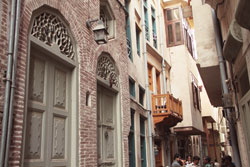
to the narrow streets of the Walled City which are inaccessible to
conventional transport vehicles. A few hundred yards from
there, some labourers sit together on a pavement and keenly look at a
piece of paper handed over to them by a supervisor wearing white metal
hat. The paper has a street map drawn over it which helps them identify
points where to dig. The street is one of many in the Walled City where
free-of-cost restoration work is underway. Here they are remaking
facades of old houses and constructing washrooms and kitchens in select
cases. The houses which had these facilities on encroached land are being
given replacements inside after demolishing the ones right there in the
street. Amazingly, there are no
piles of bricks or mounds of cement and sand to obstruct the path of
pedestrians. Minimum possible material is brought to the place at one time
where they are striving to restore the façade of a centuries’ old
building to its original shape. What is more amazing is
that a project, which could not kick-off for years for various reasons, is
running smoothly and there is little or no resistance from those who were
not even ready to listen to the plan in the past. The difference is clear,
says Ahmas, a social mobiliser working for the project. The success he
thinks is mainly for the reason that locals have ownership of the project
and they have nothing to lose. Instead, they are the direct beneficiaries
of the project. Under a pilot project in
Gali Surjan Singh, old houses were renovated and owners made to pay 10 to
15 per cent of the cost incurred on the interior, whereas all the work on
the façade and in the street was done for free. This included laying of
underground water and gas pipes and covering of electricity wires with PVC
pipes. On the contrary, there
are some walled city residents who are unhappy with the way the work is
being carried out. Ahmed Abbas, a resident of Haveli Alif Shah area is not
content with the quality of work done under the project. He says a lot of
people are disgruntled as no proper monitoring is done and substandard PVC
pipes are being used. “These pipes have developed cracks and the manhole
covers do not fit properly.” The locals are planning to protest and
write to the World Bank in this regard. He says quality work was
done only at Haveli Surjan Singh. The reason was that AKTC had worked
there with financial help from German government. The Punjab government
has failed to replicate this work in other areas. Shahid Mehboob, resident
of House 1125, says the three-storey house they owned, was vacated on
request of the project people one and a half years ago. “Since then we
are living in rented houses and paying rent through our nose. We were
promised the house will be returned after two months but this has not
happened.” Shahid tells TNS they
have complained to the project director Shahid Ali Durrani but he says he
is helpless. Launched under the
government declared plan to regenerate the Walled City, improve its
infrastructure, restore monuments to their original glory, identify and
preserve structures of cultural worth etc, this initiative missed many
deadlines due to political pressures and oppositions from trade bodies,
squatters and land developers. None of them would cooperate with the
government in removing encroachments and making shopkeepers vacate shops
constructed along the boundary walls of historical monuments. According to Hafiz Zahid,
a chemical trader in Walled City, this resistance changed into cooperation
when people were contacted by the project staff and asked to become
partners in development. The owners of shops around Shahi Hamam got
handsome compensation after ejection, which is something hardly heard of
in Pakistan. “Our governments just bulldoze structures or throw out
occupants in such cases. If someone resists, he is booked in criminal case
and sent behind bars. So, this treatment was totally unbelievable.” Zahid’s observations
are quite true and the explanation comes from an official related to the
project. He tells TNS this change in attitude is due to government’s
compliance with the directions coming from World Bank the major
international donor involved in the project. The social guidelines called
for participatory approach to the project under which the affected
population should not feel they were being deprived of something. “For four years there
was not much progress, but when we formed Community Based Organisations (CBOs)
at mohalla level, employed motivators and mobilisers, took traders on
board and offered them free solutions, things turned into our favour.” The official adds though
the pilot project was a huge success they had to suspend interior
renovation for lack of funds. He tells TNS if funds are available they can
restart it but the sharing ratio in that case would be 30:70. As per SDWCLP policy it
was planned that infrastructure services work at the Royal Trail and
adjacent streets would be started simultaneously. However, after detailed
studies and discussions with the World Bank, AKTC and keeping in view the
public convenience, it was proposed that work on the Royal Trail would be
done in phases. Asif Khan, an employee
at a cloth shop inside Delhi Gate, doubts the money shopkeepers are
getting in compensation by the government is less than that offered by the
World Bank. However, he agrees the shops from around monuments like Wazir
Khan Mosque should be removed. He tells TNS two types
of compensation packages are being offered to shopkeepers. First, one time
cash, as per compensation formula, to those whose shops are demolished and
second, an agreed amount to compensate the displaced workforce/owners
during the period(s) they remain idle due to the ongoing renovation work
at their shops. There’s a full-fledged
resettlement wing working under SDWCLP project to help settle displaced
people, says the project official adding such procedures should be adopted
by our governments in principle while executing similar projects. “No
project can be successful without involving people and passing on its
benefits directly to them.” caption Restoration of Walled
City structures progresses amidst praise and some concerns By Shahzada Irfan Ahmed
A proven fact:
human mind only craves those things that are inaccessible. The more
distant a thing is, the more time we spend to get our hands on it. Same
goes for studying abroad. People frequently go abroad to visit relatives,
hang out with friends on a shopping-spree and what not, to such an extent
that Dubai, Malaysia, England and the US are just household places now.
But the charm of studying at a foreign university is incomparable. No matter how much time
one spends being a tourist in Europe or the Americas, the fascination of
being an Oxford or a Cambridge student, not to mention graduating from any
Ivy League University still holds. Studying in these canonised colleges
and universities is the dream of everyone irrespective of where you come
from and where you want to go. But the crunch comes
when there are these two extremely hard-to-overrule barriers in the
application process: the high fee structure and the letter of rejection.
No matter how affluent one is, generally the fee structure of these
foreign universities makes everyone reconsider their options. The cost of
living abroad is always way higher than the tuition fee, and when one sees
that the degree programme will last another two to four years,
conscientious people prefer to spend a quarter of the same amount in their
local universities which fortunately do have a respectable place in the
world rankings of universities. Not only the fee
structure is discouraging, the other very disappointing facet of applying
abroad is the letter of rejection that pops in the mail-box when it is
least expected. For all the
undergraduate applicants - and of course the post-grad applicants too –
the most rigorous part of the application process is the ‘application’
itself. The most demanding and laborious part is writing the personal
statement which generally is also considered to be the ‘most
important’ part of the applicant’s chances for admission.
Interestingly, after having proof-read so many personal statements, I am
still unable to understand what is the standard of writing required by the
universities? So many people who wrote their personal statements exactly
on the paradigm given by the universities failed to get the admission, and
those who wrote what their editors termed as a ‘good effort, but not up
to the mark’ managed to get through. Assuming that the personal
statements make you eligible or ineligible for admission, I am kind of
confused. Once the personal
statements are written (by the applicants, their parents, teachers and
friends), – the next task is to get the transcripts and reference
letters. Now that’s the tricky
part: all the years spent with the teachers and administration on strained
terms take their toll at this juncture. Students do not know who to ask
for a recommendation and how to have a transcript that does not show how
non-serious they had been when back in school. Somehow or the other, even
this barrier is surmounted; good recommendations do come their way and
transcripts too. The SAT and GRE tests, including TOEFL and IELTS are
cleared too. And then one day, interview call comes through as well. But then what happens is
what is hardly expected and least desired: Rejection. Now the purpose of
detailing this arduous feat is to then prepare yourself for the
‘rejection’ letter. After all the effort that goes into applying, the
rejection letter brings one down like anything. I wonder how people deal
with it; it almost blots out the future for one second. Unless one is
strong enough to pull oneself together and say ‘Hallelujah’ this
letter isn’t the end of the world.
Today there is a concert
featuring underground musicians with Beygairat Brigade. * Exhibition of Iqbal
Geoffery’s works at Zahoorul Akhlaq Gallery at National College of Arts
till June 24. * Play: Uperli Manzil
(The Upper Floor) at National College of
Arts at 7:00 pm. * Musical concerto with
Ustad Lachman Singh Seen on Thursday, June 21 at HRCP Auditorium. * Comedy Junction at The
Knowledge Factory (TKF) every Sunday at 7:30 pm till July 29.
profile Just as one
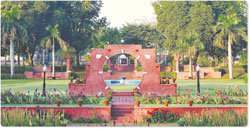
enters Bagh-e-Jinnah and turns right from the main gate, they find
themselves in the plantation nursery area. That nursery is the fruit of
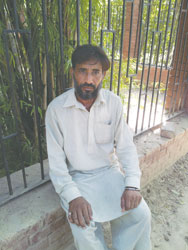
Muhammad Hussain’s incessant efforts over the years. Muhammad Hussain is
the Head Gardener of Bagh-e-Jinnah with whom The News on Sunday had an
opportunity to spend some time. Born on October 6, 1973,
Hussain has been affiliated with this historical garden for exact 19
years. Contrary to one’s expectations, his favourite colour is not
green, but white. He is fond of eating “baigan ka saalan” (bringal)
and holds his parents in high esteem they are his favourite personalities.
Hussain recalls he was
employed here in 1993 after he had passed his matriculation exams with
some difficulty as his efforts were divided in different directions of
working part time and studying. Originally, his father worked at
Bagh-e-Jinnah and after he retired, he helped Hussain to be recruited here
in his place. Hussain smiles while recalling, “I was recruited as a
‘bail daar’ (floral designer) and gradually I’ve taken the status of
a head maali” (chief gardener). Hussain’s day is
usually monotonous but he is fine with that as long as he has an agenda to
follow on a daily basis. He hopes to carry out his routine with zeal as he
enjoys spending his day in wholesome toil. He is particular about his Fajr
prayer, is tending to the garden by 7am and leaves at 3pm to tend to his
job at private residences till 5pm. He is also self-employed and takes the
façade of a blacksmith. Till 9 at night he winds up his day’s routine
and goes home to retire for the day.
In this hectic schedule of his, he makes sure he doesn’t miss his
Asr prayer, for the rest, he tries to be as punctual as he can be.
He pays homage to his wife in words, for bearing with his four
children while he is away as he says he can’t imagine how to deal with
them full-time. He recollects that
although at the moment when he was recruited here by the government, he
wasn’t ecstatic; rather he resented his father’s decision to send him
here. He ought to have big
plans for himself. Looking back today, he feels amused by the reckless
abandon he carried 19 years ago, and thanks his stars that he was inducted
here or he would have easily shared the fate of many unemployed helpless
men and scavenging garbage collectors. Today he says that he
takes immense interest in ‘gulaab ka phool’ (rose), hence loves making
rose cuttings to be planted later. Making paneeris is also his forte.
Sometime back, the director manager recognised his efforts and bestowed
Hussain with an award of exemplary gardening by the government. Overtime
the ‘Gulistan-Fatima’ has become a favourite spot for him in this
historic garden. Of all the places in Bagh-e-Jinnah, he sees it as the
most best kept place, with rose beds. Plus this place is not accessible to
the pubic at large. Colours and evocative fragrances are all over, and
maybe this is what has been attracting people in power to come here and
arrange their little parties. After working at one
greenhouse out of the three at the Jinnah Bagh for three months, he
realised that plants are as fragile and dependent as infants. According to
him, the commercial nurseries don’t take care of plants the way they do
here. For all the garden lovers and all those who possess a penchant for
gardening, they should spend at least two to three days in the company of
some gardener as it would give them hands-on knowledge. Keeping the current
months of summer in mind, he advises that while shopping for plants, one
should go for money plant cuttings, syngonium plant cuttings and table
palm and Italian palm cuttings. These plants can be grown indoors as well,
and to add to decoration, they can also be kept in glass bottles. For
outdoors he proposes motia and kanghi palm as most suitable in this
weather. It gives him immense pleasure and pride that he is directed by
his project director to prepare khad (fertiliser) and is always able to
deliver what is expected of him. People come from different parts of the
city to Jinnah Gardens seeking quality khad and Hussain never fails to
offer them something. This is a high point for him. Further, some other
useful information lent to TNS was that Lahore is blessed with a canal and
the sediment it offers is the most fertile. With a little khad added to
the cutting and that muddy sediment, any plant will grow well and fresh.
He warns us simultaneously to beware of the cheaper version of this
sedimentary ‘bhal’ as it not the one that comes from the bottom of the
canal, but the one that comes from the demolition of the buildings, mixed
with cement. Moreover, he is a
staunch believer of what goes around comes around. “I tell my children
to respect their elders, and do good for others for Allah is all knowing
and seeing, He has ways of rewarding us in life and Hereafter”, says
Muhammad Hussain. Earning through honest
means and values inculcated in him through his parents have remained his
guiding star. The yearning to overcome financial constraints is apparent. Overtime, he has started
to think that the phenomenon of trusting others is overrated. He has been
disillusioned at many instances in his life, the most significant one
being about earning his livelihood. He just can’t afford to trust
people, he says and reveals that trying times have hardened his faith in
Allah. With every passing day, he realises how graciously his entity is
blessed by the creator, and this rejuvenates his ability to be patient and
tolerant in difficulty. He strives to be a better human being, in the true
essence of humanity. He feels infidels may be forgiven but doubts if
hypocrites will be. It does not need one to
be well read or well-traveled to be loyal and responsible towards one’s
job and family. Hussain tries to overlook the barrier of time and space
when it comes to working hard and earning a livelihood for his family.
He believes in outstretching his capacities in order to never let
his family sleep with an empty stomach. He says he is providing his
children with the best education he can manage; also he is a pleasantly
optimistic father who wants two of his children to learn basic English and
IT. Just two months back
Hussain got insurance for his family. In a bid to pay an annual amount to
the company, he is in a process of chalking out the plan to save that
amount. Further, he also aims
to purchase a humble place to live once he retires from his government
job. We ended our
conversation with Hussain giving us a helpful tip to produce the best and
cost effective khad at home. One has to dig a 4 x 5 feet hole in soil,
then add freshly plucked leaves of any plant to it and keep doing that and
adding water to the brink daily for the next six months. Cow dung
should be added to it regularly but in very little quantity (25%) in
comparison to the entire existing mixture. Water should still be added and
then cover it for the next two months and then open it and let it dry
completely to get the desired results. One can reap an effective khad this
way, he says. The wall of the hole may be made even with clay to make it
secure. caption Muhammad Hussain.
Get
creative this summer “It’s a
Dragon ball Z joke!” exclaimed my eight year old sister. Summer
vacations for kids mean unlimited sleep, movies and cartoons. The erratic
and brief moments of electricity that are encountered are often coupled
with a rush to charge laptops, turn on the air-conditioners and watch
television. Alarmed by the fact that
my 8 year old sister’s brain was turning into ‘toonami’ mush, my
mother charged me with the responsibility of doing ‘creative’
activities with my sister. “Paint with her!” she ordered. Thus I was
forced to delve into my own memories to retrieve the almost forgotten
childhood joy of craft making and board games. Once I got down to it I
realised that there are so many things one can do with children around my
sister’s age (the bratty teenagers, like my brother, are a more
difficult bunch to entertain) that it was a crime to deprive them of
interactive crafts and games that exist beyond the digital world. It’s the little things
that parents/elder siblings do with their children/younger brothers and
sisters that spiral into the fond memories, life lessons and the knowledge
that fascinating, ingenous things can be created from play dough, papier-mâché,
plastacine, plaster of paris or anything that comes their way. “Carving
snoopy out of soap was something that always amused my kids, and allowed
me to share my personal love for snoopy with my kids,” says Asma, now a
mother of four. Children are creative
beings and with little encouragement they will find ways to entertain
themselves by concocting their own intricate stories or inventing their
own game and even knitting their own hair bands. To get the ball rolling,
here are a few inexpensive things you can give your kids to induce them to
close the laptops and get creative. Giving your kids the
traditional play dough is always a good idea, but parents often get tired
of having to repeatedly buy the playdough, which dries before it can be
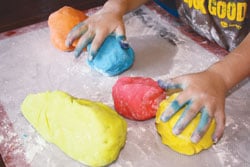
reused. Play dough can easily be made at home by mixing one cup of cold
water and 1 cup of salt with two tsp of oil and adding a little food
colour (using normal paint to add colour to the mixture will also work).
Then complete the mixture by adding around three cups of flour and 2 tbsp
of cornstarch (Maya) until the desired consistency is achieved. Finally
cover the dough and let your kids play. Homemade face paint is
another inexpensive and safe option for kids. To make face paint just add
one teaspoon of cornstarch to half a teaspoon of cold cream and water and
then add the food colour. Another great idea is to make and give your kids
chalk paint. Chalk paint is a breakthrough when it comes to controlling
the mess that kids cause as the paint can just brush off after it dries
and yet stick to the paper. Just mix equal volumes of water and cornstarch
with a little food colour and let the kids paint. We all know of the
traditional mix a little surf with water recipe to make bubble, but a
little tip is to use dishwashing detergent instead of the surf and adding
a little oil, which makes the bubbles lighter and allows them to be
bigger. To obtain bigger size all you need to do is use a bigger
circumference wire (which can be obtained from hardware stores). Kids will also enjoy
learning and experimenting with tie and die. It’s easy to do at home by
using small pieces of cloth or old shirts, folding and tying them with a
thick thread and dipping them into a mixture of warm water and die
(obtained from the die shops). There is indeed an
endless list of things to do with kids from introducing them to Mechano
set, blocks, lego, jigsaws, beads to just playing board games with them.
Summer vacations are just the time that parents have to catch up on all
these activities and spend quality time with their kids.
|
|

 *
Cogito Youth Performing Arts Festival at Ali Auditorium.
*
Cogito Youth Performing Arts Festival at Ali Auditorium.