


|
|
|
|
|
 |
 |
  |
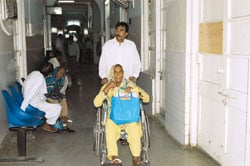
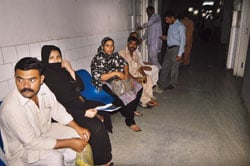
issue Duty with dignity Doctors’ strike lingers on as medical professionals are determined to save themselves first By Fatima Rahman The doctors’ duty is to serve, save lives and put the needs of the patients above themselves. How then can they ignore their duty and breach their oath by denying a bleeding patient treatment? A one-day strike alone causes thousands of patients to suffer, they are forced to go back home holding on to their stomachs and burning fever, the burden of which comes heavily on the poor class. MOOD
STREET TOWN
TALK art Summer’s
favourite treat
issue Duty with dignity Doctors’ strike lingers on as medical professionals are determined to save themselves first By Fatima Rahman The doctors’ duty
is to serve, save lives and put the needs of the patients above themselves.
How then can they ignore their duty and breach their oath by denying a
bleeding patient treatment? A one-day strike alone causes thousands of
patients to suffer, they are forced to go back home holding on to their
stomachs and burning fever, the burden of which comes heavily on the poor
class. Contrary to popular belief,
Dr Izhar Ahmed Chaudhry, general secretary of Pakistan Medical Association
highlights that the doctors strike is not a treachery against the people but
rather the last avenue of frustrated doctors that have been denied the
respect and economic standing that they have so rightfully earned after 18
long years of education. “Doctors have to complete a five year MBBS and
then complete a one year mandatory house job which gives them the license to
become doctors.” Dr Chaudhry says that
doctors today really are the cream of the cream as out of 38000 applicants in
the Punjab alone only 3000 MBBS and BBS students were enrolled in government
medical colleges, and that the last merit position was at an astounding 82.6
percent. “These doctors have filtered and passed through a rigorous system
that qualifies them to become doctors. To then disregard their level of
qualification and knowledge, and to put them at the same pay scale as
government officials that have lesser qualification and lesser work hours is
absurd and unacceptable to them.” A doctor gets Rs 18,000
monthly pay during house job while salaries of drivers employed in the
judiciary alone may go up to that level, says PMA secretary. The young doctors who are
at the disposal of the patients 24/7 and in general have 80 working hours a
week, which comes to 15 hours a day, demand a pay that is acceptable and
enough for them to feed their families. “Doctors have been swallowing the
bitter pill of low pays but the increasing lack of respect on the part of the
government has made the situation more unacceptable,” says Dr Chaudhry.
Dr Nasir Bokhari, the
spokesperson for YDA Punjab recalls the YDA was created on the April 4 in
2008. It has gone on eleven strikes in the last four years. One of their
demands has been of job security. Dr Bokhari explains that many doctors even
after 30 years of service have no idea what the process of their promotions
is. He says that the promotion of doctors takes place on a pick and choose
basis and there is a dire need for a fair and transparent system. “The
promotion of juniors before seniors has agitated senior doctors that have
then encouraged the younger doctors to protest.” The Punjab Health
Secretary, Arif Nadeem, however, claims the government has been addressing
the needs of doctors who do have a proper four tier service structure with
its ratios for doctors of every grade. “Over the past few years the
government has inducted 400 new doctors, teachers and specialists in the
primary and secondary care levels and has also regularised all doctors that
were on contract,” he says. Again Dr Bokhari of YDA
points out that the regularisation of doctors only took place in March 2009
after a strike of the doctors against the government policy that doctor be
employed on a contractual basis allowing for MS to dismiss and terminate
doctors without inquiry. “It was also after the doctors’ 4-5 day strike
in 2009 that 20 per cent of the doctors that were working without pay in the
Punjab were catered to, and still 500 doctors are working without pay in the
Punjab.” The health secretary claims
the government is trying its level best to increase the number of promotions
and has given more promotions in the last six months than ever before. He
points out that Pakistan has heavily subsidised its medical education, and
spends 4 to 5 billion on medical colleges alone, while everywhere else in the
world medical students are burdened with heavy tuition fees. “Given that
the country’s growth rate is 2 to 3 per cent and that the government spends
about 700 billion rupees mainly on the salaries of government officials and
running costs, it is nearly impossible for the government to further increase
salaries, especially those of house doctors that have had their pay increased
to Rs18,000 and that of post graduate registrars (PGRs) to Rs42,500, which is
30 to 40 per cent more than what an equally capable engineer gets in the
country. The government has spent a total of 5.5 billion in raising the
salaries of the doctors alone,” he says. Dr Bokhari points out that
the pay increase has only applied to the 6500 house officers and PGRs and not
for the remaining 17,000 medical officers and doctors that have a pay ranging
from 10 to 15,000. A senior YDA member says
the government is quick to change its calculations and that its recent bid to
build hospitals in areas like Bahawalpur shows that there is no shortage of
funds, but it is only a matter of priority. The Health Secretary Arif
Nadeem says that the government, at present, is more inclined to developing
new infrastructure and hospitals so that the investment may both boost the
economy and provide better healthcare. Secretary Nadeem urged that
the doctors should resort to avenues other than strikes. He proposes that the
media and judiciary are avenues that could help resolve the doctors’
problems. He urges that doctors should look at their problems in a broader
context and not isolate themselves from the civil society. Ironically, the YDA
spokesman and PMA general secretary thinks the doctors are only heard and
their problems addressed when they go on strike. He says that the government
concedes to the doctor’s demand one at a time after each strike, and fails
to address the problems without them striking. “The doctors say they are
more than willing to not go on strike if other members of civil society will
help move the government to address their genuine concerns.”
All through school
and college I always drew up summer reading lists. They were pretty strange
lists which not only show the setbacks that I faced as a reader but also the
absolute lack of reading material. Why the absolute lack because school
libraries quickly became boring (I devoured every book), also you had to
return all books before school closed for summer vacation. I somehow got past
this rule ; I managed to get myself a copy of the very tome of King
Solomon’s Mines and devoured it day after day. My delight when the
adventurers reached Kukuanaland was unmatched. Another reason I missed out on
reading was because one never found decent bookstores to go to: I outgrew
Naunehal and Taleem-o-Tarbiat, and simply didn’t know what to read, so I
jumped a couple of classics like the Mayor of Casterbridge, and Jane Eyre.
Also got my hands on Kafka. Not exactly a nice summer reading list for a
fourteen year old. Strangely enough, I never got around to reading Ibne Safi
or Imran Series. One book that I remember
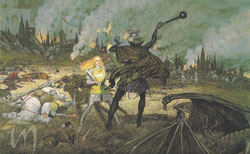
reading four times, is The Lost World. Arthur Conan Doyle’s Professor
Challenger was looking for an adventure in that book and that was what I
liked the best. An adventure. I didn’t care if it was Nemo or Journey to
the Centre of the Earth, I was always intrigued by the summer world of
pterodactyls and mysterious protagonists who may or may not be Indian. But all this time passed,
with college I found new reading interests. Sweet valley high I couldn’t
read for more than two volumes. Then there were all those sappy high school
romances. What saved pleasure reading was the discovery of Harry Potter. Now
here was something I could read, well written and inventive with few
typecaste characters. But by now I was a student of masters. So along with
pleasure reading I had read the romantics and gothics. Still, the book I
enjoyed the most was Lord of the Rings (I am planning to read The Hobbit now,
can’t imagine why I left it this long). Finished it in three nights.
Somehow, I had no enthusiasm for Twilight. And even Fifty Shades of Grey
despite its alluring tagline of middle-aged fantasies failed to keep me
hooked. I guess what I am looking forward to is reading a Game of Thrones.
Well written it is: captivating enough that one reads all books in the
series, we will find out. Over the years my books of pleasure have also
included Dalrymple, I am a fan of the City of Djinns, Meatless days,
biography of Dorris Lessing and some half baked books on philosophy and
economics. There is more than book
reading on my list of summer do’s. The itinerary of summers also includes
trying to collect recipes of drinks that are supposed to keep you cool
throughout the month of fasting. And even now I assume that the average
person is looking forward to all those sardais and jal zeera that suspicious
looking vendors are selling on the roadsides. All those kanji ka sherbet!
(made with fermenting black carrots and tastes bitter) and gond kateera
sherbet are absolutely fascinating and despite a threatening sense of doom
about the hygienic standards, I have to exercise ample self control to stay
away. My plan is to drag as many people as possible to a tasting mission for
all the cool desi drink vendors on the roadside. This way I will be assured
of getting ill with company. And misery (of being ill) loves company. Even
though it is too hot for most of the food Lahore streets have to offer except
the Kashmiri dal chawal, I can’t help but be hooked to this new place in
Dharampura which sells bong paye. I never knew about this dish and one of my
colleagues introduced me to it so I decided to try. Once there it was a
surprisingly delicious experience. Inspite of June, I ate my heart out. Signing off: looking
forward to the next year of loadshedding: and the next: and the next (I could
really go on with “the next” bit but I fear I will write myself into a
black depression). From the average Pakistani who still hasn’t applied for
Canadian immigration.
* Exhibition: Mera Nam Hai Muhabbat at
the Art Gallery of Alhamra Arts Council, The Mall. The exhibition will remain
open till June 29 daily from 5 pm to 8 pm. * Ballet Basic Course from
June 25-July 30 at The Knowledge Factory (TKF). * Comedy Junction: at The
Knowledge Factory (TKF) every Sunday at 7:30 pm till July 29. * Faiz Ghar Summer Cultural
School till July 13 from 9:00 am to 1:00 pm. * Urdu Baithak/Sing along
sessions: “Story hour” for children 5 years and above every Sunday from
5.00 to 6.00 pm at Faiz Ghar. * Book Launch: Pakistan
mein riasati ashrafiya ka urooj on Tuesday, June 26 from 5:00 pm - 6:45 pm at
Human Rights Commission of Pakistan, 107 Tipu Block, New Garden Town.
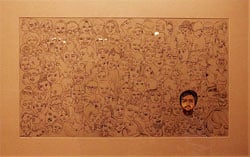
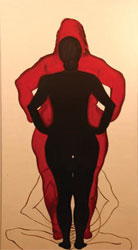
art In a society where
love appears to be a crime with so many people going to court over it and far
more forced to hold on to the tradition, the exhibition titled ‘Mera naam
hai mohabbat’ comes as a refreshing breeze. It was more about
self-exploration, demand for acceptance of individuals as they are and
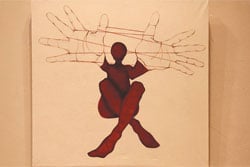
celebrating individuality. Different creative media
are used to explore the dynamics and politics of gender and sexuality at
Alhamra Art Gallery. This exhibition revolves around finding beauty in
alternative gender. The works on display are
the outcome of an artists’ residency, in which seven artists participated.
They were able to pull this show with the assistance of Dugdugi, Media-Bridge
and Heinrich Boll Stiftung as partners. Five artists stayed together and got
down to work after the theme of the art work was decided, while two others
kept in close correspondence through the internet. Some prominent names whose
works were displayed are Imran Nafees, Soofia Asad, Rizwan Waheed, Shazeb
Ahmed, Iftikhar ul Hassan, Abdullah Jamil, and Muhammad Umer. All the artists believe
that the sole visible expression of sexuality appears through commercials in
Pakistan and that sexual frustration leads to an abusive lifestyle. The
artists have attempted to break the silence about sexuality through the
medium of oil paintings, photography, and water paintings. The artwork provides the
ardent art lovers to jog their own perspectives, opinions and create their
own world of interpretations. Many people are seen deep in thought while
looking on to the display and seem to be making a sense out of everything on
their own. Most artists present at the
opening, unanimously agree that they use their creative work for finding
space and individuality. Muhammad Umer, an artist, informed that all his
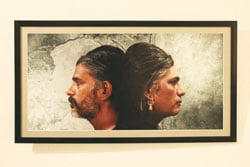
paintings were depicting his expression of freedom and desires. Imran Nafees, working in
the field of gender and sexuality explores through his photographs the fact
of duality of a single gender, found in one and the dilemma of discrimination
in harboring the hints of being different. “All that I have done is an
attempt to put an end to the silence that engulfs the topics of sexual
frustration and being different. The significance of my work lies in the fact
that I have found myself to be different and seen the stereotypes that have
been used all over, but I don’t believe in labelling, I rebel against it
through artistic expression,” he says. From paintings which show a
man being his own Buddha and his own heaven, to the yearning of being noticed
and respected as how one is, all artwork had a secret to be uncovered. It
seemed like there existed a world of tales to be heard and understood. The
guests seemed to have enjoyed the display on two floors. They tried to
understand the undertones and subtexts in the work and were rather very
receptive to what they saw. One must catch this art
display before it ends. The exhibition is on till June 29.
Summer’s
favourite treat In the sweltering
heat of June, those last few brutally sizzling afternoons, before the summer
vacations kicked in, I remember being picked up from my school by my mother.
I would look at her imploringly, hoping for her to be in the mood for my
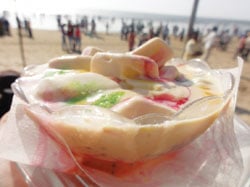
favourite sweet treat, back in the eighties the falooda from Purani Anarkali.
And when she did succumb to my wish seeing my puppy dog look, it brought me
pure joy that made my eyes sparkle at the thought of glassy white strands
dipped in a sweet creamy mix of thickened milk and crushed ice, complete with
the perfect kulfi. One of the most popular
names in the business currently, is that of ‘Yousaf Falooda’. Telling us
about his work, Haider, the owner of two of the most popular shops, located
across the road, in old Anarkali, says, “My forefathers migrated from
Amritsar and settled down in old Lahore. About forty years ago, the
foundation of a small falooda shop was laid here in Anarkali. Yousaf was my
elder brother. Since that day, the business has only been growing.” The
shop in Qaddafi Stadium, also by the same name, is not as known as the one in
old Anarkali. When Yousaf himself passed away, Haider purchased the shop in
Anarkali for a little over sixty-five lakh rupees from Yousaf’s children,
who went and settled in Qaddafi Stadium. Initially, the ingredients
were sent from the old shop to Qaddafi Stadium. Ironically, Yousaf’s own
children have been unable to maintain the quality for which their father was
so popular all over the country. It would not be wrong to say that he held
international fame. Haider has yet another brother, who has his own shop in
Chuburji, also by the same name, but again a different recipe altogether. Haider’s son sits across
the road in the shop marked Yousaf’s Falooda, and revels in the glory of
hundreds of customers, who look to no other shop in the area for their
faloodas. They belong to all classes you can hardly find a parking spot among
the colossal SUVs parked with engines running, where people sit in the
comfort of their car ACs gobbling up the sweet treat. And you can barely
manage to find a chair in the crowded street side, where men, women and
children, come and sit, sweating profusely, to cool down with a bowl of
falooda. You can order one with or without kulfi or even a bowl with double
kulfi. It costs less than Rs100. In Anarkali, the shop
serves falooda and all the other popular dairy products such as rabri milk
etc round the clock. When I asked how it was possible to freeze the kulfi
with hardly any electricity these days, I was told that the moulds are filled
each morning, slightly before the break of dawn and left under heaps of
salted ice. All other ingredients are also made there in the shop. Almonds
and cardamom are used in good quantity. One of the young boys who has been
working at the shop for four years disclosed that the longer you leave the
kulfi in the ice, the better the taste, as it keeps on improving with time
perhaps a myth, but they sure do know their trade. The number of customer
increases to five times more in summer compared to that in winter months. Falooda is widely available
in our city. The ever-popular Kasuri Falooda for which you need to take a
trip out of the city, is nearer to the original more watery preparation,
which a typical, fussy Lahori might not fancy. Salt n Pepper Village offers
it, it’s on the menu on the New Food Street and there are more shops in
Allama Iqbal Town, among many other street vendors and tiny kiosks and stalls
spread across town. But a true enthusiast would know exactly where to go for
the specific kind of a falooda preference he or she has. Back in the good old days,
I remember my mother especially seeking out ‘Riaz Falooda’. His recipe
was prepared with such loving care that none could beat his smooth texture
and perfectly blended amalgamation of all falooda factors. Today, I could not
help but go to the desolate-looking shop that once was bustling with
activity, with glorious pictures of celebrity customers, some even from
across the border, splashed all over its glittery walls. Upon inquiring, I
discovered that this family had also suffered from a split. The elder
brother, who was attracting a large clientele, had now shifted to his shop in
Allama Iqbal Town. The younger brother, though still struggling on, in
Anarkali, is at the verge of extinction. Having tried the falooda in Allama
Iqbal Town as well, I would say that the split resulted in both brothers
losing their special touch. Falooda is massively
consumed in the summer months not just in Pakistan but in India, Bangladesh,
Sri Lanka, Myanmar, and the Middle East. I have tried a few in popular
restaurants in Dubai and all I can say is that there is hardly any other food
item which such tremendous variation in preparation as well as preference of
taste. And you have to be a die-hard falooda fan, only then can you justify
the thousands of calories it comes loaded with. It pains me to see how the
quality of life around us is steadily degenerating with the passing of years.
But one would expect improvement in food recipes and yet the city that was
home to multiple delightful falooda shops, offers possibly just one falooda
worth consuming. Traditionally, falooda was
more of a beverage than a full fledge dessert that it has become now. It has
been popular since the era of the Mughals, who should be credited for
bringing it to our part of the world. It was made in rose syrup with
vermicelli, psyllium (ispaghol) or mountain-balm seeds (tukhm malanga) and
jelly pieces adding milk or water. In South Asia, it is an adaptation of the
non-liquid Persian dessert falooda. The vermicelli (lachhay) are made from
starch (arrarot). The milk is extensively worked upon, thickening it to
perfection. From that rabri is formed. And from the same mixture, kulfi is
then frozen into little cone-like moulds. Can’t even imagine, how this
amazing evolution of the falooda could ever want anyone to return to the
original beverage, when the kulfi is of course the star of the entire
production. But then it depends on your taste, I suppose.
|
|