


|
|
|
|
 |
 |


|
Lords of small goals The triumph at Lord’s Disappointment galore!
Power, Politics & Olympic Games – IV A gigantic sports plan Euro 2012: Battle of
the formations
Lords of small goals Why have our sports persons and officials learnt to live with failure? By Khalid Hussain After setting
big targets and then achieving them, Pakistani sportsmen have
unfortunately developed the unwanted habit of thinking and acting small.
Rewind to the early
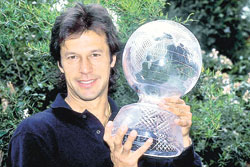
nineties. It was a glorious time for Pakistan sports. After Imran
Khan’s ‘Cornered Tigers’ pushed aside England in the 1992 World
Cup finale at the MCG it seemed nothing was impossible for Pakistan’s
high-flying sportsmen. Much before the
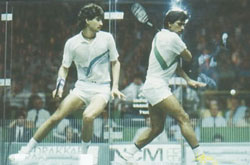
cricket triumph, the mighty Jansher Khan had already proved himself as
world squash’s undisputed champion, having replaced the legendary
Jahangir Khan on the top of the international rankings. Two years after
Melbourne’s crowning moment, Pakistan’s hockey team went to
Australia and after overcoming initial hiccups edged the Dutch on
penalty strokes in a pulsating finale in Sydney to regain the world
title. It was Pakistan’s record fourth World Cup hockey title and
their first since the memorable triumph in Bombay in 1982 when they
trounced West Germany 3-1 in the final. There was another
pleasant surprise in store for Pakistani sports fans in 1994 when a
balding Mohammad Yousuf ran like the proverbial dark horse to win the
IBSF World Snooker Championship in South Africa. Before Yousuf conquered
Iceland’s Johannes Johannesson 11-9 in the clash for the world title,
very few in Pakistan had heard his name. He became a hero back home
almost overnight. In many ways, 1994 was
one of the most glory-filled years for Pakistan sports. Pakistan had
climbed their sporting summit that year. The problem with achieving such
a feat is that most of the times its downhill from there. For Pakistan sports,
that is exactly what has happened. From an elite group of
superbly-talented and highly-motivated athletes, Pakistani sportsmen
have over the years transformed into a bunch of upstarts who think and
act small. They are the lords of small goals and they are everywhere —
cricket, hockey, squash etc. Let’s talk about
cricket first. Just a few weeks back,
our cricket chiefs were patting each others back over the confirmation
of a brief home series against Bangladesh. It’s true that the series
would have ended a three-year drought for Pakistan as an international
cricketing destination. But let’s be frank. We were talking about just
two back-to-back matches on April 29 and 30 against a lowly team like
Bangladesh, hardly crowd-pulling opponents. Pakistan Cricket Board
(PCB), for whatever reasons, even failed to stage that series after the
Bangladeshi called off the trip over security fears. Earlier this year, we
celebrated winning our first Asia Cup title in 12 years. A close win
over Bangladesh in the final in Dhaha triggered wild celebrations back
home as if Pakistan had regained the World Cup. As quite an irrelevant
tournament, the best an Asia Cup can offer is a Pakistan-India clash (by
the way we lost that game). Any way, winning the Asia Cup was certainly
a big achievement for the lord’s of small goals. Gone are the days when
players like Hanif Mohammad, Zaheer Abbas or Javed Miandad would take
the feat of scoring a century in their stride and just kept on marching
in search of a double ton. Today, you will see the likes of Umar Akmal
kissing the ground in utter joy after reaching a fifty! In hockey, a sport in
which Pakistan have won more international laurels than most leading
nations, things aren’t any different either. Till the early eighties
and even in the nineties, we used to feature in major events like the
Olympics and World Cup as title contenders. But not any more as since
falling in last four stage of the 2000 Games in Sydney, the Greenshirts
seem to have lost faith in their own abilities. In Sydney, Pakistan came
close to winning an Olympic medal before a close loss against Korea in
the semis and then a thrashing at the hands of hosts Australia in the
playoff for bronze shattered their hopes. Since Sydney, the
Pakistanis have failed to even come close to winning an Olympic medal in
Athens and Beijing. Unless our hockey team pulls off a miracle this
summer, a similar story is set to be repeated in London which will host
the 2012 Olympic Games starting July 27. Here, I would blame
our sports chiefs. They are the ones who have failed miserably in
translating talented youngsters into world-class sports persons. It’s been 28 years
that we last won an Olympic gold (Los Angeles 1984). It’s been 20
years since we last won an Olympic medal (a bronze in Barcelona 1992).
It’s a sad scenario for Pakistan — a sports-mad country of over 180
million that still takes pride in its long-lost glory in sports like
hockey and squash. It’s quite obvious
that our sports decline which began back in the eighties continues
unabated. The worst part is that
nobody is willing to do anything about it. Other than mere lip service,
our sports authorities have done precious little to make things right.
They are ones, who should be held accountable for the sorry plight of
Pakistan sports. Pakistan will have to find the right people to run our
sports otherwise things will only go from bad to worse and the lords of
small goals will continue to fade the glorious memories of the past. Khalid Hussain is
Editor Sports of The News, Karachi khalidhraj@gmail.com
The
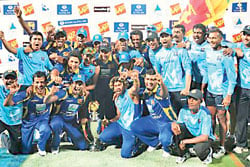
triumph at Lord’s It was at this time of
the year, two decades ago, when Pakistan achieved one of their most
memorable Test wins ever. The boys led by Javed
Miandad proved on June 21, 1992, that Pakistan’s triumph at Melbourne
against the English in the World Cup final three months ago was no
fluke. The match turned out to be exactly the opposite of the previous
Test, the high-scoring draw at Edgbaston as none of the four innings
went past 300 at Lord’s. England had an
excellent beginning of the match with skipper Graham Gooch and Alec
Stewart making 123 runs for the first wicket. But then the two Ws
struck. Wasim Akram removed Gooch and Robin Smith while Waqar Younis
removed five other batsmen, leaving only the tail for Mushtaq Ahmad to
eliminate. England perished for 255. Pakistan had some good
contributions from Aamir Sohail (73), Asif Mujtaba (59) and Saleem Malik
(55) but managed only a slender lead of 38 runs, getting all out for
293. The English had similar bowling performance as the Pakistanis.
Their two main fast bowlers did the most damage. Philip DeFreitas and
Devon Malcolm took three and four wickets, respectively. In the second innings,
Aaqib Javed was the first to strike. He sent Gooch back very early. Then
Mushtaq Ahmad ripped through the middle order, getting Greame Hick (whom
he had also got in the World Cup final), Robin Smith and Alan Lamb
cheaply. Waqar got Ian Botham and Chris Lewis and Wasim got the three
tail wickets just one run later to limit the second English innings to
175. Thanks to the
bowlers’ gigantic effort, Pakistan were set a small target of 138. But
the Pakistani batting suffered its characteristic collapse. Rameez Raja,
Asif Mujtaba and Javed Miandad left without scoring a run. Pakistan were
18 for three. Saleem Malik, who had scored a century at Edgbaston and a
fifty in the first innings of this Test, fell for just 12. Inzamamul Haq
got run out (which he would keep doing frequently during his 16 year
career) for eight. Only Sohail managed to
offer some resistance to the English bowling, making 39 runs, but he
finally became victim to Ian Salisbury, who was getting quite a lot of
spin from the pitch. Moin Khan and Mushtaq Ahmad also gave little
trouble to the scorers. Pakistan were 95 for eight, needing 43 runs.
Chris Lewis and Salisbury rose up to the occasion in the absence of
DeFreitas, getting three wickets each. There was only one
hope left ó Wasim Akram who had by then established himself as a fairly
competent late-order batsman. At the other end was Waqar, his new ball
partner. These two had pushed Pakistan to a very strong position with
their performance with the ball. But their batsmen had let them down and
they were now required to excel with the bat as well. Which they did. They played cautiously
but were not bogged down as the top order batsmen were. They scored runs
whenever they had a little chance. The English team failed to find a
breakthrough as these two took the team homeóthe senior W hitting a
drive that went past the cover boundary. The best Test win of the two
Ws’ careers was achieved. They would go on to help Pakistan win a
number of Tests throughout their careers with their bowling, but with
bat this was their only combined effort to give Pakistan a victory. I was only nine when
this Test was played. And PTV did not telecast this series, but I would
listen to all the commentary on the radio. I watched the video recording
of this Test a number of times afterwards on TV. Even today I enjoy
watching the highlights of this match on Youtube. mushfiqahmad1000@gmail.com
Disappointment
galore! Misbah and
company have lost another One-day International series: this time in Sri
Lanka by a 3-1 margin. It was Pakistan’s second consecutive bilateral
series defeat after they were beaten by England in the UAE early this
year. The series win was Sri
Lanka’s third in their last four series against Pakistan. Their
previous two series wins were 2-1 in Pakistan (2009) and 3-2 in Sri
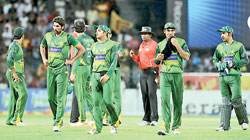
Lanka (2009). Poor ground-fielding,
dropped catches, costly spells of undisciplined bowling and
irresponsible batting were the reasons behind the loss. But it was
mainly fielding which let the team down. The output of the new fielding
coach Julien Fountain has been disappointing. Pakistani cricketers
played like club cricketers. Wicketkeeper Sarfaraz Ahmed dropped
straight forward chances. A throw by Pakistani fielders hitting the
stumps was a rare scene. And the throws from the boundary reached the
wickets after a couple of bounces. On the other hand Sri
Lankan team played like a compact unit. They were superior in all
departments: fielding, bowling and batting. Younis Khan, a veteran
of 246 ODIs, scored only 10 runs in four matches he played in the
series. People have started demanding his ouster from the team
considering his age and unimpressive form. He has already retired from
T20 cricket. It is being suggested that like Ricky Ponting, Greame Smith
and Kevin Pietersen, he should now concentrate on Test cricket only. Shahid Afridi, the
most exciting player to watch, once again failed to prove himself a
dependable player. Now there are very few people who expect Afridi to
deliver as a batsman. In four innings of five matches, he scored just 28
runs at an average of 9.39 and faced only 29 balls in his four innings
stay on the crease. As a bowler too, he
failed, taking only three wickets at a high average of 48.66. Obviously it’s
pathetic performance from a player who has 16 years of international
cricket experience and has played 347 One-day Internationals. Afridi
should think about his future; if he wants to prolong his career he must
concentrate on his batting and show responsibility as the most senior
player. The Twenty20 captain
Muhammad Hafeez seems to be following Shahid Afridi, concentrating more
on his bowling than batting. In five ODIs, he scored just 57 runs,
averaging 11.40. In two matches, he was out in the first over without
opening his account. Only twice has he
scored more than 50 runs in the 14 matches that he has played in 2012 so
far. The only positive
outcome of the series was the discovery of Azhar Ali as a one-day
opener. Pakistan need a calm, cool player at the top who can face new
balls from both ends and stay on the crease for a long time. Azhar was
the most successful batsman of the ODI series with 217 runs, averaging
54.25 with the help of two fifties. For Sri Lanka, former
skipper Kumar Sangakkara was the highest run-getter with 164 runs,
including one half-century at an average of 41. On the bowling side,
Sri Lankan bowlers led the series as first three leading wicket-takers
were Perera (11), Kulasekara (7) and Malinga (7). For Pakistan, Muhammad
Hafeez (6) and Sohail Tanvir (6) were successful. Surprisingly, Saeed
Ajmal took only three wickets in four matches, conceding 122 runs. Khurrams87@yahoo.com
Power,
Politics & Olympic Games – IV After a lapse
of twenty years, the Olympic Games returned to Western Europe with
competitions in Barcelona in 1992. These were the first summer Olympics
after the collapse of Soviet Union. Three new Baltic
republics — Latvia, Lithuania and Estonia — participated in the
Olympics for the first time. South Africa under its dynamic leader
Nelson Mandela came out with a mixed team. Cuba, Ethiopia and North
Korea were also there. The greatest
controversy of Barcelona Olympics was created by American basketball
‘Dream Team’ made up of NBA professionals, which stayed in a first
call hotel instead of the Olympic Village. These players did not eat in
Olympic commissary or mingle with other Olympic athletes. The real controversy
exploded at the medals table when Michael Jordan and Charles Barkley
refused to wear the warm-up suits given by Reebok. The German branded
‘Shoe Wars’ of football had now grown to USA branded ‘outfit’
wars of basketball. Jordan, an international basketball sensation,
endorsed and created Air Jordan in the product line of Nike. The 1996 Atlanta
Olympics will always be remembered as ‘women’s games’. The
American female gymnasts won a team gold, the American women softball,
basketball and football teams won gold medals. The Americans won the
most medals in Atlanta followed by Germany and Russia. From Atlanta the
Olympics travelled to Sydney with a challenge of 15 hour time difference
from New York. The IOC and Sydney Organising Committee generated
approximately $3 billion from the marketing of 2000 Olympics. The Games
stood as the most-watched sports event ever. More than 3.7 billion
people watched the Games in 220 countries and territories. Sydney was a
roaring success. When Great Britain
crew triumphed in Sydney 2000, 38-year-old rower Steve Redgrave became
the first endurance athlete in the history to win a gold medal in five
consecutive Olympic Games. Under Antonio
Samaranch presidency, the IOC office was accused of both nepotism and
corruption. His ties with the Franco regime in Spain were also a source
of criticism. In 1998 it was uncovered that several IOC members had
taken bribes from members of Salt Lake City bid committee for hosting
the 2002 winter Olympics that led to resignation of four members and
expulsion of six others. Athens was awarded the
2004 Olympic Games. Athens went under major renovation and construction
projects to host the Games. According to a BBC report, the costs were
close to 10 billion euros. The opening ceremony was a pageant of Greek
culture and history. Among the highlights
of Athens Olympics was the first ever gold medal by a Chinese athlete in
men’s track and field event when Liu Xaing won the gold in 110m
hurdles. The USA lost against Puerto Rico in men’s basketball — the
first time since NBA players were permitted in the Games. Swimmer Michael Phelps
with six gold and two bronze medals emerged as the first ever athlete to
win eight medals in any non-boycotted Olympics. Dr Jacques Rogge, the
IOC president, described the Athens Olympics as ‘unforgettable, dream
games’. Rogge was elected as IOC president in July 2001. In October
2009 he was re-elected for a new term till 2013. The mega event reached
Beijing in August 2008 in the backdrop of war on terror in Afghanistan
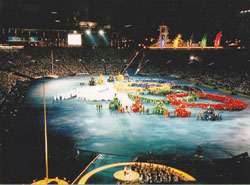
and border areas of Pakistan. The breathtaking opening ceremony in the
‘Bird’s Nest’ was witnessed by 91,000 spectators present there. More than 40 world
records and over 130 Olympic records were broken. Michael Phelps and
Usain Bolt stole the headlines. The women’s 800m
record had been held by Janet Evans (USA) for almost 20 years. But in
Beijing, Great Britain’s Rebecca Adlington smashed this record. The 2012 Olympics will
be the 30th Olympiad and start from 27th of July. While the Games are
privately funded, the cost of construction of four separate venues’ is
met through public money. A huge sum of $600
million will be spent for the security of the Games. More than 70,000
volunteers known as ‘games markers’ will carry out various duties.
Free tickets will be given to the family members of those who
died during July 2005 London bombing. A total of around
4,700 medals for Olympic and Paralympics games are to be produced by the
Royal Mint of England. The grand opening ceremony of 2012 Olympics will
be called ‘The Isles of Wonder’. Queen Elizabeth II and
the Duke of Edinburgh will officially open the games. These Games will
be the last under the belt of Jacques Rogge. We have gone through
the long journey of Olympic Games, their evolution, management,
important historical events, politics played around them, dimensions of
IOC leadership and the effects of world events on Olympics and vice
versa. The Olympic journey
shows the importance of sports in human life, culture, economy and
politics. This journey which was masterminded by Coubertin has passed
through many phases, and both developed and developing countries have
taken full advantage of the global Olympic pedestal. When educational
institutions in Pakistan had vibrant sports structures, the name of
Pakistan was well known in the comity of nations as ‘Olympic Hockey
Champions’. But with committed
personalities fading away Pakistan is no longer among the medal winners
at the Olympics. It will be virtually
impossible for Pakistan to bounce back in international sports with its
present system, meagerly funded by government. Pakistani sports need
major restructuring. It being a ‘human intensive industry’, our
first priority should be to make available trained human resource to
manage sports on modern, scientific and professional lines. This will
not be possible without establishing an institute of sport management
and sciences at some high ranking public university in the country in
collaboration with some foreign university or sport institute having
expertise in sport management. This shall help Pakistan develop an
institute of sport excellence. Only through an
institutional approach can Pakistan start producing good sports managers
of international standing, which will act as agents of change and push
Pakistan high in the world of sports. It is only through the
knowledge of sport management that they will learn to create financial
revenue streams, manage club sports, create sport education curriculum
for different levels, carry out research work in sport sciences and run
coaching courses for different sports on modern and scientific lines. Such an institute will
be the conduit of excellence capable of producing future Olympic and
world champions. This all seems a
difficult task, but is not impossible to accomplish. Education and sport
experts in the country need to sit together and work diligently to make
the ball rolling in the right direction. sdfsports@gmail.com
A
gigantic sports plan The Kashmir
Road Sports Complex owned by the KMC and considered as a big asset of
Karachi’s sports fraternity due to its huge area and location (it is
situated in the heart of the city), was being used for marriage
ceremonies and other parties until very recently. The present KMC
administration took the initiative to make the place a sports paradise
instead of a marriage garden as it became known among the Karachiites in
recent years. Informed sources in
KMC told ‘The News on Sunday’ that Governor Sindh Dr Ishratul Ibad
Khan has directed that the sports facilities be upgraded at this sports
complex. He took a personal interest to develop maximum sporting
facilities here and give opportunities to sportsmen, sportswomen. KMC administrator
Muhammad Hussain Syed conceived the plan to upgrade the sports
facilities at the complex and gave clear cut directives to sports
department in this regard. Informed sources say
that PC-1 of the project has been approved and approximately Rs172
million has been allocated for the project. Sindh government will help
in this project and as it has been made a part of ADP for 2012-13. The senior director of
sports and culture department Rehan Khan confirmed to ‘The News on
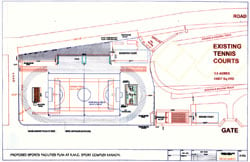
Sunday’ that the KMC is going to develop in the complex a hockey
ground, football ground, bowling alley, badminton court, tartan track,
volleyball court, physical fitness center, table tennis court and three
cricket practice pitches. He mentioned that the
existing facilities such as swimming pool and tennis courts would not be
affected. He pointed out that basketball courts and squash courts would
be relocated as per the planning of the project. Sources say that a
roofed pavilion for more than 2000 spectators and toilets would also be
established. The location of the pavilion is just in front of hockey,
football and athletics fields. Khan said that
athletics track would not be sandy, but a tartan track would be laid
here. He mentioned that development work would be carried out by the
approved pre-qualified contractor under the watch of his technical
staff. He said that once the
development work was started they would try to complete the project
within six to eight months. It has to be mentioned that KMC has already
one of the biggest sports infrastructures in the country spread across
the city. The addition of new facilities at the Kashmir Road Sports
Complex would be another feather in its cap. The KMC sports
director said the main purpose of this project was to provide ample
opportunities to the middle and lower middle class access to
state-of-the-art sports facilities. He said that after the
completion of the project, they would organise national level events of
football, basketball, volleyball, athletics, bowling, squash, swimming,
tennis and various other sports. Under a separate
project conceived in collaboration with Pakistan Billiard and Snooker
Association, snooker and billiards facilities would be provided to
masses, he said. Rehan claimed that
after completion the project it is expected that 2 to 2.5 million
people, including school children and professional sportsperson, would
visit the complex annually. He added that the main
objective of KMC’s sports policy was to provide maximum sports
facilities to masses either for free or against nominal fees. intikhab3@gmail.com
Euro
2012: Battle of the formations England take
on Italy tonight in the last of the quarter-final matches at the
European Championships, and it will be interesting to see how the two
teams shape up for this encounter, given there is none of the comfort
afforded by the group stages, and one bad night can send a team packing.
England’s formation
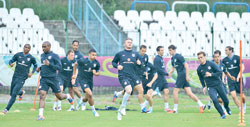
of choice is no secret. Roy Hodgson’s charges will trot out in the all
too familiar 4-4-2 that has been the go-to strategy for the English for
decades now. The only bit of flair added to this ensemble is up front
where Ashely Young gives the option of dropping off slightly deeper to
play behind either of Rooney, Wellbeck or Carroll. It should be noted
that Fabio Capello shared Hodgson’s fascination with tactical
simplicity, both in terms of formation and the roles assigned to the
various players (ball winner, passer etc.) and how his template for a
formation was set along the same lines we see England present these
days. When defending, the team stacks up in two rows of four, with the
wingers shuttling back. To hit the teams on the counter, the plan is to
move the ball out of defence or midfield directly to either one of the
front two, and then move forward to offer support. In this respect,
again, Hodgson has not departed greatly from the model Capello was
trying to impress onto the English side and more importantly, the fans.
As it turns out, English fans are more partial to accepting unattractive
football when delivered by an English manager than they are from a
foreign manager. However, one thing that Hodgson has clearly done better
than Capello is his squad selection, albeit with some help from lady
luck. Injuries to Barry and Lampard meant that their direct replacements
in the side, Parker and Gerrard, have been allowed to start all three
games uncontested in their roles, and both of them have shined. Parker
has done what was expected of him; run and run in the so-called
‘engine room’, providing energy and mobility in midfield to shield
the defence and provide the ball to Gerrard for the aforementioned
direct pass to the front line. Gerrard, with the bulk of his defensive
duties outsourced to Parker, has focused on the task of spraying the
ball from midfield, bringing the wingers and full backs into play
whenever he could. Multiple managers of the England national side
struggled fruitlessly to get Lampard and Gerrard to play alongside each
other, spoilt for choice as they were, but here, given a single task,
Gerrard has proven inspirational, wearing the mantle of the playmaker
and racking up three assists in as many games. Italy too have
benefitted from the skilful displays from two midfielders, though one of
them has spent more time in the back line than in midfield. De Rossi and
Pirlo have been the most influential members of Cesare Prandelli’s
Azzurri side in this tournament, with De Rossi a revelation in the
Libero role. For the first two
games, against Spain and Croatia, Italy played wonderful attacking
football, with Marchisio and Motta doing the leg work in midfield while
Pirlo played the ball to a pleasantly mobile front line. Often times, De
Rossi would put in an interception on the edge of his own box, and play
beautiful diagonal passes out to either wing to meet the rushing full
backs, who provided the side with natural width, compensating for the
lack in forward-running from the defensive midfielders. For the last
group game against Ireland, one that Italy needed to win at all costs,
Prandelli shifted from the 3-5-2 of the first two games to a more
‘standard’ 4-3-1-2, with De Rossi moving into the midfield three,
and Motta pushed up as a trequartista, a role which he was unsuited for,
and in which he utterly failed. Motta’s strength lies in defence, and
forcing this role on him was unwise. For better or for worse,
Prandelli’s squad selection does not allow for this formation, and I
would be happy to see Italy revert to a 3-5-2 against England tonight.
It proved a difficult formation to sustain against attacking sides such
as Spain and Croatia, but this England side are happier to concede
possession and break on the counter, so Italy should expect to have less
running to do in midfield, which consequently will mean they are less
likely to get exhausted as the second half draws down. Here is where the
tactical battle lines will be drawn. England’s 4-4-2 heavily favours
scoring first, as the side can stack the defence and hold out for the
win. Sure, they may have been very lucky in some instances, particularly
the disallowed Ukraine goal, but England are not conceding many clear
cut chances to opposition sides, and with Italy betraying profligacy in
front of goal, the edge goes to England in this regard. On the other
side of the pitch, with De Rossi as the Libero and two solid centre
backs with him, Italy should stand an easy chance of handling
England’s two man attack, especially if Abate plays instead of Maggio,
as the former is a better defensive asset. As with a lot of
international matches, the midfield will decide which team runs the
show. Playing deep, Pirlo is less likely to be troubled by pressure,
unless Milner is designated to man-mark him. Motta and Marchisio will be
shuttling around in midfield, and will look to shackle Gerrard. Substitutions may
prove key in this match, as the Italians’ midfield cannot keep running
for 90 minutes. Here Prandelli should use Nocerino, either as a starter
or even off the bench early in the second half. In each of their first
two matches, as fatigue wore them down, Italy retreated deeper and
deeper into their own half, and fresh legs in midfield can prevent this.
Cassano may prove a more potent weapon when used late in the game to
change the pace of the attack, as he clearly cannot last an entire game.
England would look to start with Milner to press defensively, and bring
in Walcott later in the game to exploit a tiring back line. The other
option could be to shift Young to the left wing and have Rooney play
behind Wellbeck or Carroll, depending on the situation. The match promises to
be an interesting tactical battle. For the sake of neutral onlookers,
here’s hoping it does not end up being a case of one side scoring and
parking the proverbial bus in front of goal. zainhq@gmail.com |
|