|
|
| |
instep
review
Jodhaa Akbar
Impressive romance, infuriating historical
One has to shake off the historical and even religious trappings
to truly enjoy Jodhaa Akbar in its romantic essence. However, in
the wake of a protesting Rajasthan (India) and the Hindu-Muslim
divide, that is verydifficult to do.
By
Aamna Haider Isani |
| |
You
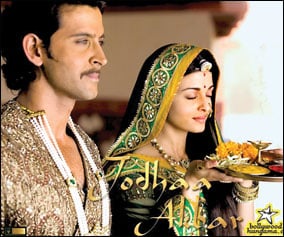
can only enjoy Jodhaa Akbar if you watch it as a fairy tale romance
between, not Mughal emperor Jalaluddin Akbar and Jodhaa Bai, but Bollywood
magnets Hrithik Roshan and Aishwarya Rai. Their onscreen chemistry
began with the modern tale of love between two con-artists in Dhoom
2 and becomes ever more palpable when explored in this sizzling saga
of a Mughal Emperor and a Rajput Princess - it thrills to no extent.
The
film has been brilliantly shot and brings the magnificence of the
Mughal Empire into full view. A lot has been invested in construction
of sets, costumes and design and in Jodhaa Akbar Asutosh Gowarikar
takes a departure from the
|
 |
| genre
of cinema he played with in Lagaan and Swades. While both those films
were shot in a crisp, documentary-like manner, Jodhaa Akbar appears
grand and with it, Gowarikar puts himself in the same league as Sanjay
Leela Bhansali.
|
|
Yet Jodhaa Akbar has loopholes that weaken its strength as a credible
historical film. Hrithik and Ash may have brilliant chemistry but
their performances are not as impressive as their body language.
Hrithik does not make a convincing Jalaluddin Muhammad Akbar, Aishwarya
as Jodhaa is relatively better.
The sword fights
and elephant taming 'action' is amateurish at best - when Hrithik
jumps on to the elephant he is more Krrish than Akbar! And the fact
that the film is only 30 percent referenced and 70 per cent a figment
of Asutosh Gowarikar's imagination (as he has confessed in interviews),
the story becomes a little lame when put in context. |
| |
The
original score by AR Rahman may not be his best, but strikes lyrical
strength with songs like 'Jashan-e-Baharan' and 'In Lamhon Ke Daaman
Mein'. The devotional track, 'Khwaja Mere Khwaja', praised extensively
by Amitabh Bachchan, is a tad bit over rated. Rahman also composed
the music for Gowarikar's previous films Lagaan and Swades, which
was received quite well. Unfortunately this score is not as stirring
as Rahman usually is.
Consequently, you can either love Jodhaa Akbar - if you watch it as
a romance - or you can hate it, as most history lovers have. The success
of this film is half full and half empty - depending on how you view
it. |
 |
| |
|
A historical
Mills and Boon?
The film begins with Amitabh Bachchan's lengthy narrative that takes
one through Emperor Humayun's death and Jalaluddin Mohammad's inheritance
of throne. He is trained to be a fierce and ruthless conqueror who
manages to add as many provinces to his empire as he touches. The
Battle of Panipat is touched upon and the story of a thirteen year
old warrior thus begins.
Interestingly, the story then steers towards his relationship with
Jodhaa and more than half of the film is channeled towards Akbar
and Jodhaa consummating their marriage. Ashutosh Gowarikar has repeatedly
clarified that Jodhaa Akbar is more a figment of his creative imagination
but one has to say that he pushes the creative boundaries (no matter
how flexible they are) beyond belief in some instances. Here is
an emperor who belongs to a dynasty of exceptionally virile and
sexual men. They had numerous wives and even more mistresses. To
even imagine that an emperor as masculine and powerful as Akbar
would allow his wife these wiles is ridiculous.
Nevertheless, the romances are quite delicious in a very old fashioned
Mills and Boon or Barbara Cartland kind of way. Here you have two
exceptionally good looking, green eyed protagonists in a tug of
war of emotions. Akbar sees Jodhaa for the first time (ever) when
his daily morning court is distracted by the melodious sounds of
her bhajans. He follows its trail and walks up to her, intrigued.
It's riveting.
The sword fights may seem amateurish but when Akbar fights his lovely
wife one night after she has (yet again) drawn the curtain between
them, the sword fight becomes poetic. Off comes her turban and down
cascades her hair. The scene is a cliché, but it is a beautifully
shot one.
The
inevitable religious
superiority kicks in
As director and screen play Ashutosh Gowarikar has made this film
with a very Hindu viewpoint, all of us here in Pakistan, have undoubtedly
eyed it with an equally Muslim bias. It happens with every Indian
film that plays with the Hindu-Muslim issue in one way or another.
On the surface, Jodhaa Akbar is the extremely neutral and pleasing
tale of secularism, celebrating the love between a Muslim emperor
and a Hindu princess. But scratch the surface and it's quite difficult
to digest the fact that Akbar the Great's biggest quality - religious
forbearance - is attributed to the fact that he is secular because
he wants to please his Hindu wife. The storyline dictates that Akbar
had taxes on the Hindus waived off (a fact that historians confirm)
as his wife had made it clear she would not allow him to consummate
the marriage until he 'won his heart and not just declared victory
over her body by marrying her'.
In the film it is Jodhaa who convinces him to become more of a peoples'
king and it is the mere hint of a perfectly sculpted eye brow raised
in disapproval that makes him less hard hearted and more humane.
It is Akbar who agrees to construct a mandir within the Mughal Muslim
fort, he who willingly samples vegetarian food from his wife's kitchen
and he who endorses the importance of 'ek chutki sundoor' when he
colours her maang. Jodhaa, for all her values and ethereal beauty,
does not change anything about herself, indicating her moral superiority
being a Hindu. It would have been more understandable if the Muslims
of India had been protesting about that!
Whose
wife is it, anyway?
It's the Rajputs who are up in arms. As with every film that is
caught in the eye of a controversy, Jodhaa Akbar's profile has gone
up after the protests in India. But it's very difficult to decipher
why the Rajputs are kicking up such a racket. According to the Times
of India - "The movie, which has ostensibly hurt the sentiments
of Rajputs, Kshtriyas, Vaishyas - and heaven knows who else - continues
to be mired in unnecessary controversy. Now the Madhya Pradesh government
has banned it." The Rajputs are finding historical references
in the film offensive, the biggest insult being that Jodhaa has
been portrayed as Jalaluddin Akbar's wife, whereas in their knowledge,
she was Jehangir's wife and therefore Akbar's daughter-in-law. Widespread
violence has broken out in India and newspapers are even writing
editorials on it.
If most history books are to be consulted, then contrary to the
brouhaha the Rajputs may be creating in protest, Jodhaa Bai did
exist and was in fact Akbar's first wife not his daughter-in-law.
The palace he built for her in Fatehpur Sikri - ostensibly larger
than the areas constructed for the rest of his wives - is living
proof. She was one of his many wives (historians acknowledge a figure
crossing 200, with even more concubines in the harem) but she was
his favourite. However, Akbar's marriage to Jodhaa was purely political,
as is portrayed in the film.
As a Muslim emperor conquering all of Hindustan, he was hated by
the Rajputs and his marriage to Jodhaa (as well as many others)
was to strike political alliances. The same reason explained his
pro-Hindu stance. Many of Akbar's marriages were meant simply to
create good will with the Rajputana, though they never favoured
him and that hatred is even reflected today. The Mughal-Rajput rivalry
lives on in India. It is based on the Hindu-Muslim divide and is
fuelled by vitriolic outbursts from organizations like the Shiv
Sena who reiterate that all 'outsiders' should be eyed with suspicion
and even hatred. But as the Times of India writes, "By caving
in to threats by fringe elements, the government has admitted its
failure to maintain law and order." Protestors are riding on
the wave of religious differences to object a film that aims to
bridge the divide, albeit in a slightly self-serving manner. In
purely artistic form, Jodhaa Akbar should be enjoyed for its visual
brilliance but living in a world in which everything is highly politicized,
it is hard to ignore the religious undercurrents that lie under
its glorious surface. |
| |
|