



|
|
|
|
 |
 |
  
|
memory Utopia for
me Sky"s
the limit
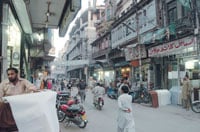
By Salman Rashid Sugar and spice and all things nice. That is what Lahoris were always made of. But let me ramble. The year was 1968, it had been a great monsoon and in September the mid-morning sun was sharp and clear but it did not hurt. My friend Sajid and I stood on the pavement outside Tollinton Market (yes, there was a pavement in those days) watching the world go by as we talked of the weather. Sajid said, "The power
of summer is broken." Translate that into Punjabi for that is what we
spoke. A man walking past overheard, paused, turned around and came up to us. Or there was the time when an out-of-Lahore family went shopping in Anarkali (Liberty did not exist then) and having done their business, the lady of the household was leading this young paandi (the carrier you could hire for large loads) with a huge bundle of towels on his head. Two passing Lahoris espied this and said one to the other, "Yar, lagda ai aina day ghar tay luma hi nahana dhona rehnda ai." But the cream of the crop is the one narrated by an-ex Kinnaird College student. Back in the early 1970s she and a friend were walking through Anarkali, one limping with an ankle tied up in a crepe bandage and the other with her wrist similarly dressed. An elderly gentleman, hookah in hand, sat outside a store regarding them as they approached. As they came abreast, he shook his head and said, "Huc ha. Lattan vi toot gaiyan, tay bavaan vi toot gaiyan pur ghar beh kay chain nahin jay aanda." That was the ramble that I just had to do to tell all you new age Lahoris what you don"t even know about this wonderful city and how her sons and daughter behaved. You, who have forgotten to smile at a stranger"s quip, have lost the culture of the city you claim as your home. The witticisms were just that: witticisms. There was never any vulgarity or an attack on one"s person; on how dark or bald one was. That was not what Lahoris did. Gujranwala perhaps would have been famous for that. But the story that needs
telling begins sometime in 1957 or thereabout for I was then five and that is
the time I can easily recall. For her sartorial requirements my mother had
two places. The one was Feroz Din in Mclagan Road and the other Latif in
Dhani Ram Street On one arm he dangled a bulging cloth bag as he ambled around the then rather uncrowded Anarkali. His call was, "Babyeeeeeee!" And his merchandise was potato crisps in sealed paper bags with the legend "Baby Chips." My sisters and I and later when my brother Imran was old enough to handle the crisps never missed any chance to wheedle our mother for at least one helping per head. Like so many other children of that time, we were pretty well-known to the Baby Chips-walla, because that is what we called him. Then we grew up. Rauha, the eldest, married and went off to live in Karachi, my brother and I had other pursuits. Only Noshaba continued to visit Dhani Ram Street with mother, but we seldom ever asked after the chips-walla. Occasionally, passing through Anarkali or Dhani Ram I would run into him and exchange a pleasantry or two. In 1972, home on leave from the army when Rauha was visiting from Karachi, the four of us were together in Dhani Ram Street after a very long time. It was now somewhat more crowded, but still not the madhouse it has turned into now. Above the general din of the street came the cry "Babyeeeeeee!" It was as if we were electrified. And sure enough, there he was. The same easy amble, the white attire, the chunky face now rather more lined, the head with fewer hair and even those mostly grey. But the cheer in his lop-sided grin remained. The only difference was that the one-anna packet that we got back in the early 60s was now twenty-five paisas. (Remember, we went metric in 1962). Something happened thinking about which even today mists up my eyes. The chips-walla, whose name none of us ever knew, recognised us. No surprise there for he had seen us growing from little children into adults. But when he saw Asiya in my sister"s arms, he was beside himself with pride and joy. He lavished my four year-old niece with bag after bag of potato crisps. My sister protested, but our nameless chips-walla would have nothing of it. He kept saying "Baby kha lay gi." And when my sister tried to pay him for what we had got, the good man simply refused. My sister persisted but he remained adamant: there was no way he was taking any money for the gift he had lavished upon us, his old customers. In 1974 our chips-walla still had worn-out clothing on his body, he was now much older than when we had first seen him in the late 1950s. Obviously there were responsibilities he had to work hard to meet. Yet this good man possessed that largesse of the spirit, regard for an old acquaintance and a kindness of the heart that was beginning to ebb away out of the collective mass of humanity that we called Lahoris. That was the last time we ever saw him. In 1980, a couple of years out of the army and living in Karachi, I was visiting Lahore when I went looking for him. Some store-keepers remembered him, some did not. But no one knew why he had stopped coming. One casually remarked that he may have passed on. Our chips-walla had been a virtual fixture in Dhani Ram Street, yet when his time was up one fretted about his sudden disappearance; no one attempted to ask what had befallen him. But the four of us, now ranging from in age from fifty-one to sixty, think of him. We think especially of his munificence upon seeing my niece for the first time. The chips-walla was imbibed with the spirit of Lahore.
Utopia
for me By Raza Rumi Karta hun jama phir jigare lakht lakht ko (I seek to gather the scattered pieces of my heart) Not long ago, say two
decades ago, we the Zia"s children yearned for a country that And then the utopia signs dwindled as the battles on the white peaks of Kargil turned red, a VVIP plane hijacked re-invoking the sorry state of martial rule. We could not live without the dream however. So the new goals -- accountability, devolution and economic miracles -- weaved a new chador of delusions. Like that mythical chador, this new age of globalised Pakistan made reality invisible. We had technocratic solutions spun once again and the opening up of imperial coffers gave us a false sense of moving towards the dream-path. Yet again, the ideal was snatched and smashed as the myriad myths of unequal development started exploding with imported and local bombs. This time my utopia seems painfully distant, blurred. I have forgotten what it was. It slipped from the vision when the suicide bombers started visiting the idyllic Islamabad. I now suffer from a mild amnesia. I don"t know what I hoped for in those naive, uninformed days when Faiz"s Hum dekhain ge outlined its contours; and the daagh daagh ujala was destined to transform into sheer resplendence of a vibrant society future. How do I gather the slipping grains of what was the cherished utopia. I had heard that human memory vistas theoretically are seamless and clear. But that vision of those vast green fields is now blood-stained. Suicide bombers are omnipresent and my dear friend in Waziristan tells me that the queue is long and restive. The streets of Islamabad, Lahore, and Karachi are potted with excess blood choking the civilization arteries. The vacant Liaquat Bagh a haunting shrine where many come to share the loss of a vision. A vision, tainted by cynicism, slander and murder, not once but twice over. The floating limbs of ticket-holders to heaven have created a temporal hell. First, it was the mosque, then the eid-gah and now a janazah prayer. It used to be the army post, then a bazaar and now it"s under the banyan tree where Gautama and his followers found peace; and Khanqahs thrived on its lasting shade. The paths with Ashoka"s footprints are infested with land-mines. Indus, the mighty nourisher, is mixed with suffering. Urban life has turned into a quest for personal security -- the 'ideal" existence where one is simply not dead! But this fear of death does not bother me. What haunts me is the deeper decay of a polity that started with a high note. The old has crumbled and the new is not there. But then pessimism is useless and nihilism is nothing but the ultimate denial of being. The recent awakening of urban Pakistan now provides the silver lining. It points towards a long road towards my utopia that will comprise a country with enough oxygen, expression and free of scary little gods. It would also mean that poverty will have to be eliminated, not just reduced, alleviated or targeted. Here inequality would be unacceptable and not a way of life (as I have grown up with it). In this world, heritage would not be dismissed or reduced to food streets. In this Utopia, citizenry would be at the forefront and will lead the country into a new era where the bitterness of the past would be nothing more than lessons for the days to come. And I want to walk freely. Pray in a mosque when I am required to without the fear that someone would enter with dreaming of the other-world. I want my children to grow up in an environment that is not plagued by the toxicity of consumerism and emptiness of a historical world. I don"t want those old trees to disappear taking along the music of koels and calls of enlightenment. I want my utopia to be free of de-humanisation, devoid of nuclear balances and imbalances and cacophony of jingoism. Above all, my utopia is where the centuries of mystical thought, bhakti and love for fellow human beings are paramount. Only such a world can be free of greed, revenge and terror. This is a utopia where Mohammad"s egalitarianism backed by the hama-oost of the Sufis shall reclaim the footsteps of Gautama, Nanak and Bulleh Shah. Is it possible to dream again when the memory has to be rediscovered and dreams re-scripted. When will those pieces of my heart gather together? (Raza Rumi is a freelance contributor. He blogs at www.razarumi.com; edits a cyber magazine Pak Tea House & Lahore Nama blog)
Sky"s
the limit "Up, up and away! Floating on thin air, I soared above the clouds whisking through the fluffy white softness, I saw the sun rise, the experience can only be described as awe-inspiring." Touring Australia, an adventurer from Pakistan expounds upon his experience of Hot Air Ballooning. At one and a half hours
drive from Melbourne City Centre, there is a site for the departure of Hot
Air Balloons. These balloons soar above the Yarra Valley, north-east of
Melbourne. The tour starts at four o"clock in the morning, it is dark at the time of the departure lying dormant on the ground are four balloons. The aim is to see the Yarra Valley at sunrise. As the balloon inflates, sixteen passengers mount the basket, four in each picket, with a pilot in the centre. The lift off is smooth and as the balloon soars higher, one can feel oneness with nature. Apart from the throttle of the engine, now and again, there is utter silence. One of the only rides, where you can hear yourself breathe. With highly trained pilots, the flight takes off and as it penetrates through the barrier of clouds and floats over the vast whiteness, the passengers can only but feel 'smitten." Then, suddenly, from the vast white 'pops" out the other balloons. Hovering above the ground at 6000 feet, one can see a mist floating across the valley. The sun rises right in front of your eyes, and the entire adventure becomes an out of this world experience. Hot Air Ballooning; being suspended in mid air conjures up the fantastic, mingling it with the realistic vista of heavenly grounds on earth. The warmth of the hot air gently caresses you from one side, and fresh breeze from the other. The misty, moist air from the shrouded woolly mass of clouds strokes your face, and you realise that you have entered the domain of the 'cloud land." It is like entering the fairy land of jack and the Beanstalk. Suddenly, the other balloons pop out like little flower buds sprouting on the woolly white. The multi-layered landscape below, with its shades of variant greens, and hues of blues merge with the white morning mist, cleansing the panorama below. The colours play games on the eyes, as they alter from hues of dark to light with the onset of sunrise. As if the vista of hybrid colours is not enough, the hot and cold breeze elevates your spirit along with the balloon. The mesmerising adventure leaves the passengers spiritually suspended even after the landing. Their spirits hover above the heaven, trying to engulf the experience, so that it impresses upon the memory forever. Global ballooning tries to make Hot Air Balloons ozone friendly. The company provides its passengers with carbon offsets to replant native vegetation to absorb the emissions of 500 balloons per year. This enables the passengers to have a 'cleaner conscience." One of the passengers, recounts her impressions of the flight as "one of the list of things to do before. I fall off the perch. This makes it an adventure of a lifetime." The dexterity of the pilots in Australia enables a safe flight. Upon its descent, the passengers are accorded a delectable breakfast on the lush green Yarra Valley grounds amidst vines and grapes. The hot air balloon ride can be the perfect anniversary, or valentine gift for your loved one.
|
|
 "Yes" he said. "It"s broken. It"s broken into two.
And I"ve seen it; it"s lying on the far bank of the Ravi." In
Punjabi he said, eyes wide and wagging his finger, "do totay hoya ai,
do!"(split into two) And having delivered his piece, he turned around
and marched off and the two of us burst out laughing.
"Yes" he said. "It"s broken. It"s broken into two.
And I"ve seen it; it"s lying on the far bank of the Ravi." In
Punjabi he said, eyes wide and wagging his finger, "do totay hoya ai,
do!"(split into two) And having delivered his piece, he turned around
and marched off and the two of us burst out laughing.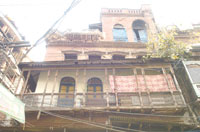 just off Anarkali. And Anarkali was the haunt of this rather smallish man who
I imagine was no more than a couple of inches more than five feet. He had a
chunky and rather kindly sort of a face with a slightly lop-sided smile, was
always dressed in white trousers and a matching shirt -- both clean but
somewhat the worse for wear.
just off Anarkali. And Anarkali was the haunt of this rather smallish man who
I imagine was no more than a couple of inches more than five feet. He had a
chunky and rather kindly sort of a face with a slightly lop-sided smile, was
always dressed in white trousers and a matching shirt -- both clean but
somewhat the worse for wear.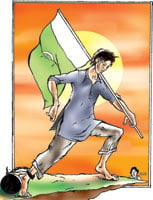 treaded the Malaysian path for prosperity; and somehow were to transform a
tolerant, inclusive society. Such were the dizzying dreams. We wanted the
Hudood laws to vanish, the witch-hunt under the blasphemy laws to end and
sectarian-ethnic monsters buried. We were inspired by the likes of Mohtarama,
for some the charitable cricketer appeared the redeemer. The road to utopia
also emerged when a bus took off from the other side of the border and landed
in Lahore. The brothers Sharifov became new faces of a moderate, booming
Pakistan. Mr. Vajpayee"s chant on the ancient roads of Lahore, "ab
jang nahee ho gi" was enough to willingly suspend our disbelief. For
many a precious day, we forgot the corruption stories, the political
squabbles and incompetence all around.
treaded the Malaysian path for prosperity; and somehow were to transform a
tolerant, inclusive society. Such were the dizzying dreams. We wanted the
Hudood laws to vanish, the witch-hunt under the blasphemy laws to end and
sectarian-ethnic monsters buried. We were inspired by the likes of Mohtarama,
for some the charitable cricketer appeared the redeemer. The road to utopia
also emerged when a bus took off from the other side of the border and landed
in Lahore. The brothers Sharifov became new faces of a moderate, booming
Pakistan. Mr. Vajpayee"s chant on the ancient roads of Lahore, "ab
jang nahee ho gi" was enough to willingly suspend our disbelief. For
many a precious day, we forgot the corruption stories, the political
squabbles and incompetence all around.
