



|
|
|
|
 |
 |
  
|
comment review
Ascent to the void Designers'
dreams
Unfortunately, the Pakistani state and nation is now caught up in this apparently endless struggle between the US-led West and the militants. This is bringing suffering on our people, destroying our infrastructure and damaging our economy By Rahimullah Yusufzai If the past is any guide, the perpetrators of the March 11 suicide bombings in Lahore would remain unidentified and at large just like the scores of terrorist attacks that have taken place from one end of Pakistan to another in recent years. There could be more bomb explosions, events would overtake all of us and only those who lost their near and dear ones would remember these tragic happenings. That has been the story of
our collective suffering since Pakistan's military ruler, General Pervez The complexity of the conflict now raging in Pakistan could be judged from the fact that most Pakistanis refuse to believe that military operations in the tribal areas or elsewhere in the country are in our interest. They consider it as a war being fought on Pakistan's soil at the behest of the US to protect and promote American interest. Our soldiers fighting this difficult war know this and some even share this sentiment. That should explain the desertions by soldiers, mainly from the paramilitary Frontier Corps and Frontier Constabulary, and the occasional surrender of troops to militants. It is an unpopular war that has heaped suffering on ordinary people, whose sons make up the ranks of both the armed forces and the militants. As usual, the intelligence
and law-enforcement agencies appear clueless about the masterminds of the two
recent suicide bombings in Lahore. Government functionaries say they cannot
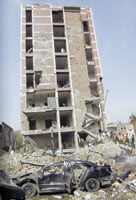
rule out As in the past, government officials immediately raised suspicion about al-Qaeda's involvement in the twin Lahore suicide bombings that killed 27 people and caused injuries to another 150. The US government and the Musharraf regime have been quick to blame al-Qaeda for almost every such bombing. Their assertions make one believe that the Osama bin Laden-led organisation is still capable of mounting terrorist attacks all over the world despite claims frequently made by both Washington and Islamabad that they have broken the back of al-Qaeda and that its leaders were now on the run. No explanation is given that like-minded militant groups with local and restricted agendas rather than al-Qaeda itself could be masterminding such bombings. Punjab police chief, Azhar
Hussain Nadeem said it was unclear if al-Qaeda was involved in the Certain other government functionaries blamed Sipah-e-Sahaba and Jaish-i-Mohammad, two banned jihadi groups. Not surprisingly, most of those nabbed in a crackdown after the two suicide bombings on March 11 and the one earlier at the Naval College, Lahore, had links with Sipah-e-Sahaba, Jaish-i-Mohammad and other jihadi outfits. As one is aware, any person with suspected links with an extremist or criminal organisation is forever condemned to be a suspect and is picked up by the law-enforcing agencies after every act of violence or crime. Such quick and mass arrests also enable the police and other agencies of law-enforcement to show that that are actively pursuing the perpetrators. Claims about finding clues are also made and as time passes that incident is pushed into the background by new acts of violence. That fact that there were so many suspects showed that police investigators and intelligence agents were groping in the dark. Also among the usual suspects were Baitullah Mahsud and his South Waziristan-based Taliban. If Baitullah Mahsud is involved, it is something alarming because it means he can strike as far as Lahore and Sargodha without leaving any trail. If not, and this is probable, then jihadi groups based in Punjab could be involved. For that matter, Baitullah Mahsud's Taliban and some of the banned jihadi groups share the same, anti-West worldview and the fight of such like-minded Islamic elements against the US is now taking place at different troublespots in the world. Unfortunately, the Pakistani state and nation is now caught up in this apparently endless struggle between the US-led West and the militants. This is bringing suffering on our people, destroying our infrastructure and damaging our economy. The most that can be done in such a situation is to keep our guard, minimise losses and gradually distance ourselves from the US 'war on terror.' Open-ended support to the US in pursuit of its objectives, some of which are driven by an urge to control the world, is in no way in Pakistan's interest. The Indo-Pak Inter College Drama Festival held at Government College, Lahore, followed up on the good initiative taken last year By Sarwat Ali Since the elevation of
Government College Lahore to the Government College University, its The educational institutions from across the border that participated were Lady Shri Ram College, Delhi University, Ramjas College, Delhi University, Sri Venkateswara College, Delhi University, Tegh Bahadur Khalsa College, Delhi University, Jamia Millia Islamia, New Delhi and Hindu College Delhi University. The production 'Bheja Fry'
mounted by Ramjas College, Delhi University was quite hilarious. Based on the
difference between appearance and reality it revolved round the character of
a very famous playwright who riding on the success of his play, which had
incidentally been a big hit, was being All this was happening against the backdrop of the leaking water pipes in his house. The plumber in the house to repair the damage did more damage and wrecked the entire piping system. In the midst of it all the poor playwright was supposed to have a solution for all the problems because his play had been such a success. The difference between the public life of a celebrity and the actual mess that he was in caused much humour and it was achieved successfully as the actors sustained the pace of the production. The comic timing was quite good and ensured that the lines were delivered at the right cue to have maximum impact. 'Kamra Khula Hua Hai' by
Hindu College, Delhi University too was a gripping play. Three characters of
college students who lived the anguish of youth, torn between high idealism
and the reality of 'Tota Kahani', an adaptation of the short story by Rabindranath Tagore, was staged by the English Department of Jamia Millia Islamia Delhi. It revolved round the question of what was authentic knowledge. If it grew out of one's own needs and realities then it was so but if not then it meant only parroting the findings of others. The parrot and the tales that it told were in reference to the legends often found in the stories, but here Tagore by giving it a twist placed it in the context of the system of education and impartation of knowledge that was imposed by the colonisers. It was felt then that unless the local people aspired to have their own system of transmission of knowledge based on their needs and experiences they would forever live on borrowed ideas. The Sri Venkateswara College Delhi produced the famous play 'No Exit'. This difficult play was handled well and the production was able to communicate the simultaneity of hopelessness and the desire to get out of a situation. As it became obvious, gradually, that the hopelessness was more of a cosmic nature and allowed no release. The Tegh Bahadur Khalsa College Delhi University 'Bade Bhai Sahib' was a play based on the complexity of human relationship in a traditional set up. The local theatre groups
that took part in the festival were GC University Dramatics Club with 'A There is always a great deal of interest in Pakistan as to what happens in India and in India too especially in northern India there is much curiosity as to what takes place in Pakistan. Probably since both were one country, it provides an opportunity to assess the growth, development or progress in comparative terms. Before 1947 the intercollegiate festivals or such competitions must have been routine affairs, especially in the northern part of India with the two cities of Delhi and Lahore becoming the focus of general attention. Last year the Government College University Dramatics Club was able to hold this festival with the collaboration of the Pakistan National Council of the Arts (PNCA) but it appears this time round they made the effort all by themselves. Creditable indeed. At her exhibition at Canvas Gallery in Karachi, Noorjehan Bilgrami unfolds the world she wills for us to discover, explore, and enjoy By Aasim Akhtar In innumerable villages of South Asia, the woman steps out of her house in the morning to make a pattern on the ground in front of the main door. She draws with her fingers using coloured powder. Often geometric in shape, the design could be called non-figurative, in other words symbolic and allegorical. This is an auspicious
pattern that changes with the days, adapts to the seasons, the weather, to In 'Folding, Unfolding', a suite of works in acrylics and conte on canvas, and indigo on paper, on display at Canvas Gallery in Karachi, Noorjehan Bilgrami unfolds the world she wills for us to discover, explore and enjoy. It is a world she found within her heart. She unfolds the lotus-like petals of the heart chakra, the centre of the nervous system, the nexus connecting the sensitive being's exquisite apparatus of selfless 'interbeing'. Authentic art is rooted in metaphysical awareness. Indeed, it is the expression of a metaphysical epiphany. Art and metaphysic are inseparable and reciprocal; their aesthetic externalisation in the form of an icon brings us to living awareness of its truth by functioning as a device for meditating upon it. Put differently, meditating on the physical icon catalyses metaphysical consciousness: consciousness of the intrinsic unity of the void and the seed. The entire task of Noorjehan's art is to achieve this aesthetic concretisation of the doctrine of void. Whether her icons emphasise the void, as in the brooding darkness of some or the luminous emptiness rimmed with darkness of the others, they are tense with the dialectic of sunyata (void) and bija (seed) -- the dialectic of creativity. The grid pattern of many works, as well as their general geometrical character -- even when gestural -- also gives Noorjehan's works a certain modernist character. More particularly, they have an affinity with those of Rothko. Using abstraction to convey transcendence, she is the pre-eminent aesthetic mystic of modernism. (Motherwell famously said the modern abstraction is mysticism in aesthetic disguise -- at least the best of it is). But Noorjehan's icons are more intimate than Rothko's rather grandiose ones, which suggest ego -- perhaps eager for heroic martyrdom to an artistic cause -- as much as the everlasting truth and possibility of transcendence. However dark some of Noorjehan's icons, there is nothing gloomy about them, as Rothko is even at his brightest. Also, Noorjehan's colour planes tend to be crystalline rather than atmospheric, as though signalling the moment of conscious realisation of the delightful metaphysical truth rather than the agonised struggle to emerge from the unconscious and rise above physicality. Rothko seems to tilt more towards darkness than light, perhaps because Noorjehan's icons follow a traditional programme and practice of spiritual enlightenment -- a clearly articulated doctrine that has stood the test of time and use -- while for Rothko it is a personal struggle for which there are no guidelines and support in modern society. Thus meditation on Noorjehan's icons is therapeutic. The tensions in them -- between contrasting colours, lines, and rhythms as well as light and dark, evoke our inner conflicts and distress even as their aesthetic resolution soothes us, finally raising our spirits. Thus aesthetic shock is two-sided: it subverts ordinary consciousness by exposing the conflicts hidden by it even as it signals the extraordinary consciousness that resolves them. Noorjehan's paintings can also be read as cosmic diagrams, or yantra. A yantra is an instrument designed to curb the psychic forces by concentrating them on a pattern. It is the power diagram by which the physics and metaphysics of the world are made to coincide with the psyche of the meditator. Most often a yantra takes the form of a temple in plan, a four-gated square area. Noorjehan has multiplied the simple square and designed an architectural layout for meditation. The devotee can travel with his mind from one exterior alcove to the next, stopping at each square to focus on the central dot, or bindu, which is crucial to the diagram. Noorjehan's work has an eternal geometry of the spirit; a permanent algebra of consciousness. It is like choosing a place, consecrating it, leaving flowers and leaves, grains of rice and a few ritualistic marks, and moving ahead. The paintings in the Indigo series with horizontal furrows, suggest the lapping waves of mantra meditation. A colour saturated broad band at the top again alludes to that illusive juncture of water and air. Noorjehan uses thick and slightly rough artisanal canvas that she primes for absorption -- just as years of regimented meditation primes the mendicant for his absorption into the Absolute. Once the canvas has been treated to amplify the dispersal of colour, she releases pigments and dyes from a loaded brush and invites serendipity. But it is an orderly, not chaotic, serendipity, controlled by disciplined practice. In larger paper works, the marks lift up their wounded edges to drink deeply of the proffered liquid, creating areas of concentrated colour. The colours have folded beneath themselves; they are present through their absence. Memory brings sacredness as if the colours render the space they enclose sacred. There is no nostalgia. This is not an escape into memory either. This is to recall: to reinscribe one's being with all its resonances. If words were colours, Noorjehan's art would not be as essentially necessary as it is. Words are only free to pay homage when they acknowledge that their topic lies far beyond. How do you introduce the flash of lightning that illuminates the world?
The work of Asad Faruki on display at Nairang Galleries is attractive, colourful and full of textures By Quddus Mirza Several years ago Asad Faruki made pigeons in plaster to decorate NCA building for its annual convocation. To celebrate the spirit of freedom, the pigeons were placed on cornices, under the niches and across the roof. Once the programme was over and many months later, pigeons were still fixed on every corner of the college, till the plaster decayed and birds disintegrated. Today, those plaster
pigeons may have left the college, they have not left the canvas of Asad The work of Asad Faruki appears attractive, colourful and full of textures. He has created canvases of different sizes in separate colour schemes. Yet all his works follow a certain pattern, a kind of formula -- filling the areas with paint of varying thickness, then adding Arabic script, and if needed drawing an object, such as a fruit, bird or even an elephant. All these components in his paintings are well-balanced, blended and present visually engaging pieces. In his paintings, Faruki demonstrates his skill by making interesting compositions and preparing tactile surfaces -- a craft he learnt at NCA as a student and later as a tutor at the Department of Communication Designs. Besides academic experience, Asad has also worked in advertising agencies and designed several posters. Hence his profile of a graphic designer contributed towards shaping his ideas and imagery. Faruki is not the only designer working as a painter. Many other professionals, after taking a communication design course, practice art, such as Imran Mir, Ahmed Khan and late Askari Mian Irani. Several designers continue with their design practice along with their adopted profession of painting, while many have abandoned graphic design to devote maximum time to the act of art making. Interestingly, one finds a marked difference between the aesthetics of those who simultaneously pursue painting and graphic design and those who have abandoned design practice for the sake of painting. It may not be surprising that the active designers are able to separate their art making from their professional obligations like Imran Mir, and are able to create work that has an independent value and artistic significance. (They do not fabricating surfaces which are mere exercises in good design visuals since that side is fulfilled in their daily routine as a designer). While others who have switched to painting somehow treat it as a substitute for graphic designing. One has to see the works of Ahmed Khan and Askari Mian Irani to identify that specific design aesthetics fully applied in their calligraphic compositions. In fact what is meant by design sensibility is not a creative command on composition, but a tendency to use elements just for their visual appeal. Thus in majority of paintings (made by designer turned artists) it is hardly felt that the maker is concerned with some idea or concept. Because most of the surfaces are treated in a way that is based on joining various visual components for the purpose of concocting attractive and pretty pieces. They are successful in this task and one can visit galleries to find canvas after canvas made in this scheme, alluring the buyers and collectors. However this attitude towards 'decorative' art making is not limited to designers alone because, as observed by Ahmed Ali Manganhar, many artists in our surroundings are working with a designer's approach. They try to make a canvas that is a rehashed version of other pieces, with slight difference in hue, composition and texture. One can recall several successful examples, such as Mashkoor Raza, Abrar Ahamed and others, who just rotate, switch and shift their well tried pictorial elements in order to create new pieces -- paintings, which are suitable to be hung in the hotel lobbies, offices, MNCs and banks. In some aspects, Asad Faruki's art is not much different from various other practitioners, who are exploring indigenous forms, colours and materials in their works. They also tend to concentrate on substance that may belong to past, but still has its visual/emotional appeal, aiming to resurrect it as a glorious and glamorous visual entity. The previous forms and genres have been picked for a sentimental purpose. Modern miniature is an obvious example of this phenomenon, but this preference can be traced in a number of other artists seeking to find a local idiom and vernacular voice. On that point, one hardly sees a difference between the lovers of tradition and the followers of modernity vis-a-vis Asad Faruki and the likes of him. Mainly because both are approaching it as a mindless, superficial and probably a commercial activity. Though each has a different target. When one scans the work made by Asad Faruki, it is realised that his goals are rather humble -- just like his main motif, the pigeon.
|
|
 Musharraf, aligned with the US in its 9/11-inspired 'war on terror' and
placed the country's air-bases, land and sea routes and intelligence
resources at America's disposal to attack and occupy Afghanistan while
pursuing al-Qaeda and its Taliban allies. The problem became acute when the
Pakistan Army deployed up to 90,000 troops in the Federally Administered
Tribal Areas (FATA) of NWFP on the border with Afghanistan, ostensibly to
fight foreign militants linked to Osama bin Laden's al-Qaeda. In due course
of time, it became a fight between Pakistani soldiers and Pakistani Taliban,
who in most cases were tribesmen drawn into battle when their villages were
bombed by gunship helicopters or artillery guns and their movements
restricted by roadside checkpoints manned by the troops.
Musharraf, aligned with the US in its 9/11-inspired 'war on terror' and
placed the country's air-bases, land and sea routes and intelligence
resources at America's disposal to attack and occupy Afghanistan while
pursuing al-Qaeda and its Taliban allies. The problem became acute when the
Pakistan Army deployed up to 90,000 troops in the Federally Administered
Tribal Areas (FATA) of NWFP on the border with Afghanistan, ostensibly to
fight foreign militants linked to Osama bin Laden's al-Qaeda. In due course
of time, it became a fight between Pakistani soldiers and Pakistani Taliban,
who in most cases were tribesmen drawn into battle when their villages were
bombed by gunship helicopters or artillery guns and their movements
restricted by roadside checkpoints manned by the troops.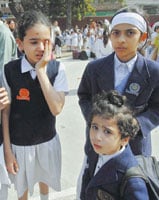 involvement of foreign hand in the incidents but no country has been directly
blamed. Pakistani officials in the past have been pointing the finger to
India and elements with the Afghan government for some of the terrorist
attacks. Caretaker interior minister, Lt Gen (Retd) Hamid Nawaz, known for
making statements and then denying or clarifying them, even went to the
extent of blaming the US, along with Indian and Afghan governments, for the
acts of terrorism in Pakistan. Though a number of government officials
privately suspect a US hand in some of the bombings, this was the first time
that a minister, that too a retired army general and confidant of President
General (Retd) Musharraf, made such a public accusation. Not unexpectedly,
the US government reacted immediately and rejected the allegation.
involvement of foreign hand in the incidents but no country has been directly
blamed. Pakistani officials in the past have been pointing the finger to
India and elements with the Afghan government for some of the terrorist
attacks. Caretaker interior minister, Lt Gen (Retd) Hamid Nawaz, known for
making statements and then denying or clarifying them, even went to the
extent of blaming the US, along with Indian and Afghan governments, for the
acts of terrorism in Pakistan. Though a number of government officials
privately suspect a US hand in some of the bombings, this was the first time
that a minister, that too a retired army general and confidant of President
General (Retd) Musharraf, made such a public accusation. Not unexpectedly,
the US government reacted immediately and rejected the allegation.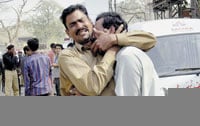 bombings but the attackers' ability to pinpoint a secret government
installation suggests that it could be behind it. If he meant the FIA
headquarters in Lahore, then he is giving the wrong argument because it won't
be at all difficult for any person to locate this building and even find out
what goes on inside its premises. It has been reported in the media that a
US-trained and equipped special investigation group was based in the third
floor of the FIA building and militants had become aware of its existence.
With regard to the second attack that targeted a residential bungalow in
Model Town, the media reported that the real target was a place used by
security agencies which couldn't be bombed.
bombings but the attackers' ability to pinpoint a secret government
installation suggests that it could be behind it. If he meant the FIA
headquarters in Lahore, then he is giving the wrong argument because it won't
be at all difficult for any person to locate this building and even find out
what goes on inside its premises. It has been reported in the media that a
US-trained and equipped special investigation group was based in the third
floor of the FIA building and militants had become aware of its existence.
With regard to the second attack that targeted a residential bungalow in
Model Town, the media reported that the real target was a place used by
security agencies which couldn't be bombed.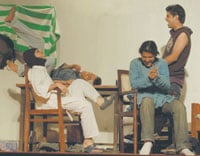 societies usually responsible for promoting extra curricular activities have
also been rechristened. The famous Government College Dramatic Club (GCDC),
now called by a new and unfamiliar name of GC University Dramatic Club staged
the Indo-Pak Inter College Drama Festival. Following up on the good
initiative taken last year this Second Pakistan India Inter Collegiate Drama
Festival was held last week at the Bokhari Auditorium in which theatre
societies of colleges/universities from India also took part.
societies usually responsible for promoting extra curricular activities have
also been rechristened. The famous Government College Dramatic Club (GCDC),
now called by a new and unfamiliar name of GC University Dramatic Club staged
the Indo-Pak Inter College Drama Festival. Following up on the good
initiative taken last year this Second Pakistan India Inter Collegiate Drama
Festival was held last week at the Bokhari Auditorium in which theatre
societies of colleges/universities from India also took part.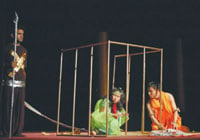 accosted by reporters, journalists and fans for interviews. As the woman
journalist interviewed him in his house, the actual life of the playwright
came to the fore. His wife was suspicious and was continuously badgering him
for his infidelity and threatening to walk out of his life. His mother who
did not get along with her daughter in law demanding that she be moved to a
new house. His poor scoundrel neighbour wanted to extort money from him for
he had once helped the playwright out of trouble. His maid, aspiring to
become a dancer paid scant attention to the house work she was supposed to do
and on top of it all the instant demand from a friend who wanted the famous
playwright to help him out of his writers' block by suggesting how the half
finished screenplay that he was writing should proceed.
accosted by reporters, journalists and fans for interviews. As the woman
journalist interviewed him in his house, the actual life of the playwright
came to the fore. His wife was suspicious and was continuously badgering him
for his infidelity and threatening to walk out of his life. His mother who
did not get along with her daughter in law demanding that she be moved to a
new house. His poor scoundrel neighbour wanted to extort money from him for
he had once helped the playwright out of trouble. His maid, aspiring to
become a dancer paid scant attention to the house work she was supposed to do
and on top of it all the instant demand from a friend who wanted the famous
playwright to help him out of his writers' block by suggesting how the half
finished screenplay that he was writing should proceed.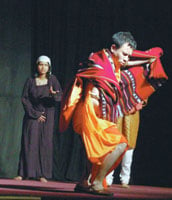 dealing with daily chores, touched on some of the basic issues confronting
the youth of today.
dealing with daily chores, touched on some of the basic issues confronting
the youth of today.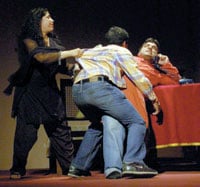 Doll's House', University of Engineering and Technology, Lahore with 'Suraj
Ki Talaash', Bahauddin Zakariya University, Multan with 'Chalo Chalo Global
Village Chalo', National College of Arts, Alif Adab and Nautankee with 'Three
Jones' and 'Mujhe Badshah Rehne Do', University of Peshawar with 'Meetha Zahr'
and Punjab University with 'Aik Election Sao Afsane'.
Doll's House', University of Engineering and Technology, Lahore with 'Suraj
Ki Talaash', Bahauddin Zakariya University, Multan with 'Chalo Chalo Global
Village Chalo', National College of Arts, Alif Adab and Nautankee with 'Three
Jones' and 'Mujhe Badshah Rehne Do', University of Peshawar with 'Meetha Zahr'
and Punjab University with 'Aik Election Sao Afsane'.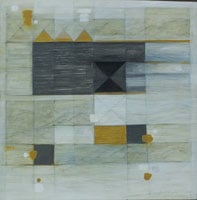 the overall condition of the family, the sentiments of the woman that morning
and the divinity that should be worshipped. It is a design meant to harmonise
the vast sky with her little corner of the earth. In other words, visually,
through a sign, things can, indeed, interconnect. Howsoever different they
may otherwise be, they can still hold together in a proper order and not sink
into chaos.
the overall condition of the family, the sentiments of the woman that morning
and the divinity that should be worshipped. It is a design meant to harmonise
the vast sky with her little corner of the earth. In other words, visually,
through a sign, things can, indeed, interconnect. Howsoever different they
may otherwise be, they can still hold together in a proper order and not sink
into chaos.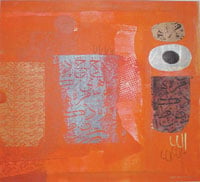 Faruki. In his solo exhibition (being held from March 10-17, 2008 at Nairang
Galleries) various paintings comprise pigeon as the central figure or the
main motif. Along with the bird, lines of Arabic text, forms of old
buildings, outlines of fruits and detail of plants are also visible in his
painterly -- almost abstract surfaces.
Faruki. In his solo exhibition (being held from March 10-17, 2008 at Nairang
Galleries) various paintings comprise pigeon as the central figure or the
main motif. Along with the bird, lines of Arabic text, forms of old
buildings, outlines of fruits and detail of plants are also visible in his
painterly -- almost abstract surfaces.