|
|
| |
 |
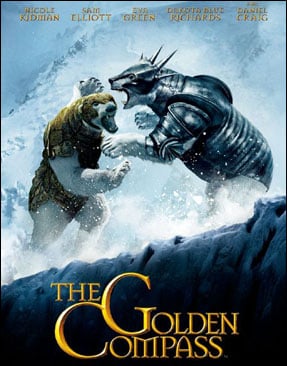
The
Golden Compass***
*ing: Daniel Craig, Nicole Kidman and Dakota Blue Richards
Directed
by Chris Weitz
|
| |
| Director
Chris Weitz's Golden Compass is quite similar in look, feel and storyline
to its more well known counterparts in the fantasy genre. Like the
Harry Potter series, the Chronicles of Narnia and the Lord of the
Rings trilogy, it features a chosen one's journey towards self discovery,
the lure of a promised land and an epic (read heavily animated) battle
between the forces of good and evil. |
| |
|
Adapted from the book Northern Lights by Phillip Pullman, the Golden
Compass takes the viewers to the world of Lyra Belacqua (Dakota Blue
Richards); a fantastical parallel universe which is ruled by a fanatical
cult called the Magisterium aiming to eliminate dissent and free thought.
A distinguishing feature of Lyra's world (and a tantalizing idea in
general) is the physical incarnation of the human soul in the form
of 'daemons'; animal accomplices that follow each person around. Boldly
defying the Magisterium with photographic proof of other worlds and
other existence is Lyra's uncle and guardian Lord Asriel (Daniel Craig).
The plucky, tale-telling, inquisitive, and strong-willed Lyra, turns
out to be the Magisterium's greatest threat because she is the child
destined to possess the last remaining Golden Compass, a truth-telling
device. Enter the femme fatale Mrs. Coulter (Nicole Kidman) the arch
nemesis of not just Lyra but all children who seem to be disappearing
without a trace. The ensuing adventures take Lyra over sky and ocean
to the north in the company of a diverse mix of characters from Nomadic
'Gyptians' to cowboy aeronauts and witches that fly the sky to armoured
ice bears that rule the north. |
 |
| |
Debutante
Dakota Blue Richards is charming and conveys her character's vulnerability,
stubbornness and inquisitiveness ably. Nicole Kidman as the evil Mrs.
Coulter effortlessly radiates both the icy beauty and hidden malice
her character possesses. Actors like Christopher Lee, Daniel Craig
and Eva Green are wasted in underdeveloped parts. An interesting idea
is the depiction of the character's secret thoughts and hidden desires
through their animal accomplices. Lord Asriel's demon is a tiger:
strong and powerful like him. Mrs Coulter has a monkey rapidly changing
from good to aggressive. Lyra's daemon keeps changing forms from cat
to bird to chipmunk suggesting she hasn't quite 'found herself'. The
enemy guards are all accompanied with either Doberman dogs or wolves.
This technique provides insight into the characters' mind that otherwise
needs to be expressed solely by the actor/actress.
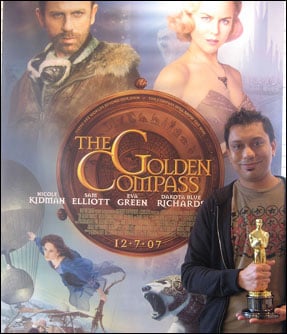
The film's real superiority lies in its realization of a bewildering,
exotic new universe through deft use of CGI. What makes The Golden
Compass a truly fun filled journey is the wondrous imagery and an
array of mysterious creatures digitally realized in astonishingly
rich detail. Or maybe the desi viewer's exhilaration borrows from
the fact that the brains behind the digital wizardry, the film's technical
director Mir Zafar Ali was born and raised in Pakistan and actually
won for the film its only Oscar in the category for best special effects.
What a truly well deserved honour! |
| |
| Conversely
the film's biggest flaw is confusion in identification of its target
audience. While the children whose adventures it chronicles are of
the pre-teen age group, the various allusions that are made to arcane
concepts like the dust, the Magesterium's attempts to rein in heretics
and various other themes are hardly geared towards young children.
Moreover the film's length (just under 2 hours) makes it impossible
to delve upon some integral sub-plots like the polar bear Iorek Byrnison,
attempts at rediscovering his lost armour. The action moves relentlessly
from scene to scene with very little scope for characterization. It
seems that the director has strung together the most powerful scenes
from the book with little exposition in between. As a result some
of the characters like Lord Asriel and Serafina Pekkala seem pretty
hollow and one dimensional. Then again it would be erroneous to expect
a film to capture the full scope and subtle nuances of a book which
is an entirely different medium of expression altogether. Maybe that
is how the film is intended to be viewed as a fantasy adventure for
the child in us all. |
 |
| |
And yet The Golden Compass is no tame fantasy adventure. The book
landed itself in trouble for its rejection of organized religion and
references towards abuse of power in the Catholic Church. And while
the film steers clear of the controversy by modeling the Magesterium
on any repressive regime, even avoiding the words God and religion
altogether, it actually ended up earning the ire of both religious
and secular groups. Die hard fans of Pullman's books have dismissed
the film for adulterating the spirit of the books, subtly hinting
at what the book fully explores. On the other hand church organizations
have called for a boycott of the film for bringing attention to the
much more 'deviant' text of the novels. The discerning viewer may
notice the religious outlook of the Magisterium through use of words
like 'oblation' and 'heresay' but since the film primarily appeals
to the sensibilities of a PG 13 audience, these references hardly
have a bearing upon the story. Or at least in the first installment
they don't.
Controversies aside fans of the fantasy genre wouldn't be too disappointed
in the Golden Compass' world of gadgetry, grandeur and intrigue. For
others watch it for the special effects. Recognition from the academy
may be the ultimate honour but love and respect of the people is surely
what nourishes an artist. Let's watch this for Mir Zafar Ali, the
Pakistani man who worked on the visual effects of the film and picked
up an Oscar for it!
– Mariam Khurram
*YUCK
**WHATEVER
***GOOD
****SUPER
*****AWESOME
|
| |
|


