|
|
| |
critique
A search for democracy… in all the
wrong places
Sabiha Sumar's 'subjective' Dinner with the President leaves
a bad taste in the mouth for an 'objective' journalist
By Huma Imtiaz
|
| |
Pakistan
is a fascinating country, its journey for democracy even more so.
Its politics are no less dramatic than a movie, with all the right
elements: the heroes, the villains, the wide range of emotions and
the unsuspecting victims: the nation. Looking for democracy in the
country can also be quite a journey. But after watching filmmaker
Sabiha Sumar's recent documentary Dinner with the President: A Nation's
Journey, one comes to the conclusion that not only was this dinner
undercooked, it lacked vital flavours. |
| |
| Recently
screened at The Basement in Karachi, Sabiha Sumar's Dinner with the
President is her personal search for democracy. Sabiha says she is
not a journalist; hence the film is subjective and at times biased.
Perhaps that too could be forgiven if the search for democracy had
not taken the audience to the oddest and rather absurd of places.
In a country that boasts many a political party from Communist parties
to socialist to Islamic, Sabiha has interviewed only three major political
figures - President Musharraf, Chaudhry Shujaat Hussain and Qazi Hussain
Ahmed. The rest of the political parties did not appear on Sabiha's
path as she searched through Pakistan for democracy. As flawed as
they may be, political parties like the PPP, PML-N, ANP and the JWP
are a force to be reckoned with, as the recent elections have proved
and cannot be ignored. Sabiha, in the Q and A session that followed
later said the parties and their feudal members did not want to speak
to her - but never in my brief experience as a journalist in this
country have I heard of anyone from the PPP or the PML-N refusing
an interview… rather they thrive on it. |
 |
| |
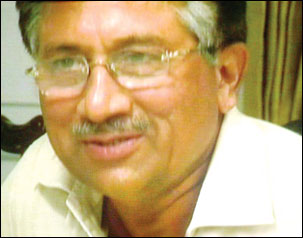
We
see a much different President in this movie, a stark contrast to
the person that we see today. Shown having dinner with his family,
he talks about the war on terror, and the history of the Afghan-Soviet
war. But it only saddens the audience, as they are reminded what their
president once was, and what a changed man he is today, in both his
words and his actions.
Sabiha's documentary is flawed in one too many ways. Not only is it
an incorrect reflection of the Pakistan we live in today, as the recent
elections, Benazir Bhutto's death and the increasing number of suicide
attacks have changed the political scenario, but it also reflects
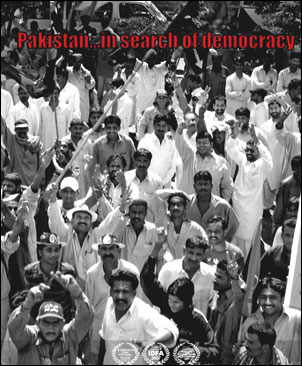
two extreme ends of society. We are shown interviews in the documentary
of people in NWFP, who are insistent they would vote for the MMA and
for Islamic law, and suddenly, we see people partying in Karachi.
Dancing on the beach, they merrily proclaim that Musharraf is a great
leader. We are taken to fashion designer Shaiyanne Malik's studio,
where models pout for the cameras, and Shaiyanne proclaims Musharraf
is good for the country.
We are taken to a village in interior Sindh, where a woman does not
know the President's name. |
| |
|
Labourers and truck drivers
in Karachi and Peshawar talk of not being able to make ends meet,
so why care for democracy when you don't have roti on your table?
But what Sabiha conveniently forgets to mention is the economic
and energy crises facing the country today were worsened by the
mismanagement of the economy and the country as a whole by the previous
regime, which is why the 'common man' does not give a hoot about
who the President is. If I, a citizen of this nation, don't have
access to basic amenities like electricity, gas and flour, why would
I care if the President remains in uniform or not? Nevertheless,
our nation did care enough to vote out the previous regime on February
18th, but that is an argument for another day.
|
 |
| |
|
One must commend Sabiha
though for travelling to the NWFP and meeting with members of tribal
jirgas and speaking to them about religion. But when men on the
streets are questioned who they would vote in again, despite a clampdown
on the entertainment industry, their reply that they would vote
for the MMA makes one realize that the film is painfully dated.
Granted, the documentary is not a current affairs program that is
up-to-date with recent political events, but the pro-MMA voters
that we see placed their thumb imprint on the lantern symbol of
the ANP last month!
Sabiha's search for democracy leads her to the National Assembly,
where we see PML-Q leader Chaudhry Shujaat Hussain voting in the
controversial presidential elections in October 2007. Political
parties including the PPP and the PML-N abstained from the vote,
and in fact members of the PPP were gathered outside the National
Assembly on the day of the presidential elections, including the
new hero of the nation, PPP leader Aitzaz Ahsan. But none of these
political parties or leaders figure in Sabiha's search for democracy.
Despite their flaws, many political leaders in Pakistan have made
sacrifices for the country and for the rule of law. Instead we are
treated to seeing Sabiha spend a day with Chaudhry Shujaat in her
search for democracy. One fails to understand why the PML-Q, popularly
referred to as the King's party that is a product of political hobnobbing
by intelligence agencies [confirmed last month by Major General
Ehtesham Zamir, the deputy head of the ISI in an interview to a
private news channel] is given so much importance and not the PPP,
the PML-Q or even the MQM!
The only mention of the PPP, Pakistan's largest and most popular
political party, that does come in is in the beginning, where she
briefly touches upon Benazir's death, and interviews from PPP supporters
on 18th October, the day of Benazir's return to Pakistan.
Sabiha says the political parties of Pakistan are flawed, are rampant
with the feudal culture, treats the nation as its subjects and President
Musharraf is a breath of fresh air. But never does she raise the
question as to why nothing was done post-1999 to eradicate the feudal
culture.
Post-screening, Sabiha fielded questions from a largely bewildered
audience, who raised questions mainly over the objectivity in the
movie, rather the lack of it. Sabiha then replied, and I still reel
in horror at the memory of it, that democracy is a culture that
may not work in Pakistan. What perhaps was the most unforgivable
part of the movie was when the audience sees Sabiha watching President
Musharraf's address to the nation on November 3, and she expresses
hope that the emergency will bring stability to the country. How
clamping down on the media and jailing thousands of people including
political workers, journalists and lawyers would bring stability
to the country is anyone's guess. In reality cultures need time
to develop. They need to be nourished, they need to go through failure
and success and experiment, and only then do they produce something
worthwhile - whether it is fashion, music, cinema or democracy.
In the 61 years of Pakistan's existence, there have been large periods
of military rule, and the Constitution has been mangled so many
times that even legal wizard Sharifuddin Peerzada must have lost
count of the innumerable amendments made to it.
Verdict: Watching the documentary was an hour well-wasted, instead
of well-spent. It reminded me how easy it was to look at the mushrooming
number of TV channels and fashion shows, and think that all is well,
and that President Musharraf's rule has been good for the country.
It is easy to fault our democratic parties, and the feudal mindset
embedded in the minds of many living in Pakistan's rural areas.
But until democracy is not allowed to breathe without the threat
of military coups breathing down its neck, it will never survive.
All searches for democracy, whether they are at the dinner table
with Musharraf, or at lunch with a jirga, will be futile.
Huma Imtiaz is a news reporter at GEO English
|
| |
|


