


|
|
|
|
|
 |
 |
   |
analysis Newswatch firstperson Dreaming
of a house terrorism A
distant dream Unhappy
highways corruption A real
nuisance By Arif Azad Climate change first rose to world's attention as a major public policy issue in 1988, when James Hensen, a NASA scientist, testified before the US Congress that he and other scientists had found that human beings were contributing to warming up the planet by burning fossil fuels. This finding sparked a flurry of initiatives by governments and the United Nations. Consequently the growing international concern led to the formation of Internal Panel on Climate Change (IPCC), which, in its 1995 report, endorses the finding of Hensen by asserting that the "balance of evidence" suggests that human activity is contributing to the process of global warming.
analysis The spillover effect The US recession has worldwide economic implications, including those for Pakistan
By Hussain H Zaidi By all accounts, the United States, the world's largest
economy and trading nation, is in a recession. Given the size of the
American economy and the international economic and commercial
integration, the recession has worldwide implications, including those for
Pakistan. Before we go to this, let us briefly analyse the phenomenon of
recession! Market economies are susceptible to periods of recession and high inflation. Recession is a downturn in economic activity, in which the actual gross domestic product (GDP) falls well below the potential GDP. Fall in GDP is accompanied by fall in corporate profits, real incomes and employment. Generally, the major cause of recession is the fall in consumer demand or spending. Since investment demand is derived from consumer demand, investment also falls. As investment demand falls, the demand for labour further falls, resulting in lay-offs. The fall in aggregate demand drives prices down. Since wages are sticky in downward direction, corporate profits fall -- leading to a fall in stock prices. The reduced demand for credit pushes down the market interest rate, leading to a fall in the value of the domestic currency. Recessions last a year or two after which the normal economic conditions are restored. However, they may also lead to depressions in which fall in output and employment is both protracted and severe. The US economy currently presents all these
characteristics of recession. In the last quarter of 2007
(October-December), it grew at only 0.6 per cent, compared with the
healthy rate of 4.9 per cent in the preceding quarter (July-September
2007). This reduced the total GDP growth in 2007 to 2.2 per cent, the
lowest rate since 2002. During the current year, the economy is predicted
to grow at well below one per cent. The slowdown in GDP is reflected by
fall in employment. In January 2008, about 22,000 jobs were lost, followed
by 63,000 in February -- the highest figure in the last five years. The major cause of the economic downturn is fall in consumer spending, precipitated mainly by two factors: rising oil prices and slump in the real estate sector. The fall in real estate prices has also created a credit crunch -- in a large number of cases, the value of mortgages has exceeded that of houses, making it a better option for the owners to abandon their property than to repay the loan. This has made banks wary of lending or they lend at very high rates, thus making access to credit difficult. To ease the situation, the Federal Reserves, the US central bank, has slashed interest rates six times between mid-September 2007 and mid-March 2008, from 5.25 per cent to 2.25 per cent. The US Congress has also passed a $ 152 billion package for tax rebate, in a bid to stimulate consumer spending and, thus, investment demand. One has to bear in mind that this is the presidential election year in the US and the economy is likely to bear more significantly than any other factor on the outcome of the race for the White House. In recession, domestic purchases fall and, thus, imports of both finished and intermediate goods come down. Since the US is the world's largest importer, fall in domestic demand in the country will reduce demand for global imports and, thus, exports. In this article, however, because of space constraints, we will be looking at the implications for Pakistan only. For Pakistan, the US is the largest export market, accounting for nearly a quarter of the country's total exports. Thus, fall in US imports is likely to significantly affect not only Pakistan's exports to the country but also its overall exports. The likely impact becomes clearer if we analyse Pakistan's export profile. More than 90 per cent of Pakistan's total exports to the US consist of textile and clothing products. The other major exports consist of articles of leather, medical and surgical instruments, sports goods, and furniture and auxiliary products. Within textile and clothing products, the major exports to the US are textile made-ups, articles of apparel, and carpets and other textile floor coverings. Importantly, not only do these products form a major portion of Pakistan's exports to the US, but also that the country is the world's major buyer for these products. Let us do an analysis of Pakistan's major products to the US in the following: Articles of apparel account for 40 per cent of Pakistan's total exports to the US. For these products, the US is the world's largest buyer, accounting for more than 27 per cent of their global imports. The US market accounts for 51 per cent of Pakistan's total exports of articles of apparel. Textile made-ups, such as bed sheets, account for 39 per cent of Pakistan's total exports to the US. For these products, the US is the world's largest buyer, accounting for more than 30 per cent of their global imports. The US market accounts for 52 per cent of Pakistan's total exports of textile made-ups. Carpets and other textile floor coverings account for three per cent of Pakistan's total exports to the US. For these products, the US is the world's largest buyer, accounting for more than 20 per cent of their global imports. The US market accounts for 42 per cent of Pakistan's total exports of carpets and other textile floor coverings. Articles of leather account for three per cent of Pakistan's total exports to the US. For these products, the US is the world's largest buyer, accounting for more than 24 per cent of their global imports. The US market accounts for 15 per cent of Pakistan's total exports of articles of leather. Medical and surgical instruments account for 1.11 per cent of Pakistan's total exports to the US. For these products, the US is the world's largest buyer, accounting for 14 per cent of their global imports. The US market accounts for 28 per cent of Pakistan's total exports of medical and surgical instruments. Sports goods account for 1.10 per cent of Pakistan's total exports to the US. For these products, the US is the world's largest buyer, accounting for 32 per cent of their global imports. The US market accounts for 12 per cent of Pakistan's total exports of sports goods. Furniture and auxiliary products account for 1.10 per cent of Pakistan's total exports to the US. For these products, the US is the world's largest buyer, accounting for 30 per cent of their global imports. The US market accounts for 59 per cent of Pakistan's total exports of furniture and auxiliary products. This makes it clear that not only is the US Pakistan's largest export market but also that for all its major exports to the US, the latter is the world's largest buyer; and accounts for a major portion of Pakistan's total exports of those products. Hence, the impact of a fall in US demand on Pakistan's export performance is going to be direct and significant. There, however, will also be an indirect effect. Pakistan's other major markets are countries of the European Union, notably the United Kingdom and Germany, and East Asia, notably Hong Kong and China. A considerable portion of Pakistan's exports to these countries consists of intermediate products, such as yarn and fabric. These products undergo value addition in these countries and are then exported to other markets, including the US. Hence, a fall in demand in the US will also affect Pakistan's exports of intermediate products to non-US countries. Since exports are an important instrument of job creation, fall in them will affect jobs and, thus, incomes and output. This impact should be studied in conjunction with other factors, such as inflation, energy crisis and increase in interest rates, which impact adversely on exports by raising the input costs. Fall in exports together with the increasing oil import bill will add to Pakistan's current account deficit. Not only is the US Pakistan's single largest export market, it is also the country's fourth largest source of imports. Already Pakistan's imports from the US are about $ 2 billion. A weak dollar will make American exports to Pakistan, which is already facing high inflation, cheaper and this may result in increased imports from the country. This will put further pressure on Pakistan's current account position. Another impact on Pakistan, as well as other developing countries, will be in respect of terms of trade -- the difference between export and import prices. Favourable terms of trade enable a country to buy a larger quantity of goods (imports) in exchange for a smaller quantity of exports. Given the size of the American market, the fall in US imports will depress their world prices and, thus, prices of Pakistan's exports. The result will be deterioration in Pakistan's terms of trade. A country's overall welfare is positively related with its favourable with terms of trade. A developing country like Pakistan needs to import machinery, equipment and raw materials to maintain its growth momentum. Deterioration in terms of trade will make it difficult for the country to buy the necessary industrial goods and this may slow down the momentum of economic growth. Unfavourable terms of trade will also compound the balance of payment and fiscal problems, as the country will be forced to borrow to bridge the trade gap. (Email: hussainhzaidi@yahoo.com) Newswatch Dalits in India lead a nightmarish existence
By Kaleem Omar Once known by the horrific name of 'untouchables', Dalits in India still lead a nightmarish existence and continue to be discriminated against throughout the country. The very word Dalit sums up their condition. Dalit means burst, split, scattered, dispersed, broken, destroyed, crushed, etc. It is a much more accurate description of their condition than the word Harijan, a term coined by Gandhi. The word Harijan is viewed by Dalits as condescending and having religious connotations. It also has a political connotation, which the Indian legal term 'scheduled caste' does not have. The widespread adaptation of the word Dalit symbolises the change in the ideology of the Dalit movement -- from passive acceptance of amelioration handed out by others to a struggle carried on from within for empowerment, by fighting for their rights and against injustice. Dalits are victims of one of the cruelest systems of exploitation ever devised. They are at the lowest rung in the caste hierarchy of the Hindu religion. They have been oppressed by the so-called 'higher' castes throughout India's recorded history, stripped of their dignity and denied basic human rights. Out of a total population of over 200 million Dalits in India, more than 60 per cent are landless. Over 40 million of them are bonded labourers. They are the worst victims of labour coercion. Over the centuries, the caste system in India has annihilated millions of Dalits. Since independence in 1947, about three million Dalit women have been raped and more than one million Dalits have been murdered. This is 25 times more than the number of Indian army soldiers killed during all the wars fought by India after independence. A survey carried out by the Indian government in the early 1990s stated that "on an average day, two Dalits are killed, three Dalit women are raped, two Dalit houses are burned and 50 Dalits are assaulted by people of a higher caste." In the decade since that survey was published, the condition of Dalits has not improved one jot, as the following headlines from just some Indian newspapers in the year 2000 alone show: "Harijan woman raped" (March 30, 2000); "Dalit woman gang-raped, paraded naked" (May 31, 2000); "Neighbour held for raping Dalit girls" (June 26, 2000); "Dalit girl gang-raped in Punjab" (August 31, 2000); "Dalit accused tortured to death by Indian police" (August 31, 2000); "Dalits showered with acid, two lose sight" (October 23, 2000); "15-year-old Dalit girl raped" (November 10, 2000); and "Dalit women tortured as witches" (November 11, 2000). The list goes on and on: "Outspoken Dalit widow murdered" (April 5, 2000); "4 Dalits shot in Tundla" (May 5, 2000); "In Rajasthan one Dalit woman is raped every 60 hours" (May 10, 2000); "Five Dalits tortured for two years" (July 9, 2000); "Bihar minister accused of torturing Dalit" (July 14, 2000); "Dalit widows branded witches, one dies after torture" (September 14, 2000); "4 Dalits burnt alive in Rajasthan" (September 26, 2000); and "Two blinded as upper caste men throw acid on 6 Dalits" (October 23, 2000). Eleven Dalits were massacred in Hasanpur on May 11, 2000. Thirty-four Dalits were massacred in Miapur on June 17, 2000. Five Dalits were hacked to death in Andhra on July 27, 2000. And, in a particularly horrific incident, a Dalit boy was killed for picking a rose on August 8, 2000. So even something as innocent as picking a rose can lead to death for Dalits. Hardly a week goes by in India without reports of some outrageous anti-Dalit act. To be a Dalit in India means living in sub-human conditions -- degraded, insecure, brutalised and afraid. Every hour, two Dalits are assaulted. Every day, three Dalit women are raped and two Dalits are killed. A report by the human rights group Amnesty International on the plight of Dalit women in rural India reveals a harrowing portrait of rape, abuse and sexual harassment. The report says it is virtually impossible for victims to even file a complaint at a police station, let alone obtain justice or any other form of redress. A few days ahead of then-US President Bill Clinton's visit to Agra in March 2000, a Dalit woman, 23-year-old Sukhviri Devi of the Nagla village in the Agra district, was stripped and beaten to death by two men in broad daylight, even as villagers stood by helplessly and watched the gory spectacle to its tragic end. What was her crime? She had made the mistake of crossing the path of two 'upper' caste Hindu brothers, Virendra Pal and Vijay Pal, while carrying an empty water pitcher. Among 'upper' caste Hindus it is considered inauspicious for a Dalit to cross someone's path with an empty pitcher. The price Sukhviri Devi paid for it was death. Getting down from their vehicle, the Pal brothers first tried to throttle the woman, and when she tried to scream for help, they repeatedly smashed her head on the ground, leaving her there to bleed to death. The Amnesty report quotes Bhanvari Devi, a Dalit from Rajasthan, as saying: "Dalit people have been repressed for years. Even when Dalit women are raped, nobody will say anything about it. If a Dalit is riding a bicycle or wearing shoes in front of an 'upper' caste person, then they are harassed by members of the 'upper' caste.' Bhanvari Devi said that when she drew water from the 'upper' caste well in her village, thugs beat her 11-year-old daughter unconscious. She went to the police station to complain, but was thrown out and called a "whore". She said that a gang of 'upper' caste locals then sexually assaulted her in her hut that night. Under India's abhorrent 'untouchability' caste system, Dalits are not permitted to move freely thorough the streets or enter the houses of other castes. They are forced to reside in separate settlements. This further reinforces the stigma of 'untouchability'. Dalits are not allowed to bathe in or fetch water from common water sources. They are not permitted to use benches to sit at village bus stops. They are forced to give way to other caste people on the roads. They are not even allowed to wear shoes in the streets of other-caste people. They must carry their shoes in their hands and walk barefoot. This is the hidden face of democracy in India.
firstperson A teacher with a difference When Bhutto established himself in power, he considered our demands and nationalised all private educational institutions
By Raza Khan Professor Zafar Ali Khan was born in Jallandhar, but after
the death of his father he was sent to Ferozepur to the house of his maternal
grandfather. The family migrated to Lahore in 1947 after the subcontinent's
partition. He was very much on his own after that -- he earned his living and
supported his education by doing different jobs. Professor Zafar did his master's in English Literature. His first job was at a private college in Sialkot and later he joined Islamia College, Railway Road, Lahore. He retired as principal of Hashmi Memorial College, Lahore, in 1978. He experienced the tyrannies of private colleges and organised the teachers to protect their rights. During Ziaul Haq's era, Professor Zafar was harassed and punished for his progressive views and for taking a fancy to trade unionism. He was transferred to remote and far flung areas in Punjab, but these coercive tactics could not deter him. Professor Zafar, an extremely self-evasive person, is not very fond of giving interviews and it took a lot of persuasion to make him agree to one. He is still active on people's rights front. He is also a regular contributor to the Tareekh magazine. The News on Sunday interviewed him recently. Excerpts follow:
The News on Sunday: Who were your favourite teachers during your student life? Zafar Ali Khan: Khwaja Ghulam Sadiq, a philosophy teacher with whom I later had a difference of opinion, and Professor Kamali. They were teachers who would inspire students with their knowledge and wisdom. TNS: How you became interested in teachers' politics? ZAK: My first job was at Jinnah Islamia College, Sialkot, which I joined as a lecturer in English in 1964. The principal of college was humiliated by the the Anjuman. As I could not take it, I mobilised and organised a protest against the Anjuman. Since the Anjumans, in particular the Anjuman-e-Islamia, were very oppressive and there was no job security, the teachers decided to unite and organise themselves. We forced the Anjuman to apologise and accept out demands. Meanwhile, I came to know that members of the Anjuman -- who belonged mostly to the business community -- had abused the principal, Professor Naeem, who was on the verge of retirement. This news spread like wildfire, but the staff was afraid of launching a protest movement. I inquired from senior staff members, but they evaded my question. So I went directly to the principal, who was like a fatherly figure. He said there was nothing to worry about, as this was a part of the job. TNS: What happened after Ziaul Haq came to power? ZAK: The teachers who were members of various associations were transferred by Ziaul Haq. I was myself transferred to a number of places in Punjab, including Sargodha, Sahiwal, Gujrat, Daultalla, Chakwal, Jhelum and Murree. TNS: What were the job conditions in private educational institutions at that time? ZAK: First of all, no appointment letter. I was entrusted with the job of teaching young people and I had credibility, so I did not like the idea and protested. I was told: 'You would not get three months salary and you would suffer.' I said: 'I choose to suffer.' Also, private educational institutions did not hire an English teacher for more than three years and terminated his or services after that. So, there was no job security and no service rules. In short, teachers were treated as personal servants. I came to know that my seniors Professor Zahoor Ahmad and Maulana Ilmuddin Salik have formed the College Teachers' Association to struggle for their rights, and I also joined them. Maulana Ilmuddin Salik became the first president of the College Teachers' Association and its office-bearers included F R Faizi, Munir Ahmed Khan and Professor Zahoor Ahmad. They would hold cultural events, but were still afraid of talking about the rights of teachers. Slowly and gradually, however, Sindh and Punjab got organised. In 1967 we visited Sindh, where a vast majority of the colleges were private. Meanwhile, Professor Amin Mughal had become general secretary of the College Teachers' Association, while I was made the publicity secretary. On coming to know about this, the Anjuman decided to terminate my services. The association decided to have a showdown on this issue. A memorandum was sent to the governor of Punjab. It was decided that board and university rules should be followed. The Anjuman reacted to this, because it enjoyed a big political and social clout. There was a long struggle and the Anjuman was forced for the first time to withdraw its demands. So, we won the first round from the Anjuman. We also got reinstated those teachers whose services had been terminated with mala fide intentions. There were some anomalies, but most of them were given alternate jobs. Many of them were accommodated in MAO College, while some were again given jobs in Islamia College, Railway Road. Those who opted not to rejoin, the Anjuman had to pay them their emolument. That was our first victory. TNS: What was role of teachers in the anti-Ayub movement? ZAK: In 1969 there was a big anti-Ayub movement, but college teachers were not directly involved in it. During agitation and disturbances, the government closed the educational institutions for a long period. The managements of private colleges in Sindh declared that they would not pay salaries to the teachers for the five months during which the institutions remained closed and they should get the same from the government. Hasnain Kazmi and Anita Ghulam Ali pleaded the case of the teachers. They resorted to agitation and hunger strike, processions were taken out, and protest meeting were held. They were supported by students and civil society at a large scale. In Punjab, salaries were not stopped but Gordon College's missionary administration, following in the footsteps of Sindh, called a meeting of teachers and declared that since the mission had no money, so it would not be able to pay the salary of five months to the teachers. Professors Khawaja Masud and Zaki Durrani were teachers' representatives. When they came to Lahore, we held an emergency meeting. A resolution was passed, stating that 'Education is not a commercial subject; it is a mission and a trust, and the teachers are members of that trust. So if the mission did not have the money, we would give a call to the parents of the students that they should give donations and we would open the college. We will take over the college and run its administration, because the mission could not do so.' The Anjuman-e-Islamia followed suit and held a big meeting at Habibia Hall, presided over by Mian Amiruddin and retired judges, and declared that it had no money so it would not be able to pay the salaries to the teachers. On this occasion, Professor Amin Mughal read out the resolution passed by the association. The staff and employees of all the educational institutions of the Anjuman rose in support of the resolution and the administration panicked, stating that it would do something to pay the salaries of the teachers. So the crisis was averted in Punjab, but the dispute in Sindh was not resolved. A delegation came from Sindh requesting for expressing solidarity with their demands, so we set up a hunger strike camp in their support. Professors Munir Ahmed Khan, Nasim Riaz Butt and Zahoor Ahmad took part in the hunger strike. Students and members of civil society also expressed their support for the teachers' cause. Then on March 25, 1969, the army took over power and imposed martial law. After the army took over, the hunger strike camp was abandoned. General (r) Nur Khan became the deputy martial law administrator and invited teachers' representatives for talks, though the fundamental rights were suspended at that time. TNS. Why were Professor Eric Cyprian and others thrown out of Islamia College, Lahore? ZAK. When General Sher Ali took charge of the affairs, his view was that power should remain with the army. As the result of the 1969 movement, martial law was imposed in the country. At that time, there were two major schools of thought -- one led by Maulana Bhashani, who was in the favour of a movement; and the other led by rightists who supported the martial law. A meeting was held at the residence of Chaudhry Muhammad Ali. Dr Syed Abdullah, Hakeem Qarshi, Maulana Maudoodi, Maulana Tufail and others got together, and analysed that the army take over was the result of agitation at urban centres. As college teachers also become restive, so something should be done to control them. Because Professors Khawaja Masud and Eric Cyprian were excellent teachers, they could not frame any charges against them. The Anjuman could not raise a finger against them because of their competence, so its leaders decided that religion should be used against the dissenting teachers. The Americans and the right-wing elements supporting them felt threatened that left-wing parties could take advantage of the situation, so they decided to persecute liberal teachers. The Jamaat-e-Islami started distributing pamphlets against them in mosques and accused them of blasphemy. For six months, the press carried out this propaganda. But trade unions, bar associations and even religious leaders, including Maulana Abul Khair Maudoodi, gave statements in the favour of college teachers. I remember that Ghulam Ahmed Parvaiz brought out a special number of his magazine in their support. On the other hand, the army used the Jamaat-e-Islami and the Anjuman mafia. A committee was constituted and accused the liberal teachers of blasphemy. As a result, many teachers were dismissed from Islamia College Civil Lines, Lahore. They had thought they would deal with the younger lot at Islamia College, Railway Road, later, but there was such a large-scale protest that they could not take any action against them. General (r) Nur Khan realised that there were some of the problems of teachers were genuine and his report on education suggested that the Anjuman should have a democratic body to run the colleges; there should be equal representation of teachers and the Anjuman in the management, while the principal should act as a secretary; and there should be by-laws and democratic structure to the run educational institutions. The Anjuman felt that this was interference in its domain. The representatives of the Anjuman relied on ex-bureaucrats, businessmen and retired judges, who would browbeat the teachers' representatives in meetings. On the other hand, the teachers' representatives were given the mandate to adopt a particular stance after a consultation process. TNS: What these teachers did after that? ZAK: Professors Manzoor Ahmed, Eric Cyprian, Amin Mughal, Zahoor Ahmad and Anwar Adeeb (not expelled) established Shah Hussain College. TNS: What was the role of the Anjuman in the 1970 elections? ZAK: In the 1970 elections, the Anjuman held a meeting of all teachers and stated that the Muslim League created Pakistan, so support should be extended to its candidates Abdul Khaliq and Mian Salli, the son of Mian Amiruddin. The Anjuman tried to use students to boost the election campaign of its candidates. But the people had a different mood this time; they supported the Pakistan People's Party (PPP) and it won the elections in West Pakistan. In order to take revenge of its defeat from us, the Anjuman stopped our salaries for three months. So we decided to approach the wining party and appraise it of the situation. A delegation of college teachers met with Zulifkar Ali Bhutto, but he did not offer much help initially. However, when Bhutto established himself in power, he considered our demands and nationalised all private educational institutions.
Dreaming of a house A roof collapse in Mardan, in which four children died, moved everyone in the area to tears
By Tahir Ali "I can't express my grief in words as it is too big a
tragedy," says Abdur Rashid, 36, "but this collapse would have been
more even devastating if a portion of the room under which other members of
the family were lying had also collapsed." Rashid heads the unfortunate
family living in Baghdada, Mardan, which lost four of its members in the fatal
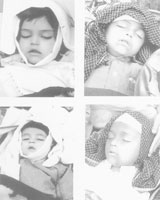
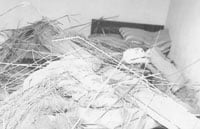
roof collapse on March 15. He is a labourer and lives from hand to mouth. Rashid was living with his family of 15 in a single room. "It is indeed hard to live like that," he says and adds with a touch of sarcasm, "but you have to get used to it." He recalls that he had sent three of his sons to a madrassa (seminary) a day earlier and thanks Allah that they were saved from the tragedy. As he utters these words, he looks towards the sky, sobs and then tears roll down his cheeks. "Abdur Rashid was sleeping with his wife, children, mother and brother in the room," says Mir Ghawas, president of the Awami National Party (ANP) Union Council Baghdada and an eyewitness to the tragedy. "It was a sudden and loud, an explosion-like, sound that awakened me. I was the first to reach the spot, and there was dust and darkness all around. We had to do the rescue work with hands and by the time we managed to clear the debris, Jabir (nine years), Anas (five years), Marhaba (three-and-a-half years) and Rabia (three months) had passed away," informs Ghawas, who is also the uncle of Abdur Rashid, adding that seven others were injured in the roof collapse. Members of the affected family and the people of the area say that they will never be able to forget this tragedy. "The sight of the lifting of four coffins at a time from a home, and that too of children and infants, moved everyone to tears," says Shamsus Zafar, a local teacher. The area forms part of the constituency from which the NWFP chief minister-designate, Amir Haider Khan Hoti, won the recent elections. Hoti personally came to offer his condolences at the tragic deaths and also assured that his government would provide all possible financial assistance to the affected family. Himayatullah Mayar, the district nazim of Mardan, tells The
News on Sunday that legally speaking, the provincial and federal governments
provide financial help for the casualties caused by a calamity under the
Natural Calamity Act and do not compensate accidental deaths like these.
"The chief executive of the province can announce financial help from his
or her own discretionary funds and that is why I have requested the chief
minister-designate to do the needful," he says. But Khwaja Muhammad Khan Hoti, who was elected as a member of the National Assembly from the area in the recent elections, has a different view: "We all know that provincial governments announce compensations for the victims of bomb blasts, which also are cases of accidental deaths," he opines and adds that he will do whatever he could if a case for financial assistance is sent to the federal government by the provincial government. Humayun Khilji and Muhammad Ilyas, the nazim and naib nazim of UC Baghdada, say that Rashid lives near the in-laws of NWFP Governor Owais Ghani and hope that he would provide financial assistance for the rehabilitation of the bereaved family. Ilyas informs that UC Baghdada had, through a unanimous resolution on the very day of the accident, requested all concerned authorities for financial assistance. As age, termites and rains make many old houses dangerous for living, while their in-mates being unable to repair or reconstruct them and the government displaying indifference to provide financial assistance to the low-income groups for the same, the poor will continue to be vulnerable to such tragedies in future too. The prices of land and the cost of construction have soured up to new heights, making it impossible for the poor to own their own houses. It is estimated that at least one-third of Pakistan's population lives below the poverty line. The poor are finding it hard to provide even two-time food to their families and they can only dream of owning a house. According to the 1998 Census, there was a backlog of 6.45 million housing units in the country and every year a further deficit of 150,000 units is added to it. There were 20 million housing units for a population seven times that size. Only one fifth of the present units were pucca and the rest were mud, shanty and semi-pucca dwellings. The average occupancy was close to four people per room and the average household size was 6.6 people. Considering Pakistan's high population growth rate, the latest figures may be even more startling. Countless housing societies have cropped up in the recent past in all parts of the country. Considering the real estate to be a lucrative business, many politicians, especially those of the Jamaat-e-Islami, have also entered it in the NWFP. But most of the housing societies, unfortunately, are only an instrument of exploiting the common people's need to somehow own a house. Article 38 (a) of the Constitution of the Islamic Republic of Pakistan says: "The state shall secure the well being of the people irrespective of sex, cast, creed and race by raising their standard of living." And the article 25 (1) of the Universal Declaration of Human Rights also stipulates that everyone has the right to a standard of living adequate for the health and well being of himself and his family, including housing. The National Housing Policy 2001 also urges the provision of housing units to the low-income groups, who form the bulk of Pakistan's population. There, however, is no urgency on the part of the government and, in fact, the opposite is being done. While the have-nots stand neglected, the affluent powerful class is bestowed with plots as gifts. The 'land parasites' are grabbing precious public lands throughout the country. When Chief Justice Iftikhar Muhammad Chaudhry took action against some of them, they turned against him. The land mafia, the CJP told a journalist, was yet another powerful segment of the society that found the superior judiciary blocking its way.
terrorism The real challenge All three members of the new coalition government accept that the US is a major player in Pakistani politics
By Aasim Sajjad Akhtar In recent days there has been a flurry of activity on
the 'war on terror' front. The Americans have very deliberately been
making their presence felt on Pakistan's political stage in a week when
the new prime minister took oath, as if to make clear that the fate of the
coalition government is inextricably tied with whether the latter will
play ball with the Bush administration. For their part, the coalition partners have had divergent responses. Nawaz Sharif, in keeping with his radical new self, has boasted that the Americans were squarely informed that Pakistan's parliament would take no dictation from any external power, and that Washington should get used to dealing with an accountable government rather than a military general who is answerable only to his coterie of corps commanders. The Pakistan People's Party's (PPP's) point of view has been more measured. It too has insisted that the parliament is sovereign and will be the ultimate authority on how to deal with the problem of 'terrorism', noting quietly that the new government's policy on the 'war on terror' is sure to be different from that of its predecessor. The Awami National Party (ANP), arguably the protagonist with the most to lose, has also made noises in the direction of change, albeit with considerably less bravado than the Pakistan Muslim League-Nawaz (PML-N). The bottom line is that all three members of the new coalition government accept that the United States is a major player in Pakistani politics, even if they are saying different things for public consumption. Nevertheless, the imperatives of an elected regime are such that it will be impossible for the unaccountable 'war on terror' policy adopted by the Musharraf junta to remain intact. Something will have to give, and all parties are now trying to work out their options. The US is of course doing its utmost to keep things as they are. In other words, the Americans want continued guarantees that their secret bases in Jacobabad and other locations on the Balochistan coast are safe, that their intelligence operatives continue to be allowed free access, and that they continue to be allowed to make incursions and attacks on 'enemy' targets within Pakistan. In short, the Americans want to continue making a mockery of the notion that Pakistan is a sovereign state. The niceties aside, the Americans do what they want in Pakistan, short of sending ground troops to occupy the country, and the Bush administration fully expects the new government to continue cooperating. The problem for the new government is that it too will earn the ire of the Pakistani people if it is seen to be Washington's lapdog, which remains Pervez Musharraf's claim to fame. But perhaps more urgently, the Musharraf regime's policies vis-a-vis the 'war on terror' have been a dismal failure. Pakistan is gripped by unprecedented levels of violence that are ostensibly a reaction to the bombing of areas on the Pak-Afghan border. An alarming number of young people are being lured towards millenarian groups that perpetrate violence almost indiscriminately. And on a separate front, Pakistan's indebtedness to the US and other external agencies is reaching extreme levels. What then are the options? At a very broad and general level, there have been calls made for dialogue to replace the policy of bombing entire villages into the stone ages. Some critics point out rightly that simply suggesting the need for dialogue oversimplifies a far from simple issue. In particular, many observers claim that the 'extremists' are not ready for dialogue and that it is naive to even consider the prospect. But these observers tend to forget the nature of the conflict that is currently taking place in the Pakhtun areas. In particular, they refuse to acknowledge that for every alleged 'extremist' that is targeted and killed in an American bombing raid, there are many more innocents who are also slain. In this way, the asymmetrical war ongoing in the northwest is scarcely different from that between the Israelis and the Palestinians or the Americans and the Iraqi resistance. Surely the people who consider themselves humanists will not argue that the Israeli and American atrocities in Palestine and Iraq, respectively, are condonable. Then why is the thoroughly discredited notion of 'surgical strikes' an acceptable option in this case? If and when it is finally acknowledged that American bombings simply exacerbate the problem, then dialogue becomes the next logical step. Or, to put it more succinctly, genuine attempts need to be made to co-opt potentially disaffected elements into an inclusive and responsive political process. As Benazir Bhutto implied before her death, this means a reform of the colonial system of administration that prevails in the tribal areas. This is not to suggest that the coercive power of the state cannot and should not be used against those who refuse to partake in peace efforts or that the state should not take a clear stand against renegades who wish to introduce obscurantism into Pakistani society. But the fact remains that it is the military establishment itself that has created the Frankenstein that is haunting us today. There is plenty of evidence to suggest that fragments of the state continue to be cultivating jihadis, regardless of what the official position of the military may be. It is important to remember that for all 60 years of Pakistan's existence as an independent state, the military establishment has tried to secure 'strategic depth' on its western frontier, and the primary pillar of this policy, at least since the late 1970s, has been the 'soldier of God'. The military wants to continue defining the ideological frontiers of the state and there is every indication that the policy of 'strategic depth' has not quite been abandoned yet. It is clear then that on the one hand the new coalition government will first and foremost have to resist American incursions; and, on the other, it will have to rollback the autonomous role of the intelligence agencies and the army, so as to be able to put a lid on 'extremist' violence. These are difficult if not virtually impossible tasks, especially given the existing situation. To a great extent, the new coalition has little choice but to try and push such an agenda. In many ways, it is very much a matter of political survival, especially for the ANP that is faced with the challenge of improving the situation in the NWFP or facing abject humiliation the next elections. Arguably the need for change is even more urgent; if things do not stabilise, the army and Uncle Sam could have an opportunity to extend the war in Afghanistan towards Pakistan. They have already brought civil war to our doorstep and now the people are hedging their bets on the new coalition to restore peace.
A distant dream The issue of Fata has today become so chronic that large-scale and multi-dimensional steps need to be taken to stem the rot
By Raza Khan In recent years there has been an extensive debate on reforms, peace, development and democracy in the tribal areas of Pakistan or, for that matter, the whole of Frontier, including the Federally Administered Tribal Areas (Fata) and the North West Frontier Province (NWFP). Whatever that has come to the fore, however, from the so-called 'experts' on the issue cannot be termed concrete. The fact that the situation in Fata and the NWFP has gone from bad to worse testifies to this fact. The issue of Fata -- which till a couple of years could
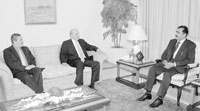
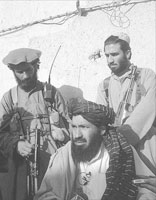
have been addressed through rational One of the key speakers, Brigadier (r) Mahmud Shah, who has served at senior positions in Fata, said the government had only itself to blame for having failed to reform this area for the last 60 years. Regarding recent efforts by the government to introduce reforms in Fata, he said: "In fact, the government has worked out a complete package of reforms -- structural, administrative, financial and judicial. The government started implementing these reforms in a camouflaged manner and the election of agency councillors was the first step in this regard. The groups with vested interests, however, torpedoed this effort and got the whole administration, including the governor, changed." Shah suggested that for development and peace in Fata, individual interest groups had to be thrown out. "As far as security is concerned, there should be no agreement with individuals but with tribes," he added. Ayaz Wazir, a former ambassador who belongs to Wana (the headquarters of South Waziristan Agency), argued that the maliks (chieftains) could be instrumental in bringing about peace in Fata, but this is an uphill task because of the killing of more than 200 pro-government maliks in North and South Waziristan agencies only. He maintained that the government's failure to provide security to the elders totally changed the traditional power balance in the tribal society. It may be mentioned here that a brother of Ayaz Wazir, who was the malik of his tribe, was killed by unknown assailants. Wazir viewed that it was not the tribal areas from where arms get supplied to the rest of the country; rather, it was the other way round. He also highlighted the need for effectively and positively engaging the potential of the tribal youth. His arguments carried weight as they came from a person who belongs to the area that is the main theatre of militancy. As far as the change in the traditional power balance in the tribal society is concerned, its main manifestation is the transfer of power to the clerics. They got hold of the power due to the use of the tribesmen and their strategically placed territory by the United States in its proxy war against the Soviet Union. It was the social innovation of establishing madrassas (seminaries) and making them powerhouses of the clerics that shifted the balance of power in their favour. Since the power was thrust upon the clerics and did not evolve as a functional social change, it did not entail appropriate checks and balances. The clerics since then have been wielding the power they got by chance, including the unnecessary use of weapons that has made peace in the region a distant dream. Colonel (r) Yahya Effendi, who is the great grandson of a former Afghan ruler and a writer, also stressed this shift of balance of power in the tribal society: "The problem in Fata is that the leadership here has shifted to mullahs and they are not ready to talk." There, however, was no detailed discussion on the social changes that the tribal structure and institutions have undergone over a period of time. In fact, this has been a common shortcoming of all deliberations on Fata and, therefore, is the major reason that the 'experts' have not come up with workable and practicable solutions to the problem. During the workshop, Dr Ijaz Khan, professor of International Relations at University of Peshawar, did not agree with the argument of other participants that outsiders have no right to talk about the issues of Fata and suggest reforms. He viewed that violence in Fata is a problem for the whole of Afghanistan and Pakistan; therefore, all the people are equally concerned about it. He especially mentioned that all Pakhtuns have high stakes in reforms in Fata. "With the passage of time, the maliks become representative of the state instead of the tribal society; therefore, they fail to solve problems of their people," Dr Khan maintained. He suggested that a high-powered task force should be formed with the NWFP governor as its head. "The body should include tribal elders, who should share power with the governor in running the affairs of the Frontier," Dr Khan said. Giving another suggestion, he said the political parties should be allowed to carry out their activities in Fata and the writ of the superior judiciary should also be extended to the tribal areas. "Political parties connect people and extremism can be countered only through the collective will of the people," he added. Colonel (r) Yaqub Mehsud, who belongs to South Waziristan Agency, said that most of the maliks of the Mehsud tribe were living outside the agency, so new maliks should take over. Professor Dr Sarfaraz Khan of the Area Study Centre, University of Peshawar, suggested that a joint Pak-Afghan security assistance force, to be supervised by the United Nations, should be formed for the region. "We need to situate the issue of Fata in the international context," he stressed. Dr Sarfaraz suggested that an economic reconstruction plan for Fata should be executed at the earliest. "The powers of the president regarding Fata should be given to the National Assembly or, more appropriately, to the Senate of Pakistan," he added. "The role of those mafias who are impeding implementation of reforms in Fata must be diminished and the Political Parties' Act should be extended to the tribal areas. Ironically war-mongers and anti-democratic forces are allowed to operate in Fata, while political parties are not," Dr Sarfaraz regretted. He viewed that the Local Government Act should also be extended to Fata and general amnesty should be offered to all militants provided they lay down arms. Ms Samina, lecturer of Philosophy at University of Peshawar, who hails from the Afridi tribe of Khyber Agency, unlike other participants who argued in favour of giving more powers to the jirga for the solution of Fata's problems, said that the institution of jirga could be easily manipulated through power and money. She deplored that women were not allowed to attend jirgas to plead their case and they had to be represented by a male relative.
(The writes is a journalist and a researcher. Email: razapkhan@yahoo.com)
Unhappy highways People may be connecting with someone in another country, but they are being alienated from the person living next door
By John Samuel Economic growth and technology, the two key drivers of
change, complement each other, as increased access to both is essential to
make life more comfortable. The paradox, however, is that both often tend
to increase the level of comfort and decrease the level of happiness.
While rapid economic growth can result in increased income, for instance,
it can also lead to 'abundance' -- a situation in which the quantity of
money undermines the quality of life. As long as the growth in gross domestic product (GDP) does not produce a corollary growth in gross domestic happiness (GDH), the purpose of economic growth, as well as that of use and misuse of technology, will continue to be questioned. Economic growth is not a bad thing in itself, but 'abundance' can create perpetual tensions between zest for freedom and entrenched fears within and without. Such tensions can wake up the demons within the self and the society, with people -- suffering from increasing insecurity, paranoia and violence -- not trusting each other anymore. Similarly, technology has both negative and positive sides. A tool's validity depends on who uses it and for what purpose? The tool itself may not be political -- but its use is always an exercise of power. Though technology has been the main protagonist in the drama of economic growth in the modern and post-modern times, it has failed to bring about any positive changes to the lives of a vast majority of human beings. In today's world, technology has acquired almost a 'God-like-power' to 'create', 'sustain' and 'destruct'; at the same time, it has become a means for the search of perfection, conquering stars and cloning life. In a metro-line in Tokyo, most of the young people are glued to their mobile phones -- playing games, browsing Internet, chatting with someone, etc -- and they hardly even notice the person sitting next to them. While people may be connecting with someone in another country, they are being increasingly alienated from the person living next door. The cyber world and social networking on the Internet create different sort of virtual and imagined communities, while undermining human beings. In counties like Japan, young people seem to be too busy to either fall or rise in love. Almost 30,000 Japanese commit suicide every year -- one of the highest rates in the world. An aggressive economic growth and an invading technology seem to have produced only more people using the Internet to find a 'mate' to do 'love-networking'. When even love, passion and feelings get automated and orderly with a sense of perfection, life becomes a burden -- where it stops to give excitement, people may search the same in death! It has become a case of an economic society superimposed on a very traditional socio-cultural society. People currently seem to be so preoccupied with their economic survival, as opposed to their emotional security, that it mostly results in social disintegration. Almost all young people seem to be looking for jobs, trying to prove that they would make hardworking and sincere professionals. As a result, no time is left for shaking hands, walking in parks or singing songs. When life becomes so automated and orderly, without any possibility of free-thinking, creativity takes a backseat and productivity a front seat. Livelihood takes precedence over living and living takes precedence over life. In short, while our work efficiency goes up, our life efficiency goes down. When human beings cease to be social and creative, and tend to be just productive workforce, preoccupied with survival of the self, the seeds of alienation bloom in to the cancer of social disintegration. One ceases to be a part of the community and becomes a loner in the midst of an anonymous crowd. This erosion of aesthetics from human relations and society tends to dehumanise the world. Increased economic growth can induce more demand in certain sectors, pushing up prices and, thus, the cost of living. The increased income of a small minority of the population also propels consumerism, with subsequent increase in the cost of living. For instance, in the rapidly growing economies of South East Asia, skyrocketing real estate prices smashed the housing dreams of a vast majority of the urban middle-class. This also reduced the real purchasing power of most population and increased the level of discontent among those people who did not get much out of the economic growth. Economic growth and technology may increase access to comforts, but they may also induce new individuation (transforming human beings from 'social animals' to 'economic animals'), social disintegration and paranoia ñ and, thus, lack of time for poetry, politics, companionship or community.
corruption Is anybody listening? The new government needs to put in place an effective prevention mechanism to counter this growing menace that is bringing a bad name to our country
By Dr Noman Ahmed On a single day, on the fourth of this month to be precise,
the Pakistani media reported four major cases of corruption: 1) The National
Accountability Bureau (NAB) filed a reference against a private firm in Lahore
for misappropriation of Rs 14.09 million. The victims of the scam included 32
medium-range investors; 2) The notorious Double Shah scam continues to be in
the headlines. In April and May, the government plans to disburse Rs 336
million and Rs 297 million among 2,105 and 4,138 victims, respectively; 3) The
Anti-Corruption Establishment (ACE) in Lahore rounded up 125 corrupt officials
in the last six months. Rs 44 million and 358 kanals of illegally occupied
land have been retrieved from them; and 4) The conservator of Lal Sohana
National Park was suspended for conniving to cause damage of Rs 500 million to
the forest. It will not be an exaggeration to say that if all the above-mentioned amounts are multiplied by 365, the net result will still be a miniscule of the actual loss incurred to Pakistan annually due to corruption. Non-reporting of corruption cases, widespread connivance, extremely sophisticated techniques of embezzlement and insufficient mechanisms to combat the menace of corruption are some of the major reasons for this. The new government, which is destined to face resource crunch as it takes over, can greatly expand the country's monetary and fiscal space by plugging the revenue losses incurred due to corruption. Pakistan is notorious for rampant corruption; the new government will have to struggle hard to dispel this impression. The Global Corruption Report 2004 includes a case study on political corruption in Pakistan, with a special focus on the late Benazir Bhutto and Asif Ali Zardari. The mysterious withdrawal of corruption cases against them and some others under the National Reconciliation Ordinance (NRO) raised many eyebrows. Adopting a positive approach, however, one can expect that the new government will learn from the past. It must make efforts to nip the evil of corruption in the bud. By taking certain basic steps, an effective prevention mechanism against corruption can be put in place. This will not only help prove the sincerity of purpose of the new government, but will also restore the confidence of the common people in democracy and democratic institutions. The first and the foremost issue is the restoration of the rule of law. The country is severely affected by the breakdown of governance over a period of time. The common people have to face unwarranted hurdles in seeking access to even the basic needs of life. According to a Transparency International study, published in 2004, the common people in Pakistan have to face bribery on the average scale of 95 per cent in the sectors of education, health care, power, land administration, taxation, police and judiciary. The impact of this state of affairs has been extremely dangerous. Many people now consider corruption as just another way of life. They believe that business cannot be done without acceding to the demands of corrupt government officials. Though it is painful to shed extra resources, the people do not pin any hope on the existing administrative system to grant any relief against the growing menace of corruption. The existing governmental procedures against corruption are perceived to be cumbersome, biased in favour of the powerful, politically motivated and partisan. Countless examples of selective application of legal and administrative provisions have further eroded the confidence of ordinary people in the judicial system, and it will be an uphill task to revive this confidence. Also, economic repercussions of corruption are tremendous ñ especially for the poor. The prices of essential kitchen items have increased exponentially in the recent past, mainly due to corrupt policies and practices of the previous regime. In particular, wheat / flour, rice, pulses, common vegetables, cooking oil and dairy products have experienced an unparalleled price hike in the recent past. This factor alone had a preponderating effect on the recently held elections, which the ruling party lost miserably. The controversial sale of 0.5 million tonnes of wheat and later floating of tenders for purchase of the same commodity testifies to at least the shortsightedness, if not corruption, of the decision-makers. Similarly, the cost of public works continues to rise without any accountability. The Karachi Northern Bypass Bridge collapsed within two weeks of its inauguration by the president in September 2007. The Makran Coastal Highway in Balochistan was damaged in the last monsoon after hardly a few months of its completion. Billions of rupees have been wasted because of these poorly managed projects, some of which definitely smack of corruption. In this scenario, genuine investors fail to muster the courage to set up any new enterprises and only the gambling spirit prevails, with stocks and real estate taking the lead. It is also important to note that, more often than not, corporate corruption also goes unpunished. A case in point is the profiteering scam of the oil marketing companies (OMCs), which have allegedly made billions in the recent years. No legal action could be taken against these OMCs, given their clout and connections. The end result was tarnishing of the national image. Therefore, it comes as no surprise that Pakistan currently is rated as the seventh most corrupt country in the world by Transparency International studies. The worst outcome of corruption is in the form of its social implications. In Pakistan, the people are being made to believe that they cannot get any reprieve from any of the state institutions. Their basic human needs are not being fulfilled, thanks to the faulty service delivery systems. This problem, however, is mainly because of corruption, and not shortage of resources as is mostly thought. Also, extremism is a by-product of corruption, which has induced poverty of opportunity and resources in the society. When people lose the faith in legitimate practices, they resort to violence. Needless to say, the loss of morals and value structures is perhaps the most dangerous outcomes of corruption. As the nation stands today at a crossroads, the agenda of combatting corruption cannot be followed with a magic wand -- it can only work if it is incentive driven. A beginning can be made by establishing the rule of law at the lowest level of governance. The rulers will also have to set an example themselves, by adopting a simple lifestyle for a change!
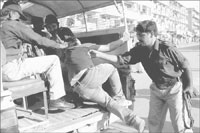
A real nuisance Almost 100 cases related to street crimes are reported everyday, though the actual number may be many times higher
By Sadia Nasir Instead of law-enforcement agencies, the offenders are
showing 'zero tolerance' in the streets of big cities, resulting in injuries
to or deaths of victims in case they offer any resistance. These criminals are
depriving public from their valuables like cash, mobile phones, cars,
jewellery, motorcycles and others things. Almost 100 cases related to such
crimes are reported everyday, and a much larger number of crimes remain
unreported due to the increasing uncertainty about police's ability to recover
their belongings. Almost all cities, whether big or small, are victims of street crimes. Even if take the reported cases in only the three big cities of Karachi, Lahore and Rawalpindi / Islamabad, what comes out strikingly is that the street crimes have increased at an alarming rate in the last couple of years. With the increased subscription of mobile phones, snatching them has become one of the most common and easiest street crimes. According to a report, more than 150,000 people lost their cell phones in Karachi alone in 2007, while only 59,744 complaints were registered by the police stations across the city. In a similar vein, the incidents of car snatching are increasing with each passing day. In the last five years, according to police sources, more than a dozen inter-provincial gangs of car snatchers have emerged on the scene and have been involved in various crimes in Karachi. Motorcyclists have remained the most targeted victims -- more than 35,000 motorcycles were snatched or stolen between January 2003 and November 2007, while only a handful of culprits were arrested. The law-enforcement agencies have not only failed to pout an end to these activities, but they have also been unable to stop the movement of stolen vehicles from one city to another. Similarly, the street crimes in Lahore went up by 25 per cent in 2007, as compared with the previous year. Almost 3,000 cases of street crimes were reported last year, and their number in only the first two month of this year was 339. In Rawalpindi too, the cases of street crimes increased in 2007, as compared with the previous year. Almost 1,000 cases of mobile-phone snatching, 58 of purse snatching and 38 of pick pocketing were reported last year, but hardly a single culprit has so far been arrested by the police. There has been a considerable decline in the registration of street crime cases, because of the police's inability to recover the stolen items. Hasan Haider, an employee of a multinational company, was deprived of his wrist watch, cash and mobile phone on the gun point in a posh area of Islamabad. No complaint, however, was filed by the victim because he did not trust the police. In another sad incident, a little girl was shot in Karachi for not giving the gold chain she was wearing around her neck to an armed dacoit. She might not have hesitated if an elder person was with her, as there is a growing perception among the public not to offer resistance to these criminals who would not hesitate to kill a human being for just a few thousand rupees. According to a report, in 2006-2007, the rate of organised crime decreased, while that of street crime increased. According to senior Punjab Police officers, the decrease in organised crime was due to the foreign help in crime-fighting techniques and equipment. Police claims indicate crackdown on 867 criminal gangs and recovery of Rs 1,362.43 million in 2007. A senior police, however, said on condition of anonymity that in 2006 the police registered cases following orders, but in 2007 it "reverted to its tradition of not registering cases to show a decreasing crime ratio." The rise in crimes in general is linked with the deteriorating socio-economic conditions, particularly rising poverty and unemployment among the educated youth. Easy access to illegal weapons has also helped the criminals. A recent report by a local non-governmental organisation (NGO) highlights that a growing number of street children, whose total population in the country is estimated to be more than 50,000, are also becoming increasingly involved in street crimes. These poor children usually end up joining criminal gangs involved in street crimes. There is also an absence of any serious effort on the government's part to check this practice. Another important cause of the increase in crimes is the police performance, which has not improved over a period of time; while, on the other hand, crimes have increased and have become a nuisance for the public. The main reason behind the police's inefficiency is that their personnel are not properly trained. Their duty hours are tough; and their salary, office and housing conditions, and fringe benefits are poor to say the least. Such poor living conditions lead them to take bribes, even from the criminals, for little 'favours'. The police force is also not generally respected by the masses or the government. There is also frequent interferences in the working of police by politicians, bureaucrats and other influential people. All these factors contribute to the poor performance of police in controlling crimes. There is a proposal to increase police force in the big cities, to control the increasing street crimes. However, a sizable number of men, weapons and vehicles have been allocated for VVIP duties, taking away a major chunk of available resources from the police force. Despite the fact that the allocation for the law-enforcing agencies has increased, this has not been reflected in their performance. It is high time that the government focuses on enhancing the quality of police force by laying emphasis on their proper training, availability of required equipment and improvement in their living standards, rather than inducting more personnel in the force. There is also a proposal to form community police to solve the local problems. This plan will enforce municipal laws and later it can enlist citizen's support in controlling crimes. Such a community police can be eventually given larger functions at the city or district level. Public involvement in security issues would not only assist police in combatting crimes, but would also take some pressure off the government. However, the introduction of such an initiative would require improvement of police image in the eyes of the masses.
The economics of climate change and Pakistan
By Arif Azad Climate change first rose to world's attention as a major
public policy issue in 1988, when James Hensen, a NASA scientist, testified
before the US Congress that he and other scientists had found that human
beings were contributing to warming up the planet by burning fossil fuels.
This finding sparked a flurry of initiatives by governments and the United
Nations. Consequently the growing international concern led to the formation
of Internal Panel on Climate Change (IPCC), which, in its 1995 report,
endorses the finding of Hensen by asserting that the "balance of
evidence" suggests that human activity is contributing to the process of
global warming. The report's findings, though measured and conservative in estimates, galvanised Europe and rest of the world into giving a united, coordinated and fitting response to the looming challenge. This heightened concern resulted in the Kyoto Protocol, which committed all world governments to reducing greens house emissions, responsible largely for global warming. The implementation of the Kyoto Protocol, however, was blocked by the refusal of the United States and some other governments to ratify it. Amid this foot-dragging over the Kyoto Protocol, the Stern Review on the Economics of Climate Change, commissioned by the British treasury, was unveiled in 2006. The Stern Review makes a convincing economic case for urgent action. It says that inaction could cost 5-20 percent of global gross domestic product (GDP). On the other hand, the cost of acting early could be as puny as one percent of global GDP. The report finds that the current level of greenhouse gases in the atmosphere stands at 430 parts per million (ppm) of carbon dioxide (CO2), compared with 280 ppm before the Industrial Revolution in 1832. These ever-increasing concentrations have already caused a temperature rise of half-a-degree centigrade. More ominously, the report calculates, if the current rate of emission continues, the concentration of greenhouse gases could touch 550 ppm by 2050. This concentration, almost double the pre-Industrial Revolution level, could cause an increase of two-centigrade in the earth's temperature. In the worst-case scenario, the earth's temperate could rise by as much as five-centigrade. This slight rise in global temperature can melt glaciers, causing changes in water availability and increasing sea level, which in some cases can lead to extreme weather conditions like floods and heat waves. In addition, warm temperature could cause crops yields to fall, leading to the collapse of agricultural and food security systems. The consequences of climate change are starker for the developing world, which is already resource-starved. As the climate change is global in its impact, Pakistan, like other developing countries, is vulnerable too. In our case, the areas of water, deforestation and renewable energy are of particular concern, though climate change is all encompassing in its impact. The Stern Review recommends, in particular, a strong and vigorous action against the increasing rate of deforestation in the world. In Pakistan, the problem of deforestation is more acute than other countries of the region, let alone the developed countries. According to Shaheen Rafi Khan, an expert on renewable energy sources working with the Sustainable Development Policy Institute (SDPI), Islamabad, only five per cent of Pakistan's land area is under forest cover. This compares poorly with the global average of 30 per cent and the Asian average of 18 per cent. In addition to an already sparse forestland, Pakistan's rate of forest depletion is also high, with almost 39,000 hectares of forest vanishing annually. This high rate of forest depletion, coupled with climatic changes, adds not only to gas emissions through burning of woods as fuels, but also removes natural deterrents against floods. According to the Stern Review, deforestation contributes 15-20 per cent of gas emissions. The consequences of forest depletion on the livelihood of barely surviving communities and their displacement are equally frightening phenomena. Pakistan's reserves of fossil fuels are fast depleting in the face of relentlessly increasing energy demands. The rate of electricity consumption is increasing annually at 10 per cent. At the moment Pakistan's fuel consumption needs are being met through dirty fossil fuels, like coal or petrol. In recent years, however, there has been a switch to natural gas, which is a relatively cleaner fossil fuel. Considering the limited availability of the existing fossil fuels, as well as the high demand for energy in the country, the challenge of switching over to clean and renewable sources of energy needs an urgent attention. The rise in global temperature, when translated into water scarcity in Pakistan, carries serious implications too. Over the years, the per capita availability of water has decreased to such an extent that in 2005 Pakistan became a net water-deficient country. With global warming, and lesser and degraded water availability, crop yields are bound to plummet and unsafe drinking water is set to increase the health care costs. Add to this scenario the decreasing investment in the sectors of water and sanitation, and the picture of an environmental apocalypse becomes quite real! Though Pakistan's share of global gas emissions is low in both absolute and per capita terms, the exponential increase in atmospheric emissions over the past few years is worrying. Moreover, Pakistan's vulnerability to high levels of global gas emissions, as well as increasing local temperature and rainfall variability, are going to have profound implications for livelihoods, crop patterns, and flood and disaster management systems. The Stern Review, besides getting the corporate sector involved in addressing the issue of climate change, urges the developed countries to share in the task by lending a helping hand to the developing countries. Besides offering market-oriented solutions to the problem of carbon trading between different countries, the Stern Review emphasises the importance of the developed countries living up to the promise of devoting 0.7 per cent of the GDP in aid by 2015. This timely released tranche of $ 150-200 billion of aid money would go a long way in mitigating the climate change-related extra costs that the developing countries are going to incur. This extra cost is estimated to be $ 80 billion annually. The battle of adapting to the climate change-related changes, therefore, can only be won with imaginative local policy initiatives, backed by proper global financial and technical support systems. As far as climate change is concerned, the local and the global are so indelibly fused that untangling them to the exclusion of each other would spell disaster for the world's environment. (The writer works with LEAD-Pakistan.)
|
|

 decision-making, policy adjustments and administrative measures -- has today
become so chronic that large-scale and multi-dimensional steps ought to be
undertaken to stem the rot. Considering the fluid situation in the Frontier
and its impact on the whole country in the shape of suicide attacks and
extremism, the stakeholders are still trying to find ways to address the
issue. A two-day workshop was recently organised at the Area Study Centre,
University of Peshawar, on the theme of The Role of Peace and Democracy in
Fata. The event brought together 'experts' on tribal areas, including some
high-profile personalities belonging to Fata. The importance of the occasion
was also noted due to the presence of a huge number of foreign diplomats
stationed in Islamabad and Peshawar.
decision-making, policy adjustments and administrative measures -- has today
become so chronic that large-scale and multi-dimensional steps ought to be
undertaken to stem the rot. Considering the fluid situation in the Frontier
and its impact on the whole country in the shape of suicide attacks and
extremism, the stakeholders are still trying to find ways to address the
issue. A two-day workshop was recently organised at the Area Study Centre,
University of Peshawar, on the theme of The Role of Peace and Democracy in
Fata. The event brought together 'experts' on tribal areas, including some
high-profile personalities belonging to Fata. The importance of the occasion
was also noted due to the presence of a huge number of foreign diplomats
stationed in Islamabad and Peshawar.