


|
|
|
|
|
 |
 |
   |
energy MOOD
STREET Town
Talk
The
state of property rights protection
RESPONSES TO LAST WEEK'S
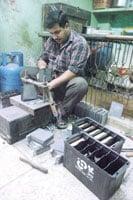
energy Lights may be out, but life must go on With hours of loadshedding increasing by the day, people are forced to buy expensive UPS units or generators to keep their businesses running
By Aoun Sahi With summer approaching, the power crisis in the
country seems to be getting worse. The period of loadshedding has been
increased. Presently, the cities are without electricity for four to six
hours whereas in suburbs and villages the period is twice the number of
hours it was previously. People are disturbed and do not know how they will be able to cope once it begins to get really hot. "I do not know how we'll manage in months like May, June and July with this much loadshedding which will also create problems of water in Lahore," says Malik Nadeem, 35, resident of Shah Alam market, Lahore. Nadeem, who owns a shop of show-pieces, laments the fact that power shortage has hit his business hard and the sales have decreased considerably over the last one month. "Consumers don't like to enter a shop when there is no electricity," he adds. Malik Nadeem is planning to install a generator in his shop and an Uninterrupted Power Supply (UPS) in his home to beat the heat in coming summer, but "water availability will still be an issue as it comes from municipality's tubewell and there is no provision of generator to run it." Nadeem also intends to construct a bigger water tank in his house before the summer sets in, which means coughing out an extra Rs 50,000 for running the generator and the UPS. All this, he believes, "will disturb my budget tremendously and I will have to cut down on some other essential items of daily use". He can't help the situation because he has no alternative. Nadeem is one of those many people who are now shifting
to alternate modes of electricity in order to beat the heat. Nasir Mahmood,
a resident of Cantonment Lahore tells TNS that he purchased a
30-horsepower Japanese generator for Rs 300,000 "because my family is
fed up of the unannounced loadshedding and we know in coming days the
problem will only increase". Shahid Ali who runs a private business in Model Town, Lahore, tells TNS that he has purchased three UPS units to keep his business going. "The units cost me Rs 50,000 but I have no other option," he says. According to Shahid, the instalments of these generators and UPS will not only affect the budget of the business community. "The burden will naturally be shifted to the consumers as prices increase," he adds. With the increase in demand of power in Pakistan and no concrete efforts from the government to increase power generation it is feared that an average day's shortfall might touch the 4,500 mega watt mark this year. The government has already made the ominous announcement that the country may have to face 'this situation' till at least 2010. What will happen after that, nobody knows, because building a dam, or coal or gas or nuclear power generation plant requires at least four to eight years and so far -- in Pakistan -- no big power project is underway. So, the people will have to prepare themselves to face the ever-increasing loadshedding hours. This 'preparation' may also mean shifting to expensive alternatives such as generators and UPS. According to Muhammad Ali, a dealer of generators at Brandreth Road, Lahore, March registered around 50 per cent increase in the sales of generators. "The demand for Chinese power generators, that are cheaper in prices, is increasing gradually. They have already grabbed more than 60 per cent of the market share," he adds. Muhammad Ali confirms that the price of generators has
also gone up -- "doubled," he says -- over the last one year.
"For instance, a small China-made generator -- used in houses and
shops -- would earlier cost around Rs 10,000, but today it is being sold
at around Rs 20,000. "The demand for heavy-duty generators, for purposes of running air conditioners and other high power-consuming items, has also increased. Consequently, the price of one generator now ranges between Rs 75,000 and Rs 100,000." Likewise for UPS. According to Muhammad Arif, a dealer at Hall Road, the sale of UPS batteries has increased tremendously and manufacturers have also doubled their production to meet the growing demand. "The prices of UPS have also increased lately, but even that has not affected the sales. We would generally be selling 50 batteries a month, but the figure doubled in March alone," he says. Now some power facts: A single UPS setup can run two tube lights and two ceiling fans for about six hours, since it has a battery capacity of 105 ampere per hour. The price for one such unit was around Rs 5,000 to Rs 7,500 till late last year, but today it is not available for less than Rs 8,500. "People prefer locally-made UPS to Chinese-made generators, which come with no warranty," adds Muhammad Arif. "The other reason why customers prefer local UPS is that they can be fixed easily and the battery needs change of water every two to three months, which is not very expensive. "Generators make big noise and also consume expensive fuel like petrol or diesel. That is why people living in small houses prefer UPS. A powerful UPS can easily operate computers together with fans and lights for hours." While these generators and UPS are affecting the budget of the people, they are also solving power problems -- at least in cities -- but they cannot help agriculture in villages. "Loadshedding is nothing less than a curse for us," says Amjad Hussain, a farmer who lives in Mandranwala village in Sialkot district. "For the last about a month, the farmers have not been able to irrigate even one acre of wheat fields during daytime with tubewells, the only source of irrigation in the fields, because of the massive loadshedding." Many of these farmers are now considering installing diesel engines to run tubewells. This option will increase the input cost of one acre for one crop from Rs 2,000 to Rs 2,500 in the form of the irrigation cost. Installation of a diesel engine costs something close to Rs 40,000.
MOOD STREET Confessions of a shopaholic
By Amara Javed I usually detest 'chick lit'; you know, those light-hearted, feel-good books with no point other than focusing primarily on things as chicks worship (fashion and love). I try to indulge myself in more meaningful literature: wordy, brooding, didactic, that's more my thing. That was until I came upon the extremely enjoyable, and surprisingly moralistic, 'Confessions of a Shopaholic' by Sophie Kinsella. The novel is about the charmingly fickle Rebecca Bloomwood and her trials and tribulations; most of which have to do with shopping, over-doing it, and then relenting in her guilt. Reading through this novel I came to the earth-shattering realisation that this novel was about me! Gasp! A novel about me. So, I shed the pretentious notion that I am some kind of bespectacled member of the intelligentsia. No, no; I, my friends, am a shameless member of the lovably materialistic shopaholics anonymous. Like the protagonist of this great novel, I too have a problem. I like to shop, I like collecting new stuff, I like letting myself fall prey to merciless advertisements (those hounds!). But it's fun. Make no mistake, I'm not snooty or superficial, I'm just someone who sees nothing wrong with a little (correction: a lot) of retail therapy. Nothing gives me that euphoric feeling as being surrounded by shiny, new things. There's just something so great about buying something you know hasn't been touched by anyone else. And it's clean and sparkly. Untainted. Embodying a new level of purity. Do you see how shopping becomes a sort of religious experience? Whenever I walk into a store-doesn't matter what type of store -- I feel like an addict getting a much anticipated high. Just last week I was walking through the crockery section of a departmental store and I couldn't contain my excitement as I skimmed through aisles and aisles of tea sets and dessert dishes. I don't even need tea sets or dessert dishes. Nonetheless, my excitement level was through the roof; the thrill connected with the thought of a potential purchase is unmatched for me. So, just for the heck of it, I ended up spending a four-digit amount on candles and lavender potpourri (which are now collecting dust in my store room) and thinking, "Did I really need that?" And I swear, people are picking up on this. Pakistani retailers are getting a lot more business savvy. They've really learned how to lure us poor, would-be consumers into their dark world. Shops are becoming trendier and chic, a far cry from Ichhra and Anarkali. Just walking around the new complexes like Xinhua Mall and Siddiq Trade Centre makes me want to spend outrageous amounts of money. It's a proven fact that the international feel of the new 'malls' with their impeccably clean floors are fool-proof tactics to up your profits. Haggling sidewalk peddlers never tempt me to empty my wallet, big shiny stores do. And then there's this recent trend of having 'sales'. I don't remember this being a Pakistani tradition. But I'm glad we've picked it up. This year I noticed it more than ever, everyone was having sales. Imagine my joy when I walked into a store and found pants for half their original price. Who doesn't want something for half-price? I know I do. Even if I don't really need it, if it's on sale I'm saving money anyway. Then there are the advertisers, they are the most ruthless. Advertisements create a need in their consumers. Simply put, they make us yearn for things we don't really need. Do we really believe that using a certain brand of toothpaste will get us the love of our life or that a certain car will suddenly make us cool? I think not. But flashy adverts full of gorgeous people can be lethally persuasive. I've also developed the hopeless habit of going online and clicking away at the speed of light. Especially when I read giant red signs saying 'discount!' or 'online offer only!'. I swear they're taunting me. I've bought two digital cameras in the duration of six months because that little patronising sign at the top of my Yahoo page made me feel like an incompetent fool for having a Sony when I should, obviously, have a Nikon. I even order books online because I get a 10% discount. What good is a 10% discount? Especially when I know that about three times more than that amount is cut in shipping costs. For a while I was convinced that the devil invented online shopping. That was until I discovered a greater evil: the credit card. I used to think that cash was 'it'; but holding a credit card makes me feel like the most powerful person in the realm of retail. I worship the genius who invented this little plastic miracle. Now, I can buy what I want even if I don't have the money and can't actually afford it. I never ever feel in want of anything, there's no annoying yearning for things. I am eternally satisfied. I can buy anything! Anything! Then I get the bill. And I am reminded why I refer to credit cards as the great evil. The eternal satisfaction turns out to be momentary. And panic takes control. Panic because I've probably overstepped my limits and might have to deprive myself of basic necessities for the next few months in order to pay it all off. So why has shopping 'too much' become such a prominent contemporary issue? Simple, it leads to two very problematic situations. First, a horrid mismanagement of funds and second, a gargantuan (and unintentional) collection of things you don't really need. I've been working and earning for some time now and I have about Rs 350 in my bank account; I am just physically unable to keep my finances in check. If there is some cash in my purse, kiss it goodbye; chances are I'll find something to spend it on faster than you can blink. But it goes a little deeper than just hoarding 'stuff'. When there is nothing to do and frustration is threatening to explode, one must find solace in something. I find that solace in shopping. And in our country and society, this is the mindset of the majority of most women. The majority of women are not tough executives with high profile careers, nor do they lead exciting jet-setting lives. Most are just normal, domesticated people. And if going out and buying things is an outlet for women to find happiness then why not? If possessions, and attainment of more possessions, are bringing some sort of purpose in an otherwise uneventful life, then who are we to judge? In the end I always come to the conclusion that this behaviour is entirely acceptable. All sense of logic vanishes into thin air in that moment of purchase. At that moment, all that matters is the joy of acquisition. And, what a joy it is, what a joy.
Town Talk • Exhibition titled 'Visual Arts' by artists from Colombo at Ejaz Art Gallery till Thursday, 03 April.
• Exhibition of Ayaz Jokhio & Bani Abidi's works at Zahoor-ul-Ikhlaq Gallery till friday, April 4. The gallery remains from 9am to 6pm daily.
• Exhibition of Moeen Faruqi's works -- 15 paintings and 5 sculptures are on display at Rohtas Gallery till Saturday, April 5.
• 5th Workshop of the EU Fashion Cycle -- Supply Chain Management for the Garment Industry from Sat, April 5 to Mon, April 7 from 8:30am to 5:30pm at Pearl Continental Hotel.
• 1st National Canoe Marathon: The Canoe Association of Punjab is holding the 1st National Canoe Marathon 2008 at the water lake of Minar-e-Pakistan. Today is the last day.
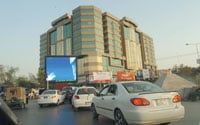
• Mela Chiraghan: Urs Madhu Lal Hussain. Today is the last day. risk Deadly traps Commercials running on TV screens placed outdoors are a constant hazard for 'distracted' drivers
By Shahzada Irfan Ahmed Huge Liquid Crystal Display (LCD) screens at busy
intersections, traffic signals and along fast-moving and crowded traffic
lanes are the latest addition to the cityscape. These screens are in
addition to the hundreds of billboards, hoardings, banners and posters
approved by the Parks and Horticulture Authority (PHA) in Lahore. In the past a few huge billboards were placed at busy places without even taking precautionary measures. Some of these billboards could not brave the heavy rains and storms and collapsed causing several deaths. This led to great uproar and formation of a six-member committee without whose approval a billboard could not be placed in Lahore. It was made imperative for the owner of the site to take special measures to ensure that the billboard supposed to be placed there is affixed properly and firmly. However, the same committee is being criticised at the moment for approving placement of LCD screens on city roads and turning them into death traps. Obviously, the purpose of placing these screens is to earn easy advertising revenue which in itself is not a bad motive. But the way this revenue is targeted has been disapproved by citizen groups, environmentalists, conservationists, media personnel and others. The biggest objection is that the LCD screens that will exclusively display commercials are bound to distract drivers and cause traffic accidents. Prof Dr Aijaz Anwar, a painter and conservationist, tells TNS that the LCD screens placed on roads are a great traffic hazard. He rejects the assertion made by some people that traffic signals are a safe point to place these screens as vehicles come to halt there. "I would say the traffic signals, crossroads and intersections are the places where the drivers need to concentrate the most. Here you have to care about the vehicles coming from the other side, those turning to left or right or taking U-turn," he adds. Aijaz says the committees formed to oversee such matters are most of the times themselves interested in earning revenues, both for the organisations they are representing as well as themselves. He says multinationals and the corporate sector on the whole have both money and influence with the help of which they can win approval of anyone. Aijaz calls for immediate removal of LCD screens that according to him may give wrong signals to the drivers of approaching vehicles. Sometimes the lights would blink and on other occasions change colours from red to green to yellow or vice versa giving the drivers a wrong signal, he adds. Zahid Chaudhry, a medical representative says it's strange why every road, street, tree, building or vehicle is being used by the advertisers to send their message across to their prospective buyers. He says the citizens are fed up with this onslaught and want a break. Zahid says even a child knows how dangerous these screens are but unfortunately our policymakers don't. A traffic official tells TNS on condition of not being named that that many a time traffic is jammed as drivers are not willing to move away from a TV screen. This, he says, happens the most at Liberty Market where cricket matches are regularly shown on huge screens. Secondly, the moving news tickers at certain traffic signals are also a big distraction for drivers. "These tickers move slowly, making the drivers wait there till they read all the breaking news." The official says he cannot say anything on record as the traffic department and Traffic Engineering and Planning Authority (TEPA) also have a representative in the six-member committee that gives approval. About the number of accident caused by such distractions he says though there is no supporting data it's a fact that many accident are caused due to eating and use of mobile phones during driving and looking at LCDs fixed on dashboards of cars. "If the LCDs placed in cars can lead to accidents why not the larger ones on roads." The official fears the situation will become even worse due to launch of mobile TV by cellular companies. The latest news is that the PHA has agreed to review the decision to place these huge screens in the city, a step criticised by people belonging to different cross-sections of society. TNS contacted PHA officials to know why the decision was taken in the first place without inviting a debate on it. Speaking on behalf of the authority, Javed Shaida tells TNS that it's a misconception that PHA single-handedly takes such decisions. "Now a six-member committee comprising a member each from PHA, TEPA, Traffic and Environment departments, renowned architect Nayyar Ali Dada and a representative of the advertisers reviews and approves all such proposals," he adds. Javed says in all probability the committee would have viewed all pros and cons before taking the decision to place ads. The same committee has the power to review its earlier decision if it thinks it's necessary to ensure people's safety. The state of property rights protection There is great risk in lending one's property when the owner is physically away from the town. Here is a case in point
By Dr Khalil Ahmad It was in January 2007 that a letter appeared in some
newspapers. Its writer was a former cricketer. He was part of the national
cricket team which toured India in 1952-1953. He also received an award
from the president for his services to the game of cricket. He had a
heart-rending story to relate: An engineer by profession, he spent a good
part of his life in Middle East. On coming back to Pakistan, besides his
family dwelling, he built a house in DHA, Lahore, with the intention to
give it on rent to meet their daily living expenses out of the rental
income. But the tenant did not pay the rent for many years and he had to knock at the doors of the courts to seek justice. After five years' tiring litigation, the court gave a verdict in his favour and appointed a bailiff to get the house vacated with the support of the local police. When they reached the house, the tenant's brother used abusive language and threatened to shoot them. The police party mysteriously escaped from the scene. The bailiff was also forced to run away by the tenant's armed companions. Later it came out that one call from a senior police officer, who happened to be the relative of the tenant, to the concerned SHO was the actual cause of the police's whisking away. After detailing his ordeal, the former cricketer wrote thus: "The bailiff has already given the factual report of the above happening. Will the court take strong action to get their orders implemented? And will some senior police officer take time to find out why their department failed to get the law implemented. If not, then where should we go to plead our case? Can someone guide us how we should get justice?" We do not know whether this particular case came to a conclusion or not. But we do know that such stories are not uncommon in Pakistan. What distinguishes this case from the other so many cases is the status of the person who has connections, and if he is unable to win police to his side to implement the court orders, imagine the plight of millions of ordinary sufferers. Every neighborhood in Pakistan is familiar with such illegal possessions and the injustice meted out to the legal owners of land plots, houses, shops and buildings, and the hanky-panky going on in the offices that deal with legal titling. And we do know how legal owners and renters of various properties waste their time and money in the corridors of courts to seek justice. If they are fortunate enough to have the court orders in their favour, they find themselves thrown out of the frying pan into the fire. Now they are at the mercy of the police, the brutal force that is notorious to usurp their right to dignity, and thus how could one expect implementation of court's orders? We do know how a good many number of people who go abroad leave their properties un-rented because they fear dispossession by the prospective tenants, thus save themselves from the courts and police ordeal. They are well aware that they will incur multiple losses such as depreciation of their property, forego rent money they could earn, pay property tax and utility bills they have to pay in any case, pay for maintenance and guarding expenses their property needs; but they lose all this only for one gain: That their property remains in their legal as well as physical possession.
QUESTION TOP 10 Food in walled city 1. Das Kulcha 2. Khatai at Koocha Mufti Baqar 3. Baba Qulfi Walay, Shahalmi 4. Kachori Haveli Mian Khan 5. Pathooray Chowk Kotwali opposite Masjid Wazir Khan 6. Barfi Lal Khooh, inside Mochi Gate 7. Haji Nihari inside Lohari 8. Baigan Pakoray inside Mochi Gate 9. Bhallay Pakorian Kucha Qazi Khana 10. Beef Kabab Landa Bazaar To enlist by popular vote for next week, send in your emails on top ten 'top ten flowers to plant'
Please email at shehrtns@gmail.com
|
|