



|
|
|
|
 |
 |
   |
Editorial reform
agenda Tns
agenda people's
agenda
Never before have such challenging times held so much promise. Never before has the politics of this country been redeemed the way it's now. For once the parliamentarians stand tall in people's eyes, even before they have done or achieved anything. All hopes are pinned on that august house which is treading the democratic path carefully but with a sense of conviction. It is being helped by the near-consensus among the people that this indeed is an august house. But it was not easy to get to this point. The struggle and sacrifices of the political parties, the lawyers' movement relentlessly waged for the rule of law and constitutionalism, the wave of terrorist attacks, the blood of innocent civilians, and finally the brutal assassination of Benazir Bhutto provided the backdrop to this moment of optimism. Things could only go right or wrong after all that. The way the political forces have joined hands is heartening. Though, as said earlier, the challenges are too many. While we have all the faith in the people's representatives to chart the right course for this country, we too decide to help the new parliament in setting an agenda. There are, of course, the long term objectives in key areas -- strengthening of institutions, economy, foreign policy, managing the federation as well as the coalition, accountability, and media -- before this parliament. This we call as its reform agenda. Then there are issues which are the immediate concerns of the people -- price-hike, load-shedding etc. -- and need to be tackled on a short term basis. This we call as the people's agenda. And finally we present before the parliament a TNS agenda. We believe these are as important as the other two but fear they might be lost under the weight of the more visible and pressing concerns. There is another agenda -- the missed one -- that we did not discuss, not because we did not want to or deemed it less important. So here it is. We would like this parliament to put in place an accountability mechanism as an institution. We want greater public spending on education, health and housing. And we want this parliament to do away with the university degree requirement for those aspiring to come into the parliament. We have tried to take agenda-setting away from the domain of the media into the domain of the people. It is up to the parliament now to pick and choose and prioritise. Strengthen [and thereby weaken certain] institutions as envisaged in the 1973 constitution This parliament comes after one that completed its five year tenure and yet remained the most toothless assembly seen by this country. That in itself is a sufficient explanation of the institutional imbalance that has been selectively brought into the constitutional scheme. Thus both the crucial decisions -- to let the parliament complete its tenure and prevent it from making laws -- were taken elsewhere. In the current scheme, many of the actors from the powers-that-be may remain outside the constitution but are immensely helped in their manipulative and destructive agenda by these distortions and anomalies in the constitution. Mercifully, to the
consensus document called 1973 constitution (in whatever shape it The constitution with all these distortions has always maintained the articles that guaranteed its own protection. No adventurer has dared to meddle with Article 6, that envisages high treason for subverting the constitution, and yet the adventurism did not stop. This brings into the discussion two more institutions -- the military and the judiciary -- who have often joined hands to the detriment of democratic institutions. Judiciary, after the last coup, has redeemed its image. The parliament must now ensure its independence for the survival of all else. The military has lost face like never before and needs some introspection to regain it. As other institutions gain strength, it will weaken automatically. Charter of Democracy seems like a good place to start with. Economic turnaround, a real one please There are no two
opinions about the fact that the economic challenges facing the Unfortunately for the next government there are certain discouraging factors, beyond its control, that are going to make the recovery process even more difficult. These are: increasing prices of oil, commodities and foodstuffs such as wheat, yawning difference between the demand and supply of energy and so on. The representatives of the coalition parties have confirmed that the economic recovery is Gillani government's foremost priority. A practical manifestation, according to certain quarters, of this fact is PPP's rapprochement with MQM without whose help the government cannot have control over Karachi -- the business hub of the country. It is suggested that the
government that would comprise leading industrialists, It would be a better option to concentrate energies on increasing agricultural productivity which is abysmal at the moment. This would help Pakistan earn foreign exchange as well as secure strategic stocks for local consumption. The previous government was more interested in showing inflated figures to the world on paper. The economic growth rate that was one of the highest in the world was based on growth of selected sectors like real estate, stock market, telecommunication and so on. Little importance was given to the manufacturing industry and infrastructural growth like the increasing power generation capacity of the country. Therefore, the sitting
government must focus on all major industrial sectors that are Increasing the tax net by trapping the non-salaried class and documenting corruption can fill the exchequer to the brim. So far only the salaried class pays income tax. Imposing tax on corruption may seem ridiculous but keeping in view that plea bargain is a legal option in this country this option seems workable. Last but not the least, a major cut in defence expenditure will give the government some fiscal space to spend on development sector. Cutting civilian expenditure under austerity drive will be of no use as it's only a fraction of the country's defence budget. Foreign policy through the parliament After 9/11 Pakistan's foreign policy has revolved around the war on terror. Its relations with the outside world are still based on this war. The familiar yardsticks like Islamic world, neighbourhood and Kashmir issue have receded in the background in terms of foreign policy. For the next parliament or government -- a coalition of PPP, PML-N, ANP, MMA and MQM -- reshaping foreign policy will be a huge challenge, especially with Musharraf sitting in the president's chair and U.S. interests in this region intact. The newly elected prime minister Yusuf Raza Gillani has reportedly told the US officials in Pakistan in a meeting that Pakistan now will make all key decisions through parliament which is a really good sign. Practically, taking a U-turn on war on terror will really be a tough task for the new government as all U.S. aid and financial support to Pakistan is linked with its role in war on terror. Pakistan is due to receive $478 million in security-related assistance in financial year 2008 and $467 million in economic-related assistance, or a total of $945 million from U.S. With the country in an economic crisis, the new government cannot afford to lose this financial assistance. But this we hope will not be a blind following of American dictates. The modalities of war on terror will be discussed in the parliament. Both PPP and PML-N have already announced that their government will prefer to have talks with the tribal people and use of power will be the last option. The new government also needs to revive its relationship with Iran and China. The parliament must also develop a consensus on normalising the relations with India and Afghanistan. The new government should play its role to make regional platforms like SAARC and ECO more effective on the lines of ASEAN and EU. Managing the coalition, a real challenge PPP and PML-N along with ANP and MMA are part of the next coalition government along with MQM as the latest entry. Managing this coalition of parties with totally different ideologies and agendas can prove a daunting task. The differences already have started emerging as PML-N has shown its reservations over PPP's move to make MQM a part of coalition. Maulana Fazlur Rehman has also shown its reservation on PPP's decision to move a resolution in the parliament over Zulfikar Ali Bhutto's 'judicial murder' which he thinks will open up a Pandora's Box. The 30 day deadline for restoration of judges is also very important for the coalition; it will also be a deciding factor for the fate of coalition in future as both major partners PPP and PML-N have some major procedural difference over the issue. The parliament will have to handle these differences with great wisdom which so far the leadership appears to be doing. Murree Declaration proves that the coalition partners are aware that they cannot go forward without acting on a give and take formula. It is right that both the parties will have to sacrifice a lot by staying in the coalition but democracy will gain. Both the big parties are bound to remain in the coalition as none of them can afford to be condemned for breaking up the coalition or in other words disgracing the people's mandate. Save Federation save the country Pakistan is currently faced with the most crucial challenge of creating harmony among its federating units. Sindh, the NWFP and Balochistan -- the three smaller provinces in terms of population -- rightly claim that they have always been, and are still being, denied their social, political, cultural, environmental and economic rights, especially in comparison with Punjab. One can cite numerous examples -- the issues of renaming the NWFP and gas royalty to Balochistan to name just two -- that testify to this claim. In addition, the population-wise smaller provinces are inadequately represented at decision- and policy-making levels -- of the more than 35 federal secretaries, not even a single one is Baloch. In addition, Pakistan's most powerful institution, the army, is overwhelmingly dominated by the Punjabis. Even before the recent elections were held, most political parties made announcements that showed that they at least had a realisation of the problem. Now that these very parties have won the elections and formed a coalition government in the centre, one hopes to see the issue of provincial autonomy addressed once and for all. Similarly, one hopes that the National Finance Commission (NFC) award will be made more equitable, with the underdeveloped areas getting more resources as per the 1973 Constitution. More importantly, there is a need not to 'superimpose' development, and involve the local populations in decision-making that directly affects their lives. Finally there is a need for genuinely redressing the grievances of oppressed nationalities, especially the Balochs and the Pakhtun tribesmen, who have been meted out several injustices in the recent past. Media independence with no gags at the end From the strictly one-sided news and analysis offered by the state-controlled PTV -- practically the only channel available locally on air till mid-nineties -- to the unabashedly critical Geos and ARYs and Aajs of today, the country's 'mediascape' has changed dramatically -- all in a matter of five-plus years only. Free (private) media is, most certainly, a new phenomenon -- the kind we don't even find in India. Most media being private can "not be part of the parliament's reform agenda" (in the words of Syed Talat Hussain, popular talk show host and Executive Director News & Current Affairs, Aaj TV). However, the parliament can do with scrapping the Information Ministry altogether. PTV should be privatised. To quote Talat Hussain, again, the state-run television network should be "reorganised by an independent board of directors, on the lines of the BBC." Media's access to information should be facilitated, which means that transparency of government departments will have to be ensured. Draconian laws like Pemra Ordinance-- whereby the electronic equipment of certain TV channels was seized or anchor persons were banned -- should be done away with. Minister of Culture, schools are the best place to start When the first Peoples Party government took office in 1971 it took culture more seriously than it had been done at any time since independence. And it has been expected of all PPP governments to pursue matters cultural with a less parochial outlook. Usually the definitions
of culture have been bound in very narrow specifics drawing That state institutions set up should be run like state institutions rather than becoming the mouthpiece of the government in power. Many of the institutions established since the first Peoples Party government either need to be revitalised or made independent with less interference from the people in power. It is an assumption that artists are born and not made and even if it is true education in the specific discipline can do no harm to anyone. Classes of music, theatre and dance can pass the accumulated knowledge deposited in our hereditary arts through academic processes thus making it more accessible. The schools are the best place to start and then it should be followed right through to the very top, opening up options of greater specialisation on the way. Restore trade and student unions When news comes from neighbouring India about the whole country coming to a halt on one call of trade unions, we are just left wondering about the whole phenomenon and for obvious reasons. Pakistan is one country where not more than 3-5 per cent of the labour force is organised under trade unions for the simple reason that it is not allowed to -- a strong indicator of how exploited the labour is. In India the trade union movement progressed in unison with the movement for political reform or democracy if you like. In Europe the welfare state model developed on the call of and by the struggle of the trade union movement. But Pakistan has been an exceptional case. An ideologically driven state, the trade union movements were discouraged for being 'communist' and 'subversive'. The military dictators, who have ruled this country for the most part, chose to ban trade unions under the pretext of protecting 'essential services'. Parliament, being the repository of people's will, must restore both trade and student unions. All it needs to do is go back to the 1973 constitution which provides for the fundamental right to exercise the freedom of association; prohibits all forms of slavery, forced labour and child labour; lays down the right to equality before the law and prohibition of discrimination on the grounds of sex alone; makes provision for securing just and humane conditions of work etc etc. And we implore the parliament to do so because in this time of capitalist globalisation, where Pakistan is supposed to strictly follow the IMF and World Bank-driven privatisation and downsizing, the workers need safety cushions. The right to strike must be respected in an era where all labour laws are defeated in the face of contractual employment. Minimum wages, working hours, suspensions from job, layoffs, the list of problems of workers in an exploitative system is endless . Let them bargain collectively for a better share. And restore the student unions please, to create a thinking youth and to let them have a say. Improve the local government system and implement it PPP under Benazir Bhutto had repeatedly called for suspension of the local governments before the election because they were focusing all their energies "on securing desired election results". On the other hand, PML-N President Mian Shahbaz Sharif sees these local governments plagued with corruption, abuse of power and patronage of criminals. ANP and MMA have not openly expressed their views on the system whereas the MQM wants to see its party man Mustafa Kamal continue as district nazim of Karachi -- the largest city of Pakistan. The system was launched with the purported aim of transferring the financial and administrative powers to the lowest level, much to the benefit of ordinary citizens. On paper the scheme of things looked good but on ground extremely difficult to implement in its true spirit. Its biggest discredit -- it is the brainchild of a team comprising President Musharraf's aides. Just like the basic democracies introduced by Field Marshal (retd) Ayub Khan, this system was also seen as a tool to strengthen President Musharraf. Despite this negative image, there is enough support from different quarters to continue with the system after carrying out "the much needed reforms". If proper monitoring and checks and balances systems are put into place, the local governments can serve as apolitical bodies to serve the masses. Devolution as a theoretical concept is validated in parties' manifestos. The parliament needs to do some serious rethinking about the local bodies' role and implement the system if they so desire. Make no secret of agencies The intelligence agencies have played a major role in breaking governments and dissolving parliaments in the past. Having done that, they cobbled alliances to bring those forces into power who did not necessarily represent the will of the people. Understandably, the prime agenda of such governments was to watch the interests of their mentors and damn care about the people. The existing coalition seems to be in a much better position than its predecessors to challenge the writ of these intelligence agencies who look weaker than ever before. The election results could not be distorted, the coalition partners are still together and the political leaders stick to their stated positions. Since the ruling coalition does not intend to victimise anyone, it does need the support of these agencies. But to achieve this, the democratic government needs need the help of the army as well as judiciary. The supremacy of the parliament, once it is established, will keep these agencies in check. The way Pakistan Army has recently distanced itself from politics and civilian jobs has kindled hope that it will no more back secret agencies that have empowered dictators in the name of 'national interest'. The 'unexpected' statements coming from former heads of the all powerful Inter Services Intelligence (ISI) have also set the pace for reform. The restoration of deposed judges will also go a long way to ensure more transparency regarding their work. A civilian government can trim the wings of secret agencies like Intelligence Bureau (IB) and Federal Investigation Authority (FIA) by bringing them within the legal scheme of things. But to achieve this, an independent and strong superior judiciary is imperative. Fix the minimum wage at Rs 10,000 Very high on the agenda of the new government should be increasing minimum wages to a level that they are enough for catering to a family's basic needs, like food, shelter, clothing, education, safe drinking water and sanitation, and healthcare. Going by the official average household size of 5.5 in Pakistan, the current minimum wage of Rs 4,000 per month (Rs 4,600 per month in Punjab) is too low. Many people advocate that the minimum wage per month should be equivalent to the price of one tola gold, which currently in Pakistan is about Rs 23,000. However, considering the economic challenges the country is faced with and the fact that the existing minimum wages have not been fully implemented, this figure appears simply too ambitious. A more viable option will be to increase the safety nets for the poor, as well as enhance the efficiency of the existing ones. Similarly, the government should work towards improving the access of the poor to basic social services. Finally, the minimum wages should also be increased to at least Rs 10,000 per month, in keeping with the skyrocketing inflation. Repeal bad laws A recent vote in United Nations General Assembly relating to international suspension on capital punishment ended with 99 in favour, 52 against and 33 abstentions. Pakistan voted in favour of death penalty. It is ironic that no national debate took place nor the views from public were sought before presenting Pakistan's recommendation. We suggest to the parliament to abolish capital punishment. In a class-ridden society with an extremely flawed judicial system, death penalty cannot be applied fairly. In February 1996, Pakistan ratified the United Nations' Convention for the Elimination of All Forms of Discrimination Against Women (CEDAW); this was a major achievement of the PPP government on international covenants pertaining to the rights of women. Since then, no substantial steps have been taken to implement this law though it was ratified in Benazir's second government. The parliament should repeal discriminatory laws and policies such as Law of Evidence (1984), Hudood Laws (1979), Law on Honour Killings (2004), Qisas and Diyat Laws, a few provisions of the Family Law Ordinance (1961) and Pakistan Citizenship Act (1951), all of which amount to discrimination against women. Let women play Pakistani women have had to struggle a lot to succeed in their chosen fields of interest. Sports is one such domain. The issues are varied from moral acceptance to financial issues to provincial bias. It was encouraging to see the performance of the women's cricket team at the recently concluded ICC Women's World Cup Qualifiers tournament. The team qualified for next year's World Cup in Australia. This came as a surprise to many who didn't even know that Pakistan had a women's team. In the past women have been forbidden from playing any sport in public. It is this attitude that the new parliament should fight against. Here is a 'to do list' for the PPPP-PML(N)-ANP-MMA coalition government, to help them constitute a new policy for women's sports. Sponsorship of women's sports should be correlated with the men's. The sponsors should assure the support of the women's wing with television rights. The women sports federations should have separate Grounds and autonomy should be given to their respective boards. In NWFP the ANP should formulate a strategy whereby sports are made compulsory in all girls' schools and colleges. Quality education for all An independent body must be formed to look at all issues related to education including formation of curriculum, extra-curricular activities, teacher training, medium of instruction and most important of all the amount of money the public sector needs to spend on education. The monopoly of the text book boards ought to be checked by allowing other publishers to compete and produce text books. Instead of producing books loaded with doctrinal material, useful instructional content should be introduced. This includes challenging the stereotypes and encouragement of independent thinking as well as creativity. The issue of taught languages must be taken up by the new parliament instantly. Language is a skill in itself. It is most important in honing the skill to be able to learn. Promotion of regional languages should be left to the provincial governments. The centre, however, should ensure that regional languages are included in the initial years of the child's education. Incitement to militancy and violence should be replaced by mutual understanding of other religions and cultures. India Pakistan -- explosive confrontation, solution Bollywood The parliament will have to pay special attention to the relations between India and Pakistan as distinct from foreign policy in general. The two countries have been at loggerheads since the time of partition. The 50th year of independence of both the countries' saw high level diplomatic activity that aimed at achieving peace through an 8-point agenda. However, this progressive stance seemed to fall apart when, just a year later, the neighbouring states conducted nuclear tests that threatened to escalate to an explosive confrontation. Strong condemnations and economic sanctions from the international community did manage to bring the then prime ministers together in Lahore in early 1999 for resuming peace talks. Ironically in just a couple of months, a major standoff erupted across the Line of control in the Kashmir region that was followed by a military coup which resulted in Pervez Musharraf assuming power. Since then, there have been developments in enhancing a peaceful relationship between India and Pakistan through bilateral trade largely courtesy of the launch of the South Asian Free Trade Area Agreement (SAFTA). The key to resolving security and strategic issue that include the Kashmir dispute and alleged cross border militancy is through economic integration of firstly the Central Asian states. This could materialise, for instance, in the energy sharing sector that involves gas pipelines going from Iran to India via Pakistan under the agreements of the Shanghai Cooperation Organisation that is observed by these states. Nonetheless, what could jeopardise all of this are US-India nuclear and military ties that entail transfer of technology and sale of advanced hardware such as stealth fighter jets. In conclusion, what will tip the balance towards peaceful coexistence between the two South Asian entities is an enhanced level of interaction via the media and cultural exchange. Bollywood movies being screened in cinemas at home and Pakistani music acts performing to teeming audiences are surely a positive sign. Joint agreements between the two respective Securities and Exchange bodies shall hopefully serve to facilitate and sustain such mutual exposure. A secular state as per Jinnah's speech of Aug 11, 1947 The fight between those adhering to Jinnah's August 11 1947 speech and those subscribing to Objectives Resolution seems eternal. Pakistan today stands at a crossroads and it is time to revisit this fight and think whether it was worth fighting for? As the country comes under the grip of terrorist attacks that kill Muslims, innocent civilians by the way, at the hands of Muslim suicide bombers, one is forced to question: Wasn't Jinnah right when he spoke about Pakistan as a secular state -- a state that prevents religion from interfering with the affairs of the state and vice versa. There is no reason to disengage religion from the society for religion is the personal faith of an individual, but perhaps it is time to envisage a progressive Pakistan, where life, liberty and the property of every citizen regardless of his or her religion, caste or creed is protected as a sacred trust by the state. By
Sarwat Ali, Farah Zia, Shahzada Irfan Ahmed, Mustafa Nazir Ahmed, Usman
Ghafoor, Aoun Sahi, Aziz Omar, Naila Inayat, Sarah Sikandar and Ali
Sultan.
On Feb 18, 2008, the nation's morale received a much needed boast. Since the shameful sacking of the chief justice of Pakistan on the March 9, 2007, the nation has witnessed countless traumatising events. The imposition of emergency and subsequent arrest of judges, curbing of human rights, mysterious 'disappearing' of opponents, restrictions on media, deteriorating law and order situation, the assassination of Benazir Bhutto, insurgencies in Balochistan and Waziristan as well as the massive price hike are issues that made 'relief' a foreign word for the entire nation. Pakistanis were hoping
for a miracle to happen, and when it came, it could not be "Price hike has made the life of the common man miserable," said comrade Irfan, a labourer who runs study circles for labour rights at Thokar Niaz Beg. Sitting with other workers in a small room without any fan, Irfan felt that people have had enough and they are ready for change. "We have achieved this freedom after 60 years. If the government cannot provide relief such as health care and education to the people even today, then the people will rise and new social movements will explode." His views were shared by Shabir Jameel, a PPP sympathiser and a worker at a factory in Gulberg. "We are relieved that the People's Party is in power as it is the party of poor,"said Shabir, with a glimmer of hope in his eyes. "Now that it is in power, it should address the issue of job security, health and skyrocketing prices. However, if the People's Party ignores the issues of its core constituency, it will lose the trust of its workers and will become irrelevant." Trade Unions are also demanding more say in the new government. "We want an end to the draconian measures taken by the previous government against trade unions," said Gulzar Chaudhry, secretary general of the All-Pakistan Trade Union Federation (APTUF). The previous government banned trade unions and formulated laws like IRO 2000, factory laws etc. which seriously dented its popularity in this crucial section of the society. "Workers had absolutely no representation in the previous set-up. While the price hike had caused a huge burden, the privatisation of major sectors caused massive unemployment and difficulties for the working class," claimed Gulzar. The minimum wage of a worker (Rs. 4600) is low as it is, but even this figure is not properly enforced. "We want an increase in employment opportunities, better working conditions, health facilities, and an increase in the minimum wage as well as its implementation," demanded Chaudhry Gulzar. Lawyers seem to be in a radical mood and want to see the independence of the judiciary. Aitzaz Ahsan, the President of the Supreme Court Bar association, has already stated that a long March remains an option if all the judges are not restored. Chauhdry Rizwan, a lawyer at the Lahore High Court, feels it is time for the Chief Justice to be reinstated and for Musharraf to leave. "The release of the deposed judges by the new government is the result of sacrifices made by the lawyers," asserted a jubilant Rizwan, who has been arrested twice since the imposition of emergency in November. "Lawyers have sacrificed too much to make a compromise. We want the chief justice back in his chair. Musharraf should also realise that he is becoming a liability for the state and should leave for the sake of our nation." Rizwan was confident that the government would restore the judges, but also claimed that lawyers are ready for another round of agitation if the politicians decided to compromise the judiciary. Women have their share of expectations from the new government. Many claim that the previous government's moves such as allowing representation in parliament gave benefit to a select few while the ground realities for the majority of women remain unchanged. Azra Shad, who heads the women worker's helpline (WWHL), termed the steps taken by the Musharraf regime as cosmetic. "The condition of women, especially working women, has not changed in the last eight years. All the laws are still pitted against women, especially the Hudood laws. Many women work 12 hours a day and are paid around Rs 2500 while sexual harassment remains common practice. We demand that the new government should nullify all discriminatory laws as well as ensure protection of women against all forms of exploitation." Students, who played an active role in the fight against emergency rule, feel they should be given freedom to organise themselves politically. "The government should immediately lift the ban on student unions so that we can benefit from the democratic spaces that have opened up," said Umer Chaudhry, a student at LUMS and member of the Student Action Committee (SAC), which has spearheaded the student movement against Musharraf. "The government should also clamp down upon the Islami Jamiat Tuleba (IJT) and APMSO so that positive student politics can flourish." Students from Punjab University, who did not wish to be named, supported the views of Umer and felt that the unions should be restored while violent student groups like the IJT should be banned. They also felt that there were four parallel systems for young children i.e., the infamous madrasa system, Urdu medium schools, English medium schools as well as child labour. They believed that this disparity needs to end and the government should ensure quality education for all citizens. Nazli Javaid, an activist in katchi abadis, claimed that the state has the responsibility of providing shelter to its citizens. "The boom in land prices has only benefited the rich. Those who did not own land, like people living in katchi abadis, can not even think of owning a house. Like the Bhutto era, the PPP should announce housing schemes for people without a shelter so they can also achieve decent living standards," Nazli suggested. Members of the religious minority community believe that the new parliament should do away with all existing discriminatory laws. "The Musharraf regime's treatment of minorities was better than that of its predecessors as it did reform some of the discriminatory laws. We now expect the new parliament to aggressively pursue the agenda of ensuring rights of the minorities so that they can become equal citizens," said Shumaila Nadeem, a member of the Christian community and a teacher at Kinnaird College. There was almost unanimous condemnation of the rise in terrorist activities ad the previous government's failure to curb them. People feel that unlike the Musharraf regime, the new parliament should give peace a chance and negotiate with all of its adversaries. All those interviewed wanted an immediate end to military operations in Balochistan and Waziristan as well as production of those who went 'missing' and are believed to be held by secret agencies. The role of the U.S. in Pakistan's internal matters is also an issue of concern for many as they demand of the government to resist foreign pressure on vital policy issues. There is absolutely no doubt that the incoming government is faced with an uphill task to resolve the prevalent economic, political and social crisis. However, it is easier said than done as the rising debt, looming energy crisis and increase in militancy are issues with no simple solutions. With the vigilant media and civil society keeping an ever watchful eye on the new parliamentarians, their hour of glory might be short lived if they fail to deliver. On top of that, many people interviewed simply stated that the government is an old bunch of defeated politicians from whom the people should expect nothing. This compounds the challenge for the government which must convince all the cynics that it will respect the mandate of the people and will steer the country out of the prevalent mess it finds itself in. Herb Brooks once said: "Great moments are born out of great opportunities." Our leaders have a great opportunity to change the destiny of this unfortunate land of ours, and it is time they turn this opportunity into a great moment in our history. -- Ammar Ali Jan
|
|
 exists) must every actor return. And so should this parliament. Since the
spirit of that document does not envisage the checks and balances brought
in the shape of a strengthened presidency, least of all its connection
with the so called 'establishment' forces, this parliament should correct
these distortions and not just by making piecemeal legislation like
removal of 58-2 (B) etc. It has to be a comprehensive exercise that shifts
or brings back the centre of power to the parliament and the prime
minister becomes the chief executive and not the president.
exists) must every actor return. And so should this parliament. Since the
spirit of that document does not envisage the checks and balances brought
in the shape of a strengthened presidency, least of all its connection
with the so called 'establishment' forces, this parliament should correct
these distortions and not just by making piecemeal legislation like
removal of 58-2 (B) etc. It has to be a comprehensive exercise that shifts
or brings back the centre of power to the parliament and the prime
minister becomes the chief executive and not the president.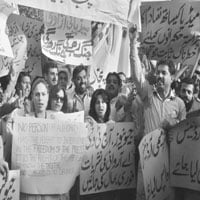 country will haunt the new government the most. The situation is so
adverse that even the World Bank has asked Pakistan to take immediate
action to prevent its economy from collapse.
country will haunt the new government the most. The situation is so
adverse that even the World Bank has asked Pakistan to take immediate
action to prevent its economy from collapse. agriculturists and businessmen must refrain from blindly toeing the lines
of IMF and other international financial institutions. If Shaukat Aziz, a
banker by origin, could quadruple banks' profits at the cost of other
sectors of the economy why can't these politicians struggle for the growth
of their sectors and economy on the whole.
agriculturists and businessmen must refrain from blindly toeing the lines
of IMF and other international financial institutions. If Shaukat Aziz, a
banker by origin, could quadruple banks' profits at the cost of other
sectors of the economy why can't these politicians struggle for the growth
of their sectors and economy on the whole. labour intensive and can give jobs to more and more people. It must take
major decisions like construction of dams to meet demand of energy. Though
hoping for consensus on this issue will be too much but it's not
impossible.
labour intensive and can give jobs to more and more people. It must take
major decisions like construction of dams to meet demand of energy. Though
hoping for consensus on this issue will be too much but it's not
impossible. legitimacy from one source or the other. It is about time to accept the
multiplicity of sources that make us into what we are. This relates to our
past as well as the present as the people belonging to the various regions
speaking different languages, singing different tunes are the determinants
of culture rather than the hand me down prescriptions.
legitimacy from one source or the other. It is about time to accept the
multiplicity of sources that make us into what we are. This relates to our
past as well as the present as the people belonging to the various regions
speaking different languages, singing different tunes are the determinants
of culture rather than the hand me down prescriptions. grander. The incumbents, focus of the public's anger, suffered a
humiliating defeat at the polls while those parties with genuine backing
of the people were able to regain control of the parliament. However,
people are demanding nothing less than a radical change in their lives and
an end to their daily miseries.
grander. The incumbents, focus of the public's anger, suffered a
humiliating defeat at the polls while those parties with genuine backing
of the people were able to regain control of the parliament. However,
people are demanding nothing less than a radical change in their lives and
an end to their daily miseries.