


|
|
|
|
 |
 |
  
|
accords preview Art
of surprises Chromatic
scapes
Priority peace The majority in both Swat and Bajaur wants peace and isn't bothered whether making deals or enforcing Shariah achieves this objective
By Rahimullah Yusufzai Within a span of a week, the government agreed to a
ceasefire and truce with the militants in not one but two trouble-spots.
Close on the heels of the Swat deal between the ANP-PPP coalition government
in the NWFP and Maulana Sufi Mohammad's pro-Taliban Islamic group, the
federal government concluded a peace accord with the Taliban in the Bajaur
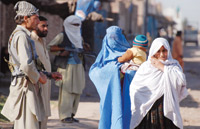
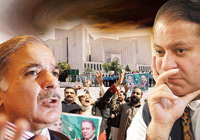
tribal agency. It was an amazing turnaround even by Pakistan's standards as President Asif Ali Zardari had declared a few days before the latest peace accords that his government was left with no other option but to carry out military operations to defeat the militants and prevent the takeover of the state by the Taliban. And his Prime Minister, Yousaf Raza Gilani, and the NWFP Chief Minister Ameer Haider Hoti had stated time and again that no peace talks would be held with the Taliban unless they laid down arms. Not a single militant has put down his gun but the peace talks have been going on openly for days and secretly as long as one can remember. And despite President Zardari's assertions, dialogue hasn't been abandoned as a means of ending the conflict in the NWFP and the adjoining Federally Administered Tribal Areas (FATA). Rather, the old policy of using both carrot and stick while dealing with the militants is still in place. Dubbed as the "Shariah for peace" accord, the
deal in Swat was made not with the radical militants led by Maulana Fazlullah
but with the pro-Taliban and non-violent Islamic group known as Tanzim Nifaz
Shariat-i-Mohammadi (TNSM) of Maulana Sufi Mohammad. The two Maulanas
happened to be close relatives, the father-in-law Sufi Mohammad being much
older and now a man of peace after having embarked on a misadventure to
Afghanistan in November 2001 by provoking and leading around 10,000
Pakistanis from the Malakand region to fight alongside the Taliban against
the invading US forces and the Northern Alliance. Earlier in the summer of
1994, he had first aroused and then doused the sentiments of his armed
followers in Swat and rest of Malakand division during the campaign for
enforcement of Shariah. That uprising sowed the seeds for further rounds of
violence in Swat, the latest being the one that began in 2007 and forced the
armed forces to launch three military actions without achieving a decisive
victory. Son-in-law Maulana Fazlullah, about 33 years old and leader of the Swat chapter of Baitullah Mahsud's Tehrik-i-Taliban Pakistan (TTP), negotiated with the TNSM and not with the provincial government. However, it was obvious that Maulana Sufi Mohammad's TNSM was mediating between the two sides and trying to sell the deal that he concluded with the provincial government in return for enforcement of Shariah in Swat and seven other districts including Shangla, Buner, Malakand Agency, Upper Dir, Lower Dir and Chitral in Malakand division and Kohistan in Hazara division. Widely known as Radio Mullah for fiery sermons on his FM Radio channel that made him known and extended his influence in Swat and surrounding areas, Fazlullah has declared an indefinite ceasefire after first agreeing to stop attacks on the security forces and government installations for 10 days. However, his fighters made two violations of the ceasefire by carrying out kidnappings of government officials, including Swat's newly appointed district coordination officer (DCO), Khushal Khan, who was abducted along with six members of his staff and held in Taliban custody for six hours. The violations brought reprimand from Sufi Mohammad, who asked the Swat Taliban to halt all militant activities and remove their roadside checkpoints and at the same time demanded a pullout of Pakistan Army troops from the valley. The army, however, wants to stay in Swat until durable peace returns to the valley. The Swat peace deal could go wrong on several counts. An
exchange of prisoners must take place because this was one of the main issues
that caused the collapse of the May 2008 peace accord between the ANP-led
NWFP government and the Swat Taliban. The Taliban have already freed four
paramilitary soldiers and are planning to free other government employees in
their custody. In The issue of granting amnesty to the Swat Taliban leaders is another contentious issue. It was left unresolved in the May 2008 peace accord as the Pakistan Army high command had reservations over offering amnesty to certain top leaders and commanders of the Taliban in Swat. Another important issue is granting compensation to the affectees of the military operation in Swat. The Taliban would like to have some say in distribution of the government money among those who suffered human and material losses as this is a form of patronage that allows an organisation to retain loyalty of the people. In the previous accord, the Swat Taliban had agreed to disarm, accept the government's writ and refrain from setting up a parallel administration. Any new deal should bind them to these terms, otherwise the government would have an impossible task reasserting its writ and disarming the militants. The government is banking on one man, Maulana Sufi Mohammad, for the success of its strategy in Swat. He can be unpredictable at times even though nobody can doubt his sincerity. He is also a simple person and his announcements that the government had agreed to his demand to enforce Shariah in Swat could haunt him in future as the Nizam-i-Adl Regulation being enforced there isn't complete Shariah. The secular ANP-PPP coalition government in the NWFP is seemingly aiming to sideline the Maulana Fazlullah-led militants by cutting a deal with Sufi Mohammad but this may not be achievable in the short term. Rather, it is Fazlullah who now holds the key to returning Swat to normalcy or keeping it unstable. Another factor that could sabotage the Swat peace deal is
the attitude of the US and, to a lesser extent, its allies. The US could have
tolerated the Swat accord and its initial reaction wasn't negative as it
considered the peace deal within the limits of Pakistan's constitutional
framework. In fact, the US would have preferred to adopt a wait and see
approach as it did in the case of earlier peace agreements in Waziristan
before proclaiming the deals as a failure and blaming them for the rise in
Taliban infiltrations across the Pak-Afghan border and an increase in their
attacks on Nato forces in Afghanistan. But the Bajaur peace agreement would
most likely harden the US attitude The people of both Swat and Bajaur have overwhelmingly welcomed the peace deals as their priority is restoration of peace and an end to the military operations and militants' sponsored violence in their villages. Most of the population in the NWFP also supports the peace initiative as it carries the promise of improved security and revival of economic activity in their areas. The most vocal opponents of the deal making are from outside the NWFP. They too have genuine concerns about empowering militants who employed force to achieve their objectives and forced the government to accept their demands. But the important point to remember is to respond to the wishes of the majority in the conflict-ridden places. This huge majority wants peace and it isn't bothered whether making deals or enforcing Shariah achieves this objective.
Art for the sake of life Twenty-two paintings of Shahid Jalal are under open auction to raise funds for the schools of TCF
By Sarwat Ali A silent auction being held at three galleries, Ejaz Art Gallery Lahore, Tanzara Islamabad and Canvas Art Gallery Karachi is probably introducing a new concept in the growing art market of the country. The painter who has offered his twenty-two paintings is
none other than Shahid Jalal. These latest works of the painter are all set
to be auctioned to raise funds for the noble cause of education. It was not
so long ago that the artists needed support and help to sustain themselves
and now an The twenty-two paintings executed in the inimitable style of Shahid Jalal titled the 'Pool Garden' are landscapes. The location chosen is as much for the personal association as for the potential inherent in it. The garden of activist Tahira Mazhar Ali's house now has twenty-two artistic variations by Shahid Jalal where he has played with light, angles and perspectives to bring forth the loveliness of the place. Not only in terms of its perfection and maintenance but also of the comfort and homeliness that it exudes. Jalal is no stranger to this garden -- he has been visiting it since his childhood and has spent many a morning, afternoon and evening savouring the lavish hospitality of Tahira Mazhar. The paintings are good examples of the significant style of the painter. The landscapes have the love of detail and texture, the colours are deep and intense, and the multiplicity of thick dots/dashes of colour builds up the image. As is his hallmark, there is little of the sky and the foreground, only close-up of plants, trees and the house. A few organisations in Pakistan have dedicated themselves to philanthropic work .One such organisation with a broad spectrum of activities with particular specialisation in educating those boys and girls with ability but the inability to afford a good education is The Citizens Foundation (TCF). In the last few years of its existence, since 1995 the Foundation has been a success story. From a few schools about ten years ago now it has more than 530 purpose-built schools where the quality of education cannot be questioned or mired in controversy. Many students irrespective of gender have benefited from the schools of this organisation, equipping themselves with the skills needed to raise their level of work and standard of living. For many, and it should be so in a democratic set-up, education provides the ladder of success as well as enlightenment. Needless to say an educated person is an asset to the society and humanity while an illiterate person can so easily turn into a liability. In these days of economic downturn TCF too is feeling the pinch and looking for opportunities to raise funds so that the basic programme of education does not suffer. The primary purpose of running the schools and running them well will jeopardise the good work that has been done in the last so many years. A roll back, or even the idea of it, is unacceptable to many whose heart beats with the nobility of the cause. Education has been a very basic problem in our society. Despite being independent for sixty odd years the percentage, despite government positive doctoring of figures, has not risen very much. The mere signing of one's name and probably reading the Holy Quran (without understanding it of course) have been the basic criteria for measuring literacy and even with these very broad and lax parameters the percentage is pathetically low. In many counties the state has taken upon itself the responsibility and acquitted itself well but in Pakistan when the state moved in it lowered the standard of education and brought to it to lowest level possible. The state does not have the resources besides the will to fully execute the task. The private sector has moved in to fill the gap but education has become out of bound for many because of the inability to afford it. This sorry state has been alleviated, tackled or remedied to some extent by the school, which is run by philanthropic organisations like TCF. The education is good and does not cost that much -- it stays within reach of many wanting their children to be educated. It has been as much a labour of love as it has been a commitment to a cause. Shahid Jalal has been associated with TCF for a very long time, assisting in their activities full time, more so when it comes to raising funds for it. The Foundation's deficit this year due to a number of economic reasons has been huge and the income that the Foundation and Shahid Jalal hope to raise through this auction will only cover some percentage of it. But it is being hoped that such initiatives and drives will generate enough support and enthusiasm to be an impetus so that the philanthropic drive does not lose momentum. When this idea was broached, the three galleries were most cooperative, offering the space and the other facilities free of charge. The other networks and associated support systems are also being fully used for this endeavour. The visitors can visit the three galleries as indeed access it on the website. The bidding will be on at the website (www.thepoolgarden.com) during the entire month of March.
At her recent one-person exhibition in Canvas Gallery, Adeela Suleman ventures onto something totally new By Quddus Mirza Only a few works of art surpass the initial surprise of the viewer and remain in memory for a longer period. This is understood as a sign of quality (a much-debated concept) in art, more so in the present times when people are accustomed to watching constantly-moving visuals on a TV screen. Surprise is an important aspect of a work of art since it
serves to attract a viewer's attention. It does not matter if the goal is
achieved by employing positive means or negative. Because in the world of art
positive and negative keep shifting their meaning, value and context. Usually
a work that is considered to have negative features -- sensational, repulsive
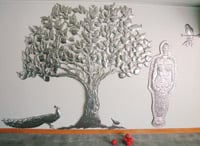
or crude -- may be seen in an altogether different light later. Shock is how one can describe one's reaction on stepping into Canvas Gallery to see the one-person exhibition of Adeela Suleman. To begin with, the artist has chosen to include only three works in her solo show. Other amazements unfold with time, but only if one is familiar with Suleman's work and the short history of contemporary art in Pakistan. It is strange to find no 'complete' work -- not in the sense of a resolved piece but a work with definite dimensions -- in the show. Although many other artists also venture in the art of installation with works of variable sizes, but due to the material of their works (twigs and rags of Ruby Chishti, for example) one hardly associates the idea of 'exactness' that one links with Suleman's experiment with metal. Outlines of women, details of a tree and shapes of birds executed in steel sheet force the idea of solidity on our minds; an idea contradicted by our optical experience. Hence, one is perplexed to find works forged in hard material, yet arranged in a scheme that is loose, open and soft. Aspects of looseness, incompleteness and open-ended arrangement could be read as a brave break and a pivotal stage in the artistic life of Adeela Suleman who has earlier been associated with exploration of popular art. Her constructions, both in forms, function and surfaces (colours) were linked with artists appropriating the materials, methods and imagery from the truck and other transport art. With her last two exhibitions, Suleman seems venturing onto something new. Her pictorial concerns have taken a different turn. Artists' presence or intervention is not visible in their use of technique, material or imagery; it is the conceptual context that reveals their personality and position. So, if taken away from the gallery and separated from their initial compositions, the single parrot, lonely sparrow and a tree could have been artefacts made by artisans working in the technique of repousse, but it was the artist's idea that turned these into art. Instead of using her hand, Suleman has employed her skill and intelligence in organising various facilities, methods and individuals to shape and convey her concepts. Looking at the work, one could only have guessed the artist's frame of mind. Suleman was trained as a sculptor at the Indus Valley School of Art and Architecture, and has been creating works often inspired by the ordinary items from our domestic or urban environment. Her new works, even though reliefs, appear more like drawings in her sketch book. The link between these pieces and drawing is not only in the formal construction -- various components independently hung or pasted on the walls of the gallery -- but in the shade of the metal. The silver grey, reminds of graphite pencil, normally used for sketching. The imagery deals with the woman and her position and perception from a historic viewpoint. Cut-outs of female figures, with plants overlapping the contours, installed along with trees, peacocks, parrots and red apples (the only object in round as well as in a colour other than grey) alludes to the archaic story of Adam's temptation, Eve's rule and their fall. Although there are many interpretations of this account but woman, by-and-large is perceived as the temptress; the entity who can incite sin in a man. A large population of males think that women are a source of trouble (to the extent of believing that female drivers cause road accidents). It appears that Suleman is not prepared or tempted to comment on the bigger issue of the state of women or her own situation in our society, but has tried to relate familiar characters from her surroundings (women of names such as Hawwa Bai, Khalida and Hajra) with the historical perception of gender -- a blend of desire and death. So, in comparison with the rather realistic representation of trees and birds, women were rendered in a symbolic manner -- like the lid of a coffin. Even though the figure is executed with layers of flowers, petals, leaves and other designs (for instance the star and crescent of coins, in the place of head), yet the whole figure communicates a feeling of fatality, enhanced by a number of dead birds lying next to another lid figure of woman. Probably the last surprise for a viewer familiar with her earlier work was the realisation of the shift from her previous pieces (exhibited at Rohtas 2 in Lahore not long ago). Although the cut-outs of female figures were seen in both the shows, the exhibition at Canvas indicates a completely different approach towards the pictorial solutions. The open format as well as the minimum 'direction/control' on the fabrication of components of work suggests a deviation from her usual aesthetics. A commendable state indeed but one wondered on the need and necessity of displaying work at that stage since artists often go through various phases, and adopt different courses, sometimes contradictory to their earlier creations, which may not require a public viewing of this kind. Moments like these kinds are essential for an artist, because these provide occasions for change and development. But it seems the motive behind the exhibition was unsurprisingly not different from the general practice -- of displaying everything, which is produced in the artists' studios.
Abid Hassan is engaged in a true act of discovery in the creation of new forms and symbols in his show at Gallery 6, Islamabad
By Aasim Akhtar After Brancusi left Rodin's studio, where he'd served a brief stint as the sculptor's assistant, he mused, "Nothing grows in the shadow of a great oak." Abid Hassan, who spent nearly eight months working with Ahmed Khan, discovered a great deal in the master's shadow and was able to incorporate much of it into his own work even as he charted a slow, sure path to artistic independence. Hassan embraced Khan's love of paint and shared his
fondness for the beautiful surface qualities that accrue as the canvas is
varnished, gilded, and repeatedly repainted. In lieu of Khan's finely
calibrated, slightly acidic palette, Hassan juxtaposes highly saturated hues,
such as Prussian blue and crimson, with larger areas of ochre and pale
yellow. More often than not, his works are built out of a series of modular,
roughly rectangular forms that are outlined by wide, dark brushstrokes. Hints
of architectural motifs, and suggestions of landscape and aquatic life appear
and disappear; in many images they're most visible when we're not looking for
them. Seek them, and they slip away. This skillful game of hide-and-seek is
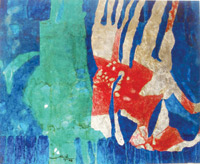
also played in the microview. Hassan's surfaces are especially beguiling when observed up close. At this proximity, countless small passages suggest paintings in their own right, and in so doing activate the imagination of the viewer, who confronts a world that refuses to coalesce into a single specific reading. Abid Hassan has displayed a knack for semi-abstract idylls in his show at Gallery 6 in Islamabad. A gifted colourist, he is at his strongest in jauntily rhythmic compositions that betray only the merest suggestions of figuration. In some paintings on show, he deploys thick black lines in spontaneous arcs, filling them with orange and other highly saturated hues. The chromatic intensity, along with the thickness of the outlines, call to mind George Rouault. In some works, little more than a horizon line was enough to telegraph content. The fluency of technique and economy of gesture contribute to a pastoral quality. By contrast, some works give up their moons and grasses a bit too readily, without sufficient invention to enliven well-trodden subject matter. Hassan has a facility for tweaking his paintings' emotional tone via careful calibration of colour temperature. One of the show's high points is a painting in which the picture plane is divided in half, the top teeming with speckled imagery in rust, turquoise, and mustard, the bottom a glassy expanse of teal and dark green. Like a cross section of a still Alpine lake where it meets its mossy shore, the painting whispers of aqueous mysteries, tantalisingly out of reach. Hassan delivers strange and tumultuous moods, unleashing torrents of yellowy gold over a turquoise backdrop to create an atmosphere oddly reminiscent of the palette of the late Victorian Aesthetic Movement. The subject matter of creation is chaos. The present feeling seems to be that Abid Hassan is concerned with form, colour and spatial arrangement. This objective approach to art reduces his work to a kind of ornament. The whole attitude of abstract painting, for example, has been such that it has reduced painting to an ornamental art whereby the picture is broken up in geometrical fashion into a new kind of design-image. It is now a widespread notion that primitive art is abstract; that the strength in the primitive statement arises from this tendency for abstraction. An examination of primitive cultures, however, shows that many traditions were realistic, and there always existed a strict division between the geometric abstraction used in the decorative arts and the art of that culture. The practicing artist always employed a symbolic, even a realistic, form of expression. One of the serious mistakes made by artists and art critics has been the confusion over the nature of distortion, the easy assumption that any distortion from the realistic form is an abstraction of that form. In primitive tribes distortion was used as a device whereby the artist could create symbols. All artists, whether primitive or sophisticated, have been involved in the handling of chaos. Hassan clearly understands the separation between the abstraction and the art of the abstract. He is therefore not concerned with geometric forms per se but in creating forms, which by their abstract nature carry some abstract intellectual content. There is an attempt being made to assign a Surrealist explanation to the use painters make of abstract forms, but Surrealism is interested in a dream world that will penetrate the human psyche. To that extent it is a mundane expression. Hassan is concerned not with his own feelings or with the mystery of his own personality but with the penetration into the world mystery. His imagination is therefore attempting to dig into metaphysical secrets. To that extent his art is concerned with the sublime. It is a religious art, which through symbols will catch the basic truth of life, which is its sense of tragedy. Abid Hassan can be said to work with chaos not only in the sense that he is handling the chaos of the blank picture plane but also in that he is handling the chaos of form. In trying to go beyond the visible and the known world he is working with forms that are unknown even to him. He is therefore engaged in a true act of discovery in the creation of new forms and symbols that will have the living quality of creation. No matter what the psychologists say these forms arise from, that they are the inevitable expression of the unconscious, the present painter is not concerned with the process. Herein lies the difference between him and the Surrealists. At the same time in his desire, in his will to set down the ordered truth, that is the expression of his attitude towards the mystery of life and death, it can be said that the artist like a true creator is delving into chaos. It is precisely this that makes him an artist because the Creator in creating the world began with the same material, for the artist tries to wrest truth from the void. Hassan's direction is continually conditioned by his responses to the particular work in progress at any given moment. He articulates the potentialities latent in the premise he selects to work from and believes that a work of art is essentially distinguished by the transformation of the elements involved. The important thing is first of all to have a real love for the visible world that lies outside ourselves as well as to know the deep secret of what goes on within ourselves. For the visible world in combination with our inner selves provides the realm where we may seek infinitely for the individuality of our own souls. In the best art this search has always existed. It has been, strictly speaking, a search for something abstract. And today it remains urgently necessary to express even more strongly one's own individuality. Depth in space in a work of art is always decisive. The essential meaning of space or volume is identical with individuality, or that which mankind calls God. For in the beginning there was space, that frightening and unthinkable invention of the Force of the Universe. Time is the invention of mankind; space or volume, the palace of the gods. Hassan's final paintings are the intimate dialogue between his total being and the visual agents, which constitute the medium. He has always tried to realise visual and emotional energies simultaneously from the medium; and his paintings are concerned with generating visual sensations, but certainly not to the exclusion of emotion. The changes in his recent work are developments of his earlier work. Those were concerned with principles of repose and disturbance. That is to say, in each of them a particular situation was stated visually. Certain elements within that situation remained constant. Others precipitated the destruction of themselves by themselves. This led him to a deeper involvement with the structure of contradiction and paradox, in his more recent work. |
|

 return, they want the government to release Taliban prisoners and
sympathisers. Under the terms of the previous peace agreement, some 19
Taliban prisoners were freed and the fate of the remaining was to be decided
on a case-to-case basis.
return, they want the government to release Taliban prisoners and
sympathisers. Under the terms of the previous peace agreement, some 19
Taliban prisoners were freed and the fate of the remaining was to be decided
on a case-to-case basis.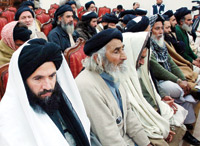 and prompt it to condemn both the accords with the militants. Ironically, the
peace deal in Bajaur was made public by Maulana Faqir Mohammad, leader of the
Taliban in Bajaur Agency and deputy head of the Baitullah Mahsud-led TTP, on
the day when Inspector General Frontier Corps (IGFC) Major General Khalid
Khan, commander of the forces battling the Bajaur militants since August 6,
2008, declared that his troops would control all the agency by March. The
General was confident that both Charmang and Mamond areas, Taliban
strongholds in Bajaur, would be retaken by then and the militants defeated.
His troops would now wind up operations in Bajaur and observe the ceasefire
that was first unilaterally declared by the Taliban militants and
reciprocated by the political administration following mediation by a tribal
jirga.
and prompt it to condemn both the accords with the militants. Ironically, the
peace deal in Bajaur was made public by Maulana Faqir Mohammad, leader of the
Taliban in Bajaur Agency and deputy head of the Baitullah Mahsud-led TTP, on
the day when Inspector General Frontier Corps (IGFC) Major General Khalid
Khan, commander of the forces battling the Bajaur militants since August 6,
2008, declared that his troops would control all the agency by March. The
General was confident that both Charmang and Mamond areas, Taliban
strongholds in Bajaur, would be retaken by then and the militants defeated.
His troops would now wind up operations in Bajaur and observe the ceasefire
that was first unilaterally declared by the Taliban militants and
reciprocated by the political administration following mediation by a tribal
jirga.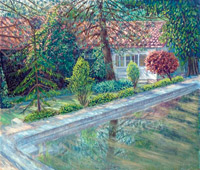 artist is offering his support for another cause. This does not imply that
certain artistic endeavours no longer need support; it only underscores the
necessity of pooling in for a cause that is shared by many.
artist is offering his support for another cause. This does not imply that
certain artistic endeavours no longer need support; it only underscores the
necessity of pooling in for a cause that is shared by many.