


|
|
|
|
 |
 |
   |
physical fitness What
physical fitness is not about Sadak
Chaap culture legend karachicharacter
Technology hands sports a thrashing defeat Lack of outdoor activities and a sedentary lifestyle can have far-reaching ramifications. Rafay Mahmood reports There was a time when the streets of Karachi would be
packed with children playing cricket. Plastic chairs would suffice as a
rudimentary wicket, unless a football world cup was going on, in which
case all cricket matches would be abandoned to make room for a flying
football or two in every park and street of the city. But all this has changed. In the words of a sports teacher at a private school, "Growing insecurity on the streets, along with parks that are big but lack technical facilities, mean that children no longer play outdoors." It is a statement that children and teenagers reinforce, although the reasons they give for staying in are different. "I am more of an indoor person," says one teenager. "I usually stay inside and spend time on the laptop downloading TV shows, movies or just surfing the Internet. I also spend hours playing on my X-box 360." As the same sports teacher goes on to say, "After the advent of the Internet and video games, the youth has started to live a sedentary life style." Dr Saeed Sheikhan, a physician and an assistant professor at the Hamdard College of Medicine and Dentistry, echoes the sentiment. "We have progressed with technology, but both parents and schools have ignored the fact that physical education is the basis of all education," he says. "If children do not have proper physical training, their academic performance is affected." With parents who are too busy and streets that are
too insecure to play on, school is the only option left. But more often
than not, even here students fail to get all the exercise they need. "I don't think sports or physical education is a priority at school," remarks Hasnain Haider, 15. "We don't have enough space on the school grounds. I'm sure if sports had been a priority, schools would have built bigger grounds." The trend bothers Ahmad Ayaz, who has three sons. "Both academic and physical education should go side by side," he insists while talking to Kolachi. "When I pay such high fees just so my children can go to school, I expect a complete package from the administration, but I'm afraid the schools don't supply it." However, unlike Ayaz, not many people believe that a "complete package" includes physical education at all. According to Dr Sheikhani, there is a widespread misconception in the society that the mere possession of a computer is a sign of literacy and education. "That is why parents allow their children to use the Internet for hours, but they don't realise that they are killing any physical activity their children could get," he laments. Amena, a 16-year-old student, agrees that a considerably portion of teenagers' time is taken up by the Internet. She freely admits that her leisure activities centre around scouring Facebook, checking her email, chatting with friends, and surfing online general. "I also watch television if there is anything
interesting on, or play board games later on in the day," she says. What many fail to understand is that the sedentary lifestyle that has become the norm has far-reaching ramifications. According to a physical trainer, the fatty diet that many Pakistanis adhere to has made it is essential for every child and teenager to exercise for at least 45 minutes every day, be it playing cricket, going to the gym, or having physical training lessons at school. He warns that a rising number of people are contracting ardiovascular disease from a very early age, and adds, "There has been a drastic increase in the number of patients suffering from juvenile diabetes, obesity, and high blood pressure."
--Photos by Zahid Rahman
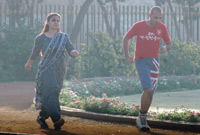
Could this be a comeback? Residents of the city complain that out of the few parks Karachi has, nearly all lack facilities for outdoor games, but the Olympian Iftikhar Park is the one park they cannot find fault with. Named after former Olympian and hockey player
Mohammad Iftikhar, the park was inaugurated a year ago is situated in
Block-6, Gulshan-e-Iqbal. The idea for the park was conceived by Town
Nazim Wasay Jalil and made operational by Iftikhar himself, who is
president of the park. Part of a series of parks constructed by the City
District Government Karachi (CDGK), the Olympian Iftikhar Park stands
out with its own jogging track, hockey ground, basketball court,
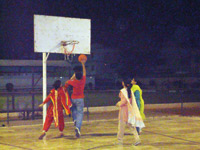
badminton court, and table tennis room. "The initial idea was to provide playground facilities in a neighbourhood park," explains Waseem-uz-Zafar, Coordinate Secretary Olympian Iftikhar Park. "We wanted to build a park with sports facilities to give the youth of today a new direction." With the exception of badminton and table tennis, which are played by people of all ages and regarded as a leisure activity more than anything, every sport has a specialised coach who holds training sessions three to four times a week so that activities can run in an organised manner. "Tanveer Ahmed, a basket ball coach of the national team, coaches both boys and girls. We regularly have around 130 girls who come to the park just to play basketball," says Zafar. "Meanwhile, a large number of children and teenagers come here for hockey lessons, which Iftikhar is in charge of." The park has its own security unit and is open to the
public from Fajr prayers to 9:30 a.m., and then from Asr prayers until
midnight. Zafar says that is full of people of all ages, who come here
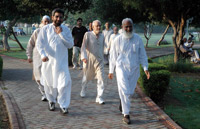
either for exercise or just entertainment. "Parents usually take a walk while their children play around them," he says. "Every day after Isha prayers, senior citizens of the colony come here with their table tennis racquets and play for a long time." Many of these senior citizens are members, but even non-members can use the park's facilities after paying an entry fee of five rupees. In addition to being secure, the administration of the park does not tolerate any untoward behaviour. "If we see anyone misbehaving, we cancel their coaching for the day and ask them to jog instead," says Zafar. It was learnt by Kolachi that there is more in store for the Olympian Iftikhar Park. After holding discussions with the CDGK, authorities plan to create a karate club, swimming pool, and squash court. Meanwhile, the CDGK has additional plans to replicate this model park in other parts of the city in order to promote sports in the youth. "We aim to build 12 cricket, football, and hockey grounds," reveals Liaquat Ali Khan, Executive District Officer Parks. -- RM
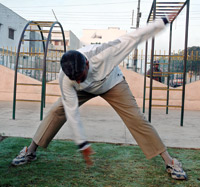
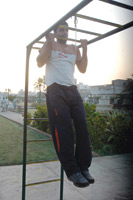
What physical fitness is not about Inadequate playgrounds and insecurity on the streets has confined physical fitness to the gym Physical and outdoor activities may no longer be on
most people's agenda, but there is no denying that over the past few
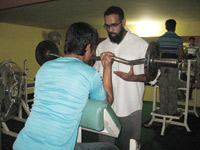
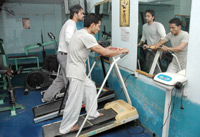
years, more teenagers than ever have started visiting a gym regularly. "They are left with no other choice," points out Kashif Haider, who runs Body Shape, a chain of gymnasiums. A certified personal trainer from the American Fitness Professionals and Associates, Haider has been helping people get into shape for the past 10 years, and today, the prevailing law and order situation in the city has meant he has a rising number of clients. "There is so much social insecurity in the city that the whole concept of outdoor sports has diminished and the trend of street cricket or football has almost faded away," he says. Like many others, Haider also blames technology on the lack of enthusiasm for sports, and acknowledges the high number of diseases such as diabetes that have cropped up in younger people as a result of the change in lifestyle. "The youth is too dependent on technology,"
he says. However, he recognises one benefit of the Internet: it has made
more people aware of the importance of physical fitness. "When people initially came to gyms, they wanted to become body builders, but with time, they have started to realise that physical fitness is about more than just the shape of their body," says Haider. Still, the misconceptions run far and wide. Haider notes that out of everyone who visits his gym, many believe that the longer time they spend on their muscles, the better their bodies will be. This, he stresses, is not true. "For an average human being, muscle training should be restricted to just an hour with small gaps in between," he says. "If you overdo it, it is catabolic which means that you will not build any muscles. You will just waste the ones you have." Haider explains that in addition to providing equipment and a coach, every gym has a diet plan for its members, which needs to be followed. "Some young people believe that eating eight
eggs a day will give provide them with the right nutrition to build
quality muscles, but they are wrong," he says. "The
preservation of muscles requires a balanced diet. Any additional
supplements or medication should be checked with a physician first. Many
people don't know this, and because of this, steroids have become very
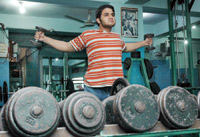
common." Shariq Hassan, 18, has realised the importance of a balanced diet, but he had to learn the hard way. Burdened with a complex about being thin, he started to have ambitions about being a body builder at the age of 14, and images of beefed up film stars propelled his decision to join a gym. "It was great to be known as a body builder among my friends," he recalls. For a year, Hassan worked hard on building his muscles, but saw no results. "That was when I realised the importance of having a balanced diet as well," he says. "For years now, every day I have been having six to eight bananas, three to four glasses of milk, and two boiled eggs." However, Hassan's revised diet makes up for just half
of what his gym trainer recommends. His actual diet plan also includes a
small pack of tuna and a 500ml bottle of a carbonated drink. "I cannot afford it," says Hassan simply. "Just the eggs and the milk together come up to Rs200. The tuna costs Rs115, and the carbonated drink is for Rs25." Besides, Hassan's motivation for going to the gym has less to do with being physically fit and more to do with having an enviable set of muscles. "I want to stay in shape and have a good body as girls prefer such men," he confesses. "To me, physical fitness is all about having the power, strength and stamina to do something others can't."– RM --Photos by Zahid Rahman
Q. What do you do to stay fit?
By Sadia Hanif Nabeel Abdus Samad, 25, Graphic designer: "I try to wake up early and go for a long walk (about 5km), drink plenty of water. I also make sure I have a healthy breakfast and am careful about not drinking water immediately after any meal. What I can't do is think about calories before eating." Dr Javeria Moinuddin, 26, Doctor: "I workout every day and do my best to avoid unhealthy food items. I don't do this to lose weight, but to remain healthy. I believe my health is far more important than how much I weigh."
Safia Azad, 21, Student: "I am not the kind who would exercise daily. I just try to drink as much water as I can and at times dance which is fun and helps me remain fit."
Azash Ahmed, 23, Journalist: "I believe green tea is the key – not the generic packaged green tea sold every where, but home made green tea from Basil leaves or thyme. I also take mint which is always refreshing and has almost instant positive effects on one's health."
Sana Mukaddam, 22, Dentist: "To stay fit, I drink lots of water, have vegetables and try to avoid oily and junk food. Regular exercise is also part of my routine."
Artistically dead Rather than earning a decent profit for their hard work in local arts and crafts, rural Sindhi artists feel cultural exhibitions in cities are more about their exploitation at the hands of wholesale dealers and middlemen By Adeel Pathan For anyone who wishes to learn more about Sindhi culture, the model Sindhi Cultural Village, or the Sindhi Saqafti Goth, is the definitive place to visit. Established during the annual Urs of the great saint
and Sufi Shah Abdul Latif Bhittai, the model village strives to pay
homage to the traditions and culture of the province. Entry into the
village is free, and a visit to this cultural haven will pave the way
for traditional Sindhi food, dances and musical "We selected artists from the district of Matiari to display their work," says Shams Jafrani, Secretary Sindh Culture and Tourism. Whether the artists who are chosen to put up their work on display are as pleased as the visitors, however, is a separate matter. Haji Allah Dino and everyone in his family, who is old enough to work, make ajrak (a special Sindhi fabric) but Dino is unhappy with the amount he earns. "My children work too, but we still earn very little," says a dejected Dino. Mixed with the pain of not being able to earn enough, Dino expresses his disappointment with the Department of Culture. "All they do is invite us for their exhibitions," he says. He feels that the Sindh Department of Culture should be working towards ensuring enough incentive for the artists of the province to continue working and sustain a livelihood. His frustration stems from the fact that however hard they work, hardly any make a good enough profit. Ghulam Abbass is yet another such artist. Abbass has been designing decoration pieces in Hala taluka of the Matiari district for the past 40 years, but for the most part, he has not been satisfied with what he earns. "The manufacturing cost of one decoration piece is no less than Rs60, but I hardly ever sell it for that much," says Abbass. The reason for this is simple. According to Abbass, shopkeepers from cities such as Hyderabad and Karachi buy them all and put them up in their showrooms for several times the original price. Still, Abbass is reluctant to give it up, although he is deeply regretful that decoration pieces made out of steel and wood are fast replacing the ones made out of sand. Conjuring up pots and vases out of sand and clay is the only way he knows of earning a living. This special art, also called kashi, is what Hala is famous for, and Abbass is determined to keep it alive for the coming generations. "I have passed on my skills to my children, who are old enough to work," he says proudly. "Even if it I don't earn enough money to run the house, I want to keep the tradition and the family business alive. This is what my ancestors did." Shahid Hussain, yet another artist chosen to display his work, has a similar story. Hussain, who is also from Hala, specialises in weaving traditional stoles in different colours, which are in immensely high in demand during winter. "It takes me six whole days and Rs800 to finish making one stole, but I make a profit of just Rs100." There are many others who have similar complaints. Nabi Bux Vighio, who specialises in jandi woodwork, sells chairs for Rs1,400 even though in bigger markets the same chairs cost a minimum of Rs2,000. At the same time, Vighio is helpless. He has no access to any of these markets. He can do nothing but watch as middlemen or wholesale dealers purchase his items in bulk for an inadequate amount and then sell them at their own price. Jafrani, however, argues that the cultural village is a way of helping such artists. "Many of the artists we employ work solely for the exhibitions," he says. "They have the chance to put their immense talents on display before visitors. It allows them market their products." Jafrani adds that there has been a proposal within the department for a similar undertaking in Karachi. "There would be an even bigger market here for such artists," he says. However, if the artists' complaints are anything to go by, there is still a long way to go before they can earn what they feel is a reasonable profit.
Crocodile cult at Manghopir
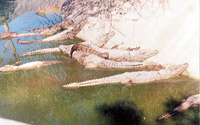
By Dr A. A. Quraishy Manghopir, at a stone's throw from Karachi, is the only mausoleum in Asia where the cult of crocodile worship has been practiced through centuries. The saint later known as Hazrat Khwaja Hasan Maroof Sakhi Sultan Baba lived around this tranquil, calm spot to preach Islam. The saint's peaceful ways and his tolerance for the local crocodiles have given the creatures a legendary and mythic significance for the indigenous population of the area. The legend of the saint and the crocodiles When the Arabs came with Mohammad Bin Qasim along with the soldiers of Negroid lineage they scattered date palm seeds along the Balochistan coast which sprouted and covered the belt with date palm trees that are still the mainstay of the residents. One of the reasons of devotion to crocodiles was the belief of the Africans that they were special from the days of Pharaohs. As word of the saint spread, people from far and wide shifted into the fertile valley for pastoral life which, they believed, was blessed by the saint, who led a pious life and preached the faith of the prophets. In this wilderness dacoits and pirates also lived;
one of them, Mangha who liked to live with a sword and a spear as his
means of livelihood, threatened the saint to move away and stop his
preaching. However, as legend goes, Mangha was soon won over by the
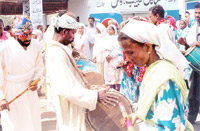
saint's message of peace and human welfare. Later, Mangha became a disciple of the holy man. He soon converted to Islam and served the saint faithfully and practiced what the holy man preached. Later, when they died both were buried beside each other while the locals built a mausoleum around their graves. Since the saint used to feed the crocodiles, the followers also considered them to be sacred, a belief which has continued to this day. Devotion of the disciples Most devotees of Hazrat Khwaja Hasan Maroof Sakhi Sultan were the Negroids. To this day the saint's devotees commemorate an annual festival which features four days of music and Dhamal. On the occasion most devotees don colourful attires and recite hymns--while they march almost in a trance to where the crocodiles reside, once there they offer sweets and wreaths to the crocodiles. When Mor Sahib, the largest of the crocodiles has accepted their offerings, they consider it a great honour as the devotees believe that they would be blessed with good fortune. The songs still carry their ancestral African colour, the drum beat, the dance style and communal singing in soulful chorus is captivating. Film makers from abroad often arrive to capture this unique cult of crocodile worship which also has the unique stamp of ancient Africa -- a feature which has no parallel in Asia or any other community. The Zikri are an offshoot of this tribe too. Hard times for the crocodiles In the past fifty or so years the saint's crocodiles had a hard fight for survival, because the silt made the depth of water unliveable for the reptiles. Consequently the crocodiles started dying until their numbers were reduced to three. At this point the SPCA – the society that took care of animals in distress – took heed and rescued the sacred animals, by increasing the depth of the pit. Meanwhile, I myself arranged for improved breeding facilities for the remaining threesome and supervised the nesting technique. Soon there were four hatchlings which were fed nourishing food and kept in comfortable temperature until they were three years old when they were released into the main pool. At present the population of crocodiles is over a hundred. The peaceful ways of their keepers has made the crocodiles calm and peaceful. So far they have not attacked a single human being. Land before time Although the arrival of a saint somewhere from the Middle East is only some centuries old but the abode of the marsh crocodiles in the well known 'Mugger pit' could well be 40 to 50 million years old during the Mesozoic era, while the earth was young and geological changes were in the process. The Hub River flowed in this region with its load of fresh water flora and fauna including the crocodiles. With constant geologic upheavals and the topographical rise and fall that continues to this day, the river changed its course while this spot being the deepest in the recent earth structure, retained the reptiles that thrived on the aquatic fauna. Wild grass and bushes kept the pond tolerably cool for the cold blooded crocodiles. Meanwhile the neighbouring spring of the subterranean strata kept it on the slight rise of temperature because it emerged from the deep layer of the earth in this volcanic stratum. A slightly cold spring also flows from the earth that refills the pit for the crocodiles. This gave rise to the Garam Chashma and Thanda Chashma lore where the sick seek cure from the spring water, which is like an added comfort along with the tomb of the Pir Baba resting nearby. The writer is the founder of Wildlife Conservation Society of Pakistan and former director of Karachi Zoological Gardens
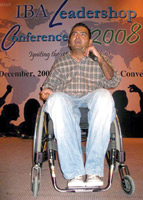
Living to the fullest from a set of wheels By M Farhan Zaheer Sarmad Tariq may not be a household name, but last
month, this 33-year-old was called to Karachi from Islamabad to give an
inspirational lecture at the Institute of Business Management (IBA)
Leadership Conference. His claim to fame: becoming the first Pakistani
to participate in the New York marathon. But what truly sets Tariq's achievement apart is that he completed the marathon from a wheelchair. In 1991 when he was 15, Tariq hit his head on a rock while diving into a canal and fractured his neck, marking the beginning of the years of trauma that lay ahead. "I was paralysed for first three months of accident," recalls Tariq. "I couldn't even move my arms. I was totally dependent on others." Tariq was treated for his injuries in Lahore, but three years later, there was no visible improvement. "I stayed in bed the whole time, fighting for my life," he says. Desperate, Tariq's parents gathered all their savings and took their son to London for treatment. "It proved to be a good decision," says Tariq. "In just a couple of months, I improved a great deal. With proper exercise, I could finally use a wheelchair." Tariq returned to Lahore in 1994 to resume the education he had been forced to abandon after the accident. However, all the colleges he applied to rejected him after learning of his disability – until he hit PAF Chaklala College. From here, he went on to do his FSc, with his graduation helping him put the ordeal of the past few years behind him. "I wanted to be independent and earn a living. It helped push me to study harder." After completing school, Tariq enrolled in Sir Syed College, Rawalpindi, and graduated with a bachelor's degree and an MBA to boot, although he is quick to credit his success to all the friends he made at university. "I had some very cooperative friends who'd help me in and out of the car. I owe my degrees to my friends," says Tariq gratefully. It wasn't too long after his MBA that Tariq found employment, helping him step towards the independence he had strived so long for. By 2001, he was also happily married. Tariq, however, craved more than just independence and a family. Injury aside, at six feet three Tariq had been blessed with an athletic physique, and ever since he was a teenager, he had yearned to "do something" in sports later in life. "I planned to drive a car from Bab-e-Khyber to Karachi, (K2K). In 2004, I set off for Karachi from Bab-e-Khyber on March 26 in a car with a few friends." Tariq managed to cover the considerable distance – 1,847 kilometres – on his own in 33 hours. The following year, he participated in the Lahore marathon on January 29 in a wheelchair, with the 42-kilometre trek paving the way for his ultimate goal: the New York marathon. "I had to take part in a recognised marathon to be eligible for New York Marathon," he explains. Unfortunately, participating in the New York marathon was not something Tariq could do immediately. In the midst of the Lahore marathon, he was struck with serious internal injuries and started vomiting blood, putting his ambitions on hold until he regained his strength. When the time was right, Tariq took no chances: he applied for the London, Boston and New York marathons at the same time. "I finally got a response from New York, and on November 7, 2005, I took part in the New York marathon," says Tariq. "I was still unfit, but this was a dream come true. At the end of race, I was the first Pakistani who completed the New York Marathon – on a wheel chair!" Tariq's pride and success has only served to spur him on the newer heights. Having achieved his dream of competing in the marathon and living independently, his days are now filled with looking for people to sponsor his hand cycle journey from Peshawar to Lahore. He is looking in particular to set an international record in the sport, and admits that it will be no mean feat. "I know it is dangerous, and I know it will be difficult to look for sponsors with the international economic downturn," he says, "But I believe that we do not lose the game as long as our minds are working. As I always say, carve your goals in stone, but plan on sand."
|
|


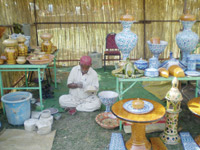 performances by folk music artists. Above all, there is always a
breathtaking display of the local arts and crafts.
performances by folk music artists. Above all, there is always a
breathtaking display of the local arts and crafts.