


|
|
|
|
 |
 |
  
|
A new political
context for Juliet performing
arts Order
of the senses Examination
of life Revelation 8, The Book of Revelation. Dear All,The death of little Ivan Cameron at the end of last month seems to have touched the hearts of the British people.
context for Juliet
Women are speaking out all over the country, attempting to exercise their rights to personal autonomy
By Beena Sarwar Another March 8, another 'women’s day'. Time to focus
again on the injustices that half the world's population faces because of
being born female. This day also provides a benchmark to look back and
celebrate how far women have come. But all this is not just about women. What
women suffer, and what women achieve, has to be looked at in the
socio-political context in which they -- we -- live. Gender injustices are as much about class and power struggles, about economic policies that continue to increase the gap between rich and poor, about inherent racism and prejudices. Among the marginalised sections of society, women are further marginalised. Where there are class and economic inequities, it is women who suffer the most. And when there are wars and violent conflicts -- initiated, it must be said, almost exclusively by men -- it is women who bear the brunt. Of the over 31 million people displaced by violent conflicts around the world, most are women and children. Often, women's bodies are the battleground over which men satisfy their lust for revenge and to bring 'the enemy' down. This is not just the case during full-scale wars and violent conflicts. It is also the norm in patriarchal societies where rape for revenge is common, when a woman is targeted in order to teach the men of her family a lesson. Mukhtiar Mai in Meerwala village near Multan is only one example of paying the price for a supposed transgression by her brother. In actual fact, the men who assaulted her had first sexually assaulted her younger brother Shakoor, about 14 years old in 2002 when the incident took place. When it appeared that he would not remain quiet about the assault, his assailants sought to protect themselves by accusing him of having an affair with their sister. The politics of caste and class figure prominently in this
saga as they tend to do in other such cases. Mukhtiar Mai's family belongs to
the lowest social rungs in the village. Their opponents, who belong to a
'higher' social class, convened a village council to settle the matter and
said that they would 'do to Shakoor's sister' what he had allegedly done to
their's. Those present tried to convince them otherwise. According to Abdur
Razzaq, the village maulvi, whom I talked to in 2006 while making a
documentary on the issue, "We said that would be wrong. Instead, one of
them should marry Mukhtiar (a divorcee) and Shakoor should marry their
sister". This kind of watta-satta arrangement is common in the area. When they insisted they would dishonour Mukhtiar, he says, he left along with other villagers. Some stayed back at the site of the meeting, across the field from Mukhtiar's house. The men appeared to agree that Mukhtiar should come to them and ask pardon for this 'crime'. When her uncle escorted her out of her parents' home for this purpose, the young men, who were armed, seized her and dragged her into a room in front of all those present. No one dared step in. Rape itself was and remains common. As Maulvi Razzak said, "It happens. Two or three bad boys will sneak into someone's house and commit an excess ('ziadati', as most people commonly refer to rape). But this was really bad." What he meant was that while rape was commonplace, the way that it happened with Mukhtiar could not be countenanced. He said that he heard about the incident a few days later. That Friday, he spoke against it in his sermon. A local journalist who was present took up the matter. Their intervention kept Mukhtiar from committing suicide as she says she felt driven to do. Instead, she registered a report with the nearest police station, at the next village. It is also a sign of the changing times that other villagers supported Mukhtiar, enabling her to remain in the village, which doesn't happen usually after such a public disgrace. Remember Nawabpur in the early 1980s, the first such case to come to media attention, where a carpenter was accused (like Mukhtiar's brother) of dallying with a woman from a higher-caste family. The men of that family beat him so severely that he died. They stripped the women and paraded them in the streets -- made them 'dance naked' as news reports put it. The family subsequently left the village, unable to bear the shame. Many similar cases have taken place. A major difference in Mukhtiar's case is that the opposing
family did not kill her brother when they accused him. Secondly, she received
enough local support to be able to survive in her own home (the government
also provided her with 24-hour protection, even building a police station
across the street from her house). Thirdly, she had the innate courage and
wisdom to focus not on herself, but on others. In the process, she has
polished herself, gained self-confidence, learnt to read and write (at her
own school), and gained an international profile. It began when she used the 'compensation' cheque provided by the government to buy land on which to build a school -- the first in the village. Inspired by her courage and also driven by their own need to earn income, young women from nearby villages come and teach there. One teacher, Parveen, told me that she used to walk an hour from Waduwalla village where she lives to Meerwala and back, until Mukhtiar Mai bought an ambulance van that that doubles as a school bus, picking up and dropping students and teachers. "I realised that those who supported me were the educated people," said Mukhtiar, explaining why she felt education was so important. "Before this, women had no other options but to work in the fields." Yet, despite all the international and national support and sympathy Mukhtiar has generated, her rapists have still not been punished, nearly seven years later. Her story reflects the changes taking place in our society as well as all that remains stagnant within it. On the one hand, there is an increasing refusal to accept injustice. Unable to countenance this defiance, those perpetuating the injustice respond with greater brutality – for which they are now well armed, thanks to the great Afghan 'jehad' of the 1980s that introduced an influx of arms and ammunition into Pakistani society. Women are speaking out all over the country, attempting to exercise their rights to personal autonomy -- education, choice of life partner, employment. Those who acquiesce to their family's wishes at the expense of their own aspirations fade quietly into the sunset. Those who refuse now make media headlines not for their acts of defiance, but when their families respond with violence. For all those embroiled in such high-profile dramas, many others get away with it -- their families reluctantly accept their choices or 'merely' ostracise them. This does not make the news. In most cases, the more civilised responses either come from those too poor to have an 'honour' front to keep up or the better educated. The British columnist Yasmin Alibhai-Brown, whose family migrated from India to Uganda where she was born, relates how her father never spoke to her again because she defied his wishes to act (Juliet) in an English play while in school, back in 1965. Writing about the relevance of Shakespeare to people of various backgrounds around the world she comments, "South Asians and Arabs and their diasporic peoples are Elizabethan still. In their world, children are parental possessions, marriages arranged, personal autonomy frowned upon. Strong women like Beatrice in Much Ado About Nothing or Katherine the shrew must be tamed. Countless Juliets are bullied, beaten, even killed if they refuse to be despatched to a chosen bridegroom." Today, more and more Juliets are speaking up, not only in Pakistan but around the world. Somehow, somewhere, this will make a difference. It gives cause for hope even as we despair about those who continue to insist on dragging us back into the Middle Ages. The writer is a freelance journalist and documentary filmmaker based in Karachi beena.sarwar@gmail.com
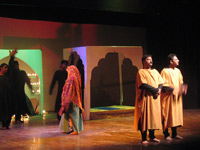
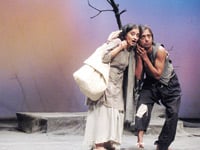
Celebrating milestones Despite hurdles, both Ajoka and Tehrik-e-Niswan have managed to survive and to be in a position to look back with satisfaction By Sarwat Ali Two of the famous theatre groups, Ajoka and
Tehrik-e-Niswan, have been celebrating their durational milestones. The two
have chosen the city of their origin as the venue for their celebration and
rightly so for most of the work of these two groups have been in the cities
of Lahore and Karachi. Thirty years of Tehrik-e-Niswan and twenty-five of Ajoka is a long enough period and worthy of being made into an occasion. The fact that these two groups have been there for decades testifies to the sixty odd years that the country has been in existence, long enough to be judged exclusively on merit without the attachments of any caveats. Usually with our myriad problems, it appears that not enough time has passed by to assess and evaluate the society and the nature of the Pakistani nation and state. However, before we realised, it appears enough water had flown under the bridge of history for Pakistan for everything to be judged ruthlessly and with little mercy. Both the groups, Tehrik-e-Niswan in 1979 and Ajoka in 1984, were formed in what was then known as the darkest period of our country's history. Pakistan has had so many dark periods that it is becoming difficult to tell one period from the other. The period was dark because it clamped down on the freedom of expression, certain artistic forms as well as curbed the right to build a more open society. Since Pakistan is a fractious society trapped in a weakening state apparatus, any ideology or system very soon tends to become repressive in character, with the ruling clique assuming the messianic role of being its only saviour. These two groups have shared many things -- a common background as well as a vision. In this sanctimonious society, that seeks a cause for every act and gesture, the mere act of performance has to be couched in some grand and venerated garb. No play can be staged or taken seriously unless it is meant to serve a cause like promoting ideas about education, health, social upliftment or gender discrimination. To make art a vehicle for a higher cause that has tangible dimensions, this has been the standard shape that the society hammers all performing arts into. In this sense, Sheema Kirmani's path may have been more difficult because she is a dancer and dance as a form is loaded with prejudice and suspicion. Many see it as another means for sensual gratification and all practitioners associated with it have slotted into preconceived roles. It has been very difficult, impossible, for all the performing artists to grow out of this societal preconceived slotting. Initially when Ajoka was formed, it was forced to do a
play in the back lawn of a house in Lahore. Badal Sircar's "Jaloos"
was an instant hit and launched Ajoka in real earnest. The plays, actually
all such theatre, received great deal of adulation and support from the
press, mainly English media though it would be wrong to limit it to the
English media only. The coverage and the criticism have always been seen in
the larger context of its symbolic value, rather than only been limited to
its technical or artistic merits. Nearly all the plays have been treated as
forums to express, dissent and oppose to an order that imposed a uniform
system in the country. Both groups have been led by strong persons, Sheema Kirmani and Madeeha Gauhar, and it is probably a proof that only strong and tough people can survive and sustain the rocky road strewn also with thorns. There have been hurdles and obstacles but the two groups have managed to survive and to be in a position to look back with satisfaction on their achievements. In the beginning these and such groups were alone and except for local support had little to bank on but gradually as things changed, the international situations underwent some transformation, fellow travellers from all over came to their help and support. Now they are in a position where they are being looked up to and backed by many more than was the case in the beginning. The understanding and camaraderie too has now a cross border resonance as the echoes of support can be heard louder than ever before. Tehrik-e-Niswan celebrations of both dance and drama spread over more than a month includes most of the plays that have been the hallmark of the group, some with original names, the others with the labels altered a little like Birjees Qadir ka Kunba, (originally Chaddar aur Char Diwari), Jinne Lahore Nahin Wakhiya, Uss Bewafa Ka Shehr and Anji. According to Sheema Kirmani, the first dance festival is being held in Karachi, in as long as she can remember -- Raqs Karo in March and the famous Song of Mohenjo Daro to follow in April. The Ajoka Festival at the Alhamra lasted about a week with performances of some of their famous plays like Hotel Mohenjodaro, Bulha, Chak Chakker, Bala King and Toba Tek Singh. This is also an appropriate time to pay tribute to all those who struggled to keep the tradition of theatre and dance alive in the country. Some of those associated with the groups are alive while some have passed away in this long period of about three decades. Many may not have been recognised and rewarded the way they should have been but the greatest reward and recognition has been that both the groups are still intact, filled with same pristine innocence to continue staging plays and dance performances. This is another dark period that we are passing through, with the performing arts being attacked directly. Perhaps one is a little wiser also about drawing a straight relationship between freedom, peace, security and prosperity. This relationship appears to be too simplistic in this complicated world where former enemies are forever becoming friends and values swapped in the name of emerging realities.
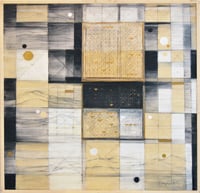
Noorjehan Bilgrami has moved from abstract aesthetics to 'readable' component in her work on display at Rohtas 2
By Quddus Mirza Going by the dictionary, the word 'order' means an authoritative command, direction, instruction, specified sequence and tidiness etc. There must be other explanations of the word, the way it's used in our conversation and writing, but in the world of art, order has one particular meaning. For a visual artist, order represents the human urge of organisation in contrast with nature's chaos. Actually the beauty of nature lies in its disorder; one
never tires of looking at the random and chaotic arrangement of stars or the
branches, leaves, flowers and fruits on trees. The vitality of nature
manifests in its unsystematic placement of entities, except in humans and
other creatures, which are modelled on a perfect scheme of symmetry, so that
if you slice them from the middle, the two halves exactly replicate each
other. It may be this 'inbuilt' idea of symmetry in his body that forces the human mind to seek to create order around him. This order not only helps him to comprehend the world of his surroundings, it also serves to assume a control and maintain a power on the wild force of nature. Classification, categorisation and demarcation -- various aspects of order -- are efforts to access nature and its objects. In a way patterns, designs and motifs are all attempts to translate and thus alter the elements of nature. One hardly finds basic geometric shapes in nature. Human beings wish to treat and transform everything they see into a system of symbols, which they can possess, store and use for communicating with others. In various cultures and different epochs, geometric symbols and motifs have acquired religious significance. So whether these are Tantric motifs, Islamic designs, or patterns drawn by primitive tribes, all are ways of taming and transforming the physical world for the sake of the spiritual. Hence one can detect traces of visible world, detached, disguised and developed (elevated) in a variety of motifs, arabesques, and patterns, both in two-dimensional arts and three-dimensional objects. In fact the history of making geometric patterns, in all civilizations, besides imposing order, is a means of introducing a sense of abstract in pictorial expression. Visuals, based on elementary shapes and their repetition, affirm a profound stage in human culture: That instead of relying on the accurate rendering of the world which can provide 'information', it suffices as a substance for the senses. This feat is a step ahead in the artistic development and represents a specific attitude where a work of art is not required to reproduce physical forms, but serves to stimulate imagination and feelings through a manipulation of pictorial elements. Several societies, including ancient, Western, Muslim and modern, have been engaged in a constant exploration of this aspect in the visual arts, from the archaic simplified motifs of fish and leaves found in the Egyptian, Mesopotamian and Indus Civilizations, to Iranian and Central Asian arabesque, till our own time, in the form of abstract expressionism and hard-edge paintings (especially after Vassily Kandinsky and Piet Mondrian). Throughout history, artists from Islamic countries as well as belonging to Indian tradition of Hindu and Buddhist art, also aimed to explore the spiritual content through geometry. For a number of years now, Noorjehan Bilgrami has concentrated on basic shapes, such as rectangles, square, circles and triangles. These visuals appear in her canvases in undulated areas of greys, blues and browns: Colours that have a link with natural dyes, and compliment each other in a minimal composition. So even though the works are created with multiple shapes and shades, these have a unified impact effect. Looking at those canvases, one becomes attracted to the intricacies of surface, subtlety of textures and delicate division of harmonious hues. All of these appeal to senses and leave a mark in the memory (particularly for their sensitive application of paint and simplified imagery). Bilgrami's interest in evolving this kind of vocabulary is not surprising, since she has been involved in textile design, and her experience of dealing with basic shapes in pure organic dyes must have penetrated into her paintings too. In her work, one is unable to 'recognise' an image. On the other hand, the interplay of shapes, forms and pattern offers a richness of its own. However, lately, Bilgrami has been trying to develop a different sort of imagery; along with geometric shapes and flat areas of colours, some kind of landscape is also introduced. This preference for the 'real' was first spotted in the group show Nocturnal Song, held in December 2008, and her recent one person exhibition 'Traversing Terrains' also contains canvases with identical concerns and solutions. In most of the paintings at Rohtas 2, geometric divisions are superimposed with traces of mountains and circles of moon shining in between. The mere fact that the artist felt a need to incorporate the 'readable' component is a sign of her shifting position on the purity of pictorial language. Lines of mountains and tiny disks of moon, demonstrate that now she is not relying entirely on abstract aesthetics. Her decision (in all probability an unconscious move) affirms the transition, which turns her work from the realm of senses to the reality of observation. There can be various reasons for this modification, but perhaps a growing weariness of being a designer -- and not a full-time painter -- could have steered the change (because an artist is normally perceived as the image-maker, whereas a designer is considered to be merely the decorator of surfaces). This divide, which does not exist internationally (only if one recalls artists such as Mark Rothko, Ad Reinhardt and Barnett Newman), may have contributed in converting Noorjehan Bilgrami from the painter of senses to the presenter of scenes. (Her solo exhibition was held from Feb 19 to March 3, 2009, at Rohtas 2 in Lahore).
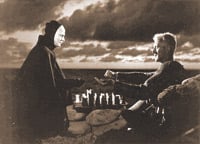
Ingmar Bergman established his place among the ranks of the truly gifted European directors of the time with the release of The Seventh Seal in 1957
By Khayyam Mushir "And when he opened the seventh seal, there followed a silence in heaven about the space of half an hour. And I saw the seven angels that stand before God; and there were given unto them seven trumpets... ...And the seven angels that had the seven trumpets prepared themselves to sound." Revelation 8, The Book of Revelation.
The auteur theory of film criticism was popularised in the
1950s through the writings of Francois Truffaut, himself a film director and
critic. Truffaut advocated the ideal that a director's work should reflect
his personal vision, that he should utilise the medium of cinema to literally
author the final product, the film, which must bear the indelible mark of his
unique vision. While Truffaut, a Frenchman, was primarily concerned with
French cinema, his theory had already been put in practice in other parts of
Europe, most notably Sweden. In 1957 with the release of The Seventh Seal (his seventeenth film), Ingmar Bergman established his place among the ranks of the truly gifted European directors of the time, as the first auteur of Swedish cinema. Shot in a mere thirty five days and with a meagre budget, it is a masterpiece of cinematography exploring existential themes such as the meaning of life, the loss of faith and the inevitability of death as a reflection of the futility of man's existence. The film's title, a reference to Christian eschatology (the Seven Seals described in the Book of Revelations) is aptly manifested in the plague-ridden country to which the films lead, the disillusioned knight Antonius Black superbly played by Max von Sydow, returns from the last Crusade accompanied only by his squire Jons (another fine performance by Gunnar Bjornstrand), a cynic and atheist. Black grapples with his dismay at having returned to a land he no longer recognises and with the growing realisation that he has begun to doubt God's existence. At the outset he encounters Death, who announces that his time is up. Black, who yearns for a last chance to meet his wife and to find some meaning in his life before the final curtain falls, challenges the grim reaper to a game of chess. The stakes -- his life for the duration of the game, his loss of life should he lose the game and his victory to guarantee the right to live. During intervals from the game, Black continues his journey with this squire and contemplates his loss of faith. We see him encountering different characters, all struggling to live, or unjustly condemned to death by man with no hope of divine intervention. The genius of Bergman and Sydow lies in their portrayal of Black's torment as he struggles to reaffirm his faith unable to accept that his was a life without meaning. Constantly taunted by his squire Jons, the cynic, to accept that there is no God or Devil, Block trudges through uncertainty and despair, using his wits to outplay death and find some peace and possibly the truth in acquaintances old and new. Finally he loses, but not without a finishing move through which he liberates a young couple and their newborn from the clutches of the reaper thereby giving some meaning to what he knows has been a wasted existence. There are important messages in Bergman's examination of
life. He exposes preachers for charlatans who make a living out of preaching
doom, advocating guilt and self-flagellation as penance for the desire to
live and instilling fear in the heart of the common man for this cardinal sin
by painting lurid pictures of the grave, the day of judgement and God as a
sadistic puppeteer incapable of compassion. He lays bare the futility of all
war whether fought for God or country as unable to alleviate the common
suffering of man except through death. And finally he challenges the utility
of organised religion in his meeting with a witch who has been sentenced to
burn at the stake for being possessed by the devil: he demands she summon the
devil so he can inquire of the truth from him. She replies that he is present
at all times in her, that he must be as the clergymen, the magistrates, the
soldiers and the townspeople who condemned her are always able to see him
when they gaze upon her. Shot in black and white that adds to the grim ambience of the feature, The Seventh Seal won the Special Jury Prize and was nominated for the Golden Palm award at the Cannes Film Festival in 1957. It catapulted Bergman and his cast of favourites including Sydow and Bibi Andersson to fame within the European film community. It is part of the director's magnum opii of films, which include Wild Strawberries, The Silence and Persona. Bergman died in Sweden in July 2007 at the age of 89.
Dear All, The death of little Ivan Cameron at the end of last month seems to have touched the hearts of the British people. Ivan was the six-year-old son of the leader of the
Conservative Party, David Cameron. He was a severely disabled child who was
born with multiple sclerosis and epilepsy. He could not use his limbs or
speak, and some time ago, his parents had to make the difficult decision to
have a feeding tube put into his stomach. Ivan was the eldest of the Camerons'
children; they have a five-year-old daughter and a three-year-old son. Ever
since David Cameron was catapulted into the spotlight by becoming leader of
the Tory party, Ivan and the rest of the family were in the public eye. The Camerons were candid about Ivan's disability and he was always part of family life. Some commentators had been critical of the family's Christmas card, a photograph which showed the family sitting together, Ivan held tenderly in David Cameron's lap. The criticism had been to the effect that it was offensive that the little boy should be "put on display." India Knight, writing in The Sunday Times summed up this logic rather well: "There were dissenting voices: was it seemly to parade a disabled child in public? Was David Cameron somehow trying to make political capital out of his son, to gain sympathy and votes? Would it not be more proper to be old-school about it and hide the complicated truth from the coy eyes of the disability-shy British public?" Knight is appreciative of how the Camerons handled the situation and says they "didn't parade Ivan -- they made a brave and honest show of love." Indeed, it was only after the little boy's sudden death that we learned more about how the family had coped with their son's disability on a day-to-day basis. Yes, they had help; they had nurses and carers, but the parents were always there, one of them always sleeping on the hospital floor by his bedside whenever Ivan had to be suddenly rushed into hospital (which apparently was quite frequently). Many commentators were appreciative of the fact that
simply by not attempting to hide away the disabled child, they had drawn
attention to the whole issue of how a society should treat those with
disabilities. An interesting contrast is that of the British Royal known as
Prince John who was the uncle of the present queen, Elizabeth II. He was the
youngest son of Queen Mary and King George V of Britain and was an epileptic
with some learning disabilities. He spent his life hidden away from public
view, as he was an embarrassment to the Royals. The little boy lived on a
separate estate with his nanny and died in 1919 at the age of just 13.
Neither of his parents was by his side when he died. He does not appear in
any family photographs, and for many years very little was known about him as
the royal family almost succeeded in editing him out of history. Prince John's story was very sad, perhaps even sadder than Ivan Cameron's, although Ivan's disabilities were much greater. The Camerons say their life was enriched by the very presence of Ivan and even though they acknowledged the stress involved in his care they have expressed gratitude for his existence. With examples like that, you'd think most people would have come a long way in their perceptions of disabled people and their place in society. Alas, this is not the case. Recently some parents of children watching a BBC children's programme (CBeebies) were outraged by the fact that the pretty young presenter Cerrie Burnell had only one hand, and a stump where her right hand should have been. Many parents complained and one father actually said he would stop his child from watching because the presenter might "give his child nightmares." Another said the presenter might "scare the children." I was deeply shocked by this reaction, and really quite appalled by the ignorance and stupidity of these individuals. I personally find their ignorance and small mindedness much more scary than the sight of a disabled child or a one-handed human being. Ignorance is perhaps the greatest disability of all. Best Wishes Umber Khairi |
|