


|
|
|
|
 |
 |
   |
cricket Sports
must not surrender to terrorist attacks: Lodhi Cricket
banished from Pakistan? cricket Home
series in foreign countries... what next? Fear factor on the cricket grounds By Muhammad Asif Khan Setback after setback has been the story with Pakistan cricket after the shocking attack on the Sri Lankan team in Lahore last month. The latest jolt was the cancellation of the Bangladesh tour. Frankly speaking this cancellation was on the cards as the terrorist incident in Lahore did just not have an impact on the whole South Asian region and not only Pakistan but the boards of India, Sri Lanka and Bangladesh have to also stand up and nullify the fear-factor in the minds of other cricket playing nations.
What will keep the flame of Pakistan's cricket burning? Most people in Pakistan believe that cricket among women here is a kind of new phenomena. Cricket was being played here back in the 1970s also when firebrand prominent Lahore students like Shamsi Sheikh started her own little group By Gul Hameed Bhatti By the time the Women's World Cup cricket has changed
a new owner early today at Sydney, much of the cricketing scene has
certainly undergone a kind of revolution. Of course, both England and
New Zealand, the two eventual finalists, have been in the finals before
with England having won titles twice including the inaugural honour in
1973 and New Zealand claimed the trophy once in 2000. Yet the 2009 event
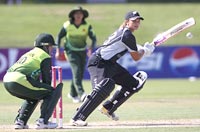
has been more closely fought as compared to any other before this. The fact that in a eight-team competition two of the sides had to qualify for the mega event from an earlier tournament, goes to show that some kind of tussle was also staged at an earlier stage. From a qualifier tournament in South Africa last year, winners South Africa and Pakistan, the runners-up, joined the six top teams in the World Cup competition in Australia. That Pakistan went on to win not one but two matches in the first two stages of the tournament goes to show that they too are making waves in the realm of international cricket. On Saturday, they were playing in their fifth-sixth place match against the West Indies in Australia and, if this doesn't give them the top world honours, at least this fact places them in the top fraternity of the cricket-playing women. A fifth or a sixth place will not earn them any trophies in Australia. But Pakistan and the West Indies will then earn automatic entry into the World Cup qualifiers for the 2013 competition in India. The bottom placed two teams this year -- South Africa and Sri Lanka -- will have to qualify from a lower level tournament to the actual qualifiers in case they want to play in the World Cup. So would, however, Pakistan will have to also. Most people in Pakistan believe that cricket among women here is a kind of new phenomena. Cricket was being played here back in the 1970s also when firebrand prominent Lahore students like Shamsi Sheikh started her own little group. Pakistan's famous all-round athlete and tennis player Tahira Hamid launched her own fraternity. Tahira is also well known as the famous sports coach and administrator Major 'Tooti' Hamid's daughter and the sister of Pakistan's fast bowler Farooq Hamid. It was not until 1997 that a bunch of Karachi enthusiasts formalised a sort of cricketing group that soon developed into a proper cricket team. For some eight years they kept the country's colours flying all around the world and remained Pakistan's representatives at the International Women's Cricket Council (IWCC). When the International Cricket Council (ICC) took over women's cricket over too, the Pakistan Cricket Board (PCB) became women's cricket's guardians too. Only a handful of girls survived from the pioneering group. Among the players who represented Pakistan at the World Cup included skipper Urooj Mumtaz, star all-rounder Sajida Shah and wicket-keeper Batool Fatima. There have been no big individual performers yet but at least the team's bowling is improving fast. The fielding still needs a lot to be desired and the batting doesn't appear to be getting into the big runs. More exposure to be getting the trick and sooner than later the Pakistani women will surely make rapid strides towards the top. Since having come under the official tutelage of the PCB, the women's cricket wing has flourished in its own manner and with its own steam. The team has appeared in three Asia Cup competitions and at the World Cup after having qualified unlike the 1997 team under the Khan sisters which earned direct entry. The girls now have an average age of only 22 or so years and that gives them the kind of head start that they were looking forward to. Post the 2009 World Cup the biggest event that the Pakistani girls would be able to embrace is surely going to be the ICC Women's World T20 in England. It will surely be an exciting tournament that is being played next June along side the men's World T20 event. To discover how some people would like to find out how the men and women measure up will be something that will become the talk of the town for a long time, even if it is only due to the interest generated among the fans who are being provided a double treat. Pakistan not only made the initial round but also surprised many by qualifying for the Super Six stage in Sydney. Then they earned a feather for their international cap with victory over the West Indies. The other teams were so far ahead in standards and strength that it was almost impossible to end up even near any of the top four. Since the PCB took over Pakistan women cricket affairs, a national championship was introduced in the 2004-05 season. Various inter-school and inter-district events followed in the following seasons. The PCB T20 Women's Quadrangular became part of the programme in 2008-09. Of course, the women's sport is not yet a professional one at the international level. It may have been organised more than seventy years ago and the women's world cup was started in 1973 -- two years before the men's event -- but women have not attained the kind of financial returns the men's game enjoys. Monetarily, the sports will still take time to take a real leap yet. The women in Pakistan have in a rather shorter time as comprared to other nations found feet for themselves in the realm of the men's game. In circles of power, it is slightly easier to get your voice heard where it matters and there's surely always a softer corner when girls need to be facilitated contrary to the same kind of difficulties yheior menfolk might encounter. Discrimination in its ugliest form in the urban areas of Pakistan is slowly giving way to less bigotry and the much welcome freedom. I for one, weren't looking at where the women's cricketers of Pakistan have arrived. They would have gotten here if it was not for their own men -- fathers, brothers, husbands, etc., their friends and their families. Everyone, who was involved in any way, was fully involved. That should remain the spirit of Pakistan's cricket burning always. The writer is Group Editor Sports of 'The News'
Sports must not surrender to terrorist attacks: Lodhi Lodhi further informed that the Iraqi soccer team did their most of preparations in neighbouring Kuwait and Jordan. Similarly, Afghan cricketers used to use Pakistan grounds for their cricketing activities and training
By Ghalib Mehmood Bajwa Though the recent terrorist attack on the Sri Lankan
cricket team has caused a severe loss to Pakistan sports and its image
the world over, we are quite hopeful that foreign soccer teams would
visit Pakistan for their international commitments, this was stated by
PFF Secretary Lt-Col (retd) Ahmed Yar Khan Lodhi while talking to 'The
News on Sunday' (TNS) at his office. Col Lodhi said sports is a big power and it can and has eased many tensions and solved several problems among different nations in the past. "What the government of Pakistan and other countries can do is to do every possible effort for the continuity of sports activities at every cost," he resolved. Col Lodhi asked the Pakistan authorities to upgrade their security arrangements to the highest possible level for hosting international sports events in the future. And even then if the foreign teams did not agree to tour Pakistan, no problem, we should send our players abroad or even at neutral venues so that the sports activities could remain continued. "We must keep in mind that in the given situation we must send our teams abroad (after getting NOC from our concerned authorities), if we want to convince and invite the foreign teams for Pakistan tour. For this purpose now we will have to do some extra efforts," he maintained. While giving the examples of Iraq and Afghanistan, Col Lodhi said, "Bomb blasts and other such terrorist activities are a routine work in those war-torn countries but even then Iraq managed to win the Asian soccer title and Afghanistan cricket team cleared three stages in just one year and right now they are on the verge of qualifying for grand World Cup tournament." Lodhi further informed that the Iraqi soccer team did their most of preparations in neighbouring Kuwait and Jordan. Similarly, Afghan cricketers used to use Pakistan grounds for their cricketing activities and training. "We should follow the devotion and commitment of these two countries in this hour of crisis," he opined. Replying to another query, he said these days almost all the countries are grappling with security problems and Pakistan is no exception. "Any player or team could be a victim of terrorism any time. And we do observe such mishaps from time to time in different parts of the world," he added. "In my point of view, we have several reasonable and safe venues such as Karachi, Lahore, Multan and Rawalpindi etc where we can hold international sporting events at any time," he explained. In recent years, we have hosted several international events such as Olympics, World Cup and Asia Cup qualifying rounds in Pakistan without any untoward incident. "During the last three years, Pakistan has played host to formidable outfits -- Oman, UAE and Jordan in 2006 and Singapore, Qatar, Bahrain, Kuwait and Iraq in 2007. Pakistan also hosted eight-nation third AFC President Cup in a splendid way in 2007," he added. When asked about Pakistan soccer team's upcoming tour of Sri Lanka, Lodhi said, "We want to send our team to Sri Lanka but only after getting NOC from the Government of Pakistan." It is pertinent to mention here that the Pakistan football team is scheduled to feature in a 4-nation 3rd AFC Challenge Cup at Colombo. PFF secretary appreciated FIFA for assigning AFC U-19 Football Championship to Pakistan. "The 6-Nation tournament will be played in December 2009 and will act as qualifying round for elite U-19 World Cup event," he told. Answering a question regarding Pakistan's future international commitments in 2009, Lodhi said that our different national age-group soccer teams are scheduled to take part in about half dozen international soccer tournaments in the remaining nine months of the on-going year. "After the 4-Nation 3rd AFC Challenge Cup in Sri Lanka, Pakistan's club team WAPDA will play the 5th AFC President's Cup in May. Then our boys are to participate in the AFC U-13 Football Festival in the same month in Iran. "In June this year, our football team will tour England for a 4-Nation South Asian Cup at Chelsea, England," he added. Lodhi further said that Pakistan side will also feature in 14th AFC U-16 Championship in October. Next month Pakistan will host the 6-Nation 37th AFC U-19 Championship. The six participating teams of the event are Uzbekistan, Iran, Lebanon, Turkmenistan, Maldives and hosts Pakistan. "In December, Pakistan will try to complete a hat-trick of titles at 11th South Asian Games at Dhaka," he further said. Replying a query regarding new Pakistan coach, Col Lodhi said, Pakistan Football Federation has appointed Austrian coach George Kottan after a thorough process and keeping his past performance in notice. "We have appointed Kottan, who has vast experience and knowledge of the game, only after he had impressed our panel of experts." Lodhi further informed that before finalising 62-year-old Kottan, PFF also checked the documents of Salman Ahmed Sharida (Bahrain), Klaus Stark (Germany), Moldovan Eugen (Romania), Poulsen (Denmark), Tom Saintfiet (Belgium), Angel Stankov (Bulgaria), Human Afzali (Iran), John Layton, David Burns and Karel Stromisk of Czech Republic for the coaching duty. Kottan, who has been hired for two years, will look after Pakistan's all age-group national teams -- Under-23 team, U-19 and U-16 teams. The recent Prime Minister Cup in Nepal was Kottan's assignment. Though the coach will need some time to produce the desired results the forthcoming 3rd AFC Challenge Cup Qualifiers in early April at Sri Lankan capital of Colombo will be testing a trip for the Austrian to show his worth, he said. Lodhi informed that Kottan is one of the seven gold medallist coaches in the history of South Asian Football Federation (SAFF) Championship. He was very impressive during the event six years ago as under his supervision Bangladesh were crowned champions at Dhaka. "The veteran Austrian coach will also deliver his services in Youth Development Programme, Talent Hunt Schemes, Youth Football Education Programme besides preparing a pool of coaches for the future challenges," he added. "We are planning to attach ten leading home coaches with Kottan so that they can get expertise, latest know-how of modern football from the famous coach," he said. Answering a query Col Lodhi said that PFF chief Sayed Faisal Saleh has approved an ambitious PFF Vision 2020 Plan through which Pakistan can earn a berth in top 15 Asian teams besides earning a ticket to World Cup, Olympics and FIFA age-limit competitions in next five to seven years. Faisal, the 17th President in PFF's 60-year history, pledged to continue his drive to youth development, women soccer and to professionalise the game in Pakistan. "We have achieved a lot in the last five years as compared to activities from 1999 to 2003 that showed that we are serious and committed about uplift and welfare of this game in this part of the world," Col Lodhi proudly said. The writer is a staffer at 'The News' Lahore
Cricket banished from Pakistan? After its exit from the Champions Trophy, the World Cup 2011 is set to leave Pakistan
By Waris Ali "Yes, cricket has been banished from
Pakistan," is the answer to the hot question whether there will be
no international cricket in Pakistan, in view of the rising incidents of
indiscriminate firing, bomb blasts and suicide attacks. While the
refusal of the Aussies and Kiwis, and then of England and the West
Indies, to tour Pakistan for security reasons turned out to be
absolutely justified after the Sri Lanka cricket team, which had agreed
to tour the fast-getting lonely state to expresses solidarity with it,
fell prey to the worst terror of the game's history on March 3, 2009.
The refusal of India to play cricket in Pakistan, after the Mumbai
attacks in November 2008, was more a political decision than being a
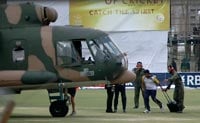
result of some security fear. Starting in September 2001, when the New Zealand team returned even before reaching Pakistan after the 9/11 attacks on the United States, a chain of terrorist activities speedily rendered Pakistan lonely, gradually alienating the cricketing nations from the South Asian country. In May 2002, a suicide bomber killed 14 people outside the Karachi hotel where the New Zealand team was staying, prompting them to leave and abandon the series; Australia had already refused to tour Pakistan for the same reason. The next year, a bomb blast in Karachi kept away South Africa from visiting Pakistan, while England refused to play a Test in Karachi in 2005. The Karachi Test had to be shifted to Multan after South Africa refused to play there after an assassination attempt on Benazir Bhutto. In March 2008, Australia bluntly refused to tour Pakistan. Terrorism, or at least the fear of terrorism, has, indeed, crept into sports and has been a major concern from Athens Olympic in 2004 to Beijing Olympics in 2008. But the March 3 attack on the Sri Lankan team in Lahore has sealed the fate of cricket in Pakistan, and endorsed the ICC decision to shift away the biennial Champions Trophy tournament from the terror-ridden country. Naming South Africa as the new hosts, the International Cricket Council in its statement said: "With the need to minimise risk and create certainty around the event, the meeting agreed to recommend that CSA (Cricket South Africa) be sought as the alternative host, with Wanderers and Centurion as the venues, provided agreement on the financial arrangements can be reached. "Originally planned for Pakistan, the venue for the event had to be shifted due to security concerns." ICC President David Morgan said: "I think the Board has made a sensible decision that will give the event every chance of success. We now have clarity on the subject and we can make firm plans for what is going to be a great spectacle of ODI cricket." While the horrible terror attack invited international fury, the security lapse made its easy to pass hostile comments about Pakistan's ability to deal with terrorists. When Australia's Prime Minister Kevin Rudd expressed his wish to seek answers about Pakistani security failings, Australian umpire Simon Taufel accused that their bus had been left unprotected by the security personnel, and England's Chris Broad said police had left them "sitting ducks", there must be some substance in their words. The video footage, captured by closed-circuit cameras, showed two suspects wearing rucksacks and ambling down the road, apparently untroubled after the carnage took place. The defensive statements of PCB Chairman Ijaz Butt and Pakistan great Javed Miandad lack full apprehension of the situation. Miandad's demand for match ban on Chris Broad, because he talk to the media despite being an ICC official, and Ijaz Butt's threat to lodge a protest with the ICC are unrealistic and apathetic in view of the gravity of situation. The statement of Lahore Commissioner Khusro Pervaiz that "A terrorist has to succeed only once, whereas security has to be successful all the time," is a fitting reply to their complaints. Conceding gap in security provision, he said, "he should put more professionalism in all the security apparatus, to come up to the expectation of the nation." The fears of Pakistani skipper Younis Khan for the future of cricket in the sports-mad country and appeal to the world to help continue cricket in the country is a balanced analysis of the matter. Younis feared that Pakistan, already a no-go zone for international teams over security fears, will be isolated. In the exile of the Champions Trophy can be foreseen the exodus of the cricket World Cup event from Pakistan. The March 3 terror has rocked Pakistan and prompted a security review for the 2011 World Cup. The ICC reaction has cast doubt on Pakistan's hopes of remaining a co-host of the 2011 World Cup, saying the attacks had changed the global landscape of the game. In connection with holding 2011 World Cup in Pakistan as co-host with India and Sri Lanka, ICC Chief Executive Haroon Lorgat has already warned that it will be difficult to persuade cricketers to play in Pakistan, though he refused to make a "knee-jerk" response to the attacks. Before this, the ICC and administrators in the four host countries were banking on the fact that the World Cup was still two years away. The PCB response to the ICC objections has little substance. COO Saleem Altaf said no Sri Lankan player was seriously injured. "We took as much care as possible and the team safely reached the airport. No Sri Lanka player was critically injured and the fourth umpire, Ahsan Raza, was also out of danger after he was operated upon." Raza, a local umpire, suffered wounds to his lungs. How absurd that Altaf took the credit of saving the players, without accepting any responsibility of attacks. In other words, he was saying that the attacks were not the incident, instead the safety of the Sri Lanka team was the incident for which all credit goes to the PCB. Of the 15 World Cup venues that had been identified, eight are in India, four in Pakistan, two in Sri Lanka and one in Bangladesh. Bangladesh is to host the opening ceremony on February 19, 2011, while the final will be played in India and the two semifinals shared by Pakistan and Sri Lanka. Australia and New Zealand are already on standby if South Asia is unable to host the tournament.
The Indian Cricket Board: The ego, separation and the illusion Retrospectively, BCCI must know that unlike the West, it lives on a triggering device and events erupt to change the political, social and geographical dynamics. India, no matter how lucrative a marketplace isn't fully a safe place for cricket's unconditional prosperity
By Dr Nauman Niaz At first glance, the goals of BCCI with reference to its huge financial market, it being the attraction for majority of top-tier cricketers and also their insight to dominate the world game might appear to conflict. BCCI after its brainchild, the Indian Premier League became a story of an overnight success, it started to use statutory rights to control access and accumulate monopolistic powers. And it also, stubbornly and quite brazenly, sidelined Pakistan, to regulate downstream activities, such as imposing exclusivity, territorial restraints and trying to isolate it in a tight corner. Inundated with success and drunk with power and unlimited opportunities, the BCCI, in the meantime, seemingly has forgotten to realise that directed at curtailing the powers and presence of other teams in the region, particularly Pakistan is fast touching the precipice of market clout which may prove harmful to subcontinent's cricket and its interests. PCB led by Dr Nasim Ashraf, apparently brokered power and stood by the BCCI to help them formulate the IPL. His support could also be seen as complementary rather than agonistic. He imagined that BCCI could stand by Pakistan and the PCB and strengthen it in the region, sharing the same fundamental goals of enhancing financial resources and promoting innovation. It was his sheer naivety admixed with hankering and self-interest. BCCI shouldn't be discredited for tapping the financial resource within India and tried to control robust competition in the marketplace, also protecting the ability to earn a return on the investments necessary to innovate. BCCI, however, instead of spurring competition among rivals to be the first to enter the marketplace with a desirable technology, product or service, deviated from the corporate ethics and attempted taking a big bite within the subcontinent. BCCI as a result could confer an economic monopoly but ended up leaving ethics and democratic moral principles shredded with their egocentric deportment. BCCI couldn't figure out the philosophical, historical and physical wedge between the Western and the Asian block. It is quite evident that temporarily dazed by the whole lot of opportunities, ICC first moved its headquarters from Lord's in London to Dubai and then tried playing second-fiddle to the BCCI. This was inevitable but resolutely and pragmatically, it shouldn't be incessant. The moment, the Western block would realise that India's marketplace was saturating or curtailed being a potential place for ethnic, religious, political and racial violence, it would step back and retaliate with muscle and arrogance. And BCCI must also realise, with respect to a specific product, process or work, there may be sufficient actual or potential close substitutes that constrain the exercise of market power presently owned by them. India has had its share of ethnic, political, state and religious terrorism. How could the BCCI be sure that the geo-politics wouldn't see a paradigm shift in the future. Mumbai has been the most preferred target for most terrorist organisations, primarily the separatist forces. Over the past few years a series of attacks including explosions in local trains in July 2006, to the most recent and unprecedented attacks of November 26th, 2008, where two of the plush hotels and another side building, in the south of the city were sieged. The history of terrorist attacks in Mumbai included a series of 13 bomb explosions on March 12th, 1993 killing 257, followed by the August 25th 2003 explosion in a car near the Gateway of India and Zaveri Bazaar killing 50, series of seven bomb blasts in trains killing 209 on July 11th, 2006 added to the coordinated series of attacks killing at least 172 between November 26th to November 29th, 2008 -- that's just the cosmopolitan Mumbai. Jammu & Kashmir has in its history quivering tales of terrorism. Bihar is another volatile province. Existence of certain groups like the CPI-ML, Peoples War, MCC, Ranvir Sena and Balbir Militias is a major concern as they frequently indulge in aggression against the law-enforcers and the politicians. Then is the Punjab; during 1970s, the Indian Green Revolution brought increased economic prosperity for the Sikh community in Punjab. This propensity kindled an age old fear in the Sikh community -- that of being absorbed into the Hindu folds and led to the rise of Sikh militants. The insurgency intensified during 1980s when the movement turned violent and the name Khalistan resurfaced and sought independence from the Indian Union. Led by Jarnail Singh Bhindranwale who, though not in favor in the creation of Khalistan but also was not against it, began using militancy to stress the movement's demands. Soon things turned bloody with India alleging that neighboring Pakistan supported these militants, who, by 1983-84, had begun to enjoy widespread support among Sikhs. In 1984, Operation Blue Star was conducted by the Indian government to stem out the movement. It involved an assault on the Golden Temple complex, which Sant Bhindranwale had fortifed in preparation of an army assault. Indira Gandhi, India's then prime minister, ordered the military to storm the temple, who eventually had to use tanks, helicopter gunships, artillery and chemical weapons. According to Indian government sources, eighty-three army personnel were killed and 249 injured. Militant casualties were 493 killed and eighty-six injured. Again in 1985, the assassination of Indira Gandhi by two Sikh bodyguards, believed to be driven by the Golden Temple affair, resulted in widespread anti-Sikh riots, especially in New Delhi. Following Operation Black Thunder in 1988, Punjab Police, first under Julio Ribeiro and then under KPS Gill, together with the Indian Army eventually succeeded in pushing the movement underground. In 1985, Sikh terrorists bombed an Air India flight from Canada to India, killing all 329 people on board Air India Flight 182. It is the worst terrorist act in Canada's history. The ending of overt Sikh militancy in 1993 led to a period of relative calm, punctuated by militant acts (i.e. the assassination of Punjab CM, Beant Singh in 1995) attributed to half a dozen or so operating Sikh militant organisations. These organisations include Babbar Khalsa International, Khalistan Commando Force, Khalistan Liberation Force and Khalistan Zindabad Force. Three explosions went off in the Indian capital of New Delhi on October 29, 2005 which killed more than 60 people and injured at least 200 others. The high number of casualties made the bombings the deadliest attack in India of 2005. It was followed by five bomb blasts on 13 September 2008. The Delhi summit on security took place on February 14, 2007 with the foreign ministers of China, India, and Russia meeting in Hyderabad House, Delhi, India to discuss terrorism, drug trafficking, reform of the United Nations, and the security situations in Afghanistan, Iran, Iraq, and North Korea. Terrorists on December 13th, 2001 attacked the Parliament of India resulting in a 45-minute gun battle in which nine policemen and parliament staffers were killed. The long simmering Ayodhya crisis finally culminated in a terrorist attack on the site of the 16th century Babri Masjid -- demolished Ancient Masjid in Ayodhya on July 5, 2005. It isn't significantly different from the situation in Pakistan, rather the hugeness of India and weak political interconnections make it more susceptible. Retrospectively, BCCI must know that unlike the West, it lives on a triggering device and events erupt to change the political, social and geographical dynamics. India, no matter how lucrative a marketplace isn't fully a safe place for cricket's unconditional prosperity. Throughout history, revolutions and political changes have brought the fall of one organisation or system only to replace it with another. "Round and round she goes, when she stops nobody knows!" In the present India-Pakistan situation, restricting to cricket alone, BCCI's egocentricity has been viewed as the root cause of the game's suffering, though indirectly in Pakistan and we still continue to jump on this ages-old, broken bandwagon. We have been led to believe that BCCI's inflated ego must be undone, negated or at least brought down a peg or two, convincing them that their prosperity would last from within the subcontinent with Pakistan, India and Bangladesh being the other three wheels. I genuinely believe that given Indian cricket's present economic growth my inclination to batter and blame BCCI's ego mentality is not only logically nonsensical, it is also irresponsible. They are ruling the roost and ready for complete domination, not in Asia but also contemplating to emerge as a major governing force in world cricket, effectively endeavoring to sabotage the ICC. Secondly, I assert that it's not the ego that's the true cause of the way things are in Asia, but rather the soul or the higher self. This includes the current crises. Although this may be hard to believe, it's true. It's time that both the BCCI and the PCB should know that the higher self's primary motivations are to experience, and through a variety of challenging experiences, to grow; they would also need BCCSL and the BCB. In fact, this is the time our collective higher selves actually engineer what's known as the illusion in order to accomplish some highly noble intentions on this Asian Block, otherwise Pakistan may well not but BCCI would end up in a real tight corner, completely isolated needing to learn through contrast and spirituality. By reconnecting within and viewing life from this higher-level perspective, you can achieve all these goals most quickly and easily. Then your life can't help but soar. Not only India, but Asia would benefit and BCCI would still be the driving force with its magnitude and prosperous economy. Otherwise BCCI would end up as a story of ego, separation and an illusion. And at the same time, the PCB needn't seek sympathy but try standing on its own feet. And it would only be possible if we sit on the drawing board and prepare a vision to see cricket prospering in the country and also try influencing the ICC through logical plans and rationale. Mr Ijaz Butt has to start now! The writer is a Member of the Royal College of Physicians (UK) and official historian of Pakistan cricket Home series in foreign countries... what next? Whilst this may be a fact we ourselves should not be the people to advertise this sad state of affairs. Also having set a bad precedence due lack of forethought does not mean that we can justify repeating a bad practice
By Malik Arshed Gilani p.s.n. It is with much pleasure that I have read the three or four statements of the Chairman PCB given to the newspapers that he will bring international cricket back to Pakistan very soon. In fact this is almost the only subject that appears to be receiving his full attention. I feel sure that I voice the opinion of all cricket lovers by saying that we are comforted by the optimism of the PCB. Unless there is some need for secrecy in the process that the PCB intends to follow in executing these noble aims, we surely would be keen to learn as to exactly how this significant change in the approach of other governments and cricket boards is to be brought about. As of last count, I hear that even the World Cup
Secretariat office is being shifted from Lahore. Have we found out the
culprits of the Lahore attack? Have we found out who is responsible for
planning the attack? Have we found out what security lapses permitted
the assailants to carry out this attack with no loss to them? Have we
found out specifically who is responsible from amongst the IB, FIA,
Police or the PCB? Have we managed to satisfy the Sri Lanka Board that should they decide to visit this country again it is guaranteed that they will be safe? Have the guilty on our side be they the assailants or members of any of the named organisations been punished? Finally which senior enough individual has offered to resign to start the blood letting that will be necessary before any team will visit Pakistan? Good intentions will not be enough. I believe that if we push this matter under the rug it will be a very long time before any team will trust us, conversely, if we are forthcoming, honest and diligent in seeking out the culprits and apportioning the blame squarely there can be hope to see international cricket in Pakistan in under a year. I would like to dedicate the rest of this week's article to the subject of playing our 'home' series in other countries. I am absolutely clear about one thing that a 'home' Series can only be played at home. In light of the difficult situation we find ourselves right now there surely is an argument for ensuring we play International Cricket. We must also accept that each time we play in a 'neutral' venue we say loud and clear that Pakistan's Government and the PCB accept that, Pakistan is unsafe for international cricket. Whilst this may be a fact we ourselves should not be the people to advertise this sad state of affairs. Also having set a bad precedence due lack of forethought does not mean that we can justify repeating a bad practice. This in no way means that we should stop playing cricket according to the Future Tours Program. Let us examine all the possibilities that could with dignity allow the Pakistan team to remain a part of the international scene. Here for one brief moment I will digress to state with pride that Pakistan's cricket team was the team that most Test countries feared. It was the team they wanted to beat. It was thus the team that had the best commercial draw. It may not be that now but the quicker we make our way back to our winning ways we will ensure a need for other countries to help us in our troubles. I was pleased to hear an ex Chairman of the PCB voice these same views. Returning to the main theme about where we should play our scheduled series. The first option that I would suggest is, for example, to request Australia to play this scheduled series in Australia and in turn play their next home series against Pakistan in this country. Should this not meet our financial needs, the second option could be that we request the ACB to allow Australian grounds to host our matches and find a way of giving them commercial recompense. This would give up our home advantage but we would at least earn the financial income that we are expecting from playing in Pakistan; i.e. television rights, team sponsorship etc. Our players could also benefit from the experience they would get from playing under Australian conditions which would be useful for them in the future. Both these options would at least send the message that we expect the current difficult situation in Pakistan to improve in a reasonable time span. Should both the above cases for whatever inexplicable reasons not appeal to our Board then in worst case scenarios whereby we will highlight our problems, one could consider the possibility of playing the series in a friendly country that is a full member of the ICC. England, Sri Lanka even South Africa comes to mind. This again has the advantage of getting us the assistance of the ICC in getting the best possible commercial deal and also ensuring a large turn out of pro Pakistan fans due to the population mix of those countries. The countries and grounds selected could help us get some PR value as this would also commercially benefit them as awindfall. Alternatively we could play our matches at official venues that are owned by or affiliated to Associate Members of the ICC and yet again we could benefit in the ways outlined above. I believe we should not lay ourselves open to question by choosing privately owned Venues that have never ever hosted an international match having no direct affiliation with the cricket board of their own country or even the ICC. This kind of official recognition and credibility can only be given in today's commercial world subject to a totally transparent process. The venue in question should not only pay the PCB for holding this event (with no costs) but also to ensure the payment of a royalty for all future international cricket events. We must remember we are dealing with a commercial company that has no government connections and thus must be treated as such. Failure to do so will in all possibility raise eyebrows of even those of us who have total faith in the PCB's present financial dealings. Finally let us all be aware that the problems of security are looming on the horizon of many cricket playing countries. Not the least among them is India. The power of money was able to convince the last team to return to complete their tour in another city. I am not sure this will continue to be the case. Already provincial governments have indicated their inability to provide safety for some of the IPL matches. The BCCI in trying to take the World Cup away from Pakistan and offering to stage our share of the matches in India was a crude method of saying that they are a safe country whilst at the same time taking political advantage. Is it so easy to forget the horrors of Mumbai? What about Pakistani cricketers playing in India? Will it be safe for them? This is not the time for any one of us to steal a march on the other. It is time for all members of the ICC and ACC to band together and fight the good fight to help each other in positive ways to see the game of cricket being played everywhere. We will need to take strict security measures and just maybe it will place strict limits in the movements of the players but surely inside the grounds it can be ensured the game continues in its true spirit. The writer is a freelance contributor malikgilani2002@yahoo.com
Fear factor on the cricket grounds The Indo-Pak situation has changed completely so the players should also realise that in view of the national interest they should also distant themselves from the league and I would urge the Pakistani IPL players to do the same too
By Muhammad Asif Khan Setback after setback has been the story with
Pakistan cricket after the shocking attack on the Sri Lankan team in
Lahore last month. The latest jolt was the cancellation of the
Bangladesh tour. Frankly speaking this cancellation was on the cards as
the terrorist incident in Lahore did just not have an impact on the
whole South Asian region and not only Pakistan but the boards of India,
Sri Lanka and Bangladesh have to also stand up and nullify the
fear-factor in the minds of other cricket playing nations. With all the unpleasant events another important issue has definitely taken a backseat. Without a doubt this ICL-IPL issue has dented the Pakistan cricket big-time and the PCB should put in serious efforts towards finding a solution to this issue because Pakistan cricket is suffering more than anything else as more than a dozen top quality individuals including Pakistan's premier Test batsman Mohammad Yousuf have been barred from playing for Pakistan therefore this issue should be addressed on a priority basis now as the return of the ICL-bunch would help the team become steady again. Very little is in the hands of the Pakistan cricket board as ICC's general manager for cricket operations Dave Richardson said he does not think cricketers linked to the rebel league are likely to get legal relief to play for their national teams. In this scenario it seems very hard that the players can play the ICL as well as represent their respective country therefore the PCB should adopt a reconciliatory approach and talk this issue out with the players involved in the ICL. Previously the case was different but after the November 26th 2008 attacks in Mumbai the Indo-Pak situation has changed completely so the players should also realise that in view of the national interest they should also distant themselves from the league and I would urge the Pakistani IPL players to do the same too. In the meantime Kapil Dev has already decided to sue the BCCI over this issue therefore wait and see strategy would be a better option for our players. I would like end this piece on a depressing development after the attack on the Sri Lankan team. Everyone has been rightly full of praise for the bus driver (Maher Muhammad Khalil) who managed to safe the Sri Lankan. The Pakistan cricket board is to arrange a ceremony to acknowledge his service and the Sri Lankan government has invited him along with the family to visit Colombo as a state guest. Khalil truly deserved the appreciation but what about another fellow, Ahsan Raza who was in the van carrying the ICC officials to the Gaddafi Stadium. The 34-year old Ahsan Raza was the fourth umpire in the last Test match against Sri Lanka, was seriously injured during the bloody episode on March the 3rd. Until now no aid has been announced for him until this writing. Ahsan Raza has undergone surgical procedure twice and some 20 blood bottles have been transfused and doctors feel that he still needs intensive care. What is disheartening is the reported behaviour of the PCB high-ups who in the beginning did visit him a few times but no financial assistance has been announced for Ahsan as yet who is the father of three daughters. I appeal to the cricket board as well as the supporters of Pakistan cricket who time and again announce hefty rewards for our cricketers to look into this matter as well as Ahsan Raza suffered in the line of duty. I would also like to appeal to the patron-in-chief of the board (the President) to help the young man fighting in a hospital bed. The writer is a freelance contributor |
|