


|
|
|
|
 |
 |
   |
performingarts Sadak
Chaap ups&downs graffiti book
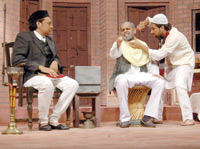
All the city's a stage Despite the problems artistes are faced with, one thing becomes clear after talking to professionals in the industry: the stereotype that Lahore is the cultural hub of arts is no longer tenable By Rafay Mahmood With World Theatre Day having come and gone on March 27, the power of the stage is being celebrated across the globe, and Karachi is no exception. "We bring theatre to the masses," boasts Sheema Kermani, founder of Tehrik-e-Niswan. "It is something that no one else does." From the post-independence era, theatre in Karachi
has travelled a long way, striving to highlight social issues of its
time, even during the days when censorship was practised with an iron
hand. But with a host of problems plaguing the industry in Karachi, the
recent controversy surrounding the National Academy of Performing Arts
(NAPA) being the most famous one, many see little reason to celebrate. "Karachi is the only place in the world where a tax for the seating space has to be paid before a play is even performed," says Khalid Ahmad, senior theatre producer, director and faculty member at NAPA. "Usually you book a space and pay tax after the event has taken place. In our case, if fewer seats are occupied than what we paid for, we have to chase the authorities to get our money back." Ahmad feels that the golden era of theatre in Karachi has long passed. Contrary to the popular belief that theatre artistes suffered the most during dictatorial regimes, he believes 'the best time for theatre was in the eighties during the regime of General Zia-ul-Haq.' "With just one state-run television channel, PTV, there were many restrictions on art forms. That was when theatre groups like Ajoka, Natak Wallah and Tehrik-e-Niswan used the stage as a platform for voicing the concerns of the masses." Today, however, he is pessimistic about the future of
theatre in Karachi, partly because many of their problems have not been
solved for decades. "We still have the same problems we had 30
years ago," he argues. "It is essential for artists to get
proper rehearsing space, but right now the only place they have is the
Arts Council. Theatre should be considered a proper art form and be
supported by whoever is ruling at the time." Kermani, who founded Tehrik-e-Niswan as long ago as 1979, agrees that little has changed. "In fact, theatre groups were more regular, there were many more theatre halls and far more performances from abroad," she says as she mulls over how theatre has evolved. "That was a time when the British Council and the American Consulate, along with other cultural centres brought in their own plays." Like Ahmad, Kermani is saddened to see the lack of space for artistes, and insists that having enough venues is very important for theatre to develop. She blames the government, which has made it necessary to obtain a No Objection Certificate (NOC) and pay excise tax before any venue can be made available. "We have no government support and very little corporate funding," she complains. Kermani's complaint is not baseless. As Khalid Ahmad points out, after the change in government, all funding for NAPA has been slashed to a third of what it used to be. "Because of this, our tickets are more expensive. Our target audience has narrowed down, but we are
helpless. We incurred a loss in our last four productions." Despite all the problems, one thing becomes clear after talking to professionals in the industry: with the formation of the NAPA Reparatory Theatre Company and the Tlism festival, the stereotype that Lahore is the cultural hub is no longer true. Most theatre groups now perform before an audience in Karachi before they move to entertain those in Lahore. "I won't argue that there was a time when it was so, but the traditions and culture of Lahore are different now," observes Ahmad. "Groups such as Rafi Peer Theatre are still doing a brilliant job there, but the audience in Lahore and the way they think has changed." Kermani, meanwhile, goes so far as to claim that Lahore was never such a hub of liberal arts. "I have always thought that to be a myth," she confides in Kolachi. "To me, Karachi has always been the hub, whereas Lahore is conservative and provincial." The swing in perception is evident. Where on the one
hand, serious theatre has an audience, one cannot ignore the commercial
plays like those of stand-up comedian Omar Sharif who has managed to
cultivate an enthusiastic and responsive theatre-going audience in
Karachi. Although certain groups dismiss Sharif's brand of theatre for
distorting public taste, it is one area where Ahmad remains uncritical. "You cannot criticise commercial slapstick theatre productions, because they have a different goal," he says. "They are meant for an audience from the lower-middle class who need a place to go to laugh out loud." By contrast, non-commercial theatre targets an audience from the higher social strata – people who see plays to get food for thought, but as Ahmad is quick to add, "Even serious theatre needs to be entertaining, or it would fail." However, there are some who find serious theatre
still entertaining. Asad Shahzad, a student, saw Habib Mamoon two years
ago, and since then, he saves up to see all the plays he can at the Arts
Council.k "Believe me, after I saw Habib Mamoon, which has legends like Rahat Kazmi, Talat Hussain and Arshad Mehmood, I have not missed a single play," he says. "It is a form of entertainment even my parents don't object to." In addition to the plays, Shahzad has words of praise for the audiences in Karachi. "You don't need to talk to them to get their feedback," he says. "You can judge their response from their faces and the discipline with which they watch plays. I think they're better than the audience in Lahore, or anywhere else."
NAPA: producting quality fare The National Academy of Performing Arts (NAPA) is the first government institute in Pakistan to focus on the performing arts. Established during the Musharraf era, NAPA is headed by Zia Mohiuddin, considered one of the greatest performing artists of the sub-continent. The NAPA board also includes other icons such as Talat Hussain, Rahat Kazmi, Dr Anwer Sajjad, Arshad Mehmood and Khalid Ahmed, among others. "I was always interested in the performing arts, but felt something was missing," says Zeeshan Haider, a former NAPA graduate and adjunct faculty member at SZABIST. "At the time, there was only the Indus Valley School of Art and Architecture, but its high fees put it well out of my reach. It was only when NAPA came along that I was able to learn what I wanted." NAPA fees come up to Rs6,000 a semester, which Haider says is a very small price to pay for the high-quality training its students get in return. However, despite the high standards of NAPA, Haider – who now teaches acting classes himself - is unsure about the future of professional actors in Pakistan. "The state of the industry is so bad, it cannot get worse," he says. "I can only hope for something better, although it will probably take another 10 to 15 years for there to be a technical acting degree such as a BBA in Pakistan." –RM
How many plays did you see in the past year? By Sadia Hanif Uzma Abr Rasheed, 24, Lecturer: "I saw four plays in the past year." Muneeza Khan, 23, student: "I only saw one
musical over the past one year and that was Chicago." Sara Iqbal, 24, Assistant coordinator: "I am quite fond of theatre but unfortunately did not see any play in the past year." Shaista Noor, 35, Housewife: "I saw about two plays recently-Insha Ka Inteezar and Nawab Sahab Qibla" Feroz Shah, 36, teacher: "I make it a point to
not miss any play when in Karachi but unfortunately I was not in the
city last year. Since I returned, I saw only one play recently." Nida Khan, 24, Psychologist: "I saw a few plays by Tehrik-e-Niswan and one called Pak Zar Zameen ." Maryam Javaid, 25, Law internee: "I just saw one famous musical that came to Karachi recently - Chicago." Fatima Zakir, 25, workingwoman: "I saw about three plays over the past few months." Rabya Ali, 22, Recent Graduate: "I barely got a chance to see any play recently."
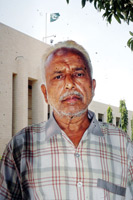
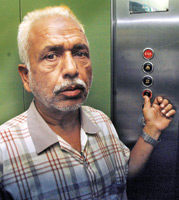
The Sindh Assembly -- through the eyes of a liftman Running a lift in one of the most prestigious buildings in the province has taught Iqbal more than he expected to learn at a school By Fasahat Mohiuddin "I have never, ever seen a Sindh Assembly
session start on time," declares Mohammad Iqbal. Iqbal is not a
politician who has been to countless weary, delayed Sindh Assembly
sessions. For 35 years, however, he has been privy to minute details
going on in the Sindh Assembly building. He is none other than the lift
operator. As a lift operator, Iqbal has weathered nearly all the changes the Sindh Assembly building has gone through. He was there when the lifts were manual, he was there when security was a fraction of what it is today, and he was there when the food from the canteen was not only edible, but affordable as well. He was there when the ministers had smaller cars and was also there when the lift turned automatic and would never fall prey to load shedding. "Those were the days," he says, his mind drifting back to a more peaceful time. Taking a few minutes to talk to Kolachi, Iqbal offers a collection of all the insights he has picked up during the three decades he has been here. He has seen over 10 chief ministers come and go, and a host of other ministers he concedes were "very nice", such as PPP MPAs Nabil Gabol and Abdul Khaliq Juma. His favourite, however, will always be former chief minister Jam Sadiq Ali. "Jam Sahab would usually take the stairs, but whenever he did take the lift, he would always pat my back, ask about my welfare and give money out of his own pocket," remembers Iqbal fondly. Iqbal's devotion to Ali, however, stems from a far bigger act of generosity. "Every day, he would arrange lunch for all the
lower staff in a huge tent outside," he says, and adds with a wry
smile, "No one used to miss a day of work back then. Often there
was so much food some of us would take some back home." The lunches ended with Ali's days in office. It was a kindness Iqbal is unlikely ever to forget, particularly as the number of people who ask after his health or welfare diminished over the years. Iqbal heaves an enormous sigh when asked if Chief Minister Syed Qaim Ali Shah or anyone from the PPP government provides them with lunch. "No," he says emphatically. "Now we just watch the MPAs and Ministers being served food." Far from offering him meals or enquiring after his welfare, the majority of people scowl at him in the lift and start shouting at him when they feel their journey to their floor is too slow. "There's nothing I can do," says Iqbal with a shrug. "Thousands of people visit the building every day. They really should get another, much faster, lift." Having been at the Sindh Assembly for so long, there are things Iqbal cannot help having picked up over the years. He may not be an educated man, but can confidently assert, for example, that Syed Muzaffar Hussain Shah was the best speaker the Assembly ever had. "He was also a nice man," allows Iqbal. In Iqbal's assessment, Shah's other commendable quality included his diligent effort to always start Assembly sessions on time, although he does quickly add that he did not succeed. Iqbal also credits Shah for transforming the Assembly building into what it has become today. "You see all this nice landscaping here?" he says, pointing out of a window. "That is all Shah's doing. Without his hard work, this building would not be as it is today." Iqbal is happy enough to be where he is. He has been running a lift for so long he cannot imagine picking up anything new at his age. For now, he is content to stand back and watch the ministers go by and judge them for himself.
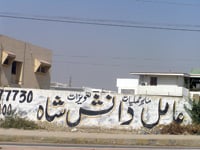
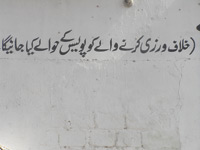
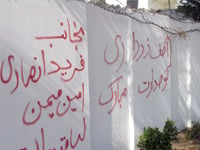
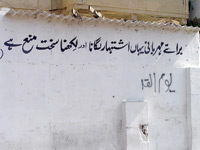
Pathology on display The wall surfaces of Karachi have acted as the populist mode of communication for masses. Dr Noman Ahmed comments Karachiites experience visual pollution of all sorts
every day, but one would be hard-pressed to find a bigger eyesore than
the graffiti splashed on walls. With heterogeneous messages of all sorts
spotted along walls on all major thoroughfares, the evolving ugliness of
this anarchic enterprise has For decades, particularly when the press was censored, the walls of the city became the ideal medium for providing much-needed communication, propelling the regimes in power to condemn the act as anti-social and almost seditious. In the late eighties, for example, the Movement for the Restoration of Democracy thrived because of graffiti. Then there were appeals to exonerate Z.A. Bhutto
before he was executed, mass messages in support of jailed nationalist
leaders, expressions of solidarity with chained peasant leaders like Jam
Saqi and Shaikh Rashid of the Pakistan People's Party, welcome messages
on the arrival of Benazir Bhutto in early 1986, the fluctuating moods of
Jamaat-e-Islami, Jamat-e-Ulema-e-Pakistan and other religious parties,
the rise of Altaf Hussain, fury at the arrest of many a popular leader,
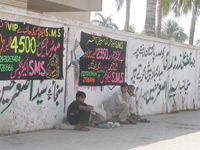
and venom against There has also been anguish over the military operation in FATA, threats to those who murdered political activists of student wings, marks of appreciation for the Karachi City Nazim and veiled threats to those who killed Khalid Shehanshah have all covered walls of the city. In short, the wall surfaces of Karachi have acted as the populist mode of communication for masses. But it would be wrong to blame political parties alone for violating the sanctity of public and private walls. As any casual observer would have noted, walls are a favourite medium amongst advertisers of unbranded product manufacturers, traditional healers, and homeopaths. Wall-ads, as they are commonly known, are concentrated in Lea Market, Burns Road, Kharadar, Mithadar, Empress Market, Benaras Chowk, Orangi Town, Karimabad, Sohrab Goth, Quaid-e-Abad, Shershah, Mauripur, and both entry and exit points in the city. Keeping abreast of modern day developments, they now
offer packaged advices and products with some unqualified guarantees. Such wall-ads have now become a fairly effective means of advertising, and have turned many unscrupulous entrepreneurs into millionaires. Stressed, dejected, frustrated, depressed and deprived common folks are forced to take notice of luring invitations by this tribe. Wall-ads related to this business are concentrated in and environs, (near Landhi), and entry/exit points to the city. Even though laws regulating all types of outdoor advertising exist, such as the Advertisement and Outdoor Signage Bylaws of 2003, the provisions are vague and enforcement almost non-existing. The municipal administration of Gulshan-e-Iqbal Town, for example, undertook a massive campaign to confiscate hoardings and banners in 2004, but failed to tackle the problem successfully. There came a point when the City District Government Karachi (CDGK) considered arresting faith healers, hakims, homeopaths and others advertising illegally on public walls, but ultimately shelved the plan, deeming it to be futile. "Wall-chalking has remained an unattended area
for a sizable period of time," confesses a senior official of Law
Department of the City District Government Karachi on the condition of
anonymity. Whilst it is true that other parts of the world are also prey to graffiti, such as slogans condemning the American occupation of Iraq in New York, London, and Sydney, what sets them apart is that in most of these places, it is restricted to certain public spots and does not affect private property. If there is to be any change, in Karachi, the legal and statutory structure needs to be revamped. In addition, all political parties should adhered to by political parties to limit graffiti through municipal permission. Before implementing any reforms, a comprehensive survey should be carried out to identify where graffiti is most popular, along with introducing an effective regulatory mechanism at both town and union council level.
Meanwhile, commercial messages should be charged and informal street artists, most of whom are self-taught, should be trained to hone their skills. All graffiti should have a purpose. If the walls of the city are properly kept, the scale of urban aesthetics can rise exponentially with very little input.
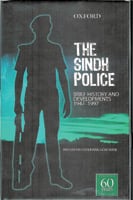
review Reforming the police By Aroosa Masroor Book: The Sindh Police Author: Akhtar Hassan Khan Gorchani Publisher: Oxford University Press Price: Rs 225 With the province of Sindh and its capital Karachi having witnessed much political turmoil and suffered at the hands of an inefficient police force, the 56-page The Sindh Police provides a thoughtful insight into why this state institution remains one of the most ill-reputed in the country. The author, Akhtar Hassan Khan Gorchani, currently DIG Police Larkana, is one of the few dedicated and educated men in the police force, and through his brief analysis of the Sindh Police from 1947 to 1997, he seeks overcome the shortcomings in the department. Although much has been written on corruption in the police department, what makes Gorchani different is his attempt to present his facts simply so the average reader can understand why the police are so inefficient. Rather than just criticising, he offers suggestions to improve the system of justice and make it more 'people-friendly'. Gorchani holds a Master's degree in political science and a bachelor's degree in law. In a career spanning almost 30 years, he has served in various capacities in the police service in Punjab and Sindh, as well as taking part in the UN peacekeeping mission in Kosovo. His vast experience enables him to explain why controlling crime in this part of the world has always been difficult. After familiarising the reader with a brief history and geographical and population trends of Sindh, he discusses the evolution of the police and judicial system in developed parts of the world. This he follows by the policing system in both the Arab world before the advent of Islam and in the sub-continent, and only then does he provide a comprehensive account of both pre- and post-partition Sindh police. The current organisation and hierarchy of the overall police in Pakistan is also discussed in detail. In his fifty-year overview, Gorchani explains how the massive influx of population into Karachi post-partition put pressure on the police force to expand. However, with so many employment opportunities in other sectors, a job in the police force did not prove to be lucrative, leaving the force with no choice but to hire large numbers ill-trained and ill-equipped people from upcountry, all of whom were uninformed of local politics and issues. Later, the 1964 elections and 1972 riots led to a confrontation between the police and the public, reducing the former to an effective 'political tool' and giving rise to endemic corruption. As Karachi became the hub of ethnic riots in late eighties, the police failed to gain the confidence of the public, with crime, particularly kidnappings, reaching a peak in the early nineties. Trends have changed in the past decade, but according to Gorchani, one reason the police have remained ineffective is lack of research in the department. "Just giving crime statistics is not enough," he asserts. He goes on the explain that the growing sense of insecurity in the country has left little time for police officers to conduct research or analyse the changing crime patterns. In addition, since the police force in Karachi blindly follows the system inherited from the British, there is no specialisation within the service. "A police officer is expected to be a jack of all during his frequent postings in different departments, therefore he proves to be master of none," comments the author. Towards the end, Gorchani explains that his dream police station would be headed by a judge or magistrate who would have a group of detectives for investigations, leaving well-trained police officers to patrol the city day and night. He adds that with computer literacy and on-job training, efficiency would improve, and a boost in salary and allowances would eradicate corruption and community policing. However, before bringing in reforms, Gorchani believes the state should realise that the 'police are a service, not a force'. Although the short book proves to be a good read for those interested in understanding why Karachi remains the most volatile city of Sindh, there is not enough information on why the police have failed in rural parts of the province where the jirga or tribal policing system is rampant, nor what reforms should be brought about to do away with this parallel system of justice. Still, for a brief understanding, The Sindh Police can be a good start.
|
|


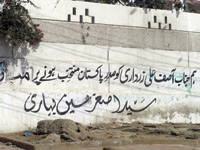 overwhelmed Karachi with revived vigour. Well-wishers of the president,
spiritual congregations, and faith healers have all left their indelible
marks on boundary walls, and in some cases, the announcements remain
long after the event has taken place, such as slogans inviting onlookers
to receive Benazir Bhutto at the airport on October 18, 2007.
overwhelmed Karachi with revived vigour. Well-wishers of the president,
spiritual congregations, and faith healers have all left their indelible
marks on boundary walls, and in some cases, the announcements remain
long after the event has taken place, such as slogans inviting onlookers
to receive Benazir Bhutto at the airport on October 18, 2007. 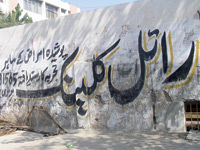 martial law.