


|
|
|
|
|
 |
 |
   |
MOOD
STREET Town
Talk service No
utility stores RESPONSES
TO LAST WEEK'S
housing God lives here In a market-driven real estate scenario, some committed people have done the impossible -- by launching a housing project for poor people By Saadia Salahuddin In a scenario where real estate is the most profitable
business of all and a house of one's own looks like a remote possibility to
many, a group of people have turned the dream of owning a house into a
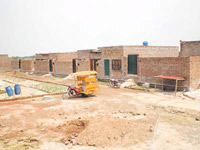
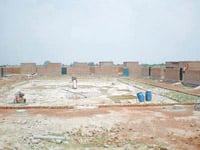
reality. At 25 minutes drive from Lahore and five minutes walk from Kala Shah Kaku railway station, is a housing scheme for the poor, Khuda ki Basti. Once a person buys the land he has to move on it within a month. He cannot pass it on to anyone, not even his brother. If a person pays for a plot and doesn't move in within a month, his plot is cancelled. He can't sell, rent or leave it vacant for a period of five years. So this is not a scheme for speculators who buy land and leave it vacant for years to reap profit later. The 20 acre colony has 12 blocks and 460 houses. There are 23 houses in each block. The plot size is 3 marlas. By Lahore's standards it makes 24x34ft. The plot is for Rs. 80,000. The down payment is Rs.40,000 while the rest of the money is to be paid in installments which is Rs 1000 per month to be paid in the next forty months. Booking has been done for sixty houses by now. Saeban is offering construction of houses as well whose
rates vary according to the kind of construction. A one room, one bath house
with boundary wall costs one lakh sixty thousand rupees. Construction of two
rooms, one bath house costs two lakh twenty thousand rupees and full fledged
house which has two rooms, one lounge, two baths and a kitchen, cost four
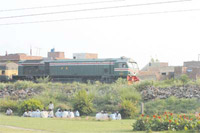
lakh rupees. House Building Finance Corporation (HBFC) has agreed to provide fund on 70-30 basis, that is if people give 30,000 to Saeban, they will get 70,000 from HBFC. The interest rate of HBFC is 12-13 per cent. This Basti was initiated in Kala Shah Kaku in June 2006. Construction work started here in September 2006 and by February 2007 13 families had moved on the land. People living at Khuda ki Basti at Kala Shah Kaku presently, are masons, drivers, electrician, teacher, lawyer and a widow. The plots and houses are for people in the low-income bracket. Anyone can buy the plot but he/she cannot sell it. Saeban is the brainchild of Tasneem Siddiqui, former chief secretary Sindh and director Katchi Abadis at one time. The first Khuda ki Basti scheme was launched in Hyderabad with 200 houses. Saeban has already provided 3000 houses to poor people in Karachi under this scheme and people are living there. Saeban meets the community once a week to educate them. The person who is looking after the Khuda ki Basti project in Punjab is Jawad Aslam. He was born in the United States and got all his education there. He came here to serve his country in January 2006. Since then he is with Saeban. "We see whether the party genuinely wants to live on the land. There is no question of fraud here. Payment is made through bank by filling a chalan form which is available at the bank. The bank gives him a receipt. It is a one-window operation. The person can take possession of the land immediately," says Jawad. The scheme 'Khuda ki Basti' has some amazing features like underground electricity lines and septic tank. Muawin, the NGO which has laid the sewer here, has put EME technology in the septic tank -- a water treatment method where fruits and vegetables rind and refuse are kept in water for 25 days. This cleans waste water and dispels smell. This water is particularly good for plants and costs three rupees a day only. At present water that is being used in the Basti has been drawn from 60 feet deep and people living there invariably find it good but PCSIR tests call for drawing water from 600 feet down the earth. This will cost 40 to 50 lakh, says Jamshaid, the Saeban person at the spot. "Work on it will start as soon as funds are made available," he says. Arooj of Muawin tells The News on Sunday, "This water will be released for one hour in the morning in a day so that people store their drinking water while water drawn from 60 feet deep will be used for the rest of the daily chores." This approach is certainly new and educated and says a lot about the importance of being responsible with natural resources. To ensure that the community interacts and thus develops in a better way, the scheme offers one and a half kanal playground in the centre of every block of 23 houses. Every block has one gate used both for entrance and exit. The ground has benches in it for people to sit and chat there. The lane before the houses is 30 feet wide. At present construction of one block has been completed. Saeban has initiated construction of road from railway station to Khuda ki Basti. There is two murabba land just before Khuda ki Basti -- another housing scheme where land is selling for forty thousand rupees per marla and there are one kanal, ten marla and five marla plots in it. Construction of a poultry farm is going on nearby. Though Khuda Ki Basti comes in Sheikhupura district, the telephone numbers start from '042' which is the Lahore code. Ring Road will be only one and a half kilometre away from Khuda ki Basti and a 40 feet road connects the basti to the railway station. "For those who want to move in when the pucca road is there, the scheme allows them to shift here after one year of payment of one lakh ten thousand rupees in a year," says Jamshaid, the Saeban person at the site. The rail ticket to Lahore from Kala Shah Kaku is Rs. 7 only and the train takes less than 30 minutes to reach Lahore. Khuda ki Basti has a medical complex, two schools and a graveyard in its plans. Citizens Foundation has plans to open a school here and their schools are all purpose-built, providing good education to children wherever they are. Then Baqai Foundation has promised to establish the medical complex on the pattern of famous Baqai Hospital in Karachi. On visit to Khuda ki Basti at Kala Shah Kaku, TNS found that though there is no school there at present, the community is looking well after its children. A young woman was teaching some ten small children in a room. There was a blackboard in the room and all the children were learning counting. Another family TNS got to talk to was of a driver in Gulberg, Lahore whose family lived in Sargodha earlier in a rented house while he was working in Lahore. Now they are living together and are very happy. The family shifted four months back. They are two brothers living side by side. There are houses in a line in the scheme which are called reception area. People can stay there and construct their houses. A community worker, Saif-ur-Rehman's house is under construction at present. He is all praise for the scheme and goes about convincing people to avail this golden opportunity to live here. There is something truly striking in the name of this housing scheme. It is said God lives in the hearts and homes of the poor and this is a housing plan for the poor, rightly named 'Khuda ki Basti'. It's noble work by all means. Kudos to the persons behind this project. Jawad says they would initiate more such projects in Punjab once this one is complete. MOOD STREET
By Bilal Tanweer At first, it might seem facetious to read instances of
warfare in something as benign as rickshaw rides. But if one thinks long
enough, it becomes evident that rickshaw rides and military encounters have a
lot in common. Indeed, many rickshaw-battle veterans are known across their
mohallahs and offices for their negotiating skills with rickshaw drivers and,
if we allow for adjustments of 'perks' that military officers enjoy, then we
see many more parallels between these two apparently disparate areas of human
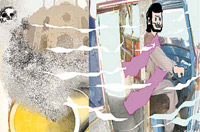
engagement. Military is known for its adherence to rules. So are the rickshaws. If your destination is not a landmark, and if it is not called by names such as 'Lalak Chowk' or 'Cheering Cross' (which will not be the case in any normal circumstances), then consider yourself to be a potential victim of these rules. Rickshaws are notorious for taking you at the exact point you asked them and would stop smack next to the landmark you pointed. And will not budge. Because you asked for Kalima Chowk you will get off at Kalima Chowk. Not an inch here or there. This, however, is just the beginning. Then there are the oft-repeated instances of guerrilla-warfare. Often rickshaw drivers would ask you to ride with them, haggle only a little bit when you tell them you pay x rupees for a distance. You ride the rickshaw, content that the battle is over without being fought. But as soon as three minutes pass, you realise that you have been drawn in protracted guerrilla warfare. And now you are in the territory, and there is no escape. You must fight or stand down. The rickshay waala begins his attacks: "Bhai, you are going x hotel?" You sense the move and negotiate with caution, "Yes?" "Oh... I have heard that all the important people, rich and famous, go there?" Ah, appeal to nobility; you maintain your guard. "Yes." He takes a pause -- a posture before bringing you out into the open. "What happens there?" You are taken by the realisation that you are exposed, and it takes you a while to get hold of the armour. "Well, there are all sorts of things..." And during these increasing and receding skirmishes, you concede that you have been blessed by the Unseen. After this, the rickshay waala would begin a series of deadly blows: May you be blessed by the Unseen, may everything stay on course for you -- your health, next job promotion, family, marriage, and everything else. During these skirmishes, he emphasises that this is the only thing he can give you. Once you are assuredly bowed, he gives the killer blow and you find yourself weighing between an additional rupees or a disturbed sleep. More often than not, you value peace of mind over money. On most rare occasions, you'd be in for a surprise. "I have to go to Kalima Chowk." "How much will you pay?" You try to keep room for bargain, "50 rupees." Without a word, the rickshaw breaks in speed and the rickshay waala sticks his neck out and hollers, "Keep those 50 rupees in your pocket!" Yes: Shock and awe. Then there is the obvious, overused, yet effective and time-tested technique of battle for the minds and hearts. This is the most favoured technique because of low costs. Without going into too much details, as it is self-explanatory, the rickshay waala would tell you the troubles that he has to face, especially at the hands of the police. Needless to say, the success rate is remarkable in this case -- possibly higher. But it requires years of practice and dexterity to execute this particular technique. It requires a lot of experience to be able to accurately measure the temperament, mood and other invisible of the passenger and then launch and emerge victorious in this engagement. Coming down to earth from grand abstractions of the military-rickshaws to mundane news, let us quickly mention that the female traffic wardens have become an overnight sensation in Lahore. According to reports, where people used to disobey traffic rules and despised chalaans, they are now enthusiastically lining up for the same. The female traffic wardens, on the other hand, are faced with the conundrum of not having enough laws; they still have to figure out how to punish those who express such enthusiasm and ask for chalaans for crimes not committed. In another related development, female traffic wardens have been provided extra security by police because of the 'unfriendly' environment. This, however, has created problems of unity and discipline in the police department because of the overenthusiastic response by police-jawaans vying for the limited positions available. The police officials are now considering other possible options to resolve this dispute, including one of drawing names through a lottery so that matter could be resolved in a fair and peaceful manner. Some police jawaans, however, have shown willingness to withdraw from the ballot given their other demands be met. But the controversy, it seems, has become complicated and remains inconclusive (since Kane and Abel). Town Talk • Concert: Carvan organises a tribute to Asad Amanat Ali Khan at Alhamra Arts Council, The Mall, tomorrow. • Ethics of job hunting, a comical farce by Saad Sultan tomorrow at Alhamra Arts Council, The Mall. Timing: 7:30pm to 9pm.
• LEAF readings of poetry, prose and drama on Tuesday, May 15, at Alhamra, Gaddafi Stadium at 6pm by Asghar Nadeem Syed, Sarwat Mohiuddin and Zahid Huma. Art Capsule by Shehrazade Alam (an offering of images).
• Leaf Discourses in Science: Dr. Mujahid Kamran will talk about Albert Einstein and Germany at Model Town Library on May 17, Thursday at 6pm.
• Puppet Show for Children every Sunday at Alhamra, The Mall at 11am. Fee: 5/10 rupees.
• Puppet shows for everyone every Sunday at Peerus Cafe at 3pm.
• Nazir Ahmad Music Society stages a concert every Saturday at 1:30pm at Government College University Lahore (GCU). service Wrong track Passengers of trains running on branch lines in Punjab share their concerns By Zaheer Ahmed Pakistan Railways is a cheaper source of travel for people from areas where public transport system does not function. While all out attention is paid towards the mainline,
branch lines remain neglected. It seems that nothing is being done to improve
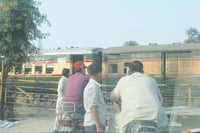
them. "I have been commuting daily from Narowal to Lahore by train for the last 30 years where passengers have increased while the number of bogeys have decreased. People have to travel in overcrowded trains," says President Daily Passengers Association (DPA) Hafiz Abdul Qayyum. Hafiz Abdul Qayyum says there is more tariff on branch lines than on the main lines but there are no facilities for passengers here. Giving an example of Narowal section, he says: "A majority of people travelling on this route are employees in various public and private departments and commute daily from this area to their job destination." Narowal section is the most profitable section. "I have conducted a survey that 95 per cent people travel with tickets in this section, but when we complain to railway officers about the poor service of trains, they say that most people travel without ticket on this section. This is baseless," says Qayyum. Another concern of passengers is the slow speed of trains
on branch lines. "Trains are being run in this section upto 50
kilometres per hour while the maximum speed of trains at main line is 120 km
per hour." According to Pakistan Railways timetable, the travel time of the trains from Lahore to Narowal is 2 hours but it takes four to five hours to reach the end point due to criminal negligence of railways staff concerned. "Whenever railway authorities are contacted they say they cannot increase the speed of trains as the railway track of this section is weak and it cannot afford train speed above 50 kilometres," he adds. Railways has now increased the number of trains from seven to ten but speed remains the bane of passengers of Narowal section. The department had replaced rail carriages some 15 years ago but the track was not improved. President Daily Passengers Association demands of Pakistan Railways to do complete track renewal (CTR). Ministry of Railways has announced to provide Rs 100 million for the renovation of this track. Sohaib Khalid who commutes daily from Narang Mandi to Lahore complains about over-crowding, unclean trains and travel time. During inauguration of 219/Up Narowal Express in April 2007, Federal Minister for Railways Sheikh Rashid Ahmed had expressed his concern over the speed of trains, he says. Sohaib says service is not being provided to the small sections as it is being provided to the passengers of main line. Ashfaq Ahmed, another daily commuter from Narang Mandi to Lahore, says train service of Narowal section has improved with the efforts of Daily Passengers Association and now the people of this section are getting facilities of ten trains on one way. He recalls that in 2000, the general manager Railways had said in 2000 that speed of trains in Narowal section will also be increased upto 100 km per hour like it was done for Faisalabad. But nothing happened. Muhammad Hayat, an old passenger who has been commuting daily from Narang Mandi to Lahore for the last 40 years, says that in early days service of the trains was very poor, there was no proper light system in trains and railways. Now there is much improvement. People also complain that trains on branch lines are halted at various stations to let the trains of mainlines pass by. "We have to give priority to the trains of mainline because it has to cover a long distance after passing through large part of the country," says Muhammad Khalid, Divisional Superintendent (DS) Railways, Lahore. When his attention was drawn towards the train speed, the DS said that speed varies in different sections, the train drivers of some sections are allowed to run the carriage upto 60 km and 80 km per hour as well. About Narowal section, he says the track is weak so the drivers are allowed to run trains upto 50 km per hours only. "We have sent PC1 for Complete Track Renewal (CTR) to the Ministry of Railways for approval and work would start in Narowal section after the approval," says Khalid. "The work on CTR would be carried out in phases as per the directive of the high authorities," DS added. About tariff, he said that fare tariff of branch lines is different from the tariff of mainlines. His claim is that the tariff of mainline is more than the fares of other sections. "How can we improve service while 80 percent passengers travel without tickets in Narowal section?" he asks. "I, alongwith railway police, raided on this section many a time to nab the ticketless passengers but guilty commuters went on rooftops of the trains to avoid being caught." When asked whether branch lines are lucrative for railway department, he tells that overall railway department is going in loss. According to another official of Pakistan Railways, about 1.2 million people travel by train from branch lines and the railway department collects revenue of over Rs 285 million in a year. He says that 42 trains run in branch lines including Lahore-Wazirabad, Lahore-Shorkot, Lahore-Narowal, Lahore-Faisalabad, Lahore-Okara, Wazirabad-Sialkot, Wazirabad-Narowal, Faisalabad-Wazirabad, Faisalabad-Lalamusa, Pakpattan-Wazirabad and Lahore-Pattoki. No utility stores Common man is yet to benefit from utility stores that have a lot of strings attached regarding purchase of subsidised items By Rana Muhammad Sajjad Utility Stores Corporation started functioning in July
1971 with the idea to provide essential kitchen items to the poor consumers
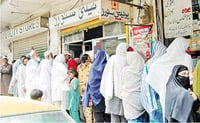
at affordable prices and to stabilise demand and supply position. The objective statement shown at Utility Stores Corporation's (USC) website reads: "The basic objective of the USC is to provide essential and other items of daily use to the public, specially the poorer segments of the society, at prices comparatively lower than the market. It is, therefore, required to act as a price moderator and deterrent to profiteering, hoarding and black marketing, thereby to provide economic relief to the public." The News on Sunday visited five utility stores in the city to see if USC has succeeded in achieving its objectives. Qaiser Saleem who works in a factory was visiting one of them "Government had opened utility stores to facilitate the public but a very small segment of the population is benefiting from them. Sugar and ghee, the hot selling items, are usually in short supply. Moreover, it is mandatory to purchase other items up to a specific amount in order to buy sugar or ghee." Qaiser Saleem suggests the government should set up new stores in poor localities to benefit the less fortunate segment of society. "Majority of the utility stores corporation's staff is involved in hoarding," says a wholesaler Malik Haroon. "Most of the sugar and ghee stock of utility stores is transferred to the hoarder's stockpile. This is evident because a number of shops in the city sell items that carry Utility Stores Corporation tags." Zahoorul Islam, Incharge utility store in Governor House, denies all such charges by the customers. "Utility Store Corporation is here to serve, not to exploit people," he asserts. "There isn't any compulsion to purchase other items up to a specific amount if one wants to purchase sugar or ghee." A worker of Utility Stores Corporation tells TNS, on condition of anonymity, that a mafia is functioning in the USC team and is pocketing huge profits, leading USC to destruction. Items issued for stores are sold in markets at market price and profit is taken home. Some franchised stores are only on USC's papers. Items issued for these stores are directly sold to the market which promotes profiteering and hoarding mafia. Azmatullah, Regional Manager Lahore, disagrees. He says USC is running 58 stores in Lahore, 40 stores are being run by the corporation itself, 15 are franchised and 3 are mobile utility stores. "There is no policy for customers to purchase items upto a specific amount of money if one wants to get sugar or ghee only from utility store. It is only to prevent shopkeepers who only want to purchase cheaper items like sugar and ghee," he explains. "It is wrong that items sold in utility stores are of inferior quality. We directly purchase goods from manufacturers and producers after checking the quality of goods. It is illegal to sell utility stores items in the market. We are aware of it and any case brought into the notice of USC is handled according to the law. It is hard for us to check out all stores or shops but we are trying to establish a good checking system to ensure transparency. We have huge stock of sugar and we have asked wholesalers to purchase sugar from us as much as they want," says Azmatullah. Whatever the policy, most of the utility stores do not allow customers to purchase sugar or ghee only. The USC Regional Manager Lahore doesn't want shopkeepers to purchase from utility stores while wholesalers are welcome to do so. The USC should maintain buffer stocks and daily essential items of quality to act as a price moderator in the market to prevent profiteering and hoarding. The corporation should take strict action against the corrupt elements. The number of utility stores should be increased and a proper check and balance system installed. RESPONSES TO LAST WEEK'S QUESTION TOP 10 Exciting places in Lahore 1. Nairang Gallery 2. Fortress Stadium 3. Shah Alam Market 4. Bano Bazar 5. Zoo 6. Ichhra 7. Lahore Canal (during summers) 8. Food Street 9. Siddiq Trade Centre 10. Liberty Market To enlist by popular vote the 'top ten' for next week, send in your emails on top ten 'Top ten boring places in Lahore'.
|
|