



|
|
|
|
 |
 |
  
|
analysis The train of events having crossed the Rubicon with the judicial crisis that has upset many a calculation. Thanks to Musharraf's uniformed presidency for eight years, the fates of Pakistan and the General are entwined. Movers and
makers For Musharraf the math is more or less clear: keep the support-base of the two Hussains - Shujaat Hussain and Altaf Hussain. The latter have managed to keep him propped up for over four years and he would want to avoid new - and potentially unpredictable - political crutches. review Some years ago a female artist, on her short visit to Lahore, was criticising the vernacular art practices, while everyone was waiting for dinner. The London based sculptor did not approve of male models posing in shorts or loin cloths in the local art schools. Listening to her harangue, a young painter protested and pointed out, that she also did what our artists were accused of doing. The sound of
music It may appear that Lahore is perhaps beginning to revive, in another style, an old tradition when the baithaks of many a connoisseur served as nurseries that introduced and then honed musicians to perform in the bigger wider world. Scientology and
Me analysis Like a genie out of the bottle, the body politics of Pakistan is set for a potential new milieu The train of events having
crossed the Rubicon with the judicial crisis that has upset many a
calculation. Thanks to Musharraf's uniformed presidency for eight years, the
fates of Pakistan and the General are entwined. The critical mass will be two sets of elections - parliamentary and presidential. Their outcome will determine if the status quo prevails - with necessary adjustments, of course - or a new order emerges where traditional power bases employ a tactical, if not strategic, retreat, to borrow a phrase from the lexicon of Musharraf - the face of the current status quo. Less than ten weeks ago, it was a foregone conclusion that Musharraf would continue in the saddle with perhaps a few changes in his set political allies. The judicial crisis has disrupted not just the planned post-election scenario of more-of-the-same variety but also the pre-election equations of simple majorities. It is no longer a given that Musharraf will be re-elected president by the current assemblies. Musharraf's erstwhile friends - the Muttahida Majlis-e-Amal - are no longer automatic shoo-in supporters. Qazi Hussain Ahmed, the leader of the alliance of religious parties, has formally petitioned the Supreme Court to declare Musharraf's holding of dual offices as illegal. Citing Article 184(3) of the Constitution, he maintains that the General attained the age of super annuation in August 2003 and should not have continued in the job of the army chief thereafter. MMA is simply piling on the pressure on the General through the courts at a time when feelings on the street - and in the courtrooms - is running against Musharraf's continued cockiness. Even if Qazi Hussain's
contention - that Musharraf as president has been violating the law and
service rules by granting himself extensions in uniform - is considered by
the court as un-maintainable, while also keeping in view that the same judges
have pledged oaths of allegiance to the General through his Provisional
Constitutional Order, the MMA still has a potentially powerful trick up their
sleeve: dissolving the North West Frontier Province Assembly and quitting
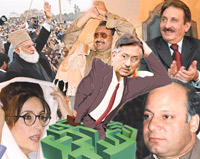
their majority coalition government in Balochistan. This will disturb Musharraf's electoral college - the federal and provincial legislatures. And even if Musharraf manages to hobble through to a 'new'term as president, it will not just be with a severely dented legitimacy but will also leave him to manipulate an endorsement from an increasingly unpredictable post-election parliament. Throw into this mix the increasing confidence of Benazir Bhutto and Nawaz Sharif who fancy their chances of finally ending several years in bitter exile and Musharraf finds himself in a tight corner. So palpable is the rising political temperature that Bhutto - unbelievably to many - offers a way out for Musharraf, albeit at her terms, and the General cannot seem to categorically deny the possibility of stitching up a deal. In case an understanding between the two does take shape, it will amount to a major climbdown for him. As for Sharif, he can smell a good electoral response in urban Punjab. He knows a Musharraf-Bhutto deal would lead him as the leader of the opposition by a long distance. Yet another point against Musharraf's 'strategic' planning. Then there is judicial crisis of Musharraf's own making whose drop-scene can only mean more trouble for Musharraf. Irrespective of the outcome of the Chief Justice of Pakistan's legal battle to redeem himself, he has already won in the court of public opinion. In fact, he surely stands to gain far more politically by not being re-instated by the Supreme Court. Musharraf, by renting disinterested crowds through PML-Q and state resources, and forcing his allies - the MQM - to try and steal the CJ's thunder in Karachi in a bid to deflect perceptions of dwindling public support for him, has only managed to alienate more people. If PML-Q and MQM, exposed as opponents of public opinion, are the support-bases of Musharraf for the presidential elections, the General's days of power and forced respect are numbered. His time has come and passed. For Musharraf, the Supreme Court trial is the beginning of the end, for surely he, and not the Chief Justice, is in the dock. The General has overstayed on his welcome by a long time. Movers and makers Presidential and parliamentary elections scheduled before the end of the year are building up to be a straight contest between President General Pervez Musharraf, his allies, an increasingly belligerent and more confident even if fractious opposition. Opposition-in-waiting? For Musharraf the math is more or less clear: keep the support-base of the two Hussains - Shujaat Hussain and Altaf Hussain. The latter have managed to keep him propped up for over four years and he would want to avoid new - and potentially unpredictable - political crutches. The problem is that although Musharraf does not have to beg for people's votes, PML-Q and MQM cannot do without this. Even if the Karachi fiasco had not happened, which has exposed both these parties to the risk of toeing Musharraf's untenable argument against the Chief Justice and the high political costs of this fallout that will cost them votes, both PML-Q and MQM are afflicted with the curse of attrition. The two parties have been in power for more years on a run than any other party, except Zulfikar Ali Bhutto's Pakistan People's Party, which held office for five years (1972-77). Among these two governing parties, while MQM may have a more assured vote bank, the larger partner, the PML-Q, is a very different beast compared to when it was born. Only 40 current PML-Q members of National Assembly were elected on the party tickets. Quite a sobering thought only a few weeks from an election they must win for the sake of their patron-in-chief - the army chief. Rest of PML-Q 'cadres' are a motley crew of 'lotas' who were engineered into the ranks from several parties and rag-tag alliances of virtually one-man parties to give Q a non-mandated power to govern Pakistan. The Q simply stands no chance to even win back the 'original' 40 seats unless the intelligence agencies are adamant although it may no longer be easy - but that's another story. Government-in-waiting? On the other side of the divide are the opposition parties and alliances which smell blood and are beginning to unleash their political creativity. Clearly the brightest star in the opposition constellation is Benazir Bhutto's PPP, which seems to have already employed a policy of running with the hare and hunting with the hounds. It coyly offers a lifeline to a beleaguered Musharraf while quite successfully managing to make his life difficult by engineering the judicial crisis into a political crisis through the cool but calculating Aitzaz Ahsan. The PPP strategy is assured. Will its voters - drifting away from a party that has been unraveling outside the corridors of power for over a decade (PPP 'gave' no less than 20 elected MNAs to bolster Q ranks in 2002) - strengthen Bhutto's hands who is seen to be betraying them by offering to strengthen a tottering Musharraf? We will surely find out by the end of the year. The PML-N of Nawaz Sharif may yet turn out to be one of the major beneficiaries of the elections. The clean, unwavering and attractive rhetoric of Sharif against the Establishment is appealing in a time of uncertainties. Sharif has already acquitted himself politically quite admirably by not just surviving but also not compromising with his tormentors. Sharif's major appeal lies in the difference in choice he offers voters compared to Bhutto. While he cannot dream of conquering Sindh, he can, with intelligent electoral adjustments in Punjab with the religious alliance MMA and Imran Khan's Tehrik-e-Insaf, maximize his bargaining power post-election. Punjab has 125 seats in the National Assembly. And 40 to 50 seats will make him kingmaker in next parliament. Thanks to its reductionist outlook on how to deal with Pakistan's complex problems, MMA is unlikely to repeat its ballot feat of 2002. But having successfully managed to pass itself simultaneously as a governing as well as an opposition grouping, it still has lots of appeal among non-PPP voters in general. It's not going to be easy for MMA to be among the major winners of the elections but it is reasonable to assume it will win enough nuisance-value to be a coalition ally of whichever group vying to form governments in the center and NWFP. The other opposition groups likely to shine are Asfandyar Wali's ANP, which is likely to win enough seats in NWFP to stake a claim for major influence in a coalition government in the province. Balochistan - a hot bed of opposition to the federal government - is most likely to retain the status quo of a hopelessly hung parliament. -- Adnan Rehmat
In his recent works on display in Karachi, Mughees Riaz relies on the typical female reclining poses for his male models Some years ago a female artist, on her short visit to Lahore, was criticising the vernacular art practices, while everyone was waiting for dinner. The London based sculptor did not approve of male models posing in shorts or loin cloths in the local art schools. Listening to her harangue, a young painter protested and pointed out, that she also did what our artists were accused of doing. Mughees Riaz is also guilty
of the same, so to say. In his canvas, the male figure First among these issues appears to be of the skill. The male body is not drawn with the same confidence and maturity, which can be observed in his landscape paintings. Trees, fields, streams, crows and buffalos are painted in a sensitive manner, but when it comes to the depiction of male body, the artist's skill does not seem too convincing. The contours of the body, details of the muscles, shape of the limbs and the tonal variation of skin do not suggest the keen eye of the artist, who, on the other hand, is able to capture the fleeting impression of nature in its vastness. The obvious disparity in the depiction of male body and the landscape has nothing to do with the past learning of the artist or his experience in painting one kind of theme. Because for an artist of his calibre, it is not a matter of memorising one subject and not being capable of tackling something else. Actually the inability to draw male figure in a perfect scheme is connected to aspects other than acquiring a certain skill. May be the difference between the figurative element and the other works with landscapes, is related to the way art is practiced and perceived in our surroundings. Probably the lack of figurative finesse is the result of some reluctance on part of the painter in dealing with the idea of male in nude. Even in our art world, which is perpetually under the threat of religious fanaticism and market forces, the practice of making nude images has a peculiar angle. Here, majority of artists do not have the experience of studying naked women as their models, but they -- following the tradition of European art -- prefer to paint female nudes. So from the sources of art history, a range of poses, and methods of composition are available to them and most of these painters and sculptors fabricate their new pieces on the pattern of old and classical works. Hence in the absence of female models, the artists are continuously creating canvases with the contours of naked women. So the image of nude female figure is not an unusual sight in the works of our artists. But on the other hand, the theme of the male nude is a challenging task for a number of artists. Since this subject is rarely depicted in our art; and does not represent the ideal of beauty nor manifests the idea of harmony (like in the Classical Greek art). In addition to this, while drawing the male nude, artists also face a problem: of how to take their work beyond the level of academic studies, which are usually carried out in the studios during the lessons on human anatomy. There are no clear positions in the work of Mughees Riaz, as one is not sure about the presence of a gender conscious content. Neither are the compositions with the male bodies elevated from being mere studies of human figures nor does the artist seem to be keen on suggesting the male beauty or power. Thus the confusion in his concept is evident in his canvases. This absence of a conceptual clarity is the reason for awkward representation of male bodies (although in some cases Riaz relies on the typical female reclining poses for his male models). In comparison the landscapes in several of his canvases, he uses a predictable set of imagery -- the setting sun, spread of fields, crows, cows, an occasional dog and broken clay pitcher -- yet with their easy to grasp significance, these elements are drawn with a considerable command over the subject and with ease. For the painter the scenes of nature are rendered with a confidence without a need to infuse some hidden meaning. The rural settings and usual views are portrayed in a humble yet, sophisticated manner. The truth in the depiction of these elements can be traced to his affinity with this theme and leads to his construction of landscapes as extension of his personal vision. The unevenness in figurative works and landscape is a sign of how the subjects have their own limitations in our minds. The artist's familiarity with nature plays a part in portraying these in a convincing manner. Whereas the male nude, even if it is painted from a model, due to its oddity is transformed into merely a labour -- and even that too, not of love! (The
work of Mughees Riaz was displayed for preview on May 10 in Lahore, prior to
his exhibition, being held from May 15-May 26, 2007, at Canvas Gallery in
Karachi.). The sound of music The cultural capital is trying to revive an old tradition of introducing and honing musicians It may appear that Lahore is perhaps beginning to revive, in another style, an old tradition when the baithaks of many a connoisseur served as nurseries that introduced and then honed musicians to perform in the bigger wider world. Many a new and not so new avenues have been struggling to establish or survive as places to hold music soirees and in the process produce musicians ready to perform in an adequate manner. The All Pakistan Music
Conference besides organising a five day annual festival also does Newer organisations like Carvaan too have been pitching in and doing their bit by organising events, some big ones where the leading musicians are crowned in the traditional manner. Leaf in the past 16 years has held a large number of programmes at various venues. If anything it cannot be faulted on the fact that the programmes have not been held regularly. Idara Farogh-e-Fun-o-Mausiqi has also been quite active in music related activity though lately it has concentrated more on publications, mostly of new or old material on music. The Rafi Peer Theatre Workshop with its mega projects of puppet, theatre and film festivals has now added music to the itinerary. It has held music programmes in the last few years where the leading musicians from the country get an opportunity to perform with some of the famous international artists. It has also included a night long session of classical music to its programmes that often were tilted heavily in favour of folk, pop and sufi music. This is other than the barsis that are held from time to time to honour a great musician. These occasions become venues for performance since the best way to pay tribute to a musician is to propagate his art form. This excellent tradition has continued as these barsis are organised by societies or groups run by those who are either related by blood to the great musicians or are his shagirds. A number of colleges also
held music programmes of classical music, especially through Despite the initiation of music in schools especially the expensive private schools, the musical activity at the private colleges and universities has not been of the same level. If any, more popular varieties of music are promoted by the music and performing arts societies of these newer institutions. Now two public sector institutions, the National College Of Arts and Punjab University Department of Performing Arts, offer formal degree courses in Musicology From time to time one keeps hearing of or reading about some academy to be opened in the name of an Ustad who has died but after holding a couple of concerts and press conferences such efforts usually peter out or are held with great inconsistency and make no mark. Amanat Ali Khan Academy has been on the anvil and Salamat Ali Academy too lies dormant. Before independence classical music concerts were held at the YMCA and Barkat Ali Mohammedan Hall, SPSK Hall, the Takiya Mirasiaan and the innumerable baithaks that underpinned the framework of cultural activity in the city. These baithaks were run by Barkat Ali Khan and Mubarak Ali Khan in Hira Mandi, Babu Mairaj Din in Moti Bazar, Ustad Barkat Gotebaaf inside Masti Gate, Ustad Khurshid Butt in Bhatti Gate, Allah Ditta in Shahalam Gate, Master Qamar Din and G.A Farooq in Misri Shah. Khawaja Feroze Din in Mochi Darwaza and Jeewan Lal Matto. Lahore also witnessed the experimentation of passing on the musical knowledge to the next generation outside the ambit of lineage and family. When Bhathkhande and V.D Paluskar started their initiative they also chose Lahore to be one of the centres of such a movement. Gandharv Mahavidyala set up off Ravi Road was seen as a departure from tradition and it continued to exist till partition when its head Pundit Janardhan had to migrate. Sadly the institution that was set up on the lines of a modern teaching method did not survive. It is said that the barsi of Alamgir Khan organised by his sons Rangi Khan and Babar Khan was held regularly for more than 20 years in the vicinity of the Gandharv Mahaviddayala on Mohni Road. After partition the initial concerts of live classical music were organised by the radio billed as Jashn-e-Baharaan before the All Pakistan Music Conference took over in the 1960s by holding a regular annual event at the Open Air Theatre Bagh-e-Jinnah. At the old Alhamra Music classes were held by Feroze Nizami and Sharif Khan Poonchwaley and an occasional concert was also organised. If all, the activities being held now are better organised and taken one step higher, it will start making a decisive impact on the music of the city.
Scientology and Me Dear
all, I watched with interest the recent BBC Panorama programme on the 'Church of Scientology'. This is, of course, a somewhat controversial organisation, with an international network whose members include Hollywood stars like John Travolta and Tom Cruise. In the late 1980s the Scientologists also launched themselves in Pakistan and were able to recruit some fairly high profile members(some of whom eventually moved to the US to devote themselves full time to this cause). The Panorama programme had
some interesting buildup because before it was aired the Apparently one of the tactics the Church of Scientology uses to protect itself from negative criticism is to consider anybody investigating it as 'fair game'. In other words they begin to harass, intimidate and follow the person in question. They also try to incriminate and defame the person. The Panorama investigation hinged on the question of whether the movement could call itself a 'Church' or whether a cult would be a more apt description. This was because while Britain has allowed it to operate as a charity, it will not allow it to register as a church. But, as became clear from the programme the word 'cult' is the worse thing you can say to members of this organisation because it seems to cause them great offence! Anyhow, the whole thing was founded as a result of a self help book written decades ago by a science fiction writer called L Ron Hubbard, who developed it into self help; a 'potential realisation' programme which involves members paying large amounts of money and basically obeying whatever the Church of Scientology tells you. As is the case with most cults, members mostly cut off ties with their family members who are outside the cult. I have to say, I have always found these people really creepy.Ever since, that is, I had a brief encounter with them over two decades ago. So here is what happened: I was a student at London University's School of Oriental and African Studies (as part of Princeton's Study Abroad program). It was a pleasant day in the spring of 1984 and I was walking along Tottenham Court Road on my way to the bank. A pleasant, smiling girl asked me if I could fill out a questionnaire for her. I refused as I needed to get to the bank quickly. However, on my way back I thought I would help her and said I would fill out the questionnaire. Big mistake! Whereas I had thought this would take a few minutes right there on the pavement, I actually had to go inside their premises, sit at a large table and complete the questionnaire there. Once the questionaire was complete, I gave it to the staff and was about to leave when I was told that I had to wait to speak to the person who was going through my completed form. By this point I was cursing myself for getting into this time-wasting activity. I was then shown into a room where a very grim looking woman sitting at a desk asked me to take a seat. She then proceeded to tell me that I was very selfish and self-centred person with lots of problems and no life skills. I was a little surprised by this but she proceeded to elaborate on how this questionnaire revealed what an awful human being I was. The punch line was of course, that 'they could help me become a better person who could work towards good in the world'. She again aggressively told me what a terrible person I had revealed to be and 'WHAT WAS I GOING TO DO ABOUT IT?'. I said I would think about it, and somehow managed to exit that horrible place with hundred of copies of Hubbard's 'Dianetics' and its scientology posters. The whole encounter had not lasted very long but it took me weeks to get over it. At that time of my life, all was going well, I had no financial, health or emotional problems, yet it really shook me up and filled me with nagging doubts about myself and my self worth. I reflected on my reaction and I realised that the sort of bullying and emotional battering that they had used would cause anyone in a vulnerable state to completely break down, and therefore be completely controlled by the organisation. And this, I believe is what they do, what most cults do, they prey on vulnerable individuals who they then proceed to 'uplift' and brainwash. It is a bit disturbing to see the Scientologists raise their profile by setting themselves up in large, central premises (like their City of London building), but I for one, am glad to live in a country where at at least some cynicism exists about their work and the nature of their organisation and their 'pay as you go' religion. Best
Wishes Umber
Khairi
|
|

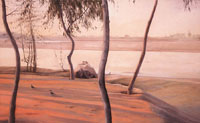 dominates the space, but the subject -- the naked man -- does not face the
painter and is shown turned away from the gaze of the viewers. Although due
to this scheme of placement, the painter is saved from portraying the male
organ, but this posture poses some other problems -- formal as well as
cultural.
dominates the space, but the subject -- the naked man -- does not face the
painter and is shown turned away from the gaze of the viewers. Although due
to this scheme of placement, the painter is saved from portraying the male
organ, but this posture poses some other problems -- formal as well as
cultural.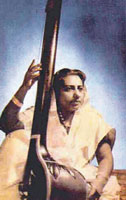 a more credible job by holding a concert every month where practitioners of
classical music have a chance to test their abilities and, on feedback, to
hone their talent. Lahore Chitarkaar too has been holding regular classes
where music and dance training is imparted but better still music programmes
are held regularly where mostly artists; primarily musicians and dancers,
have a chance to display their talent and express their prowess in these art
forms. Similarly the Pakistan Music Guild which has been around for many a
decade has been organising functions, though irregularly, of late.
a more credible job by holding a concert every month where practitioners of
classical music have a chance to test their abilities and, on feedback, to
hone their talent. Lahore Chitarkaar too has been holding regular classes
where music and dance training is imparted but better still music programmes
are held regularly where mostly artists; primarily musicians and dancers,
have a chance to display their talent and express their prowess in these art
forms. Similarly the Pakistan Music Guild which has been around for many a
decade has been organising functions, though irregularly, of late.
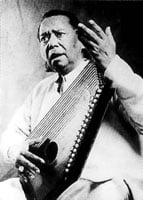 their active music societies. In the early decades of the 1950s and 1960s,
some kind of musical congregation took place at the Engineering College which
later was elevated to the University level at Mughalpura. Dyal Singh College
held music programmes due to the personal interest of Abid Ali Abid once he
became its principal. But despite the interest of Dr.Nazir Ahmed, very few
music programmes of the classical genres took place at the Government
College. Sponnerberg and Shakir Ali made sure that the best musicians took
part in National College of Arts music concerts. Roshan Ara Begum, Ustad
Sharif Poonchwale, Salamat Ali, Nazakat Ali and Amanat Ali Fateh Ali took
part in the concerts held in the 1960s and 1970s.
their active music societies. In the early decades of the 1950s and 1960s,
some kind of musical congregation took place at the Engineering College which
later was elevated to the University level at Mughalpura. Dyal Singh College
held music programmes due to the personal interest of Abid Ali Abid once he
became its principal. But despite the interest of Dr.Nazir Ahmed, very few
music programmes of the classical genres took place at the Government
College. Sponnerberg and Shakir Ali made sure that the best musicians took
part in National College of Arts music concerts. Roshan Ara Begum, Ustad
Sharif Poonchwale, Salamat Ali, Nazakat Ali and Amanat Ali Fateh Ali took
part in the concerts held in the 1960s and 1970s.
 Scientology people had posted on the internet, a clip of the reporter John
Sweeney getting hysterical interviewing one of the officials of the Church.
This footage is in the programme as well, and it is a bit surreal but you do
somewhat sympathise with the reporter, because the tactics used by the
scientologists are fairly harrowing.
Scientology people had posted on the internet, a clip of the reporter John
Sweeney getting hysterical interviewing one of the officials of the Church.
This footage is in the programme as well, and it is a bit surreal but you do
somewhat sympathise with the reporter, because the tactics used by the
scientologists are fairly harrowing.
