



|
|
|
|
 |
 |
  
|
analysis review
New paradigm The wasted
land
Experts think the economic problems are acute and the country needs a well-chalked-out plan to be implemented over a longer period of time By Shahzada Irfan Ahmed It was an encouraging sight indeed to see the leaders of the world's richest states come forward in New York last month and show their willingness to help Pakistan out of one of the worst economic crisis in its history. The forum 'Friends of Pakistan,' comprises the United States, Britain, Italy, Germany, France, Japan, China, Australia, Turkey, Canada, Saudi Arabia and the UAE. They gave assurances to Pakistan that urgently needs around $10 billion to prevent its economy from collapsing. Efforts on the part of Pakistan to secure financial help from friends like Saudi Arabia and the US were underway for quite long as it had no alternate solution in sight, at least in the short run, to overcome its financial worries. The realisation of this fact on part of these states have at least given Pakistan hope, though they have not yet come up with any concrete commitments. While the government is touting this development as its major achievement there are those who are terming it just a one-time intervention (in case these countries release funds to Pakistan) and calling for much more. To them the situation is so worse that it would take decades of prudent planning on the part of country's economy managers to take it to the road of real economic growth. The state of affairs is such that Pak rupee has shed its value by 24 percent during the last couple of months against the US dollar, touching its lowest by trading close to Rs79 against the dollar. The country's economy that had been expanding at rates closed to 8 percent during the last few years are expected to fall to 4.6 percent this year. The budget deficit is expected to hover at around 4.7 percent of the Gross Domestic Product (GDP) though the government is trying hard to cut it further. At the same time, Pakistan's foreign currency reserves are falling fast and, if forward liabilities are included, the real reserves may actually be just $3 billion. This amount is hardly enough to meet the import bill of just one month. To make matters worse, Pakistan's credit rating has been lowered by global rating agencies making people sceptical of investing in Pakistan. On the front of balance of payments, Pakistan is facing a huge trade deficit of $21 billion mainly due to an exorbitantly of high import bill. From July 2007 to July 2008, the Pakistani government spent $11.35 billion on foreign oil, a two-thirds increase over the previous year. This year, oil imports may cost up to $14 billion, further exacerbating Pakistan's economic crisis. Inflation in the country has hit a 30-year high, 24.3 percent, in July; and fast-rising unemployment that is projected to reach 6.6 percent in 2009. Unemployment is like to rise further as the manufacturing sector is bound to suffer heavily due to unabated load-shedding and surge in power prices. Similarly, the stock market has lost 40 percent of its value since April 2008. It would have lost further had the management not put a cap on the index to keep shares from falling even further. Apart from seeking capital injections from foreign states and donors, the government has announced a stabilisation programme to halt the downward slide of country's economy. Federal finance minister Naveed Qamar has announced that under the programme, the government is taking steps to cut down the development budget and current expenditures too. He has said that the government will not borrow from the central bank as it triggers inflation in the country. Instead it will launch various schemes like the National Savings Schemes (NSS), Commercial Papers (CPs) and Pakistan Investment Bonds (PIBs) to generate finances. The government's decision to impose 15 to 25 percent duty on non-essential items and increased letter of credit margin by 100 percent is another step taken to reduce imports and reduce the yawning trade gap. It also aims to generate money from sale of national assets mainly in the gas and power sector. However, experts think the economic problems are much acute and the country needs a well-chalked-out plan to be implemented over a longer period of time. "Financial help coming from friends will solve the cash flow problem only once whereas Pakistan needs similar amount every year for its economic survival," says leading economist Dr Kaisar Bengali while talking to TNS. He says the most important task for the government shall be to change the import orientation of its economy. The country imports huge quantities of petroleum products whereas the manufacturing sector also comprises industries dependent on imported raw materials. Bengali says the transportation of goods which is dependent on trucks that consume diesel shall be made via train. This way the amount spent on import of diesel can be reduced, he says adding: "train is highly cost-effective and fuel efficient as compared to trucks." He also disapproves the government plan of selling off assets on grounds that the foreign buyers start sending proceeds abroad once they take over the operations of a state entity. This has happened in the past as well and always leads to depletion of foreign reserves. Bengali suggests that the government must invest in infrastructure and settle for lower economic growth rates -- around 4 percent -- even if it takes ten years for the fruits to be reaped. What the Shaukat Aziz government did was that it claimed high economic growth rates but on ground the situation was opposite. His government did not realise that Pakistan's energy needs were bound to increase drastically with the passage of time," he adds. Bengali says he is not worried at all about the stock market crash as he thinks it is not a true representative of country's economy. "I would rather call it a casino where a handful of people play their game and nothing more," he adds. Economist Dr Salman Shah, a major member of PM Shaukat Aziz's team, differs with Bengali. He says stock market is the best means to attract foreign investment in the short term. He says what is needed at this time is a major privatisation deal in a highly transparent manner that will definitely attract foreign investment. Salman suggests that there is no harm in selling off assets worth $3 billion to $4 billion to increase cash reserves of the country. "Our assets are worth hundreds of billions of dollars and disinvesting this much amount will not cause any harm," he adds. On the meeting of 'Friends of Pakistan,' he says these countries will have to go through a long process to release funds. They cannot give the amount just like that; in fact there are lots of modalities in such matters, he says. "For example, the US has approved $7.5 billion in non-military aid to Pakistan spread over five years but the process is still pending with the Congress," he says "The only short-term solution I see is the one coming from Saudi Arabia which can offer oil facility on deferred payment to Pakistan. Or I would wish that Saudia Arabia or China deposit sufficient sum with the State Bank of Pakistan to improve the situation," Salman adds.
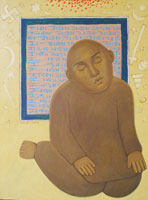
Abdul Jabbar Gull's works, currently on display at Ejaz Galleries Lahore, focuses on the language and not the script as the main subject matter By Quddus Mirza Arguably it is the act of
speaking, which distinguishes human beings from other animals. Language, the
most Throughout history, sacred calligraphy has been a form of aesthetic expression in many Muslim cultures. It was practised in other societies where it did not have specific religious connotation. Apart from the conventional practice of calligraphy, some artists have utilised the creative possibilities of the script in various manners. In Pakistan, a leading exponent of this art was Sadequain, who may not have 'discovered' artistic calligraphy but extended its concept and made it into a popular art form. Not only did the sacred text appear in his paintings and drawings, his figurative paintings were also conceived as works based upon 'readable' narratives. The other notable artists who have worked with the script (both of religious and secular significance) are Hanif Ramay, Shakir Ali, Anwar Jalal Shamza, Gulgee, Ahmed Khan, Rashid Ahmed Arshad and Naiza Khan. With an unmistakable emphasis on script, one can also include Abdul Jabbar Gull in the same league of artists. Though, on a careful examination, it feels his interest lies somewhere else – beyond the script, the visual manifestation of the language. Actually in his works (currently on display at Ejaz Galleries) it is the language, and not the script, that seems to be the main subject matter. Perhaps due to this shift
in approach, Jabbar does not attempt to write words in an aesthetically
beautiful or even graceful manner. The words, whether carved or painted, are
placed closed to the human figures in his reliefs Jabbar has painted, drawn, scribbled and carved these letter/forms on the works executed in diverse mediums. In this solo exhibition, he has displayed paintings in oil, ink drawings, reliefs and freestanding wooden sculptures (a total of 74 works). Human bodies are depicted in majority of the pieces, but these figures, both male and female, have recurring features and particular characteristics. All of these -- from one gender -- appear to be identical personalities, with slight change in their dress, size and position (and strangely reflect the artist's own features). These figures, mostly on painted canvases and in the loosely rendered ink drawings are dressed in the local attire and seem to come from within our surroundings (described as 'Ordinary Souls' by Jabbar Gull in his catalogue), especially belonging to middle class, which is patriotic, religious and is dealing with the issues of survival in this society. These men and women are drawn in a simple and straightforward pose. Except occasionally when they stretch their arms in an expressive gesture, these figures are portrayed in a clam and archetypical fashion (much like the people who quietly stand in front of a camera). Along with the full figures, the portraits also suggest a sombre expression, enhanced by placing them symmetrically in the middle of compositions. The frontal postures, and rather expressionless faces, are translated into his sculptures. The wooden figures are highly stylised and are composed in different groups/orders. These figures or faces are put in groups or in grid formations. The faces and the bodies of these figures are flattened to give them a uniform and elementary look (to the extent that these figures resemble pawns on a chess board or from any other board game). The combination of motionless figures and the text (language) appears odd at first sight, but later it unfolds the situation in our society. Jabbar has, perhaps unconsciously, indicated the general public's state of being speechless. Our people are rapidly losing the habit of voicing their thoughts, problems and affinities. They prefer to remain silent, indifferent and aloof, or they have learnt to remain mute after several years of state suppression. This sense of quietness (or helplessness in the domain of the language) is the primary concern of Abdul Jabbar Gull. It is suggested in the groups of figures that are arranged as if performing a ritual on a sacred site or circling around a desirable object/symbol, or in prayer formation: Acts, which demand absolute silence from participants. The focus on the speechless individuals (the presence of incomprehensible letters denotes the absence of speech in their lives) is also apparent in the frequent usage of writing tablet (takhti). Many works are constructed in the form of this object, which is the first introduction to the knowledge and words for most of our people, of a certain age and from a specific background. In more than one works, these takhtis show human presence on their two sides -- the outlines of figure in the front and the lines of text at the back. However the shape of human bodies is carved much like a sketch, quickly drawn on a piece of paper or like scribbling on a notebook. The relationship of humans with language and their inability to express themselves reflects the political awareness of the artist. The political themes are dealt in some other works too, but in a more direct manner, for instance writing political slogans or comparing the social groups and political/religious divides -- by making bearded and clean-shaven soldiers, individuals from each province, or people that represent different creeds and ethnicities, shown through holy signs. In some areas, Jabbar appears to be too involved in the political content -- in what he may think is relevant for our times (in the global and national context). But the majority of his work, implicitly, suggests a more serious issue -- of speechless creatures what we have turned into over years! If one claimed recording to be the oldest medium then one should know when it all began and put an exact date on the recording By Sarwat Ali The new technological
inventions that facilitated the propagation of arts were very fascinating for
some and a But gramophone records needed a gramophone player which was expensive according to the buying power of most, and a few owned it. They were like the radio in most houses kept in the section which was not visited by women. The mardana as it was commonly known had a baithak or a sitting room that was zealously guarded as space for men from which women and children were kept out by design. Gramophones were kept and played in such places and in some quasi public space like a shop either directly concerned with the music business or some other like a barber's outfit. And many people took great pride in owning and playing recordings of well-known and popular vocalists and musicians. Gradually with the passage of time, people with good collections started to boost of their collections and taking pride in owning a rare number or a piece that had archival value. There were, as the years passed by, many a snooty collector who just displayed their collection and did not play it to those wanting to listen to music. There emerged collectors of recorded music who had all the failings of collectors, they were mean, uppity and guarded their collection like a proverbial snake protecting a treasure. The collection had more value for them than the music it contained. Previously kings and the nobles took great pride in patronising musicians and artists; in the twentieth century there emerged a breed that just took great egoistic delight in just possessing the recordings of famous artists. And these collectors then
boosted of having or being in possession of the oldest possible recordings.
As all of us But if one claimed the recording to be the oldest medium then one should know when it all began and put an exact date on the recording. Like with most Pakistanis, the tales revolved around hearsay, make-belief, bolstered by self-importance. For no one knew exactly what old was or what antiquity meant, but now Michael Kinnear has pierced the silky veil of myth and looked at the history of recording in places like India. His study covers the first decade of recording from 1899 to 1908. In 1900, Harmendra Mohan Bose acquired an Edison phonograph recording machine and began recording local talent and originally had the master cylinders sent to France for manufacturing into commercial cylinders. By late 1906, he had blank cylinders manufactured in Calcutta upon which his cylinders recordings were reproduced as H. Bose's Records featuring performances in Bengali, Hindi and Urdu. Valabhdas Runchordas in Bombay had set up the Talking Machine and Indian Records Company and became the sole monopolists of Beka Records Berlin and later controlled the Odean Records label in India. Meanwhile Fred Gaisberg of the Gramophone and Typewriter Ltd along with their local agent John Weston Hawd made the first native recording in 1902 of two nautch girls aged 16 and 14 "with miserable voices" Soshi Mukhi and Fani Bala, both dancing girls associated with Classic Theatre. He then went on to record Gauhar Jan and later Saila Bai. He also recorded Haree Motee, Sushila and the Classic Theatre Band. One of the first classical male vocalists that he recorded was Lalchand Boral who died only a few years later in 1907. Similar to Gauhar Jan, L.C Boral was a firm favourite of the local populace and was to remain one of the best-selling recorded artist for many years. While Fred Gaisberg and John Watson Hawd may well be acclaimed for initiating the Gramophone and Typewriter Ltd successfully beginning the sound recording industry in India but much of the success should surely be attributed to Amarendra Dutt whose whole knowledge and supreme understanding of the local music cultures must have gone a long way in establishing the Indian repertoire in recordings. He was born in a zamindar family but took to acting and established his Classic Theatre. He then also ran the Minerva and Star Theatres. His own voice too was also recorded in 1908. Another local contributor Jamshedi Madan had a vast business empire but his interest in the arts made him open Elphinstone Picture Palace, first permanent Picture house in India in 1907 He also opened the Madan Theatre and Palace of Varieties. He made many cinema houses and, by the 1930s, the number had increased to one hundred and seventy. All the artists that took part in his productions were recorded and this proved to be a treasure trove of recorded music. Recording industry bloomed and many labels competed with one another such as Dwarkin and Son, Universal Record, Nicole Record, Neophone Disc Phonograph Record, H.Bose Records, Bewka Records, Royal Record, Ram- A -Phone Disc Record, James Opera Record, Singer Record, Odean Record, Aldridge Salmon and Co Ltd, Elephone Record and Pathe Sun Disc Record. Initially the recordings were sent to Europe where discs were manufactured but then Gramophone and Typewriter Ltd set up their own factory in India. Gradually Indian recording companies then were set up like Binapani Record, Kamala Record usually recording music and nationalist songs like Bande Matram. Dear all, I have just finished reading Nadeem Aslam's new book The Wasted Vigil, and it has been a mesmerising but rather harrowing experience. The book is set in
Afghanistan (a setting in itself so disturbing that I have been trying to
avoid reading even The cast of characters is interesting: Lara is a Russian woman who has come to try and find out what became of her brother, a Soviet soldier who was last heard of when he tried to defect; Marcus is an elderly British doctor who married an Afghan woman and has spent most of his life in a small town near the Tora Bora mountains; David is a former CIA operative and the man who loved Marcus's missing daughter; and Casa, a young Talib who hates America and looks forward to martyrdom for his cause. The paths of these characters cross and a heartbreaking collection of stories and histories collide with each other. But what should be an unbearably bleak story, because of its harsh subject matter, is told in such a lyrical and beautiful way that it feels less like a war novel and more like an epic love story. Nadeem Aslam is really an
astonishing storyteller; he weaves a richly coloured tapestry with layer upon
layer of Aslam unfolds the narrative as a multi-layered tale with echoes of the great human tragedies of historical myth. It is also a lyrical meditation on the tragedy of war, and the heavy price that many generations pay for it as they are locked into a seemingly unending cycle of revenge and bloodshed. The legacy of the battle for Afghanistan is a blood feud that has mutilated and dehumanised generation upon generation. Aslam reminds us that Afghanistan is not just about a Soviet invasion, or the hunt for Osama or another suicide bombing, but that it is a complex conflict in which injustice and brutality are ripping apart any sense of humanity or compassion. Many decades ago, I read an altogether different sort of novel about this region, Caravans by James Michener, and what I remember most about it is the passage in which he elaborated on the idea of this being a sort of cursed land. The idea of it being doomed by ambition and betrayal was explained by a legend that it was here, in Kabul, that Cain (Kabeel) murdered his twin brother Abel (Abeel), and that ever since this has been the scene of ruthless fratricide. The Wasted Vigil is a lyrical, thought-provoking story. The sort of book you will want to read, read again, talk to friends about, whose characters you will want to discuss and whose tragic events you will want to mourn. Best Wishes Umber Khairi
|
|
 important human 'invention', has been a medium for creative expression.
Literature, poetry, film and theatre rely on language to communicate ideas.
Like these, several artists have also concentrated upon verbal language in
their creative pursuits. One of its most obvious examples is the usage of
text in visual art.
important human 'invention', has been a medium for creative expression.
Literature, poetry, film and theatre rely on language to communicate ideas.
Like these, several artists have also concentrated upon verbal language in
their creative pursuits. One of its most obvious examples is the usage of
text in visual art.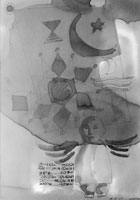 ,
paintings and works on paper. The fact that the language and the act of
speech are more important for him (rather than the decorative potential of
the Arabic script) is revealed in the uniformity of the text. The words like
shapes are drawn in a simplified scheme, often resembling the writing in
Urdu, English and Hindi. In reality these 'words like characters' do not
possess any meanings, these only represent a form of speech.
,
paintings and works on paper. The fact that the language and the act of
speech are more important for him (rather than the decorative potential of
the Arabic script) is revealed in the uniformity of the text. The words like
shapes are drawn in a simplified scheme, often resembling the writing in
Urdu, English and Hindi. In reality these 'words like characters' do not
possess any meanings, these only represent a form of speech.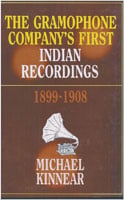 matter of consternation for the others. Mediums like the films, radio,
gramophone records and much later television were seen as agents that led to
the moral degradation of the societal values. Films were only exhibited at
designated venues but radio led the outside world right into the homes.
Television was the last nail in the coffin, the image which accompanied the
sound could be doubly damaging for the young and old, especially of the
feminine gender.
matter of consternation for the others. Mediums like the films, radio,
gramophone records and much later television were seen as agents that led to
the moral degradation of the societal values. Films were only exhibited at
designated venues but radio led the outside world right into the homes.
Television was the last nail in the coffin, the image which accompanied the
sound could be doubly damaging for the young and old, especially of the
feminine gender.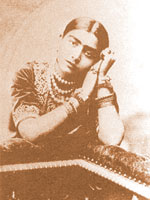 know antiquity has great value and the recording, more in words than deeds,
was brandished as being very old, probably being the very first and in the
sole possession of the collector. The travails, the effort and the money they
had to spend in getting this precious number or recording and many such
heroics dominated the dinner conversations.
know antiquity has great value and the recording, more in words than deeds,
was brandished as being very old, probably being the very first and in the
sole possession of the collector. The travails, the effort and the money they
had to spend in getting this precious number or recording and many such
heroics dominated the dinner conversations.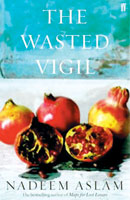 Khaled Hossaini's recent bestsellers) and the picture it paints is not a
pretty one. Or perhaps I should say it depicts Afgahanistan as what was once
a beautiful picture, but one which has been destroyed by hatred, revenge,
brutality and ambition. It offers a glimpse of Afghanistan as a land with a
history of tolerance and humane Buddhist thought, of great natural beauty and
inherent poetry -- a sort of gilded, intricately worked Persian miniature
damaged by bigotry, hatred and war.
Khaled Hossaini's recent bestsellers) and the picture it paints is not a
pretty one. Or perhaps I should say it depicts Afgahanistan as what was once
a beautiful picture, but one which has been destroyed by hatred, revenge,
brutality and ambition. It offers a glimpse of Afghanistan as a land with a
history of tolerance and humane Buddhist thought, of great natural beauty and
inherent poetry -- a sort of gilded, intricately worked Persian miniature
damaged by bigotry, hatred and war. colour, history and texture. His portrayal of the sights and smells of the
landscape are memorable, the lasting impression being of beautiful but cursed
land. The way that humans suffer in the midst of war and territorial power
struggles is conveyed with a piercingly painful beauty and poignancy. The
ghosts of the dead haunt the living: the soviet soldiers poisoned and
mutilated, the women and children raped and murdered, the young men
incarcerated and tortured, the directionless, unloved children of war lured
into carrying out suicide missions...
colour, history and texture. His portrayal of the sights and smells of the
landscape are memorable, the lasting impression being of beautiful but cursed
land. The way that humans suffer in the midst of war and territorial power
struggles is conveyed with a piercingly painful beauty and poignancy. The
ghosts of the dead haunt the living: the soviet soldiers poisoned and
mutilated, the women and children raped and murdered, the young men
incarcerated and tortured, the directionless, unloved children of war lured
into carrying out suicide missions...