



|
|
|
|
 |
 |
   |
Editorial overview Commuter-friendly Road to
better management Question
park One
for the road 'The
only working solution is a rapid bus transit system' Capital
loss
Some things need to drastically change in the big cities of this country. There is no space for pedestrians; all new roads, bridges and even residential localities are being built without any provision for footpaths. The cyclists, of whom we have too many, are on the road only at the risk of their lives. The public transport is minimal and ineffective. You cannot commute in a decent manner without having to own a car. Worst of all, there is no sense of dignity accorded to any commuter who is not sitting in a car. There is a sense of competition even among cars; the luxury cars tend to claim more road space and show little respect for traffic rules. Our policy-makers have been constantly feeding news stories about high-sounding projects -- mass transit systems to be precise -- to the media that will ultimately come to the rescue of the people and wash off the traffic madness from our roads. Till that happens, there is no effort to build facilities for all the people on all the roads. The pedestrian space has shrunk to being non-existent and so has the sense of social equality. Over the years we have seen some grand plans implemented in bits and pieces, in the form of an underpass here and a flyover there. Sadly, after months and years of building time and spending millions of rupees, these projects have created new problems not too far from they were built, putting into question the rationale of the whole exercise. Widening of roads as a solution to traffic jams has proved to be counter-productive in each case and yet the planners cannot seek any solution beyond this. So what is the way out of this huge bottleneck facing the big cities? Urban planner par excellence, Arif Hasan tells us there is no overall understanding of the problems; there is no larger traffic management plan which is in sync with urban design exercises. Efficient management agencies, good transport system, car parks, provision of facilities for pedestrians and cyclists etc. are all not there because, as Arif Hasan suggests, we do not have institutions that can generate thoughts and solutions. So, perhaps, the biggest need of the hour is to build institutions that train people: at the masters and PhD level to be educated in urban design, transport planning, traffic engineering, landscape architecture; and at the level of vocational centres and polytechnics to produce technicians who can help implement these solutions. A rail mass transit system is thought, and wisely so, to be too expensive for our needs, even though the sheer volume of its budget may be mouth-watering for any government of the day. What we need instead is a rapid bus transit system with dedicated roads. It is about time we pushed for separate lanes for cyclists, too. Most importantly, we need to teach our children certain societal values in schools. We need to ask the motorists to slow down their cars for the pedestrians, at zebra crossings and otherwise, by force of law and through education. Getting out from homes has become a dreadful and tension-filled exercise that one must undertake every day: the pollution, the traffic jams; the constantly increasing commuting time are all taking a huge toll on people's psyche. The Special Report this time takes a look at all these problems separately and together, in order to suggest ways to turn the cities into more livable and likable places. While urban developers mull plans to come out with long-term solutions, we can learn from the successful experiences of many big cities of the world and reduce our miseries to a great extent By Shahzada Irfan Ahmed Endless queues of
smoke-emitting vehicles, jammed roads, blocked intersections and
crossroads, baffled The situation is only getting worse, with every passing day, irrespective of the fact that the government is spending millions and, in many cases, billions to find a solution to this problem. Some of the instant and short-fix solutions in the eyes of authorities have been to build intersections, flyovers and underpasses, widening the roads and closing busy highways for two-way traffic. But such measures lead to further congestion of traffic as commuters are more than encouraged to bring their cars on to the roads in anticipation of a hassle-free drive. No doubt, those to be blamed in this whole scenario are the car owners for whom there exists no other respectable mode of commuting. They make it a point that they use their four wheelers whenever they step out of their house regardless of the time spent or wasted in reaching their destinations. This also leads to blocking of pavements and green belts as people are unable to find sufficient parking places. But if one looks at the alternatives available to them one tends to agree with what they say to justify their travelling by car. The situation on ground is that the urban transport planning in Pakistan has mainly been focused on accommodating motorists, much at the expense of the people opting for public transport and the pedestrians. Because of this, none of the country's big cities can boast of having a reliable public transport system -- something that is urgently needed in order to convince the motorists to keep their vehicles back home. Though traffic management has always remained a challenge for the concerned authorities, the issue has assumed greater proportions thanks to some obvious factors. These include i)the amazing expansion of cities like Karachi, Lahore, Faislabad, Gujrawala, Islamabad and exponential growth in their population; ii)growth in urban motor vehicle ownership; iii)a growing reliance on private vehicles leading to a substantial decline in the share of total trips being provided by the urban public transport system; iv)private ownership of all the urban bus services; v)encroachments along roads and on pavements; and vi)lack of public awareness on traffic issues and their unwillingness to respect municipal and traffic laws. Traffic congestion has emerged as a menace over the past couple of years that saw an unprecedented increase in the number of automobiles sold in Pakistan. In 1998-99, it was three cars per 1000 persons, which has significantly increased to above 11 cars per 1000 persons today, thanks to the consumer finance offered by banks. As per figures provided by the Pakistan Automotive Manufacturers' Association (PAMA), against 30,131 cars in 1995-96, the number of cars sold in 2006-07 stands at 160,496, showing an increase of over 430 percent in the last 11 years. To stop such a big number of new cars from coming on to the roads an alternative public transport is needed the most. Besides, it needs to be inculcated in the minds of motorists that travelling by public transport or on foot when distances are short does not undermine their social status at all. This is the case in many developing and developed countries where motorisation (people-to-car ratio) is many times more than what exists in Pakistan. But before that target is achieved, quality and sufficient bus service has to be provided to the general public. Today, cities like Karachi and Lahore are planning to build expressways and launch mass transit projects that are bound to cost billions. These have been criticised by experts who think rapid bus transit is the best solution in the context of Pakistan and a much cheaper public transport as well. Similarly, there are voices demanding improvement in the existing infrastructure instead of laying new. For example, the Karachi-based think-tank -- Urban Resource Center -- pushed for the revitalisation and extension of the Karachi circular railway as an alternative to the Karachi Mass Transit Plan (KMTP). This railway already connects Karachi's five main work areas, including the central business district, the port and the major industrial estate, as well as the major inner-city residential areas. URC suggested that if 19 kilometres of extensions were built, about 80 per cent of Karachiites would live within two kilometres of its 98 kilometres of track. Another issue that hampers effective traffic planning in urban cities is that the administrative control of the transport sector is fragmented and the responsibility for different sub-sectors lies with different ministries and departments. Each of these entities pursues policies from its own narrow perspective in the absence of coordination with others. Therefore, it is suggested that a practical working relationship be established among them and one of the overarching department made responsible for getting the best possible output from them. But to give the required results, all these departments need highly qualified skilled staff educated in disciplines related to traffic management even at masters and doctorate levels. While urban developers mull plans to come out with long-term solutions, we can learn from the successful experiences of many big cities of the world and reduce our miseries to a great extent. For example, people can themselves start car and van pool programmes to reduce vehicular flow on roads. Meanwhile, the government can launch shuttle buses in cities, improve the process of motor vehicle inspection, reserve lanes for different types of vehicles, introduce proper signage, secure pedestrian improvements, construct bus shelters, spaces for parking and loading/unloading of goods and remove street hawkers and other encroachments blocking the movement of traffic. These steps will need much less funds than mass transit plans but greater political will, especially when it comes to removing encroachments from roads. In every big cities there are vested interests including extortionists that protect encroachments which are a regular source for them. In addition to reducing space for smooth traffic flow, these encroachments create problems for pedestrians. Therefore, it is imperative that pedestrians be provided facilities like overhead bridges and underground ways to enable them to cross the roads safely. Last but not the least, the awareness level of the general public has to be increased regarding obeying traffic rules. Many a time traffic jams are caused due to irresponsible driving, entering forbidden lanes and a mad rush on the part of the commuters to cover distances in no time. That is why, in Pakistan, a traffic cop has to be posted on every traffic signal. In the absence of the cop the signal means nothing to them. Commuter-friendly By Aziz Omar An efficient and
low-cost mass transit system is a means to improving the quality of life
of the denizens of any However, in the absence of a moderately comfortable and reliable mass transit system, possessing an automobile becomes one of the main pursuits of life. The urban mass transit systems in Pakistan have always been in doldrums. Public transit on a national level has already been in a deregulated state since the 1970s. The Punjab Road Transportation Corporation had, however, continued to operate an urban transit system of sorts until its complete collapse in the late 1990s. Some of us would recall those pale looking Volvo buses. Well, the number of public buses decreased from 1,000 to eventually 50 on account of the Punjab government incurring heavy financial losses. Consequently, the year 1998 saw the closure of this publicly operated urban transit system and witnessed the rise of transit franchising in the form of New Khan, Metro and Daewoo bus services. These services were allowed to be operated on specific routes while guaranteeing a certain level of transportation quality. However, as these services are being run on a profit maximisation basis, the number of buses in proportion to the commuters has drastically gone down. Even after the buses have been stuffed chock-a-block with passengers at the various stops, many are still left to wait for the next bus to arrive which takes anywhere from 20 to 50 minutes. Since the early 1990s, the so-called 'mega urban transit projects' have been on the charts for big cities like Karachi and Lahore. The Karachi Mass Transit Programme (KMTP) and the Lahore Rapid Mass Transit System (LRMTS) have been proposed largely around a rail-based system that would be underground -- on ground level as well as on elevated passage ways. However, all such rail-based mass transit systems require several billions of dollars for their construction and after completion have to be heavily subsidised in order for them to stay functioning whilst charging nominal fares. Just as in the case of the LRMTS, by the time the first stage is expected to be completed in 2011 at a cost of $2.4 billion, for a passenger to avail it for a one-sided trip across town at a rate of about Rs.30, the government would have to pitch in Rs.100. This is besides the fact that public projects with such massive funding open all sorts of backdoors for kickbacks of millions of dollars. Already, cases of siphoning off of hundreds of millions of rupees have surfaced even before any groundwork commenced, with the culprits being close aides of head honchos of the previous provincial government. With the extreme levels of economic turmoil that our country is currently plagued by, we cannot by any means risk our future by borrowing such vast sums of funds from the likes of Asian Development Bank (ADB). One viable and very cost-effective option is to have dedicated lanes for bus-based transit on the existing network of city roads and constructing overhead and underground only where highly necessary. Of course, this would entail a severe restriction on the flow of private cars and subsequent traffic jams if their numbers and use is not curtailed. Hence more than a logistical matter, the adoption of a dedicated bus-based transit system is a matter of political and personal will. Good coordination between different government departments is central to improving the traffic system By Waqar Gillani Traffic mismanagement on
the roads has become an ever growing menace in metropolitan cities like
Lahore the The issue, according to experts, can be addressed if rules are implemented properly, scientific methods are employed to maintain the traffic system, and a sense of responsibility is inculcated among the general public whereby they can recognise the rights of every stakeholder, including the pedestrians. For instance, Lahore's traffic system calls for an involvement -- directly or indirectly -- of the Punjab government (in policy making); Regional Transport Authority (in vehicle management); Traffic Department working under Punjab Police and Planning and Development Board (P&D) Urban Development Unit (in making policies and launching new projects to improve the situation); Traffic Engineering and Planning Agency (TEPA) (for constructing roads and other civic projects); Lahore Development Authority (LDA); Transport Department; District Governments (local governments); Communication and Works Department; and Environment Protection Agency and Environment Department. Moreover, the outdated system of motor vehicle examination needs an immediate overhaul in order to improve the traffic system. A senior Punjab government officer told TNS that the running of unfit vehicles on the roads had become a common phenomenon and the government was not able to help matters because of its lack of interest. "For example, there are only two Motor Vehicle Examiners (MVEs) for checking more than 1.7 million (till Sep 2007) vehicles registered with the provincial capital-Lahore-jurisdiction." According to Malik Muneer Joya, the current RTA Secretary, "We have written to the Punjab government about the problem and suggested the use of scientific labs in examining vehicles. But no action has been taken so far." He stressed on the need to develop the system on par with international models followed by the developed nations. Traffic police authorities, on the other hand, say that they have never intervened in the jurisdiction of the transport department. "Sometimes we bring to the department's notice cases of unfit and non-maintainable vehicles running freely on the roads, but it is up to the MVEs to act," says Ghalib Bandesh, Deputy Inspector General (DIG). Regarding coordination between various departments he said, "After the implementation of the new traffic warden system, we have been able to improve the situation, and the result is for all to see. "We are open to suggestions not only from all government departments and authorities concerned, but also from the stakeholders and civil society groups." These suggestions, he added, were also being incorporated. Ghalib Bandesh also said that the help of TEPA and other agencies had always been sought to ease the burden of traffic through projects such as overhead bridges, service roads, and by taking line marking input and coordinating with City District government to remove encroachments for a smooth flow of traffic. "We regularly hold meetings with the concerned departments to discuss the pending issues." He also spoke of "many new initiatives" that have been taken "after proper consultations". These initiatives include the use of Google Earth software for projecting daily diversion plan on the web; digital displays; countdown timers; participation of boy scouts in road traffic regulation; online traffic monitoring through Close Circuit Television (CCTV); and new licensing system with eight booths across the city and license delivery at home. According to Khushal Khan Khattak, Chief Engineer, TEPA, the coordination between the line departments has improved over the past some time. "However, there is a need for developing a traffic sense coupled with a sense of responsibility, and recognising the rights of every stakeholder including the pedestrians." He said that there was a new project in the pipeline whereby bus lanes on selective roads of the provincial capital will be introduced. "We've also laid out a plan for widening of roads. "There is a dire need to follow international standards and to educate citizens to change the mindset of common commuters that results in traffic chaos." Sajjad Bhutta, District Coordination Officer (DCO), Lahore, also claimed that there was "a complete coordination in removing encroachments, especially on service lanes and roads. During different festivals, these lanes are occupied by vendors." He said that the situation would improve and the service roads would be made free of encroachements after the Eidul Fitr.
Condominiums in Pakistan have been proposed time and again by various governments as a sure-shot solution to parking woes, yet few have seen the light of the day With a couple of million
or so cars plying on the roads of Pakistan, especially concentrated in the
urban jungles of The sides of roads are by default considered as an ideal place for car parking and, in the instance of a footpath (an extremely rare instance at that), it too is assumed to be a 'tire path'. Residential streets, on the other hand, are already constructed in such a way so as to barely allow for the passage of two cars. When one throws in a car parked outside every other house or so, the route becomes akin to an obstacle course worthy of testing the navigating skills of even the most experienced of drivers. A report reviewing the then state of urban transport was prepared by the National Transport Research Centre (NTRC) in the January of 2005 and suggested that all cars that were parked in front of offices and businesses etc be charged a parking fee. This could either be in bulk form of Rs50 a day or could vary from Rs15 to Rs30 on an hourly basis according to the traffic conditions. The intention for charging these seemingly high rates was to discourage long parking durations, albeit with the provision of on-street and off-street parking facilities. However, sadly no such measures have been implemented even after three years of the Senate's standing committee on communications having accepted the respective draft recommendations. Parking metres are an effective means of collecting parking tolls and have been in use in most of the developed countries of the world for around half a century. They have to be charged by the hour and non-payment results in the issuing of a parking ticket (fine) by designated parking monitoring officials. Parking metres can either be for singular parking spaces or for numerous ones such as those on separate floors of parking condominiums and the funds thus collected go towards maintaining such facilities. Parking condominiums in Pakistan have been proposed time and again by various governments as a sure-shot solution to parking woes, yet few have seen the light of the day. Those that have materialised include the D-Point Plaza at Lahore's Shah Alam market. Yet, this parking plaza as well as others proposed to be built in Karachi's Zamzama commercial area, Lahore's Liberty market, Nila Gumbad and Islamabad's Blue Area cost up to Rs300 million and several years in the making. Not surprisingly, most of them have been shelved or put off due to lack of funds. Even if they are constructed and have a capacity of accommodating 300-500 cars each, there will always be a need to erect or dig out more of them to cater to the growing influx of cars. Considering that Pakistan is a so-called developing (read desperately struggling) country, the need of the hour is not to build more costly roads, express ways and the subsequent parking lots and plazas to facilitate cars. An efficient and cost effective urban public transport system needs to be developed along restrictions on the numbers of cars on the roads to counter environmental pollution and enhance the quality of human life. -- Aziz Omar
There is a limit to which the traffic police can manage the traffic, given the resources they have and the authority over those who encroach By Sarah Sikandar In Pakistan's urban and
rural areas, encroachment is a common practice. So much so that it is not
even identified Under the Lahore Development Authority (LDA) Act of 1975, if a person encroaches upon public property, he is first issued a notice by LDA which warns the accused to bulldoze the property within the allowed time. If the accused fails to do so, LDA holds the right to bulldoze the property. The accused has to pay for the bulldozing other than the additional fine. This, however, can only be done when the property is owned by LDA or it comes under the so-called 'controlled area'. The term is usually given to places of public utilities including roads, market places or parking areas. Since encroachments on private property is a matter between the parties involved, LDA cannot intervene. Looking at the number of encroachments on the roads, one wonders where and how does LDA exercise its authority. It is done at the whims of the authorities. An example could be the road from Lahore Railway Station to Badami Bagh which is so narrow that a car can hardly pass through. Only after a few kilometres one can see the actual size of the wide road crammed by encroachments by shop keepers and other business men who have built their shops, practically on the road. There is a limit to which the traffic police can manage the traffic, given the resources they have and the authority (or lack of it) over those who encroach. Footpaths are almost obsolete in the big cities and those that are there are encroached upon by vendors forcing the pedestrian to use the road. The construction of these footpaths itself is illegal encroachment since they are made on the road. These footpaths are also the favourite parking space in the big cities. Boat Basin in Karachi is another example of horrid encroachment making it impossible to use the road without getting your car dented. In Islamabad, the CDA has also identified more than three thousand encroachers in different sectors of the city that are to be demolished after Eid.
'The only working solution is a rapid bus transit system' Urban planner, Arif Hasan, suggests that traffic management and urban design are inter-linked and proposes some do-able solutions to manage traffic The News on Sunday: What exactly is wrong with the traffic management in big cities? Arif Hasan: There are a
whole lot of things. First, we need efficient management agencies. Second,
there is no Then, we have developed high density areas. There's no problem with that except that they need to be a result of urban design exercises, for instance knowing how much traffic density is going to be there on a particular road. Traffic management planning and urban design are inter-linked. Other problems include lack of an efficient transport system which is why more people travel by car. The transport system must be cheap and for it to be cheap needs subsidy in some way or the other. There are a whole lot of other issues, like car parks, enforcement issues, lack of co-ordination between various agencies. Then there's the issue of police training. And finally we don't have institutions to do all this. TNS: You have talked about public transport system but there is a thinking among urban planners that no public transport, especially bus service, can ever be a substitute for privately owned automobile which is faster and more convenient? AH: I don't agree with this view. It can be a substitute if it's faster. There are two rapid busways in Jakarta; on those corridors the use of cars has come down substantially. Same is the case with other big cities where they have been able to introduce fast urban transport. In Bangkok where there is light train, nobody would dream of taking out a car or taxi. It depends on how fast or well-planned the system is. It has to have an exclusive right of way. And that you can only have at the expense of automobile. So we have got to do that. TNS: How have other countries inculcated this sense of privilege for the pedestrians among their people? Why is our system so pedestrian unfriendly and how can we change it? AH: To begin with, you have to make facilities that the pedestrians can use. Then, things will have to be enforced somehow. For the time being, you can place para-police at the zebra-crossings that stops motorists to let the pedestrians pass. You have to educate the people. In other countries students are educated in schools; they are taken out and taught how to cross the roads etc. So certain societal values are inculcated in them through education. Secondly, when you provide facilities, people start behaving nicely. You can observe a difference in people's behaviour at Daewoo Bus Station and Badami Bagh in Lahore, and similarly at the airport and the railway station. The physical environment makes a difference and you have to create it. TNS: What is your opinion on mass transit? Is it viable? Do we need it? AH: You see mass transit has many forms. The light rail, metro and heavy rail are extremely expensive solutions. In Karachi, the first scheme of light rail was proposed on a build and operate basis and the ticket came to around Rs45 per trip. This was unviable unless there was a huge subsidy. The second problem is that you have to keep building the rail system, which is a time-consuming process and needs immense engineering skills. In third world cities like Bangkok, only 3 percent of trips use the light rail. The rest use the bus. In Delhi's metro, only 4 percent of trips are generated. The most important thing is that it is so expensive. In the case of light rail, the cost is worked out at $30 million per kilometre. The underground is far more expensive. In comparison, the bus transit system with dedicated routes comes to around $2.5 million per kilometre. And then you can keep adding to it. What is affordable for our people, a working solution, is a rapid bus transit system. But you need political will to do it. Then you need institutions that can plan, operate and maintain it. And finally you need skills for all this, and for that you need educational institutions and training courses. TNS: Can you spell out some practical solutions? AH: We should opt for solutions that are economically feasible; because the expensive solutions have not worked even in other cases. We should have a system which we can operate locally and which we can expand and multiply. And most importantly, it is important to create institutions. TNS: Do you think the political will to do so is there? AH: I can't say about the political will but the desire is there. But the desire too is about grand things. For instance, none of the grand schemes proposed in Karachi are economically feasible. They are just too expensive and then the contractor wants sovereign guarantees. The bus transit system is doable. Generally, for a mass transit or any system, you can inject qualified people from outside but, in the long run, you need academic institutions that teach urban design, transport planning, traffic engineering, landscape architecture at masters and PhD level. Without this a larger vision becomes difficult. Then these qualified people need technicians who in turn polytechnic institutes and vocational centres. The polytechnic colleges of Ayub era and the vocational centres of Bhutto's time are in terrible conditions. -- F. Zia
Capital
loss Soon after Islamabad
Traffic Police (ITP) was launched in early 2006, one commonly came across
policemen at the Today one does not see the radar in the morning, on the road leading to the secretariat, but certainly there is a radar to check the speed of the vehicles coming from the secretariat. The ITP insists that it has been enforcing laws without any regard for the status of the violator. It claims that -- to date -- it has issued tickets to the violators including 41 federal ministers, 15 senators and 62 senior government officers. Interestingly, 133 army officers top the list of persons challaned by ITP. The figure of 656 (as has been put on the ITP website) challans distributed among 22 categories of influentials which include MNA, diplomats etc., in around three years' time, is too small a number to convince a common man that we do not have a selective application of the law -- meaning that no exception is taken to the elites and that our traffic policies are not elite-friendly. This becomes evident when one finds a virtual non-existence of pedestrian bridges or cycle lanes on or around high-speed, newly built 7th and 9th avenues in the federal capital. On both the roads, pedestrians crossing is banned. Although hundreds of people cross them every day. A majority of buses plying on different routes in the city are in a pathetic condition which shows that public transport system is also not a priority of the cities managers. In Capital Development Authority (CDA)'s budget for 2008-09, decidedly the highest budget for any development authority in Pakistan, Rs800 million has been allocated for Kashmir Highway, Rs600 million for Zero Point Interchange, Rs500 million for rehabilitation of Islamabad Highway and Rs300 million for underpass and flyover at Faisal Avenue. It seems the government failed to foresee the mammoth growth of cars and other vehicles on the roads. Once it's done the official formula to resolve this crisis is construction and dualisation of roads. Although the newly established ITP and traffic wardens have been put in place, considering the magnitude of the problem the capacity of these set-ups seems quite limited. Or, perhaps, the problem is simply beyond their control. There is also a need to initiate polices to reduce the pressure of traffic on roads by promoting an efficient urban public transport system for the middle class and by making roads cycle-friendly. For example, one finds long queues of cars stretching over a distance of a kilometre or so, during rush hours, on 9th avenue, making it clear that the official response to the big problem does not correspond. The official figures are either not credible or they are faulty and outdated. Such as, the available figure on the total number of registered vehicles in Islamabad is 2,40,335, which is two years old. Similarly, that of 2,36,123 registered vehicles in Rawalpindi also does not correspond with the reality on ground where the public has to put with long, unending traffic jams. The data that as many as 1,43,886 vehicles enter Islamabad on a daily basis is also not reflective of the actual situation. No wonder when planning is based on outdated statistics, it is destined to be a dismal failure. In January 2006, ITP was launched in the capital city with a seed money of Rs204 million. It was trained by the Motorway Police. Earlier, the strength of the traffic police was 266 which was increased by threefold to 709. This force does not have any coordination with the road engineering department of the CDA which builds and expands roads on its own based on the feedback from ITP if the loops are driver-friendly or not. The CDA ITP has introduced many ventures such as time metering signals, but these have failed. Now, one sees ITP officials riding bulldozers and adjusting medians. In a recent moot to make Islamabad signal-free on many roads, the drivers were barred from going straight on certain crossings. At a time when the prices of fuel continue to soar, asking the vehicle drivers to go an extra mile means the campaign has flopped. A recent ITP press release shows that it imposed a fine of Rs2.43 million on 8,205 drivers for using mobile phones and high beam and not fastening their seatbelts while driving. According to the report, 6,480 motorists were fined Rs1.94 million for not fastening their seatbelt, 1,439 were fined Rs0.43m for using mobile phones, and Rs57,200 for using high beam. But, it has not improved the situation. It appears that the problem is bigger than it seems. Therefore, it is pertinent that a new middle-class-friendly road plan and strategy be devised that includes a strict enforcement of laws complemented by an efficient public transport system, cycle- and pedestrian-friendly roads and a driver-responsive road engineering.
|
|
 pedestrians jumping to their right and left in order to avoid collisions
with speeding vehicles and jam-packed public transport vehicles are a
common sight in any of the big cities of Pakistan. Wrongly parked cars,
encroachements on roads, and the fast diminishing walkways and footpaths
for pedestrians are other pressing issues that are yet to be tackled with.
pedestrians jumping to their right and left in order to avoid collisions
with speeding vehicles and jam-packed public transport vehicles are a
common sight in any of the big cities of Pakistan. Wrongly parked cars,
encroachements on roads, and the fast diminishing walkways and footpaths
for pedestrians are other pressing issues that are yet to be tackled with.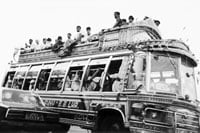 urban centre. By utilising public transport to and fro -- between their
homes and places of work -- city dwellers are able to maximise their
disposable income on more tangible experiences such as going to cinemas,
concerts, theme parks, eating out and of course shopping.
urban centre. By utilising public transport to and fro -- between their
homes and places of work -- city dwellers are able to maximise their
disposable income on more tangible experiences such as going to cinemas,
concerts, theme parks, eating out and of course shopping.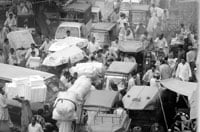 blame for which is apt to go to a lack of coordination between various
concerned departments of the provincial and local governments as much as
to the government's negligence on the issue.
blame for which is apt to go to a lack of coordination between various
concerned departments of the provincial and local governments as much as
to the government's negligence on the issue.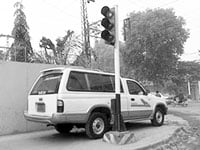 Lahore, Karachi and Islamabad/Rawalpindi, it is no wonder that every
available non-confined spot has become an ad hoc parking space.
Lahore, Karachi and Islamabad/Rawalpindi, it is no wonder that every
available non-confined spot has become an ad hoc parking space.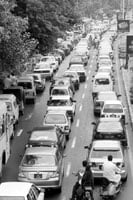 as a problem any more. In fact, most of the traffic problems in the cities
-- both in residential and commercial areas -- are directly proportional
to encroachments.
as a problem any more. In fact, most of the traffic problems in the cities
-- both in residential and commercial areas -- are directly proportional
to encroachments.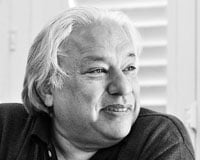 overall understanding of the problems; we have to have a proper
understanding of things like engineering projects. So for a small problem,
we make a flyover which in turn creates problems in other areas. These are
piecemeal solutions. What is required is a larger traffic plan, keeping in
consideration the traffic volume, land use and its various linkages.
overall understanding of the problems; we have to have a proper
understanding of things like engineering projects. So for a small problem,
we make a flyover which in turn creates problems in other areas. These are
piecemeal solutions. What is required is a larger traffic plan, keeping in
consideration the traffic volume, land use and its various linkages.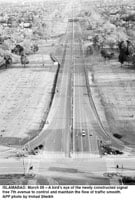 speed radar, telling the higher government officials cars to stop and
challaning them over any speed limit (of 65 kmph) violation. This radar
was placed on VIP Margalla Road close to the Federal Secretariat, and most
of the people challaned were those heading to office.
speed radar, telling the higher government officials cars to stop and
challaning them over any speed limit (of 65 kmph) violation. This radar
was placed on VIP Margalla Road close to the Federal Secretariat, and most
of the people challaned were those heading to office.