



|
|
|
|
 |
 |
   |
cricket Skipper
Ponting breaks jinx of failures in India Here's
some fair advice for Mohammad Yousuf cricket An
unconventional year of tennis nears a blazing close Is
the Aussie Kangaroo limping?
cricket He has taken over at a juncture when Pakistan cricket finds itself in total chaos. Most international teams have refused to honour their commitment and tour Pakistan, which means the Board has lost a sizeable amount of revenue By Imran Farooqi The last week
witnessed some major developments on the cricketing front, with the The appointment of Ijaz Butt as the new chairman of the Pakistan Cricket Board seems to be a nice step in the right direction as several ex-players have lauded the move. Butt, who is a member of the PCB's governing body, has succeeded Dr Nasim Ashraf who had resigned soon after Pervez Musharraf's decision to quit the national stage. Butt, who is a well-known businessman and a former Harvard student, brings with him rich experience of running business and cricket affairs. But the most important event which might have far-reaching consequences for Pakistan cricket was the minister's meeting with Wasim Akram, Inzamam-ul-Haq, Saeed Anwar, Rameez Raja, and Mushtaq Ahmed regarding the decline of cricket in the country. Those who were invited included four ex-captains and a leg-spinner, and all of them have played the game at the highest level and performed outstandingly. So their input and opinion regarding the current state of the game certainly hold weight, and there cannot be better judges of the game than these fellows. The meeting was held prior to the appointment of Butt, and the players had emphasised the need for bringing in a person who has played at least 50 Tests and/or a good number of One-day Internationals. Their contention does make a lot of sense as in past we have seen bureaucrats with little or no knowledge of the game heading the PCB. Most of them were handpicked and were not answerable to anybody except the president of Pakistan, and that's why cared little for the game and its development in Pakistan. It remains to be seen how the new PCB chief gets along with the committee of the former players, who have sincerely offered their services for the betterment of the sport. The former players wanted a person with vast experience of international cricket to lead the PCB, and Butt does not fulfil that condition as he appeared in just 8 Test games between 1959 and 1962. However, the ride for the new chairman PCB does not promise to be an easy one. He has taken over at a juncture when Pakistan cricket finds itself in total chaos. Most international teams have refused to honour their commitment and tour Pakistan, which means the Board has lost a sizeable amount of revenue which it could have generated by hosting series against different countries through sale of TV and marketing rights. Pakistan's performance on the field, too, is not that encouraging with the team falling well short of the people's expectations and failing to make notable progress in the right direction. The results are not consistent despite the fact that the current pool of cricketers comprises the best talent this country offers. The team lack self belief, and frequent incidents of indiscipline and fitness problems are only aggravating the situation. A fresh controversy that erupted soon before the team's departure to Toronto for the four-nation Twenty20 tournament was the resignation of chief selector Salahuddin Ahmed. There is no doubt that the selection panel, which also includes ex-pacer Saleem Jaffer and former batsman Shafqat Rana, has done a wonderful job so far. They did everything they could, from giving opportunities to upcoming players to backing the established players. They always picked the best side according to the requirement of a given assignment and if, for some reasons, the squad did not perform it is not their fault and they should not be held responsible for that. Though Salahuddin has claimed that he had quit the post to allow the new chairman to bring in a panel of his own choice, the reports suggest otherwise. The last-minute change in the squad that was picked for the Toronto event seems to have forced the chairman to tender his resignation. Before its announcement the line-up was approved by the Ministry of Sports and that's where the change was effected with Quetta opener Shoaib Khan replacing the originally-picked off-spinner Saeed Ajmal. Salahuddin was obviously perturbed over this change and quit immediately as it's the selection committee's task to pick the best players for the job at hand. The side left for Toronto without a genuine spinner, with Shahid Afridi and skipper Shoaib Malik expected to fill in the vacant spot. The selectors have served Pakistan well and their efforts need to be acknowledged. The PCB chairman must speak to Salahuddin and sort things out. For the time-being at least the selectors need to be retained and don't deserve a sacking. A new set-up takes time to settle down and this might mean new problems for the Board. Rifts between captains and his charges are not something new in Pakistan, and this ghost is again raising its head. There were reports telling of differences between the selection committee and the captain over the selection of Afridi. Although such incidents are always dismissed as mere speculations and media-inspired rumours by the quarters concerned, the fact is that Malik did not want Afridi in the squad, probably unhappy over his recent statements wherein the latter had expressed his liking for captaining Pakistan. Such things have hurt Pakistan cricket a lot in past also, and the new chairman will have to work hard to eliminate such practices if he really means business and wants to stem the rot. Differences are not something which can't be dealt with amicably. A way out can always be found provided the parties concerned are willing for a solution and are sincere in their pursuit for achieving excellence. Pakistan's next assignment is a home series against India. Butt will have to act fast if Pakistan are to give their neighbours a good run for their money. Skipper Ponting breaks jinx of failures in India 'My record everywhere else is great. Sri Lanka has probably the hardest spinning conditions to play in but I have got a record there as good as anybody's, and against a set of bowlers a whole lot more skilled than Harbhajan might be' By Khurram Mahmood The most important
Test series of the year between India and Australia is going on in Now without Shane Warne, Glenn McGrath and Adam Gilchrist there is a tough task ahead for Ricky Ponting. Especially without any experienced specialist spinner retaining the Gavasker-Border Trophy would be a miracle for Australia this time. Before the current Test series Australia had toured India 10 times; four Test series each were won by both countries while two Test series were drawn in which one Test during the 1986-87 series finish as tied. India have never won any Test series in Australia so far. So far, 72 Tests have been played between the two teams. Australia has a clear edge with 34 wins while India remained successful on 16 occasions in which 11 Test won by India on their own soil while Australia won 12 Tests in India. Finally, Australian skipper Ricky Ponting has broken the jinx of his failures in India with a morale boosting hundred on the first day of the first Test at Bangalore on Thursday. It was his first century on Indian soil. Before the current Test series Ponting, one of the best batsman in the world, always faced problems to bat on Indian soil especially against their spinners. He has an excellent overall Test average of 58.38 in his 119 Test including 35 centuries and 40 fifties. Even against India his overall average is over 49 in 19 matches with five hundreds and five half-centuries, but surprisingly in India he failed completely to show his class. In his eight Tests he played on Indian soil before Bangalore, he scored 172 runs at an average of just 12.29. His highest score was 60 at the Eden Gardens in 1998. Ponting accepted that he failed to overcome the Indian spinners and was trying to improve his technique after his conversation with Muttiah Muralitharan and India's former coach and his countryman Greg Chappell. "My record everywhere else is great. Sri Lanka has probably the hardest spinning conditions to play in but I have got a record there as good as anybody, and against a set of bowlers a whole lot more skilled than Harbhajan might be." The problem, according to him, was the first 10-15 minutes against spin. "That's the challenging period." After the retirement of spin magician Shane Warne in early 2007 his best possible replacement Stuart McGill also hung his boots in June this year at the age of 37. For the Indian tour where an experienced specialist was required Australia selected leg-spinner Bryce McGain, but unfortunately he was ruled out of the series before making his Test debut due to a shoulder injury. Now off-spinner Jason Krejza is the only specialist slow bowler in the Australian squad. But against the strong Indian batting he could not be successful as his performance showed in a warm-up match against Indian Board President's XI. Krejza remained wicketless after conceding 123 and 76 runs in first and second Indian innings respectively. Therefore Cameron White was preferred over Krejza for his all-round ability in Bangalore. Australia has never lost a Test series against India after losing the Test rubber in India by 2-1. After that three Test series have been played between the two countries, two won by Australia while one remained undecided. The last Test series in Australia was one of the most controversial ever played between the two teams. During the second Test at Sydney one of the major disputes of Test history arose when Indian players and the board criticised umpire Steve Bucknor and demanded his removal for the third Test at Perth after some disputed decisions which cost India the match. In the same Test Indian spinner Harbhajan Singh received a ban for three Tests by South African match referee Mike Proctor following charges under the ICC Code of Conduct following his on-field exchange of words with Andrew Symonds while he was batting. The Indian board reacted immediately on both issues and threatened to cancel the tour on the Harbhajan ban and umpire Steve Bucknor issues. After the ICC's interference Steve Bucknor was removed from the third Test. During the last Test at Adelaide, Australian vice-captain and wicket-keeper batsman Adam Gilchrist unexpectedly announced his retirement from international cricket. Gilchrist has admitted that dropping the catch off Laxman on Day 1 of the fourth Test against India prompted his decision to retire as he felt he probably didn't have enough "desperation" left in him to succeed. On the last tour of India in 2004 Australia won the Test series 2-1. Stand-in captain Gilchrist became the first Australian captain since Bill Lawry in 1969-70 to win a Test series in India. India's batting collapsed yet again and succumbed to their biggest defeat against Australia and and the much awaited "series of the year" between the two turned into an ordinary contest as India's "strong" batting order dissolved under Australia's accurate and disciplined bowling and the Aussies had finally conquered the Final Frontier. Team Australia has turned Test cricket from boring draws into highly exciting cricket matches that produce results. Talent, discipline and a positive professional approach gives them an edge. The Aussies never waste an opportunity to improve and even resist the temptation of not changing a winning combination. Australia retained their combination in the first three Tests and made only one change in the final Test when captain Ricky Ponting got back into the side after recovering from injury and record-holding spinner Shane Warne had to sit it out due to a thumb injury. The
writer works in 'The News on Sunday' in Karachi khurrams87@yahoo.com Here's some fair advice for Mohammad Yousuf Yousuf, 34, must keep in mind that the Twenty20 form of cricket requires cricketers with young legs, quick movements and sharp reflexes, particularly in the fielding department By Ghalib Mehmood Bajwa The National RBS
Twenty20 Cup Tournament concluded last Wednesday at Gaddafi The event also marked the return of controversy-ridden speedster Shoaib Akhtar to the national team and bluntly exposed senior batsman Mohammad Yousuf's ability to play in the shortest version of the game. Was it a lack of twenty20 practice, pressure to prove his eligibility, natural playing style, age factor or whatever it was, the five-day event made many things clear to Mohammad Yousuf himself, his fans and Pakistan Cricket Board (PCB) high-ups as well. Now the batsman, who used to build his innings in Tests and ODIs, should plan his future priorities in the light of his latest showing at Lahore. Without indulging into debate whether he was dropped from Pakistan's squad for the inaugural Twenty20 World Cup last year rightly or wrongly, now it seems that the PCB officials were justified in their assessment regarding Yousuf's credentials in the T20 form of the game. Frankly, Yousuf could not win hearts in the domestic Twenty20 event scoring just 32 runs in three games and resultantly failed to earn a berth in the Toronto-bound side. His team Lahore Lions lost in the semifinal against the defending champions Sialkot Stallions. Chasing 118, Lahore managed only 111, with Yousuf scoring 17 off 34 balls. Though the PCB officials insisted that Yousuf was left out due to non-availability of visa from the Canadian High Commission, less than ordinary batting and fielding performance of the star cricketer was open to all and, according to many critics, his below par performance in the domestic event was behind his being dropped from the national twenty20 squad. It seems that this is the right time for the stylish batsman to accept the bitter reality that he is not fit for the Twenty20 form of game at least. Yousuf, 34, must keep in mind that the Twenty20 form of cricket requires cricketers with young legs, quick movements and sharp reflexes, particularly in the fielding department. It may be recalled here that Yousuf, who struck an unbeaten double century (205) in his final County Championship game for Lancashire in June 2008, had threatened to quit cricket last month if he was dropped from the Canada-bound squad. Now after watching his latest T20 performance, his threatening statements looked quite awkward. It is pertinent to mention here that last year India dropped four leading but ageing performers -- Sachin Tendulkar, Rahul Dravid, Sourav Ganguly and VVS Laxman for the inaugural Twenty20 World Cup in South Africa. Similarly, South Africa overlook great all-rounder Jacques Kallis and reliable batsmen Hashim Amla and Ashwell Prince when it comes to Twenty20 form of cricket but none of them threatened to quit cricket. They are all happy and playing Test and ODIs with authority and offering healthy contributions to their teams. During the last couple of years, the scenario in cricket world has changed a lot and several star cricketers have been restricted to one or two particular forms of the game due to different factors like age, style, temperament etc. For example, master batsman Sachin Tendulkar and leading South African all-rounder Jacques Kallis are playing Test and ODIs while VVS Laxman, Micheal Vaughan and Ashwell Prince are taking part only in Test cricket. As far as Yousuf's calibre is concerned, there is no doubt about his cricketing potential for Tests and ODIs. He has been Pakistan's batting mainstay in Tests and ODIs for the last 12 years and can remain for another 3/4 years. He proved his talent on a number of occasions in the past. An ordinary performance in a local twenty20 event does not mean the end of the road for Yousuf. At this stage of his career, Yousuf should concentrate on Tests and ODIs and, above all, the World Cup 2011, which could turn out to be his last international appearance for Pakistan. Now Yousuf, who scored run-a-ball 20 against England in 2006 in his only Twenty20 International, needs to formulate strong planning for next ODI and Test assignments. Yousuf, who led Lahore Lions in the National Twenty20 Tournament, has been one of Pakistan's leading Test and ODI batsmen for the last one decade along with Inzamam-ul-Haq and Younis Khan. Yousuf has scored 9,242 runs in 269 One-day Internationals and 6770 runs in 79 Test matches at an impressive average of 55.49, the best by a Pakistani batsman in Tests. Former Pakistan skipper Javed Miandad is the only other Pakistani batsman who had a 50 plus Test average (52.57). It may be recalled here that former Pakistan captain Inzamam had also a 50 plus average before his last Test but unfortunately he could not maintain his level of performance in his last Test and resultantly finished his otherwise illustrious career at 49.60 and three runs behind Javed Miandad's Pakistan record of 8832 runs. Yousuf, who already has several world and national records in his kitty, can clinch many more batting distinctions if he plays only Test and ODI forms of cricket with full concentration. It remains a fact that despite growing popularity of Twenty20s, the longer version of the game (Test cricket) and ODIs are still considered the real and prime form of the game. Yousuf should forget the dreams of Twenty20 and set his focus on Tests and ODIs like Tendulkar, Dravid, Laxman and Kallis etc. He can easily play the next World Cup in 2011 as a batting spearhead of the Pakistan cricket team and ultimately can complete 10,000 or more runs in ODIs by then comfortably. Yousuf could also become Pakistan's leading Test run scorer and century maker if he manages to regroup himself. Right now, he requires three more Test centuries and over 2000 runs to surpass Inzamam and Miandad's respective landmarks. He must take inspiration from his charismatic performance in 2006. In that memorable year, he piled up a world record 1788 runs including nine centuries which was another world feat. Very few know that Yousuf is the only batsman in Test history who struck four centuries in a three-Test series. He grabbed this distinction against visiting West Indies in late 2006. Yousuf got two more world records the same year. He became the first player who succumbed to three 190 plus scores in a year and five 150 plus scores in a calendar year are another rare feat. However, after 2006, one can observe a slight decline in Yousuf's performance in both Tests and ODIs. It is worth-mentioning that Yousuf could not score a single Test century in 2007 following a gigantic performance in the previous year. He played six Tests in 2007 and scored 368 runs with 83 being his highest score. During the ongoing year, unfortunately Pakistan could not play a single Test match. However, our national team featured in 18 ODIs including six-nation Asia Cup at home in 2008. Yousuf gathered 592 runs including two centuries and as many fifties. Incidentally, he could not score a big knock against leading teams of the region -- India and Sri Lanka. The above-mentioned analysis shows that Yousuf needs to concentrate only on Tests and ODIs instead of wasting his time in 'irrelevant' things like Twenty20 and that's what Pakistani people want Yousuf to do. The
writer is a staffer at 'The News' in Lahore ghalibmbajwa@hotmail.com cricket The crucial point about management is that those on the receiving end must have complete faith in the person handing out advice if a meaningful relationship to be established By Dr Nauman Niaz It is pointless at
this point to pick apart the published correspondence and press Given the histories of those involved, it might be more instructive to try to figure out why this is happening. The natures of the parties may shed something of a clue. The Ministry of Sports and its affiliated bodies have spent decades immersed in crisis and controversy. It has remained alive by the one skill it has truly honed as a collective -- survival at all costs. It has done that by learning to prevaricate, to sidestep, to insulate itself with the protective cover of being politically strengthened, and to run its affairs with little regard for public opinion. Heck, it has even been willing to cut off different heads to save its carcass. Pakistan cricket has entered a dreadful phase with the administrative control being 'hijacked' by the Ministry of Sports. Hijacked may well be a strong word to use in the present circumstances where democracy is not only flourishing but running full speed on the political highway. It is a war from within. Instead of playing second fiddle and establishing a support role picking up the PCB and helping it become a well-organised body, it's trying to impose its own authority. Pakistan cricket is completely demoralised and formulation of unnecessary committees is only increasing the work-load without any chance of driving a viable result. There have been contradictory statements and aspersions with reference to the Ministry of Sports. These events sparking a lot of newspaper speculation is leaving the revered Federal Minister of Sports in an embarrassing position. Everything is under a cloud with every committee formed and alleged changes in the constitution regarded as the equivalent of the death sentence. The Patron His Excellency the President of Islamic Republic of Pakistan Asif Ali Zardari has appointed the prolific and dynamic Ijaz Butt as the board's chairman. It is heartening that politics aside a thorough professional has been brought into cricketing power. He is a visionary provided he doesn't fall prey to the egocentric and stagnating people around him. May God be with him always. It doesn't seem that advice sought from people like Wasim Akram, Saeed Anwar, Inzamam-ul-Haq, Mushtaq Ahmed and even Rameez Raja would benefit cricket from their guidance in the course of some intensive debate. Ironically, having core cricket knowledge is absolutely a different ball game as compared to management and devising strategy. Inzamam or for that matter Wasim Akram were great cricketers. Akram was even better, presumably the best of all times if not his generation and still they don't belong to any management tier. Ministry of Sports and even our revered Federal Minister for Law would be stressed from the start that he mustn't be intending to waste his time talking into darkness and to people not really eager to listen. The crucial point about management is that those on the receiving end must have complete faith in the person handing out advice if a meaningful relationship to be established. On the basis of historical evidence and outcome of seminars, meetings and press conferences I would be completely skeptical about people talking about reinvigorating the failing game in Pakistan. Such happenings have been a joke in the past with non-technocrats stumbling in utter confusion from one wheel into another and in another. In stopping the rot, it all depends what our intentions are. Leave cricketers and their marvellous records in the past aside and see into the problem. A down-to-earth, not necessarily from the old school man adopts an uncompromising attitude and runs the man-management machinery. The man, unlike the one on the newly formulated committee who had been Member of the Advisory Council and eventually a Chief Executive Officer of the PCB and failed to iron out weaknesses, not even getting back to the basics, is needed to come in power and coming to the crunch does himself justice. We need to stop settling for desultory debate sessions and pleasing ourselves about the way in which we are prepared to look at the things. Pakistan cricket finds itself in a terrible mess. It now stumbles into another major controversy with controversial ex-players enrolled in the committees to straighten the wavery lines. The situation comes as no great surprise to anyone who has studied the administrative set-up. It gives me no satisfaction to see Pakistan cricket in such a mess, even though those in charge have so often attempted to make others the scapegoat. Indeed, I am saddened by all the obvious mistakes and extremely worried by the blank refusal of people to quit who have in their prime and in their careers even failed to appreciate the size of problems they were creating, and not solving them. These very people remain both defiant and defensive, so that any other man who speaks out in an attempt to rectify matters needing urgent attention can expect to be marked down as a trouble-maker on the wrong side of a clear dividing line. People included in the party to revalue the devalued game (and most of them have contributed in its devaluation at one time or another) are again at the heart of it have had weak links. Like characters in one of those marvellously complex plays by Alan Ayckbourn they spent their time hurrying busily down blind alley, dragging a poor committee in their wake. Additionally, they tend to exert massive and largely misguided influence through the strength of their profiles as cricketers. Management is altogether a different ball game. If they are tenacious and sincere, they should be prepared to shoulder a heavy burden of responsibility for the decline in Pakistan cricket standing with both the leading officials and a shrinking performance, weary of unfulfilled promises. Instead, these same people would soon hide behind an endless string of excuses for poor domestic structure and poorer management. Wasim Akram is a former Pakistan captain of great repute, and a man who was sidestepped by the PCB on more than one occasion. His stint as team captain led to an acrimonious parting of ways. His pass over for the captaincy in 2003 could not have forged any profoundly warm bonds between the PCB and himself. Yet he accepted the invitation to conduct coaching sessions not avoiding any conflicts of interest when things, rather scandalously, slipped out of hand. As a man, how did Akram overcome these issues to join hands with the Ministry of Sports now running the PCB? By his own declaration, to serve Pakistan cricket for the better. Who could fault such noblesse oblige? It is, after all, the kind of commitment craved from leadership. But surely there must be moments when he remembers what he had described as a 'slap in the face' from the PCB. It might simply be a power thing, who knows? Maybe now he knows. As a top batsman, Inzamam-ul-Haq epitomised Pakistani pride. Admired for his silkiness on the field, he revealed another aspect after his playing days. As a captain his dry, laconic, caustic approach divided his pupil. Many were delighted at the frankness with which he opined; many were appalled at the harshness with which he delivered, especially when it came around to power-sharing. On the middle ground, it remained generally accepted that he was calling it as he saw it and such candour was not really admired, even if one agreed. Yet, there had been hints and accusations that he was often driven to pick on certain players because of their attitudes and this distorted his ability to assess their cricket skills. He is in there in the committee. All the recent announcements and statements still do not afford one a clear picture of what has actually triggered these unseemly exchanges. Even if one were to accept that misrepresentations have been made as to who said what and how it was meant to be interpreted, the spectacle of these people battling it out is unwelcome, not to mention baffling. Something unsaid is driving this. Whatever games are being played behind closed doors might be none of the public's business, but these sorties have been put on the world's plate, and people remain unconvinced that this has anything to do with selections and committee mandates. It reeks more powerfully of a trend for players now sitting together trying to define the managerial parameters in the past have shown absolute disrespect for each other. Then there is another problem damned and unresolved. Pakistan first-class cricket, contradictory to Imran Khan's claims used to be the best finishing school, a marvellously broad-based structure in which those fortunate enough to take part could hone their skills to a fine edge. Consistently high standards of performance were demanded, but while winning was obviously important committees and captains put great stress on the right sort of attitude and behaviour. The game was crammed with character and quality (barring the 1960s), the younger element being kept in their place and tutored by the senior professionals and 'Chachas' whose authority, under the captain, was never challenged. Sadly, this is no longer true. The most searching test of ability, the four-day game, has been pushed into the background and squeezed into a variety of unsuitable shapes to accommodate one-day cricket or Twenty20 matches. Those in authority have sacrificed quality in pursuit of increased revenue and self-interest. Money, I accept, is important, but there has to be a sensible balance between financial considerations and the need to preserve all that is best on the cricket field. Now is the time to move forward, but contentious issues cannot be swept under the carpet. Rather than having them so biliously aired, it might be prudent to acknowledge that they exist and provide a proper forum for them to be discussed with solutions, not graffiti in mind. An unconventional year of tennis nears a blazing close 2008 was a season that went against convention. Would you have guessed that, heading into the US Open, Roger Federer and Justine Henin would have no Grand Slam titles between them? By Abdul Ahad Farshori All four Grand Slams
of the season are now over. Nadal has taken over the No 1 Remaining are two major tournaments Shanghai Open for men and Doha Open for women. However, 2008 was a season that went against convention. Would you have guessed that, heading into the US Open, Roger Federer and Justine Henin would have no Grand Slam titles between them? It's been a very interesting year, no matter which player you support. Typically, the four Grand Slam tournaments have a way of revealing everything in tennis, and that happened again this year, for better or worse: THE BEST... Match of the Australian Open: Lleyton Hewitt defeated Marcos Baghdatis, 4-6, 7-5, 7-5, 6-7, 6-3 (Third Round). Hewitt and Baghdatis had played each other just one other time prior to this match -- at Wimbledon in 2006. Apparently, they had a lot of catching up to do. Their third-round tussle in Melbourne lasted a beefy four hours and 43 minutes, but that was only half the story. Due to the length of earlier matches in Rod Laver Arena, this match didn't get underway until the moonlight Hewitt -- who failed to serve out the match twice in the fourth set when leading 5-1 and 5-3 -- eventually prevailed. It was the latest ending to a match in the history of the Australian Open, transforming this extended narrative into an epic. Match of the French Open: Dinara Safina def Maria Sharapova, 6-7, 7-6, 6-2 (Fourth Round). With clay-queen Justine Henin out of the picture. Sharapova, who won the Australian Open in January, had her best chance to complete the career Grand Slam (at age 21). But her shrieks of joy turned to terror after her title aspirations were dashed for the second time in three years by her nemesis, Safina. Sharapova had her chances -- she led the second set, 5-2, and earned a match point -- but it would be yet another cruel ending in Paris. In 2006, Sharapova lost to Safina at Roland Garros (5-7, 6-2, 5-7) after leading 5-1 in the final set. This match was a turning point for both women -- Safina reached the final and positioned herself in the top 10; Sharapova has since been plagued by injury. Match of Wimbledon: Rafael Nadal def Roger Federer 6-4, 6-4, 6-7, 6-7, 9-7 (Final). Without fail, this was not only the best match of Wimbledon but also the best match of the year -- and the decade. Of all-time? It's certainly up for debate. The quality of tennis was sublime, improving with every set. The drama was built alongside, thanks to the history and accomplishments of the two competitors. But the darkness also grew. Ironically, had this match run any longer, its lasting impact might not have been as strong, since its conclusion would have been suspended until the following day. But the tennis gods smiled -- particularly on Nadal -- who ended Federer's five-year reign at Centre Court and won both the French Open and Wimbledon in the same year for the first time since Bjorn Borg in 1980. Match of the US Open: Serena Williams def Venus Williams 7-6, 7-6 (Quarter-final). Even if Federer and Nadal met in the US Open, it would have been impossible to best the quality of their Wimbledon final. But the Williams sisters had no problem doing so in their re-match. The evening crowd at Arthur Ashe Stadium was treated to a performance with endless plot twists -- Venus led both sets, 5-3, yet ended up losing both in tie-breakers. The main reason for this turbulence was Serena, who saved all 10 set points she faced, including eight in an incredibly tense second set. The prevailing opinion coming into this match was that it deserved to be the final. Jelena Jankovic may have a differing opinion about that, but this match certainly lived up to its hype. Man at the Slams: Rafael Nadal. Heading into 2008, everyone knew that Rafa was a force on clay. But few thought that the dirt devil could actually improve on his favorite surface. The proof lies in his Roland Garros contests against clay-specialist Nicolas Almagro (whom Nadal beat, 6-1, 6-1, 6-1, in the quarter-finals) and an overwhelmed Federer (whom Nadal beat, 6-1, 6-3, 6-0, in the final). Four weeks later, Nadal thrived on the lawns of Wimbledon in spite of relentless internal and external pressures. And although he failed to claim a hard-court Grand Slam title, Nadal's appearances in the semifinals at both the Australian and US Opens should not be overlooked. In one of the most dominating seasons in tennis history, lefty from Mallorca towered over everyone else. Woman at the Slams: Serena Williams. No woman won multiple Grand Slam titles in 2008, but Serena's resume stood above those of the other solo Slam winners. In Melbourne, she lost in the quarter-finals to Jelena Jankovic, but Serena's eventual revenge in New York would be sweet. A poor showing at the French Open (a third-round loss to Katarina Srebotnik) was one of the few lulls in Serena's season, but she quickly made up for it at Wimbledon. She reached the final, and although she came up short against her sister Venus, the loss seemed to inspire her to succeed in New York. She did just that, beating both Venus and Jankovic on her way to capturing her ninth career Grand Slam title. Serena didn't drop a set in the victory, and she leaves Flushing Meadows as the new No 1 on the WTA Tour. THE WORST... Man at the Slams: David Nalbandian. Things change very quickly in tennis. Recall the Australian Open, when many pundits tagged David Nalbandian as a favorite to win after his torrid run to close 2007 (he won both the Madrid and Paris Masters events). The Argentinean instead disappointed with a meek third-round exit against Juan Carlos Ferrero. Come summertime, no one dared pick Nalbandian to excel at the Slams. They were proved right, as he fared even worse. Nalbandian lost in the second round of Roland Garros and, astonishingly, in the first round of Wimbledon. At the US Open, Nalbandian lost in the third round to a much more energetic Gael Monfils. The "best player to never win a Slam" might never end up winning one. Is the Aussie Kangaroo limping? It seems that the Aussies have decided that the big boys in bowling department will spearhead their strategy. Brett Lee and Stuart Clarke would exploit low-bounced Indian tracks by bowling line, length stuff By Syed Ahsan Ali Craziness makes all
the money and headlines these days. Heath Ledger's role of Joker But it is something that is beyond even the might of mighty Aussies and now they have to content with an apparently feeble bowling side which looks so thin in spin resources. As one of my friends pointed that now we understand that Australia has so many cricket nurseries there and consequently they start sending toddlers on to the Test tours where their grandfathers like Steve Waugh sweated like a roasted chicken to squeeze a win. If picking so many new faces was not enough then they force to speak time and again in press conferences and interviews that they are not beatable. Self-doubts keep you babbling about your own ability more pompously than ever. Otherwise, Shoaib Akhtar concentrates on the task at hand instead of meeting journalists. No matter what Aussies reiterate, they are on the hinge of losing their supremacy and what is more bitter is that they are going to do it in the land where they do not want that to happen at all. Who could have thought that the team that decimated Indians on the last tour with the aid of Shane Warne -- the greatest spinner of all time -- would have to rely on the off-spin of young Jason Krejza and the experienced but all-too-old leg-spin expertise of Bryce McGain. These disappointingly depleted bowling resources can be accommodated well in the Indian conditions if the Indian batsmen continue their poor vein of form which brought their downfall in Sri Lanka recently. But conditions in India are a bit different when we compare it with Sri Lanka because there Anil Kumble and company had to face two most enigmatic spinners of modern times -- Muttiah Muralitharan and Ajantha Mendis. Here on their home soil, they have to face two conventional spinners who have minimal knowledge of the Indian conditions. It seems that the Aussies have decided that the big boys in bowling department will spearhead their strategy. Brett Lee and Stuart Clarke would exploit low-bounced Indian tracks by bowling line, length stuff by bringing in chances of LBWs and clean-bowleds. Shane Watson, Mitchell Johnson and Michael Clarke will do the support staff. On paper, it looks to be a workable proposition but for that they would definitely need some pace in the pitch to rattle the defence of formidable Indian batsmen. Last time around when the Aussies dazzled the Indians in their own backyard, they relied on mind-boggling field placements, smart fielding skills, tight bowling and big scores. The Indians were found wanting on every step in the 2004-05 series at the hands of lethal planning skills of Aussie think-tank. This Indian tour would challenge the Aussies more harshly because they lack experience this time which they had plenty in 2004-05. Justin Langer opened the innings then. Damien Martyn exhausted Indians with his resolve and big hundreds; Adam Gilchrist played the three-pronged role of stand-in skipper, wicket-keeper and batsman with awestruck precision; Warne held the middle part of the bowling together with his accuracy-cum-magic; Jason Gillespie and Glenn McGrath called-on last drops of experience and chivalry to keep the tap on the run-flow. In the 2008-09 series, their squad has only four remnants -- Simon Katich, Matthew Hayden, Ricky Ponting and Michael Clark -- of that memorable tour. Two of them, Hayden and Ponting, have personal fronts as well to surmount. Apart from Hayden's troubling heel and newly-recuperated wrist of Ponting, the former has to encore their past performances in India while the latter has to score heavily to redefine his cricketing career which is in limbo at the moment with the looming danger of going down in the history annals as a below-par batsman against the spinners. Punter's batting average on Indian soil stands at a miserable 12.28. These pressures on the minds of lynchpins of Aussies are not doing any good to them at all. There is hardly any doubt about the fact that they can overcome all these obstacles as always. They had numerous and excellent bail-out plans in the past which could have mustered something for Bush junior who is also looking for an economic bail-out presently. But now with this inexperienced touring party, it looks little misplaced anticipation. This anticipation can only be turned into reality if Indians act as their opponents want them to in foolish fashion. It is not that Indians do not have any problems in their own ranks but when it comes to the conditions, they have far more know-how and better line-up to respond. Another thing that goes in their favor is the worries attached with their batting order that force them to exhibit better. Talks of extinction of the Fab-four -- Dravid, Tendulkar, Laxman and Saurav Ganguly -- already hit them furiously that they want to wrapped up as quickly as possible. And Dravid slowly but surely is getting back into his groove which would be enough to give the Punter's camp several sleepless nights in coming few days that can be quite burdensome when you have security concerns as well to cope with. Indians also have the privilege to prepare pitches that suit them best and give their seen-it-all spinners' duo of Kumble and Harbhajan Singh an added advantage. In a great turnaround the Aussies can stand up to the India challenge but looking at their composition, it looks little long shot. They start this series with a limp. Let's see where they end up. Note:
This article was written just before the start of the first
India-Australia Test in Bangalore on Thursday
|
|
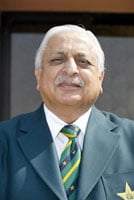 law minister holding a meeting with former stars, a new chief taking
over the reins of the PCB, and the chairman of the selection panel
stepping down.
law minister holding a meeting with former stars, a new chief taking
over the reins of the PCB, and the chairman of the selection panel
stepping down.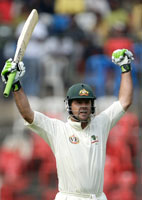 India these days. The series has an equal importance for both sides. The
touring Australia side needs to maintain its reputation as the world
champions. On the other hand India's veteran players are under pressure
to perform as young players are doing very well especially in One-day
Internationals.
India these days. The series has an equal importance for both sides. The
touring Australia side needs to maintain its reputation as the world
champions. On the other hand India's veteran players are under pressure
to perform as young players are doing very well especially in One-day
Internationals.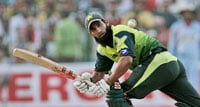 Stadium Lahore with Sialkot Stallions completing their hat-trick of
titles after a thrilling but low-scoring final.
Stadium Lahore with Sialkot Stallions completing their hat-trick of
titles after a thrilling but low-scoring final. statements issued by the Ministry of Sports. Careful reading left a
sense that information was manipulated for the wiliness of spin on the
one hand, rather than the frank hostility of pace on the other.
statements issued by the Ministry of Sports. Careful reading left a
sense that information was manipulated for the wiliness of spin on the
one hand, rather than the frank hostility of pace on the other.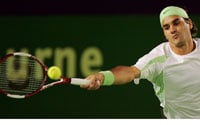 ranking from Federer; in women's tennis the No 1 ranking has changed
hands six times in the last seven months. For now Jelena Jankovic is at
the top, but many WTA events are left and the points difference between
the first, second and third position is too little to be decisive; with
Serena and Safina still in the race for the position.
ranking from Federer; in women's tennis the No 1 ranking has changed
hands six times in the last seven months. For now Jelena Jankovic is at
the top, but many WTA events are left and the points difference between
the first, second and third position is too little to be decisive; with
Serena and Safina still in the race for the position.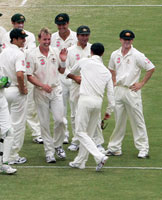 in 'The Dark Knight' is the one that makes the case. Now it seems that
cricket teams, even the very best, are trying to emulate the formula
otherwise Australia never picked so many rookies for one of the most
hostile tours to India.
in 'The Dark Knight' is the one that makes the case. Now it seems that
cricket teams, even the very best, are trying to emulate the formula
otherwise Australia never picked so many rookies for one of the most
hostile tours to India.