


|
|
|
|
 |
 |
  
|
comment review Upholding
the banner of defiance Coming
Home Discovering a good book is still such a pleasure. Yes, I am truly grateful that even now, in my jaded middle age, I can still derive pleasure and feel excited when I read something that I enjoy. It doesn't have to be highbrow or famous; it just has to be something that grips me and engages me as a reader, something that speaks of life and the whole process of dealing with life. It can be something as humorous as Bridget Jones' Diary or anything by P G Wodehouse or anything about Adrian Mole -- or it can be any Dickens book. Or something by William Boyd. The possibilities are endless, because there is so much to read, and one is forever discovering books that one had not come across before.
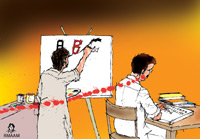
Reading a work of art The prevailing confusion about what the art objects say lies precisely in the fact that it is not comparable to spoken or written communication By Nadeem OmarEvery art exhibition, which goes up in the city, leads to
a fresh round of skirmishes between artists and critics. Much of it is
fuelled by the disagreement over how art communicates. Some critics expect
art to communicate to us instantly and directly, in a manner an essay or a
newspaper article does. They assume it to be an act of communication
comparable to an act of speech or writing. Every non-visual communication act, be it verbal or
non-verbal, involves a medium through which it carries a message and delivers
it to a receiver in time and space. An act of writing or speech contains an
argument. An argument carries a message and delivers it to a receiver in a
certain amount of time, through the medium of writing or speech (A dense
argument may take more time to deliver). Two things should happen, if a
message is to be delivered effectively. The message should lose its utility
once it has reached the receiver (otherwise it may involve the risk of
non-communication). Second, different receivers should get the same message,
if a proper communication is to occur. The present article, for instance, is an act of communication. It contains an argument (a message), expressed through writing (a medium) to be delivered to the readers (receiver) in a certain amount of time. Ideally speaking, in order for an effective communication to take place, the argument should be understood by all readers equally well, without leaving any room for conflicting interpretation. Moreover, once it has reached the readers, this argument should run out its utility and may lead to another argument or counter argument. This is how we communicate through words in daily lives. An essential feature of an effective verbal or written communication is linearity. Ideally, a speech or writing act is linear and unfold over time in a straight line. It starts from a point A and moves along a unilinear progression (of ideas and concepts) to conclude at a point Z in time. It is because of the linear nature of intellectual activity that even an entire book of 1000 pages can be described in a series of schematic statements. The structure and character of written or speech
communication act can now be contrasted with art or visual communication. The
prevailing confusion about what the art objects say lies precisely in the
fact that it is not comparable to a speech or written communication. If we
try to understand or read a work of art as an act of writing containing a
specific message, we will end up in frustration. The reason lies less in
abstraction, which writing does involve, but more in the fact that aesthetic
communication leaves the sphere of rational discourse and enters into the
realm of un-theorised experience and feelings. The fabric of art is the
province of subjective feelings, which lends itself to formulation through
images. The art or aesthetic communication is an on-going process. It does not start or stop at definite points. It neither contains an essential message intended by the artist, to be communicated to the spectator nor the message will be finished once the communication act (of painting) is over. The great works of art never finish communicating to the spectator. Theoretically speaking, a masterpiece should let you discover new meanings and message every time you look at it. It is mainly because of the open-ended nature of aesthetic communication that generation after generation can live off the aesthetic experiences of great works of arts, without losing their capacity to generate new messages. Given these contrasting features of aesthetic and non-aesthetic communication, one can begin to understand the conflicting views held by artists and critics/spectators. The former tend to see their work as a part of an on-going aesthetic experience while the latter see it as a product of finished intellectual message. A "structure of intelligent dialogue" between the critic and the artist, which Quddus Mirza anticipates, can only be established, if the fundamental differences between the two communication acts are placed in their respective contexts. Other social explanations, including curbs on critical thinking in our society, of course, reinforce and split this divide further.
review Feminism in reverse Nausheen Saeed's recent sculptures in Canvas Gallery convey the conformist side of women, content with the customs and norms of society By Quddus MirzaOld bag is a term referred to aging women. Maybe because
both bag and old matron have to be dragged, pushed, lifted and held by
others. Besides the element of helplessness, the association of women with
bags can have a wider connotation, since both are perceived as containers. In
a sense all humans are containers, since they accumulate food, air, language,
ideas, images etc. in them but the capacity of women to contain is more than
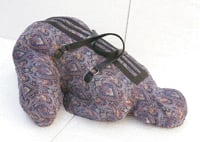
men. Usually a piece of luggage is packed with objects which are essential but only for the purpose of travel. If screened by a psychiatrist, it may reveal our personality -- our ideas about us and how we would like to project ourselves to the public. To come back to the analogy of bag, women are akin to containers in our culture. Despite their independent souls and individual personalities, they are treated as bearers of not only their children, but of the male psyche as well. The society is happy if they are fully involved with their male partners, accompany them in public or private functions. They are expected to acquire an identity linked with their male counterparts; to the extent that the custom of a woman changing her surname after marriage is never viewed as an oddity. Women in our surroundings are supposed to remain hidden within the confines of a house -- safeguarding the tradition, customs and norms of the society. This latent agenda is manifested in our attitudes, preferences and our day to day survival in our metropolises, small towns and villages. This is the subject matter of the recent works of Nausheen Saeed, who blends female figure with the shape of a luggage piece. Two of her works -- sculptures -- suggest a synthesis of human body and the travelling bags. The handles attached to these figures, all wrapped in printed fabric with stripes of leather like the outer surface of a suitcase, help in picking the pieces and moving them, much like parts of a luggage. Yet, it is difficult to distinguish the baggage from the woman's body. Other works from the same exhibition extend this idea with female figures converted into a mass of beauty soap; or a naked body cut in two halves and cooked as a piece of bread, or females fabricated with flowers or cloth. All these works evoke a paradox that exists in our thoughts, attitude and behaviour. The figures in Saeed's works are naked, yet they are covered or constructed with materials that remind of domestic engagements: Soap, flour, flowers, garments and suitcase. Here the woman is not defying her role in domestic chores; she only appears to contradict the concept of beauty bestowed upon her by the males' eye. Hence, the nude figures do not appear naked or provocative. On the other hand, these convey the conformist side of women, content with the customs and norms of society. Interestingly, in an age dominated by women artists with feminists concerns, Nausheen seems to be shying away from this cause and need. On the contrary, her work is a celebration of women being a part of the traditional environment: A choice she asserts in the face of several feminists active in our art world. In that sense, Saeed is moving away from the regular -- rather stereotypical -- representation of gender, and focuses on the wholeness of a woman. So in her work, if a female is treated like a bag, it is simultaneously created with multiple flowers, or with draperies of different colours, or like a freshly baked bread and beauty soap. All of these guises affirm how the artist perceives herself -- or women at large. Instead of an object of pity or a victim of male suppression, Saeed celebrates the womanliness of her subject. Perfect contours, self absorbent postures and delicate features indicate how the idea of beauty is not negated, but pushed on the fore in these sculptures. This aspect, of recognising the element of beauty, distinguishes Nausheen from a number of other artists working with the female figure. The male artists normally treat women as an emblem of desire, while some women artists stress upon their miserable condition. In each case, the representation of women is linked with the male's attention, even in defying it. But Nausheen Saeed does not invite the intervention of a man; instead her women appear to be self-contained and content creatures. This aspect of her work infuses a truth, of being a woman, in her art. The other truth evident in the work is linked with her materials. Looking at the sculptures on display, one becomes aware of the presence of diverse substances – all transformed into the skin of a human body. Yet these materials hold separate identities and functions too. Plastic roses, bread, suitcases and soap are all present in our surroundings, as objects of utility. But we are not much aware of the visual delight or physical aspect of these objects. Neither have we pondered on the possibilities of meaning they can generate. Nausheen, by shifting and replacing flesh with ordinary materials, has discovered another aspect in the organic, industrial and commercial matter which documents our desire, dreams and distractions. The exhibition will remain open till Oct 21, 2008, at Canvas Gallery in Karachi. Upholding the banner of defiance With a few changes in the production, Ajoka's Chaak Chakkar was staged at the Alhamra in Lahore
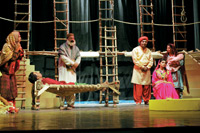
By Sarwat Ali It was not the first time that Ajoka's Chaak Chakkar was staged at the Alhamra. The production had been mounted by them many a time before this; the first being at the erstwhile Lahore's Goethe Institute. Since then, it has generally received a favourable response from an audience which Ajoka has successfully been able to build up in the last twenty five odd years of its existence. The first time it was mounted in the mid 1980s also
happened to be one of Ajoka's first productions and, given the difficulties
that were involved in staging a play then, it was welcomed and received well
as much for its merit as for upholding the banner of defiance. It is very usual that a group or a company over a period of time produces several plays and that builds up its repertoire. From time to time it dips into the deep pocket of that repertoire and stages a play again. This is a legitimate way of staying afloat and of keeping the theatre scene warm and alive. In Pakistan very few companies have lasted long enough to boost of their own repertoire. To stage plays regularly, if not by producing new plays then by staging the plays that were originally their own production in the past, is a common practice in countries that have a living tradition of theatre. Ajoka has reached a stage where it has enough plays in its repertoire to be producing them from time to time. In the early years of its inception, it was expected that a new play would be staged by them every time they announced a production, but over the years it has been seen that the number of new productions has fallen dramatically and most of the productions are of the older plays. Plays already staged have been the standard fare of the traffic on stage. Brecht, for some reason, became a hot favourite with the theatre-goers in the third world countries. Possibly because he rebelled against the laid down rules and norms of socialistic realism and created his own theories and looked for inspiration in the theatrical traditions of non western societies. His theories about Epic Theatre and Alienation were accepted by many caught in the tightening web of normative critical theories. This also gave new hope to the non western societies who were apologetic about their own art forms being static and repetitive. He explored the levels of interpretation and meaning embedded in traditional and ancient art forms like music and drama. In such productions, about twenty years ago, the folk elements were reintroduced into urban theatre. With greater exposure to the experiments being conducted in India, the song and dance format was introduced in patches in the theatre that was establishing itself in the name of social relevance. Music and dance has been an integral part of theatrical performances in the subcontinent, and these were brought back so to stay on stage with the difference. The classical drama depended hugely on song and dance and at times it provided its main content. Here dance and music were introduced as a means of making the entire enterprise more palatable. The danger that it can be reduced to a tableau with sound and dance merely become illustrative has been avoided as most of the productions of Ajoka, tended to become tableaux without actually being so. There were some changes in the production; the set was different since it was designed for proscenium stage, the costumes had some changes and of course many of the actors were new but the overall design of production and the interpretation remained more or less the same. The original team of Shahid Mehmood Nadeem who adapted Caucasian Chalk Circle and Madeeha Gauhar who directed it has persisted. One indication of the company or a group having been in existence for some length of time are people who once worked with the group but are no longer alive. Israr Ahmed, who composed the music for the original Chaak Chakkar, was a man of many parts but primarily devoted to music. His knowledge of music was considerable and he was an active member of a diminishing body of people who understood the significance of keeping classical music alive. He was also a composer and many of his compositions became famous without many people knowing these were his. The famous "Hum Daikhain Gay", the poem of Faiz sung by Iqbal Bano, was composed by him but the fact is not universally known. Basically the man had plenty of humility and did much for music, even going out of his way like composing music for this play. Uzra Butt, Aslam Malik and Sarfaraz Ansari have been with the group for many years now and it was good to see many new and younger faces in the cast and production team. A formidable team can be built up with Hania Cheema, Nirvaan Nadeem, Imran ul Haq, Aaalia Abbasi and Nadeem Abbas. Perhaps like our classical poets, who had seen it all and enough, and were not willing to be duped into another illusion of becoming a part of a solution to redeem mankind, Brecht too was becoming acutely aware of the sameness and repetitive nature of the human condition. Simple solutions and instant remedies were just as much a part of the mirage as the policies and steps taken by people on the other side. What is most important is that the human spirit should remain undaunted and hope kept alive. Perhaps, for Brecht, theatre was probably the best arena where this could be achieved.
60 artists present their unique views on 'home.' Looking beyond the media, political and religious definitions
By Ali Sultan Reaching on time is never a virtue. At 7pm, Lahore's
Alhamra Hall 2 is nearly empty, half-dark and uncomfortable. I hear a woman
at the back saying: " You know people came an hour late for the
conference yesterday." A tall man smiles and says "I have finally
come to the conclusion that 2 minutes actually means 20." I notice, the
tall man is bald and his white earring sparkles in the half-dark hall. Slowly
the small hall fills up and the tall man stands up and introduces himself as
Ali Zaidi, artistic director, 60x60 Secs (and director of one of the best
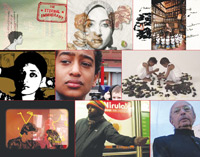
films) and welcomes us all to the programme. 60x60 Secs is a visual project and comprises of 60 one-minute films from 60 artists, 20 each from Britain, India and Pakistan. Commissioned via open call, both established and emerging artists, working in a variety of mediums and spanning a wide age range, present their unique views on 'home.' Looking beyond media-dictated, political and religious definitions, 60x60 Secs unravels identities and stories, and redefines cultures that are evolving in an age of globalisation. The screening experience is two-fold. First, it is a daunting experience, divided into two parts (30 movies each) with a break in between. Taking in so much visual information in two sittings is not only hard, you also tend to forget many of the films. Secondly, the films that the viewer does tend to remember out of the sixty are in a way those that are close to how the viewer views 'home.' Love song by Asma Mundrawala from Pakistan is a disturbing film. Popup paper-constructed art works set the stage for what looks to be old family photographs against the backdrop of urban architecture, the calm of which is slowly taken over by the movement and frenzied laughter of vultures singing the love song of a place both beloved and beleaguered. Would YOU trust a man on the road? by Neel Chaudhuri from India plays upon the general insecurity of the region. With a muddy visual palette and jump-cut editing, the narrative shows a man driving across Delhi late at night, a city in slumber except for stranded men, on the roads, angling for a ride home and how the driver does not trust anyone. Musafir by Riswan Mirza from Britain is perhaps the most touching film about Indo/Pak migrants in Britain. Shot in 16mm, an old man -- heading to an unknown destination -- looks out of the window of a moving train and retraces the deep lines mapped out on his weathered hands. He recalls fragmented memories, reminiscing and reflecting on the longer journey he has made from his childhood to the present. The Great Identity Swindle by Nikesh Shukla, Laura Taflinger and Seb Ahmad from Britain is an inventive and funny piece; it explores what it means to be a British-Asian, while deconstructing the identity myth through poetry and comics, using rhyming couplets and snappy editing. Telephone Pyar by Adnan Malik from Pakistan is an intelligent film. An intimate voice-over telephone conversation between an unidentified man and woman is laid over archival material sourced from Lollywood films. As the provocative nature of the conversation gains momentum, the visuals become progressively more suggestive. Extracted from sixty years of Pakistani cinema, Malik by dialogue and visuals conveys metaphoric representations of love and sexuality that point to a rich cultural engagement with sexual identity; a history that is often sidelined, suppressed and unacknowledged today. The last but not the least 'remembered' film is Arriving by Ali Zaidi from Britain. A one minute journey of ever-changing rain shapes against an airplane window evokes memories and awe. It is perhaps the best example of coming home.
Dear all, Discovering a good book is still such a pleasure. Yes, I am truly grateful that even now, in my jaded middle
age, I can still derive pleasure and feel excited when I read something that
I enjoy. It doesn't have to be highbrow or famous; it just has to be
something that grips me and engages me as a reader, something that speaks of
life and the whole process of dealing with life. It can be something as
humorous as Bridget Jones' Diary or anything by P G Wodehouse or anything
about Adrian Mole -- or it can be any Dickens book. Or something by William
Boyd. The possibilities are endless, because there is so much to read, and
one is forever discovering books that one had not come across before. My most recent discovery is a book called The Elegance of the Hedgehog by a French writer called Muriel Barberry. I had not noticed it in bookshops nor had I read anything about it, but my friend Azra bought a copy when she was in the States, and thus the book came my way. I loved reading it. I was sorry when I finished it because a whole, very engaging, process came to an end. The book's story revolves around a widowed, middle aged concierge in a posh Parisian apartment building. The concierge, Renee Michel, is careful to keep up appearances as a low-brow employee, but she does it because she has a secret. And her secret is that she is intellectually superior to to most of the building's upper class inhabitants. She muses on life and the human condition and searches for beauty and meaning in art, literature and music. Another inhabitant of the building with a secret life and a similar detachment from her social surroundings is the precocious twelve year old Paloma, who has decided to commit suicide on her thirteenth birthday. The stories of these two outsiders come together with the arrival of a new inhabitant in the building, a perceptive and kind Japanese gentleman. The book is about these characters but also about a great
many other people and lives that these two observe. It is a story about
beauty, kindness, class divisions and social stereotypes. It is about funny,
petty, everyday situations but it is also about philosophy and literature and
the transformational power of great art. The Elegance of the Hedghog is an elegant book; it is about human beings trying to find meaning and beauty as they muddle their way through the process of living. But it also has a great deal of humour and a very down-to-earth tone to it. Apparently a Parisian psychotherapist has even recommended it to her patients, so perhaps it also has some kind of therapeutic value to it as well. I love this book because not only is it the story of these people but it also pays tribute to the power, the wonder, of art and literature. It is an acknowledgement of the heights to which images, language and music can take us and the power of the human spirit. I suppose I am making it all sound very grand, but it is just a very readable, enjoyable novel. And I feel so grateful whenever I come across a book like that. Discovering a good book is still such a pleasure. Best Wishes Umber Khairi
Umber Khairi
|
|
 These expectations and assumptions reflect a conflation of two communication
activities which are anything but different. The point of the article is to
identify the different nature of communication process at work: in words and
in images. Let's take written/verbal communication first.
These expectations and assumptions reflect a conflation of two communication
activities which are anything but different. The point of the article is to
identify the different nature of communication process at work: in words and
in images. Let's take written/verbal communication first.