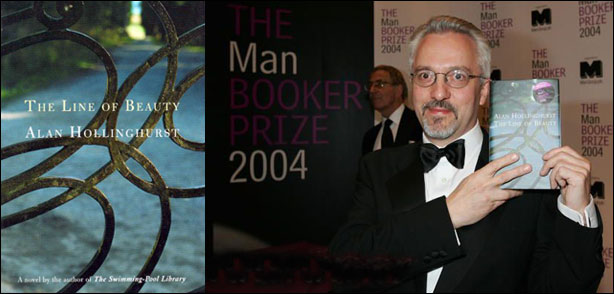
The
Line of Beauty- Alan Hollinghurst.
The Line of Beauty follows Nick Guest, a gifted young PhD student,
during his four years lodging at the London family residence of
his former Oxford class mate Toby Fedden. The Fedden household is
made up of Toby's parents and siblings: the graceful but distant
Rachel, the ambitious Gerald - newly appointed as a minister in
Thatcher's Government; and Toby's troubled younger sister Catherine
who is given to bouts of depression and self harm. Nick arrives
at the Feddens on the flimsiest of invitations. He is an unremarkable
personality who earns his place in the household by being un-contentious
and helpful. It's refreshing to see that Hollinghurst does not resort
to the traditional cuckoo in the nest story, he refrains from demonising
Nick as a schemer or manipulative intruder. Rather, the author shows
Nick's awareness of his tenuous connection with the Feddens and
his understanding of how his own parochial background will garner
him nothing more than the status of family pet. He accepts his position
pragmatically and settles back to enjoy the benefits of life with
a powerful family at a well-appointed London address.
That said, Nick is seduced by the Feddens. His Phd on Henry James
suffers, and all the while his desire to be accepted within their
inner sanctum intensifies. His access to the affluent set sees him
indulge in reckless sexual escapades in a haze of alcohol and cocaine.
In particular he develops a bond with a Lebanese heir, Wani, a closet
homosexual, engaged to a girl of his family's choosing. He is spoilt
in a manner typical of the nouveaux riche, on the one hand he funds
and 'keeps' Nick much the same as he would a mistress and on the
other he agrees to an engagement to appease his domineering father.
Although there is nothing 'contentious' about Nick's sexuality,
he conceals it from the Feddens. After all this was the Eighties
and although homosexuality was acceptable people still carried certain
notions fueled by the emergence of AIDS. Indeed AIDS makes a fatal
debut in the novel but Nick, being a survivor, comes out unscathed
both physically and emotionally.
British politics also makes its presence felt but only as a backdrop.
It is class that takes center stage, orbited by entitlement, opportunism,
exploitation and decadence. Wealth and opportunity are used by Wani
as a way of ironing out the differences between himself and the
Feddens. Nick is used to add authenticity to Wani, with his refinement
and cultural insight. The Feddens and Wani are used in turn by Nick
to further his lifestyle and sense of himself. And the Feddens use
Nick to make up the numbers, amuse themselves and finally to provide
them with a scapegoat to avoid any hint of self recrimination. Yes,
there is a comeuppance, a fantastic, scandal-ridden comeuppance,
characteristic of the Conservative government of the 80s.
Despite the intricacies of plot and the dark motivations at work,
Hollinghurst manages to keep a light hand and allows the characters
to speak for themselves. The writing is beautiful, erudite and free
of ponderous explanations or excessive analysis. Alan Hollinghurst's
style, for fear of descending into hyperbole, is nothing short of
breathtaking.
Booker
Prize 2008 shortlist
While many a Pakistani held their breath hoping Mohammad Hanif's
A Case of Exploding Mangoes would make it to the Booker Prize shortlist,
the list sparked quite a reaction with its omission of favourite
Joseph O' Neill's Netherland and Booker Prize winner Salman Rushdie
(Salman's long-listed book, The Enchantress of Florence didn't even
get considered by the judges, as the story goes). Judges, chaired
by Michael Portillo, have described this year's shortlist as "intensely
readable" and "page-turning", but this doesn't seem
to be an opinion shared by many book buyers. This year's short-list
has been marred by low book sales, due to the star author-free shortlist.
The 50,000 pound Booker Prize featured six nominees on the shortlist:
Amitav Ghosh's Sea of Poppies, Philip Hensher's The Northern Clemency,
Steve Toltz's A Fraction of the Whole, Linda Grant's The Clothes
on Their Backs, Sebastian Barry's The Secret Scripture and The White
Tiger by Aravind Adiga.
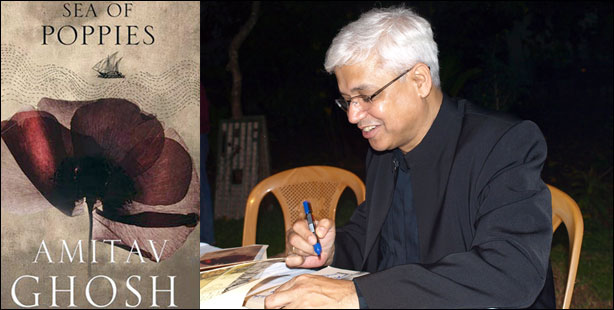
Amitav Ghosh, author of the Sea of Poppies (reviewed above) talks
to Reuters about his book and what the Booker prize means to him.
Q: Can you describe your book and why should people read
it?
A: "Sea of Poppies tells a simple story: it follows an assortment
of characters who find their way on to a ship called the Ibis, which
is sailing from India to the island of Mauritius. The year is 1838,
and most of the passengers on the Ibis are indentured migrants from
northern Bihar, an area that was, under the rule of British East
India Company, the world's most important opium-producing region:
the poppy is thus the star that rules the migrants' destiny. Along
with the migrants, the Ibis is also carrying a few convicts and
stowaways, as well as a contingent of Indian guards and overseers.
She is manned by a crew of Asian sailors -- 'lascars' as they were
then known -- and her officers consist of three 'Europeans'.
"Once at sea, the Ibis becomes a crucible in which people of
different classes, races, castes and nationalities find themselves
thrown together with consequences that are sometimes absurd, sometimes
murderous and even, possibly, redemptive. It is my hope that the
reader will find here a story of transformation, one that I imagine
all too many of our forebears had to live through."
Q: What
does the Man Booker Prize mean to you?
A: "The Man Booker prize has been hugely successful in generating
interest in contemporary fiction and in expanding readership. For
a book to be on the shortlist is already to have won a kind of prize
and I am delighted that Sea of Poppies has been accorded this privilege.
However, this
year's Man Booker Prize went to Aravind Adiga's The White Tiger,
a first novel by the Indian author.
Amitav Ghosh's Sea of Poppies is the first in a trilogy of books
based on the Opium Wars, when the British fought to continue smuggling
opium from British India into China inspite of Chinese drug laws.
Sea of Poppies is a meticulously researched novel putting you in
the midst of history as it happens. The attention to detail can
take some getting used to, in particular the seafaring minglish
employed by crew members that I found myself re-reading. However
once you get a handle on the language, it's a rewarding page-turner
that will leave you yearning for more.
The Line of
Beauty by Alan Hollinghurst follows Nick Guest, a gifted young PhD
student, during his four years lodging at the London family residence
of his former Oxford class mate Toby Fedden. British politics also
makes its presence felt but only as a backdrop. It is class that
takes center stage, orbited by entitlement, opportunism, exploitation
and decadence. There is a comeuppance exhibited in the book, a fantastic,
scandal-ridden comeuppance, characteristic of the Conservative government
of the 80s.
Despite the intricacies of plot and the dark motivations at work,
Hollinghurst manages to keep a light hand and allows the characters
to speak for themselves.
|