


|
|
|
|
 |
 |
   |
Editorial paradox Credibility
vs TRPs solution Breeding
alienation Changing
of the undertones
Around the flames of CDs burning and the debris of the bombed-out juice shops are unfolding several questions about the level of tolerance in our society. We are confronted with the after-effects of our less-than-ideal policies implemented by the regimes long gone. During the American-funded jihad in Afghanistan against the former Soviet Union, our rulers tried to instil a new degree of puritanical rigidity in our minds without adequately thinking about the impact of such drastic ideological engineering on our collective future. Now when our rulers are trying to grapple with the legacies of our proxy wars, the question of purity and its nature becomes even more pressing. Are we going to try to recover our tolerant and syncretic and hybrid forms of spirituality or succumb to the puritanical demons we created on the behest of our erstwhile war financers? This Special Report tries to examine the moral conundrum of a nation torn between an extremist interpretation of virtue and vice. Our contributors have tried to unravel different aspects of the moral issues we are facing, including the impact on the conscience of the citizens who often have to kowtow to the expediencies of realpolitik for their own survival. As demonstrated by the writers, the situation is murky but not totally hopeless because the talent of self-critique is still abundant and therefore the hope of redress and recovery from our morass is still possible. Keeping in mind the fact that suppression of critique dims the prospects of our collective recuperation, we present an analysis of the risks overzealous puritanical thought. Promoters of purity An examination of the ways in which absolutist forms of imagining purity and virtue can produce terror and authoritarianism By Saeed Ur Rehman Purity may be a good
thing when it comes to material things such as gold or silver or diamonds.
But, in the realm of cultural practices, the idea of purity is intimately
linked with intolerance, bigotry, fundamentalism, and fascism. Purity is a
metaphysical concept with its systematic expression found in philosophy
from the time of The Republic by Plato. According to the argument propounded by Plato, every object in the world was an imitation (mimesis) of its divine idea and, therefore, was already inferior. Painters and poets were imitators of these imitations; hence their creative products were twice removed from 'pure reality'. Plato banished poets from his ideal form of government. It basically meant only those deserved citizenship who were indulging in 'ideal' activities. Hitler used the concept of German racial purity to kill at least 8 million Jews, Gypsies, Communists, and Poles. The victims of Hitler, after getting a state of their own, did not get rid of the idea of purity but adopted it for their own purposes. Now Israel also practices the idea of 'Jewish purity'. Anyone whose grandparents were Jewish can migrate to Israel and become a citizen. But if any citizen's both parents are not Jewish, he or she is not a pure Jew and therefore cannot marry a 'pure Jew'. The Arabs living within Israel are second-class citizens and many are also labelled as the present-absent people. They are present in the country but do not officially exist. Similarly, an imagined
version of 'pure' or 'ideal' Islam exists in every demagogue's mind. And
from Hassan-i-Sabah to Mullah Omar every 'defender' of faith believes his
or her ideas of the purity of faith are the answer to the problems of the
ummah. Armed with their faith in the absolute purity of their ideas, they
are ready to marginalise, oppress, and kill those who do not subscribe to
their way of thinking and living Islam and spirituality. The Taliban,
during their rule over Kabul, created a Ministry for Promotion of Virtue
and Prevention of Vice in order to impose their culturally specific
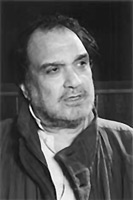
reading of the injunction 'Amar bil ma'ruf wa nahi anil munkar'. The Taliban interpreted this verse as their divinely ordained right to inflict their understandings of what the word 'ma'aruf' means. According to the renowned Islamic scholar Javed Ahmad Ghamidi, the word 'ma'aruf' in this injunction signifies 'universally acceptable notions of ethical behaviour' since the word 'ma'aruf' also means 'well known' in Arabic. It means the Taliban had no right to impose their own 'less known' and 'less universally accepted' notions of virtue on others. This kind of violent promotion of one group's ideas of 'purity' is not without its supporters and admirers. In a political space where the legal system is corrupt or only protecting the interests of the select few, it is quite easy to seduce a large number of the disenfranchised with the idea of speedy 'purifying justice'. Those who are not seduced become pretenders and sympathisers because of the fear of brutal repercussions. This was observed by the large number of people who started growing beards in order to survive with the Taliban. After the recent blasts at the alleged dating spots in Garhi Shahu and the burning of CDs on Hall Road, many people have started praising the courage of those who purify society of vice. The problem with this stance is that there is no end to the process of purification. The distance between the burning of CDs, the bombings of girls' schools, the barbers ordered to stop shaving men's beards, and the disappearance of TV sets is a short one. Within a short span, the process of survival through mimicry can make the whole society look like a perfectly 'purified' place. An antidote against this type of violent ideas of purity is to encourage syncretism in religion: the way the Qawwali works, by combining Arabic ideas with Indian and Persian musical compositions. Before Pakistan became an ally in the war to drive out the Soviets from Afghanistan, the ideas of puritanical practices were not as common in the public sphere as they are now. It seems that the American-funded proxy war was also given an ideological boost by Zia ul Haq's emphasis on piety and purity. If the government wants to win the war against terror (even though war itself is terror), it will have to promote hybridity, syncretism, and provide more cultural space to self-reflexive and self-critical discourses instead of the self-congratulatory and self-justifying forms of moralising diktat.
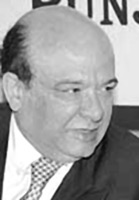
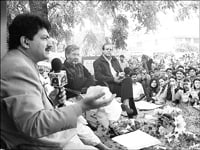
The media needs to redefine its mission statement in order to avoid any lop-sided presentation of facts By Waqar Gillani The role of media, both print and electronic, is highly crucial, especially at a time when the country is badly hit by terrorism. There is no room for any unauthenticated news and irresponsible analyses, talk shows resorting to gimmicks or Live reporting bordering on sensationalism. TNS spoke with a number of senior journalists and representatives of different media organisations -- all of whom seconded the opinion that is now becoming popular. Khaled Ahmed (news analyst and columnist): "Our
media, today, is mostly right-wing. Because of a dearth of anchor persons,
second-rung columnists are picked up for TV shows. "Our TV anchors think their adversarial bite is their key to success. The ruling party is targeted incessantly to get high popularity ratings. There's the so-called crème de la crème of anchors that walk away with all the credit and hefty paycheques. The trend has backfired. An illiterate CGH with a bad journalistic reputation creates a traumatic experience for the participants who don't want to return to the show after one discussion. KA is now getting the same kind of feedback, while HM has to supplant his programme with the same faces again and again. TV channels are not getting good discussion participants. Their debates are one-sided and the anchors have to announce over and over that the government invitees don't turn up. People are switching off because TV channels have lost credibility. "Anchors should not be judgmental. Besides, the aim should not be revenues but a balanced presentation of facts. Anchors should be well versed in global affairs and have clear concepts. "For instance, the idea of state sovereignty, long replaced by relative power play among states, should not be dragged out of the early 20th century and fed to the viewers now. Such home-grown concepts as 'ghairat' should not be used as a weapon by anchors. The concept of adversarial relationship should be redefined to save the media from becoming one-sided and, hence, non-credible." Hussain Naqi (former editor The News; currently working with HRCP): "A major part of
print and electronic media in Pakistan is not playing its required role to
inform and educate the reader, listener and viewer about issues related to
the growing use of force and violence in the name of religion. "The media has attracted criticism, both from within the community as well as from those who were concerned about its (media's) silence over the issue, suspected to be either because of threats to individuals and to their property or because of the media's own complicity -- willingly or unwillingly -- with those who disregard the democratic principle of plurality. "Use of violent methods such as torture, kidnapping, beheading, slaying and slaughtering of common people, including those from security forces not directly engaged in the combat, has not been portrayed objectively or placed in proper context. The brutalities being inflicted upon common people by the fanatic armed insurgents have not been duly focused. Even when such incidents are reported, the accompanying comments are laced with the argument that they (the incidents) were a reaction to the violence perpetrated by the Americans on Muslims in Iraq and elsewhere. "No genuine media person or body can give such a justification for counter-terrorist acts -- by religious extremists or any one -- on our very own homeland. The media must seek to expose the vested interests of those who support, assist, fund and forge such bodies to fill their own coffers and share funds with the families of those gruesomely used as human bombs to kill their brothers in faith and fellow citizens. "In both print and
electronic media the world over, it is the job and discretion of the
editors to decide as to what is fit for printing/broadcasting/telecasting.
Unfortunately, in Pakistan, both the public and private sector media have
usurped the role of the editor." Imtiaz Alam (senior columnist; Central Secretary General, SAFMA): "Media, especially electronic, seems to be obsessed with playing on and creating controversies without a reasonable editorial constraint or direction. Its focus is more on conflict without putting it in its proper context. "The media should be neutral in its reports and should give both sides of the story. But it has to take into account its responsibility towards the people and the country that are under threat from the terrorist crusaders. "The media doesn't
generally follow a code of ethics which causes despair and frustration
among the common people, especially the younger generation that is turned
off by the sight of bleeding, torn body parts et al. "The decline of serious, investigative journalism is timed with the rise of a kind of a 'Talibanisation' of news that amounts to sensationalisation of events. Actually, media should not be part of any executive but it should be a true watchdog of public interest. "Hopefully, the media will learn through trial and error and be ready to volunteer to adhere to its universally recognised code of conduct. "A serious and responsible section of media seems to be not doing enough. The stories are published without concrete evidence and speculation, and one-sided comments are prevalent. Even the distinction between news and comment is not being observed. Talk shows on TV have become tautological and repetitive. "There is a need for in-house stocktaking without any interference from the executive." Huma Ali (Central President, PFUJ): "Media is reflective of a society and does not work in isolation. If there is violence and breakdown of state's writ or bad governance, media has to report the facts without any bias or leanings. "Unfortunately, some of the mainstream media organisations resort to sensationalism in order to get an edge over their competitors. I don't have any qualms about saying that such practices do bring us bad name. "The concept of owner-editor is also a problem that hinders a professional role. Various journalist bodies such as PFUJ are trying to bring the media organisation owners and owner-editors to one table so that they can work out a comprehensive, joint strategy to wade off the threats from state and non-state actors currently facing the media. "PFUJ is making a comprehensive code of ethics and strategy taking all media organisations into confidence. We hope that some positive-minded people will join hands with us. "It's a complete failure of the state which for 13 long years projected the same people as mujahidins and heroes and, after 9/11, the same guys have become extremists and terrorists." Whose (dirty) business is it, anyway? Experts denounce terrorist acts conducted in the name of 'purging the society of impurities' and offer 'acceptance of individual rights' and 'social liberty' as a solution By Aoun Sahi Three consecutive bombs
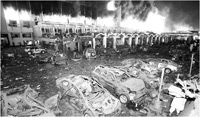
ripped through the fruit juice shops and a beauty salon in a busy market
in Garhi Shahu, Lahore, on Oct 7, leaving two dead and five badly injured. The area where the deadly incident took place - some 50 metres away from Queen Mary School - is home to a number of juice corners (15, to be precise), 10 beauty salons and about the same number of tuition centres and academies. Ironically, for a majority of residents of adjoining areas, the bomb blasts were NOT shocking. Their viewpoint: 'It had to happen, sooner or later!' It transpires that the juice corners had famously become 'dating spots' for young couples, and the more 'morally' awakened locals were only too happy to get rid of them. To quote 55-year-old Muhammad Hanif, owner of a pan shop in Garhi Shahu, "Most juicewallahs had kept isolated cabins (in their shops) for couples and charged extra money from them." According to him, the shopkeepers and residents of the area had often requested the shop owners to close their 'dirty business', "We also brought the matter to the notice of the local police, but nothing came out of it." Hanif told TNS about the police arresting the owners of the juice outlets namely Chinno, Al-Rehman, Shabab and Friends, some five months ago. "But they were back to business the very next day." He was of the view that if the police had raided the place earlier, the blasts could have been avoided. Interestingly, Hanif is not the only one who considers 'terrorists' as doing the 'just' thing. A majority of locals think the same way. Muhammad Shafiq, for instance, believes that the blasts "should be seen as a lesson to the shop owners". He said that they (the shop owners) had been issued several warning letters from the authorities in the past, but there was no response from their side. Reports have it that a man named Abdul Razzaq, admittedly a representative of the organisation called Tehreek-ul-Haya, rang up at a local newspaper office and claimed responsibility for the incident. He also threatened with further attacks on the like "centres of vulgarity". Abdul Razzaq's telephonic statements were followed by the Hall Road traders in Lahore receiving anonymous calls on Oct 9, 2008, bidding them to stop the business of selling CDs with obscene content. However, experts believe that the people involved in such incidents do not mean to 'purge the society of impurities'. They point to the 'worst form of hypocrisy' as these people themselves are far from morally perfect. According to Dr Rasool Baksh Rais, Professor of Political Science, Department of Social Sciences, LUMS, the aim of such elements in the society is to enforce their values on others. Talking to TNS, Dr Rasool Baksh said that two opposite forces had always existed in our society. On the one hand, we have the youth trying to meet halfway with a globalised culture and value system; on the other hand, the larger part of society continues to follow the traditional and conservative mores. They are intolerant to any deviation from the 'norm'. In this situation, "the only meeting point is the acceptance of individual rights and social liberty, as nobody can stop modernity from conquering the traditional way of life and thinking." The incident of bombing the fruit juice market in the name of combating evil has frustrated the youth who were already lamenting a lack of entertainment spots for them in the country. "What evil can you expect one to do, sitting in a cafe?" asks Furqan Hussain, 21, a college student who was also a frequenter of the beauty salon in the area. Furqan holds that the terrorists wanting "to impose their own value system upon others" is not a new phenomenon. "In the past, we've seen how a number of religious groups in the city were out to ruin the Basant festivities and their actions were hailed by most common people." I A Rehman, veteran journalist and Director Human Rights Commission of Pakistan, believes that religious parties like Jamaat–e-Islami have always propagated their own policies in the name of 'purification of the society'. "They also justify the use of force as an acceptable means of checking vulgarity." In his opinion, an open society with no feudal barriers is the only option left to curb such acts, and religion is not to be exploited. "These acts are the outcome of the severe degradation of our society. Majority of our people are still very conservative in their thinking." I A Rehman quotes from "a long history of such incidents. More recently, Zill-e-Huma Usman, former provincial minister for social welfare, was killed in Gujranwala, on Feb 20, 2007, because she had resisted adopting the 'Muslim dress code'." The killing of the woman minister was not the first act of its kind. Her murderer – namely Maulvi Sarwar – had earlier (in 2001-2002) killed at least seven women - described in the press as 'call girls' - in separate incidents in Gujranwala and Lahore. Upon his arrest, he confessed to killing the 'sinful' women. Unfortunately, he was set free after a year and half because of lack of evidence. According to the residents of Gujranwala, a committee comprising 20 people who used to offer prayers with him in a local mosque was formed to save the murderer. The committee arranged money and convinced the relatives of the victim to offer forgiveness to Maulvi Sarwar. "He was greeted like a hero, the day he was released from the jail," says Sarmad, a young social worker in Gujranwala currently working with Bargad, an NGO, talking to TNS. "Hundreds of people were present on the 'occasion' to welcome him. They garlanded him, lifted him on their shoulders and chanted slogans." According to Sarmad, the city of Gujranwala has seen several such incidents. In May 2003, hundreds of students from different Islamic seminaries descended upon a circus show, armed with sticks, and started beating a crowd of spectators - for spreading obscenity. The mob, reportedly led by Qazi Hameedullah, MNA, dismantled the circus tents and torched them, chanting 'Allah-o-Akbar'. The same year, the same mob of madrassa students attacked different theatre and cinema halls in Gujranwala. In April 2005, extremist elements of the city showed their power again when they forcefully disrupted the state-owned mini-marathon that was to be held in the city. "All these acts (of terrorism) had the endorsement of the general public," says Sarmad. Dr Javed Ghamidi, renowned Islamic scholar, strongly rejects the idea that Islam allows individuals to stop any activity within the state by using force. "Individuals can only try to convince others with their logic, and if they believe that somebody is involved in an illegal or immoral business, they should inform the law enforcement agencies of the state. And, if they do not trust the agencies, they should go to the court. That's it," he said, talking exclusively to TNS. According to Dr Ghamidi, "Islam does not allow anyone to go beyond this." He also said that the people who were behind the bomb blasts "in fact use religion for their own purposes, just as our political leaders use religion to suit their interests, although a majority of them have nothing to do with it (religion)."
Religious
police is responsible for committing excesses against the people and
making their movement and government unpopular By Rahimullah Yusufzai Abdul Wakeel, a young bearded man aged 20, confessed in the presence of reporters after getting arrested on Oct 14 that he and his friends had bombed eight video shops and Internet cafes in Peshawar because X-rated movies being shown there were spreading obscenity in the society and were bad for young people frequenting those places. He is among numerous
young people who have taken it upon themselves to prevent vice and stop
whatever they feel is obscene even if it is risky business for them and
their families. They are obsessed with cleansing the society of things
that they believe are un-Islamic and impure. Wakeel was caught with eight explosive sticks and six packets of crackers. He explained how he learnt to make crude bombs from one Ziaullah who sold religious audio cassettes for a living and was killed while planting a bomb at a music shop in Peshawar. During interrogation, Wakeel reportedly gave away the names of one of his accomplices to the police. The man was promptly arrested. The Peshawar Police was confident that it had got hold of the accused responsible for a spate of bombings targetting CD music shops and Internet cafes in Peshawar. But such bombings aren't confined to Peshawar. CD shops, Internet cafes and barbers' salons are being bombed all over the NWFP and even outside the province. There seem to be many groups of militants active in the demolition squads that have been bombing and destroying shops selling music CDs or showing movies. Nobody knows if these groups coordinate their activities or operate independently of each other in different cities and towns. It is, however, obvious that the bombings have forced some of the owners to give up the business and do something else. Business has seen a sharp slump and livelihoods have been affected. Not many people sympathise with the owners due to the controversial nature of their audio and video cassette-selling business, which leading Ulema haven't approved as something Islamic. Individuals such as Wakeel have organised into small cells to carry out their bombing campaign. They don't intend to kill anyone and confine their night-time activities to bombing shops and buildings. But sometimes someone sleeping in those shops could get killed and injured. On occasions, chowkidars at the markets where the CD shops and Internet cafes are located are known to have suffered harm in such bombings. And it is not unlikely that Wakeel and others involved in these bombing activities would be willing to eliminate anyone they consider as a non-believer or a 'bad Muslim'. On a bigger scale and in a more organised form, an Islamic militant group in Bara in the Khyber tribal agency named itself as 'Amr Bil Maruf Wa Nahi Anil Munkar' (Organisation for the Promotion of Virtue and Prevention of Vice). The Arabic name is still being used by the vigilante group even though its founder, Haji Namdar Khan, was shot dead recently by a young assassin. The killer is still in the group's custody after confessing that he was sent by a rival group of militants loyal to the Tehrik-i-Taliban Pakistan (TTP) head Baitullah Mahsud to eliminate Namdar. Though Namdar was opposed to Baitullah Mahsud and his TTP, he had the same approach to imposing their views and lifestyle on fellow Muslims living in their areas. Namdar and Mangal Bagh, who heads the Lashkar-i-Islam militant group in Bara and Tirah valley, had formulated regulations that forced people living in their area to grow beards, wear caps on their heads, regularly offer prayers, stop watching television and movies and refrain from vices. To their credit, though, they also ensured that kidnappers, car-lifters and drug-traffickers were taken to task and stopped from using the tribal territory of Bara close to Peshawar to carry out their criminal activities. During their rule in Afghanistan for more than six years, Taliban too had set up a full-fledged department of 'Amr Bil Maruf Wa Nahi Anil Munkar' to implement edicts that formed the basis of their strict religious rule. The force that used to implement those edicts was also known as religious or morality police. It comprised mostly young Taliban riding pick-up trucks flying white flags and wielding sticks that were used to strike anyone defying those edicts. On occasions, the over-zealous among these Taliban from the religious police would carry glass to measure the size of men's beards and arrest those with short beards. Violators were detained for some time so that they grew beards of the proper size before being released. Women failing to cover their faces also faced punishment. Some Taliban leaders and religious scholars now admit that their religious police was responsible for committing excesses against the people and making their movement and government unpopular. In particular, they concede that publicly hitting men with sticks in bazaars for not keeping beards and reprimanding women for failing to cover up was a wrong thing to do. A better approach in their view would have been to win the hearts and minds of the people, influence their thinking through propagation of true Islamic teachings and gradually enforce tough edicts. Ironically, Taliban members pointed out that Maulana Qalamuddin, head of their religious police and the department for Promotion of Virtue and Prevention of Vice, defected to the new Afghan government after the Taliban regime and was accommodated in President Hamid Karzai's administration. Pakistani militants trying to force people to do things against their will also risk alienating the population in the same manner as the Afghan Taliban. In fact, this has already happened in many places and it could signal the loss of support for the militants even in their strongholds.
Ironically,
the beauty of terror tactics is such that the power players can kill (pun
not actually intended) many birds with one big stone By Aziz Omar In the first half of the
twentieth century, wars usually broke out in retaliation to a direct
attack on a country's territory, its allies or its bases. However, in the
latter half, the perceived fear of totalitarian regimes or rogue entities
impinging upon sovereign countries such as the United States was
manipulated by their respective governments to initiate armed conflicts.
However, the onset of the new millennium saw the changing of the
undertones and the rise of the politics of terror started dictating how
and where an affected country should wage a war to counter the
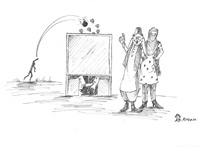
perpetrators of terrorist acts. The Merriam-Webster dictionary defines terror as "a state of intense fear". Of course, there is no denying the extreme fearfulness that is prevalent in war zones where bombs are constantly exploding left, right and centre. Even in the context of a typical societal life, many of us have experienced intense agitation in relation to the suffering or demise of a loved one. However, in recent years, an environment of heightened fear has become apparent through the depiction of incidents of the so called acts of terrorism. Mass media has played a crucial role in the relaying of the violent and ruthless nature of events such as those occurring on Sep 11, 2001, as well as portraying the gory fallout of Iraq and Afghan wars. Subsequently, this sequence of terrorism and counter-terrorism was dubbed the 'war on terror' that became the buzzword for the neo-conservatives being fronted by the Bush administration. The current phenomenon of terror is no more limited to subjecting a group of people to the use of brute force in order to contain the larger population. Such approaches are reminiscent of what was done during the Spanish Inquisition, Hitler and Stalin eras and more famously the nuclear attacks on Hiroshima and Nagasaki, courtesy of the US. Now, terror is characterised by actual or possible attacks on the civilian population of a country and manipulated by the respective powers that be to shape foreign policy and justify increased defense spending. The enemy behind these attacks, though, is elusive and mysterious, yet existing in the form of a vast network of terrorist cells scattered all across the world. Hence, the threat is not only from the Al-Qaeda operatives but also from any other entity that has links with or is giving assistance to this over-arching enemy. The idea or notion that such a network as Al-Qaeda exists and is capable of accomplishing all sorts of sinister plots is central to the politics of terror being practised by the neo-conservatives. The likes of Donald Rumsfeld and Paul Wolfowitz have been instrumental in giving a facelift to the grand external enemy of the US from that of being the Soviet Union to the Al-Qaeda network. Where the former foe was also supposed to extend its agenda through KGB spies, communist agents and partner regimes such as Cuba and East Germany, the hub was in a tangible form as that of the USSR. However, the umbrella organisation of Al-Qaeda is purported to not have a nationalistic form and hence poses a threat as long as its constituent elements are conspiring and executing their plans. This can be wherever intelligence information alludes to their current base of operations. Therefore, even though the Saudi born Osama bin-Laden has been consistently projected to be the mastermind behind Al-Qaeda, he serves the purpose of being a recognisable face of the worldwide organisation. Consequently, his mere presence and that of his accomplices is sufficient basis for the US-led NATO forces to launch air and ground strikes with the intent of "smokin' 'em out of their holes". The American citizens have bought into this combination of manufactured paranoia and due to the use of heavy rhetoric such as the 'axis of evil'. Their hopes have been raised by the promises of the Bush administration clinching a victory against the terrorists in whichever region that they are touted to be hiding out in. Hundreds of billions of dollars have been spent on fueling the conflicts in both Afghanistan and Iraq. However, very ironically, the beauty of terror tactics is such that the power players can kill (pun not actually intended) many birds with one big stone. The neo-cons were firstly able to gain massive public support in invading the Afghan territory, dismantling the Taliban regime and then initiating construction and rebuilding all in the name of championing democracy. When the real enemy Al-Qaeda proved to have slipped out of their hands, the neo-cons decided to take Saddam Hussein's Iraqi regime out as well on charges of possessing weapons of mass destruction and having links with Al-Qaeda. The architect of the 2003 invasion of Iraq was none other than Paul Wolfowitz, who had been pushing for toppling Saddam's government since the Gulf War and re-establishing the United States' global supremacy and military might. Combating terror sure has proved to be a treasure chest for the neo-cons, the federal reserve that has bankrolled the twin wars as well as the corporation known as the Carlyle Group that has made significant investments via defense contractor firms and construction companies. Of late, successive Pakistani regimes have been offering new pastures for harvesting terror to the American government in the form of Bajaur and Kurram Agency. In return, the current rulership has been busy begging for a couple of billion dollars from Washington which are nothing but scraps of the table laden with the feast that the terror mongers are dinning upon.
|
|