


|
|
|
|
 |
 |
   |
talibanisation "This
is also our city" Madrassa
reforms: the missing link political Like most cities in Sindh, Hyderabad has its share of civic problems but decades of neglect compelled most of its residents to migrate to other cities for better prospects By Adeel Pathan Hyderabad is a city that has been riddled with problems. For a long time, it remained in the opposition, with the population deprived of basic amenities, be it drinking water, a sewage system, roads, or recreation activities. A dilapidated sewage system that was not maintained regularly has made matters difficult for the rising population, especially for those living in low-lying areas. calling Locksmith's diaries In a city where thousands of unemployed graduates are looking for jobs, the legacy of a locksmith lives on By Fasahat Mohiuddin All around the world, key making can only be performed by licensed professionals. However, here in Pakistan this industry has been working alongside roads with the skills to unlock any key or repair all kinds of locks.
The Taliban are coming – or are they? By Sabeen Jamil Residents of Aiwan Colony in Karachi have recently learnt a new fact: The dumper trucks that some of them own can actually yield income in more ways then one. This nugget, narrated by some to Kolachi, comes from
information gleaned from refugees who have arrived in the city from
parts of FATA and the NWFP. Along with a dumper, if the family also
spares one male child, the Taliban can pay them up to Rs5 million as
"compensation." Needless to say, the combination of a dumper and a 'volunteer' to drive it has become the biggest threat faced by cities in Pakistan. There are some migrants who have done exactly that. "They sold their way out of poverty," it is said. They sold one of their six or seven male children. However, after the deal, they left their hometowns for other cities in Pakistan "including Karachi," says an area resident. Yet, no one is willing to say whether any ended up at Aiwan Colony. Have the Taliban come to Karachi?
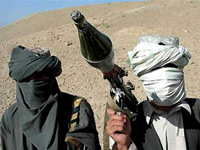
The Muttahida Qaumi Movement (MQM) says that the Taliban have not only established themselves in Karachi, but have also started "Talibanising" some Pakhtun-dominated neighborhoods in SITE and Gulshan-e-Iqbal Town. Talking to Kolachi, MQM representatives identify Pathan Colony, Sohrab Goth, Afghan Goth and some neighborhoods of Manghopir Hills, namely Pakhtunabad, Sultanabad and Aiwan Colony (also called Kowwari Colony and Waziristan Colony by locals) as areas where taliban are "forcefully implementing a specific form of tribalised Islam," says Haider Abbas Rizvi, an MQM parliamentarian. Who are the Taliban?
Taliban are, "those who have fought against the government in the Federally Administered Tribal Areas (FATA), and have now moved to Karachi," says Faisal Sabzwari, Sindh Minister for Youth Affairs, stressing that they should not be confused with the innocent people who migrated to Karachi to escape war. Rizvi adds that the Taliban among the migrants to Karachi must number in the thousands and that they have relocated as part of a strategic move to spread themselves. Besides the migrants, Sabzwari and Rizvi also categorise those willing to work for the Taliban, those who are providing funds to them and "a lot of students in the madrassas in Karachi" as Taliban. According to Rizvi, there must be some "0.2 m Taliban in more than 2,000 madrassas in Karachi." Rizvi and Sabzwari tell Kolachi that the Taliban in Karachi are heavily armed and supported by some ethnic and religious parties such as, "Jamat-i-Islami whose members sheltered a lot of Al-Qaeda members in their houses." Sabzwari believes that donations collected in the name of the Taliban by some mosques in Karachi, the pro-Taliban wall chalking and the reports appearing in some sections of press suggesting that CD shops were closed in Pakhtunabad and Sultanabad "suggest that the process of Talibanising Karachi has begun." The Ground Reality
"No one has asked us to close down," says Ikram Shah, at Muskaan Video shop at Pakhtunabad. Ikram tells Kolachi that, while running the shop, he earns up to Rs30,000 per month and that the business has not gone down in years. "Not even after the arrival of migrants," he says, adding that, for the last seven years, he has been renting at least 40 cassettes daily and the number has not decreased. Ikram says that his colony is far from the possibility of Taliban influence. "My clientele include both average Pakhtun men as well as the bearded religious preachers at mosques," he tells Kolachi, adding that, in Pakhtunabad, people know how to keep "religion balanced with everyday life" and would not even allow an attempt to Talibanise the area. "Even if militants have moved from war zones to these neighborhoods," says a resident of Aiwan Colony, "they cannot turn them in to Waziristan nor have they attempted to." The sight of the open CD shops in these areas seems to give credence to that, as does Pakhtun men getting a shave at the barber shop while enjoying television, an equal number of girls and boys heading to school in uniform and a great number of Pakhtun women clad in a Chaddar along with some women in the traditional Afghan burqa moving around the streets or shopping at the market. "A lot of children of migrating families have enrolled in our school," says Khalid Aleem a science teacher at a school in Pathan Colony. Aleem feels that a majority of them have moved only because they did not want to be a part of the war – else they would have stayed back. "They are also facing a lot of problems in adjusting and finding jobs in Karachi," he says. An ethno-political stunt?
"This is just a scare fabricated to serve political and ethnic interests," believes SITE Town Naib-Nazim Syed Badsha while denying the presence of Taliban or Talibanization in his town or in Karachi. The Awami National Party (ANP) and Jamaat-i-Islami (JI) share somewhat similar views. JI Naib-Ameer Asadullah Bhutto, while denying MQM's charges of JI supporting the Taliban, says that, if there were Taliban in Karachi, MQM, being an ally of the government, should have identified them and taken action." Asadullah adds that if the scare is true then MQM should resign from the government for not being able to protect the city from the Taliban. Shahi Syed, President, ANP, Sindh, on the other hand, says that Taliban may moved to Karachi but he totally rules out the possibility of Karachi being Talibansied because "Taliban need mountains, caves, hideouts and a long supply line of food and arms to grow," which, he says, is impossible to get in Karachi. Syed adds that, if there was Taliban or Talibanisation in areas identified by the MQM, the ANP would have been the first to know as they have offices in all those areas. Syed goes on to say that those who think the ANP is supporting Talibanisation in Karachi should correct themselves because ANP was the first to raise a voice against the phenomenon and will do the same if it happens in the city. SOS: Save Karachi from Talibanisation
Sabzwari suggests that madrassas being taken into the national loop, those coming to Karachi being registered and Afghan nationals being sent back to their homes are possible actions that can curb the phenomenon in Karachi. Abdul Waheed, an ASHOKA fellow (an international association of social entrepreneurs aiming to bring solutions to the problems in societies), who is working on bringing religious reforms in Karachi's madrassas, especially in Pakhtun neighborhood in SITE Town and Gulshan-e-Iqbal Town since 1993, proposes something different. Having worked in these neighbourhoods for over a decade, Waheed says that he has not found Taliban or Talibanisation anywhere. Yet, given the poverty, lack of civic infrastructure, government schools, hospitals and developmental schemes by the government, he says, there is a threat that youngsters in these areas can fall prey to the Talibanisation trap. "Taliban target the oppressed and idle faction in societies," he says. Therefore, Waheed suggests, the government, instead of carrying an armed operation or expelling people from these areas, should initiate employment schemes, provide basic health and education facilities and update infrastructure, on an immediate basis. Waheed believes this will avert the threat of Talibanization. Besides this, he proposes that the government help the refugee families settle in Karachi, provide them with employment and shelter to prevent them from resorting to criminal activities out of frustration or to meet their financial needs. Waheed stresses that the migrants should be "developed by exposing them to a moderate city."
"This is also our city"
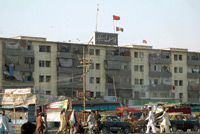
By Ahmed Yusuf The hustle bustle in the market facing the main road on Al-Asif Square belies the world inside. Making one's way through the main entrance inside Al-Asif Square proper, there is a reduction in the intensity of the cacophony witnessed outside. Al-Asif Square has commonly been described as a
"mini-Peshawar" or "mini-Afghanistan." It certainly
bears an acute resemblance to Peshawar as any non-Pahtun can obviously
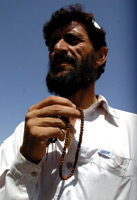
be spotted as an anomaly. The overall scene is largely male-dominated. Sitting at a baithak outside one of the restaurants, I ordered a cup of qahwa. While I waited for my qahwa to be served, I was received by suspecting glances by a group of men. Clearly apprehensive of my motives, one of them accosted me to ask for the purpose of my visit. When I explained to him that I was a journalist working on a story about Talibanization of Karachi, he smirked. "Produce your identification, so that we can trust you. We will only talk if we are certain that you are a journalist". Once the process of identification was complete, I was introduced to the other friends sitting in the baithak. "You don't understand our culture", he said. "Guns are part of it. Of course there are many apartments here where you will find some kind of ammunition, even if it's just a simple TT. Does that mean we are Taliban?" he asked as if it the answer was self-evident. I asked him to explain. "The history of this area in particular is one where Pashtuns have been violently targeted. Pashtuns are people that have never been conquered, and Inshallah will never be. We cannot be sitting ducks and allow anybody to kick us out of this city. This is also our city. This is the reason why we are conscious of who is trying to enter our areas. There are forces who are working against Pashtuns". But the Taliban also claim that Karachi is their city, I told him. "The Taliban are not Pashtun. They come from other countries. Earlier people supported them because they took an anti-America posture. They were fighting a good war. The situation now is very different. There are areas in Karachi where they have started extorting money from Pathan shop keepers and businessmen. When that happens, support does start eroding, you know". Where is the police, and can the police not stop them, I asked. "Maybe they take their share, or maybe they are too scared to do anything about them, I don't know". Just as I was about to ask another question, the electricity goes out. Children between the ages of eight and twelve start throwing firecrackers around, and to my surprise, at each other. The group of men called for their attendant to ask for their bill. I took that as a polite manner of telling me that the talk was over. One couldn't help but leave with the feeling that Pashtun culture was really more interesting and complex than a mere homogenized version of Talibanized ideology. Madrassa reforms: the missing link
By Aroosa Masroor With the failure of the previous government to introduce the much needed madrassah reforms and subsequent growth of unregistered madrassahs mushrooming across the city, clerics of questionable credentials continue to exploit the current situation with no government officials to check this practice. In a recent incident reported to Kolachi, it was
learnt that a local madrassa distributed a circular in a neighbourhood
in Clifton a warning the residents of dire consequences if they
continued with their 'unIslamic' practices. Such incidents, although
few, are being reported that has created a sense of insecurity among
citizens. However, as the news of 'talibanisation' is fast gaining momentum in Karachi, the genuine religious institutions appear unaffected by the phenomenon as they continue to run their seminaries across the city. They believe the advent of Talibanisation is a disgrace to the real face of Islam, which they claim is in contrast to the religious education being imparted at their institutions that now have a more significant role to play in clearing the misperception. The government unfortunately was unable to achieve this through the streamlining of madrassas as part of the education sector reforms proposed in 2001. The said progam proposed to introduce subjects like English, Science, Computer Studies and Mathematics in the Madrassa curriculum so the degrees attained by students of religious schools could be equated with the Matric and Intermediate boards. However, representatives of the Ittehad Tanzimat Madaris-e-Deeniya, a federation of the five seminary boards – Deobandi, Barehlvi, Alhe Hadith, Shia and Jamaate Islami - in the country, refused to comply. Despite several attempts of the previous government to engage in dialogue with representatives of the said bodies in order to regulate the madrassah sector their efforts proved futile when the ITMD objected to the syllabus and the recruitment process of teachers. They alleged that the syllabus was reformed without inviting suggestions from representatives of the concerned bodies, which former Minister for Education, Zobaida Jalal, claims is not true. "The Madrassa reforms were part of the bigger program of regulating the entire education sector but it failed because the secretary-general of the Wafaq-ul-Madaris, Maulana Hanif Jalandhry was unwilling to accept any change. Since Wafaqul Madaris is the governing body of all Deobandi Madaris in Pakistan heading some 8,000 madrassas, we did not receive support from the majority," said Jalal while talking to Kolachi. "I suppose they felt insecure that the government was trying to take over the system when that was not the case. We only wanted to equate it with mainstream education by introducing four main subjects so students from religious schools could also stand eligible for jobs in the mainstream sector." But the Madaris representatives are not the only ones to blame, she adds. "Officials at the education department were lethargic too and the unutilized funds for the purpose eventually lapsed." Balochistan, however, remained the only province back then that partially introduced the reforms in their religious seminaries. But later, when Minister for Religious Affairs, Ijaz-ul-Haq, took over his ministry was unable to achieve the said objectives too. Saifullah Rabbani, a senior teacher at the Jamia Binoria University (in SITE Town) which is one of the seminaries affiliated with the ITMD, however, offers a different opinion. Rabbani felt the reform program was unsuccessful because the matter was being handled by four different ministries instead of just one alleging that each ministry wanted the donor agency to provide them with financial aid. The reform program had jointly been taken up by the Ministry of Religious Affairs, Ministry of Education, Ministry of Interior and the Ministry of Finance. But Jalal clarifies that each ministry had a role to play. "The job of religious ministry was to set up Darul Ilm – a model madrassa - in each province. They were also assigned to set up a madrassa board which could not happen due to resistance from the clerics." The Ministry of Interior, on the other hand, was responsible to issue an NOC to the foreign students seeking admission at Pakistani religious universities. The biggest reason behind the failure of these reforms, feels Rabbani, is that the government is trying to confuse issues and is simply following the dictates of the West without proper investigation. While Rabbani does not deny the fact that there are certain madrassahs that have become breeding grounds for terrorists, he is quick to clarify that Jamia Binoria cannot be equated with them. "We do not want foreign interference in madrassahs. The problem with our government is that they are so confused amongst themselves that none of are clear on exactly clear on the kinds of reforms they want. Moreover, the concerned ministries need to sort their internal differences before they decide on how they want to regulate religious institutions." Observers say it is the increasing poverty due to a high inflation rate coupled with rising unemployment that has resulted in the growing strength of students at these seminaries as those parents unable to afford the fees of private school have been pulling their children out of schools and admitting them to religious schools instead that provide free religious education along with boarding and lodging facilities. "It is wrong to generalize. We have students from different economic backgrounds. While it is true that most of them are from the lower income neighbourhoods, there are others from wealthy backgrounds too," he says making a special mention of the latest models of cellular phones most students possess. Under the said program, the government – backed by former president Pervez Musharraf - had decided in principle to reform the curriculum and establish a network of schools across the country – Dar ul Ilm - with free lodging and boarding facilities for the poor and destitute. The madrassah board, however, refused to comply because the government did not engage in an interactive dialogue or invite suggestion from the head of the seminaries who later took offence. Hence refusing to bow down to government pressure to reform the madrassah curricula, the seminaries later altered certain portions of their syllabus to avoid misinterpretation of religion. "Our job is to impart Islamic education and to teach people to be faithful to the religious text so they can become better practicing Muslims and preach the same. We don't teach students to blow themselves up," he said adding "this sentiment springs up from injustice meted out to individuals by the government. We need to differentiate between the two." The teacher, however, did not rule out the possibility that students graduating from religious schools are more vulnerable than those who receive education from mainstream schools. "That is why it is essential to impart religious education with logic and that is what we aim to achieve." It may be noted here that students graduating from religious schools have little chance of employment in the mainstream job sector and either end up as peshimams in mosques or take up teaching professionally in the country and abroad. Those from the Pukhtoon community sometimes take up the family business as well. But increasing rate of enrollment in schools owing to poverty and limited opportunities of employment remains a source of frustration for these young individuals who are then exploited by clerics of unregistered madrassahs for achieving 'ulterior' motives in the name of religion. Most are of the opinion that since the practice continues unabated, the strength of unregistered madrassahs is increasing that have now become immune to government pressure. Others say the present government should shift its focus from ineffective efforts to reform religious schools and instead improve the weak public school sector that will eventually compel parents to send their children to public schools for free mainstream education than only religious education.
perspective Talibanisation: how it all began The how, when and why – a historical analysis of how the extremist element came about in Pakistan and how it affects its citizens
By Shahid Husain In the wake of a mass movement led by the Pakistan National Alliance (PNA) in 1977, the then Prime Minister Zulfikar Ali Bhutto declared Ahmedis as non-Muslims and banned liquor and gambling. Obviously, the move was aimed at appeasing the religious elements because Bhutto was a social democrat and not a religious person. The origin of Talibanisation in Pakistan can be traced back to that move and even earlier to the anti-Ahmedi riots. However, Islamic militancy flourished in its true sense when military dictator General Ziaul Haq usurped power in July 1977 and promoted the Madrassa culture. Today, those violent traditions have reached their zenith. This can be gauged from the fact that Pakistan is now on top of the list of countries who have to bear suicide attacks, even coming ahead of Afghanistan and Iraq in terms of deaths and casualties. Taliban literally means student. These students are the product of madrassas that mushroomed across Pakistan, including Karachi, since the Zia era and played a vital role in the so-called Afghan Jihad. It's no wonder many of the Taliban leaders were educated in Pakistani madrassas and have been proponents of a puritan ideology that is akin to the teachings of Islam that even the right-wing Jamaat-e-Islami (JI) find it difficult to endorse. Recently, religious scholars have also issued Fatwas (religious edicts) denouncing suicide bombing. However, it must be kept in mind that religious extremism and intolerance is not confined to madrassa students because in the wake of the 9/11 tragedy and the subsequent bombing of Afghanistan and Iraq by the United States, even highly educated people in Pakistan have been influenced by the Taliban and al Qaeda and their network encompasses the entire country, including Karachi. The Wall Street journalist Daniel Pearl, for instance, was trapped in the financial hub of Pakistan on January 23, 2002, and brutally murdered by a highly educated al Qaeda operative. Similarly, Ramzi bin al-Shibh, one of the leaders of the Hamburg cell that had planned the 9/11 attacks, was arrested in Karachi. Intolerance in Pakistan, including Karachi, has grown slowly and steadily and at times it has been perpetuated by the state. The tolerance threshold in Karachi, as elsewhere in the country, was remarkable up till the 1960s. Hotels and restaurants used to remain open during the holy month of Ramazan and merely curtains were drawn on the fronts and nobody objected if a non-fasting Muslim or a non-Muslim went in restaurants to have a meal. Similarly, both Shia and Sunni Muslims participated in Majalis at Nishtar Park in Karachi and processions during Moharram. Christians in Karachi had their lively clubs and nobody was bothered if Christian women wore skirts etc. But with the brutalisation of society in the wake of the Afghan War, Karachi also became intolerant quite rapidly. Several jihadi groups, closely associated with the Taliban, began preaching sectarianism quite openly; so much so that a large number of professionals hailing from the Shia minority started migrating to western countries after target killings of Shia doctors a couple of years ago Lately, the "City of Lights" is witnessing yet another trauma. Tens of thousands of innocent civilians have been displaced in the Federally Administrated Tribal Areas (FATA) and Swat as a result of ongoing military operation against Taliban and bombing by drones of ISAF forces. They have been forced to migrate to relatively safer places, including Karachi and live in miserable conditions with their friends and relatives. But alarmingly, a vicious campaign is going on against them these days. Without verifying facts it is being claimed that hundreds of thousands of Taliban have entered Karachi. This is ridiculous because according to Rahimullah Yousufzai, a veteran journalist and an authority on Taliban, the strength of Taliban guerrilla forces – even in Afghanistan – is not more than 5,000. However, in the absence of the culture for dialogue and easy availability of deadly weapons, the emerging scenario in Karachi is fraught with danger. Psychiatrists point out that aggression may be a response to frustration but as behaviour it is learnt in the process of socialisation and is reinforced through rewards. This is what we are witnessing today. The state patronised ethnicity and sectarianism in the yesteryear. It also used madrassa students for its geopolitical interests in Afghanistan, but the strategy backfired. Today, the state finds it extremely difficult to rein in Taliban and other jihadi forces in FATA and Swat because they have been thoroughly brainwashed and are fully equipped with deadly weapons. Given the situation, one can only predict that a persistent policy of tolerance and dialogue can save Karachi and other parts of Pakistan from bloodshed and mayhem.
from the days of yore Like most cities in Sindh, Hyderabad has its share of civic problems but decades of neglect compelled most of its residents to migrate to other cities for better prospects
By Adeel Pathan Hyderabad is a city that has been riddled with
problems. For a long time, it remained in the opposition, with the
population deprived of basic amenities, be it drinking water, a sewage
system, roads, or recreation activities. A dilapidated sewage system
that was not maintained regularly has made matters difficult for the
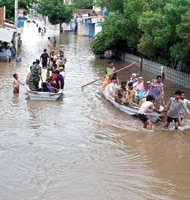
rising population, especially for those living in low-lying areas. In fact, in what has been described as one of the worst times Hyderabad has faced, during record-breaking rainfall in 2006 the poor sewage system and ineffective pumping stations brought life in Latifabad and Qasimabad to a standstill for nearly two weeks. With the population marooned in a mixture of rain water and sewage water, boats eventually had to be called in for a rescue operation, while the army supported the civil administration. To add to the woes of the citizens, clean water was not available. Something else that adversely affected the standard of living has been the ill-planned construction of commercial plazas and apartments. The sewage system, which was only effective for a few 100,000 people, could not take the strain of the added population, which has now touched 1.7 million. This figure does not take into account the population of Matiari, Tando Allahyar and Tando Mohammed Khan. Generally, however, many of the problems Hyderabad was afflicted with abated during the Musharraf era. After the introduction of the local bodies system, during his tenure (2001-04) Makhdoom Rafik Zaman, the first District Nazim of Hyderabad (combined), persuaded the then President General to announce a package of Rs10 billion for the development of the city, that had been neglected for decades.
The project, which came to be known as Hyderabad
Development Package, was not executed during Zaman's tenure, but it was
he who prepared the development plans and documents for the project. The
new government, with Kanwar Naveed Jameel of the Muttahida Qaumi
Movement as District Nazim, implemented the changes and accelerated the
pace of work. Many of the differences can already be seen. However, problems still exist. Today, the city lacks recreational activities such as parks, gardens. The only 'proper' garden in the city is Rani Bagh, which has not been maintained by authorities. Meanwhile, the non-functional Niaz Stadium and Airport have become the victims of red tape. For a while after independence, Hyderabad was full of cinema houses that attracted many movie goers. The number of cinemas, however, has whittled down to four. Many blame the 'builder mafia' for this. "There was a time when all the cinema houses in Hyderabad were full but in the late nineties, it became a city without cinemas," complains Yaseen Hameed, a cinema lover and showbiz writer. Other problems include traffic, which is difficult to maintain on account of the city having just two sets of traffic lights. Both of these are located at Fatima Jinnah Road. The rest of the city is in the hands of the traffic police despite the fact that there are not enough traffic constables to keep up with the rising number of vehicles on the roads. Government schools, too face neglect. The effects became visible when private school chains mushroomed across the city, and small schools started opening up in houses in both urban and remote areas. In addition, hospitals that deal with patients not only from Hyderabad but from surrounding districts as well cannot cope with the number of patients, prompting doctors and surgeons to open up their own private clinics, leaving state-run health facilities in poor shape. One of the biggest problems Hyderabad has faced, however, is the brain drain. A lack of opportunities in most fields has left much of the manpower and emerging talents with no choice but to relocate to Karachi and other parts of Pakistan. Yasir Akhtar, who did his post-graduation in business administration from Sindh University two years ago, is one such example. "I am planning to move to Karachi or Faisalabad, because I cannot find good opportunities here in Hyderabad," he says. Hyderabad is not without its own industries and companies, but according to Akhtar, new recruits are usually hired only when an employee retires. This, coupled with an increase in the cost of living, has prompted people from a variety of sectors such as artists, academics, artisans, newsmen, businessmen to leave for Karachi. People have complained that far from owning a house it has become difficult to even afford a flat. "I live in the suburbs of Hyderabad and pay Rs6, 000 as rent for a flat," laments Kashif, who works at a local pharmaceutical company. "This is higher than what is being charged in Karachi. Plus, I would earn more in Karachi than what I make here," he believes. However, despite all the problems there are still thousands of residents in Hyderabad who are unwilling to leave their own city, even if their purchasing power would be higher elsewhere. Crime, for example, is not a serious issue here. Although some areas have fallen prey to extortionists who are allegedly backed by political and influential groups, street crime is not a routine. The situation also depends on the arrival and departure of high-ups in the police department, add observers. The people who want to continue living in Hyderabad insist the city has its own attractions and advantages. In the words of an employee at an English newspaper in Hyderabad, "Moving to Karachi is not an option. Life in Karachi is like that of a machine. In Hyderabad, even if there is a traffic jam, it takes less than an hour to reach home. Can this be possible in Karachi?"
calling Locksmith's diaries In a city where thousands of unemployed graduates are looking for jobs, the legacy of a locksmith lives on
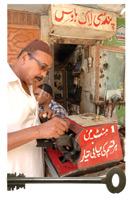
By Fasahat Mohiuddin All around the world, key making can only be performed by licensed professionals. However, here in Pakistan this industry has been working alongside roads with the skills to unlock any key or repair all kinds of locks. The work of a locksmith is the only the roadside profession in our country which requires only skill and presence of mind from the key master. The locksmith's only tools are a small iron rod tapered or flattened at one end which gives him the necessary leverage to open any lock which has lost its keys. These locksmiths or key makers also have the skills
to repair all types of car and motorcycle keys and also sell both old
and new locks. Such locksmiths are present in Karachi on every other pavement with their small shops. Each day they go through hundreds of keys helping people open padlocks which they would have been unable to unbolt without the help of locksmiths who can open these locks within a few seconds. It is based on this skill that they can demand whatever amount they want and exploit clients in their time of need. The clients usually do not negotiate and have no choice but to oblige A random survey by Kolachi led to a locksmith by the name of Mohammed Saleem Ansari who has been picking locks and making keys for the past 40 years. Ansari can be found most of the time making keys at his little shop, filing the key or fixing a lock for a customer who has arrived at the shop for a key or a lock that needs repairs. Having migrated from Rajasthan, India in 1947, Ansari has been associated with the profession ever since and remembers that back then he used to make a key or repair a lock for 30paisas going only as high as five rupees. However, now he says, "times have changed and the cost of tools and grease has skyrocketed." As a result the prices of keys and locks have also gone up. Ansari, who has a certain set of personal rules for the profession, says that he follows the rules conscientiously as this is a highly risky job which can land some one in a lot of trouble at any given time. Replying to a question Ansari explains that if any
youth or person is trained he has to pass a test. Usually, he adds, the
trainee does not know that he is being tested and some money is left in
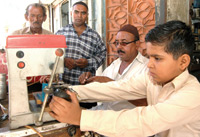
the shop and it is checked whether the person slips or not. Even a locksmith's background is thoroughly scrutinised, adds the key master. "His neighbours are questioned, it is checked whether that person has ever been involved in drugs or any illegal activities and if something is discovered then the new locksmith is fired." The initial training only requires presence of mind and to understand the position of lock levers and the use of tools, explains the locksmith. Unfortunately nowadays every other person has bought a machine and makes sub-standard keys which in turn cause problems for the customer. Ansari who uses a computer to make his keys elucidates with a smile how he can use the machine without even being educated. Ansari explains that he knows the basics therefore he has no trouble using a computer and can make keys within a few minutes. These computer keys Ansari exhibited are of peculiar design and cannot be made manually as they have some holes designed on them which the human hand cannot create. Talking about the sensitivity of his profession
Ansari adds that sometimes people have asked him to make keys for banks
but he follows his principles strictly and never aids such people. He
doesn't even visit houses where he gets even an inkling of doubt. In one case, Ansari refused to help a family which claimed that a bride and a groom were locked inside of a burning room until a trusted friend vouched for the family. Ansari adds that in this case he charged a high fee afterwards because of the risk to his life. Almost 60 years old, Ansari, relates that he has seven daughters and a ten-year old son who is in school. Though he has about six shagirds (students) in Nazimabad, when Ansari himself started out in Bara Maidan, he was the only key maker. There are around 540 locksmiths and key-maker's shops in this locality now. In response to a question about teaching if there was an institute for locksmiths, Ansari replied in the negative adding that although not educated, he would be happy to train the youth willing to take up this profession. Other key makers at Burns Road lack the skill of making keys manually as they are used to making keys with machines only. Three such key makers Shafeeq, Ishtiaq and Gul Mohammed explain that they were unable to find jobs but with little training they are now key makers. They added they are also learning how to pick locks with rods from their seniors.
|
|