


|
|
|
|
|
 |
 |
   |
bills MOOD
STREET Town
Talk education Fundamentally
fundamentalist
bills The price of state negligence Electricity bills have fallen as lightening on the people, bringing them on roads to protest By Waqar Gillani Tahir is a security guard at a bank in a local hotel
which pays him Rs 6000 per month as salary for 12 hours duty daily. He
gives Rs 2500 in house rent and this month he has received as much
electricity bill to his horror. That leaves him with Rs 1000 in hand, with
which he is supposed to pay for food, transport and other necessities of
life. And mind you, he has a family to feed as well. How does he meet his
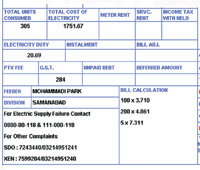
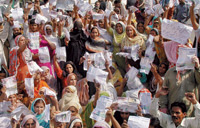
and his family's needs, is anybody's guess. Masood, a helper in a private organisation in Lahore who gets Rs 6,000 salary per month, was shocked on October 20 when he received the electricity bill for the month of September 2008 with 31 percent increase in the power tariff. Living in a two room house with three tube lights, two fans, one small respirator, one iron, and one water pump, he had been paying up to Rs500 per month against the use of electricity but this time the Rs1,200 bill shook him as the charges for this nominal use of electricity were 20 per cent of his total income in which he runs a family of five. This is what brought many people on the roads protesting against the government, condemning the electricity price hike and alleging the Wapda and the government of 'over-billing.' There were protests almost in every locality and on every road of Lahore last week against the exorbitant electricity bills. Apart from the increased rate of electricity, the units that people have received are also more than usual this month and to top that the sum total of the bill is wrongly calculated. T N S found out that residents of Sanda Road, Atif Chowk, received bills in which the sum total was stated more than the actual amount. People see it as an attempt by the billing authorities to trick them. Many people felt puzzled on seeing the electricity bills and when they went to their Wapda subdivision with the complaint, they were told to go to the government. Who is responsible for the billing? The National Electric Power Regulatory Authority (NEPRA)
allowed four power distribution companies to make power tariff adjustments
based on global oil prices on a monthly basis in September 2008. In
separate decisions, the authority allowed Lahore Electric Supply Company (Lesco),
Multan Electric Power Company (Mepco), Islamabad Electric Supply Company (Iesco)
and Quetta Electric Supply Company (Qesco) to file revision petitions by
the 15th of every month. Nepra has set the sales rate at Rs9.58 per unit
for Qesco during 2008-09, including Rs. 7.06 per unit as the purchase
price and Rs1.81 per unit as distribution margin. Nepra also changed the
medium-use slab of domestic consumers from 301-1,000 units a month to
301-700 units. The authority further approved an increase in the power tariff for domestic consumers of Rs 5.60 per unit for up to 100 units to Rs13.50 per unit for more than 700 units per month. However, domestic consumers of Iesco using 50 to 100 units would be charged Rs3.75 per unit, those using 100-300 units would be charged Rs6 per unit and those using 300-700 units would be charged Rs8 per unit. Lesco consumers using up to 100 users would pay Rs3.75 per unit, and those using more than 700 units a month will pay Rs10 per unit. Peak hour rates will be Rs12 per unit. The issue took the people to streets burning tyres, attacking Wapda offices and enchanting anti-government slogans. Haji Muhammad Javed of Gujjarpura Welfare Scheme, Lahore, who has also led a number of protests against over-billing, in his locality and outside Lesco office, told TNS that the majority of the locality residents was from lower middle class and people living below the poverty line. "Every house has been charged with 100 to 200 extra units apparently for no reason," he said, adding, "The average bill of the poorest house of the locality is not less than 1,000." He said what else they could do but protest and condemn the government on further deteriorating the life of economically depressed people. Shamim Begum, a woman of a middle class family living in Northern Lahore said, "We have been going to Lesco and Wapda offices but there is no proper response to our grievances." Wapda has nothing concrete to say on the issue. All they have to say is that they can do nothing about the public complaints. She suggested the rich and those who can afford may be charged high rate electricity rates but how can the poor pay such bills. "These are the localities where the use of air conditioner is rare and only tube lights, fans, fridges and tvs are used in these houses," she said, adding, "In some of the houses people have replaced the bulbs with energy savers to save the electricity, still the power tariff is quite unaffordable." Asif Nazir, registrar Consumer Courts Lahore, talking to TNS said that the complaints against all services and utilities, either provided by the government or non government actors, could be entertained by such courts. There is a procedure to file these complaints and awareness is required to inform the people. He said the issue of over billing of electricity bills also comes in the ambit of the consumer courts. He urged the public that if they considered themselves an agrieved party, they could move consumer courts in their respective areas. Chief Executive of Lahore Electricity Supply Company (Lesco) Muhammad Akram Aarain told TNS that the announcement of increase in power tariff was made late while its implementation was quick -- with effect from September 2008. "That is why the bills were quickly adjusted according to the old format instead of preparing a new format with increased tariff." He refuted the charges of 'over-billing' as 'baseless'. "This is not over-billing but adjustment of the bills according to the new tariff." It is also important to mention that the payment date of these bills had also been deferred for 10 days with effect from October 23, 2008. The federal government which is losing its repute rapidly in this power crisis and over-billing issue has also formed a broad based national level committee to review these bills and the tariff situation. The committee can also approve some remedies for the poor and lower middle classes to tackle this crisis. Moreover, the committee would also seek the input of people from all walks of life, CE Lesco Aarain told TNS. Though the review committee has been formed, the issue has raised a serious question: as to how long will the people have to pay the price -- of negligence of state? vaqargillani@gmail.com
Savage noble By Mubeshra J. Pracha No matter how much man achieves in terms of science,
technology or medicine, the need to look back in the past remains. No
matter how much he thinks he has contributed to the world in terms of
development, he still feels incomplete. He looks back -- opens the half
torn, half forgotten pages of the chapters of history. Questions about his
existence and mortality haunt him and the quest for his roots begin. Our identity answers the puzzling questions about our past. Since the discovery of truth always belongs to the past, man sets himself on the road that, according to him, would lead him out of the maze he has lost himself into. He breaks free from the chains of society and like an Olympics' athlete starts running on the promising yet tiring road. No matter how much we like watching those sci-fi movies and the wonders of time machine, the lives of our ancestors always intrigues us. Man has come a long way from being a savage to civilised. Leaving behind all the other species, he created a place for himself in the world. Having done that, he made a place for the other species too -- zoos -- and now the animal rights activists promote safari parks for the freedom of our half brothers. But he never forgot them, did he? He put them behind cages, placed ticket on them and told everyone to come and watch these those who achieved nothing for themselves. One wonder why he has spared the jungle. The life of jungle reminds him of what he is from within -- uncouth, barbaric, always striving to win the survival-of-the-fittest battle. Rousseau held that the man and the civilisation stand in contradiction to each other. He believed in the natural goodness of man, the savage noble. 'Savage noble' is itself contradictory. But that was his point. At least man was what he was. As long as he was unaware and oblivious of his true, raw nature, he didn't hide what he was and that's why he was noble. There was no law or morality. Hence the term 'savage noble'. Man built a society on the foundations of justice, equality and honesty believing that has left behind the life of savagery. It, however, did not take long for him to forget about those foundations. Rousseau's adage goes "man was born free but everywhere he is in chains." Today, women hold placard, protesting for the rights of those women who are the victims of inequality. Their notion of equality, however, doesn't apply to themselves. such a women would never want her maid to be her equal. The fear of one's authority being challenged and overthrown is feudalism in a different light. Layers of make-up and elaborate dressing can never conceal the savage withing. We can hide the dirt of our bodies and the odour of barbarism through glittering clothes and heavenly colognes, but can never wash away that dirt of barbarism. Somewhat like Lady Macbeth who couldn't wash guilt off of her hands. So aptly did Bano Qudsia say that man is a vulture -- a bird of prey who feeds upon the dead. Man does have a selfish delight in taking possession of other species as subjects and then feed upon them like greedy vultures. The savage man and his rawness still resides somewhere deep inside him. The only difference is that the reflection we look at in the mirror is the new us -- polished and civilised. We take pride and indulge in vanity forgetting that perhaps civilisation is just a sham. What perhaps Rousseau failed to understand was that it doesn't really matter if man stays in the state of nature or goes on to be civilised. Both are two extremes after all. Town Talk • 'Vasda Lahore' photo exhibition is being organised by Chitrkar which has extended the call for entries. Now the last date is October 30. This exhibition will be based on entries submitted by citizens Other than photographs, verse and poetry, as well as sound recordings are also welcome. Weblink-www.lahorechitrkar.com
• Puppet Show at Alhamra, The Mall every Sunday at 11am.
• Talent Hunt Show (singing) every Saturday
• Panjabi Sangat is a weekly gathering every Friday and Sunday at Najam Hussain Sayed's house at 7pm where Punjabi classical poetry is readand sung. Any person who visits the Sangat can freely and actively participate in the above mentioned activities. education The educators' perspective The government must listen to what the teachers have to say if it truly intends to reform its schools By Saadia Salahuddin Teachers are considered builders of a nation so it is important that we treat them well. We cannot hope for any improvement in the system or the policy without involving our headteachers and teachers because they are the people who actually work with the children and know the issues first-hand. There are approximately 1500 vacancies of teachers in
government schools in Lahore alone which will be announced hopefully
within ten days through advertisements in newspapers, a district officer
at the EDO office says. The Lahore figure makes one guess how many
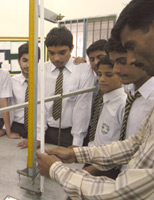
teachers are required in the whole of Punjab. So the first task the government has at hand is to provide teachers in schools wherever they are needed. The question is that the academic session started in June then why the teachers' seats have not been filled but the fact that the government is serious about providing teachers in its schools, is a good augury. A District Officer (DO) Ashfaque Ahmed at the Education Department says, "In some of the schools in Lahore we have shifted teachers from schools where there was less attendance, to schools with large attendance and less teachers previously." This is a balancing act apparently but the shortage remains there. The problem is that the government hires teachers on contract who leave as and when they get better opportunities so the exercise of filling in seats does not bear the desired results. It is important to note that there is no concept of leave in this cadre so far. It is like 'dehari' (daily wages) because a teacher's pay is deducted even if he is absent for a day, says an education official. A senior person in the education department says teachers need to be appointed in more than 50 percent schools of Punjab and that there is grave shortage of SSTs in schools, particularly of science teachers. A recent removal of the headteacher from Government High School Shahpur Kanjra in the outskirts of Lahore has a lot to say about how people can suffer from political interventions. The charge against the man was that he preached the children to misbehave and that too in assembly. It sounds ridiculous anyway but particularly when you know the person. Such an allegation came from a teacher who is said to have a political backing. Political appointments in schools have been seen to be a cause of much woe and the government must discourage it for it is unhealthy for an institution's environment in every way. Office-bearers of the senior school teachers' association also condemn it as detrimental to healthy environ at educational institutions. Senior educators right from Lahore to Mianwali have become victims of political interference, they say. Teachers are the key people in the education sector so what they have to say is important. So far the headteachers have been held responsible for the matriculation results of their respective schools. In 2005 results were bad in schools, as a result many heads of the schools were removed. Did that improve the results? Hardly. Ask the headteachers and they say the results will improve tremendously if the teachers are held responsible for their respective subjects. "For 61 years we have held headteachers responsible for the results. Can we try to fix responsibility on teachers for the result -- say for three years only. Every class is important in itself, not just classes 9 and 10," says Malik Allah Daad, an ex-senior headmaster. The headteacher cannot appoint or transfer a teacher. After talking to a number of headmasters of different schools in Lahore, it was shocking to find out that the headmasters do all the clerical work. The headteacher should be spared from running errands like paying bills and visiting education department office for official work. For that the department should have clerks. In addition the headmaster also does the PT teacher's job. There is acute shortage of PT teachers as well. If we are not grooming children in sports, it means we have left sports to the privileged few who can afford coaching. We cannot produce sportsmen and women in this country in such a scene. Have we given up on that? The headmasters are supposed to pick the books for their respective schools from warehouses. A funny case came to view when the headmaster in the government school at Township was asked to get the textbooks from the school in Karim Block, Allama Iqbal Town, Lahore. Actually the Township school had a warehouse at its campus and plenty of the same books there which it was asked to get from another school. Its apathetic, isn't it? The teachers' issue is one thing, the government needs to look into its policy on students as well. For that we need to listen to both the teachers and students. Teachers say "children don't tuck in shirts, don't do their homework but can't even make them stand because physical punishment is banned. There is no policy on attendance as well. A senior teacher suggests upgradation of all schools to higher secondary schools so that the children remain in discipline because the intermediate stage is the make or make break period for children. Teenagers take to smoking cigarettes and charas. Some fall into the trap of watching x-rated films. They are over-exposed and we fear many have lost interest in studies, some teachers observe. Then there are schools without facilities and those with all facilities. They cannot fall in the same category. The government must listen to what the teachers have to say if it really means to impart education but when did governments give importance to teachers really? We have DC house but did we at any time have a DPI house or an EDO house? No, because they are considered 'masters'. How the government treats its teachers, counts.
Remembering a remarkable poet who passed away at a tender age By Nadia Anwar The Department of English Language and Literature,
University of the Punjab, Lahore, organised a commemorative event last
week to celebrate the life and works of the late Hima Raza -- poet,
teacher and critic. Though she died at a tender age of 27 in 2003, yet to
experience once again the fact of her untimely death shook many of those
attending the event. Smug in our cocoons, we sometimes forget the
fragility of our existence. However, when encountered by the passing away
of such a gifted person, we are reminded of the truth of the reality. The programme began with the screening of a movie that depicted different phases of Himaís life, and was interspersed with photographic clips and excerpts from her poetry. Shaista Sonnu Sirajuddin, chairperson of the English Department at PU, expressed her pent up emotions by reciting Rose in the Afternoon, a poem by Jenny Joseph. The event, she said, had been arranged to "provide some measure of healing and comfort" to the bereaved family and friends; Hima would have never wanted this, because "the dead are beyond all kinds of wants." Shaista's welcome note set the tone of the event. After completing her early education from Lahore Grammar School (LGS) and graduating from Kinnaird College, Hima did her Masters in English Literature from the University of New South Wales, Australia, in 1997. After a brief teaching stint at LGS and Lahore University of Management Sciences (LUMS), Hima continued her academic career at the University of Sussex, from where she did her MPhil in English Literature with distinction. Hima, being the sentient poet she was, returned to Pakistan with wide-ranging ideas that she had developed over the years from her experience of the outside world. But life was not something Hima could have prolonged through her intellect; she died in an accident while on vacation in London just when she was planning to join the faculty at Beaconhouse National University, Lahore. The people who knew Hima Raza since her childhood describe her as a vocal and precocious child with an artistic touch about her. Perhaps this attributive balance in Himaís personality helped in shaping her poetic sensibility. Memoona Idris, an MPhil student at the English Department, appraised Himaís poetry in her research paper entitled Code Switching in Hima Razaís Poetry: A critical Study of Us in Two Tones and In Translation. She termed Hima's unique style of using both English and Urdu languages in a single poem an amalgamation of two cultures. It seemed as if she was forming two ethnicities by using different patterns, Memoona said. Shireen Rahim, senior faculty member at the English Department, emphasised that Hima actually challenged the nature of discourse. For the same reason, Hima's verse goes beyond the linear and she, with all the power of her irrepressible shades of poetry, becomes a role model for the poets looking to stretch the medium. It is in the unconventional cascading/ascending and left/right movements of Himaís verse that she goes a step ahead of her contemporaries. Through her unusual mode of writing, she makes us read her feelings, rather than a mere perusal of the words. This also helps her create personal metaphors, but ones that have corresponding feelings too. In short, Hima's poetry does not deprive us of that part of her conscious to which only she herself was privy to. Words become a means to explore the subliminal waves of history. For Hima, collective memory and historical narrative are interchangeable entities. In her collection of short verse, entitled Memory Stains, she claims: "I am stories, dreamt before birth -- beyond death/in a stranger's imagination." Hima reveals to us another face of history, without destroying the previous one as if this reshaping would help her build a future for "infinite beauty", "infinite justice" and "enduring freedom". While Hima's vision for the future is filled with hope, the stains of memory take her to the past, where things should have been treated and dealt with differently. For her, "forward means backward"; because she takes history as a whole, evolving both synchronic and diachronic patterns at a time. She seems to suggest that it is only through our journey backwards that a construction of a viable future can be deliberated about. While writing about the issues concerning history and memory, Hima does not lose sight of the dilemmas facing the postcolonial world. Her poetry prominently features the notions concerning displacement, uprootedness and alienation of an individual or a nation, among other neocolonial realties. At the event held in Hima's memory, faculty members as well as students recited the late poet's verses, and appraised her poetry and personality. A rendering of the messages from her sisters, Anjana and Bela, and friends moved many an audience to tears. Renowned educationist Dr Syeda Arifa Zehra, in her bereavement note, stated that "28 is not an age to die. Hima did. To live forever." She also recited Aamir Hussain's tribute to Hima, entitled A Ghazal in Prose. The programme ended with a moving musical performance by Himaís sister, Noor Zehra Kazim. Although Hima has gone far away from us, her spirit continues to hover above our heads, as does the visions of memory, both past and present. She is truly a "fundamentally fundamentalist", who "remain(s) in process,/with a story to tell,/a shadow to chase,/a ghost to carry." But those who love her would always miss the "sweet memory stains"! (The writer, MPhil in English Literature, teaches at a local college.)
|
|