


|
|
|
|
 |
 |
   |
cricket Pakistan
cricket coach Geoff Lawson Butt(ed) Is
there something left to be achieved for Tendulkar? cricket Prince of Calcutta Sourav Ganguly calls it
quits By M Shoaib Ahmed Sourav Ganguly on October 7 announced his retirement from international cricket after the end of the four-match series against Australia, bringing to an end an era in which he brought aggression to the Indian team.
Domestic cricket: Back to the basics Pakistani cricket needs to become truly professional, it needs to be made into an institution: Imran Khan By Gul Hameed Bhatti Some former Pakistan Test cricketing stars want to take the country's domestic cricket back to the basics. Asking for a change, but a meaningful change, is always welcome and the pros and cons of a system that could be adopted for the good of all concerned does need to be discussed threadbare and implememted in its true essence. Unfortunately, however, it is sad to say that some of these proponents of a revised domestic cricket format have been living in the dark ages, eversince having said goodbye to the playing arena of the sport. More than most others, however, Javed Miandad has kept himself active, if not out there in the middle, but at least in the management of the game. He has served as the national cricket team's coach on a few occasions in the recent past. Perhaps that's why you don't hear him lamenting about our 'decaying' system regarding the domestic set-up. Imran Khan, one of the finest all-rounders, fast bowlers and captains that Pakistan has ever seen, continues to harp on the same tune from time to time, with a few amendments here and there. But sometimes it appears that he is a little cut off from reality. Recently, in a lengthy interview given to a Pakistani website in England, although the subject of which was his political career as chief of the party Tehreek-e-Insaaf, he touched upon the game of cricket at the outset. The interviewer asked: "Given the current state of Pakistani cricket, what would be your solution to put us back on the map?" And Imran goes on to say that "Pakistani cricket needs to become truly professional, it needs to be made into an institution..." Of course, no one can deny this as the main cause why Pakistan cricket continues to lag behind the rest of the world, but Imran then launches into his usual tirade about the departments that are included in the domestic cricket set-up. He says: "These departments are a cancer within Pakistani cricket, we need to get rid of them and replace them with a maximum of seven regional first-class teams. These teams should be represented by regional associations with elected members and the chairman of the Pakistan Cricket Board (PCB) should be someone who is elected by the same regional associations. "We need to separate politics and sport, it's unacceptable for the head of state to appoint the PCB Chairman. This ad hoc system needs to stop, we need a full time salaried head of the PCB who is selected solely on merit and not because of his connections. I mean it's not rocket science, it's the same system in place elsewhere." One has no issues about his thoughts on the selection of the PCB Chairman, perhaps this is exactly how it should be, but we here in Pakistan simply cannot separate politics from everything else in our society. The Federal Ministry of Sports recently started a campaign to hijack the PCB and turn it into a sort of government institution. So, maybe, one would continue to see the PCB chairmen being appointed by the President of Pakistan, who will contiunue to be branded as the PCB's 'Patron in Chief'. For years, Imran has been saying that it is not the domestic first-class structure, but the country's under-19 tournaments that have been producing Pakistan's national team cricketers. Isn't that exactly what under-19 competitions are supposed to do? These youngsters don't play their cricket on the Mars, they play on the very same grounds that much of our first-class cricket is staged. Then, what are these "seven regional first-class teams" that he keeps talking about? Does he really mean regions, as conceived by the PCB, or the political divisions in the country that used to be in fashion before August 2000? Just a few days back, Imran's pace bowling partner Sarfraz Nawaz had come out with a statement whereas he has urged the PCB to disband all the national and regional cricket academies. He also said "regions are no answer to the development of the game at the domestic level. Instead of regions, associations should be promoted." Sarfraz's demand is in total contrast to the one put forward by Imran. These two cricketing superstars have to realise that 'regions' don't exist in Pakistan's administrative set-up. The PCB has itself created them, just to divide the various district cricket associations in the country into regional cricket associations according to the areas which they represent. And divisions, as we knew them, within the four provinces of Pakistan don't exist anymore either. The country has now been divided into 112 districts, in addition to the Islamabad Capital Territory, Azad Jammu & Kashmir, Federally Administered Tribal Areas (FATA) and Northern Areas. The districts of Pakistan form the third tier of government here, ranking as subdivisions of the provinces of Pakistan. Prior to August 2000, the provinces contained administrative units called divisions which contained districts as the fourth level of government. In August 2000, the divisions were abolished as an administrative tier, and the provinces are now directly divided into districts. Sarfraz would be well advised to realise that districts are part of the regional associations, that PCB formulated only for cricketing purposes. There are still a large number of districts which don't enjoy playing rights. For example, only nine of the districts in Balochistan have active cricket playing outfits, and the other 18 do not, although Chagai featured on the district-level circuit only once in 2003-04 before finding it difficult to continue with its cricketing pursuits. In the North West Frontier Province (NWFP), 16 districts are represented in national cricket and eight others don't play. Chitral, however, did appear once in 2003-04 before returning to obscurity. As many as 29 districts form the playing fraternity in the Punjab. One of the other six, Gujrat, was shifted from the Sialkot region competition to Islamabad, when the capital's team was elevated to a 'regional' level and needed a few districts to complete its circuit. There are only four teams in the Islamabad region round. Islamabad themselves in addition to Gujrat, Azad Jammu & Kashmir (AJ&K) borrowed from the Rawalpindi region and Northern Areas from the greater Peshawar region before Abbottabad's own regional association was formed. Sindh has a total of 23 districts; 13 of them have full playing rights and 10 don't. Karachi is a single district, but the regional competition here is contested by all its seven zones. Similarly, in Lahore district in the Punjab, the inter-district competition is held among the city's six zones. Thus, in fact, only 71 of Pakistan's 112 districts -- in addition to Islamabad, AJ&K, FATA and Northern Areas, play cricket at the national level. Every season, the PCB arranges the Inter-District Senior and the Inter-District Under-19 Championships, with competition conducted separately in all 11 regions of the country. Then, teams from these districts are selected for the regional championships. The first-class Quaid-e-Azam Trophy event and the Pentangular Cup are the season's crowning glory, with the departments competing in the Patron's Trophy Grade-II contest alongside other limited overs and twenty20 tournaments. Of course, Imran keeps on thinking about the Australian first-class circuit which he wants to 'cut and paste' in our system. But which seven regional associations would he like to be in the top grade? Maybe Imran would like to take part in a sort of national cricketing debate, even if he can't take time away from his politics, and come out with a plan that's really workable. Surely, the district level system needs to be streamlined, all the 82 teams involved being given seedings instead of comfortably playing in their home circuit. Maybe Sarfraz is right when he says that "more Test cricketers should be involved in cricket promotion". He has proposed an international cricket committee headed by a renowned former Test cricketer. "This international committee would help raise the image of Pakistan cricket." On the same lines, a constitution committee headed by chairman Ijaz Butt and including former PCB chairman should also be formed. "On the same pattern, evaluation and fitness committees should also be established." He proposed a selection committee consisting of five former Test cricketers. "The committee should have one fast bowler, spinner and batsman each." Sarfraz has also asked for promoting players like Iqbal Qasim, Abdul Qadir and Javed Miandad. "These are the players who have the capacity to deliver and they should be involved in training and coaching programmes." The key to a better system of cricket is in how the sport shoud be run here and not just the cricketers. The domestic game needs to have certain snags cut out and must be streamlined. Just how that's going to be possible should be decided by the PCB. Not through a public forum, but through the decisions made by a brains trust of the best minds in national cricket. It has to be decided once and for all, whether the district teams should stay or the old system of teams divided into slightly larger cricketing divisions should be devised. Can the regions play a more meaningful role in the uplift of cricket? Do we need more teams or less and just how can we improve the entire structure, encompassing consistency, continuity, better physical fitness, discipline, coaching methods and overall attitude problems? Will the best men kindly put a step forward? The writer is Group Editor Sports of 'The News'
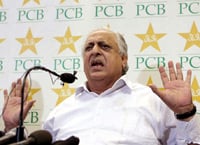
Pakistan cricket coach Geoff Lawson Butt(ed) The Pakistan captain and coach made a startling 'disclosure' by claiming that they lost because they did not get the team of their 'choice'. It's unclear which team they were referring to
By Imran Farooqi Pakistan's cricketers might be facing another long
and unwanted lay-off from the game after their flopped Canadian trip, a
lot of things are, however, happening on the administrative front. The
new PCB chief is working overtime to bring new people on board and has
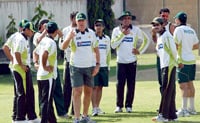
already made a lot of positive changes. As expected Pakistan rolled past the minnows hosts Canada and Zimbabwe and also tamed a relatively weak Sri Lankan challenge on their way to the final on the penultimate ball of the match, but succumbed in the game that mattered most. For a change Pakistan were able to field their strongest side, whereas Sri Lanka had brought a young side most of whom are likely to occupy a permanent place in the side in future. The Sri Lankans had rested Kumar Sangakkara, Muttiah Muralitharan, and Chaminda Vaas for this successful off-shore event, but in the end it did not matter as Pakistan surrendered meekly in the final. Against Ajantha Mendis, who did not play when his team went down to Shoaib Malik's boys, Pakistan's batsmen had no clue, and he was the deserving man of the series. And as usually happens in this part of the world, nobody bothered to take the blame. It was only after the team reached Pakistan that it was 'revealed' that in fact it was wrong selection that had led to the defeat at the hands of the Sri Lankans. Otherwise, we have been made to understand, Pakistan were set to clinch the inaugural 20-20 event Toronto come what may! The Pakistan captain and coach made a startling 'disclosure' by claiming that they lost because they did not get the team of their 'choice'. It's unclear which team they were referring to. The one which was picked by the selectors that included off-spinner Saeed Ajmal, or the one that eventually went to Canada? In any case just one player's omission or inclusion provided he's not a world-class performer can't justify such a dismal show. After a long time Pakistan had at their disposal the services of all their experienced fast bowlers, i.e. Shoaib Akhtar, Umar Gul, and Sohail Tanvir. The batting, too, could not have been stronger. If Younis Khan, Salman Butt, Shahid Afridi, Kamran Akmal, Misbah-ul-Haq, and Shoaib Malik can't win us games, what can? All of them are vastly experienced and talented players who know their jobs well. If they do not perform, what can the selectors do? If Malik and Geoff Lawson were not satisfied with what they got, why did not they raise any objection when the squad were announced? And why are they complaining now? After all Pakistan lost just one game, and won three. That wasn't something which should worry the captain and coach. They also did not disclose what was wrong with the selection. A captain and coach's input regarding selection of teams is very important for the overall development of the squad, but, at the same time, they must make sure they are prepared to deliver with what they have, not bothering about what they should have. Anil Kumble is his team's captain and premier wicket-taker, yet when the Indians inflicted a historic morale-sapping defeat upon the Aussies in Mohali last week he was watching the game from the sidelines. On the other, Shoaib Akhtar, supposedly Pakistan's match-winner in every game the team play, was butchered mercilessly by the Sri Lankans in the Toronto final. That shows matches are won through dedication, self-belief, and discipline. Unfortunately, Pakistan traditionally relies on star players. Other things assume lesser significance. PCB chief Ijaz Butt's recent outburst against Lawson is a clear indication that the latter's contract would not be renewed, but the attack seems a bit premature as the Aussie alone could not be targeted for the team's inconsistent performances over the last year. If this is the case, the captain and the players, too, should be taken to task. Anyway it will be interesting to see how Butt and Lawson get along in future. More than anything the assault looks to be a pressure tactic from the chairman who apparently wants the Australian to leave on his own rather than being forced out of the job. Considering this fact Lawson's insistence that since his coaching record to date with Pakistan is quite impressive (21 ODI wins against 9 defeats) he won't quit and instead would like to continue his association with the team, seems nothing but waste of time. It's great to learn that Butt wants somebody from Pakistan to look after the side, yet criticising somebody who's still in charge of the national team does not sound well. He could have obtained the same result in a far descent manner by waiting for Lawson's term to expire and then telling him he's no longer required. Butt has made his intentions clear by going public and it may lead to further trouble as there are already reports regarding differences between the coach and the team members. How can we expect a coach to keep his focus on the job when he knows his fate has already been sealed? Let Lawson complete his term and things will be pretty clear by that time as Pakistan would have finished their Test and ODI assignments against India at home and, possibly, West Indies, in Abu Dhabi. However, Butt deserves rich praise for getting rid of other highly-paid top-ranking PCB officials -- who were only pursuing their personal agendas -- and bringing ex-captain Javed Miandad on the governing body of the Board and inducting Ijaz Ahmed and Shoaib Mohammad as new members of the selection committee. Miandad is known for his cricket acumen and his presence on the body is likely to induce a positive change. Similarly, Ijaz and Shoaib were active on the field till a few years ago and possess enough knowledge of the current state of affairs in Pakistan cricket. Since they'll be picking players they have played with or have watched from sidelines chances of mistake will be minimum. The salvo against Lawson apart, Butt seems to be heading in the right direction, and it will take a while before he'll be able to clear the mess. He can't please everybody, but cricket's revival in Pakistan has to be his top priority. Is there something left to be achieved for Tendulkar? He has reached a stage that others can only dream of. He has destroyed every bowling attack in the world. India's batting has revolved around Tendulkar for more than a decade
By Khurram Mahmood In modern cricket if you think there's a batsman who
has achieved almost all landmarks of the game, scored most Test runs, is
the highest scorer in One-day Internationals, has the most centuries in
Tests and ODIs, if there is such a batsman who can hold all these
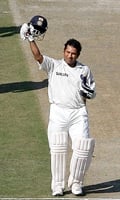
records is none other than India's little master Sachin Tendulkar. There can be few more exciting sights in cricket than watching Sachin Tendulkar bat at his best and, whenever he does, the spectators at the stadium especially in India are on their feet cheering and why not. Tendulkar is setting almost impossible targets for the other batsmen. He has reached a stage that others can only dream of. During the second Test against Australia at Mohali, Indian master batsman Sachin Tendulkar broke another world record of being the highest run-getter in Test cricket. He surpassed West Indian legend Brian Lara's 11,953 in 131 Test at an average of 52.89. During that innings he also achieved another landmark when he became the first first batsman in Test cricket to score more than 12,000 runs. He has also scored most (39) centuries in Test cricket. Tendulkar also holds the record of most runs in One-day Internationals, having scored 16,361. He is also the highest century-maker in limited-over internationals with 42 hundreds in 417 appearances at this level. Sachin Ramesh Tendulkar made his Test debut against Pakistan at Karachi in November 1989 and became India's youngest Test player at the age of 16. He scored his maiden Test hundred at the age of 17, against England at Old Trafford. He was named among Wisden's Five Cricketers of the Year in 1997. He also made his One-day International debut at the age of 16 against Pakistan in 1989. In 1996-97 he was appointed as the captain of the Indian side, making him the second youngest captain in the history of Indian cricket after Mansur Ali Khan Pataudi who was named captain at the age of 21. Tendulkar, 35, regarded among the premier batsmen in the world in the last decade, is ranked second in both the all-time Test and one-day lists prepared by Wisden, behind Australia's Don Bradman and West Indies' Viv Richards, respectively. Donald Bradman was watching a 1996 World Cup match on television when he first saw Sachin Tendulkar bat. The Indian player's technique seemed strangely familiar to him. He regarded Tendulkar as one of the best batsmen of the modern era who most reminded him of himself. In batting, he has reached a stage that others can only dream of. He has destroyed practically every bowling attack in the world. India's batting has revolved around Tendulkar for more than a decade. So much so the critics have often labelled India a one-batsman team, especially on tours. Beside his extraordinary talent, courage and consistency have been the main virtues of Tendulkar who has made batting glamorous and entertaining without sacrificing solidity. He is also generally considered to have a near-perfect balance between aggression and defense. Sachin's overall average is 54 -- even against World Champion Australia his average is 55.82, but surprisingly against Pakistan and South Africa his performance is quiet below average, that is 42.28 and 35.35 respectively. He has scored 1000 runs against every major team. Tendulkar has suffered a series of wear and tear injuries in the last few years and recovered from a long-term tennis elbow injury to play against Pakistan last year. High expectations from the millions of fans who do not accept anything less than a century from him the build-up puts a lot of pressure on the master batsman. No other player suffers so much from the pressure of expectations like that. He perhaps puts too much pressure on himself because he feels he has to win big matches and prove his critics wrong. With age on his side, this man is set out to be the highest run-getter in the history of world cricket. Sachin Tendulkar, known as 'The Little Master', has served two unsuccessful terms as India captain, the first aged 23 in 1996 before being axed 17 months later after his batting suffered. He was re-appointed in 1999, but stood down after a 0-3 Test series rout in Australia the following year. Since 1999, India has won 37 Test matches. Most surprisingly Sachin Tendulkar was not man of the match in a single match. It shows he is not a match-winning player. On the other hand man of the match award in these winning matches have gone to Kumble (7), Dravid (5), Harbhajan (5), Sehwag (3), Ganguly (2), Laxman (2) and Zaheer Khan (2). Tendulkar was named player of the 2003 World Cup, scoring a record 673 runs to help India reach the final, where they lost to Australia. The next year, he equalled compatriot Sunil Gavaskar's world record of 34 Test hundreds while compiling 248 not out, his highest score, in Australia. He was declared Wisden Cricketer of the Year in 1997. The writer works in 'The News on Sunday' in Karachi Pakistan cricket: No need to reinvent the wheel The results provided by this system were visible and Pakistan was consistently amongst the top three teams in the world. We were the envy of the world in the amount of talent we produced
By Malik Arshed Gilani Pakistan cricket can well learn from the old saying: "Don't reinvent the wheel". If one was to examine the systems exercised over two periods, 1990-2000 and then 2000-2008, the results which are clearly obvious must differentiate between which system was right and which was messed up. In 1990, the Pakistan Cricket Board (PCB) was
operated under a constitution that had been improved from the days of
Justice Cornelius. It was based on representation in the PCB by elected
members from the associations around the country. The associations provided elected members to the General Body of the PCB which then provided twelve members to form the Executive Committee of the Board. Thus the clubs were the grassroots of Pakistan cricket, providing not only the players but also representation in the management of the game. A great addition to the source of talent was teams operated by various institutions. These provided some 1,200 first-class cricketers with jobs which allowed them to concentrate on their game. A critically important point for Pakistani conditions consistently ignored by some of our 'greats' whose background and education gave them the luxury of not being affected like almost all our other first-class cricketers. The institutions were also represented on the Board. The talent and support to our national team from this source needs no highlight for the knowledgeable reader. The President of Pakistan had been given the honour of nominating a Chairman and a Chief Executive Officer and then with the advice of both these individuals a treasurer. In all cases these appointments were ratified by the Executive Committee of the Pakistan Cricket Board. The first-class structure of Pakistan Cricket was based on three logical major tournaments. The Quaid-e-Azam Trophy played by the associations, the Patron's Trophy for the institutions and a one-day tournament played by a mixture of the associations and institutions. About five hundred players participated in a senior and junior league with a system of promotion and demotion. In a country with some 150 million people this was obviously a competitive situation. An under-19 tournament was an important part of the structure to highlight the young available talent which was then matured in the senior tournaments. The results provided by this system were visible and Pakistan was consistently amongst the top three teams in the world. We were the envy of the world in the amount of talent we produced. From the year 2000, the PCB's Chairman appointed by the Patron chose to manage the PCB through an ad hoc system. Ignoring the results achieved in the past ten years, he decided that he knew it all and major changes in The constitution and in the cricket Structure were needed. If that was not dangerous enough, he also decided that he could perform two major jobs simultaneously. The fact that he had no real first hand knowledge of either domestic or international cricket was amply proved by the results. He selected as his second in command a first-class cricketer of great speaking skills, no track record and a reputation amongst his peers that he was able to 'bat for everybody' for his own interest. The Chairman set about having endless Seminars which allowed all and sundry to vent their views which were supposed to be collated and then analysed to provide the complete answer. The results achieved by the Pakistan Team during this tenure surely suggest that either the recommendations were not followed or ignored. Strangely enough, discipline, a matter of utmost importance in the armed forces suffered the most in this period. The PCB's principal claim to fame during this time was a programme of building new grounds. This in itself a noble aim lost sight of the fact that existing grounds were under utilised and badly maintained. If the Chairman had paused to consider and get good advice he would have found that institutions were by law required to have their own home grounds and if they could be could have been assisted in 'owning' their playing fields it would have ensured upkeep and maintenance. This would of course not have been so 'novel'. This simple move would have ensured the commitment of these commercial bodies to cricket. Sadly having been badly misguided by some of his advisors he also started reducing the importance of the institutions. The ad hoc body operating the PCB steadily denuded the associations of authority. The Chairman apparently wanted to create an 'autocratic' constitution with all powers and no checks but with an appearance of 'democracy'. Quite naturally this was difficult. The next appointee to the job of the Chairman a diplomat, had no evident knowledge or experience at sports management other than having once managed our national team in their tour to India on account of his diplomatic skills. His principal qualifications were his love of the game and an ability to use his political connections to put forward his candidature. This last comment is made purely on the basis of hearsay! The Chairman began his tour of duty by deciding to tour and meet with all the associations to ostensibly have a first hand look at their set ups. One believes it actually was a learning trip as the incumbent had no knowledge or feel of Pakistan cricket. This was followed by a repeat of the seminar efforts to find the right 'path'. In retrospect it is apparent that the plan coined together was unsuccessful. This period was highlighted by the efforts of the Chairman to revive school cricket ostensibly to make this the grassroots of the game. It had obviously gone unnoticed that in the principal cricket countries, scholastic institutions had much reduced their importance on sports due to the demands of education. No longer were the 'battles won on the playing fields of Eton'. In any case for Pakistan this was a pipe dream far removed from reality. It totally ignored the tried and tested and our natural grassroots which were, and are, the clubs and the mohallas of Pakistan. During this tenure domestic cricket again only received lip service. It is incredible that the PCB who supposedly appreciated the importance of this sector to Pakistan cricket were incapable of announcing a calendar for their domestic tournaments even four months before the start of the season. The sale of domestic rights for a mere eighty lacs, drummed at being 'for the first time' belied the fact that a tobacco company used to fund the PCB with many crores some twenty years earlier. It also conveniently hid the bad management of this important part of our cricket. The fiasco in which Pakistan lost a Test match by virtue of it being awarded by the umpires for 'not appearing' in the field of play amply sums up this tenure. It is ironic that the individual visible on television on the balcony of the Oval Cricket ground with his 'thumbs up' appearing to claim credit for settling the matter before it all went pear shaped was able to convince the Patron that he deserved the appointment as the next Chairman. Cricket in Pakistan is a very high profile sport. It is opined that the Chairmanship of the Board is sought for the opportunity it affords for fame and publicity. If the widely held view that much political muscle is needed to get this appointment is correct, then the aspirants and their supporters forget that this is a very difficult task. It requires very special skills and wrong selections have repeatedly and visibly damaged our cricket. The last eight years of Pakistan cricket exhibit that those successive Chairmen, no doubt with good intentions, vied strongly for this appointment. They paid no attention to history and, or, had the ultimate arrogance to believe that with no track record, a very cursory knowledge of our cricket conditions and the minefield that is the make up of our cricketers, could do better. Sadly the Patron also repeatedly ignored these factors. This last Chairman, a medical doctor by profession, was a great 'Corporate Management' proponent who also believed that he could do justice to two very important posts. The PCB during his period adopted an autocratic constitution that put all its power in the Chairman and his appointed directors. The Board took on the direct control of all Pakistan cricket. He developed a management chart that needed some eight hundred staff thus making it by many multiples the most populated Board in the world. It took away all development incentives from the associations and went to the ludicrous limit of having selectors of teams who were not from their respective regions. The Chairman considered it good practice to get close and familiar with the players. He considered it good management to train and practice with the Pakistan team. It is opined that this familiarity did tend to breed contempt.From reported comments of our top cricketer's one got the feeling that the respect and formality due to the Chairman of a cricket board were missing. These three years of PCB will be remembered for the fact that the Board went from one controversy to another. The players were charge sheeted, then forgiven and then tried again. The cavalier style of this management is typified by the saga of one player hitting another on tour being only banned for three months. When he allegedly again committed an equally, if not a more serious offence he got six months. But next when he criticised the working style of the Chairman, a misdemeanor compared to previous severe felonies, he got banned for five years. When first-class cricketers start taking the Board to court one can honestly judge that the system has broken down. A serious fault that had crept into our old system was that some of the officials in the respective associations had almost institutionalised their elections. This was achieved by creating clubs on paper who voted as directed.It is sad to report that efforts made to correct this have been weak and politically motivated. One believes that a simple remedy would be to have a special Department of the PCB preferably headed by a respected and reputable ex police officer with no interest in the game. This proposed full time department would only report to the PCB Board and would continuously monitor all clubs in Pakistan to ensure full enforcement of the rules that are clearly laid down in the previous constitution. This department should have no discretionary powers. The need to keep new blood coming into the management of the associations can easily be managed by limiting the number of tenures that one individual can serve in the associations. As we stand at the beginning of a new era one can only hope that the powers that be revert as quickly as possible to the previous tried and tested constitution and using the General Body carry out the improvements considered necessary. It should give back regional cricket to the associations. The PCB cannot do it all. All efforts should be made all to revive institutional cricket by provision of good marketing opportunities for these commercial bodies to achieve their business goals which would automatically bring more finances into the game. Even more importantly they should be assisted to own 'home grounds' as required by the old Constitution which would then be well maintained and also create more cricket fields. The new leadership has the great advantage of having worked at many levels in the association and the Board. It has the experience, knowhow and knowledge of what made the system work. It is hoped they will have the fortitude to execute the tried system that had consistently worked for Pakistan cricket to restore our country's cricketing fortunes and not to 'reinvent the wheel'. They will surely have all our support in this noble task.
Prince of Calcutta Sourav Ganguly calls it quits His ability to play shots on the off side is special because there are very few players who can hit the ball in that area as crisply as he does By M Shoaib Ahmed Sourav Ganguly on October 7 announced his retirement from international cricket after the end of the four-match series against Australia, bringing to an end an era in which he brought aggression to the Indian team. The announcement has signalled the end of a 16-year
brilliant career, which in the last three years or so had shown a slump
and was punctuated by his run-in with the establishment. Ganguly, a veteran of 109 Tests, has been in and out of the team after he lost the captaincy in 2005 following a spat with the then coach Greg Chappell during a tour of Zimbabwe. He had assumed the captaincy at the most difficult time when Mohammad Azharuddin had to step down on match-fixing charges. The overall fifth-highest run-getter for India, Ganguly is also among the only seven batsmen in the world to cross the 10,000-run mark in One-Day Internationals. Ganguly's ability to make amazing comebacks after being written off on several occasions showed his grit and perseverance. But the constant scrutiny at times proved too much even for a strong man like him. Very few sporting heroes have enjoyed such public support in his home turf, as Ganguly did in India, particularly in his state West Bengal. This is borne by the scenes of public outrage that followed the Prince of Calcutta's exclusion from the national team in December, 2005, with fans blocking roads and railway tracks, and burning effigies of then Chief Selector Kiran More and Coach Greg Chappell. His ability to play shots on the off side is special because there are very few players who can hit the ball in that area as crisply as he does. He is an aggressive left-handed batsman and is also an effective right-arm medium pace bowler. He started his international career as a 19-year-old during the tour to Australia in 1991-92. His batting is the perfect blend of elegance and power. He has all the traditional style that goes with left handed batsmanship. With superb timing he almost caresses the ball to the boundary. But when the mood gets to him - particularly in the one day game -- his batting can be a murderous assault on the bowlers and a delight to the spectators. But then Sourav Ganguly is not just strokes and class and powerful batting. He has a sound temperament and the ability to rise to the big occasion. The greatness of Ganguly as a captain lay more in his approach to the game than mere statistical analysis. A killer instinct that endeared him to the nation not famed for the quality; a combative style, raw passion and an ability to pick and foster young talents and blend them into a well-knit unit are the attributes that distinguished him as a cut above others in the hot seat. Ganguly led India, known for its vulnerability on fast and bouncy away turfs, to rare Test and one-day series wins in Pakistan, besides finishing at par with Australia in the 2003 series Down Under. The NatWest Trophy final win in 2002 against England after heroic performances by Yuvraj Singh and Mohammad Kaif brought out the spontaneous passion ingrained in the man, who celebrated by taking off his shirt and fluffing it in the air from the Lords balcony. In all, Ganguly has scored so far 18,453 runs in both forms of the game, 7,090 of them came from 111 Tests at an innings average of 42.20, while another 11,363 came from 311 limited-over internationals where he averaged 41.02. Along with Sachin Tendulkar, he formed perhaps the best opening combination in limited over internationals. The pair produced 6609 runs at an awesome average of nearly 50 per partnership in 136 innings. Coming from the state of West Bengal, not known for its cricketing prowess, Ganguly made his Test debut in 1996 with a hundred at Lords, and reached his zenith during a tremendous run as Indian skipper from 2000-2005 before becoming an in-and-out member of the national team till the Australia series. He is India's most successful Test captain till date, winning 21 Tests out of 49 Tests he captained and leading India into the 2003 World Cup finals. In ODIs, he has led India in 147 games, and is in the exalted company of Sanath Jayasuriya and Sachin Tendulkar as one of the only three cricketers to complete the treble of 10,000 runs, 100 wickets and 100 catches. An aggressive captain, Ganguly is credited with having nurtured the careers of many young players who played under him He was born on 8 July 1972 in Kolkata. His father ran a flourishing print business and was one of the richest men in Kolkata. He had a luxurious childhood and was nicknamed the Maharaja. After he scored a century against the Orissa U-15 side, he was made captain of St Xavier's School's cricket team, where several of his teammates complained against his arrogance. Following a prolific Ranji season in 1990-91, Ganguly made his One-day International debut for India against West Indies in 1992, and scored three runs. He was dropped immediately since he was perceived to be 'arrogant' and his attitude towards the game was openly questioned. He toiled away in domestic cricket, scoring heavily in the 1993-94 and 1994-95 seasons. Following an innings of 171 in the 1995-96 Duleep Trophy, he was recalled to the national side for the tour of England in 1996 amidst intense media scrutiny. He played in one ODI, but was omitted from the team for the first Test. However, after Navjot Sidhu left the touring party citing ill-treatment by the then captain Mohammed Azharuddin, made his Test debut at Lord's alongside Rahul Dravid, in what was umpire Dickie Bird's last Test. He scored a century, becoming only the third cricketer to score a century on debut at Lord's, after Harry Graham and John Hampshire. Andrew Strauss and Matt Prior have since accomplished this feat, but his 131 still remains the highest by any batsman on his debut at Lord's. In the next Test match at Trent Bridge he made 136, thus becoming only the 3rd batsman to make a century in each of his first two innings (after Lawrence Rowe and Alvin Kallicharran). In 1997, he scored his maiden ODI century, opening the innings he scored 113, in his side's 238, against Sri Lanka. Later that year he won four consecutive Man-of-the-match awards in the Sahara Cup with Pakistan, the second of these was won after he took 5/16 off 10 overs, his best bowling in an ODI. After a barren run in Test cricket his form returned at the end of the year with three centuries in four Tests all against Sri Lanka two of this involved 250-plus stands with Sachin Tendulkar. In January 1998, in the final of the Independence Cup at Dhaka, against Pakistan, he scored 124 as India successfully chased down 315 off 48 overs, winning the Man of the match award. In March 1998 he was part of the India team that defeated Australia, his biggest impact came in Calcutta as he took three wickets having opened the bowling with his medium pace. In the 1999 World Cup Ganguly scored 183 against Sri Lanka at Taunton, Somerset in England. The innings took 158 balls and included 17 fours and seven sixes. It is the second highest in World Cup history and the highest by an Indian in the tournament. His partnership of 318 with Rahul Dravid is the highest ever in the World Cup and is the second highest in all ODI cricket. On 12 December 2007, Ganguly scored his maiden double century of his career while playing against Pakistan in the first innings of the third and final Test match of the series. He was involved in a 300 run partnership for the 5th wicket along with Yuvraj Singh - a much needed partnership that saved India which was struggling at 61 for the fall of four wickets. He later went on to score 239 before being dismissed by Danish Kaneria. Ganguly has been prolific in both Test and ODI cricket in the year 2007. He scored 1106 Test runs at an average of 61.44 (with three centuries and four fifties) in 2007 to become the second highest run getter in Test matches of that year after Jacques Kallis. He is the fifth highest run getter in 2007 in ODIs, where he scored 1240 runs at 44.28. Early in his career he was not comfortable with the hook and pull, often giving his wicket away with mistiming such shots. He was also criticized for having difficulty in handling short pitched balls and bouncers, notoriously exploited by the Australians and South Africans. However, after his comeback in 2007, he has worked upon these weaknesses to a large extent. He can hit powerful shots to the off-side on front and back foot with equal ease.
|
|