


|
|
|
|
 |
 |
   |
overview Public
relations Editorial competing
interests Building
economic linkages Terms
of endearment
Back to Beijing By I. A. Rehman President Zardari’s visit to China this month, the second one by a Pakistani head of state within half a year, offered little surprises. It did, however, remind Pakistan that in today’s complex global situation the goodwill of even a steadfast friend, that the People’s Republic of China has certainly been, demands continuous nourishment. The joint statement issued after Zardari’s talks with
President Hu Jintao and other high-ranking Chinese leaders contains much
for Pakistan to seriously reflect upon. The framework of General Musharraf had tried to arouse Chinese interest in three projects he fancied — new nuclear power stations, China’s association with the Turkmenistan oil pipeline, and a Gwadar-China rail link along the Karakoram Highway — and had drawn a blank. Neither side seems to have subsequently referred to these suggestions and a maturer mind might have seen the reasons for not advancing them in the first instance. In general terms, the two sides reiterated their opposition to "all forms of terrorism, extremism and separatism (emphasis added)" and resolved to "cooperate with each other to fight the above-mentioned three forces". They also agreed to "maintain communication and coordination on major international and regional issues to safeguard their common interests". But the issues chosen for close cooperation only
include "the reform of the United Nations, climate change and energy
and food security to promote world peace and development". One looks
in vain for any agreed responses to what the joint statement describes as
"new circumstances" or "changes in the international,
regional and domestic environments". And issues touching on Pakistan—India
relations have since long been out of Islamabad-Beijing communiques. The list of topics referred to in the joint statement and the 12 memoranda of understanding (MoUs) signed during the Zardari visit clearly reveal a shift away from preoccupation with defence — and one should not forget that the army chief’s visit to China preceded Zardari’s — and an increased emphasis on economic collaboration, and that too between industrial-trade-cultural enterprises and organisations. This development can only be welcomed as it extends Pakistan-China cooperation beyond the not-too-congenial official domain. However, the obvious risks in this arrangement need not be overlooked. While the gain in freeing the joint ventures of bureaucratic shenanigans is evident, smooth cooperation between entrepreneurs demands a different approach to matters than is seen in state-to-state engagements. Among other things a critical look at the volume of bilateral trade is required. It is not clear whether the current year’s target of 8 billion dollars (significantly higher than the 2001 level of 1.45 billion dollars) will be realised. Since Pakistan has a trade deficit to the tune of 7.5 billion dollars it has a greater responsibility than China to push mutual trade. The 12 MoUs signed during President Zardari’s tour cover a fairly broad area, though they do not match the 30 MoUs signed when President Hu Jintao visited Pakistan in 2006. Apparently, the authors of such memoranda are finding it increasingly difficult to think of sufficient number of themes for cooperation between Pakistan and China for ceremonial inking during each summit. That they have to seriously take up cooperation between the Cricket Association of China and the Pakistan Cricket Board is a measure of their difficulties, or their despair. There can be no doubt that both China and Pakistan need to think of fresh initiatives to maintain the unblemished record of their understanding, especially since their roles crafted over 50 years ago seem to have been reversed. In the 1950s and 1960s, China needed friends to help it beat the Western designs to keep it under a politico-economic blockade. It was then possible for China to show forbearance, to borrow an expression from former foreign office chief Abdul Sattar, in the face of Pakistan’s opportunism and lack of sensitivity in appreciating her concerns. Today the world is looking up to China to help it out of one crisis or another. In this situation, Pakistan cannot afford to take China’s friendship for granted. True, the Chinese are known for their long memory and for keeping their emotions to themselves till their suppression becomes hazardous. They will not forget Pakistan’s solidarity with them in the past till, and only until, Pakistan makes the mistake of compelling them to forget it. Just as China used to say in the fifties that it understood Pakistan’s difficulty in ignoring its fealty to the United States, Pakistan must appreciate China’s responses to global trends and its attempts to go on refining its role as a world power. Pakistan paid the price of expecting China to be in 1971 what it was in 1965 and it simply cannot afford to expect China to be in 2010 or 2015 what it was 60 years earlier. Times change and so do all living societies, even if Pakistan refuses to do that. It seems Pakistan will need to concentrate on three points in order to retain China’s goodwill. First, Pakistan must learn to define what this state stands for. The Chinese had no problem with our antipathy for their communism and the intemperate utterances of our free-lancers in the area of external relations (such as Mohammad Ali Bogra or Ayub Khan) but they have always had problems in dealing with a state that does not know its mind and professes ideals that are never followed in practice. Now, we must not keep China, or any other country for that matter, in any doubt as to what Pakistan stands for and where it wishes to lead its people to. The task is not easy for it involves replacing belief with a vision within the realm of attainable objectives. Secondly, Pakistan must appreciate Beijing’s concern at any possible involvement of its citizens with the happenings in Xinjiang. That the quasi-religious militants that are threatening Pakistan’s integrity also have designs on the large Chinese region is no secret. Unfortunately, these militants have patrons and collaborators all over Pakistan, especially in and around Lahore, Bahawalpur and Rahimyar Khan, and China will watch how sincerely and effectively our government subdues them. Pakistan just cannot afford to ignore the elements that are committed to extra-territorial adventures in the name of religion. Our failure to control such elements could thoroughly undermine Pakistan-China friendship. Thirdly, the whole edifice of Pak-China economic cooperation will collapse if Chinese nationals coming over to Pakistan to work on different projects continue to be kidnapped and killed. Our record in this area has left much to be desired. Nobody is going to allow us time till eternity for learning to maintain order. Not even the Chinese. The time for living by excuses and grandiose promises is gone. What needs to be done to qualify as a responsible state must be done. And soon. Exchange programmes in the fields of culture, education and sports can help bring the people of the two countries closer By Waqar Gillani Pakistan and China boast a time-tested friendship, but
there haven’t been many cultural exchange programmes between the
countries — the kind that would essentially work to improve
people-to-people contact between the two countries. According to Orya Maqbool Jan Abbasi, the sitting secretary of Information Department, Punjab,"The number of civil society groups and cultural promotion is not up to the required level." Orya Maqbool Jan recently led a delegation of journalists to China. Talking to TNS, he said, "Hundreds of Pakistanis visit China every month. There’s a need to lift the visa restriction to further enhance the ties." He pointed out that language was another problem commonly faced by people on both sides and hoped that this would be helped with the passage of time as "a lot of educational institutions in Pakistan have started Chinese language teaching programmes." Conversely, there are over 3,500 Pakistani students in different educational institutions in China. Islamabad-based All Pakistan China Friendship Association (APCFA) is one of the few civil society organisations that has been working to promote Pak-China ties at the people’s level since 1979. Initially, it had chapters in Karachi, Lahore, Peshawar and Rawalpindi and was working under the Government of Pakistan Cultural Association Act of 1975. Mian Habibullah, Vice President APCFA, cites "security hazard" as "one major reason for a decreasing people-to-people contact. "However, despite this issue, APCFA is working towards improving its membership." According to Habibullah, APCFA has more than 300 members from Pakistan and China. "We celebrate our national days on both sides and are trying our best to increase the interaction." He said that the situation was currently in favour of China and the Chinese Embassy in Islamabad was now more actively involved in improving relations. He stressed upon the need for more and more of cultural exchanges and sports activities between the two countries. Siddique ur Rehman Rana, Chairman, Pak-China Economic Relations Committee, Lahore Chamber of Commerce and Industry, and an industrialist himself, has formed an association called Pak-China Economic and Cultural Cooperation Forum that means to work for enhancing people-to-people contact through exchange of delegations. "Apart from economic ties, we are also looking for collaborations in art, culture and education. This will help develop a better understanding between the people of both countries," he told TNS. The founder of PCECCF did his Bachelors in Science from China in 1978 and is currently working as a consultant on Pak-China industrial relations. Prime Minister Syed Yousaf Raza Gilani also recently declared that the forming of the Pak-China Friendship Group in the parliament was meant to improve contact between the people of the two countries, particularly at the youth level, through elected representatives. He made the announcement while addressing the students of Urdu Department at three different universities in Beijing. These universities include Tsingua University and Foreign Studies University of China. The PM also announced a grant of Rs 100 million for the construction of a Cultural Centre in the Chinese capital.
The new president’s first state visit would be to China. The announcement was made more than once. And when the actual visit came about a few weeks later, and after two semi-official visits to the United Kingdom and the United States, the country was facing one of the worst economic crises of its history. Some hurried media leaks raised the Pakistani nation’s expectations about the cash commitments that China would make during the visit — to bail Pakistan out at this crucial time. This did not happen, even though many other things did. Most of all, the visit and Pakistan’s relations with China became a subject of analysis and discussion. The war on terror may have been pushed to the sidelines and economy seemed to have occupied the centrestage as the immediate results of the visit were being weighed here. But it indeed provides an occasion to adjudge the foreign policy of Pakistan, as well as China’s, in the process. We at TNS for example were mystified about the reality of this all-weather friend. We wondered about the almost paradoxical relationship we had with two of our foreign policy cornerstones — the United States and China. Why did the actual people-to-people engagement between Pakistan and the US — apart from that between the two governments — generate so much of anti-Americanism in our society? On the contrary, why does everyone in Pakistan, from top to bottom, considers China a friend when there has been no such contact between the Pakistani people and the Chinese? Is the Pakistani establishment responsible for creating this positive image since China has been Pakistan’s biggest military and technology supplier? We have not been able to adequately address and answer all these questions in this Special Report. But we do know that China, during the Cold War and later, did become an economic model to emulate for people in the third world, and Pakistan was no exception. We have spent a lot of time and space on the actual value contained in the president’s tour and how it is linked with the relationship that we cultivated with China in the last more than 55 years. There is immense logic in the ‘Look East’ policy and Pakistan stands to gain a lot by engaging with China in a more meaningful way than ever before. The articles below testify the truism of this logic. Ties and shine As a multipolar world undergoes new transformations that change political and economic goalposts, Pakistan’s bilateral ties with China as well as the US will hold it in good stead as long as Islamabad is careful in balancing counter geostrategic interests of these two world powers in the region By Adnan Rehmat As in a jungle survival is the primal instinct, in the
civilised world each country tries to protect itself and its interests
through a mix of self-reliance, military and political strength and, of
course, relations with other countries that are projected as friendships
but are essentially trade-off arrangements dictated by shared mutual
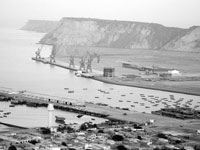
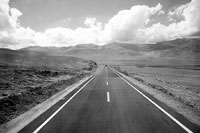
interests. There are plenty of countries that are not smart about socio-political evolution (weak institutional base, moribund economy and poor rule of law) and allow themselves to be either dominated easily by others because of a lack of clarity (or national consensus) on a long-term future and being bogged down in day-to-day governance rather than sustainable development; or they happen to be in a geo-strategic position where a constant state of alert against hostility — real, imagined or manufactured — wears them out. Pakistan fits this bill, and to offset perpetual adversity has done what countries like it do: look for powerful countries to befriend that can, hopefully, make up for its inability to defend itself against threats of aggression of the military, economic and political kinds. All such countries must have at least one ‘reasonably reliable’ veto-wielding permanent member of the United Nations Security Council to protect them against military hostility, economic sanctions or coercive diplomacy by its enemies. Not one but two For Pakistan there have been two candidates with whom it has tied its strategic future: the United States and China. Both countries have supporters and detractors in Pakistan who argue that Washington and Beijing have been either indispensable or harmful for Islamabad. However, since before the Cold War and now into the new millennium, Pakistan has been one of the rare countries in the world that have managed to be in strategic relationships with both countries despite monumental global developments (from Cold War to Cold Peace to Global Terrorism and from an isolated Communist China to a gradually dominant Capitalist China and from a dominant America to a beleaguered America). This is no mean achievement and is one of the rare foreign policy successes of the past six decades for Pakistan. As the economic tumult catalyses global political transition in the new millennium and as a multipolar world undergoes new transformations that change political and economic goalposts, Pakistan’s bilateral ties with the US (despite the strained relationship at times) and with China will hold it in good stead as long as Islamabad is careful in balancing counter geostrategic interests of these two world powers in the region it finds itself situated, for the short- to medium-term. Strategic depth Geographic realities alone dictate that in a region that houses two permanent members of the Security Council (Russia and China), Islamabad should not compromise on its strategic relationship with Beijing as Moscow is nowhere near a platform of mutual interest with Pakistan that will be helpful in the near future, thanks to its extremely close ties with New Delhi. Hence, even as Pakistan is inexorably tied with American presence in Afghanistan, it makes sense to be part of alternative regional security regimes such as the Shanghai security group that opposes a long-term US presence in the region. Because Pakistan is now stuck with the status of being a country with nuclear weapons (and the hostility that generates and the crippling economic cost it engenders when the country is itself on the verge of default) it has to have a UN veto power close at hand which can prevent an invasion on it. This, too, in a region that China cannot afford to ‘lose’ influence of to not just one but three nuclear powers — the US, Russia and India. Hence while Pakistan may be in the thick of the controversial ‘war on terror’, Islamabad is as much dependent on Beijing for diplomatic survival as China is on Pakistan for strategic depth in its neighbourhood. More of the same But if all Pakistan has to do is maintain diplomatic status quo on its strategic relationship with China, how should it deal with what are clearly competing interests of its other ‘veto friend’ — the US, which is steadily moving into a long-term strategic relationship of its own with India, which has its own problems with Beijing? The answer is simple enough but easier said than done: more of the same. The future to Pakistan’s equally important strategic relationships with the US and China lies in the past. Washington and Beijing have been strong political (and to some extent, military) rivals in the past few decades and yet Islamabad has maintained good relations with each because of a national consensus at least in the case of ties with Beijing and because three bouts of military rule have benefitted from political and monetary support from Washington. America’s ties with Pakistan have always been short-term — support against Cold War foes from General Ayub in the 1960s, support against Soviet Union in Afghanistan from General Zia in 1980s and support against Al Qaeda/Taliban in Afghanistan from General Musharraf in 2000s. The ‘good’ periods of American relationship with Pakistan have been when there have been Republicans in power in Washington and military rulers in Islamabad. 1970s and 1990s were ‘bad’ times in bilateral ties characterised by the presence of Democrats (Carter and Clinton) in Washington and elected leaders (Benazir and Nawaz) in Islamabad. It is then, perhaps, not much of a surprise that with Democrats and democrats’ ascendant in the US and Pakistan now, the ties seem strained even though neither side can afford to ‘dump’ the other for the moment. Pakistani military rulers have cultivated a service-oriented relationship with the Americans for hard cash. General Ayub got $2 billion, General Zia $3.5 billion and General Musharraf $10 billion. In most cases, military hardware was additional. There was no trace of the money after the generals left the scene. China’s relationship with Pakistan has been less flashy and more passive but steadier and soothing. Unlike Washington, Beijing has never been choosy about Islamabad’s leaders and has been equally friendly with Ayub, Bhutto, Zia, Benazir, Nawaz and Musharraf and now Zardari. As against about 40 agreements signed by the US with Pakistan, China has signed over 200, reflecting a more institutional approach in bilateralism. Also, China does not deal in cash but prefers to build monuments to friendships that offer a sustainable return to the Pakistani people (as opposed to benefitting rulers, the preferred US method). Hence Karakorum Highway, Gwadar Port, Heavy Mechanical Complex, Chashma Nuclear Power Plant, Aeronautical Complex, Kohat Friendship Tunnel, AJK Hydropower Project, missile technology, dams, joint production of F-7 Thunder fighter jets, etc. You will struggle to name one monument to Pak-US relationship that people will recognise. Impulsive vs steady In short, Pak-US relationship has alternated between engagement and estrangement but Sino-Pak ties have been virtually steady and un-flippant. Chinese aid to Pakistan is consciously public-interest specific, scientific and non-controversial while most US aid is military-specific and mostly controversial. And yet, China is a net exporter of trade goods to Pakistan while the US is a net importer (leaving aside military procurements by Islamabad from both Washington and Beijing). The good ties between Pakistan and China are heavily government-centric with next to no interaction between the people of the two countries. The relationship between Islamabad and Washington, on the other hand, is a much better people-to-people with Pakistani professionals having much greater exposure to more popular American standards and culture and doctors, engineers, scientists, educationists, students and visitors bringing the best of America to Pakistan. No such interaction between middle and elite classes of Pakistan at the people’s level takes place between Islamabad and Beijing. For the average Pakistani there is no China in everyday life while American culture, literature, standards and information is near ubiquitous in the country’s urban areas. Treading with tact Pakistan derives great value from each relationship. There is even greater advantage Pakistan can provide the US and China and these two countries to Islamabad in the next decade and beyond if they play it right. A stable Pakistan can provide the corridors of energy the absence of which will cost growing Chinese and Indian economies much more than if they did not engage Islamabad. A stable Pakistan, at peace with India, will limit the influence of Al Qaeda for US and ease China’s anxiety at American military presence in Afghanistan and help raise the profile of bilateral and multilateral economic relationships by offering Washington and Beijing the world’s biggest middle class in India. It will also provide a steady market for Pakistani goods and cheaper imports from India. The US with its $2 trillion debts and China with its $2 trillion reserves are changing and if the economically, politically and militarily beleaguered Pakistan of today is to pull itself up, it will have to change, too. And yet, the more things change the more they remain the same: For Pakistan, conducting the relationships with the US and China, without one adversely affecting the other, with the same tact in future as it has exhibited in the past, is the key to the greatest self-advantage.
Reverting to international financial institutions for its immediate cash needs would be a short-term solution, whereas economic engagement with China will ensure economic stability and energy security to Pakistan in the long run By Dr Shaheen Akhtar During President Zardari’s recent visit to China, the premiers of the two countries underscored the need to reinforce efforts for "deepening the Pak-China strategic partnership in new circumstances". China with $1.9 trillion forex reserves growing at a
pace of $40 billion a month is considered the strongest economy today. On
the other hand, the IMF forecast shows that Pakistan’s economic growth
rate may slip to 3.5 percent in 2009. The areas covered in the 12 MoUs signed during Zardari’s visit show that both sides are trying to infuse strategic pragmatism in their relationship which can enhance their strategic engagement in the 21st century. These include infrastructure, information technology, energy, telecommunication, agriculture, industry, minerals, trade, disaster relief and space technology. Each one of them is very crucial for the economic growth and development of Pakistan. The country is currently severely hit by food and energy crises, aggravated by a hike in oil prices. The deepening economic crisis has hit not only economic growth of Pakistan but is also causing political and social instability in the country. The expansion of cooperation in these areas will help Pakistan overcome its current economic difficulties in the long run. It is important to note that the outcome of the visit was much debated in the Pakistani as well as the Western media in terms of Chinese commitment for cash needed to shore up Pakistan economy. The general take in the media is that perhaps Pakistan has been ‘rebuffed’ by China in this regard or that it has been unable to extract solid commitments. In fact, China has tried to address Pakistan’s financial crisis at three levels. It has provided $500 million in a concessional loan to help Pakistan meet its balance of payment requirements in April. In addition, according to The Financial Times, Pakistan hopes to secure another concessional loan of $500 million to $1.5 billion. In 1996, China had provided $500 million in balance of payment when Pakistan was on the brink of default. Secondly, Chinese companies have entered into a number of agreements consisting $5 billion investment that would support Pakistan’s economy in a tangible way. Thirdly, the financial institutions of the two countries will stay in touch to avert financial crisis. Leaders of major Chinese financial institutions like Peoples Bank of China, China Development Bank, Industrial and Commercial Bank of China and Ex-Im Bank of China are shortly visiting Pakistan to see how they could contribute towards assisting Pakistan. The Chinese foreign ministry spokesman Quin Guang also stated that China will "continue to support and help Pakistan within [its] capability". Further, China has assured to play an active role in the newly formed Friends of Pakistan Forum comprising potential donors which is expected to meet in Abu Dhabi in mid-November to pledge economic assistance for Pakistan to help it avert an economic crisis. Adviser to the Prime Minister on Finance Shaukat Tareen has stated that Pakistan needs around $4 billion for bridging the gap in balance of payments during the current fiscal year. Media reports quoting official sources state that Chinese were informed of Pakistan’s immediate need of a $2 to $3 billion input to avoid default. Realistically speaking, while in the short term Pakistan perhaps has to resort to international financial institutions for its immediate cash needs, economic engagement with China will provide economic stability and energy security to Pakistan in the long run. In the area of trade, two sides have decided to accelerate the implementation of the Five-Year Development Programme on Economic Cooperation. A Free Trade Agreement signed in 2006 aims to increase bilateral trade to $15 billion by 2011. The bilateral trade has increased from $2 billion to $7 billion with a balance of trade in China’s favour. Pakistan’s exports are largely agricultural-based such as cotton yarn and fabric, grain, fruit, vegetables and leather while some minerals have also been added to it. China enjoys trade surplus partly because Pakistan does not have exportable surplus either in agricultural or industrial sectors which in turn have been severely affected by the energy crisis. There is a great need to diversify trade with China through border and transit trade as well as to set up joint ventures. The development of trans-border economic zones would also enhance trade and investment between the two countries. During the visit, the two sides have also focused on enhancement of cooperation in the area of investment. President Zardari met over 200 top corporate executives and offered "special preferential treatment" to Chinese investors and urged them to invest in Pakistan and benefit from its geo-strategic location. Highlighting "investor-friendly environment, laws and legislation, human capital and other resources", he invited Chinese companies to invest in trade, industry, financial services, banking, energy, construction, real estate and tourism sectors to help develop Pakistan’s untapped potential. Zardari promised to extend all possible facilities to the Chinese investors and set up a special cell for development of Pakistan-China industrial and economic zones across the country. It is encouraging to note that despite Pakistan’s internal security situation Chinese entrepreneurs have expressed deep interest in business, trade and investment opportunities in Pakistan. It is estimated that leading Chinese companies have offered to invest $5 billion in Pakistan’s defence, banking, oil exploration and mining sectors, as well as the Thar coal and Bhasha dam projects. In the area of civil nuclear energy cooperation which is an ongoing process between the two countries, China has agreed to build another two nuclear power plants, Chashma III and Chashma IV reactors with an additional 680 MW of generating capacity. China has already assisted Pakistan’s Chashma I with 300 MW which has been completed and Chashma II which is under construction. These agreements are very significant as electricity shortages have shot over 5,000MW while the United States has refused to offer a nuclear energy deal similar to the one it offered to India. In addition, regarding energy sector, foreign minister Shah Mehmood Qureshi also saw a role for China in the gas pipeline project between Iran and Pakistan. It appears that India is dragging its feet from IPI project which requires huge investment. Although China has not showed its explicit desire to join the project, given China’s energy demands, such a possibility could not be ruled out. Another important MoU signed is for launch of Pakistan’s first telecommunication satellite Paksat 1R in 2011. Pakistan will use it for domestic telecommunication and broad band services. Besides, framework agreement to set up $300 million National Electronics Complex in Pakistan would help Pakistan economy in this important sector. On the political plank, China has assured its complete support to Pakistan’s commitment and efforts to fight terrorism and appreciated the sacrifices made by the government and the people of Pakistan. China is deeply interested in the political stability in Pakistan that is very essential for economic stability, especially foreign investment. There are however, two main areas of challenges which if not attended properly would render all the agreements a futile exercise on paper. First and foremost is the poor record of implementation on the agreements in the past. The government has decided to set up a new mechanism of inter-ministerial meeting to monitor the implementation of the agreements and MoUs signed in Beijing but that is not sufficient. There is a great need of initiating an institutionalised Strategic Economic Dialogue with China in which high officials from both sides, heading different sectors of economy, engage themselves on a regular basis. There is also an urgent need to launch a separate Strategic Energy Dialogue with China that can focus on hydel energy, development of coal energy to serious discussion on the trade and energy corridor between the two countries. (The writer is a research fellow at the Institute of Regional Studies, Islamabad)
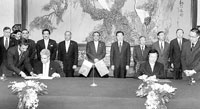
The 12 agreements relate to collaborations in trade, mineral resources, information, environment, cricket and the Paksat-1R satellite procurement contract By Nadeem Iqbal Zardari’s visit to China elicited a great interest for the political analysts, far more than the unofficial visits to UK and the US did. The official jubilation over what is being dubbed as a ‘successful’ visit is a sign of the ground realities that have bound both the countries in an all-weather friendship. Although Zardari failed to secure a bail-out package
from China — in the shape of soft loans ranging between $500 million to
$1.5 billion — he came out having signed 12 agreements of cooperation in
different fields. It is interesting that Pakistan’s being an ally of the US in the war against terrorism has not affected its relations with China in a negative way. Instead, it seems to serve the Chinese interest that orchestrated the formation of the Shanghai Cooperation Organisation in 2001 that included Russia and other Central Asian republics, meant to partially address the threat of terrorism emanating from these countries and Taliban’s Afghanistan on its borders. Pakistan was granted observer status in 2006, and China remains concerned about the links between Islamic militants in Pakistan and in the Xinjiang Uighur Autonomous Region, which is where the Karakoram Highway terminates in China. The 12 agreements relate to a further strengthening of ties in trade, mineral resources, information with regard to radio and TV, environment with regard to climatic change, natural history museum, cricket and the Paksat-1R satellite procurement contract between China Great Wall Industry Corporation (CGWIC) and Pakistan Space and Upper Atmosphere Research Commission (SUPARCO) etc. A spokesman of the China Great Wall Industry Corporation recently said that a Long March 3B rocket would be used to send the satellite into orbit. It will be launched from the Xichang satellite launch centre in China’s southwestern Sichuan province. The company further said that ground control facilities for the satellite would be delivered to Pakistan’s Space and Upper Atmosphere Research Commission (SUPARCO) after it entered into orbit. The satellite will have a lifespan of 15 years and Pakistan will use it for domestic telecommunication and broadcast services. The real issue remains the use of nuclear technology for energy production.On his return, Foreign Minister Shah Mahmood Qureshi said that China had promised two more nuclear reactors of 680MW each. The minister also spoke of China being one country that had clearly spoken against the discriminatory nature of the ‘understanding’ between Washington and New Delhi. However, Qureshi didn’t specify as to when would work on these projects start. According to media reports, China has agreed to follow a step-by-step approach to fulfilling Pakistan’s aspiration for an expanded nuclear energy programme, instead of signing an ambitious civil nuclear deal of the kind recently struck between the US and India. Beijing, the reports say, is intent on investing heavily in Pakistan despite the deteriorating law and order situation which is not helping the foreign investors; such as, the recent kidnapping of two Chinese engineers by the militants that posed a serious threat to the lives of some 3,000 other Chinese engineers, technicians and entrepreneurs in the country. The threat is not only from the Islamic militants. In Balochistan, the Chinese working on infrastructure projects face threats from the nationalist militants. The joint statement issued at the end of the President’s visit said that Pakistan unequivocally upheld the one-China policy and considered Taiwan an inseparable part of the People’s Republic of China besides supporting all efforts made by the Chinese government to realise national reunification. For its part, China has praised Pakistan’s long-term support on issues concerning China’s territorial integrity and reaffirmed its support to Pakistan’s efforts to uphold its own sovereignty. The two sides also agreed to enhance ‘connectivity’ by developing new communication links, including fibre optic links, and to explore the concept of integrated border management, overland trade and development of trans-border economic zones. Zardari’s visit has also rejuvenated the protagonists of ‘Look East’ policy that can be further extended to ‘Look Far East’. This policy has been the buzzword during the political governments of Benazir Bhutto and Nawaz Sharif who were looking for an enhanced economic cooperation with the Asian tigers in the far East. The economic cooperation between Pakistan and America is more of military nature and it reaches its climax during the military regimes in Pakistan when military service was extended to the US. Post 9/11, Pakistan was offered a number of soft loans and extensive rescheduling of loans which has created a smokescreen of prosperity which has never benefitted the poor and the middle classes and vanished with the end of the military regime.
|
|
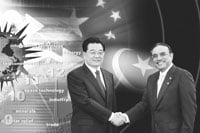 Pakistan-China relationship is still provided by "all-weather
friendship and all-round cooperation" and the words President Hu used
white addressing General Musharraf in April last — that China considers
Pakistan "a close neighbour, a good friend, a partner and more
importantly as a dear brother" — have found their way into the
joint statement. But shorn of platitudes, the statement makes it clear
that Beijing wishes to operate strictly within the 2005 Treaty of
Friendship, Cooperation and Good-neighbourly Relations between the two
countries.
Pakistan-China relationship is still provided by "all-weather
friendship and all-round cooperation" and the words President Hu used
white addressing General Musharraf in April last — that China considers
Pakistan "a close neighbour, a good friend, a partner and more
importantly as a dear brother" — have found their way into the
joint statement. But shorn of platitudes, the statement makes it clear
that Beijing wishes to operate strictly within the 2005 Treaty of
Friendship, Cooperation and Good-neighbourly Relations between the two
countries.