


|
|
|
|
 |
 |
  
|
interview ghazal Images
to the icon Gift
of art
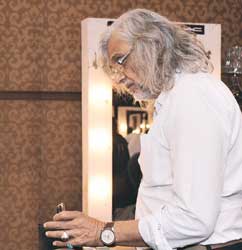
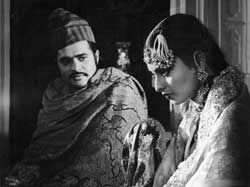
interview “Best actors reinvent themselves” The tall frame, the long flowing mane of silver hair, the large sad looking eyes, there is a certain something, calmness, in Muzaffar Ali’s face. He speaks very quietly; the words come, wait and trickle down through the tip of his lips. In the world of film quickies, Ali might only be known for Umrao Jaan which he directed in 1981 and we all remember it because of the decadent milieu depicted by the unforgettable Rekha and the beautiful whiff of Khayyam’s music, but he started off with Gaman (1978) a little known gem which made Faiz Ahmed Faiz write “Gaman is a poem in visuals. Its tragic lyricism, its muted eloquence, its deeply perceptive, its sensitively conceived and truthfully captured slice of reality around us, the beauty and the heart break of the human situation in town and country, makes it a sheer delight, a veritable tour de force.’’ Ali has made two more
feature films other than those, a rather short career in Bollywood, but
Muzaffar Ali is much more than that, a painter, a music aficionado, a poet
and a fashion designer who marches to his own drumbeat and always seeks a
journey of self-discovery through various mediums.
He was recently in Lahore on the occasion of Faiz’s centenary where
the Faiz Foundation Trust held a three-day screening of films by the Indian
film-maker at the HRCP Auditorium. Muzaffar Ali sat down with TNS for an
exclusive interview. By Ali Sultan The News on Sunday: What inspired you to be a filmmaker? Muzaffar Ali: It would be a series of things; everybody does not become everything in life. It is your mental makeup and your journey that helps you to do what you want to do and makes you move towards that direction. One important thing was that I was always a visual person, the language of colour and form was always important to me. The second thing is that I came from a cultural background where social reality meant something more than met the eye. I came from a certain family, saw the decline and fall of eras, saw the anguish, the neglect, the change. So you could say that was also visual, to some extent cinematic. Finally being in Calcutta during 1962 to 1966, I worked with Satyajit Ray very closely. We were in the same advertising agency, and I saw how he worked on his films, his sense of story, his use of music, his use of his own culture in making films which was very rare. Normally Hindi films were born out of more hybrid situations; they were not born out of deep cultural identity, so Ray was making films no one else was making, out of a sense of a deep cultural bond. So he was a big influence. TNS: They say any storyteller really has only one story to tell. You have directed four films, so tell us what has been that one concern, that one story that connects them all? MA: The divide between big
cities and small cities, between weak cultures and growing economic cultures
and how big cities like Mumbai devour small cities. TNS: Bollywood is an actor-driven industry, but do you think it’s an industry that respects one? MA: The interesting thing with actors is: can an actor carry some kind of story on his or her face or not? A lot of popular actors in India today have lost the story on their face; they just go by their face value. Today actors have nothing special to tell and they oversell their faces so much with doing so many films and ads that the mystery goes and directors also lose their imagination when they try to author their films with these actors’ faces. The best actors always reinvent themselves. TNS: Can you name a few who you think have that face, that mystery. MA: In women, I think Rekha, Dimple Kapadia and Shabana Azmi. Shabana had a very powerful story to tell. She’s done quite a few roles that have given her a distinct identity. I think Sushmita had a very interesting face but she never caught a director’s imagination. Kareena has a very powerful face, but her story is not being used with any mystery. Among the male actors, everybody knows Naseeurdin Shah. Amir Khan is an actor who reinvents himself, but some director has to stir up his imagination. The other problem today is that all these actors are hounded by people, by time, by their own minds, so it’s very difficult to really get into their realm. TNS: While we are on the subject, you’ve used Farouque Shaikh in three of your films. What was so special about him? MA: I am shy and
self-effacing and so are my characters. Farouque as an actor was gentle,
vulnerable, humble and his face could tell a story. TNS: Do you think that Bollywood has evolved? MA: It’s very difficult to pass judgment on that. Everyone has to take his or her own journey; nonetheless there is a definite evolution in technology, in screenwriting, in the structuring of a film, the only thing that could be improved is the director’s authorship of the various layers of a film. I think the other thing is that there should be films made that show a positive evolution of democracy. Certain periods of history have to be understood. In Hollywood, for example, there has been a huge effort to make artistic films about the Holocaust. I think we, on the other hand, have evaded parts of our history. Lost parts of history, certain eras, certain people were wiped out of our minds which delayed our cultural renaissance and caused alienation. Bollywood also needs to turn global otherwise it will die. What it needs is to go international in marketing, collaborations, associations, cast and crews. TNS: Painting, poetry, music and film are all “serious” art forms but why dabble in fashion? MA: With all my films, I’ve tried to fiddle with clothes. I did not want to depend on any one else; I want to be the author of the whole palette of the film. After I got married to Meera and my father had also passed away, I had to shift back to my village Kotwara in Lucknow to handle things there. I did not want to go back to Mumbai. I just wanted to do something that kept me aesthetically activated. So I made a society and involved some 300 to 400 women of Kotwara and we started doing weaving and embroidery and then I realised this was something wonderful and that I needed to keep reinventing it. It keeps me connected to my village, to Lucknow. I am not a fashion designer per se; I like craft, I like reinventing it.
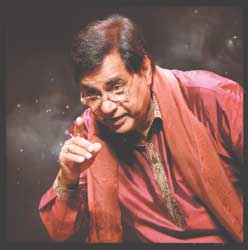
Jagjit Singh who died last week was a very popular vocalist. Though he was seventy, he presented a youthful look that went along well with his music which carried a saccharine sentimental strain. It is a little difficult to pinpoint the reasons of his popularity over the four decades that he sang with the leading vocalists in more than one genre of music across the subcontinent. He made a name for himself in singing the ghazal and in his later years he also sang the bhajans and gurbanis which also endeared him to a sizeable segment of the music-listening public more comfortable with religious music. Actually it was his ghazals that made him one of the most popular singers in the subcontinent. India did not have a ghazal singer as Akhtari Bai Faizabadi (Begum Akhtar), the last great exponent of the ghazal, had ceased to sing with regularity in the decade of the 1960s. Talat Mahmood two-timed between film songs and ghazals, fizzling out sooner than he should have had. Meanwhile, musical influences travelled across the political boundary freely as musicians dealt with similar creative issues on both sides of the border. The major exponents of ghazal were all Pakistanis and the reason could have been that the kheyal and thumri had a thinning audience in the country which made these exponents of the kheyal and thumri switch to singing the ghazal which was less abstract and more acceptable to the emerging cultural contours of the new state of Pakistan. Ustad Barkat Ali Khan, Iqbal Bano, Fareeda Khanum, Mehdi Hasan and later Ghulam Ali all switched to singing the ghazal and enriched it considerably. Similarly, in folk music, too, the musical virtuosity went up markedly in Pakistan for the same reason. In India, the lines were
more formally drawn as most of the classical vocalists stuck to their genres
while film music too was dominated by a few great exponents of the lighter
forms like geet. There was hardly any scope for breaking through the confines
of the already established parameters of the forms. Mehdi Hasan, a truly great exponent of the ghazal, started to sing in a constricted voice in the lower and middle registers and allied the Rajasthani ang into the prevalent ghazal gaiki of the times. As his style caught on, others started to emulate him across the music divide in both India and Pakistan. Jagjit Singh was one such follower but he did not travel all along the high virtuosity path of Mehdi Hasan. The purity of sur, the exploration of the raag and the graces of the kheyal and thumri were amalgamated in his new style of singing the ghazal. Jagjit Singh took the path that was being followed by the more popular vocalists; he scaled down the high virtuosity and merged it with the geet-like suppressed ebullience and created a form that had been perfected by Ghulam Ali in Pakistan. The popularity of the geet ang and then the ultra sweetness of the cultivated tone within a very limited range were what the people wanted to listen. This music was soothing and did not question the comfort zone of the listeners; the music evoked a romantic strain and did not have the quality to disturb or address the chaos within. In the last fifty odd years, both in India and Pakistan the effort had been to scale down on the virtuosity and create music which has a more popular appeal. The markers have been — greater reliance on lyrics of the popular kind and compositions, which are not complicated and easy to hum. This consistent drive at appealing to the largest number in a democratic age may have been politically correct and commercially rewarding but it came at the cost of virtuosity. Jagjit Singh rode this wave of sentimentalism and became hugely popular. There may have other reasons for his popularity. The manner of a man and a woman singing in a concert outside the film duet too was considered a novelty and his earlier successes were the numbers that he sang with his wife Chitra .It was pleasant on the eye as the duo performed in public or on television. He also sang for the films, though not very many but in the subcontinent to sing for the film is one sure way of reaching out to a great many people who are overly fond of associating music with lyrics, a situation, a character, thus avoiding the perils of the wanderings of the imagination. He also lent his voice to the very popular television serial based on the life of Ghalib, enhancing the aura of the leading poet of Urdu in the most realistic attempt at the portrayal of the man and his times. This was seen on both sides of the border with great avidity. He was more technology savvy than perhaps many of the other musicians and singers of his time. He was also one of the first vocalists to be recorded in the new technology of digital multi-track recording. His compositions also had instrumentation not usually associated with genres like the ghazal, bhajan and gurbani. Jagjit Singh was a Punjabi and though he was born and raised up in Rajasthan he did not belong to a family of musicians. It is always more difficult for outsiders to break into the inner sanctum of music which the hereditary musicians think as their very own, though he did learn music from professional musicians and ustads like Pandit Chaganlal Sharma and Jamaal Khan. He had started to sing in the 1960s and gained popularity in the seventies. Along with the ghazals and geets he also sang bhajans and gurbani He was awarded the distinct honour of singing in the joint session of the Indian Parliament on the occasion of the one hundred and fiftieth anniversary of the war of independence by rendering the famous ghazal of Bahadur Shah Zafar “Lagta nahi hai dil mera ujre diyaar main”and was awarded the Padma Bhushan in 2003.
The Faiz Art Prize exhibition and related events concluded last week, with an impressive ceremony at the historic Frere Hall in Karachi. The evening was organised by Aman Ki Asha, Nukta Art and the Progressive Writers’ Association, to applaud the winners of the art competition ‘Postcards to Faiz’. To commemorate the birth centenary of the humanist poet Faiz Ahmed Faiz, icon of peace and tolerance, upholder of social justice and human rights and a devotee of the arts, the A4 sized Postcard was an appropriate and specially chosen format for expression. Artists combined letters and imagery, materials and relief in their messages to Faiz, as also to the awam, the masses. About 150 practicing Pakistani artists and art students from across the country, as well as artists in the Diaspora sent their Postcards, including Abdullah M. Syed, Adeel-uz-Zafar, Amin Gulgee, Ghalib Baqar, Hamra Abbas, Hasnat Mehmood, Mashkoor Raza, Meher Afroz, Moeen Faruqi, Naz Ikramullah, Riffat Alvi, Ruby Chishti, Sabah Hussain, Saeed Akhtar, Shakeel Siddiqui, Sylvat Aziz, Zubeda Javed and several others. A few entries were also received from India. A distinguished jury
belonging to the fields of visual arts and literature determined the awards.
These included Prof. Naazish Ataullah, Mussarrat Nahid Imam, Saquib Hanif,
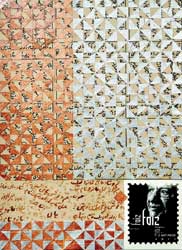
Tariq Rangoonwala, and Dr Asif Aslam Farrukhi. The Jury Awards for artists went to Karachi-based Meher Afroz and New York-based Ruby Chishti, while another Karachi artist, Sheema Khan received the Popular Award, which was decided by the votes of all those hundreds of people who visited the show throughout the week. Each of them received a beautiful translucent ruby-coloured statuette, conceived and crafted by Shahid Sajjad, arguably the most prominent sculptor of the country. Several years ago when I had asked artist Meher Afroz about the imagery in her art, she had said that she explored her subconscious in her paintings. She was brought up amongst a large number of family members in her grandparents’ huge ancestral home in Lucknow, where there were “three aangans, three devdees, a kutubkhana and an azakhana… Aware of the various conflicts around her, she had learned to treasure good values early in life. Her deeply devout and religious but nevertheless broad-minded father, as head of the family, gave his children a traditional upbringing. Meher was, however, allowed to study at the liberal Government College of Arts and Crafts, Lucknow, from where she graduated with honours in Fine Arts. For Meher to come out as one of the winners is perhaps not surprising for those who have followed her seamless continuum. She has been projecting her worldview and philosophy in her prints and paintings: the contradictions and conflicts of the man of the new millennium, sometimes exploring the new relationships that he forms with the outside world, and sometimes lamenting the moral decadence that startles and mortifies her. Her temporal experiences have been expressed through various ‘series’, such as portraits, masks, puppets, amulets, mehvar, niche, hisar, zindaan, dastawez, etc. For the Postcard to Faiz, Meher rendered a beautiful collage created with tiny, jewel-like triangles of gold and silver arranged in the ganga-jamni tradition and titled “yeh phool hain kay lahoo.” The words are taken from Faiz’s famous poem “Yahan say Sheher ko Dekho” from the verse “jo rung her dar o deevaar per pareshan hain, yahan say kuch nahi khulta yeh phool hain kay lahoo.” Meher’s collage reminds me of some of her other works in which she has used needle-work, appliqué, etc. Her ‘postcard’ is an interpretation of the dualism between the benevolent and the malignant. It can also be read as the artist transcending the duality of her times and achieving a kind of enlightenment…spirituality. The amalgamation of the text and the gold and silver paper cut-outs has several layers of meaning. In the background, the artist has used words from a marsia written by Mir Anees, which describes the martyrdom of Ali Akbar, the handsome, eighteen year old son of Imam Husain who, like several other men fighting the Yazidi forces, sacrificed his life in the battle of Kerbala on the tenth of Moharram. Meher arranges and thus
presents the pieces of shiny paper geometrically as if they are four-petalled
flowers blossoming after the blood has been spilled. Since the words in the
title are from the compiled works of Faiz called “Sar e wadi e Sina” (The
Valley of Sinai), and all the poetry in the composition is quite poignant,
Meher has created a unique relationship between the heart-rending marsia and
Faiz’s poetry, which will remain relevant for all times to come. She
observes that man has two major responsibilities: he should either give
evidence to an event he/she has witnessed or convey those important messages
to other people. The truth as elicited in the verses of Faiz reveals the
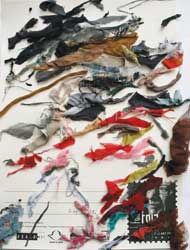
layers of the intangible as well as ceremonial interaction and dualities. Ruby Chishti, who trained as a sculptor at the NCA, Lahore, is the other award-winner. Ruby lives and works in Brooklyn, New York. In the light of the medium used by her in all her works (fabric, straw, plastic bags, old newspapers, cotton-wool, etc.) it is interesting to read this text on her website: “The materials Ruby employs raise the question of permanence, a preoccupation in our society. However the artist believes the value of works cannot be measured in how long they survive. We have seen ideas that exist nowhere last for centuries and sculptures in bronze meant to stay forever melted down for weapons.” Ruby Chishti’s entry for the Faiz Art Prize was certainly one of the most innovative works in the show. Although she has continued to use the same idiom as she does for her other works created in a contemporary manner while employing traditional doll / toy-making techniques with novelty, her Postcard to Faiz was an outstanding example of thinking out of the box. Her award-winning work, using threads and scraps of fabric is titled “aaj ik harf ko dhoondta phirta hai khayaal” (my thoughts today are in search of a single word). These words are borrowed from Faiz’s poem by the same title in his work “Shaam e Shehr Yaraan” of which some of the other lines read: “mudh bhara harf koee, zehr bhara harf koee, dilnasheen harf koee, qehr bhara harf koee…” As mentioned earlier, Sheema Khan received the Popular Award. A miniaturist, she received her training at the Visual Studies Department at the Karachi University. It was obvious that her entry was a popular choice of the visitors who were fascinated by the unusual 3D miniature. A diptych, one part of it was a executed in wood and paper. She references the ‘Hamzanama’, titling her work “bus ker rukh amn ka,” drawing connections from history and literally ‘framing’ today’s socio-political circumstances. The other part is text-based, where Faiz’s verse is calligraphed in bold: “mataa-e-loh-o-qalam chhin gaee to kya ghum hai, keh khoon-e-dil mai dubo li hain ungliyan main ne, zuban pe mohr lagi hai to kya, keh rakh di hai har ik halqa-e-zanjeer main zuban main ne,” which could be translated as follows: what if they snatch my pen and ink, I have dipped my fingers in the blood of my heart; even if they seal my tongue I have no qualms, as I have kept my tongue in each ring of the chain around me! The
writer is cofounding senior editor of Nukta Art, one of the organisers of the
Faiz Art Prize.
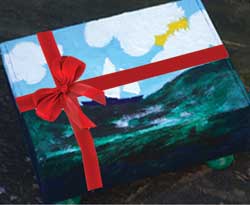
With the wedding season in full swing alongside the dengue epidemic (any phonetic similarity between wedding and dengue being purely coincidental), a question faced by our major artists is: what to present to the newly-weds. Artists are generally expected to present their artworks as gifts and they have been following the practice. Thus several families, who may not be interested in art or could not afford it, had a few works of art in their collections. In rare cases, these were works by important painters who were their distant relatives, family friends or mere acquaintances. Since we are not quite bothered about banal issues such as documenting works of art, these ‘gifts’ are lost forever from the cultural memory. Occasionally, one comes across a small Shemza or a Pervaiz on paper hidden away at an obscure wall space in someone’s house. Mostly, the owners are not aware of the importance, worth or price of the piece. If they do, they are not prepared to part with something given to them or their parents as gift. Not only as a matrimonial
gift, art had been presented on other occasions too. Artists like Sadequain
were known for donating his works frequently to his admirers or well-wishers.
Zahoor ul Akhlaq gave his paintings to his friends, colleagues and to his
dear students to the extent that one can gauge the level of his association
by the number of his artworks a person possesses. In other instances, artists
distributed their work free of cost because of lack of storage space or the
content of the work which made it impossible for the painter or sculptor to
keep in his house. All this may have happened in the past, but not anymore. Today, artists don’t want to part with their work so easily. Although people still hope to get complimentary pieces but these favours are not in fashion any more. Art critics also suggest or indicate to artists their desire to have a ‘masterpiece’ (even a tiny example) during solo exhibitions, but artists are not prepared to trade art as bribe in exchange for a good review in a paper or magazine, or an essay in a catalogue. There are some obvious reasons why artists have become more ‘possessive’ about their work. Compared to say 1960s and 1970s, a work of art now fetches huge amounts, both here and abroad. In some instances, foreign collectors are prepared to pay a lot more than the local connoisseurs. In addition to that, modern and contemporary works are sold at various auction houses, bought by museums and art galleries around the world. The other reason relates to artist’s approach towards his work. Because of the increase in value and international exposure, artmaking has become a professional endeavour and not like a part-time task, which could be carried on the side but never relied upon. At present, a number of artists solely depend on their work, without having to do another job to earn money. In fact the change in the artists’ attitude, in terms of not treating their productions as gifts, has resulted in a transformation in the level of artmaking too. Unlike earlier painters, who were not concerned about the quality of the material used, the venue where they must exhibit their works or places to store them, artists today are more careful about these considerations. Even lesser known, and not yet successful, artists are finicky about the standard of their material, manner and venue of presentation. Today one hardly comes across a warped stretcher, creased canvas, or broken-down picture frame. Sculptures too are not so frail that would break during their exhibition or transportation. By and large, artists are using good material which may last longer and can withstand changes in temperature and climate. Hence, if a person pays for a work, he is confident his purchase would remain intact for decades at least. This sense of satisfaction played a pivotal part in the growing trend of buying artwork which has consequently enhanced the art market and extended the gallery business. So without going into the chicken and egg debate — whether artist’s professional behaviour created a serious market or an increase in the business of art made them more professional — one realises this phenomenon has not only affected the material, physical or financial aspect of art making, it also has had an impact on the nature of image making and the range of subject matter. One can discern a shift in the way artists are constructing their imagery and how they are addressing their visual, formal and conceptual concerns. Knowing that their products could be seen in various parts of the globe on a permanent basis and may fetch a high price, the apparent standard of artmaking has risen considerably high. Thus one can’t imagine an artist presenting his work as gift at weddings etc. Or even to his fellow artists and admirers. And understandably so because a number of artists can’t afford even their own works! Yet in these prosperous times, it would be pleasant to discover some artist doing that because it not only depicts the warmth of relationship, it also denotes the courage of the artist who still thinks beyond the concept of art as a commercial commodity. |
|