



|
|
|
|
 |
 |
  
|
situationer review Sufi
legacy lives
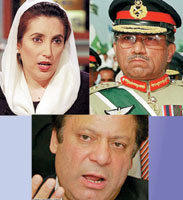
situationer By striking a compromise with Benazir Bhutto, Musharraf may get a temporary lease of life, but this power-sharing arrangement will be far from being stable and legitimate By Adnan Adil President Gen Pervez
Musharraf may be forced to shed his military uniform in the coming It is in fact hard to imagine a military takeover in an atmosphere when more than 100,000 Pakistani troops are committed to fighting militancy on the Afghan border and the apex court seems in no mood to legitimise extra-constitutional measures under the so-called 'doctrine of necessity'. Previous martial laws were imposed in circumstances when a large section of the political community was there to welcome the military rulers and a silent majority was willing to tolerate it. At this point in time, one can neither see political parties who would welcome a military takeover nor do the people seem in a mood to sit idle without putting up resistance. The recent lawyers movement on the issue of chief justice's removal and the electronic media's activist role are two pointers of the defiant public mood. In these circumstances, Gen Pervez Musharraf is now forced to conclude his bargain with the opposition leader Benazir Bhutto. The National Assembly's session scheduled for September 7 is likely to legalise the contract. Sources say that President Gen Pervez Musharraf's emissaries in London, Messers Tariq Aziz, Lt Gen (retd) Hamid Javed, Ishfaq Kiani et al, have worked out a constitutional amendment that could be passed with PPP's support in the parliament before the general and presidential elections. Obviously, the thrust is on removing legal hurdles in the way of Pervez Musharraf from becoming president for another term and for Benazir becoming prime minister for the third time. Sources say General Musharraf is willing to retire from the army provided he is re-elected as a civilian president. The proposed constitutional amendment is likely to lift the ban on a person to become prime minister for the third time, though the ruling party is reluctant to introduce this clause before the general elections. The fear is that this amendment is likely to create an impression that Bhutto is sure to become next premier -- thus raising her party's ranking in the general elections and causing mass defections from the ruling party's ranks. The other proposed amendment is to allow President Gen Musharraf to stand for presidential elections by giving him one-time waiver from the law that bars a government employee from contesting an election until after two years of retirement. The two sides are also working to reduce some powers given to the president under the 17th Amendment to dissolve elected assemblies and also to rework the composition of the controversial National Security Council. Gen Musharraf has been engaged with talks with Benazir Bhutto for long but was yielding very little to her. Bhutto has recently admitted in a television interview that she has been negotiating a compromise with the Musharraf regime for the last two years. As a result, the regime put the corruption cases against her in cold storage. In return, Benazir stayed away from joining forces with the country's regional and religious parties to form a wider opposition alliance and gave a cold shoulder to any suggestion of street protest against the Musharraf regime. Musharraf's recent haste in concluding the bargain could be attributed to the Supreme Court's assertive role since the judicial crisis. He is faced with the prospect that the judges may hold him ineligible to contest presidential elections -- with or without wearing the military uniform. The Supreme Court has already issued a couple of major decisions of political significance one after another, in defiance of the executive. The court reinstated its suspended chief justice dismissing the presidential reference against him, freed opposition leader Javed Hashmi on bail after his four years in jail on treason charges, and allowed Nawaz Sharif and his family to return home trashing the government's claims of an exile agreement. The court has taken up the petitions questioning President Musharraf's holding of dual offices and eligibility for contesting presidential elections and the constitutional amendments introduced by him under the 17th amendment. Emboldened by a favourable verdict by the apex court PML-N chief Nawaz Sharif also seems to be giving a tough time to the regime. By far, he has been firm on his position not to strike any bargain with Gen Musharraf and on his plan to return home in September. As he has stayed away from striking deals with the regime, he seems to have gained in popularity with recent polls results showing him to be the most popular leader in Pakistan followed by Benazir Bhutto and Gen Musharraf. Seeing the turn of the tide, the ruling party is facing desertions from its ranks with more than a dozen disgruntled members of the National Assembly lining up to join the PML's faction headed by exiled leader Nawaz Sharif. Following Minister of State for Information Technology Ishaq Khakwani's resignation from the federal cabinet, the ruling PML's Senior Vice President Lt Gen (retd) Abdul Majid Malik also expressed his reservation over the president's plan to contest for the next term while wearing his military uniform. Kabir Wasti, PML Vice President and outspoken critic of party high command and against the president's election in uniform, has been expelled from the party. Keeping in view the fact that Punjab's rural elite have traditionally been turncoats and fair weather friends, the ruling party's falling apart could not be ruled out. In the aftermath of Musharraf-Benazir deal and the return of the Sharif brothers, it would be hard to hold together the ruling Muslim League. The ruling Muslim League is the only card left in the hands of Gen Musharraf once he loses his powers to dissolve the assemblies and takes off his military uniform. And that is what he is striving for -- to save as much of the king's party as he could under the circumstances. No less worried are the members of Benazir Bhutto's People's Party who already face loss of popularity among the public. The prospects of PPP winning majority in the next general elections seem dim in the face of rising tide of popularity of defiant Nawaz Sharif, especially in central and north Punjab and other urban areas of the country. Nawaz Sharif's electoral alliance with Pakhtoons in the Frontier province and some statesmanship and flexibility in his dealing with the MQM in Sindh may turn the tables on Musharraf-Benazir plans of sharing power. Even if Musharraf-Benazir plan is successful, the duo is not likely to earn legitimacy in the eyes of public. A general election with Musharraf as president could neither gain across the board approval nor carry a stamp of being fair and free. The ruling coalition will have the huge advantage of the large intelligence apparatus comprising special branches, Federal Intelligence Bureau, ISI and MI, on their hands and billions of rupees at the disposal of local governments in districts and tehsils/taluqas to be spent directly or indirectly on the official electoral campaign. The Hunerkada Alumni exhibition depicted how the artists associated with this institution have paved their distinct forms of expression By Quddus Mirza 'Alumni: Plural of Alumnus, this stands for a former student or a pupil'. The Concise Oxford Dictionary Imagine an old man,
actually the old boy, who once was a student at a prestigious In such a situation, what to do? An immediate solution is to form a certain link with the institution and then propagate it. Doing so, the personality of the old boy will be projected, automatically. Mind you, all this is likely to happen when the old boy has not achieved much success in his chosen field. So in a way the association with his alma mater and link with fellow graduates provides a sense of identity -- connecting him with the present setup in his old institution. And this may well work for an ordinary old boy. But for an art school graduate, it is irrelevant to say the least. Because if an individual is trained as an artist, designer or architect, he does not depend on a link with his alma mater. It is not the past which attracts him; it is the present -- rather the future -- that presents a challenge to him. Each day his profession demands new solutions. For this he can not rely on specific group camaraderie because art, being a universal language, is shared by many individuals across continents; hence the entire world of art becomes a community. In fact when a person
chooses art as his career or way of life, he faces an enormous In some cases the fondness for alumni associations is a means to grab their share of fame and recognition through their relationship with their fellows and alma mater. Therefore, it is observed that usually the not-so-successful individuals are involved in activities of such kind and drag their more successful and busy companions in. They also press on the importance of traditions of an institution (abstract, highly subjective and usually confusing notions) and hope that everyone who has graduated from an art institute must regard these traditions/conventions. But this is a tall order where art and artists are concerned. The artists often disappoint in such matters. So a serious artist never fully comprehends the need to form a group or follow a doctrine. Although, with the passage of time, a tradition or style emerges in the works of artists trained at an institution, that happens unconsciously. In some cases that style -- rather method -- functions as an obstacle for the personal development of an artist; because it provides easy and already tried out aesthetic solutions. This can be seen in the alumni exhibitions of some old institutions. Hunerkada is saved from such a burden of tradition. Since this art institute is not ancient, its alumni exhibition represents diversity in paintings, drawings, prints, miniatures, sculptures and installations. This trait becomes sharp when compared to other alumni shows that concentrate on just one medium -- mainly painting. In fact, exhibitions that display paintings only depict a peculiarity of our artists and educationists who use two different words 'painting' and 'art' as synonyms. The Hunerkada Alumni
exhibition 'A Journey Through Colours' (held between August 21-27 A number of artists approached the historic genre of painting in an unconventional manner. Examples could be seen in the paint applied on flex prints (by Mohammed Zubair) and paintings constructed in the form of open and closed books (by Sobia Butt). Likewise, the traditional form of miniature was treated in a different manner in the work of Hadia Moez who used metal foil. This could be read as a response to the popular culture, and at the same time a continuation of tradition of putting silver paint on some portions. As expected, the alumni exhibition of Hunerkada offered a variety of technique and medium but the diversity was visible in visual solutions. Some works on display appeared more resolved and innovative while a number of other pieces lacked finesse -- both in terms of form and content. However, this is not unusual for the alumni exhibition of any institution. The saints and their places of burial have, over centuries, given a certain sanctity to the performing arts By Sarwat Ali The urs of Bulleh Shah was
observed last week while Shahbaaz Qalander's begins today. Though the shrines of the sufia have become repositories of art and cultural activity it can be argued that all these sufia were great figures in history. It has been a while that a person commanding the same respect and awe for his courage and creativity has been around. It may seem that these figures were a product of certain historical forces and, with the sands of time shifting, the appearance of such personalities too has become a rarity. It can be said that these figures and their places of burial gave certain sanctity to the performing arts. Their kalam or kalam of other saints was sung and dances inducing a trance like condition were performed in a state of ecstasy. The synthesis arrived at during the eight hundred year of Muslim rule in India reverberates in the cultural activity weaved round the shrine waiting for the next figure of great import to emerge. The kalam of Shahbaaz Qalander is sung in the length and breadth of Sindh and Balochistan as he seems to be one of the favourites with the musicians. He was one of the early sufi saints to have found their station in South Asia. He came from Central Asia in the early centuries of the Muslim rule in the subcontinent and can be said to be a senior or junior contemporary of the early saints Data Ganj Buksh, Mueenuddin Chishti, Bahauddin Zakria and Boo Ali Qalandar. The beginning of the second millennium must have been a great time to be living in this part of the world as the influences from Central Asia and Persia were being creatively assimilated in the evolving synthesis of North Indian culture. Since such times are extremely fertile for the generation of new ideas, artistic movements and forms, the fact that he was a Qalandar must have been reflective of the boldness and innovation which expanded and stretched the definitions traditionally associated with religious practices. Boo Ali Qalandar too was stretching the definitions in Panipat in the same era and was accused by the more orthodox sections of the ulema of heretical practices. What exactly do we know about Shahbaz Qalandar? He was a Jelali Fakir and according to Richard Burton Jelali Fakirs were generally poor who lived from hand to mouth. The Jemali sufis in Sindh were a more respectable class than their Jelali brethren. The latter openly dispensed with the formalities of religious worship, the former did not except when inward sanctity was felt, known and acknowledged to be superior to the outward form. His real name was Usman Marwandi, and was a great grammarian, philologist, traveller and saint. He died in Sehwan in 1274. As a Qalandar he was a rigid celibate and left no children. His modern disciples are initiated by his khalifah, (successors) and mujawar, (who attended the holy sepulchre). According to Athar Abbas Rizvi the establishment of the sufic khanqah synchronised with the penetration of the Qalandria movement. They were divided into several branches as the Hydaris and the Jawalqis. Their reputation to perform miraculous deeds had filled both the Suharwardia and the Chishtiyya khanqah with consternation .They were deeply devoted to music and loved to sing the songs eulogizing Ali and Ahle Bait. It was, however, the khanqah of Shahbaz Qalandar in Sehwan which until this day has been radiating the love of Ali and Ahle Bait through Persian and Sindhi songs. He has also left behind a number of works which formed part of the academic courses like 'Mizan e Sarf', 'Ajnas' or 'Munshaib', rules for the formation of the increased derivatives, and the 'Kisim i Doyyum' for the irregular verbs. These works by Lal Shahbaz were written in Persian while 'Akds' another of his work written in mixed Arabic and Persian deals with the permutation of letters. Usually it is assumed that the famous poets whose kalam is widely sung were the first composers and probably the first singers of their own poetry but there is a greater likelihood of this assumption not being fully true. Bulleh Shah was one of the most popular poets of Punjabi and his popularity has been ensured by gawaiyaas, qawwals and roving minstrels who building upon the tradition of oral transmission have sung his kalam to a population that far exceeds the numbers that live within the physical boundaries of his native province. In our society poets have been more respectable figures while the gawaiyaas unless associated with the courts were often taken for granted. It was a common practice in feudal society that musicians were usually affiliated with the famous personages like royalty, saints or poets, especially if the latter owed allegiance to a particular order or a shrine. One such person whose name is taken with a degree of certainty as a figure in history was Bhai Mardana, a rabab player. He was associated with Guru Nanak and is credited with composing his kalam. The reason for the survival of his name could be that his descendants calling themselves rababis became the custodians of that music and helped in establishing it as an institutionalised part of Sikh religious practices. The numerous other musicians who composed and sang the kalam of poets were not as fortunate as Bhai Mardana and have been lost to history. Kaafi is also a musical mode. The prevalent classification defines it as a thaat as well as a raag. There could have been some relationship between the raag kaafi and the poetic genre of kaafi but no one has been able to establish the exact relationship of the two. It is again difficult to say to who the kaafi singers were, because popular music and the names of musicians practicing these forms have hardly been documented. Kaafi can be sung in any raag. Other than raag, kaafi the other commonly employed modal structures have been Sindhi bhairween, aimen, desh, bhairween, and talang. In raags not usually engaged in kaafi compositions some memorable kaafis too have been sung like madhvanti and ahir bharoon. In the text of Shah Hussain compiled by Mohan Singh Diwana from a Sindhi edition, raags have been mentioned with some kaafis probably as an indication that the kaafi were sung in that particular raag. Those raags mentioned are:asawari, paraj, sindhara, gori, gojri, sorath, jaijaiwanti, wadhans, dhanasari, bhairween, majh, dhola, tikhaari, basant, kalyaan, sri, soohi, ghandhaari, ramkali, devgandhari, kangrahmaaro and talang. Now in an age that is far more eclectic no ang or raag is considered critical in the singing of kaafi. Even to be in sur is not thought to be crucial if Janoon's number "ki janan main kaun" is taken as an example. Perhaps we all wait for the next great synthesis before another great man arrives and gives a new configuration to the disparate forces. Till such time let us sing to the tune of Ghoonghat ohle na luk sajna Main mushtaq deedar di aan
|
|
 months. The imposition of another martial law and the suspension of the
constitution seem rather less likely options. Some government officials, such
as federal minister Sheikh Rashid, have been hinting at such eventualities
though -- apparently to scare the PPP and affect its bargaining position.
months. The imposition of another martial law and the suspension of the
constitution seem rather less likely options. Some government officials, such
as federal minister Sheikh Rashid, have been hinting at such eventualities
though -- apparently to scare the PPP and affect its bargaining position.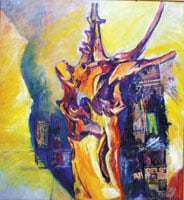 institution and then served there as a tutor. Now for years he has had
nothing to do with that institution. Like an exemplary old boy, whenever he
goes back to his school or college, he feels so out of place. He who once was
an essential part of the institution feels utterly useless.
institution and then served there as a tutor. Now for years he has had
nothing to do with that institution. Like an exemplary old boy, whenever he
goes back to his school or college, he feels so out of place. He who once was
an essential part of the institution feels utterly useless.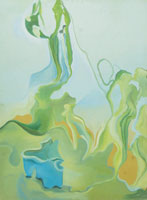 world with all its possibilities. Here, the training in an art school of
course helps, but it's not the key to success. Mainly because a large number
of students receive similar education from the same group of teachers. Not
all of them succeed in their fields though. Only a few do, depending on their
own struggle, capacity, skill and intelligence. The frustrated majority
blames it on hard luck, the tutors and nepotism in general. However, they do
not hesitate mentioning the names of their celebrated class fellows here and
there. The desire to form alumni associations is perhaps a way of
consolidating that connection.
world with all its possibilities. Here, the training in an art school of
course helps, but it's not the key to success. Mainly because a large number
of students receive similar education from the same group of teachers. Not
all of them succeed in their fields though. Only a few do, depending on their
own struggle, capacity, skill and intelligence. The frustrated majority
blames it on hard luck, the tutors and nepotism in general. However, they do
not hesitate mentioning the names of their celebrated class fellows here and
there. The desire to form alumni associations is perhaps a way of
consolidating that connection.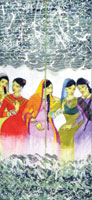 at Alhamra Art Gallery) comprised sculptures, mixed media works, photography,
paintings, prints, miniature paintings and installations. Some of these works
from the two branches of Hunerkada in Lahore and Islamabad suggested how the
artists associated with this institution -- that has not yet evolved a strong
and stifling sense of history -- have paved their distinct forms of
expression. For instance the wall installation (made out of Styrofoam)
depicted a fresh approach towards art and ideas. Similarly the use of lines
to suggest movement in the works of Azam Jamal and Naveed Butt, illustrated
the vast possibility of a single element, along with its lyrical aspect.
at Alhamra Art Gallery) comprised sculptures, mixed media works, photography,
paintings, prints, miniature paintings and installations. Some of these works
from the two branches of Hunerkada in Lahore and Islamabad suggested how the
artists associated with this institution -- that has not yet evolved a strong
and stifling sense of history -- have paved their distinct forms of
expression. For instance the wall installation (made out of Styrofoam)
depicted a fresh approach towards art and ideas. Similarly the use of lines
to suggest movement in the works of Azam Jamal and Naveed Butt, illustrated
the vast possibility of a single element, along with its lyrical aspect. These two were the most outspoken and courageous sufia. Both shared
non-conformity and intolerance towards duplicity, rigidity and above all
hypocrisy. For them the adherence of one's belief in actual practice was more
important than mouthing loyalty. Both were poets, their shrines have become
centres of music following their death.
These two were the most outspoken and courageous sufia. Both shared
non-conformity and intolerance towards duplicity, rigidity and above all
hypocrisy. For them the adherence of one's belief in actual practice was more
important than mouthing loyalty. Both were poets, their shrines have become
centres of music following their death.