



|
|
|
|
 |
 |
   |
interview Zia
Mohyeddin column
interview By Altaf Hussain Asad At first glance, he appears
quite weak. It is unbelievable how he managed to talk for the Author of more than fifty books on criticism, poetry and other genres, Agha has lived life to the full. Cooped up in his room, he welcomes many a lover of literature who throng his house from dawn to dusk. Excerpts of the interview follow: The News on Sunday: When and how did you start writing? Wazir Agha: I was studying at Government College Lahore when I fell in love with Urdu nazm. It fascinated me a lot in those days. I read poetry of Meera Jee, N.M Rashid, Faiz, Majeed Amjad. I too started writing poetry. But I did not send these poems to any magazine. Later in 1944, I came across Maulana Salahuddin Ahmad who was the editor of famous magazine 'Adabi Duniya'. His encouragement proved to be very beneficial for me and I started writing poetry with more zeal. TNS: At that time what did you want to do in life? WA: I was inclined towards
literature. But my father wanted me to study Economics so I TNS: The topic of your PhD thesis was humour and satire in Urdu literature. What prompted you to write one? WA: To begin with, my doctoral thesis was among the very few that were done right after partition. There were two other people who were working for their PhD but only my thesis came out in a book form. Titled 'Urdu Adab Mein Tanzo Mizah', it became a bestseller when it was first published in 1958. Before this, Maulana Salahuddin Ahmad who had read my essays on humour in the magazines exhorted me to further explore the subject. He egged me on to write a thesis on humour and satire in Urdu literature. TNS: How true is the assertion that the genre of Inshaia (Essay) was first introduced by you in Urdu literature? WA: Yes there was absence of essayists in Urdu literature. The literal meaning of Inshaia is not essay; rather it means a light essay. It was Qayyum Nazar who told me there is no tradition of light essays in Urdu. He was of the view that I must try to write some light essays. I still remember that I was in my village when I wrote my first light essay. I was writing under sweltering heat so I penned an essay on the unbearable heat. That was the beginning for me. In 1961, my first book of essays saw the light of the day. It was well-received. Let me add that Abul Kalam Azad and Mumtaz Mufti did write a few pieces that carried the traits of light essay. But on the whole, there was not much essay writing in the past. TNS: Are you satisfied with what has been produced in the field of Urdu criticism? WA: There are two types of criticism -- theoretical and practical. As for the earlier, we have not done any worthwhile work because of the strong Western influence that impeded any innovation on our part. As far as practical criticism goes, we have done substantial work. We must try to do work on both the categories. TNS: Criticism is not an easy field. Why did you tread this difficult path? WA: I was by nature very inquisitive. I had a habit to look into background of the things. I wrote critical essays in order to know what lies beneath the things. I wanted to explore the background of Urdu poetry. In order to do that I researched a lot and this was how my book 'Urdu Shairi Ka Mizaj' was produced. I tried to understand poetry by taking into consideration the cultural background. I discussed dualism and endeavoured to tell how one civilization gets influenced by another civilization. So criticism came naturally to me. TNS: Can the influx of movements like Progressive movement, New Poetry or Modernism serve any cause of literature? WA: You know each movement has a 'core' -- it is either mythological, psychological etc. One must not be intimidated for they give impetus to new movements as well as broaden the horizon and vision. You need a synthetic mind. Concepts go on changing with changing times. For instance, Greeks gave preference to beauty over truth. In the era of Romanticism, Truth and Beauty came at par with each other. But in the current scientific era the demarcation between Physics and Metaphysics is dim. At times the vanguards lost their lives in order to seek new paths. But they serve a great cause for the coming generations. We must not close our minds. TNS: You have tried your hands in various genres. Which one do you prefer? WA: I wrote poetry, criticism and essays. These genres demonstrate various dimensions of your creativity. You try to express yourselves in different ways so all the genres are very close to my heart. Nazm is very dear to me, it gives me aesthetic pleasure. TNS: Your fame as a critic has eclipsed all your other literary ventures. Why did you think this happened? WA: The criticism I wrote became quite controversial. For example, my book 'Urdu Shairi Ka Mizaj' is controversial to this day. I have written Urdu as well as Punjabi poetry and books on other topics. But more importance was attached to my critical works. Frankly speaking, I am not afraid of the strong opposition of certain people. TNS: Why did you not try your hands at short stories? WA: I wrote essays instead of writing short stories. I believe essays do come very close to fiction. I wrote two stories which were published in magazines. But after that I did not write any short story. TNS: What are the attributes of a true critic? WA: He should not be biased. He must persistently try to seek truth in all the things. He must strongly believe that each thing carries an element of truth which he is supposed to explore. He must be a thoroughly well-read person. TNS: Our great poets like Iqbal, Faiz, Rashid neglected Punjabi language as they did not use it as a medium to express their feelings. WA: They were all urban poets. Though they did try to write in Punjabi, they were not good attempts. You need to have strong roots in rural culture in order to write in that language. TNS: How do you assess the great triangle of Iqbal, Faiz and Rashid? WA: No one can emulate Iqbal. Faiz wrote good verse in Naqsh-e-Faryadi but later he became static. His creativity froze as he became poet of a single track. But you can not reject him. In my opinion, Rashid and Majeed Amjad are more important. They do show diversity in their subjects. Sadly Majeed Amjad died unsung. But now people are re-exploring his works. TNS: How vital is reading for a poet? WA: If a poet reads a lot, his creativity will add up. Otherwise he will start repeating old themes. TNS: But don't you think that vast reading of a poet renders his poetry abstruse for the common folks? WA: You need to train people. For example, one can not understand the intricacies of classical music without its thorough knowledge. Teachers can play a role in this regard by training their pupils. TNS: Do you think criticism caters to limited people because of the way it is written? WA: One can write good critical work by using common language. It is for all the people. Critics must not make it out of bounds for commoners. When I write criticism, I become its reader too. I write it to teach myself. So I become its writer as well as its reader at a same time. TNS: How many hours do you read these days? WA: I receive a lot of books and magazines. I can not read a lot due to advancing age. I now read in installments.
Zia
Mohyeddin column Words acquire new meanings in every decade. The computer has been largely responsible for this. Who would have thought that application would mean anything other than applying yourself closely to a task or making a request? But it does. A computerist would tell you that application is a piece of software, whatever software means. It is obvious that I don't know the first thing about computers. If I did, I would have known that the noun source has become a verb meaning "to go out" just as the verb access now means "to go in". I learnt all this from our assistant librarian. So nowadays instead of saying "I think I'll go into the loft and bring out the old family album", you say, "I think I'll access the loft and source the album." Culture once meant refinement of mind and tastes. Not so. Now we talk of the culture of 'hoolyganism' or the culture of 'laddism'. Often, you would hear remarks like, "Our police is governed by the culture of corruption". Culture used to refer to acquired wisdom, but now it means the opposite. The word philosophy too, has assumed a different context. The other day I heard an Australian commentator say that "Pointing's philosophy is to win every Test match". Philosophy now means a strategy. It's not old words that have changed their complexion. If you really want to add new words to your vocabulary you must listen to the Foodies. (Foodie is the current term for someone who claims to be a connoisseur of food). It is only from him that you hear words like cuisine minceur, creme brulee, duck confit, celeriac slices, aioli and mange-tout. Other than mange-tout, a variety of pea, of which the pods are eaten, I cannot tell you much about brulee or confit or celeriac slices. As for cuisine minceur, if it means what I think it means, you can keep it to yourself. My idea of dinner is not to have a tastefully fanned trilogy of mange-tout sheltering a fragment of perch. When talking of a cheese sandwich, a foodie will tell you that you must have foil-wrapping slices of fresh ciabata, that you must lace each slice with drizzled aioli and oven-bake it before sprinkling fresh goat's cheese to crumble on top -- and a dash of radicchio. (Pray note then he chooses to say aioli instead of mayonnaise with garlic) A mouth-watering description, I grant you, but when you taste the sandwich you find that the entire ensemble merely brings out a slightly rancid flavour. I like duck. I have had the rare pleasure of eating a real Peking Duck in Peking. The master chef, an eighty-year old, wizened Chinese, who had been around in the Imperial era, entered the dining hall holding aloft a platter on which rested a steaming, tawny, golden brown duck. The entire dining hall broke into a spontaneous applause. He put down the platter, bowed and existed, leaving his expert minions to carve and serve. There were several condiments, all excellent, but the one I remember most was a pale yellow mustard-based sauce with a touch of honey: it was simply exquisite. It is difficult to describe the taste. Can perfection ever be described? The foodies are forever flashing their spatulas and drooling over their copper-bottomed skillets; they argue about their Agas and worry about which drink brings out the true piquancy of their risottos and roulades. They will tell you that before you peel a potato you should first sniff it, then wash it down with some blood-temperature hock to establish its pedigree as a Pomeranian pink. No matter how hard I try, my potatoes never turn Pomeranian pink simply because I have never been to Pomerania. The colour they sometimes assume, after having been rinsed thoroughly, is the Jaipur pink which is not my idea of pink. Foodies are more concerned with describing food than eating. I'm not sure they like eating any more than the growing number of Bang and Olufsen owners like music. In my experience those who spend an awful amount of money buying the most sophisticated sound equipment enjoy only talking about the dynamic range of frequencies that each one of their speakers exudes. They wax eloquent about their concealed amplifiers that have been designed to coalesce strings with brass, but when, at last, they put on a Churasia playing raga Jaiat Kalyan with divine inspiration, their sole concern is whether the decibles reach the percentage specified in their manuals. America is a paradise of junk food. It's a country which has given the world cheese in a spray can. Not only that: they have made sure that its colour, when it comes out, is a shade of yellow unknown to nature. Food enthusiasts in America are less pretentious, largely because aside from producing steaks the size of a leather slipper the rest of their cooking is an imitation of French Italian, Spanish or Hungarian cuisine. The truly native American fare, the hamburger or the hot-dog, is not something you can talk about with any real enthusiasm. The rich, unrivalled possibilities of greasiness and goo that the American diet offers defies description. On the odd occasion when I tried to bite into a fully garnished hamburger, the liquid inside the two buns squirted and plopped into my shirt front in such gross quantities that I had to rise very very carefully from the table to move over to the 'gents' to clean myself up. The food section in a Houston supermarket that I visited was large enough to accommodate a jumbo jet. True, there was an aisle where the finicky buyers could pick their broccoli, squeeze their melons to test their firmness and wonder whether they can afford more than just half a pound of shiitake mushrooms, but the rest of the store was full of cookie crisps, artificial bacon and a million other varieties of nuts and pizzas. The breakfast cereals alone can occupy you for a whole morning. A supermarket in England stocks several kinds of corn and bran flakes, Swiss muesli and some chocolate-based cereals like coco-pops, but in an American supermarket you will find every possible substance that could be dried, puffed and coated with sugar. There are names like Peanut Butter Crunch, Cinnamon Mini Bun, Monster Marshmallows and a brand called Cookie Blast Oatmeal. All of them pretend to be nutritious breakfast, but are really chocolate ringlets and biscuits (called cookies). But there is one product, a butter substitute, that I fell for. It comes in a small plastic container shaped like an ice-cream tub and it is called. 'I can't believe It's Not Butter', it certainly tastes better than butter and I wonder if it is possible for anyone to eat it and not believe it is not butter.
|
|
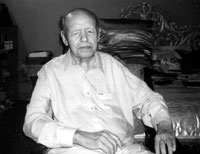 next one hour. Such is the importance that Dr Wazir Agha attaches to
literature. At 85, Agha discusses literature, criticism as well as other
issues concerning our literary world with the agility of a young man. A man
of many talents, Dr Wazir Agha has enriched every genre he chose to dabble
in. An astoundingly well-read person, he is a critic, poet and also an
essayist. But criticism remains his forte.
next one hour. Such is the importance that Dr Wazir Agha attaches to
literature. At 85, Agha discusses literature, criticism as well as other
issues concerning our literary world with the agility of a young man. A man
of many talents, Dr Wazir Agha has enriched every genre he chose to dabble
in. An astoundingly well-read person, he is a critic, poet and also an
essayist. But criticism remains his forte.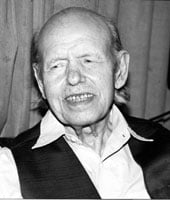 obtained a masters degree in Economics. I was also interested in History,
Psychology, and Philosophy. I had no concrete plans for my future. I only
wanted to unravel the secrets of life as I used to read a lot on cosmology.
obtained a masters degree in Economics. I was also interested in History,
Psychology, and Philosophy. I had no concrete plans for my future. I only
wanted to unravel the secrets of life as I used to read a lot on cosmology.