



|
|
|
|
|
 |
 |
   |
issue If Saadia and Ruqaiya
had been born in well-to-do families, they would have now decided for
themselves that they would pursue careers in the fine arts. Now, in their
pre-teen years, they would already have been dreaming of one day joining the
National College of Arts or the Fine Arts Department of the Punjab
University. Both of them are artists of exceptional talent. Faster than most
people draw a squiggly line, these two sisters can draw your caricature or an
idyllic mountain scene complete with animals and birds. MOOD
STREET As recently as two years ago, I was a student in the United States. Today, I have returned to being a student in Pakistan. The contrasts between these two different paradigms of higher education continue to occupy my thoughts. Town
Talk campaign Photos by
Rahat Dar
The
banners displayed by the Parks and Horticulture Authority (PHA) saying,
"Just make a call and our official will plant tree saplings at your
place", could not motivate Lahoris as most of them have no space to
plant trees.
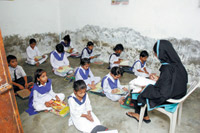
A school opened in Kot Lakhpat by a student is transforming lives of the people of the area. Children here do not want vacations By Salman Rashid If Saadia and Ruqaiya
had been born in well-to-do families, they would have now decided for
themselves that they would pursue careers in the fine arts. Now, in their
pre-teen years, they would already have been dreaming of one day joining the
National College of Arts or the Fine Arts Department of the Punjab University.
Both of them are artists of exceptional talent. Faster than most people draw a
squiggly line, these two sisters can draw your caricature or an idyllic
mountain scene complete with animals and birds. But they do not dream of
ever going to NCA or the University. They do not because of the abject If one were to think the
sisters gifted, their older sibling shows even more promise. Accompanying her
mother on her daily jaunt to the rich homes, Rabia had the good fortune of
catching the attention of a kind-hearted employer. Noticing the girl's quick
mind, the mistress brought her books and began coaching her. Over time this
bright spark completed high school and eventually became a college graduate.
All this as a private student. While Rabia was toiling
to complete her graduation, unbeknownst to her, another young woman, Farah
Deeba (not a resident of Kot Lakhpat), was also in a similar situation. Ardent
and bursting with the desire to change the world, as part of her graduate
programme Farah Deeba undertook a survey of various localities of Lahore. In
Kot Lakhpat she found a world whose existence she had vaguely been aware of.
This was a world of drug addicted fathers; mothers caught in the grind of
double jobs and neglected children who aimlessly roamed the streets. Interviewing the
children, Farah Deeba learned that most of them wanted to be in school; only
poverty kept them out. The idealist in her resolved to get a school going for
these poverty-ridden children. Though some of her friends were willing to work
as teachers without pay, none of them being residents of Kot Lakhpat
eventually wanted to work in that out of the way locality. It was survey time
once again until Farah Deeba had located five educated young people (four
girls and a boy), residents of Kot Lakhpat, who were willing to be teachers
for a virtual pittance. Rabia, who had done her graduation the hard way, was
one among them. Imtiaz Welfare School
System took off in September 2005 in a narrow alley of the fancifully named
Quaid e Millat Colony of Kot Lakhpat. Cheek by jowl with a cattle pen and its
unbearable stink, it is not the best of situations. But for children who had
little better to do than to roam the filthy streets, beg for food and get into
squabbles, this was the best thing to happen. This was to be a school for the
poorest of the poor. Here the pupils were not required to pay any fees. Their
books and stationery were paid for in full and their uniforms subsidised. Most of the one hundred
and forty odd children that attend Farah Deeba's school today had no
educational background when they joined up; a few came with two or three
grades of education. If it is anything, it is indicative of the children's
thirst for the written word that many of them have raced through three grades
in a matter of two years. Ask a child from an affluent family who attends a
good school and takes education as a matter of course if he or she would like
to forego summer vacations and there will be a howl of protest. The poor children of
Imtiaz Welfare School, on the other hand, were frantic when last year (end of
the first school year) summer vacations were announced. For them the Sunday
holiday was too much, leave alone a full two months without school. Not one of
them was in favour of the long break. And when school reopened there wasn't a
child who turned up with incomplete homework. Saadia and Ruqaiya may
well be gifted children, but they are not exceptions at the school. The entire
bunch of pupils who sit on the hard floor show an uncanny hankering for
learning; every one of them is phenomenal for their age and grade. Where
children of well-off families take school as a matter of course, these
children of drug addict fathers and toiling mothers know that if their school
closes down for a lack of funds, they will be back on the street again. That
is the last thing they want to happen. If this institution be
called anything, it should be named Miracle School for it has survived two
academic years without any assistance from any quarter whatever. The roughly
twenty-five thousand rupees outlay needed every month to pay for rent,
conservancies and teachers' salaries is raised single-handedly by Farah Deeba.
These funds all come from donations from her own purse as well as from friends
and family. For Farah Deeba who
daily sees the ardour of her young pupils and their thirst for education, it
is easy to part with whatever little she can manage from her pocket money.
(She is a law student and without an income of her own). But for those who
only have her word on the progress of the school to go by, perseverance is
beginning to run thin. All her efforts to interest well-heeled business people
in supporting her endeavour have failed and it is easy to see her becoming
cynical about the so-called piety of our public figures. That's one side of the
picture. On the other hand, her five teachers, all from poor families of Kot
Lakhpat, stand firmly by her. They tell her to hold her ground and the school
will weather whatever hardships come its way. As for the pupils who, whenever
the going is good, are treated with visits to the fort or the zoo, the rough
patch is perfectly acceptable. They reassure Farah Deeba that they understand
her constraints. All they want is the school to run forever, for this is their
only chance to become literate and perhaps one day move on to a better life. It is a daunting and
uphill task. But if one were to go by the passion and commitment that one sees
so clearly in Farah Deeba, it is easy to believe that she will pull it
through. If she can make this one school in the narrow alley of Kot Lakhpat
succeed, she wants to one day have similar schools in all poor localities
across the city of Lahore. Donations for Imtiaz
Welfare School System can be sent to Account Number 010-3930-0 in favour of
Farah Deeba, United Bank Limited, Bank Square, Model Town, Lahore. MOOD STREET Worlds apart By Jazib Zahir As
recently as two years ago, I was a student in the United States. Today, I
have returned to being a student in Pakistan. The contrasts between these two
different paradigms of higher education continue to occupy my thoughts. True to
its capitalistic ideals, America spoils its consumers with choice.
Prospective applicants visit all institutions of their interest a year in
advance. They proceed to evaluate each option over a spectrum of parameters:
academics, extracurricular opportunities and social life. This allows
everyone to find his own comfortable niche. It is not uncommon for students
to reject a golden ticket to the hallowed Ivy League in favour of a school
that they deem 'a better fit'. I find that this results in students who forge
an umbilical cord with their alma mater. And it means that even a lowly
ranked public school can produce a CEO. But when
I ask anyone in Pakistan why he picked a certain institution, he shrugs and
mumbles something about 'the standard of education'. The most avid can
regurgitate statistics on average One of
my current professors spotted me penning this article in between classes. He
cautioned me that such activities were likely to detract from my academic
performance and should be avoided. I do not doubt the sincerity of his
intentions. But this makes me think about the 'work hard, play hard' ethic of
the States where professors will encourage you to pursue your interests on
the basketball court or in the dramatics club by granting extensions on your
assignments. It is little wonder then that they are a nation that learns to
balance family, career, hobbies and social work. I find
our obsession of competing for rankings a little disconcerting. Peer teaching
is not intrinsic to our culture. We only seem to collaborate when the action
is sanctioned by our professor. In the United States, the administration
provides the brightest students cash incentives to conduct their own office
hours. Weak students get help from people they are comfortable with and
strong students are already gearing up to become the professors of tomorrow. Since
the American college system encouraged me to explore academic disciplines, I
was able to kindle an interest in biology, a subject I had not pursued since
seventh grade. I blended it with my study of engineering to apply technical
skills to improving the delivery of medicine. This experience gave me the
confidence that I could tackle interdisciplinary problems. But I find our
local system is more inclined towards pigeonholing students into rigid
disciplines. I don't
believe that everything about the American system is better. I accept that
admissions to colleges in Pakistan are, for the most part, transparent. The
American process is more subjective and means that students can be rejected
for as fickle reasons as not dressing to the satisfaction of their
interviewer or not contributing enough 'diversity' to the school. And some
may not reap the benefits of the freedom of academic inquiry. I recently
heard from one of my American classmates who majored in Creative Writing but
found she really didn't have the motivation to become a professional writer.
Having blown a few years on mundane jobs, she now uses her savings to travel
around Europe with no long-term plan on the horizon. How
would I change things if I could? I would certainly want my compatriots to
have the opportunity to exercise more independence in their education. At the
same time, I might suggest that administrators and parents of the West add a
little more structure and control to their own setup since it really is a
shame for the talented students who are not able to thrive in their system.
•
Classical music concert on
Wednesday, Sep 5 at Alhamra, Gaddafi Stadium.
•
Asian Students Fair 2007 on
September 4-5 from 10am to 6pm at Avari Hotel.
•
Jazz Night at Peeru's Cafe --
a fusion of Jazz and tabla on Sundays at 9pm for free. •
A concert of unheard melodies at
Government College University Lahore every Saturday at 01:30 PM •
Puppet Show for Children at Alhamra, The
Mall at 11a.m. •
Horse Race Shah Jamal - Shalimar Bagh at Shah Jamal every
Thursday 09:00 PM •
Puppet Shows for everyone at Peerus Cafe Every
Sunday03:00 PM campaign Issue of books Around 11000 books, including some precious manuscripts, are missing from Punjab Public Library. Record shows them as borrowed by some eminent people of the city By Naila Inayat Photos by
Rahat Dar "These
people have been the source of a huge loss to this library," says
Azizuddin Ahmad, Vice-President Executive Committee, Punjab Public Library. Who are
these 'people' and what damage have they done to the 123-year-old most
resourceful library of yesteryear? A recent
in-house six-month study conducted by the library concluded that since 1947
as many as Still
reluctant to name the bigwigs, he states categorically: "Our study
unveils the 'who's who' of our society." The executive committee has
decided to initially make an appeal to all the defaulters to return these
traditional pieces that belong to the people by writing letters to the
members or, in case they are dead, to their heirs. Once this attempt to get
back the books fails, they might come out in the open with names and all and
launch a campaign. The
majority of the missing books were old manuscripts from late 18th or early
19th century. Now the membership has come down drastically in numbers due to
the non-availability of books on history, religion, literature, politics,
science and humanities. The library comprises five sections -- Oriental,
English, Baitul Quran, Record section and the E-library. Starting
with a mere 75 books donated by Punjab Lieutenant Governor Lord Aitchison in
1884, the library now contains more than three lakh five thousand books and
manuscripts. They include 118691 English and more than 1,10,000 manuscripts
in Urdu, Persian, Arabic, Punjabi and many other regional languages. The
library presently has 31,12,06 members with 2064 life, 40811 general, 547
student and 1705 children members. At an average 290 people make use of the
library daily. The loss of some important books in the past is making things
difficult for the management. "We
do not have sufficient funds to meet our requirements," says Azizuddin.
Every year the government grants Rs1,44,76,000 of which Rs9 million is spent
on administrative expenditure and the rest is used for buying books.
"The book worth Rs5 in the 1950s now costs Rs400. Books have enhanced
the expenses of people as well as ours," claims Azizuddin. Purchasing
new books has become difficult for the library administration in the existing
scenario.
Sana, a
student of Mass Communication who used the library for research some time
ago, thinks the content in Punjab Public Library is unique in that it has
newspapers in the record room from Hicky's Gazette to the present newspapers.
The
concept of a lending library along with the trend of book reading are on the
wane. In such a situation the administration of this library is hard pushed
to ensure the safety and preservation of books. Have they ever thought of
turning into a non-lending library on the pattern of Quaid-e-Azam Library?
Azizuddin says: "We do not want to discontinue the process of lending,
as it will directly affect the students and researchers who benefit the most
from this library." He further said that the administration wants to
create a reader-friendly environment so that the reader enjoys his time spent
at the library. Computerising the entire unit is also on the cards so that it
becomes easy to find books. Other
than that keeping the shelves open for the readers is also a priority with
the management so that it is no hassle for a reader. The executive committee
is also planning to install a 'RF: Electronic Article Surveillance System' --
tags placed in books which when removed raise an alarm -- to avoid incidents
such as stealing or tearing pages of the books. This system has been
successful in Government College and National College of Arts. In its annual
report of 2006 the committee also recommends the installation of CCTVs to
avoid book thefts.
The
banners displayed by the Parks and Horticulture Authority (PHA) saying,
"Just make a call and our official will plant tree saplings at your
place", could not motivate Lahoris as most of them have no space to
plant trees. Ill-planned
construction in a haphazard manner in the city is causing damage to greenery
and vegetation considered to be a major source of oxygen. The slogan
inscribed on the banners are very impressive like 'Ek rukh sau sukh', 'Drakht
lagey to saya, cut jai to sarmaya'. The
PHA's tree plantation drive launched this monsoon invites active
participation of citizens including Trees
can be planted in new housing schemes established in various parts of the
city with proper planning but the same cannot be done in old and congested
localities due to ill-planning. There is no space for tree plantation in the
old areas of the city, so fresh air and pollution free atmosphere is but a
dream here. "How
can we benefit from tree plantation drive launched by the PHA as I live in a
3 marla house where there is no space for planting anything?" asks
52-year-old Maqbool Ahmed, a resident of Ramgarh. He says this locality is
congested with no green belt anywhere in sight. "We and those living in
localities like ours, cannot benefit from monsoon tree plantation
campaign," he says. Still, can anyone think of a means to clean the air
here. Are there any shrubs or plants which act as air cleaners and can be
grown in pots. Perhaps the PHA can look into it. People want to be educated,
only if the concerned authorities take the pain to do that. "I
took the initiative to get planted 40-50 tree saplings of various varieties
in my community centre, in Railway Officers Colony, Walton," says Rugae
Tauseef while talking to TNS. He says, "When I rang PHA a day earlier,
the officials asked me to visit the PHA office and inform what kind of trees
I want to plant. The very next day I went to PHA office and a gardener with
my selected saplings came along with me to community centre and planted
saplings of trees free of cost," he says. Expressing his satisfaction
with the PHA's monsoon tree plantation drive, he says this drive should be
launched every year in letter and spirit and people from all strata of life
should take part in that. The PHA should launch drive to plant flowers in
addition to tree plantation, which keep the mind fresh and active. If a man
can bring up his children he can look after plants as well, he argues. Muhammad
Javed Qamar, resident of Garhi Shahu tells TNS that he rang PHA to get plant
saplings of trees at his school, Iqra Jadeed Education School System, Garhi
Shahu and PHA officials promised to plant trees free of cost. "Two days
have passed, no PHA official has contacted me yet for plantation of trees in
my school." Director
Parks and Horticulture Authority (PHA), Misbah ul Hassan Dar while talking to
TNS said that monsoon tree plantation drive launched from August 9 was going
successfully under which 100,000 sapling of trees are being planted in the
city. "We have tried our best to ensure maximum participation of the
community in our monsoon tree plantation drive and for this purpose a large
number of students took part in the drive by planting saplings of
trees." The PHA
claims to have received about 400 to 500 telephone calls from various parts
of the city for tree plantation during the current monsoon drive ending on
September 8 and it says that quick responses were given on the call of
citizens. "We are planting saplings of various kinds of shady trees
including Estonia, Moba, Shisham, Neem, Marva, etc. in parks, green belts,
public and private buildings in the city," Dar informed. All out
measures are being taken to make the city green by planting maximum trees and
the credit for this effort goes to Director General PHA Rugae Muhammad Abbas
who is working day and night, said Dar. "We launch tree plantation
campaign every year but this year we started it vigorously and now it is the
responsibility of the citizens to look after the newly planted trees as the
department alone cannot do every job."
1.
Nawaz Sharif is coming back 2.
Nawaz Sharif is not coming back 3.
Lahore's mass transit system to start
soon 4.
Ring Road will be ready in six months 5.
Shahrukh is coming to Wagha 6.
Aitzaz Ahsan is joining PML-N 7.
Sucidie bombers in the city 8.
Musharraf-Bibi deal done 9.
Hundred PML-Q members join PML-N 10.Shahid
Afridi and Shoaib Akhtar joining Indian Cricket League To
enlist by popular vote the 'top ten' for next week, send in your emails on 'Next
week's question: Top ten excuses for leave'. Please
email at shehrtns@gmail.com |
|
 poverty
their family lives in. Residents of the one-room quarters for factory workers
in Kot Lakhpat, these sisters have been raised on the meagre income of their
mother who works as charwoman for the affluent households of nearby Model Town
while their father lives in the drowse of drug-induced vacuity.
poverty
their family lives in. Residents of the one-room quarters for factory workers
in Kot Lakhpat, these sisters have been raised on the meagre income of their
mother who works as charwoman for the affluent households of nearby Model Town
while their father lives in the drowse of drug-induced vacuity. 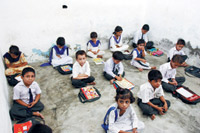 salaries bandied about by their admissions
office. My sense is that our colleges are just a stepping stone to a goal.
Those who are ambitious feel pressured to follow the road often travelled by.
salaries bandied about by their admissions
office. My sense is that our colleges are just a stepping stone to a goal.
Those who are ambitious feel pressured to follow the road often travelled by.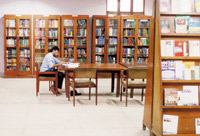 11,000 books and manuscripts -- 6,000 English and 5,000 Urdu --
are missing from the library. These three to four hundred year old historical
manuscripts of the Sikh and British period have either been deliberately
stolen or not returned to the library. "According to record these people
include eminent intellectuals, lawyers, poets, writers, bureaucrats,
journalists, scholars, politicians, researchers and civil servants,"
says Azizuddin.
11,000 books and manuscripts -- 6,000 English and 5,000 Urdu --
are missing from the library. These three to four hundred year old historical
manuscripts of the Sikh and British period have either been deliberately
stolen or not returned to the library. "According to record these people
include eminent intellectuals, lawyers, poets, writers, bureaucrats,
journalists, scholars, politicians, researchers and civil servants,"
says Azizuddin. 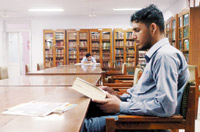 There is
a general rule whereby one quarter of the shelf is left empty to save the
books from fungus attacks. No new shelves had been built in the library due
to lack of funds and even if there are sufficient funds, there is no place to
keep the shelves in the library. This creates problems for the readers as
well as the librarians as it is difficult to find books.
There is
a general rule whereby one quarter of the shelf is left empty to save the
books from fungus attacks. No new shelves had been built in the library due
to lack of funds and even if there are sufficient funds, there is no place to
keep the shelves in the library. This creates problems for the readers as
well as the librarians as it is difficult to find books. 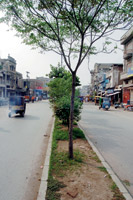 students of various schools and colleges.
Every year, PHA launches tree plantation drive in the city but measures are
not taken by the department to protect them while they are growing. A major
concern is that trees are being cut down either by the civic agencies of the
city district government or by the developers to construct buildings.
However, Parks and Horticulture Authority has now devised a strategy to shift
the trees to another place instead of cutting them down which is a
commendable step.
students of various schools and colleges.
Every year, PHA launches tree plantation drive in the city but measures are
not taken by the department to protect them while they are growing. A major
concern is that trees are being cut down either by the civic agencies of the
city district government or by the developers to construct buildings.
However, Parks and Horticulture Authority has now devised a strategy to shift
the trees to another place instead of cutting them down which is a
commendable step.