



|
|
|
|
 |
 |
   |
Gearing
for POLLS Expensive
business Outside
the fence Testing times
ahead Local campaign
Promises
to keep
Editorial The assumption of course is
that there is an election round the corner. For all those who Political parties, we thought, were the right place to begin. We began by asking some basic question. How seriously do the political parties take their manifestos and do they care to bring them before the voters? Once in the assemblies, do they follow or digress? In a political scenario that's personality driven, how interested are the parties in internalising democratic values? Do they hold elections, do they educate political workers, do they prepare polling agents, do they allow dissent? How are the parties funded and how transparent is the process?. Incidentally those who believe election and democracy as synonymous also believe in devolution of power as the ideal way to bring democracy close to the common man. Yet, come general election and we want to suspend these local governments to make the elections transparent and fair. We also seek an independent Election Commission and not a partisan one. No questions about more women in politics. So women come in huge numbers in the legislatures, albeit on reserved seats. The family connection still matters and they do not make much difference, except perhaps adding colour to the political landscape. Do the political parties realise the challenges? We did not want any more lessons in Political Science than we already know; therefore, we made an attempt to see the situation on ground, matching the reality against the ideals. We haven't found answers to most of these questions; the few that we did have not been to our satisfaction. But unlike those who equate democracy with election, we believe in democracy as a process. Elections are incidental to the process. All those gearing up for the election may or may not think the same way. Prevailing funding practices have contributed to anti-democratic elements, and space is increasingly shrinking for people with limited financial resources By Aoun Sahi It is an open secret that
certain influential individuals, industrialists, and groups fund The groups or influential people who fund different parties also get a lot of benefits in return. It is on record how a certain group progressed in Mian Nawaz Sharif's regime. After the dismissal of his government the owner of that group also left the country returning only after having struck a deal with the NAB. He would often confess, in his private sittings, that he had donated millions to both the PPP and the PML-N in order to protect his business interests. At present, Rehman Malik, ex DG FIA is the main sponsor of the PPP's political activities in London. It is mainly because of his money that he has become even more important than Makhdoom Amin Fahim in the party. Azam Khan Swati donated Rs 20 million to the JUI-F days before he got nominated as a senator from the same party last year. In the present political scenario, the way the interests of different influential groups such as sugar mill owners headed by politicians and financers of PPP, PML-Q and PML-N, cement mill owners, or certain people in stock exchange, are guarded clearly shows the importance of these influential groups in the power game. Even the prime minister of Pakistan is being blamed for getting monitary benefits from some influential group for watching their interests. There cannot be two opinions about the fact that money in politics is important. However, unnecessary secrecy involved in this regard in Pakistani politics casts a shadow of doubt on the chances of a free and fair polls. According to the Global Corruption Report 2004, published by Transparency International Pakistan, figures in a category of states where investment in political parties can yield desired policy outcomes sought by the investors in the game. The report places Pakistan in the category of the countries with 'medium political corruption', where the culture of irregular payments in government policy-making, policy consequences of political donations and the odd reality of illegal political donations do exist. An ex-MPA from Sialkot who lost the National Assembly election in 1997 tells TNS that during the polls he did not have to spend a penny from his pocket. "People from my family and some industrialist of Sialkot funded my entire election campaign. I find it really funny, but I actually ended up 'earning' a few thousand bucks even though I lost the elections." Requesting anonymity, the former MPA says that the politicians in the ruling party are obliged to guard the interests of those who invested their money in them. "It's a kind of a give-and-take relationship." He goes on to add that an influential political family from Hafizabad district is well known for never spending a penny out of their own pocket in elections. "It's a very common phenomenon now. All major politicians have their particular financers." The prevailing rules and regulations regarding the political party funding also support methods of secret funding by the influential groups. Article 6 of the Political Parties Ordinance 2002 (PPO2002) prohibits any contribution made, directly or indirectly, by any foreign government, multi-national or domestically incorporated public or private company, firm, trade or professional association. It allows only contributions and donations made by individuals. Presently, several opposition political parties in Pakistan rely on their leaders' wallet while the ruling parties as always hesitate to abuse development budget, secret funds and state administrated religious handouts like zakat and baitul maal funds to strengthen themselves. Some political parties are also known to resort to bhatta to raise their funds. A leader of the ruling political party reveals to TNS that gone are the days when groups used to fund parties to support their own interests. "Now they fund influential leaders or generals on an individual level in order to get the same results, which is why the political parties are now poor while their leaders are rich." This is also the reason why a party depends on its leaders to fulfill its needs, he adds. According to finance secretary ruling party Imtiaz Ahmed Ranjha, the larger chunks of the party funds come from oversees branches and enrollment of new members. "The expenditure on party meetings is paid by different individuals." PML-N Finance Secretary Pervaiz Malik denies that the industrialists or some specific groups fund the party. "All resources are collected by ourselves. Even now we have asked our parliamentarians for Rs 1 lac each, which they will have to submit with the party so that arrangements can be made for Mian Nawaz Sharif's welcome." The PPO 2002 also bound all political parties to submit their annual audited accounts by August 29 every year to the Election Commission of Pakistan (ECP). If the figures of annual income and expenditure submitted by the political parties to the ECP are to go by, then all parties are floating on a very fragile funding base, with three main parties -- PPP, PML-N and MQM -- being run from London. It is a very interesting fact that the ECP is supposed to accept whatever accounts are provided by different political parties. It does not question the credibility of audit of these accounts. During the year 2005-06, a total of 58 political parties submitted their accounts to the ECP. The sources of funds for most parties were their membership fees and donations from leaders. According to the official gazette of the ECP, during the same year, the Pakistan Peoples' Party (PPP) -- headed by Benazir Bhutto -- remains the party with the maximum funds. PPP started with an opening balance of Rs 95.29 million, and was able to raise funds worth Rs 13 million and spent Rs 4.16 million. Next in line is the Markazi Jamiat Ahl-e-Hadith Pakistan (MJAH) which had an opening balance of Rs 928,557, raised Rs 57.83 million, and spent Rs 48.29 million. Interestingly, MJAH is a member of the six religious parties' alliance, but its name does not figure in MMA's sponsors. Third in line is the ruling Pakistan Muslim League-Q which had an opening balance of Rs 6.65 million, raised Rs 16.14 million, and had annual expenses worth Rs 19.73 million. It is interesting to mention here that Chaudhry Shujaat Hussain is the single largest donator to PML-Q. Muttahida Qaumi Movement's income during that period was Rs 8.07 million and it spent Rs 8.09. Jama'at-i-Islami Pakistan's income during 2005-2006 was Rs 4.6 million and it spent Rs 4.2 million. Zafarullah Khan, Executive Director, Centre for Civic Education, says that politics has become an 'expensive' business today, and the frequency of scandals in politics is a norm everywhere in the world. "It is true that the PPO 2002 forbids the political parties to receive funding from corporate donors, unions, and foreign donors, but these groups have been actively providing funds to Pakistan's political parties." According to him, the leaders of parties, overseas Pakistanis and candidates' fees are major sources of funding to the political parties. He lamented the fact that the utilisation of funds is not transparent nor properly documented by the parties. "Figures provided to the ECP by the political parties contained in its report do not match with their actual spending." He also questions the funding mechanism of major political parties in which they claimed that their membership fees was an important source of funding. He advocates public funding for political parties in the country. According to him, the manifestos of three mainstream parties including the ruling PML state that appropriate legislation shall be introduced for funding of political parties by companies, societies, public bodies, or individuals. However, in 2004, when the PML-Q got the opportunity to amend the law, "the only amendment they introduced was that the party head could also become prime minister, which was meant to make Chaudhry Shujaat qualify for the slot."
Despite the substantial increase in the number of women seats, they continue to be treated as outsiders By Zeenia Shaukat Women and political parties have shared an uneasy alliance. Rather than being natural drivers of the political process, women's inclusion and exclusion and their overall position with regards to their parties itself has been seen to be a politicised issue. Whether they act as an electorate or seek a legislative position for themselves by associating with a political party, women have found themselves confronting obstacles as the system continues to be dominated by men whose influence on decision-making far exceeds their number. Throughout the country's legislative history, reserved seats has been observed to be a better way of ensuring women's participation in the political parties compared to a system where there is no provision for reserved seats (1990-1997 elections). The reserved seat requirement has been in place in all constitutions from 1956 onwards. The 1973 constitution made a provision for the reserved seats for two more general elections -- a term that expired with 1988 elections. General seats, however, has been a problematic area. In a research paper 'Women in Politics -- Problems of Participation: A Case Study of Pakistan,' Dr. Dushka H. Saiyid observes that before the 1970 elections, no woman contested on a general seat for the parliament. No woman was given the party tickets to contest polls in the 1970 elections where nine women fought independently and all lost. Of the 107 women that contested elections on the general seats from 1970-1997 elections, only 24 were able to succeed. General Musharraf restored the reserved seat system through amendments in constitution prior to the general elections 2002. These amendments -- that later became a part of the Legal Framework Order -- created 205 reserved seats for women in all the legislative assemblies. Today there are 232 women in all legislatures and this includes those contesting from general as well as reserved seats. The overall proportion of women's legislative representation has shot up to around 20 per cent from 1.4 per cent in 1997-1999, according to the United Nations report on Political and Legislative Participation of Women in Pakistan. While the system is becoming more open to the inclusion of women in the legislation, political parties do not seem to be following the trend. Higher offices of the political parties are dominated by men, who also manage to get tickets to contest elections with comfortable ease. Zafarullah Khan, Director Centre for Civic Education (CCE), says that the structure of the political parties explains why there are still fewer number of women in the parties. "Our political parties work on an application-based mechanism, which means that membership is given only to those who apply. Women will only be awarded membership and tickets if they apply, and their willingness to apply depends on economics, and cultural factors. Women in our society are not economically empowered. They largely depend on their fathers and husbands for finances. Politics is an expensive proposition with political parties charging substantial amount as membership and ticket fees, while the cost of campaigning itself is very high. There is no special concession for women and there is certainly a dearth of affirmative action on the part of the parties to include women." Apart from the application-based system, another reason that acts as a bar for women seeking a representative position in the legislative assemblies is their ability to pull voters. The party's ticket awarding system is usually non-discriminatory as far as women are concerned since tickets are awarded on the basis of the ability of the candidate to win the seat. In the 2002 elections, Hina Rabbani Khar, a young politician who contested elections for the first time, was able to win a comfortable majority from her father Ghulam Noor Rabbani Khar's constituency. Her success is attributed to the strong political position her father -- who could not contest because of the graduation bar -- enjoys in the area. Similarly, Syeda Abida Hussain has never had difficulty acquiring the ticket to contest the elections from her constituency in Jhang as, because of her strong roots in the area, she is more likely to win than any other candidate. Though almost every political party has a women's wing which, on paper, is aimed at the inclusion of women in the system, it largely acts to marginalise women. A report by the International Crisis Group on 'Authoritarianism and Political Party Reforms in Pakistan' points out the failure of the political parties in empowering women at all levels of their organisation. It observes that "most parties have isolated women's activities from the party's mainstream, alienating a potentially powerful constituency." Women's representation in the top leadership cadre of the political parties remains a weak point, too. A 2006 study by CCE on women's representation in the highest decision-making body of the party observes their meek presence at the top positions. Women make up 16 per cent of the leadership in the Central Cabinet of the PML-Q. This is followed by 12 per cent in the MQM's Central Coordination Committee. The PPP has 7.69 per cent share of women in its Central Executive Committee while the PML-N gives a 3.4 per cent representation to women in their Central Cabinet. Male attitudes have also been a stumbling block for women. A patriarchal mindset continues to dominate the party policy-making process, and the decisions made by this mindset are no good news for women. Women legislators, despite backing Karo Kari and the Women's Protection Bills in the parliament in their personal capacity, showed hesitation in supporting the bills when they were moved in the parliament -- toeing their parties' lines. Another blatant demonstration of feudalistic mindset was witnessed when Federal Tourism Minister Nilofer Bakhtiar, who was also the head of the women's wing of her party the PML-Q was shown the door by her Party for 'harming the party's image' as she was photographed hugging her elderly male paragliding instructor in France. Those coming on the reserved seats also faced resistance and sniggers as they attempted to make their way as novices into a male-dominated political party. Commenting on the attitude of her male fellows in the party, Kashmala Tariq was quoted as saying, "They make you feel they have done you a favour by giving you a reserved seat and bringing you into parliament." Countless reports have been churned out on the subject of the women's participation in the political process. It is a general conclusion that the onus to increase their participation lies on the political parties that need to show a strong affirmative action if women have to make an qualitative difference to the political system. While the Election Commission is unsuccessfully attempting to fix the faulty electoral rolls, the real test of its exercise of authority is close at hand By Naveed Ahmad The July-20 verdict of a full court marked a new dawn for the Pakistani judiciary. Expectedly, judicial activism at the bar and bench has increased the massesí expectation from other judicial organs of the country including the Election Commission of Pakistan. With 2007 being an election year, vibes from the lawyers' movement and the judges' unflinching self-confidence set high standards for the countryís election management constitutional body. On the contrary, the chief election commissioner continues to live a dormant and quiet life in the safe confines of the secretariat facing the Supreme Court. Created on March 23, 1956, under Article 137 of the Constitution of 1956, the Election Commission of Pakistan is meant to be an independent and autonomous constitutional body charged with the function of conducting transparent, free, fair and impartial elections to the national and provincial assemblies. The holding of elections to the office of the President and the Senate are, however, the functions of the Chief Election Commissioner. Reacting to General Musharraf's campaign for presidential re-election and lobbying for the Pakistan People's Party at the expense of national exchequer, the CEC could politely 'suggest' that the president should avoid doing so. Ideally, the chief election commissioner should have banked on enormous constitutional authority by issuing a warning notice and effectively stopped the practice. The CEC's call was probably too mild and soft to be heard and even noticed. General Musharraf is speeding up his drive for a fresh term in military presidency while setting the stage for an engineered parliament through deal with Benazir Bhutto et al. With its constitution-guaranteed independence and autonomy, the ECP has an abundance of resources and donor expertise at its disposal. Though Musharrafís military democracy is not an exception, the degree assertion of EC authority has been at the lowest ebb. Many analysts, including PILDAT Executive Director Ahmed Bilal Mehboob, compare the pre-July 19 superior courts with the ones taking shape after the landmark short order by Justice Ramday and other 12 judges. "The Election Commission should not stay aloof from the defining development taking place in its very neighbourhood," says Ahmed Bilal, in a telephonic conversation with TNS. Like so many other observers, he rejects the notion of a lack of enabling environment for the EC to create the machinery for free and fair democracy. The CEC's rejection of twin references by MQM and Sher Afgan Khan Niazi seeking Imran Khan's disqualification is, however, a welcome move. TNS witnessed the hearings in the reference which were attended by over half a dozen sitting MQM ministers along with Sher Afgan Niazi, the minister for parliamentary affairs who himself is facing contempt of court charges before the Supreme Court. While the Supreme Court takes Musharraf's dual office claim to a decisive phase by seeking the help of senior advocates -- Aitzaz Ahsan, S M Zafar and Hafeez Pirzada -- the Election Commission is clearly in a hot water due to increasing pressure from the presidency and power-that-be for announcement of presidential elections. The Election Commission is expected to fairly deal with the question of General Musharraf's candidature in both cases, with or without uniform. Luckily, the prime constitutional body has not been made a party by the Jamaat-i-Islami in its petition against dual office claim before the Supreme Court. While the Election Commission is unsuccessfully attempting to fix faulty electoral rolls, the real test of its exercise of authority is at hand. Like the 160 million people of Pakistan, the bar and bench are eagerly watching their veteran colleague, wearing the hat of the CEC, deal with the critical questions of Musharraf's candidature for presidency as well as the fate of the national and provincial assemblies in the run-up to the general elections. Undoubtedly, the defining moments are still not over for the land of the pure. (The author can be reached at navid.rana@gmail.com)
The PPP demand to suspend local governments at the time of general elections itself hangs in suspension By Shahzada Irfan Ahmed PPP Chairperson Benazir
Bhutto's demand for suspension of local governments to ensure Those advocating suspension of this system recall how local government machinery was used during the April 2002 presidential referendum and later in October 2002 general elections to gain political mileage for PML-Q candidates. At the same time, critics of the devolution plan term it a ploy of the military ruler to nullify the role of political parties and provinces in the current set-up. The sitting parliamentarians, on the other hand, find themselves at the losing end with most of the development funds going to the local government representatives and their role simply confined to legislation. In this backdrop, the PPP has formally conveyed its apprehension that in the presence of government-backed nazims, the general elections cannot be transparent. The party has called for the suspension of the current local governments once the election schedule is announced, and appointment of administrators at union council level till the elections are held and results announced. Dr Mujtaba, a former union council member, tells TNS that the demand is justified for the reason that the ruling parties or the outgoing governments have always used every possible means to win elections. The union council members can be highly influential in elections as they interact with people of their area frequently and help solve their day-to-day problems, he says. Mujtaba is of the view that the day the election schedule is announced the local government machinery will start canvassing for the ruling party candidates. "If President Musharraf can himself address public gatherings arranged by PML-Q, then why can't he expect that party's union council members to campaign for its candidates in general elections," he adds. Hafiz Tahir Nadeem Butt, Naib Nazim, Union Council 19 in Lahore, thinks otherwise. He says the local governments should not be suspended as it would halt development projects being carried out solely for the welfare of the people. He tells TNS that it's an irony that of all the people Benazir Bhutto has made this strange demand. He says everybody knows she plans to return to Pakistan after striking a deal with President Musharraf and his favourite party-the PML-Q. "It's strange that on one hand she is on the verge of striking a deal with PML-Q bigwigs but on the other afraid of this party's workers operating at union council level." Hafiz Tahir says Benazir Bhutto is not aware of the blessings of the local government system. "Had she been in the country she would have seen how close the interest of common people is linked with the proper functioning of this system," he says. "The advice she has given to replace a 13-member elected team of a union council with a single state-appointed administrator is by no means sane." Hafiz Javed, spokesman for Punjab Ministry of Law, Parliamentary Affairs and Local Governments tells TNS that the constitution of Pakistan does not have any provision under which the local governments can be suspended during the general elections. Even the process to amend Local Government Ordinance (LGO), he says, is very complex. "If a province wants to make an amendment, it will have to muster support of the House and then send it to the National Reconstruction Bureau (NRB) for approval. In case the approval is given, all the provinces will be supposed to amend their respective local government ordinances accordingly." He also rejects the idea of appointing administrators saying that under the LGO, a nazim has to be replaced by a naib nazim and so on. In no case whatsoever, an administrator can be appointed. On the misuse of development funds during general elections, the spokesman says that allocations for districts are made in June every year. He says the provincial finance commission decides the amounts and the Annual Development Plans (ADP) are presented before the House for approval. Once the ADPs are finalised there can be no changes at all in the development schemes. "In this situation how can development funds be misused?" he asks. Party leaders remain indifferent to the political grooming of their workers and polling agents By Aoun Sahi A majority of the political parties of Pakistan have never shown an interest in any form of political education of their workers. At best, they dish out statements that are coming from different political leaders and circulated through the press or public rallies. Generally speaking, the workers of these parties are wet behind ears when it comes to issues related to elections. That is the reason why the rate of rejected votes in Pakistan remains very high. According to the data provided by the Election Commission of Pakistan, in the last general elections more than 3 per cent of the total votes was rejected. In many constituencies, the number of rejected votes was over 5000. There were many constituencies in which the difference between the winner and the runner-up was smaller than what the number of rejected votes in that constituency suggested. In NA-177 Muzaffargarh, for instance, the winner -- Hina Rubbani Khar -- got 46752 votes and the runner-up received 46409 votes, while the number of votes rejected in the constituency was 4766. Similarly, the polling agents of different political parties who have an instrumental role in streamlining the election process, themselves create problems because of their ignorance on certain important issues. According to Muhammad Shabbir, PPP's polling agent in his village in Bhawalnagar district for many years, since 1977 neither the party nor the election commission has trained its polling agents. "In the 1997 general elections, a polling agent was mistreated which led to the killing of three persons belonging to two different groups in our village," Shabbir tells TNS. However, according to Deputy Secretary Election Commission Iftikhar Hussain, a programme is underway to train polling agents and workers of different political parties on how to conduct elections. Muhammad Ali, 65, a politically active resident of the Walled City, contends that until late 1960s, there was a tradition of study circles, position papers by mainstream leaders and supporters of different political parties as well. They would also publish newsletters on a regular basis. "But, over time, all that has become extinct. Now both leaders and workers are not interested in training masses or themselves on the political issues," he says. General Secretary PPP Punjab Chaudhry Ghulam Abbas admits that at present most political parties are not pushed about training their workers and masses. But, according to him, there are reasons for this, "When political parties are barred from performing their normal functions, and there are examples of forceful interferences into their organisation by the military establishment, how can they play any positive role in democratising the society or training their workers." He adds that General Zia's martial law deliberately depoliticised the whole society. Whatever the reason, it is obvious that no political party or leader ever encouraged the growth of alternate leadership in their parties. According to political scientists, the parties in Pakistan do not create politicians or leaders out of their workers, on purpose. They do not let their workers rise through the ranks and become important decision makers in the scheme of things. Parties conducting their membership campaign is also quite rare. Even those who joined them at some point are demoralised. Part of the problem lies in the inner workings of these parties which do not inculcate a sense of participation in their members.
A comparative study of the manifestos of leading political parties By Ali Sultan In any system of
parliamentary representation, political parties form the primary unit of Political parties prepare electoral manifestos which set out both their strategic direction and outlines of prospective legislation should they win sufficient support in an election to serve in government. Although the election manifestos of the major political contenders resemble each other, the main political players can be divided into three distinct groups: a) Parties and alliances committed to support all actions and policies of the military rulers unconditionally. (PML-Q and MQM) b) Parties and alliances that are acting as opposition to the military rulers and are professing to change the arrangement made by the regime. (PML-N, PPP and PTI) c) Religious parties and alliances that are against the military regime because of its policy against religious extremism and its decision to extend unconditional support to United States' military campaign in Afghanistan. (MMA) The main points of major political parties and alliances' election programme are given below: PML (Q): • Political reforms to have a stable democratic government. • To have independent judiciary to provide justice to all. • To ensure basic civil rights to all citizens. • To eradicate poverty through enhanced economic activity. • To provide more employment opportunities by eradicating unemployment. • To give special attention to agriculture, industries, education and health sectors. • Special planning will be done to develop agriculture • The role of the 'middle man' will be curtailed to ensure better prices for agricultural produce. • Better facilities will be provided to transport produce from fields to markets. • Small dams will be constructed to provide more water for irrigation and generate power. • To avoid governance through ordinances and to make working of parliament effective through reform in the role of parliamentary committees. • To preserve the 'Islamic identity' of the State. • To provide more facilities for education and to raise the standard of education at every level. Muttahida Qaumi Movement (MQM): • Revival of the true spirit of Lahore Resolution. All the Constitutions, including the 1973 Constitution, failed to provide fundamental rights, security, democracy, freedom, social justice and equality to the people of Pakistan, especially to the people of smaller provinces. All the defunct constitutions of Pakistan including the 1973 constitution were bereft of the true spirit of the Lahore Resolution. • The civil and military autocrats have made so many amendments to the Constitution of 1973 without the consent of the people that it has lost its original form, spirit and utility. • MQM stands committed to strive for complete economic, financial and administrative autonomy and political freedom for provinces through: a) Making the Senate an effective body for the protection of constituent units. b) The provinces will have full provincial autonomy in accordance with the spirit of the Lahore Resolution of 1940. c) No taxes or fee will be imposed by the federal government on its own behalf. d) Funds needed by the federation for defense, foreign affairs and currency will be paid by the provinces on the basis of population. e) Zakat will be distributed in the districts from where it is collected. f) All federally administered areas will be made regular districts within the jurisdiction of the respective provinces, except the federal capital. g) The local bodies institutions will be strengthened with effective financial administrative and legislative powers. h) All federal corporations, autonomous bodies and services including defence will have equal provincial representation. i) Governor will hold office subject to the approval of the provincial assembly. • Allocate 5 percent of GNP annually for education. • Education up to matriculation will be compulsory and free. • Subsidized girls' education in rural areas. • Allocate 4 percent of GNP for health sector. • State Bank of Pakistan to be completely autonomous with a Board of Directors having equal representation of all provinces. • Minimal reliance on foreign loans • Revised labour policy. • Guarantees for security of life and property. • Eradication of feudal system Pakistan People's Party Parliamentarians (PPPP): • If voted to power, the party will undo all constitutional amendments, except for women's representation and joint electorate, introduced by the military rulers; • Will provide jobs to everyone, protect personal respect and improve law and order situation. • Will strengthen democratic reforms and provide protection to minorities • Support right of self-determination to the people of Jammu and Kashmir and creation of a Palestinian State • Support an independent and impartial anti-corruption institution to investigate matters against any citizen irrespective of the office he or she may hold, • One economy, the PPPP focuses on making the changes that help people make successful business. "Pay as you earn scheme" will be adopted in government corporations and other salaried institutions. • A credit bank will be established for small and medium size loans to encourage purchase of television, furniture, cars, houses and other household items. • The party pledges to eradicate poverty by increasing social sector budget. • For enhancing literacy and standard of education textbooks will be provided to schools. • Libraries will be promoted and vocational centres will be established. A special credit facility will be available for outstanding students. Pakistan Muslim League (Nawaz): • Resistance to continue till the end of military government. • Eradication of poverty through enhanced economic activity. • Education for all by providing more funds for education. • To create an effective defence committee for solving controversial issues between armed forces and civilian leadership • To work for the restoration of the prestige of the armed forces by making it a non- political institution and raising its professional expertise in the field of defence. • To have an open debate on the defence budget, except for confidential expenditures. • To provide more economic activities for greater employment opportunities. • To support right of self-determination of the people of Jammu and Kashmir. • To improve relations with India through bilateralism. • To have an independent judiciary to provide justice to all. • To stress on mutual dialogue and debate to reach national consensus on various issues. • To provide full protection and equal opportunities to religious minorities and other disadvantaged classes. • To have close friendly relations with the Muslim world. • To undo all amendments made by Musharraf administration in the Constitution. Pakistan Tehrik-i-Insaf (PTI): The PTI has stressed upon providing justice, human rights and enhancing the feeling of' self-respect and dignity among the people. • People's power as the basis of democracy. • Strong federation with autonomous provinces, with equitable distribution of resources. • To undo amendments in Constitution made by the military government • Protect and strengthen local bodies • To implement police reforms for the betterment of law and order situation. • To have an effective system of accountability to end corruption in all walks of life. • Provision of permanent residence to the people living in katchi abadis. • To build 5 lakh houses every year. • To provide better sports facilities to youth. • To improve water resources and build new dams. • To provide all employment in government sector through Public Service Commission • Eradication of illiteracy. • Provide better health facilities. • To have tax reforms. Muttahida Majlis-i-Amal (MMA): • To implement 'Shariah' in Pakistan and make the Holy Quran and Sunnah the supreme law of the country. • To protect ideological boundaries of Pakistan along with geographical boundaries. • To end foreign interference in the affairs of Pakistan. • To eradicate linguistic, ethnic and regional feelings and create a peaceful society based on Muslim brotherhood. • To promote democratic traditions and protect Constitution and federal parliamentary system. • To have independent judiciary and rule of law. • Eradicate corruption and ensure democratic fundamental rights. • To guarantee provincial autonomy and end of concurrent list. • Protection of minorities' rights and security of their places of worship. • To provide rights to women in accordance with the Holy Quran and Sunnah. • To make the education system in consonance with Islamic Ideology. • To end unnecessary taxes on agriculture. • Eradicate feudalism. • Independent foreign policy with stress on better relations with Muslim world. • Develop nuclear technology for peaceful purposes. • Support to right of self-determination for Kashmiri people. • To provide healthy entertainment to youth. • To ensure freedom of Press and freedom of expression and bring it in line with religious norms. • To work for improvement in economic conditions • To enhance employment opportunities. In education policy, PTI and MMA lead the race with both allotting 5 per cent of the GNP to education While PML-N would allocate 4 per cent and PML-Q 3 per cent which it would raise to 4 per cent in 10 years. PML-N and MMA both would change the use of English as the primary medium of instruction to Urdu. In terms of literacy rate, PML-Q claims 100 per cent can be achieved in tenure. PML-N claims 75 per cent, MQM claims 70 per cent, while PTI claims 80 per cent literacy rate in 5 years. In terms of free education, PML-N would make education free till primary level while PML-Q and MQM would make education compulsory and free till matriculation. PML-N, PTI, and MMA all urge for a common core syllabus for all schools. While all manifestos detail political, economic and social reforms, the points of interest are PML-N's and PTI's commitment to undo all constitutional amendments done by Musharraf. PPP would retain only women's representation and joint electorate, introduced by the military rulers. MMA's claim to implement the 'Shariah' as the supreme law and MQM's demand of funds needed by the federation for defense, foreign affairs and currency to be paid by the provinces on the basis of population. Both PTI and MQM demand for tax reforms as well. All of the manifestos are rather weak on foreign policy. With PML-N, PTI and MMA support the right of self-determination of the Kashmiri people and only MMA stressing for better relations with other Muslim countries. Interestingly,
only MQM and MMA talk about eradicating feudalism.
|
|
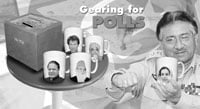 do not tire of declaring that democracy flows from election, here is a
reality check -- the election preparation gauged against some democratic
indicators. Only some though.
do not tire of declaring that democracy flows from election, here is a
reality check -- the election preparation gauged against some democratic
indicators. Only some though.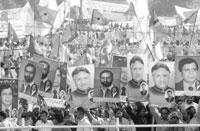 different political parties or their leaders in Pakistan, albeit
underhandedly. Their only concern is to guard their own interests. It is said
that the nature of funding shapes the dynamics of political processes in a
society. It is true that at least in Pakistan, the prevailing funding
practices have contributed to creating anti-democratic elements, and space is
shrinking for people with limited financial resources. The political parties
have also become private limited companies, owned by a few influential
persons, and depend only on potential investors. It is also on record that
intelligence agencies in Pakistan use state money to shape and run certain
political parties.
different political parties or their leaders in Pakistan, albeit
underhandedly. Their only concern is to guard their own interests. It is said
that the nature of funding shapes the dynamics of political processes in a
society. It is true that at least in Pakistan, the prevailing funding
practices have contributed to creating anti-democratic elements, and space is
shrinking for people with limited financial resources. The political parties
have also become private limited companies, owned by a few influential
persons, and depend only on potential investors. It is also on record that
intelligence agencies in Pakistan use state money to shape and run certain
political parties.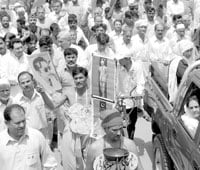 transparency in the upcoming general elections has triggered an unending
debate. Many union council nazims from opposition parties have supported the
idea whereas there are others who think suspending these bodies for three
months or more would severely harm the interest of the common people.
transparency in the upcoming general elections has triggered an unending
debate. Many union council nazims from opposition parties have supported the
idea whereas there are others who think suspending these bodies for three
months or more would severely harm the interest of the common people. democracy. As such, they are instrumental in moving the process forward and
determining the particular shape of a state's internal and external policy.
democracy. As such, they are instrumental in moving the process forward and
determining the particular shape of a state's internal and external policy.