



|
|
|
|
 |
 |
   |
campaign Taal
Matol Dialogue
with arms RIPPLE
EFFECT
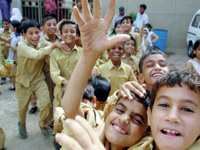
TCF has set up 530 schools all across Pakistan where over 65,000 students work towards a brighter future, gaining from a 'pay-as-you-can-afford' fee system. There is no compulsion to pay. The stress is on completing education By Gibran Peshimam Four-year-old Mehwish
stands bashfully in front of a class of about 20 children, reciting an Urdu "Aalloo Mian, Aalloo Mian Kahan Gaey Tum" The kindergarten class is located in the heart of Karachi's most impoverished slum located just off Mauripur Road. "Sabzi Ki Tokri Mein So Raha Tha" While Mehwish joyously displays her new-found talent in the class, children her age are loitering aimlessly in the heavily littered, mud-path streets outside. A heavy noxious odour, a mixture of poverty, helplessness and destitution, lingers in the outrageously filthy area beyond the gates of the school campus. "Baingan Ne Laat Maari, Roh Raha Tha" This is Machar Colony,
possibly the city's, may be even the country's, poorest and most deprived "Gajjar Ne Pyaar Kiya, Hans Raha Tha" Her joy, however temporary, stands in stark contrast to the decrepit situation that the families that live in Machar Colony find themselves in every single day. It is quite the opposite of the helplessness evident on the faces of children playing in the dangerously unsanitary environment outside, not lucky enough to make it to school, condemned to loiter in the filth outside and to grow up, to remain imprisoned in a living nightmare. "Matar Se Keera Nikla, Dar Gaya Tha" The school's principal narrates horror stories of how almost every day a dead body is found from the streets of Machar Colony. How children have to often pass by these corpses, shivering in fear. "Keeray Ne BHOW Kiya, Bhaag Gaya Tha" They will be condemned to
live in this vicious circle of poverty and helplessness unless they are given
a chance to drag themselves out. That opportunity has to be provided by the
rest of society; provided by institutions such as the one in which Mehwish
finds herself; where she can learn and The school, established in 2003, is one of three set up by The Citizen's Foundation (TCF) in the sprawling slum of Machar Colony. Called MC-II by its administration, the primary school campus embodies a sort of oasis of hope in a desert of despair. Three rooms down from Mehwish's Kindergarten class, sits Aisha, a bright student of class five. Aisha has been at MC-II since Kindergarten, and has struggled her way up through difficult circumstances at home. Both she and her sister Hanifa, who studies one class below, work in the fisheries located behind Machar Colony. They peel freshly-caught prawns, assisting their family in their livelihood while continuing their education against all odds. They go to the fisheries right after class, and often remain there till the early hours of the morning. They return to school a few hours later. It's tough but they
continue -- that too with a smile on their face. That smile is powered by a
small With 149 students in its morning shift, the school will provide much-needed avenues of hope for children of Machar Colony. TCF has set up plenty of other schools, 530 to be exact, in other such areas across Pakistan where over 65,000 students work towards a brighter future, gaining from a 'pay-as-you-can-afford' fee system. There is no compulsion to pay. The stress is on completing education. These schools have been set up from scratch using the generous donations of Pakistanis who believe that every child has the right to an education; the right to a chance, to better their lot. They are full of Mehwishs
who will learn to build up the courage to become Aishas, who strive to A product of a TCF school near Yousuf Goth, Karachi, 18-year-old Anum scored an incredible 78 percent (an A grade) in her Matriculation, which allowed her to get admission into one of Karachi's renowned girls' colleges, Khatoon-e-Pakistan, on a TCF scholarship. She didn't stop there. She topped her class with 81 percent score in her Intermediate (commerce), and was able to get admission into the Institute of Business Management (IoBM, also known as CBM), a top business college. Obviously, her family was not able to afford to send her to CBM due to its sky-high fees. However, thankfully, there are stories of such impediments being broken, and merit allowed to shine. Anum was given another scholarship, this time by Standard Chartered Bank as a part of its community investment strategy. Anum will not only pursue her BBA, but aims to complete her MBA. Such dreams are a reminder of the sort of hope that can still be found on the streets of Pakistan's many under-privileged areas; of the need to strive to ensure that these hopes remain alive. She is a shining example of
the avenues that such schools have created. There are also others. Sabahat Anjum, 23, also studied at a TCF school in North Karachi, from where she passed her Matriculation examination. Her father passed away 10 years ago, months after which she joined the TCF school. Her two brothers, who she calls Bhai took up tailoring jobs to support the family. They themselves studied till Grade 10, but wished for Sabahat to study on. After completing a solid grounding at TCF, she joined Sir Syed College, from where she did her Intermediate. She is currently pursuing a Bachelor of Arts, hoping that she can secure a good job to pay her brothers and her mother back for all the support they gave her. Sabahat says that she has been able to realise these dreams, thanks to the guidance of her teachers at TCF who gave her all the time in the world. Then there is Danish Qamar, 19, who is studying at Government Commerce College, who says he is determined to do his BBA. There is Sidra who has passed the Dow entrance test and aims to do her MBBS and become a successful doctor. They are just few of hundreds of students who have been given the chance for a brighter future right here in Karachi. Such efforts are not restricted to the urban centres of Pakistan. Hundreds of miles away from the coastal metropolis, TCF has another school in the rustic village of Minhala. Located a few kilometres from Lahore, east of the famous BRB Canal, where Indian Forces were stopped from entering Lahore during the 1965 war, is a school for girls. It is nestled neatly in a plot surrounded by lush green fields, and a water hole occupied by dozens of buffaloes belonging to Arcadian villagers of Minhala, which separate the campus from the few small shops that cater to the village. The serenity of the surrounding notwithstanding, one cannot ignore the absence of opportunity. Before the arrival of the TCF schools, the only educational institution in Minhala, one run by the government, was far from a proper establishment. The private school, which is one of five set up by TCF in the area, was established in April 2000 and awarded the status of higher secondary school in 2005. It has 280 students currently. Many girls who have graduated from the school have gone on to pursue higher education. Most of them who attended the government school before transferring to TCF testify to the difference in the quality of education. Many of them have gone on to higher learning; Rabia Nasir, a resident of Minhala, is doing her BCom from Queens College in central Lahore. She boards a bus from her village that takes an hour-and-a-half to get her to her college campus. But she is driven by a desire that was instilled in her while studying in school. These are just a few encouraging stories of children who, equipped with little other than a dream and the courage to persevere, have been able to take a giant step towards realising goals that, at one time, may have seemed far-fetched. Hundreds of miles away, back in Karachi's Machar Colony, Mehwish, who has since our last visit become the class monitor, takes her seat after performing her newly-learnt nursery rhyme. Finding it difficult to contain her delight, she gives a satisfied yet humble smile as her classmates award her with a hearty applause. The sense of achievement is apparent on her face. Hopefully, some day, Mehwish's sense of achievement will be taken onto a larger platform; where a simple rendition of "Aaloo Mian" will be substituted by a college degree and a key to a brighter future. It is possible.
By Shoaib Hashmi The news is enough to give
one nightmares, despite the fact that I think of the mobile phone as a Horror of horrors, these news were followed by further details of how the cell-phones were not the only thing thus hidden, although it was bad enough because it seems there were thousands of phones thus concealed. It turned out that once having discovered the capacity of the human body to secrete stuff, the people had gone to town and also secreted television sets! At which my senses baulked and I have to think of other things. It is the kind of thing that could only happen in the subcontinent, because it is a prime example of convoluted logic, shooting oneself in the foot and oriental ingenuity. At the time of independence, both parts had a fetish for the film, and a sizeable industry to go with it. We produced a respectable hundred or so movies a year, and our neighbours around three or four times as many. Since then, it has been one of the main bones of contention. For half a century no one has been able to understand how two countries which made exactly the same movies, in the same language, and lived within shouting distance of each other should choose to simply ignore the presence of the other industry. Actually we didn't ignore them, and were indeed all too aware considering the great exchange in clandestine videos, and the hordes of mutual fans. The point is that on paper there was no contact between the two industries at all, and no desire for it. Until it began to change! I seem to recall it was Taj Mahal which helped open the floodgates on the pretext that the heroine was the grand daughter of the great Nur Jahan and that made it welcome even if it was produced on Mars! And it gave lots of people lots of ideas. Without noticing it since then we have had a steady stream of exchanges of all kinds! What really symbolises the intention is a Pakistani film called Ramchand Pakistani! I have not seen the film, but it is by the young daughter of good friend Javed Jabbar, and the intent is obvious from the title. It is to put the silliness of cross border dichotomy in its proper place, which is the dustbin. Glad to report that the people have already taken that at the word. First there was the trio of Gangster and Jannat and Race at least two of which were hits and made a packet. Then they sneaked in You, Me aur Hum which was one of those titles that no one can tell where it came from, as was Love Story 2050 and also Kismet Konnection with the title mis-spelt just enough to muddle things up. In between somebody stuck Bhootnath which was a peculiar title and obviously not local but no one noticed. Taray Zameen Par was touted as an innocent little kids story so no one bothered to ask where it came from, and I am told it did rollicking business; and Goal which is decently non- committal and could have been from anywhere; and the rear is being brought up, rather lucratively by something called Singh is King and the point is that everyone has forgotten that officially there is a ban on movies from the neighbours, and they are brought in on pretexts which would not stand up in a kangaroo court for five seconds!
By Delawar Jan The Awami National Party,
which staunchly advocated a negotiated settlement to the growing The nationalist party, that secured sweeping victory in Swat district due to its slogan of peace, declared the Taliban militants their own 'brothers' and offered an olive branch to them soon after coming into power in the NWFP. Subsequently, a 16-point peace agreement despite immense pressure from the US was signed on May 21 2008, at a time when the insurgents were on a death and destruction spree in the valley by carrying out deadly suicide attacks and bomb blasts on security forces and even in public places. However, the peace deal could not remain intact, as less than one month into the peace deal the militants continued their attacks on the girls' schools. The situation grew worse when the security forces and militants clashed in Sambat Cham area of the militant-teemed Matta tehsil, resulting in the death of two Taliban commanders, Shahzad and Khan Agha and a security forces person. With this, the Taliban started a series of militant activities, but both sides kept expressing their 'resolve' to keep the accord 'intact.' However, the militants, angry at the alleged failure of the government to release their members, abducted two cops and threatened to pick up more to bargain the release of Taliban prisoners. After Maulana Fazlullah's press conference on July 27, in which he claimed responsibility for attacks on the girls' schools and threatened of suicide attacks if the government took action, the militants ambushed three Inter-Services Intelligence officials the next day. Moreover, they attacked the security forces check-post in Deolai area of Kabal and picked up 33 cops and Frontier Corps personnel. After these aggressive attacks, the security forces with a nod from the provincial government re-launched a full-scale military operation against the rebels on July 30. However, the militants held the ANP and members of the NWFP assembly responsible for the operation and turned their guns towards them. In early August, they threatened to take action against all ministers and members National and provincial assemblies, but their threat proved more lethal than it seemed as the unrepentant militants didn't even spare the families of the MPs and ANP workers. They attacked the house of former federal minister and Awami National Party's senior leader, Afzal Khan Lala, with rockets in Drushkhela area on August 12 but he and his family members remained unharmed. They again surrounded his house on Wednesday night but his guards made them flee by opening fire on them. The militants then killed a local leader, Musa Khan, who was on his way back home after Isha prayers. They ambushed another leader and former union council nazim, Muhammad Ameen, the same night when he was returning from Mingora after taking the injured body of Musa Khan to the hospital. The militants, who carried out another suicide attack towards the end of August, stormed the family residence of Awami National Party member NWFP Assembly, Waqar Ahmad Khan, in Shahdherai and killed his brother Iqbal Ahmad Khan along with his two sons and seven guards. The MPA was not at home at the time of attack when around 150 heavily armed Taliban militants first gunned down all the seven guards and then entered the house forcing the family members to queue up. They separated women from the other inmates and fired a volley of bullets at the male members, before blowing up the house. The security situation was so precarious that the MPA could not attend the funeral rites of his loved ones and received condolences at the fortified MPA hostel in Peshawar. The series of target-killings did not stop; the combatants killed another local leader of the party, Gul Bacha, the next day. All the elected representatives from the volatile district have shifted their immediate families to Peshawar and have stopped going to the valley. This was once the case with PML-Q's leaders and workers. The militants killed the member of Swat's royal family and the party's candidate for PF-81, Miangul Asfandyar Amirzeb, in a bomb blast along with a local nazim. Another leader of the party, Shujaat Ali Khan, was also attacked along with his family members, injuring several people. They also burnt down the house of Jamal Nasir, his son and the incumbent district nazim of Swat. In a meeting of all MPAs from the valley, the military was asked to withdraw if they could not effectively crush the militants. The MPAs were of the opinion that the security forces have failed to protect people from the Taliban; instead they have increased the danger to people's lives. The militancy-weary people of Swat are under the impression that the forces do not come to the help of those being attacked by the Taliban and are not serious in their elimination. It is, however, encouraging that the NWFP government led by ANP, whose central and provincial leaders have received threats, has adopted a principled stand of crushing the militants if they don't lay down their arms.
By Omar R. Quraishi Much has been written and
said about the death of 'fashion designer' Sheikh Aamer Hasan. I write From the looks of the social pages as shown on certain weekly publications, it seems that the man was a regular on Karachi's social scene and entertained all kinds of people, especially those associated with the fashion and glamour world. He also managed to write for a weekly and was at one time employed with one of the country's largest media groups. Of late, prior to his death, he was doing a show on a private television channel, where viewers thought he was trying to portray men as 'sex objects'. It was also said that he was -- like many from the industry -- someone who did not necessarily like only women in a romantic sense. However, that is a matter of one's privacy and judging people on the basis of their sexual orientation is certainly not a good thing (of course it's all the rage in a society as warped and conservative as Pakistan's). Having said that, there are people in the media and entertainment world who make no bones about their preferences and sometimes even flaunt it -- one person in particular who has made cross-dressing kind of socially acceptable said this pretty openly in a BBC documentary -- and this only invites attention of the mostly unsavoury kind. So while one's sexual orientation should be a private matter, things that border on the criminal or illegal certainly should be everybody's business -- especially activities that are designed to physically and/or emotionally harm the well-being of others. Apparently, a between-the-lines reading of some reports written on Mr Hassan's death would suggest that he was allegedly involved in matters that were probably in a very grey area as far as the law and sex between consenting adults was confused. And it wasn't as if these allegations or rumours, or what have you surfaced or were born the minute news came of his murder. Many people -- even those who had never met him or known him personally but who were keyed in to Karachi's social scene -- would have heard of reports. Of course, those who were particularly friendly with him and would regularly appear at his flat -- called, for some odd reason, 'Sheikh Villa' -- must have known of such talk. It was all hush and hush and probably never to be discussed and pushed under the carpet but how come never did any of these people -- who didn't have any problem gracing the social pages of English magazines at Sheikh Villa -- have any qualms about the alleged activities of their gracious host? How come no one ever spoke up about what was happening? Unfortunately, this kind of culture of silence and of ignoring the obvious is something that characterises instances of abuse all over the world, especially of the kind that the now deceased 'fashion designer' was allegedly a part of. And in this context, the question whether those who were his friends and acquaintances and chose to frequent his 'villa', even for harmless parties, were in any way condoning the man's alleged activities is one that comes to mind -- of course, with no willing to come out and talk about the passing away of the 'designer' or of his legacy, this question is likely to remain unanswered. ******** A relative of mine had to recently check himself in at one of Karachi's top private hospitals. Supposed to be one of the best in the country, going by his account, the facility seems to be far worse than most run-of-the-mill government hospitals. He went to the facility's emergency services section in the afternoon because of acute back pain and after initial inspection was advised that he get himself admitted. For this he was told to wait -- and he could lie in one of the make-shift beds that one finds in emergency sections of hospitals. The narrowness of the bed, he said, was such that he was rendered more or less immobile and this was obviously not good for his back ache. He was told that a bed in a semi-private room would soon be ready for him but this did not happen till well after midnight! Once he was moved -- having waited for almost ten hours -- he thought he could finally get a good night's rest because the specialist doctor was not expected till the following morning. However, this seemed to be too much to ask for because after a brief period he was intermittently disturbed by the nurse and a doctor on duty who wanted to check his vitals. It was early morning before these interruptions ended and he thought he could get some shut-eye. But this too proved a wish because at eight in the morning he was woken up by resident interns who again asked questions that he had already answered a few hours before. All this time, the specialist doctor was nowhere to be found and eventually he was more than a bit shocked when the doctor on duty suggested that everything was fine and that he check out -- also because they needed the bed for another patient! Understandably angry, he told the doctor that at least he should be seen by a specialist. After much waiting and calling, the specialist did come but apparently did not spend more than five minutes and told the relative to head home. The way the specialist doctor spoke -- in an abrupt and brusque manner -- was as if he was doing the patient a favour. The relative, needless to say, has learnt a lesson and vowed never to go to this 'prestigious' hospital. Will someone in the health ministry take note of this? Sherry Rehman? Anyone? The writer is Editorial Pages Editor of The News. Email: omarq@cyber.net.pk
|
|
 nursery rhyme that she has just learnt.
 area. Mehwish's gleefully exaggerated gesticulations while reciting the
nursery rhyme are watched intently by her classmates, including her sister
Saira. Her excitement overwhelms even her healthy coyness.
area. Mehwish's gleefully exaggerated gesticulations while reciting the
nursery rhyme are watched intently by her classmates, including her sister
Saira. Her excitement overwhelms even her healthy coyness. recite her nursery rhymes with a vigour that promises to break the shackles
of pessimism.
recite her nursery rhymes with a vigour that promises to break the shackles
of pessimism. but potent fuel
-- that of hope. They study hard, often topping their class, knowing that
they could have a better future, not only for themselves, but for their
family. The desire to emancipate themselves from the throes of desolation
needs only an opportunity for it to be realised. MC-II, for them, is this
opportunity.
but potent fuel
-- that of hope. They study hard, often topping their class, knowing that
they could have a better future, not only for themselves, but for their
family. The desire to emancipate themselves from the throes of desolation
needs only an opportunity for it to be realised. MC-II, for them, is this
opportunity.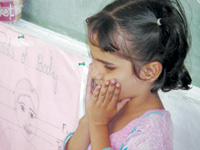 become something more -- that success story that is talked about by everyone.
Such as Anum Fatima.
become something more -- that success story that is talked about by everyone.
Such as Anum Fatima.
 despicable instrument and have never owned one and do not intend to do so in
the future. It started innocently enough with the announcement that the
authorities have decreed that people in prison would no longer be allowed to
keep cell-phones. That seemed reasonable enough and in any case did not
bother me, until they followed up with horrendous details of how many
clandestine phones had been confiscated from convicted inmates of jails. That
was followed by even more horrendous details on how exactly the people had
hidden these phones on, or in their anatomy.
despicable instrument and have never owned one and do not intend to do so in
the future. It started innocently enough with the announcement that the
authorities have decreed that people in prison would no longer be allowed to
keep cell-phones. That seemed reasonable enough and in any case did not
bother me, until they followed up with horrendous details of how many
clandestine phones had been confiscated from convicted inmates of jails. That
was followed by even more horrendous details on how exactly the people had
hidden these phones on, or in their anatomy.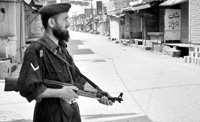 militancy in the scenic Swat valley before and after the Feb 18 elections, is
now under attack from the irreconcilable militants loyal to Maulana Fazlullah.
militancy in the scenic Swat valley before and after the Feb 18 elections, is
now under attack from the irreconcilable militants loyal to Maulana Fazlullah. fashion designer in single quotes because this is what he used to portray
himself; however, I have yet to come across a shop that would stock clothes
made by him. Also, I cannot add much beyond what has already been written in
a very good expose that appeared in the Instep section of this newspaper on
Sept 1 by fellow-journalist Muniba Kamal. However, it is worth noting that no
designer or fashionista was willing to come on record and be quoted either by
this newspaper or by Geo TV whose reporter sought comments from various
people on the death of Sheikh Aamer Hassan.
fashion designer in single quotes because this is what he used to portray
himself; however, I have yet to come across a shop that would stock clothes
made by him. Also, I cannot add much beyond what has already been written in
a very good expose that appeared in the Instep section of this newspaper on
Sept 1 by fellow-journalist Muniba Kamal. However, it is worth noting that no
designer or fashionista was willing to come on record and be quoted either by
this newspaper or by Geo TV whose reporter sought comments from various
people on the death of Sheikh Aamer Hassan.