



|
|
|
|
 |
 |
  
|
visit Mombasa
for Mothers Pukhtun
Stonehenge
A Londoner returns to his home-town to enjoy some good theatre, heated politics and Prof. Amin Mughal's company... By Arif Azad The first thing you notice
on arriving in London is a sense of economic gloom louring upon the Sensing this, some innovative restaurant-owners have creatively advertised cheap offers. One restaurant in the Strand area creatively advertises its lunch offer as credit brunch which rhymes nicely with credit crunch. The deal is that you bring your last bill and get 20 percent off on your next meal. Every friend of mine from old days reported sharp increase in food prices in recent months. I discovered the veracity of this myself when a few days of eating out knocked holes in my tightly fortified pocket. Hence, from the first few days onwards, I determined to keep a tight leash on my pocket. Summer season also draws an
unending concourse of visitors to London. By far, students from other
European countries form a major portion of these visitors. You hear a babble
of languages in the British Museum is another popular venue where a bulky throng of camera-wielding tourists congregate. Currently the museum is running an exhibition on the life and times of the Roman emperor Hadrian which is the centre of attraction, thanks to a well-advertised, pre-exhibition publicity. The exhibition has been prefaced by lengthy pieces in the Guardian and other broadsheets, dilating upon the life and times of Hadrian. London is famous for its theatre scene. Major sites of theatrical and cultural productions are South Bank and West End. South Bank also houses major concert halls and cinemas on the Thames bank. A brilliant new play about suffragettes' movement, 'Her Naked Skin', is playing at the national theatre on the South Bank and is a big draw among those seriously interested in political theatre. Tanika Gupta, the author of Gladiator Games, one of the best political plays in recent years, about the death of British-Pakistani teenagers in a Feltham youth offenders' institution, spoke highly of the play. Another play, 'We the people', directed by Charlie Westerna, a brilliant new young entrant in British political theatre, drew considerable notice from serious theatre-- going public. While on the subject of
theatre, Mohammad Hanif, whose novel, 'A case of Exploding Mangoes', has Apart from friends from Pakistan visiting London I met professor Amin Mughal. He looked his usual sharp and buoyant self, dressed in impeccable attire as is his wont. Amin Mughal is one of the vanishing breed of left-wing Pakistan intellectuals in whom we can still discern a glimmer of lofty and humane aspirations with which we set out on our journey in the early days of Pakistan. Prof. Amin left Pakistan in the early eighties and has not returned since. Before beginning his exilic life in London, he was associated with the weekly Viewpoint, edited by Mazhar Ali Khan, and the literary journal Lailo-Nahar. Before that, he was fired from Islamia College for his trade union activity. This led to the founding of Shah Hussain College along with Professor Manzoor Ahmed. In London he worked for daily Jang before taking up the editorship of daily Awaaz in early nineties which had a short life span of a little over a year. Over the years, his house in Finchley has become a port of call for all visiting and transiting writers, politicians and political and cultural activists from both sides of the border. Though, in the last few years, he has pulled himself out from active engagement with Pakistani-Indian political scene, he still remains an enduring reference point for a lot of politically-conscious Pakistanis living in the UK. In recent years, however, he has stepped out from his hermetic existence to write about the death of Benazir Bhutto and its aftermath. His extended essay on the life and politics of Bhagat Singh has earned him accolades far and wide. The essay deserves publication and dissemination to the widest possible audience. As for the weather, the favourite stop-gap topic of the English people, it was pleasant for a July month. And it was a huge relief, though, from an unending cycle of unannounced nightly load-shedding which has afflicted Islamabad, and the rest of the country, for the last few months. On the domestic political front, things are rocky for the ruling Labour Party. This is showing up in the declining poll ratings of Labour Party. The dip in the party's ratings is so consistent and alarming that Labour backbench party is seriously thinking of ditching Gordon Brown, the current prime minister, whose performance has been lackluster since he wrested power from the ever agile Tony Blair. Although Labour Party is historically reluctant to stab its party leader in the back, there is a serious chance of a new challenger emerging from within the party. First salvo in the succession war was fired by the current foreign secretary, David Milliband, who, through articles in the newspaper, advocated a fuzzy line of the party becoming more attuned to aspirations of the people (a code word for course correction meaning removal of Gordon Brown). It is almost a given now that the Labour party is going to lose next elections. The fight back by Blairite faction of the party, represented in David Milliband, is a significant development which would determine the future ideological direction. The other source of Labour party's consistent dip lies in the Tory's party resurgence under its new media savvy leader David Cameron. Although Labour has been traditionally known as the natural home for Asians, Conservative party under David Cameroon has made concerted efforts to woo Pakistanis and Indians into its fold. As a result, the monochrome complexion of the party is changing (the party, thus far, has been seen as the party of white middle class England). Whether this change is for real and is long-lasting, only time will tell. As for myself, I shall be watching very closely the recent change of strategy (whether it is a change of heart I am not so sure) of the conservative party from Islamabad.
A Pakistani family joins the hordes of tourists bitten by the African bug By Durdana Ali Malik If I were to tell you the
most wonderful child-friendly holiday I've ever experienced was in Africa, On one count you would be right…Africa has got me - caught me in the heart, with its beauty, easy adventure and lovely child-friendly people. For two summers I have ventured to distant Kenya in East Africa with my children, which include two young mothers and their toddlers and one college going nazuk mizaj girl. That's the odd combination of us travel mates that now swear by holidays – in Kenya's coastal town Mombasa, with beaches on the Indian Ocean. Mombasa is the second largest city in Kenya, lying on the Indian Ocean. The city is the centre of the coastal tourism industry. My holiday actually started from the moment a rather fierce-looking immigration officer, noticing one of the mothers carrying a sleeping child, hurried to help her out, calling out lovingly 'let Mama and Toto go first!' Revered by anthropologists
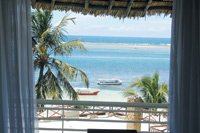
as the 'cradle of humanity', Kenya offers visitors magnificent wildlife Mombasa is the largest port on the coast of East Africa. Its earliest history dates back to the 12th century. A Muslim haven for centuries, it was attacked by the Portuguese in 1505 and burnt to the ground. Through the ages it has been destroyed and rebuilt several times. Today Mombasa beaches are host to innumerable beach resorts, which include some world class hotels as well as economy ones. Several European airlines fly directly into Mombasa carrying hordes of tourists, most of whom are also bitten by the African bug and keep coming back every year! Each morning, by the time
we chased the feisty toddlers to put on their swimwear, we would already be
on the sparkling white sands of Nyali beach. The weather from June to August
is wintertime in Mombasa; but for us it's the perfect cool day in March in
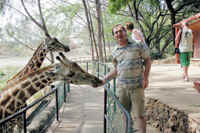
Lahore. The children would One morning we ventured out on a sea safari. A small boat which took us a couple of kilometres out of sea to see a coral reef and for those of us up to snorkelling, an underwater swim around the reef with spectacular views. You may have seen stuff on animal planet but, believe me, nothing quite prepares you for this view. Within the city of Mombasa is the famous Haller Park, a nature trail where the highlight was a giraffe eating out of the children's hands. Of course there were baboons, hippos, antelope and other animals too, but knowing toddlers we couldn't trust them to hug a baboon! It was bad enough getting them to throw away a huge caterpillar a park warden let them carry. We were hysterical. The goras were thrilled. Those who know toddlers will recognise that they go through a 'spitting' stage. It's not rude, just a trick they discover. The science is Hey there's liquid in mouth, collect it and throw-watch adults squirm! Well, those were our spit stage days. Exasperated, we stood around the crocodile pit as ecstatic children spat down on them. It was a long drop, so it was more fun watching, than just from everyday potty seat to floor. Like I said, a holiday made for kids.
One day when some serious-minded people turn their attention to the Asota stone circle, they will discover tales that will make sense Out there on the Salisbury
plain in England, they have their stone circle they call Stonehenge. Now Salisbury in England, incidentally, is not the only place with a stone circle – it is the most spectacular and one that goes back some five thousand years in time. There are other sites on the British Isles and elsewhere in Europe and elsewhere in the world – though I am not certain about Americas. Sources other than my dictionary also confirm that stone circles were indeed used for some arcane ritual as well as to mark the rising and setting of celestial bodies on particular days. The rising or setting of a specific star on a given day between two upright stones marked a special time of year: either it was when night and day were of equal length or when the sun was at its most vertical in midsummer and was beginning its journey to its lowest point in midwinter. For primitive people living in northern latitudes the length of the day and summer sunshine were of particular importance. At the sun's annual high point it was time to start lying in provisions for the long cold and dark ahead. The stone circle was their calendar that warned them that they had reached the 21st of June and that three months' (to autumnal equinox) was all they had to gather food for themselves and their cattle to last through the winter. In Pakistan too we have stone circles. The one outside the village of Bawata in Balochistan lies by the road from Fort Munro to Loralai. The stones used are plates of shale and limestone that stick out of the ground to a height of no more than half a metre. At some point in time, finding it handy, someone tried to convert this circle into a mosque by creating a sort of mehrab facing west. The Bawata stone circle also has a menhir and people use this site as a shrine of sorts. The other stone circle that I have seen lies just outside the village of Asota on the Mardan-Swabi highroad. Here the uprights are hefty stelae, as in proper stone circles; some reaching up to a height of about two metres. Others are shorter and there are a few that seem to have been broken off. Part of the circle, to the east, is missing. The Asota stone circle is about twelve to fifteen metres across and that would make it about the same size as the one outside Bawata. The one time I was at Bawata and twice in Asota, it was the wrong time of year: it was neither midsummer nor winter, nor too either of the equinoxes. And so I could not watch at sundown nor keep the vigil until dawn to be able to check if our stone circles also mark astronomical events. But when one day someone does, they will discover that both these ancient sites served the same purpose as their counterparts in Europe. Now, we know that Stonehenge was laid out some five thousand years ago. But since our circle in Asota has never been scientifically investigated (so far as I know), I cannot say when this would have been built. However, there is evidence that ancient Pukhtun ancestors were busy in this region a very long time ago. The nearby village of Adina is now well-known for the discovery in the mid-990s of early Aryan graves. On a low hill outside the village, there are graves containing, besides the bones or ash urns, other relics as well. These relics have been dated between the 14th and 12th century BCE. This was a time when the Aryans had been in the subcontinent for nearly five hundred years. I suspect that the people who buried their dead with gold and copper ornaments and pottery on the Adina hill were the very ones responsible for erecting the stones of Asota. If my surmise is true the stone circle should be three thousand five hundred years old. Meanwhile, local people have invented a tale to explain the upright stone pillars: a wedding procession passing by a forest that once grew here was set upon by a bunch of thieves. Having done in the revelling men, the robbers turned their attention to the women who, fearing the worst, prayed to be turned into stone. And so before the evil-doers could lay so much as a finger upon them, the women were petrified. If this were an English-speaking country we could have said that was how the term 'petrified with fear' originated. Moreover, the merry precession seemed not to be going anywhere. If it had, the stones would have been in a file not in a circle. Keeping in view that we have been stuck at the famous crossroads that every usurper evoked over the past six decades, our habit of going around in circles seems to go back a long time in the past! Thus the wedding procession went round and round before being petrified with fear. But legends, by their very nature, are generally illogical. One day when some serious-minded people equipped with necessary knowledge turn their attention to the Asota stone circle, they will discover tales that will make sense. And then we might know of a connection between these silent stones and the tombs on the Adina hill.
|
|
 horizons. One newspaper after another is brimful of predictions of economic
downturn in prospect. The word credit crunch is upon every lip. The drip-feed
of news headlines of housing marker in slump, economic downturn, and high
unemployment adds to a general feeling of a gathering economic slowdown which
is predicted to last a few years.
horizons. One newspaper after another is brimful of predictions of economic
downturn in prospect. The word credit crunch is upon every lip. The drip-feed
of news headlines of housing marker in slump, economic downturn, and high
unemployment adds to a general feeling of a gathering economic slowdown which
is predicted to last a few years.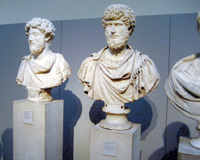 London tube. Sometimes you spot an elderly teacher taking students through
the intricacy of tube-map-reading. Once, when I stepped into this learning
exercise to bail a struggling student out, I was told off by the furious
teacher saying she was testing the ability of her students.
London tube. Sometimes you spot an elderly teacher taking students through
the intricacy of tube-map-reading. Once, when I stepped into this learning
exercise to bail a struggling student out, I was told off by the furious
teacher saying she was testing the ability of her students.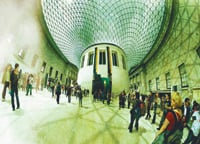 been long-listed for the Booker Prize, showcased his brilliant new play, 'The
dictator's wife' at the School of African and Oriental Studies (SOAS), which
drew over-spilling crowd despite the semester break. The play takes a sly
look at the graying relationship between a dictator and his wife. Nimra
Bucha's solo performance was a brilliant piece of acting. The play, after its
initial enthusiastic reception, was staged at the Edinburgh festival. One of
the biggest spinoff benefits of going to Asian theatre in London is that you
get to meet long-lost friends.
been long-listed for the Booker Prize, showcased his brilliant new play, 'The
dictator's wife' at the School of African and Oriental Studies (SOAS), which
drew over-spilling crowd despite the semester break. The play takes a sly
look at the graying relationship between a dictator and his wife. Nimra
Bucha's solo performance was a brilliant piece of acting. The play, after its
initial enthusiastic reception, was staged at the Edinburgh festival. One of
the biggest spinoff benefits of going to Asian theatre in London is that you
get to meet long-lost friends. you might wonder if the African sun got me!
 parks, unsullied beaches, thriving coral reefs and ancient Swahili cities.
 play in the sea swallowing huge amounts of water and then cough it out, as
their anxious mothers watched…but by the end of week, the mothers were
calmly lounging in hammocks in the shade sipping coolers, while the kids
thrived in the sand and saltwater! Of course watched by the rest of us, who
also preferred to be in the water. Often local African women playing with
their kids closeby would playfully splash our children too! Near the Mamba
Village there is a Crocodile Farm, the largest crocodile farm in Africa. We
spend an afternoon there to watch 'Big Daddy' a hundred year old crocodile,
that had eaten several 'human' meals before he was caught, we were told.
play in the sea swallowing huge amounts of water and then cough it out, as
their anxious mothers watched…but by the end of week, the mothers were
calmly lounging in hammocks in the shade sipping coolers, while the kids
thrived in the sand and saltwater! Of course watched by the rest of us, who
also preferred to be in the water. Often local African women playing with
their kids closeby would playfully splash our children too! Near the Mamba
Village there is a Crocodile Farm, the largest crocodile farm in Africa. We
spend an afternoon there to watch 'Big Daddy' a hundred year old crocodile,
that had eaten several 'human' meals before he was caught, we were told.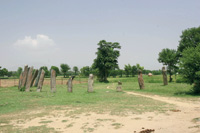 stones are stones, but a henge is an obscure word. According to my Random
House Dictionary it is a 'circular area enclosed by a bank and ditch and
often containing additional features including one or more circles of upright
stone or wood pillars used for ritual purposes or for marking astronomical
events, as solstices and equinoxes.'
stones are stones, but a henge is an obscure word. According to my Random
House Dictionary it is a 'circular area enclosed by a bank and ditch and
often containing additional features including one or more circles of upright
stone or wood pillars used for ritual purposes or for marking astronomical
events, as solstices and equinoxes.'