



|
|
|
|
 |
 |
   |
changing
trends mysticism public
changing
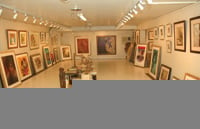
trends In a country where art was earlier not seen in a positive light, yet produced masters like Amin Gulgee, Bashir Mirza, Ali Imam and others, times have now changed a great deal where any artist able to paint a few portraits is in great demand. By Gibran Ashraf "Art exhibition
again," I moaned, holding up an invitation to my fifth exhibition
invitation in 15 days. I am not much of an art buff, but coming from a journalistic background, I had the good fortune of being exposed to the more creative aspects of society from a very young age. Honestly, when I was young I would be ecstatic when my part-time journalist parents took me to art galleries, although I was much less interested in art than in the free peanuts. The art would just sink somewhere in the background. Nevertheless, exhibitions in those days were few and far in between, which made each gallery trip enjoyable. Now that I am a working journalist, art and culture has been entrusted into my uncreative hands, which is how I returned to the city's art scene after a lapse of nearly ten years. Nothing is as I remember it to be. Now
exhibitions open every other day at galleries or at private spaces all
over town. Artists are So what exactly has brought about such a revolution in the art industry of Pakistan? Before going any further, it is necessary to understand the many different aspects involved in the art industry. Over the past decade or so, there has been a simultaneous change in the market, the artists and the marketability of artists. There was a time when an entire collection by an old master like Ahmed Perwaiz used to be sold for a mere Rs500. Now, paintings by Ismail Gulgee, an equally revered artist, are sold for as much as Rs1.5 million. The price of art indicates two things. One is that the price of art really has shot up considerably over the past years. The second is that the market has matured and has loosened some cash for paintings. However, not all meets
the eye. The price factor has only recently been come into play as much
of There is a direct link with the international market price for Pakistani art and art being sold here. The explosion of the mass media has linked every artist together, and the artists, young or old are starting to demand money, although art is still believed to be cheap in Pakistan, despite even fresh artists demanding nearly Rs30,000. Those who are lucky enough to go abroad even once demand over Rs50,000. The problem, though, does not lie in artists demanding to their heart's content. The problem is that people are more than willing to pay, and this is what is contributing to inflating art prices. More than that, a number of galleries have sprung up trying to get a cut of the action, say, about 30 percent. Much of the time, it is the art gallery that sets such high prices. There is also the quality of the art on offer to consider. After all, it is the technical quality of the art that ascertains its true value. With a host of schools opening up, the chance to learn to produce good art is becoming easier to those who can afford it. It is true that there are a few great self-taught artists, but they are a minority and have to struggle. The latest trend is
miniature art, which become the signature of Pakistan. Even India has
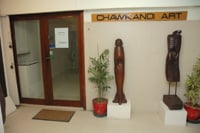
retired its One reason for the immense popularity of art today can be attributed to the fact that modern art is very straightforward. It does not use a variety of visuals and other paraphernalia to put out a twisted philosophy. Nowadays, there are no hidden meanings. Everything is in plain sight. What you see is what you get. Collector Muneera Noorani says that when a new artist emerges, their work is carefully scrutinised for technical ability, the presentation, and how the artists are able to sell themselves. As soon as four or five of the paintings have been sold, the artist is bought out immediately. She says that if you keep the work for a while, you can net a hefty profit, particularly if the artist has marketed to the right people and managed to go abroad. Observing this lucrative business, many multinational companies have invested heavily in the local art sector, and have agents scouring the market for cheap art to earn a good profit out of. Much of this art is often purchased from Corporate Social Responsibility funds. Whenever there is an auction or sale in the name of charity, get large cheques in exchange for helping put the red dots over the work. It is a good little spot to put your money in. There is no tax on it, so it is untraceable. The art makes the office walls colourful and inspiring, and is a good profit to boot. Big companies are often seen buying a good amount of art for their annual calendars. But the field of art has greater problems than a high price. The market is full of fakes. Remember the old masters mentioned earlier? Gulgee's and the Ali Imam's and other the works of other great artists are being copied and sold. A number of the 53 art galleries in Karachi are owned by collectors or other middlemen for copiers, although the identity of these copiers and their employers is a closely guarded secret. With the absence of an art loss register or a gallery registration system, tracking the original is difficult. Paintings are swiped away right under the noses of artists and buyers. There are online galleries that buy local art, promising artists a lump sum amount of the artists' choice. The art is then sold at three times the price to foreign buyers. Collectors think that the prices have gone through the roof and the market berserk, but art continues to rage on. Indeed, it remains a passion for those who can afford it. The media have played their part in promoting art. In these very pages, you can find reviews and analysis of art work from local artists. This promotion of art has provided a link between the art sellers and art buyers. With a dearth of writers on the subject, much of the writing has been full of praises. Our anti-art heritage has led to too much review and not enough criticism. Television channels have fuelled the glamour. The pull of the idiot box and splash pages in newspapers and magazines have suddenly made art an appealing profession to the youth and acceptable in the eyes of parents. When the state was viewing only PTV, art exhibitions never used to be covered. Now at every exhibition, there are more people from the mass media than there are serious art buffs. With people getting more 'liberal' or 'secular', age-old beliefs of putting up pictures in homes have been rejected, although sculptors have been unable to break the shackles of religious fundamentalism. The semblance with the statuettes of Hindus and Buddhists is ingrained, and the religious connotations in the minds of the people are too strong to break. It is the internet, however, that has been the greatest thing to happen to art. From ideas being exchanged, to people being more educated on the subject, to actual trade, the internet truly revolutionised art in the world, especially in Pakistan. The website tasweersaz.com, for example, features the work of many local photographers. It acts as a promotional institute, a correspondence and discussion centre, and a sale resource. Ahmed Sharjee, a photographer whose work can be found on the website, explained that bargaining in the art market is complicated, although there are a few who harass the painter and gallery about the price. He said that the internet has made work very simple for artists. Asif Ahmed, a young artist, concurred, saying that a portfolio can be sent half way across the world with the touch of a button. "I had an exhibition of my miniatures at Chawkhandi. Because they put the work online, nearly all of my work was sold out before the exhibition even opened," he said. The personal marketing of a painting is essential to success. Ahmed had a show in France last year and one in Morocco this year, and said, "It is very important to maintain relations and have good public relations to develop a circle. The exhibition in France came about as a result of an acquaintance from the National College of Arts who was quite senior to me, who recommended to the gallery to approach me. The gallery talked to me and reviewed me thoroughly. My work was picked for display out of (the work of) 300 artists." A strange phenomenon in Pakistan is that galleries play it safe by lowering the prices of paintings to eke out a sale. Foreign galleries, on the other hand, push the artists to charge high prices. A banker and an art collector, who preferred to remain anonymous said that the art available in Pakistan is nearly equal in quality to India, but is much cheaper. Many foreign auction houses are interested in Pakistan, he said, so much that the regional director of Christie's, a London-based global fine arts auction house, visited Pakistan recently. C added, though that art prices have shot up considerably over the past two years as more artists have had exhibitions or are auctioned abroad. "There are many influential people in Dubai who throw their weight behind artists and get their paintings into auctions or galleries overseas, raising the prices of art at home," he said. Art in Pakistan has evolved past the modern into post modern forms. Gone are the days when art was used merely as a medium for free abstract expression of ideas in tangible form. In art today, the heavy influence socio political connotations are visible. Art photographers, however, are far lower down the pecking order. Internationally, our photographers are recognised and reasonably well established, but locally, there is only a small niche with a taste for photography. Photo artists like Amean J and Tappu Javeri complain that people here are uneducated and do not consider photography an art form in the first place, but snap up a copy at a display or exhibition and reprint it a million times because unlike a painting, a photograph can be easily reproduced. There is a great need for more massive permanent art galleries which catalogue the great art that this nation has been producing. A registration of the artists or their work would greatly help in spotting fakes and put an end to art piracy. There is also a need for the general public to educate themselves and take the hideous contorted metal pipe installations off our major roads and put up some real art. For some, this explosion of art is the golden egg they had been waiting for so long. With art earning Pakistan some much needed foreign exchange as an unknown export of great value, we need to be sure as to where this path may lead us so we can plan a better future for all concerned. heritage on wheels The Quaid's Silver Ghost By Sabeen Jameel
She might not be the most prestigious car among the fleet of 300 cars of the
Nawab of Bhawalpur, Sir Meant to serve the royal dignitaries and rich in the world, this 1924 Silver Ghost was preferred by Jinnah over other prestigious cars including Rolls Royce, Renault and Cadillac in the Nawab's personal collection primarily because "it was the only convertible car in the collection of the Nawab that time," tells Karim Chhapra a Karachi-based industrialist who now owns the1924 Rolls-Royce Silver Ghost.
Karim tells that the Nawab of Bhawalpur was very fond of cars especially
Rolls-Royce and had 14 of The Nawab of Bhawalpur Sir Sadiq Muhammad Khan was one of the most influential persons in the sub-continent at the time. He had his own army as well as his own currency in his princely state. The Army of the Nawab is believed to have given the first guard of honor to Jinnah. The 1924 Silver Ghost of this courteous Nawab remained unused for almost four decades as the entire property of the Nawab, including his fleet of cars, was sealed when the legal heirs of the Nawab approached the court for a decision over the distribution of his assets.
The matter remained pending in court for over forty years and the government
of Pakistan served as "I put my sweat and blood to restore it," Chhapra tells Kolachi of the car that he got hold of through Nawab Sahabzada Muhammad Umer Abbasi, one of the legal heirs of the Nawab. He bid for Silver Ghost on behalf of Karim. Chhapra says that he was after the car for over a decade and had been requesting the Sahabzada to get him the car whenever it is put for sale. "I wanted it not only because of the historical importance attached to it, but because it was a Rolls Royce and the only convertible car in the fleet of Nawab."
Made by the Rolls-Royce Company in Britain for the first time in 1906, it
was named 'Silver Ghost' "The Nawab of Bhawalpur bought it against 1, 852 pounds," Chhapra tells Kolachi. However, he shies away from telling for how much he got the car for, when inquired. "Those having little knowledge about cars would regard it very expensive while others would believe I got it for a very reasonable price," he continues. But he admits that the car cost him a fortune especially since he had to restore the original factory specifications of the car. "I had to pay 450 pounds to restore the original clock alone." It took Chhapra more than a year to restore the original looks of 1924 Silver Ghost.
Before reaching Karim Chhapra in 2004, the car had been parked on
bricks for decades and had never been maintained over years. "It was in
a very bad condition," he says adding that the car paint was To restore the original ivory doors knobs of the car, Chhapra got ivory from Sri Lanka. The clock, on the other hand, was purchased from the UK. "After so much effort," he adds, "the car is a treat to watch now." Having regained its original specifications, the Silver Ghost now rests in an air tight glass room in Karim Chhapra's house. The glass room is specially made to protect the spacious, seven-seat car of the Nawab from the dusty, humid weather of the city by the sea. Chhapra says that despite the passage of 84 years since its making, this 8000 cc car has no comparison with the recent cars. "It is still in very good running condition than the cars of this era," he tells adding that given its elegant looks, some ad agencies and drama producers also offered him to project the car on commercial basis, but Chhapra refused. "I won't commercialize the car that drove Nawab of Bhawalpur, Quaid-i-Azam and Lord Mountbatten," he adds with pride. mysticismLal Shahbaz Qalandar Urs – a unique spiritual experience By Adeel Pathan The province of Sindh
is not only rich in natural and mineral resources but also in the
blessings of Usman Marwandi alias Lal Shahbaz Qalandar was one such saint who arrived in Sindh more than 800 years ago in the small town of Sehwan Sharif – now a part of District Jamshoro. It is located at a distance of 130 kilometres from the city of Hyderabad. Lal Shahbaz Qalandar is known to have visited this province to spread the message of brotherhood and preach the teachings of Islam among the population. He spent years in isolation, meditating, in the rocky mountains of Sehwan Sharif. Sehwan is a small Taluka of the Jamshoro district where the saint was buried. His shrine lies in the centre of the city. Every year, hundreds and thousands of devotees of the Qalandar visit his shrine especially during the three-day Urs festival that is organised from 18th to 20th Shaban, the eighth month of Islamic calendar, to mark his death anniversary. This year, the festival was celebrated from August 21 to 23. The festival attracts Devotees from all over the country and abroad pay homage to the saint and pray for the fulfillment of their wishes and desires. They arrive in the town of Sehwan well before the official beginning of the Urs celebrations and set up their temporary abodes in tents or book guesthouses and hotels in advance. This festival also gears up business activity in the town and temporary markets are set up to sell traditional items for women and children along with different food stalls. The devotees pay homage to the saint by praying at his shrine and also perform Dhamal -- a rhythmic dance performed on drum beats. People of all age groups, including children, perform the spiritual dance to express their respect for the saint. The Urs does not only serve as a festival for Muslims, but is largely attended by Hindus of Sindh as well, who visit the shrine to experience the Sufi trance dance. The saint preached religious tolerance among Muslims and Hindus – which can be observed at the occasion of his Urs. "I came from Bhawalpur alongwith my family and neighbours to pay homage to the Qalandar because we believe our wishes will be fulfilled," Bashir says while talking to Kolachi. Bashir, however, is not the only one who hopes his desires will be fulfilled. "We have been coming here for the past ten years [without any break] with our entire family," says another devotee, Nargis, who visits the shrine annually at this time of the year from Hyderabad. "It's because the saint blesses us and our wishes are fulfilled." However, the festival has its share of problems as well. Most observers claim that some Muslims pay homage to a few other holy sites as well that the Qalandar is known to have visited. The holy sites are located on the mountains, a few kilometres away from the actual shrine, where the Qalandar spent his time in meditation. The site is marked with a water well around which people move in circles. The devotees then pelt three "evil spots" with stones which most visitors feel is an 'act of disrespect' to the holy site. This practice, they insist, should be stopped to avoid any confrontation between the different sects of Muslims who visit the shrine. Furthermore, the provincial government and local administration that organises this annual festival, should also keep a strict a check on immoral activities and sale of narcotics reported during the Urs. Also, keeping in mind the popularity of the festival, the authorities should ensure the availability of CNG stations on the route so that transport fares are reduced. Arrangements should also be made to meet the electricity needs of the district during prolonged power cuts and the courtyard should be expanded to accommodate the growing number of visitors each year.
public After the PPP swept
the February elections, loyalists of the party, particularly in Karachi,
looked Majority of the Pakistan Peoples Party (PPP) cadre living in the suburbs of Karachi, a stronghold of the party, is disappointed with the current leadership. Despite the passage of six months in power, the party has failed to bring about any tangible uplift in the suburbs. A local activist from Old Golimar, Nisar Baloch, told Kolachi that the PPP has awarded only two to four low-grade jobs to union councils, which had cast at least 20,000 votes each to the party candidates in the general elections. The people, who have been deprived of their basic rights by certain civic agencies for long, were expecting more from the party, he added. "Providing few low-grade posts is not the solution of our problems. We feel insecure because of the increasing lawlessness, while the land grabbing mafia is active, occupying playgrounds and vacant amenity plots. We have conveyed our complaints to the concerned ministers and the party leadership but it seems all is going in vain," he said. [Extract] The party activist added that while the community has been making efforts to convey their problems to the elected representatives, their elected parliamentarians and cabinet members pay no heed to the people's needs. Akhtar Shaikh, a diehard activist from Bin Qasim Town said the elected PPP MPA Haji Muzaffar Shujrah while campaigning, had promised jobs for local youth while launching more uplift projects. Shaikh was sure that the PPP would do more for the low-lying localities which have been most affected by the high tides. Unfortunately, he laments that not a single project has been launched by the PPP-led government in the area. Accusing the CDGK of neglecting the suburban communities, Mubarak Sanghu, Nazim Union Council, Gabopat, Keamari Town said that in his entire period in the office, hardly a few projects have been launched for the UC jurisdiction. "Despite my repeated complaints no project pertaining to a school building and basic health unit has been launched so far. Apart from this neither has any school nor basic health unit been made functional, he added. The CDGK authority's response to the UC Nazim's queries ends with the excuses that they are short of doctors, para-medical staff, medicines, teachers and funds for the area, explained Sanghu. There are five secondary schools in Gabopat UC but only two of them are functional. The reason is that the government is unable to provide facilities, staff and equipment to make these close institutions functional. Government Shamspir Degree College, located near the Hawkes Bay road, established 12 years ago is unable to enroll students till yet. The building exists but the government has done nothing to activate the college by providing it staff and equipments. Area students instead of getting admission in this college prefer to travel several miles to study in other city colleges.[Extract] Mubarak Sanghu added that the 25-kilometer road project costing Rs100 million from Hawkes Bay to Mubarak Village, launched three years ago by the CDGK has been in the doldrums for the last two years. The area people in case of emergency suffer when they have to take their loved ones to the hospital because of the dilapidated conditions of the road. He said he has asked PPP MNA Qadir Patel and MPA Nadim Bhutto about the problems and is still waiting for a positive response from them. Till yet he said not a single low-grade job has been given to any youth from his neighbourhood by the PPP. However, he said that the PPP, MNA Patel has ensured the launch of an electrification projects the localities from his quota. Speaking about the major water problem of the entire coastal area, the UC Nazim said that he still is waiting to hear any good news from the elected representatives. Coastal area activists add that all the elected MPAs and MNAs have done nothing for the well being of the fishermen. The situation, they add, is not different from that of former ruling parties, who always placed the people of the suburb at the end of their priorities. Similar sentiments were expressed by the Keamari Town activists, who explain that it seems these elected PPP representatives have not come into power to give to the people. Instead they have come to snatch what the people possess. For instance, they pointed out that the CDGK had designed a 50 million rupees project to establish a Poli-Technical college in Budhni Goth, near Mauripur. The site identified for the project, belonged to the people of the community, who are not being compensated for their plot. The activists said PPP MPA Nadim Bhutto claims to have obtained the approval for the institute, which was actually approved by the CDGK on the recommendations of the UC Nazim Mubarak Sanghu a few years ago. MNA Qadir Patel on queries by Kolachi added that he has initiated the move to provide electricity to all villages and in this regard the survey has already been completed. For water he said he is making efforts to resolve the issue soon. According to Patel he belongs to the fishermen community and is doing more for them. He said Poli-Technical institute in Budhni Village will facilitate the youth of the entire neighbourhood. Despite efforts by The News, MPA Nadim Bhutto was not available for comments regarding the complaints made by the community people. |
|
 mushrooming everywhere, from interior Sindh to the interior of jails. A
host of institutes with big names and equally big fees have sprung up
all across the country. Art has been transformed from a relatively
unknown and cheap entity to copious galleries with pricey paintings.
mushrooming everywhere, from interior Sindh to the interior of jails. A
host of institutes with big names and equally big fees have sprung up
all across the country. Art has been transformed from a relatively
unknown and cheap entity to copious galleries with pricey paintings. our artists
get immense publicity abroad, especially from the high end circles of
Western Europe, and more notably the jewel of the desert - Dubai.
our artists
get immense publicity abroad, especially from the high end circles of
Western Europe, and more notably the jewel of the desert - Dubai.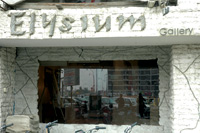 brushes here. To the pleasure of international audiences, Pakistanis do
not stick to traditional techniques, but create contemporary and post
modern conceptual art in miniatures.
brushes here. To the pleasure of international audiences, Pakistanis do
not stick to traditional techniques, but create contemporary and post
modern conceptual art in miniatures.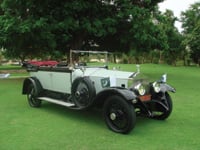 Sadiq Muhammad Khan Abbasi V. Yet, the 1924 Rolls Royce Silver Ghost was
attractive enough to make Muhammad Ali Jinnah, the first Governor General of
Pakistan, borrow it from the Nawab to ride across Karachi on August 14,
1947, the first day of the newly established state of Pakistan. Lord
Mountbatten, the last British viceroy to India is also said to have
accompanied Jinnah during this ride which is claimed to have stretched from
the Governor House to Sindh Secretariat in Karachi.
Sadiq Muhammad Khan Abbasi V. Yet, the 1924 Rolls Royce Silver Ghost was
attractive enough to make Muhammad Ali Jinnah, the first Governor General of
Pakistan, borrow it from the Nawab to ride across Karachi on August 14,
1947, the first day of the newly established state of Pakistan. Lord
Mountbatten, the last British viceroy to India is also said to have
accompanied Jinnah during this ride which is claimed to have stretched from
the Governor House to Sindh Secretariat in Karachi.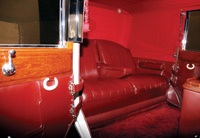 them among his personal collection. After the ride, the car was returned to
the Nawab and it remained with him till he died in late 50s, adds Chhapra.
them among his personal collection. After the ride, the car was returned to
the Nawab and it remained with him till he died in late 50s, adds Chhapra.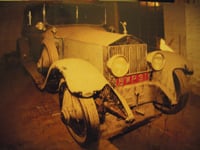 the custodian of Nawab's property as well as the fleet of cars during these
years until the heirs of Nawab reached on an out-of-court settlement over
inheritance dispute. The fate of the 1924 Silver Ghost of the Nawab, masked
with dust and rust for over four decades, was then decided through an
'in-house auction' of the fleet of cars held by the government of Pakistan
in 2004.
the custodian of Nawab's property as well as the fleet of cars during these
years until the heirs of Nawab reached on an out-of-court settlement over
inheritance dispute. The fate of the 1924 Silver Ghost of the Nawab, masked
with dust and rust for over four decades, was then decided through an
'in-house auction' of the fleet of cars held by the government of Pakistan
in 2004.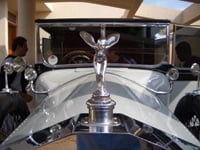 because of its next-to-silent six-cylinder engine in the car. Produced in
limited numbers, Silver Ghost is a rare car that was recognized as "the
best car in the world." Silver Ghost was a special car also because the
Rolls-Royce would only make the chassis for them, while the bodies were
later crafted according to the buyer's specifications. Given this, every car
was an exclusive one.
because of its next-to-silent six-cylinder engine in the car. Produced in
limited numbers, Silver Ghost is a rare car that was recognized as "the
best car in the world." Silver Ghost was a special car also because the
Rolls-Royce would only make the chassis for them, while the bodies were
later crafted according to the buyer's specifications. Given this, every car
was an exclusive one.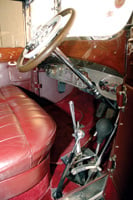 scratched, seat leather torn, windows broken and original parts of the car
were either broken or stolen. However, through his efforts the car is now in
a very good condition. "It's even better than the original," he
claims.
scratched, seat leather torn, windows broken and original parts of the car
were either broken or stolen. However, through his efforts the car is now in
a very good condition. "It's even better than the original," he
claims.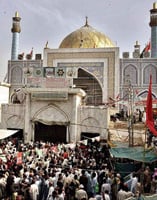 cultural heritage. It is a land of traditions and cultures which are
being followed despite the passage of centuries when various Sufi saints
and philosophers visited Sindh to spread the message of Islam,
brotherhood and peace.
cultural heritage. It is a land of traditions and cultures which are
being followed despite the passage of centuries when various Sufi saints
and philosophers visited Sindh to spread the message of Islam,
brotherhood and peace. forward to
the fulfillment of the promises that the party made during their
election campaign. However, not much has changed in six months.
forward to
the fulfillment of the promises that the party made during their
election campaign. However, not much has changed in six months.