



|
|
|
|
 |
 |
   |
cricket Rain
at Cardiff restricts squash Pakistan
cricket: Trapped in attitudes cricket Cricket would have to compete with the likes of not just Roger Federer and Rafael Nadal, but Michael Phelps and Usain Bolt besides a clutch of other superstars who enjoy a global identity that cricketers do not By Gul Hameed Bhatti Just when we thought
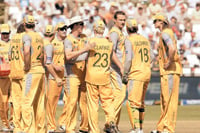
that we have had enough of cricket already -- although many in But the question still remains: Do the Olympic Games really need cricket? Or let's put the query the other way round. Does cricket actually need to ride the Olympics bandwagon to grab universal appeal? Shouldn't cricket continue to have its own private environment, away from the Olympic Games, as it has always had? According to several news reports recently, especially around the time when the Olympic Games were being played in the Chinese capital of Beijing, the move for 2020 cricket to be included in the 2020 Olympics had gained a growing number of high-profile supporters from the cricketing world, including Sourav Ganguly, Yuvraj Singh, VVS Laxman, Kapil Dev, Adam Gilchrist, Steve Waugh, Kumar Sangakkara and Stephen Fleming. Joining the band of players pushing for cricket's inclusion in the Olympics, Pakistan's present and former captains Shoaib Malik and Younis Khan said with the advent of the twenty20 event, the sport could easily fit into the Games' schedule. The two Pakistanis said cricket deserved to be a part of the biggest sporting extravaganza on the planet. The International Cricket Council (ICC) is already targeting a place in the 2012 Olympics or 2016 with the twenty20 version. "We are all professional cricketers and I for one would really like to take part in the Olympics which are the biggest global sporting event," Malik said. "It would be great to go to the Olympics and play cricket. The length of a match is a factor which has dissuaded the organisers from considering cricket as an Olympic sport but with twenty20 cricket coming into play things have changed," Malik stated. Younis said cricket was one of the top-five sports in the world and should be part of the Olympic Games. "Other team games are played in the Olympics so why not cricket. I am not concerned what type of cricket makes it to the Olympics... be it a 10 over version, 20 overs version or 50-50 but it must be there," Younis said. Cricket was last part of the Olympics in Paris way back in 1900 when Great Britain beat France to take the gold medal. But it is due to be played at the 2010 Asian Games in Guangzhou, China for a start. According to unconfirmed reports, hockey has been taken off the schedule of the next South Asian Games, to be held in Bangladesh late next year, and already replaced with cricket! Of course, there are arguments in favour of having cricket as an Olympics sport. There are several against it too. There's a suggestion that cricket be included at the 2012 Olympiad in London as a 'demonstration sport' and then "it would be 'even better' if New Delhi won a bid for the 2020 Olympics and hosted the inaugural Olympics cricket competition". CRICKET AUSTRALIA GETS SERIOUS ABOUT THE IDEA According to an AAP report Cricket Australia (CA) believes that cricket could be "the vehicle to give the Olympics a greater presence and TV audience on the subcontinent, which accounts for almost a quarter of the world's population". In turn, the Olympics would help cricket gain a foothold in new regions. "It would give cricket a global audience and help stimulate our push into markets like China and North America," CA spokesman Peter Young said. Australian skipper Ricky Ponting, Adam Gilchrist and Steve Waugh have already said that they would like to see cricket as an Olympic sport. CA has held informal talks with the ICC and cricket Boards of England and India on the issue. The topic is set for further discussion when CA chief executive James Sutherland and his fellow chief executives meet in mid-September. The International Olympic Committee (IOC) can decide by 2013 whether cricket can be included in Olympic as an event. Ricky Ponting says the global appeal of Twenty20 cricket will see it become an Olympic sport. "I think it's inevitable Twenty20 will be an Olympic sport," Ponting said. "The International Olympic Committee could do a lot worse than put cricket into the Olympics. Just think about the audiences in the sub-continent." The ICC has previously expressed support for pushing cricket as an Olympic sport, though Ponting has warned that any increase in Twenty20 competition must work inside the existing international calendar. Of course, the lure of the Olympics is not about earning money, of which there's already a lot on cricket's own circuit. But just imagine what winning an Olympics gold medal would do for an international cricketer's ego and stature. The success of the Indian Premier League 20-over cricket competition this year could pave the way for the sport to be admitted to the Olympics, one of the IPL's top executives has predicted. IOC chiefs have been scratching their heads as to how to get the subcontinent, with more than a billion people and a booming economy, more engaged in the Games. India won just three medals in Beijing, including its first individual gold courtesy of shooter Abhinav Bindra. But Pakistan won three less: for the fourth time in successive Olympiads since Atlanta 1996, they have returned home empty handed. An Indian official noted that cricket had a place at the Olympics early last century, but "the lengthy nature of the game had conspired to see it ignored by the IOC for a century". He said the dynamic, fast-paced nature of Twenty20 would be attractive to the Games organisers and fans around the globe -- including, he projected, the United States. He said with Indians showing little interest in the medal count at the Olympics, the inclusion of Twenty20 cricket would immediately attract the interest of more than a billion people in the region. Although he called for Twenty20 cricket to be part of the world's biggest sporting event, Australian captain Ponting also warned that it had to be handled carefully by international cricket bosses. CRICKET AT THE OLYMPICS IN 1900 Was the only cricketing event ever held at an Olympiad, back in the year 1900 at Paris in France, really an occasion to rejoice? A peek into the past suggests otherwise. Four teams had originally been expected to attend, but Belgium and The Netherlands (Holland) pulled out eventually, leaving only a Great Britain side to play a team from France. A contemporary report reveals: "Neither team was nationally selected. The British side was a touring club team, Devon & Somerset Wanderers. The French team (French Athletic Club Union) consisted of Britons living in Paris, reportedly mostly members of the British Embassy. By the captains' agreement the game was played as a 12-a-side game, unlike the usual 11 in most cricket matches. "The two-day game was played commencing on August 19, 1900. Great Britain batted first and scored 117. France were then bowled out for 78. Great Britain then scored 145 for five in their second innings, setting the hosts a target of 185, who were promptly bowled out for 26. This meant that Great Britain was convincingly the winner of the contest (by 158 runs). "The Great Britain team was awarded silver medals and the French team bronze medals, together with miniature statues of the Eiffel Tower. The medals were later retroactively reassigned as gold and silver. "With the match billed as part of the 1900 Universal Exposition, neither side appears to have realised they were competing in the Olympics. The match was only retrospectively formally recognised as being an Olympic contest in 1912, when the International Olympic Committee met to compile the definitive list of all events in the five modern Olympiads up to that point." Only two players ever appeared in proper first-class cricket -- both were Englishmen, Alfred Bowerman and Montagu Toller. The last named actually captured seven wickets for just nine runs when France were bowled out for 26 in their second innings. Cricket and the Olympics might still appear to be unlikely bedfellows, but it was one of the original sports listed in the provisional Olympic programme, Des Jeux Olympiques de 1896, published in 1895. Closely identified as being the archetypal play-hard-but-fair game, cricket fitted almost perfectly with Baron Pierre de Coubertin's Olympian ideal. The Wanderers finished their tour but were left less than impressed with the French -- described as "too excitable to enjoy the game", according to one contemporary journalist, who added that "no Frenchman could be persuaded to play more than once. A cricketer in France is a stranger in a strange land looked upon with mingled awe and contempt by the average Frenchman." DOES CRICKET HAVE A PLACE IN THE OLYMPICS? Probably not. Yet, various other sports have survived on the Olympic Games circuit for hundred years or more, although they now have their separate world events too. Many sports, like for instance hockey, have been in the Olympic programme, but the coverage they receive during the fortnight is miniscule compared to swimming, gymnastics and athletics. Now with the NBA stars too in attendance, there is already an invisible class system. For example, hockey "legends" like Teun de Nooijer barely attract a glance unless you are a woman player who has posed for magazines like 'Playboy'! Cricket, for instance, would have to compete with the likes of not just Roger Federer and Rafael Nadal, but Michael Phelps and Usain Bolt besides a clutch of other superstars who enjoy a global identity that cricketers do not. If cricketers believe that at the Olympics, they will enjoy the kind of frenzied following they are used to in the sub-continent, then they will have to think again. At the end of the day, Olympics is not about being a vehicle to promote a particular sport. Inclusion in the Olympics programme only gains a particular sport an acceptance as a sport and not necessarily a public endorsement. Perhaps, a few top cricketers do realise that they are not as big a name as at times it is made out to be. When viewed in the context of the Olympics, cricketers are merely localised heroes and certainly not global figures that they might secretly wish to be. Further, no cricket tournament can capture or match the romance and the drama of an Olympics. By joining the Olympic programme, cricket would lose its identity rather than global acceptance. It will become a small fish in a big pond at a time when it is better off being a big fish in a small pond so long as Lalit Modi can generate millions! Cricket will eventually make it to the Olympics, but it may not get the kind of coverage that it usually gets otherwise. Several other team sports like hockey, even football and tennis, don't get the kind of headlines that they are bombarded with in their own circuit. So many sports shouldn't even be part of the Olympics on the other hand, yet they continue to be on the list. Beach volleyball, once termed as nothing more than soft porn by its severest critics, still thrives. Team sports like baseball, basketball, football, handball, hockey, softball, tennis and volleyball, even synchronised swimming, may not have a place in the Olympic Games. The Olympics, after all, are about men and women's individual efforts and not just the achievements of a bunch of players called a team. The
writer is Group Editor Sports of 'The News' gulhbhatti@hotmail.com bhatti.gulhameed@gmail.com
Rain
at Cardiff restricts Andrew Flintoff was the main difference between the two sides. After four matches in the series, his batting average was 187 while he returned 12.90 with the ball By Khurram Mahmood Rain at Cardiff during
the last One-day International between England and South Africa Around 14000 spectators were in the ground to witness their side beat the Proteas in a fifth match consecutively and move to second place in the one-day ranking, but rain shattered their dreams. Kevin Pietersen's team won the NetWest ODI Series comprehensively by 4-0 and England finished as the third best ODI side in the ICC ranking behind Australia and South Africa. England could have been at an all-time high second in the One-day International rankings if they were able to complete a 5-0 clean sweep. But victory even by a 4-0 margin is impressive enough, especially when England had not performed well in one-day series for so many years. Just one month back, not one English player or their fans could think of such an outstanding performance from England, especially when they lost the Test series against the same opponents by 2-1 on their home grounds last month. Only once England have won any ODI series by a 5-0 margin and that was also against one of the weakest sides -- Zimbabwe -- seven years back in 2001, while they lost 5-0 against Sri Lanka on their home ground in 2006. Man of the Series Andrew Flintoff was the main difference between the two sides. It's very good news for England that this all-rounder has returned to top form with both bat and the ball. After four matches in the series, his batting average was 187 while he returned 12.90 with the ball. After an outstanding performance Flintoff has got the top position in the all-rounders ranking, before starting the series he was at the sixth position. The other and most important factor of England's victory was their new skipper Kevin Pietersen who turned a demoralised team into one of the best teams on the circuit. Kevin Pietersen, 28, was appointed England captain when Michael Vaughan stepped down after going down 2-0 in the Test series against South Africa. Pietersen, who led the national side in an ODI match only once against New Zealand last year, took the responsibility with full confidence and proved his quality in his very first Test as skipper when the disheartened England team beat South Africa in the last Test by six wickets at the Oval. The disappointed Michael Vaughan resigned as the most successful English Test captain with 26 wins in his five-year tenure. Kevin Pietersen led the side from the front and also scored a century in his first innings as captain. Before Pietersen, only four England captains have made hundreds in their first Test. Andrew Strauss at Lord's in 2006, Allan Lamb in Bridgetown in 1989-90 and Archie MacLaren in Sydney in 1897-98. After taking the Test captain's responsibility, Pietersen got elevated again when Paul Collingwood also stepped down as ODI captain after feeling the captaincy was affecting his performances. Once again Kavin Pietersen became the first choice of the selectors and again he accepted the challenge. In the shorter version of the game, England had a poor World Twenty20 record and have suffered back-to-back series defeats against New Zealand. Therefore, it was a great challenge for Pietersen to rebuild a split side into a fighting unit, especially against the second best ODI team. His approach in changing in batting order, field placings and bowling changes never showed his lack of experience. Kevin Pietersen started his first-class career with Nottinghamshire in 2000. In November 2004 he made his ODI debut against Zimbabwe in Harare where he scored 27 not out. The year 2005 was a lucky one for him as he scored three centuries in the seven ODI match series against South Africa on their soil. In the same year Pietersen made his Test debut against Australia at Lord's and remained the highest scorer in both innings with 57 and 64 not out. In the fifth Test at The Oval he scored his first Test century (158) which helped England save the Test and win the Ashes after 16 years. Before ending his lucky year (2005) Pietersen was named the ICC Emerging Player of the Year and the ODI Player of the year. Andrew Flintoff was the leading run-getter of the NetWest Series with 187 runs including two fifties with an average of 187 while opener Herschelle Gibbs scored the most 136 runs for South Africa. On the bowling side, once again Andrew Flintoff finished on top with 10 wickets in five matches at an average of just 12.90. Off-spinner Johan Botha and Jacques Kallis took four wickets each for South Africa averaging 23.25 and 22.75, respectively. The
writer works in 'The News on Sunday' in Karachi khurrams87@yahoo.com
squash Azam was at the peak of his powers when he last appeared on the professional circuit in 1962. That year, he had not only won the British Open and the British Professional titles but also the US Open By Dr Ijaz Chaudhry Winning the British
Open four times in succession is a no mean feat, yet Azam Khan, Now 81 years of age and settled in England since 1956, Azam Khan owns and runs the New Grampions squash club in London. Osteoarthritis in one knee forced him to stop playing squash a few years ago but he still spends a couple of hours every morning at his club doing exercises, including cycling. I asked him to tell me
about his journey in squash from the beginning. How was he "I was a tennis coach at the officers club of the Pakistan Air Force. My elder (and only) brother Hashim, who had won the last two British Opens, told me to switch to squash. I was 26 at the time and had never played the game." Yet within one year of Hashim's bidding, Azam was ready to take on the best in the world. "The Air Force raised the funds for a trip to Britain through exhibition matches in various bases. My first competition there was the British Professional Championship, where I defeated the British no.1 in the semis and lost to my brother Hashim in the final. In spite of this, the Squash Rackets Association (now England Squash) was reluctant to allow me to enter the British Open of 1953. "I was pushed into a 'trial' match against a top British player, which I won easily. Even then I was not given a seeding. I had to face the no. 3 seed in the first match whom I despatched in three straight games and progressed to the semifinal, only to lose again to my elder brother." But Azam Khan had arrived at the world squash scene, and the very next year he reached the final of the British Open for the first time, losing to... who else but Hashim. And the 1955 final was a replica of the previous year's. "At this point, British newspapers started running headlines such as a "family affair". So in the next two Opens, we were kept in the same half of the draw and came face to face in the semifinals." According to Azam, Nusrullah Khan, who was a professional squash player/coach with the SRA, played an important part in this arrangement. "Thus Nusrullah helped his brother Roshan Khan to progress to the final of both the 1956 and the 1957 Opens, where he faced Hashim. A 'just draw' was restored in 1958 and Hashim beat me again in the final." But the following year, the 'crown prince' took over. In 1959, Azam won the coveted title for the first time, beating his nephew Mohibullah in the final in straight games. He went on to win the title four times in succession. "The most memorable of those four truimphs was that of 1960. I trounced Roshan Khan (a distant relative) 9-1, 9-0 and 9-0 in the final. It's still the shortest final in the history of the tournament, lasting just 19 minutes." This had other repurcussions. The paying public felt short-changed, so the organisers decided to introduce a play off for third position for losing semifinalists before the final. Azam was at the peak of his powers when he last appeared on the professional circuit in 1962. That year, he had not only won the British Open and the British Professional titles but also the most important hard ball tournament, the US Open, for the first time. Azam then had to quit competitive squash due to Achilles tendon injury. The injury healed in about 18 months but he never returned to the circuit. "Yes, the Achilles healed but another wound never healed. I completely lost interest when my 14 year old son died in 1962. Thereafter my squash activities were confined to my club." There was a brief interlude -- and it was in the land of his brith. "I was on a private visit to Pakistan in late 1963 when the Pakistan Squash Federation (PSF) invited me to play in the National Championships. On their insistence, I reluctanatly agreed. I had remained crippled by the injury to my foot for about a year and a half and not only was completely out of practice but also found it painful to play. Moreover, I had not played on the cemented courts for several years. I still managed to win the Professionals final, overcoming Roshan Khan, who was ranked in the world's top three at the time. A few days later, I also won the Pakistan Open, again defeating Roshan in the final. "I settled in England in 1956. Since then, I have been to Pakistan off and on. My last visit was in 2000, when I was invited to a function organised by the PSF to honour Jehangir Khan." Why did he leave Pakistan? "Although I was a coach in the Pakistan Air Force, I'd been employed as a porter, with a monthly salary of 60 rupees (equivalent to five British pence at the current exchange rate). In 1953, when I reached the semifinal of the British Open on my maiden appearance, I was promoted to 'electrician' and my salary rose to 100 rupees per month. But the following year, when I finished as runner-up, far from being promoted, I was demoted back to the level of porter. The reason given was that the post of electrician no longer existed. "As I said, the Air Force only provided us with the return ticket; during my stay abroad, I had to take care of my own boarding and lodging. And unlike these days, there were very few torurnaments which offered prize money. Principal among them were the British Open, the British Professional, the Scottish Open and a few hard ball tournaments in the USA and Canada. So it was difficult to survive. "In 1956, I played an exhibtion match against Hashim Khan at the New Grampions club in Shepherds Bush. After the match, the owner of the club approached me and offered me the job of coach. The offer included a salary as well as accomodation. I had no option but to accept it. "The owner wasn't in good health and in 1957, he asked me to take over the club. I didn't have the financial resources to buy the club, so he asked me to pay in instalments over a period of five years. That's how I became to own this club." Hence Azam's association with the club is more that half a century old. And during this period it has been associated with the emergence of several outstanding players. "The very person who halted the Khan era in British Open history, in 1964, was a product of this club. Mike Oddy of Scotland ousted the defending champion Mohibullah Khan in the semifinal, thus achieving the distinction of being the first Briton since 1953 to reach the final -- which he lost to Abou Taleb." The club is also linked with the development of arguably the greatest squash player, Britain has ever produced -- a story that sheds light on what Azam might have achieved had he continued with his squash career. --More next week The
writer is a freelance contributor ijaz62@hotmail.com
Pakistan cricket: Trapped in attitudes Pakistan cricket should be intimately tied to the idea of progress: The idea of a systematic progress, of a development from the worse to the better needs to be introduced through theories of rational, global, technical development By Dr Nauman Niaz The great irony is
that Pakistan cricket is still fantastic, given half the chance. The Shame is that back-to-back chairmen of the PCB had full space and chances, not once but many times over, to walk away from it all, having done their bit, they didn't. Instead they clung to power and bred redundant attitudes. Cricket suffered. Now, with Dr Nasim Ashraf gone, regardless of how he had to go, why is everyone, and I mean everyone, acting like a stilly stick in the mud? You would have thought by now that everyone having blown their lid, let off steam and hurled expletives in the stratosphere, would have calmed down and thinking things through, but that's not happening. Instead the whole lot, expecting to catch the fish is going round the bend and there are more theories than insects which say a great deal about the cricket dilemma and an insult to all decent people holding newspapers in hand. Pakistan cricket is awash with theories of all shades, colours, hues and complexions. So what should we do? We need to realize how important it could be to understand the philosophy of modern sports and how to change our attitudes, if we really want to run with Australia and others, blowing minefields in world competitions. Australia has changed the philosophy of cricket. They adhere to the Olympic motto 'citius, altius, fortius' -- faster, higher, stronger, giving a precise concentrate of the strong belief in eternal progress. To break barriers, to push limits, is very important and central in Australian mindset. Modern cricket for a long time considered as a contrast to original game with its weight on harmony between body and soul. According to recent research this is a myth that was developed in the Edwardian clubs and county pavilions in England in the 19th century. WG Grace's game was desperately focused on the importance of winning and felt a corresponding shame over defeat. It was very individualistic, often brutal, with high money prices and rewards, with worship of heroes, with show for the masses, and so on. What we need to do is to believe that modern cricket has many parallels to the old one. But there are also important differences. One important characteristic of modern sport, that distinguishes it from the ancient, is the belief in continuing progress and the quest for new records. 1. Pakistan cricket should be intimately tied to the idea of progress: The idea of a systematic progress, of a development from the worse to the better needs to be introduced through theories of rational, global, technical development. The new use of reason and science should improve the conditions of all men. Early theories had been theories of rise and fall or of a steady decline. We need to focus on the original state. In Pakistan, despite tall claims there have been growth crisis in several areas. In cricket management there must be limits somewhere. Contrary to what we have tried to sustain in the preceding couple of years, Australia has given newer dimensions to the word 'limit'. With increasingly better performances and new world records one seems to get asymptomatically closer and closer to an imaginary limit that marks the boundary for what is possible for a human being. But what will happen when performance stagnates, when no new records are set for years? A central problem is whether the idea of a linear progress should be given up, in cricket as in other areas, and exchanged with more flexible, dynamic, stability-oriented paradigms. Or, if the idea of progress is maintained, how should cricket be developed to avoid becoming stagnant and sterile in its pushing of limits? 2. Elite Cricket is a child of liberalism. Liberalism, as it was developed in the traditions, contained the idea of a free market with free access for actors who compete and are rewarded according to effort and skill. Cricket is a legitimate child of liberalism with in principle free access for players to test their skills against others under equal conditions, according to prescribed rules and with rewards according to performance. The liberal society is an achieving society. So is cricket -- or the other way around. Some philosophers think that cricket in many ways represent a perfect model for the achieving society. No other place gives a better opportunity to test one's skills and abilities in a hard, fair, and open way, and with a reward according to performance. 3. The breakdown of global maximisation. The faith in a heaven often includes a notion of a complete and simultaneous realisation of all types of goodness. Our experiences in the real world often points in an opposite direction. Progress in one area must be compensated by decline in other areas. Or expressed in a more precise way: It is impossible to optimise all parameters at the same time, global maximisation is impossible. Let us suppose that elite cricket is evaluated according to the following parameters: performance, joy, cultural value, health, morals, social community. In some elite cricket organizations there seems to be a sort of convergence model where all parameters are thought to be converging towards a common optimum. The elite player/cricketer and his maximum performance is supposed to be in the center and all the other evaluation parameters are optimised at the same time. The elite cricketer should be healthy, happy, moral, social and so on. Models of this kind have to be well founded if they are going to look plausible. How plausible are they? Performance will most likely grow according to the S-shaped growth curve which we find in several areas of life. A slow increase in the start is followed by an almost linear growth and then a slowing down as the growth curve gets closer to the asymptotic limit. This means that as increase in performance in the end will become rarer and smaller. Improvements in performance will then have to be bought at higher prices, with new and more distant factors becoming affected. We know that both health and ethical values have become problematic in elite cricket. The standard of morals seems to be inversely related to level of performance. The health problems probably follow an algorithmic increase model as the performance limits are approached, at least in all sports with heavy demand on speed, strength or endurance, as well as sports with high speed or risk and acrobatic sports. 4. Elite sport; the individual and the system. Modern cricket is completely dependent upon the system of people and resources around the cricketers. There is system upon system in ever widening circles, starting with 1) the player 2) the coach 3) the medical personnel, equipment support. It goes on with the wider circle of 4) science, technology, 5) leaders, organisation, 6) sponsors, marketing, business, and with 7) media people, journalists, 8) fan clubs, public. The development of sport into systems, called the 'totalization process', makes cricketer a part of huge teams or organisations that fight and compete with each other in various ways, not only in the sports arena, but also in the press, in the sponsor market, in the politics. 5. Sectorised or common morality? There is another interesting problem about morals that surface in elite sport. Are all people in a society committed to the same universal morality or are there different moralities in different sectors of society? According to deontological theories of a Kantian type moral rules must be universal. No private morality! 6. A common morality for hard achievement work. Cricket is professional in many senses of the word. It includes hard training, it has high quality of performance, and it is an often a full time job. Cricket is now included in the group where other full time achievement-oriented professions belong, like musicians, painters and sculptors, researchers and scientists, acrobats, stuntmen, and circus artists, business leaders, top politicians, leading actors. I think it would be fruitful to develop a common work ethic for all people that work hard to push limits, do the impossible, break new barriers. It is long since cricket was an innocent amateur pursuit. But many of the rules of conduct, the ethos, regulations belong to the old ideology. Should we allow people in some areas to develop another type of values and rules, another ethos and morality than ordinary citizens? Probably not, if morality is defined as something that regulates human interaction and obligation to others. 7. The ethical tolerance level. Suppose ethical actions can be placed in a space where there is positive and negative sector, and between them a sector of ethical indifference (What the Greeks called 'adiafora'). In Pakistan, the army of inept people, self-serving sycophants and cheap, hick town opportunists whom our managers present and in the past have approved of, and elevated to positions of great and totally undeserved fortunes and official clout, revealed their real colours as soon as the chips began to come tumbling down. Here we have had a question of leadership both of the team and the PCB and also we as we are, we have been a bunch of cold and timid souls. |
|
 Pakistan would tend to disagree as we currently feel being
internationally sidelined -- several others around the world believe
that now cricket should even be in the Olympic Games. Now that cricket
has an 'Olympics style version' in its twenty-twenty format, it could
very well be a part of the world's multi-sport, multi-nation circuit
within the next few years.
Pakistan would tend to disagree as we currently feel being
internationally sidelined -- several others around the world believe
that now cricket should even be in the Olympic Games. Now that cricket
has an 'Olympics style version' in its twenty-twenty format, it could
very well be a part of the world's multi-sport, multi-nation circuit
within the next few years.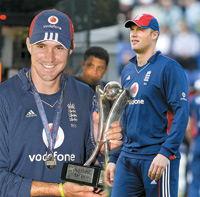 washed out not only the match but also the England players and
spectators' hopes of a whitewash against South Africa for the first
time.
washed out not only the match but also the England players and
spectators' hopes of a whitewash against South Africa for the first
time.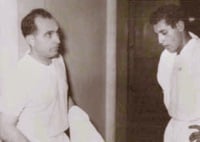 who achieved just that between 1959 and 1962, has not been given due
recognition by sports historians. There is a reason for this. His
victories came at a time when the British Open was already Pakistan's
domain. His elder brother Hashim Khan had won the title as many as seven
times before him, so only those with comparable achievements are
mentioned in the same breath: Jahangir Khan, Jansher Khan, Geoff Hunt
and Jonah Barrington. Neverthelss, some people are of the view that Azam
Khan was the greatest of them all -- and there are reasons for this too.
who achieved just that between 1959 and 1962, has not been given due
recognition by sports historians. There is a reason for this. His
victories came at a time when the British Open was already Pakistan's
domain. His elder brother Hashim Khan had won the title as many as seven
times before him, so only those with comparable achievements are
mentioned in the same breath: Jahangir Khan, Jansher Khan, Geoff Hunt
and Jonah Barrington. Neverthelss, some people are of the view that Azam
Khan was the greatest of them all -- and there are reasons for this too.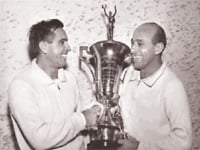 lured into the game?
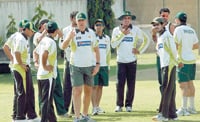 players -- not the forcibly installed management teams -- are capable of
doing great things provided there is a reasonably level playing field.
Life here -- in spite of management failures, the political
contamination, absence of discipline, the lack of adequate protection of
cricketers and their careers, in spite of depressing facets of sporting
life to which we have been exposed everyday -- is still not half bad.
players -- not the forcibly installed management teams -- are capable of
doing great things provided there is a reasonably level playing field.
Life here -- in spite of management failures, the political
contamination, absence of discipline, the lack of adequate protection of
cricketers and their careers, in spite of depressing facets of sporting
life to which we have been exposed everyday -- is still not half bad.