



|
|
|
|
 |
 |
|
visit Long
flight home Though Paris unveils its charms to newcomers in a slow manner, I had resolved to keep the process of knowing Paris a bit more intimately By Arif Azad Paris, even when it is in
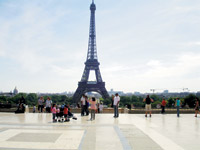
doldrums, is never boring, wrote Saul Bellow, the great American novelist. Though Britain is firmly anchored in Europe, there is still a strong Europhobic political current that runs through the political and psychological systems. This current is more pronounced in the Conservative party than the Labour party. Part of this Europhobic feeling stems from British long-standing policy of splendid isolation -- operated between the 17th and 18th century, if by playing one nation off against another in Europe without getting British hands dirtied. Europhobic feelings generated within political class, breaking the ordered bounds, filter down to the general public too. This hits you in the face when you mention your intention to visit a European City -- say, Paris -- and you get a strange reaction along the lines: Oh! You are going to Europe, as if Europe were a far off continent of whom Britons knew nothing of. I always travel to Europe, in some ways, carrying this acquired ideological baggage gathered out of my long residency in England. Regardless, I bought the
ticket and crossed the English channel, as opposed to my previous visits Well actually, over the last ten years the right-wing British tabloids have raised such a noise over the issue of lax immigration at Dover that Labour government, in one knee-jerk reaction after the other, capitulated by introducing annoyingly tough border controls at both Calais -- the first port city on the French side of the border -- and Dover. As a result Dover and Calais have the visible signs of inwardly-looking Europe in a globalised age. After negotiating immigration control, I boarded the ferry which rolled rolling merrily over the sea to other side of the border. This bit of journey, most soothing and comfortable, feels like coming to a close too quickly. From Calais, another three to four hour's journey deposited me at the Euro lines international terminal on the suburb of Paris. Having ensconced myself in my friend Julie's flat in an artistic enclave, I headed out to get the first taste of Paris. Julie, a French, and Ralph, a German, represent Franco-German axis in alternative politics of social movements (Franco-German political axis has been the pet hate of Britain Europhobes). Both have been involved in the World Social Forum (They met at the European Social Forum and have been together since). From Julie's flat, the city centre is either within cyclable distance or requires two three stops on the metro, which is more efficient than London tube (the fares are low; trains run on time and spill out less of humanity out in the street during rush hours.). One of the more recent innovative and environment-friendly transport solutions has involved the introduction of city-sponsored cycling scheme. The scheme lets you use bicycle free of charge for half an hour within Paris. An ever increasing number of Parisians are taking to the scheme. In summer, the road along the river Seine is closed off to vehicular traffic and instead sand is nicely laid out on the road to provide a sandy beach for tourists and Parisians. No wonder, sandy beached portion forms the major magnet. Nearby, in the Chatlet area a crowd forms in the area around Notre Dame Church during night. You can see a small knot of musicians strumming on guitar and always on hand to disperse mellifluous music into the nice cool night. With music vibrating into your ears, you can go gently into the night and the buzz of Latin Quarter. I only discovered the Latin Quarter nightlife scene during the last few days of my stay and regretted for not visiting before. After the endlessly talked-about Eiffel tower, Louver museum deserves a special mention. It is too grand -- it covers vast network of palatial building sited in a pleasant garden -- and is too elegant to be missed. Having braved the long queue, I entered the museum, walked to and fro and walked up and down for hours in the biggest museum in the world. I spent most of my time in the sculpture and the Italian painting sections. The paintings section containing the famous Mona Lisa is always jam-packed. You count yourself lucky if you get a toehold within a viewing distance. The museum opens into the elegantly elaborated garden, opposite which stands another muse d'Orsay. My destination, after getting a fleeting view of other tourist attractions, was the Left Bank famous for its literary cafes. This forms the hub of Parisian intellectual life. By far, the most famous literary cafés on the left bank are: Café De Flore and café Les Deux Magots. There is hardly a major writer or artist, living in Paris, who has not been to one of these literary cafes. Jean Paul Sarte and Simon De Bouver were regulars at Café De Flore. I spent time in both of them, sitting silently and watching the day and the Parisian crowd goes by. Waiters at the cafés are very polite and try hard to meet the history-laden expectations from clients who come from far and near. Paris' reputation as the magnet for artist and writers from far off is well established. From the dawn of the twentieth century, the city has hosted and inspired writer ranging from Picasso, Hemmingway, Oscar Wilde, Ezra Pound. In recent time the city offered productive and stimulating refuge to James Baldwin, a great black American writer and Susan Sontag, the great America public intellectual and essayist and novelist. Indeed, most of her brilliant essays on the European art and culture were written in her Paris flat. Paris's lasting attraction does not spring from arts alone though. President Sarkozy has added to this allure though his extra-parliamentary romantic romps. On account of his romantic adventures, and because of his outrageous right-wing, he is always on the cover of newspapers, so much is his penchant for publicity. My long-standing interest in the issues of immigrants has always tended to focus my mind on the French case. France is home to a majority of Muslims living in Europe. In 2004, race riots erupted in France which involved the second generation immigrants going on a rampage, burning cars to protest the deplorable situation they have been pushed into as result of discriminatory policies of the state. The current president, Nicholas Sarkozy, then the interior minister, doused fuel on this simmering fire of resentment by labelling them immigrants and scums of the earth. By so doing, though Sarkozy garnered far-right racist vote which was previously in the bag of Le Pen' National Front, he failed to address the root-causes of second generation of immigrants -- mostly from Morocco and Algeria -- alienation, unemployment and discriminatory practices inherent in the state structures. It is well-documented now that the rate of unemployment is disproportionately higher among immigrant population, compounded by dangerously low representation of ethnic minority in the decision-making structures of the government (in fact, French law does not allow this category to be used as the law assume all citizens to be equal irrespective of ethnic or religious origin). Though Sarkozy has pledged to correct the situation, there is yet a very long way to go. One illustration of this pessimism, I detected, among my fellow traveller, Pauline, whose parents moved to Paris in the sixties from French Caribbean. Finding no future in France she moved to London four years ago; her other sister too moved to Canada for similar reasons. Against this background France has to go an extra mile to re-engage second generation immigrants, like Pauline, in national life in a meaningful way to live up to her founding principles of liberty, equality and fraternity. Few recent developments in the creative media, however, furnish an indication of baby steps being taken in this direction. One recent film Cache, directed by Michael Henke, has lifted curtain from the massacre of Algerian immigrants agitating for independence of Algeria from France in Paris in the 1960. The film exposes the lingering guilt that has hung around the conscience of liberal French middle class. More recently, Indigenes explored the officially hushed role of non-French soldiers from French rule colonies in Africa in liberating Paris from its long-laid siege. These films have served to acquaint the French public with a suppressed bit of their history. My friend, Julie, always makes a fine distinction between British colonialism and French colonialism. She thinks that French colonialism was more invasive and total than the British , because French colonialism sought to Frenchify people while British colonialism sough to exploit resource only and kept local cultural and religious practices intact (This differential approach still informs British multiculturalism from French secular state where no cultural , religious distinctions are entertained) I often wonder that if Julie thesis is to be accepted then it quite natural to see the emergence of major anti-colonial theorists like Franz Fanon and Albert Memphi -- both from the French colonies of Algeria and Tunis -- whose major theoretical works laid bare the insidious psychological effects which invasive and uncompromising civilising mission inherent in French colonialism have exerted on the colonised Though Paris unveils its charms to newcomers in a slow manner, I had resolved to keep the process of knowing Paris a bit more intimately.
I found long details of people's travelling experience boring and uninteresting till this time... By Sarah Sikandar I had never enjoyed reading
travelogues because I found long details of people's travelling Two months ago I embarked on my first international journey accompanied by the warnings and cautions of family and friends. After spending two months in England and America I was only too glad to go home. Despite being bed-ridden with high fever I felt relatively fresh that morning. All went too well until I missed my connecting flight from Washington D.C. to London. What followed can simply be defined as "a series of unfortunate events." Once I got to the airport
-- only twenty minutes prior to the take off I was told there was no way I
could make it. I told the Asian staff woman (I named her 'Chinese or
whatever') how she can be my saviour but she smiled at me as if saying
"I can but I won't." But the puss-in-boots acts didn't work here.
Only seconds later she opened her Chinese eyes as wide as she could to tell
me how lucky I am because she found me another flight for London and I could
check-in in two hours. I said it so abruptly I couldn't even hear myself say
"of course." But ah! Here is the catch! Since it was my fault that
I missed my flight I owed the company $150. Again because it was my fault --
a line that would resonate for the next fifteen hours. Since I had no cash
with me I asked my cousin for her credit card which miraculously didn't work
that day. My luck. I was still planning out my next strategy when she told me
to check in the bags (which I knew were over weight). I thought I should
rather keep my mouth shut but who can shut away those computers. Since I
already knew my luggage was over weight I had come prepared. I opened both my
suitcases and put the extra I almost reached half an hour after my next flight from London had taken off. I had two options: go to the United Air people to give me another ticket because their flight was late or ask Qatar Air to book me for their next flight. Since I was at Terminal 1 I thought it would make sense to wait for someone to appear at the Qatar Air counter. An hour lapsed like a minute but nothing like a human being appeared behind the counter. Another half an hour and a man finally shows up only to tell me it is not their fault because their flight was on time. Since my flight from D.C was late he told me to go and see someone from United Air at Terminal 3. I dragged my feet and waited for the bus to get to Terminal 3 with my overloaded handbag, a laptop and a scroll bag. About fifteen minutes later I was at United Air counter. I tried to look angry, which I was, and told the Asian man to give me anything to Lahore, Islamabad or even Karachi. "I'll find something for you" and he told me to relax. That wasn't hard, I thought. The computer didn't show any flight to Pakistan. Those available were booked. He gave up and called another lady who looked at me like "oh she's a desi." "Why is she coming down on us?" she asked her colleague and I smelled trouble. She told me she can't find anything for me. I told her maybe she should look again. She told me to go back to Qatar Airways counter and get another ticket because it was my fault I missed my flight. But I had already paid a hundred and fifty dollars for 'my fault.' She left her chair and came back with the 'bad cop.' I don't think I will forget his demonic face for many days to come. He abruptly started talking in a twisted accent telling me it was my fault I missed the flight. I don't even remember how many times he repeated himself. I told him I had paid the fine for missing my flight. He took my ticket and wrote on the back of it "The passenger missed flight, cousin lost way. Please don't send again U(nited) A(ir) not responsible." He under lined UA. Twice. I couldn't believe my eyes. I called back home and said nothing. Because I couldn't speak. Embarrassment or anger I couldn't stop crying for the next two hours (and I am not proud of it). I decided to go back to Terminal 1 to look for someone at Qatar Airways counter. I security checked for the third time in four hours. As expected there was no one at the counter. I waited. I was told there was no flight for the next five hours so the counter wouldn't open till then. I made my way to the gate where I could find someone from Qatar Air. Another fifteen minutes walk. The beautiful blue eyed girl repeated the whole 'since it was my fault' thing again. The only option I had was to buy another ticket. You got to be kidding me. Another call home. "Stop crying like a baby and tell me what happened." How rude. My brother kept telling me to call his friend but I thought I could manage. I was wrong. For the next one and a half hours I walked like a zombie thinking why I even came here. I could swear I heard myself say a thousand time "I just wanna go home." Almost five hours had elapsed since my arrival. I suddenly thought of a number I had written on a piece of paper with my eye-pencil. It was my brother's friend. I was utterly hopeless he will be able to do something but he was my last straw. The awfully nice man at the immigration desk asked me if I was okay and I told him to tell me the way out. Looking at my passport he told me his encounter with late Benazir Bhutto and how she was so nice to him. Maybe United Air should learn something from her. Next stage: find my brother's friend. I later realised he had left his fiancé at the market to come here. He told me to relax and give him my ticket. Only three minutes later he was back with my ticket. No, not the old one. A new ticket for Lahore that leaves the next morning. I couldn't believe my eyes. How did he do it? He just told the staff member that since it wasn't my fault, they should give me the ticket back home. But isn't that what I have been trying to tell them? Talk about discrimination. Wait a second. What about my luggage. After a fifteen minutes walk to Terminal 3 we realised the luggage should be at Terminal 1 because that's where I came. It took the staff woman another half an hour to find the luggage. The carton was torn from the edges with peep-toes peeping out of it. At that moment, it didn't even seem like a problem. The journey back home proved to be longer than I had imagined. I think I now know what Maya Angelou was thinking when she said, "I've learned that people will forget what you said, people will forget what you did, but people will never forget how you made them feel."
|
|
 And he is dead right on every count, having observed French life from close
quarters. After spending a few weeks in London my itchy-foot insisted on
venturing across the English channels.
And he is dead right on every count, having observed French life from close
quarters. After spending a few weeks in London my itchy-foot insisted on
venturing across the English channels.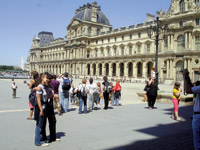 via Eurostar train, which snakes underneath the channel. The bus journey
turned out to be an entirely different ball game, not only in terms of time,
but also in how cheap holiday-makers are viewed at the border between England
and France. The bus taking you to Dover -- a journey lasting about two hours
-- is thoroughly searched by immigration and police official on both sides of
the border. Because the buses are usually used by students and cheap
travellers, the immigration regime is tougher and menacing in comparison.
Poverty thy other name is tougher immigration.
via Eurostar train, which snakes underneath the channel. The bus journey
turned out to be an entirely different ball game, not only in terms of time,
but also in how cheap holiday-makers are viewed at the border between England
and France. The bus taking you to Dover -- a journey lasting about two hours
-- is thoroughly searched by immigration and police official on both sides of
the border. Because the buses are usually used by students and cheap
travellers, the immigration regime is tougher and menacing in comparison.
Poverty thy other name is tougher immigration.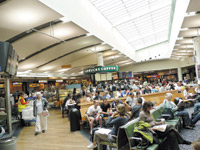 experience boring and uninteresting. No offence. Only recently have I
realised it could be my lack of experience as a traveller.
experience boring and uninteresting. No offence. Only recently have I
realised it could be my lack of experience as a traveller.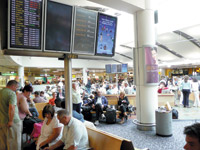 luggage into the suitcase I had brought with me. Problem fixed. Not yet. Who
will pay for the extra luggage? She politely asked me to pay another $140 as
if I had managed the money she had asked for previously. (I looked at her as
if she is the last generous soul on the planet. But of course she wasn't. She
told me I had to pay otherwise I could leave the extra bag there. I don't
even know what made me say "but I have pounds." She gladly pointed
to me the currency exchange counter. Only God knows how that money slipped
from my hands to those Chinese hands. I went straight to the restroom to let
eyes vent my anger out and made my way to the gate only to learn that the
flight was late. Things are under control now, I told myself and waited to
board the flight that promised to take me home.
luggage into the suitcase I had brought with me. Problem fixed. Not yet. Who
will pay for the extra luggage? She politely asked me to pay another $140 as
if I had managed the money she had asked for previously. (I looked at her as
if she is the last generous soul on the planet. But of course she wasn't. She
told me I had to pay otherwise I could leave the extra bag there. I don't
even know what made me say "but I have pounds." She gladly pointed
to me the currency exchange counter. Only God knows how that money slipped
from my hands to those Chinese hands. I went straight to the restroom to let
eyes vent my anger out and made my way to the gate only to learn that the
flight was late. Things are under control now, I told myself and waited to
board the flight that promised to take me home.