



|
|
|
|
 |
 |
   |
education vandalism
education Technical education contributes significantly to the economic development of the country, but unfortunately this sector is not receiving the due attention of public authorities. As private technical training institutes across the city continue to prosper, it is the students at public sector schools that are at the suffering end who are unable to compete in the local and international market because their knowledge is not up-to-date. By Aroosa Masroor At a time when
graduates from various colleges and universities have a hard time
getting jobs, Partly to blame is the mindset of the middle-income class which is unwilling to get its hands dirty in order to make a living. Equally responsible are successive governments who have allocated billions for technical training but have little to show in the form of skilled and semi-skilled workers. Instead, the way is being shown by private training institutes and centres. "We have got enough labourers and computer engineers in the market, but not the skilled professionals required to run our labour-based economy," comments Marcus D'Sa, Principal St Patrick's Institute of Science and Technology. He says there is a need to "fill the gap" which is what his institute aims at doing. The institute is
currently training over 1,000 students in two different shifts and the
graph of Market potential Mohammad Rafique, a parent visiting the Government Technical High School located in Saddar for his son's admission, told Kolachi: "After doing a lot of research, I made the decision to enroll my son in a technical school. I know for a fact that once he graduates, my son will not have to run from pillar to post for a decent job. He may not make good money instantly, but I don't want to see him frustrated like other unemployed young men. As long as he will be able to bring home some money, my wife and I are happy," said Rafique who is employed at a bank in Mehmoodabad. Many parents have started to think on the same lines. The Principal of
Government Technical High School, Syed Arif Ali, agrees with this
assessment. After However, educationists feel that just 'recognizing the degree' is not the solution to the problem. With numerous government and private technical institutes running in the city and all over Sindh, what is needed is promotion of this sector of education, so students can realize that vocational education is financially rewarding too. It may be recalled that the government established the National Vocational & Technical Education Commission (NAVTEC) in 2005 in an initiative to promote technical and skill development. In collaboration with the Ministry of Tourism and the Pakistan Institute of Hotel and Tourism Management (PITHM), NAVTEC has been imparting skill-based education in the tourism and hospitality sector. "As markets
trends are changing, the courses are designed to impart skills to both
men and women But Badar Hussain says that most of those trained are geared for the demands of the international market. There are also some training programs for those wishing local employment. Because of the demand in the local market for properly trained drivers, NAVTEC Sindh will soon launch a training program for drivers in collaboration with the District Government. And yet, most who acquire technical training want to go abroad. Manpower export But what is the use to
the Pakistan economy if the person trained leaves for greener pastures?
Skilled The demand for mechanics, electricians and welders is high in the Middle East and diploma holders of Pakistan are able to compete in the international market. However, in the absence of a certificate, they are required to pass an alternative examination to get accreditation. Then there are gaps left in between. What is surprising on the other hand is while institutes across the country are producing trained electricians and plumbers for the international market, there is no formal training for housemaids who are also much in demand. "We refrain from sending our housemaids in the international market because we fear they may be exploited by agencies involved in the flesh trade" Executive Director NAVTEC, Athar Tahir, said. On the other hand, industry observers claim that the country has still not reached the 'social phase' where even housemaids are required to have a high educational background. "They acquire their skills on the job. If domestic servants are educated or trained, they would eventually demand more salaries which many would not be able to afford," remarks Shaheen Azfar, a teacher at a private school and resident of PECHS in Karachi. This may not entirely be true, say other city residents, who add that they would be willing to pay more for a housemaid who is properly trained in areas of hygiene and is groomed. The presence of Filipina maids in the city attests to the fact that many want to hire better quality maids and are willing to pay. Azfar, however, adds that considering the level of poverty and rate of illiteracy, basic education should be the target of the government after which quality technical education should be imparted in public sector schools. Public sector schools worse off But that may not be the answer. In terms of technical training, government school students, unfortunately, stand no where in terms of ranking. While private institutes like the St Patrick's Institute of Science and Technology, Young Men's Christian Association (YMCA) Polytechnic Institutes and Jinnah Polytechnic Institute among others have kept themselves abreast with the changing trends in the industry, public sectors schools have not been able to do so. Lack of basic facilities, obsolete training equipment and an outdated syllabus are a major setback for students at government institutes. This affects the quality of education being offered at the schools. "The training manual of Sindh Board of Technical Education (SBTE) has not been changed for more than ten years," officials at a government technical school said. An SBTE official, when questioned, held the federal government responsible as it withdrew powers from the provincial education department to update the syllabus according to the market requirements. "The decision-making power was transferred from the provincial to federal government in 1986 and the syllabus is now updated at the National Institute of Science and Technology, Islamabad," informs Rashid Aziz, Joint Director Research at SBTE. He confirmed that the syllabus was last updated in 1996. There are pros and cons in this system, claims Aziz. "If you go to see, the power with the federal government means the entire country is following the same syllabus. But it also means that frequent update of the syllabus at the country level would be difficult." The students studying at public sector schools are hence at the suffering end who are unable to compete in the local and international market because their knowledge is not up-to-date. Ali added that government schools relied on theory during the first few years of teaching rather than practical training as most schools in the public sector are not properly equipped with technical apparatus for hands-on training of the students. It is after attaining the Technical School Certificate (equivalent to Secondary School Certificate/Matriculation), that students are exposed to technical equipment. Moreover, in a recent move by the government to facilitate students, even the nominal fee of Rs114 charged for the maintenance of the school had been done away with. "It becomes difficult to generate funds even for the cleanliness of the school premises. In such circumstances how can we collect funds for equipment?" questions Arif Ali. Due to this, the public sector is also unable to hire professionals from the industry as they cannot afford to meet their (teacher's) financial demands. The state of affairs, Ali feels, will not improve unless basic needs of the school and teaching staff are met by the government. Rashid Aziz added that the state of affairs at the education department should be handled by technical staff rather than a non-technical one, as the latter would never understand the challenges of the industry. To overcome this problem, the St Patrick's administration, chose to join hands with Toyota Motor Corporation and launched the "Toyota Technical Educational Program (T-TEP)" in 2004 to create apprenticeship opportunities for students. According to a research conducted on "Problems and Prospects of Technical Education in Pakistan" recently by Iftikhar Hussain Shah, member University of Arid Agriculture, Rawalpindi, teachers of technical institution should be abreast with modern teaching methodologies and the institute and industry linkage is necessary for the promotion of technical education and development of Pakistan. This is not usually the case. 2010 Technical Education target unachievable In his research, Shah notes that while objectives of technical education in the country are adequate, they are not formulated after proper research. "Technical education implementers and administrators are not consulted during planning stages and education policies are not realistic and achievable," he mentions in his study. Experts of technical education have expressed dissatisfaction over the allocation and release of funds and say there is a leakage too. Moreover, political instability and improper monitoring are the major causes of failure of plans apart from the outdated curricula that should be at par with international standard, comments Shah. Considering the state of affairs, Marcus D' Sa further added that the government's stated policy objective outlined in Medium Term Development Framework (2005-2010) "to develop a technical education and vocational training system to produce a skilled workforce of 0.95 million annually by 2010" is also unachievable for which the government would have to double their efforts. It is thus important that the government shift its focus from formal to technical education as it is the need of the hour, or at least, give this sector the attention and funds it deserves, conclude many. national asset Firing up the Thar coal project Although the Thar Coal project has kicked off, differences between the federal and provincial governments is further delaying the exploration By Adeel Pathan Two decades have
passed since the discovery of huge reserves of coal in the deserted area
of the The site, discovered in 1993 by the government of then Prime Minister Benazir Bhutto, led to the creation of Sindh Coal Authority through a bill unanimously passed in the provincial assembly. The body was formed to exploit the resources of coal in the province. But with the dismissal of the Bhutto government in 1996, the project came to a standstill. Although the present government, led by the PPP, was once again eager to kick off the power-based project in Tharparkar, some differences within the federal and provincial governments has further led to a delay in the project. Recently, when the coalition government in the center issued a notification about formation of Thar Coal Authority with only one member from Sindh – the Chief Minister Qaim Ali Shah – as head of the authority, think tanks in Sindh opposed the move. They resented the fact that majority of the members were from the federal government when the site is located in the province of Sindh, and hence a provincial matter. Sindh Minister for Information, Shazia Marri, went on record saying that the notification regarding the Thar Coal Authority was considered "irrelevant" because coal is a provincial subject. This led the government of Sindh to officially oppose the said authority. Later in July this year, the provincial government of Sindh formed the Thar Coal Energy Board (TCEB) with majority of ministers from the province. However, this time as well the adviser to Chief Minister on Mines and Minerals Dr Khatumal Jewan was not included in the board. This was despite the fact that Dr Jewan is also a resident of Tharparkar and well-aware of the issues in the district. The new board comprises six members from Sindh including the chief minister Qaim Ali Shah (as chairman), his son Asad Shah Jillani, Syed Murad Ali Shah (Revenue minister), Jam Mahtab Dahar (Minister for Population Welfare), Jam Saifullah Dharejo (Minister for Irrigation) and the Chief Secretary of Sindh. The remaining members are from the federal government. "Representatives of the federal government in the TCEB are only to facilitate the whole process of the mega project at Thar. The royalty and income from the project would come to Sindh," Asad Shah Jillani of TCEB told Kolachi. According to the Geological Survey of Pakistan (GSP), coal – also known as the 'black gold' – is found in all the four provinces of Pakistan. However, the bulk of it (approx. 175 to 185 billion) is found in the Sindh province that is sufficient to meet country's fuel requirements for centuries. It is one of the world's largest lignite deposits discovered by the GSP in 1992 and is spread over 9,000 square kilometers. The site is located at a distance of 70 kilometers from the district headquarters of Tharparkar, Mithi. Only four-wheel drives can access the mining site. Experts add that Thar coal reserves in the country, if exploited properly, can generate more revenue than the oil reserves in the Middle East. The coal reserves can produce about 0.1million Mega Watt of electricity which would not only be sufficient to meet the national requirements, but would make the country capable of exporting power to its neighbors, including India. However, it is not as easy as it sounds. Recently, during a visit to the site in Tharparkar, it was observed that a lot more needs to be done on war-footing basis as there is no proper infrastructure available, including the non-availability of water. Residents of the district complain that the site has long been ignored by the government. Moreover, local representatives of the PPP complain that they have no say in exploiting the reserves in the desert, where they have been staying for years. The government does not consider their opinion worthy enough of attention, which was proved during the selection of members for the TCEB. Commenting on the poor infrastructure in the district, Jillani added that feasibility studies of the Thar coal would be updated soon and the government is making all out efforts to start the project as early as possible. A conference in this regard was also organized in Washington recently to seek the attention of foreign investors in the power project. But before that, there are some local issues that require the attention of the powers that be which includes compensating those people who would be displaced during the process of mining and power production. Perhaps, it is time the government of Sindh acted hastily and came forward to address the grievances of one of the most important (yet neglected) district of Tharparkar. A wise move would be to give the residents of the district some representation in the Thar Coal Energy Board to avoid any confrontation (from the locals) that would further delay the project as energy crisis in the country is an issue that needs to be tackled at the earliest. vandalismWalls that speak Graffiti takes a
different shape in Karachi where one can find message varying from
political to Wall chalking is not a new concept for Karachiites. Graffiti has been a part of any living community on earth. In Karachi, it adds to the texture of the city. It is a clear cut depiction of its people and the surroundings. It speaks of the local mindsets and the insurgence in the hearts of Karachi's dwellers. It is used to muck walls with political proclamations. It is used to voice judgment on present governments or publicises the arrival and departure of well-known figures. The most popular one, which can still be seen in some areas, announces the return of Benazir Bhutto. Those unable to reach the mass media have always used put up posters painted by amateur artists to endorse advertisements. The trend is particularly visible in Saddar or the sides of bridges that remain busy throughout the day. The artists are hired by small local companies. In many parts of
the world, graffiti is attractive. The streets and walls are decorated
with a variety of artwork. In Karachi, the situation is different.
In 2007, for example, the Muttahida Qaumi Movement Despite the
all-prevalent mass media, people still abuse walls to vent their
frustrations. Today, people have a wide variety of channels
available to express themselves, such as writing letters to the editors,
but they still choose to abuse the walls, believing that graffiti is a
medium of expression in their control. In spite of the government's
effort to prevent people from littering the walls with graffiti, people
regard it as their right to persist writing on them. One can find "With time graffiti, has become a record of past activities that have happened in generations before ours, and it today is just like any normal activity ," said people near Cantt Station. Apart from expressing political views, the free walls of the city are also used by pranksters to scribble offensive comments or declare their undying love for their partners. If used constructively, graffiti can change the way people think. The scribbling on Karachi's walls, however, not only angers people, but is annihilating the biggest metropolitan city of Pakistan.
|
|
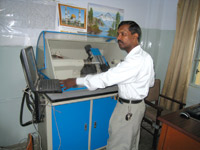 Pakistan continues to suffer from a shortage of skilled tradespersons in
almost every sector. While jobs in the corporate sector and in
government shrink, little attention is being paid to the area where
opportunities exist in large numbers.
Pakistan continues to suffer from a shortage of skilled tradespersons in
almost every sector. While jobs in the corporate sector and in
government shrink, little attention is being paid to the area where
opportunities exist in large numbers.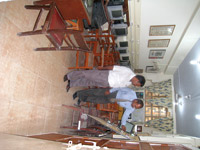 enrollment is gradually increasing as the stigma attached to vocational
education is disappearing, added that principal. "The common
stereotype that only those students seek an admission in a technical
school who are academically weak is changing," says the principal.
enrollment is gradually increasing as the stigma attached to vocational
education is disappearing, added that principal. "The common
stereotype that only those students seek an admission in a technical
school who are academically weak is changing," says the principal. attaining a Diploma of Associate Engineer (equivalent to the HSC
certificate/Intermediate) followed by B-Tech (Hons) Degree, the starting
salary of a graduate is between Rs6,000 and Rs8,000 in government
organisations and Rs15,000 to Rs20,000 in private organisations. The B
Tech degree has recently been recognised by the Pakistan Engineering
Council as equivalent to a Bachelors Degree in Engineering, informs Ali.
attaining a Diploma of Associate Engineer (equivalent to the HSC
certificate/Intermediate) followed by B-Tech (Hons) Degree, the starting
salary of a graduate is between Rs6,000 and Rs8,000 in government
organisations and Rs15,000 to Rs20,000 in private organisations. The B
Tech degree has recently been recognised by the Pakistan Engineering
Council as equivalent to a Bachelors Degree in Engineering, informs Ali.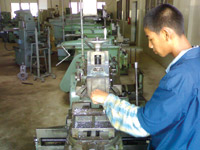 with minimal literacy for jobs like receptionists, food service
(waiter), food production (cooking) and housekeeping," informed
Badar Hussain at the Sindh Regional Office of NAVTEC. This is right on
mark as the hospitality business in the country is expanding rapidly.
with minimal literacy for jobs like receptionists, food service
(waiter), food production (cooking) and housekeeping," informed
Badar Hussain at the Sindh Regional Office of NAVTEC. This is right on
mark as the hospitality business in the country is expanding rapidly.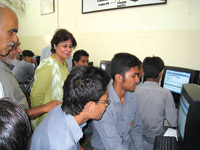 graduates produced by the private sector prefer migrating abroad for
better job prospects after gaining experience of few years in the local
market. "An experience of atleast four to five years is a
must," informs an official from Al-Kareem Corporation, a
recruitment firm dealing with employers abroad. This means that despite
the government's best intentions, the local shortage is not being
addressed.
graduates produced by the private sector prefer migrating abroad for
better job prospects after gaining experience of few years in the local
market. "An experience of atleast four to five years is a
must," informs an official from Al-Kareem Corporation, a
recruitment firm dealing with employers abroad. This means that despite
the government's best intentions, the local shortage is not being
addressed.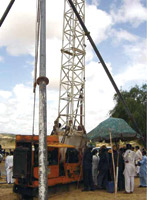 Sindh province – Tharparkar. However, the natural treasure remains
untapped owing to different priorities of the successive governments.
Sindh province – Tharparkar. However, the natural treasure remains
untapped owing to different priorities of the successive governments. medicinal to the most random mafia leaving their mark on the walls.
Shiraz Mukarram delves deep to find out the mystery behind these
markings
medicinal to the most random mafia leaving their mark on the walls.
Shiraz Mukarram delves deep to find out the mystery behind these
markings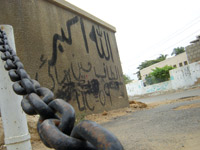 (MQM) put up posters and slogans all over the city bashing national
hero-cum-politician Imran Khan. According to a social worker of
Saeedabad, political graffiti is mainly done by the workers of political
parties like MQM and Pakistan People's Party (PPP), and both these
parties have their own colour and specific regions. Red, green, and
black
(MQM) put up posters and slogans all over the city bashing national
hero-cum-politician Imran Khan. According to a social worker of
Saeedabad, political graffiti is mainly done by the workers of political
parties like MQM and Pakistan People's Party (PPP), and both these
parties have their own colour and specific regions. Red, green, and
black 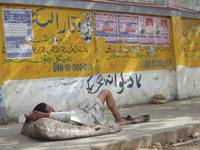 are
the most common colours, used by the PPP. In an area where people from a
particular political party are in greater number, there are hardly any
banners or graffiti by another political party to be found.
are
the most common colours, used by the PPP. In an area where people from a
particular political party are in greater number, there are hardly any
banners or graffiti by another political party to be found.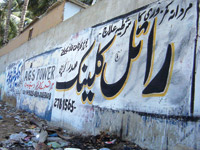 infinite kinds of statements doodled on walls near MA Jinnah road or
Lyari, such as the ubiquitous "Pakistan ka matlab kya? La Illaha
illallah" scrawled across the walls of the city in green.
infinite kinds of statements doodled on walls near MA Jinnah road or
Lyari, such as the ubiquitous "Pakistan ka matlab kya? La Illaha
illallah" scrawled across the walls of the city in green.