



|
|
|
|
 |
 |
   |
cricket PCB
needs a chief with outstanding management skills Dhoni
now needs to be given Test captaincy too cricket Graeme
Hick decides to hang up his batting gloves When
Abou Talib surrendered his challenge to Azam Khan
cricket The ICC umpires award is decided by a jury containing all captains of the Council's 10 full member nations and the eight members of the Elite Panel of Match Referees By Gul Hameed Bhatti Pakistan's Aleem Dar
has missed out on the International Cricket Council (ICC) Umpire Does anyone smell a
rat in this case? Is the process that goes into the decisions that
finalise who gets the awards transparent enough? Of course, it is.
Because no one has really come forward with any kind of rash or even
justified critcism over the years. However, while most awards are based
on cold, hard statistics, the one for the best umpire of the year seems
to be subjective in nature, decided according to the 'personal' opinions
put forward by a handful of people who are chosen as the jur Taufel at 37 is three years younger than the 40-year-old Aleem Dar. The very fact that he and compatriot Asad Rauf are part of the ICC's Elite Panel on international umpires is something to rejoice and, at the same time, something to be proud of. Because Aleem and Asad are on the panel, they continue to get postings in the choicest of Test matches and One-day International series. No Indian umpire is part of this elite group, in spite of this country's hold on most financial matters that govern the international game. In a manner of speaking, you could say that Aleem and Asad are two of the best umpires on the circuit. Asking for Aleem Dar to have been given the best umpires trophy would really be trying to bring in some sort of quota system in the distribution of the ICC awards. No one would want that. If the jury believes that Taufel is the best umpire in the cricketing world, then this should be accepted in good grace. But, aside from the giving away of the awards, some kind of criterion should also be made public and the people's misgivings addressed to. It was said on the occasion of the awards ceremony in Dubai last Wednesday night that the difference between the standards set by Taufel and the rest was so big that the Australian was the winner of the honour hands down. That's really being unfair both to Aleem Dar and the South African Rudi Koertzen, although one felt that England's Mark Benson and Australian Steve Davis had been included in the list of the nominees only to make up the numbers. Just where has Aleem Dar slipped up over the years? Hasn't Taufel been found to have made atrocious decisions in the recent past? Is the highly experienced Koertzen not good enough to stand at par with Taufel? There's not much to choose between Taufel and Dar where umpiring positions have been allotted to the two. Taufel has stood in 53 Tests as compared to Dar's exact 50. Taufel has 138 One-day International to his credit and Dar 108. Koertzen's case is entirely different. The almost 60 years old gentleman has officiated in 92 Tests and is the leading ODI umpire with 190 matches to his credit. As the period between August 9, 2007 and August 12, 2008 was kept in view to decide the latest round of ICC awards, it cannot be said that the black marks put in front of the names of Dar and West Indian Steve Bucknor were taken into consideration. The two had called play to start near the end of the 2007 World Cup final in Barbados, after it had been assumed that the match might go into a reserve day. The final was eventually played in near darkness and both field umpires as 'punishment' were withdrawn from a couple of future assignments. The ICC umpires award is decided by a jury containing all captains of the Council's 10 full member nations and the eight members of the Elite Panel of Match Referees. So, one can say that some kind of personal bias can creep into the final decision. It can easily be seen that certain persons in the jury would always want Taufel as their choice, come what may. People like Dar and Koertzen may never be on their list. One may sound rather cruel in saying this, but perhaps Taufel may have to say goodby to umpiring -- as he has been indicating for sometime in the recent past, to enable someone else to be given out the umpires award! Maybe those who have criticised Taufel's being declared Umpire of the Year for a fifth time are really making a mountain out of a molehill as, after all awards are just recognition of one's inherent talent and don't really mean a thing in real terms. They should also look at the composition of the other individual and team prizes. Only one Pakistani, Younis Khan, has made it into the One-day International Team of the Year, where Salman Butt has found a place as the 12th man. Mohammad Yousuf, nominated in the ODI Player of the Year award category, eventually missed out completely. Of course, more Pakistanis didn't make the lists. The country hardly played any Tests during the period under review and their perfomances in the ODIs didn't inspire much confidence. Certainly not in the manner of West Indies' Shivnarine Chanderpaul, who was declared the ICC's International Cricketer of the Year. His choice was really a foregone conclusion. South Africa's fast bowler Dale Steyn was the deserving recepient of the Test Player of the Year award with India's Mahendra Singh Dhoni being declared ODI Player of the Year. Sri Lanka's mystery spinner Ajantha Mendis is the Emerging Player of the Year and the Netherlands' all-rounder Ryan ten Doeschate Associate Player of the Year. For his six sixes in an over feat, India's Yuvraj Singh won the Twenty20 International Performance of the Year award while Charlotte Edwards of England took the Women's Player of the Year trophy. Sri Lanka got the Spirit of Cricket award. South African Graeme Smith was named captain of the ICC World Test Team of the Year while Australia's Ricky Ponting was placed at the helm of the ICC World ODI Team of the Year. The
writer is Group Editor Sports of 'The News' gulhbhatti@hotmail.com bhatti.gulhameed@gmail.com
PCB needs a chief with outstanding management skills Symonds's crime, if it can be called one, gets dwarfed in comparison to what Shoaib has been doing for the last many years. Yet, for some unknown reasons, he always finds a way out By Imran Farooqi With the Champions Trophy rescheduled for the next year by the game's administrators amid the worsening security situation in Pakistan, a serious debate regarding the captaincy issue has started. Younis Khan and Shahid Afridi have already indicated through press statements or interviews that they won't turn down the offer if approached. Skipper Shoaib Malik
on his part has made his intentions clear by declaring that he There's little doubt that Pakistan cricket is currently in a state of absolute turmoil. The Champions Trophy's postponement, the resignation of the PCB chairman, pacer Mohammad Asif's struggle to prove his innocence in his latest drug scandal, Shoaib Akhtar's frantic efforts to resurrect his career to prove 'yet again' to the nation that he's indispensable to Pakistan cricket, Saleem Altaf's sacking and reinstatement, and the coach's tense relationship with the selection panel and his abrupt departure to Australia are definitely 'some' of the issues that need to be sorted out before cricket in this country can make some headway in the right direction. In spite of the fact that South Africa were the first side that had refused to participate in the Champions Trophy citing security concerns, they were the first side Pakistan had approached for a short series to provide some much-needed practice to its players and partly compensate for the Champions Trophy loss. This could easily be the height of sycophancy and shamelessness. What was the PCB trying to prove by approaching the Proteas for a short trip? That it's willing to play anywhere as long as it is paid a cool sum of money no matter whether that country honours its commitment or not! It's an absolute irony that the PCB was looking for help from a country which triggered the postponement of the Champions Trophy. Sri Lanka, too, has told Pakistan it couldn't host the latter because of some dispute over money with its broadcasters. The latest snubs put Pakistan in a state of near-isolation where international cricket has become a rare commodity. Now Pakistan will have to wait for a few weeks before they can have a taste of international cricket again by appearing in a 20-20 event in Canada next month. Shoaib Akhtar is again in the news for all the wrong reasons. At a time when his prime objective should have been to focus on his cricket considering the fact that his future is on the rocks for the umpteenth time, he's creating further trouble for himself by flaying the PCB and indulging in off-field activities that are not likely to endear him to his Pakistan fans. A decision on his ban is pending with the High Court, and his irresponsible statements against the cricket hierarchy of this country are the last thing one would like to hear. The PCB and Shoaib must learn something from Andrew Symonds's case. The Aussie all-rounder had just missed a team meeting and instead went on an angling stint. But that was enough for his captain and Cricket Australia to send him packing. Bangladesh was not a huge series by any standard, yet the Aussie authorities came down hard on their premier all-rounder and have also indicated he might have made his last appearance for his country. Symonds's crime, if it can be called one, gets dwarfed in comparison to what Shoaib has been doing for the last many years. Yet, for some unknown reasons, he always finds a way out. Nobody can say for sure why the successive boards could not take a definite stand on Shoaib. In any case, since making his debut about a decade ago, he has spent more time off the field than on it, so what's the big deal if he's thrown out of the side for good. Pakistan cricket won't be poorer without Shoaib. In an era where players like Mohammad Yousuf and Shahid Afridi are trying hard to uphold the sanctity of Ramadan by refusing to play in the holy month, Shoaib is having dancing sessions in Mumbai. The pacer is free to do as he likes, but there has to be a limit to which one can afford to go. Though he has never cared for such things in past, he certainly needs to be communicated in clear terms as to what is required of him. The PCB officials have made it clear on several occasions that Shoaib could not play unless he paid his Rs 7 million fine. He's currently playing for Surrey and at most would be figuring in two first-class games for the struggling county. This looks like a fund-raising trip. The pacer claims that he's representing the English side to prove his fitness, but more than anything else it seems a crude attempt by Shoaib to make some quick bucks to reduce his liability. With the instalment of a new president in the country the PCB has now got a new patron. Few would argue that the Board is in a mess and a thorough post-mortem is essential for putting things right. It would take a few weeks of thoughtful planning to pull Pakistan cricket out of its rotten state. The most challenging job before the new patron would be to pick the right person for the lucrative and very influential job. Pakistan's previous experience with people who had limited exposure to top-class cricket, or those who were appointed on political basis, shows that a former player of repute with outstanding management skills must now head the PCB. Such figures are very few, but a selfless and unbiased search can make the task easier.
Dhoni now needs to be given Test captaincy too According to Madan Lal "No disrespect to Kumble and how he has performed as a captain, but it's time for him to step aside and let Dhoni take over' By Khurram Mahmood Exactly one year back
on September 14, 2007, the then India cricket team captain Two important series -- against Australia and Pakistan -- were ahead for the Indian team and the BCCI surprisingly selected the inexperienced 26 years old wicket-keeper batsman Mahendra Singh Dhoni for the next two all important ODI series. Leading the Indian cricket team especially against arch-rivals Pakistan is never easy for any captain. Therefore, veteran spinner Anil Kumble was given the task to lead the Test side while Dhoni was made responsible for One-day Internationals. Dhoni became the fifth youngest player to captain India in One-day Internationals, after Sachin Tendulkar (23 years 126 days), Kapil Dev (23 years 249 days), Virender Sehwag (24 years 178 days) and Ravi Shastri (24 years 245 days). He was also the third wicket-keeper to lead India in a One-day International after Syed Kirmani and Rahul Dravid. Before becoming the one-day team captain Dhoni led the Indian cricket team which won the first Twenty20 World Cup in South Africa. After taking this huge responsibility Dhoni immediately showed his leadership qualities, and under his captaincy India won the Twenty20 World Cup and the triangular series in Australia for the first time, beating Australia in consecutive two finals. He also won the one-day home series against Pakistan and the ODI series against Sri Lanka while Anil Kumble lost the Test series against the same opponents. It is important to note that Dhoni depended more on the young players than the veterans and the young guns kept up his confidence. This proved so in the Twenty20 World Cup and recently in the Sri Lanka ODI series where nine of the 15 players were 25 or under, two were 26 and the oldest was 29. The Dhoni-led India has now broken the 10-year jinx of not having won an ODI series on Sri Lankan soil. Team India also took revenge of a huge loss in the Test series in the presence of their most experienced players like Tendulkar, Dravid, Ganguly and Laxman. Mahendra Sindh Dhoni, 27, was born in Ranchi (Bihar) in 1981. He made his first-class debut in 1999-2000 from Bihar. Since getting the call-up for the Vinoo Mankad trophy under-16 championship in 1997-98, he has never looked back. After four years in 2004 he got a chance in a One-day International along with Joginder Sharma against Bangladesh at Chittagong. Unfortunately in his inaugural match he was run out without opening his account. But he didn't waste much time and in just his fifth one-dayer against Pakistan at Vishakapatnam he hammered 148 runs in just 123 balls batting at the number 3 position. In October 2005 against Sri Lanka at Jaipur once again batting one down he played another explosive innings of 183 runs off just 145 deliveries with the help of 15 fours and 10 sixes. During his innings he broke Australian wicket-keeper batsman Adam Gilchrist's record for the highest score by a wicket-keeper in One-day Internationals. In One-day Internationals, he has played 120 matches so far and scored 3,893 runs with a high average of 47.41 including four centuries and 24 fifties. In December 2005, Dhoni made his Test debut against Sri Lanka at Chennai. In his first Test innings he scored 30 runs. In the second Test during the tour of Pakistan in 2005-06, which was his career's fifth Test, he scored 148 runs at Faisalabad. In Test matches too, he showed his maturity and patience and became a dependable regular batsman of the team. After playing 29 Tests his batting average 33.76 is better than some of the regular batsmen. After a wonderful one-day series against Sri Lanka, India captain MS Dhoni has got back his top position in the ICC batting ranking. He displaced his South African counterpart Graeme Smith with a 17 points lead. In April 2006 he was also on top of the ICC batting ranking. In One-day Internationals in 2008, MS Dhoni as captain has averaged an outstanding 63.66 in 24 matches. A figure that goes to illustrate that being captain has not affected his batting. Dhoni is regarded as 'Captain Cool' as he never loses hope and does not surrender till the last moment. He has showed his maturity and self-confidence in high-pressure situation many a time. The Twenty20 World Cup semifinal against Australia and the final against Pakistan are just two examples. In the semifinal against world champions Australia he took a calculated risk when 22 runs were required in the last over. 'Mr Cricket' Mike Hussey and Brad Haddin were on the crease. Dhoni selected medium pacer Joginder Sharma for the last over after senior players showed their reservations. Joginder didn't disappoint his skipper and took two important wickets (Hussey and Brett Lee) after conceding just six runs and India won the game by 15 runs. Once again in the final against Pakistan, Dhoni yet again took a risk with Joginder Sharma when Pakistan needed 13 runs in the last over. Misbah-ul-Haq made Dhoni's decision wrong with a six on the second ball of the over. But on the very next ball, Misbah went for the scoop, a risky shot over short fine-leg, Sreesanth took an easy catch and India became the first Twenty20 world champions by winning the final by six runs. For his outstanding and consistent performance, Mahendra Singh Dhoni has also become only the second cricketer after Sachin Tendulkar to receive the Rajiv Gandhi Khel Ratna Award, India's highest sporting honour. Last week Mahendra Singh Dhoni bag another crown in his fold as he won the ODI Player of the Year award at the ICC Award ceremony in Dubai. He was selected among Sachin Tendulkar, Nathan Bracken and Mohammad Yousuf. Dhoni also chosen for the ICC ODI Team of the Year by the ICC selection panel. Regarding the leadership former Australian captain and Indian coach Greg Chappell appreciated Dhoni and said that "the Indians are lucky to have a leader like him. He showed his potential as he led an inexperienced team to victory in the ICC World Twenty20 in his debut series as captain." As far as the team's performance and his personal contribution are concerned now Mahendra Singh Dhoni deserves to lead the India Test side too. Indian coach Gary Kirsten, former coach Madan Lal and former Pakistan captain Wasim Akram all are in favour that the Indian board must hand over the Test team to Dhoni. According to Madan Lal "No disrespect to Kumble and how he has performed as a captain, but it's time for him to step aside and let Dhoni take over." Pakistan's former captain Wasim Akram also supports Dhnoi as Test captain. In an interview he said that Anil Kumble has rendered yeoman service to the Indian cricket team but it's time for the seasoned leg-spinner to quit and pass the Test captaincy to Mahendra Singh Dhoni. Wasim Akram also advised Pakistan captain Shoaib Malik that he should gain knowledge of Dhoni's style and learn how to lead a national side from the front. The
writer works in 'The
News on Sunday' in Karachi khurrams87@yahoo.com
cricket Actors after Kardar couldn't keep his traditions alive and Pakistan's culture unlike in the 1950s couldn't be seen as a mirror within which the modern Pakistani ontology could be viewed By Dr Nauman Niaz Dr Nasim Ashraf's tenure as Chairman of the PCB confirmed that the game in Pakistan had come to a pretty pass. Nothing wrong with his resignation since it was long-awaited. Although it ruffled fluffy feathers -- a custom founded more upon indiscreet policies that anything he actually did. Pakistan cricket has been bogged down by poor governance, internal conflicts, historical complications and various other handicaps. We have a large population, a weak infrastructure, and strife. And we have been vulnerable to numerous forces. Doubtless the system is faulty. Policies of the PCB merely scratch the surface. Their problems go much deeper, into the heart of the nation with its tiredness, into the schools with their softness, into the past with its stubbornness, into the present with its lack of conviction. Recently, Pakistan's failure to produce players is proven. Fortunes are paid to foreign coaches and at one time the national team had more management imports than a computer shop. What's wrong with our cricket and why haven't been we be able to run it a professional unit. Confidence, competence and calibre are the factors -- but how to explain that? Unavoidably, the main difference lies between the ears. Patently it is a state of mind, a point where Pakistanis are extraordinarily loath to accept prioritisation of work and requirements. At best Pakistan has relied on men from the extremes. In the end it is all about national culture. Pakistan cricket to a disconcerting degree has been sustained by non-technocrats. Therefore the system is deeply flawed. Most of these working within their frameworks have had strong outside forces. Evidently the status quo does not address the real problem, namely indulgence, and therefore cannot produce high quality products to take on the world. Mostly, there has been self-deception and cricket being wrapped in wordiness and rhetoric. It is a question of outlook. Pakistan has an abundance of resources and ability. Both are wasted. Until this uncomfortable truth is faced, until this weakness is corrected, every surge will peter out. On the contrary, it seems, mostly based on rhetoric and behind the smokescreen of corporate culture, run by people handpicked or selected seem to have a little heart and mindful strategies to develop cricket when they arrive and subsequently, as they grow into their power seats, the business of a fair deal is obviously a philosophy they mostly do not subscribe to. It is just as well that most educated people in the PCB cannot tell the difference between principles and principals, since the first word lost meaning decades back and as for the second one, a cursory look around is enough to see people clinging onto power and are unwilling to move on. But what do you do in times like this? With people hanging for dear life on shattered remains of sinking ships, desperate to grab any life line, thrown by anyone, as long as it offers a chance to stay afloat -- where in all this, do you find sanity or a balance of things? Do you simply obliterate from your mind the charade that now passes for our national life and join the ranks? No. The answer sadly is that we have lost focus. Every day, all of us who step out to do a job or get a job done, who have to deal with other people, realise with increasing frustration that every day you revisit the rules, re-explain to the same people the same job and the same results that you want, with almost always the same conclusions. We are simply incapable of going forward, learning and getting better and better at what we do. We have to be told again and again, parrot-like recitation of the same rules, the same dos and the same don'ts and next day the same drill again. So the better part of the day is spent in activity that is largely non-productive, frustrating and soul killing. Why don't we learn? Why is our attention span a few seconds only? Why are we unable to record and put things down on paper? Why are we so lost and purposeless? Whatever happened to pride of doing a job well the first time and even better the next time? In the early 1950s it was only a matter of time before the twin forces of culture and demographic creolisation and Abdul Hafeez Kardar coalesced to promote cricket as a popular trans-cultural expression. The desire of nationalistic athletes to play cricket their own way seemed to have grown in direct proportion to Kardar's determination to establish it as the exclusive sport as an emblem of national pride, and not the usual stereotype game of the propertied, the educated, and the well-bred. By end of the 1950s, versions of the game were being played and celebrated at all levels of the society. It is largely irrelevant to question whether AH Kardar was a dictator leading Pakistan to unprecedented successes or Fazal Mahmood tried to run the team as his predecessor did, or whether in the absence of other mass activity captured their creative imagination and proved useful in their cultural and political struggle. The important point is that all sections of society valued its form and moral messages, which is precisely why its growth was characterised by a dichotomous political history of intense instability, contention and the search for an area of life in which a non-political utopia could safely exist without producing any contaminating effects upon the general body politic. Regrettably, cricket was mostly politicised and degenerative symptoms made it morbid and moribund except brief periods from 1948-1957, 1977-1979 and from 1986 until 1992. Against this background are to be seen the peculiar features of early Pakistani cricket culture, particularly its original origins, and subsequent social democratization in the hand of radicals. It was at this juncture that local communities split to outshine one another. Highbrow gymkhana cricketers in Lahore more dominant tried to mask their prejudices against the rest and still tried to seek influential posts on the governing bodies. In Pakistan, several powerful cricketers including Kardar could be seen as seminal contributors to the struggle in local cricket, the issues of self-government, adult suffrage, and biases. Kardar's philosophy saw the importance of cricket culture as a space within which the struggle for self-leadership was waged by and with the support of the institutionally disenfranchised working people. The period between 1960 and 1969 was a picture that showed white-collared and elite squared-off for the fisticuffs that came when Intikhab Alam took the team's captaincy against New Zealand at the turn of 1970. Political activity was a manifesto of organised agitation in the area of social culture, signalled the ideological consciousness that forged the alliance between cricket and politics in the activities of the West Pakistan government. One could see the whole scene as intervention within the epistemological tradition. What AH Kardar did was to discredit the dominant paradigm of the divided cricket culture, and called for the dogmatic legitimatisation of his mind-set and the untold pluralism within the organized game. His captaincy did help Pakistan to win regularly in majority of their inaugural matches against top teams India, England, New Zealand, Australia and West Indies. But his style of leadership indicated the turbulence of power-concentration that to some extent tortured the process of cricket stability in the 1960s. Actors after Kardar couldn't keep his traditions alive and Pakistan's culture unlike in the 1950s couldn't be seen as a mirror within which the modern Pakistani ontology could be viewed. Subsequently, with superstars erupting with flashing regularity and individualism that spanned the emancipation of the early 1970s and the rebellions left behind the finger prints on the politics ridden cricket culture in which subjects were divided and united as they inched towards a fragmented Pakistani nationalism.
Graeme Hick decides to hang up his batting gloves When he finally became eligible for England in 1991, he had already made 51 first-class hundreds with a top score of 405 not out Former England batsman
Graeme Hick, who has been suffering from a long-term elbow He has rarely dominated the opposition in the manner that characterises his county appearances. At his best, he is an attacking bat with a wise range of strokes. At his worst, vulnerable against fast bowling and lacking confidence. In 1998, he joined the hallowed ranks of those who have scored 100 centuries. Only Wally Hammond reached this mark at a younger age and only Bradman and Compton took fewer innings. He was named by Wisden as one of their cricketers of the year in 1987 and this year scored his 136th century, placing him eighth on the all-time first-class list. The hard-hitting batsman averaged 31.32 in 65 Tests for England after making his debut against West Indies at Headingley, Leeds in 1991. Hick had to wait seven years to qualify to play for England, an overlong apprenticeship for one so talented. When he finally became eligible in 1991, he had already made 51 first-class hundreds with a top score of 405 not out. He played for Queensland in 1990-91, one of only a few county cricketers to play Australian State Cricket, the toughest arena outside Test cricket. Hick flourished too, becoming the fifth highest scorer that season with an average of 47. He joined Sir Jack Hobbs and Graham Gooch early in the 2006 season in becoming only the third player in history to score 60,000 runs in all forms of cricket. Soon afterwards he brought up yet another ton against Northamptonshire to become the eighth player to compile 100 first-class centuries for one county. Hick broke Graham Gooch's appearance record of 1,197 matches in a Twenty20 Cup group game against Somerset at New Road during the 2008 season. Against Somerset at Taunton on May 5 and 6, 1988, Hick carved his name into the record-books with his career-best 405 not out. Then, three weeks later, the formidable West Indians came to visit, with Hick still requiring 153 in the match to reach his milestone. He responded with an unbeaten 172 against an attack including Patrick Patterson, Curtly Ambrose, Courtney Walsh and Ian Bishop. Those same bowlers, however, exacted their revenge three years later when Hick finally became eligible to play for England. He was thrust in for his debut Test against West Indies at Headingley where Ambrose, in particular, tormented him. He was dismissed for 6 and 6, and made only 73 runs at 10.71 before being dropped for the fifth Test of the series at The Oval. Hick was granted a benefit season by Worcestershire in 1999, which raised over £345,000; he was also awarded a testimonial in 2006. Born in Salisbury (Harare), Rhodesia (now Zimbabwe) into a tobacco-farming family, Hick was at first more interested in hockey than cricket, and indeed went on to play for the national schools hockey team. He was also more of a bowler than a batsman, but in 1979 he began to make big scores regularly, averaging 185 for the school side. He suffered from a mild form of meningitis in 1980, but he nevertheless progressed to become captain of the national Junior Schools Team, and before long to play for the Senior Schools side. In 1984, Hick came to England on a scholarship from the Zimbabwe Cricket Union. For Worcestershire's Second XI he was impressive: he twice took five wickets in an innings, and a prolific sequence of 195, 0, 170 and 186 gained him a first-team debut against Surrey in the last match of the 1984 County Championship. Worcestershire declared in their first innings, and Hick did not get to bat, but in the second -- once again coming in at nine -- he made 82 not out, sharing in an unbroken eighth-wicket partnership of 133 with captain Phil Neale. In both 1987-88 and 1988-89 Hick spent his winters playing in New Zealand for Northern Districts. He was a great success, hitting ten centuries in all and averaging 63.61 in the former season and a startling 94.46 in the latter; in one game against Auckland he scored a first-class record 173 runs between tea and close of play. It was at this time that John Bracewell called him a 'flat-track bully', a comment which was to dog Hick throughout his England career. The Indian tour proved to be the start of by far the most successful period of Hick's Test career. At the end of 1992 his average was a mere 18.06, but by the end of the South African series just over three years later it had improved to a very respectable 38.66; his average over those three years alone was an impressive 46.44. Despite scores of 34, 22, 20 and 64, Hick -- along with Mike Gatting -- was dropped after the second Test at Lord's; the decision amazed Shane Warne. Hick was recalled for the sixth Test at The Oval and hit 80 and 36 in a 161-run England victory, giving him a series average of 42.66, behind only Gooch, Atherton and Thorpe among England's specialist batsmen in a series in which England used 24 players. The 1994-95 Ashes tour came to be known for one incident in particular. In the third Test at Sydney, England captain Mike Atherton had let it be known to his players that he intended to declare. Hick was nearing what would have been his first Ashes century, but Atherton felt he was scoring too slowly and that as a result the team were 'dawdling'. He took the decision to call the players in with Hick 98 not out. Hick was surprised and hurt not to be allowed to reach his hundred. The 1997 English season was the first for seven years in which Hick had no international duties to perform, and he averaged 69 in scoring over 1,500 first-class runs, the highlight being an unbeaten 303 in the final match of the season against Hampshire, sharing in an unbroken third-wicket partnership of 438 with Tom Moody, an English record for that wicket and a Worcestershire record for any wicket. Hick was recalled to England duties for the Singer-Akai Champions Trophy ODI series at Sharjah in December 1997, and in April 1998 for just the ODI portion of the West Indies series. He played in nine games altogether, but though he got starts on several occasions he never reached fifty. Hick began the 1998 season slowly and was left out of the England team at the start of the year, but he responded with four hundreds in successive first-class innings in late May and early June. Although this form left him somewhat thereafter, he was nevertheless selected for the final two Tests against South Africa. A total of nine runs from three innings left his hopes of a place on the Ashes tour looking extremely shaky, but after two half-centuries in ODIs and then 107 in the one-off Test against Sri Lanka it seemed he might have done just enough. Hick was left at home, to console himself with the memory of the adulation of the Worcestershire crowd: in May at New Road he had made his hundredth first-class century. Just before the first Test, however, Hick received an emergency call-up -- officially as 'reinforcement' rather than a replacement -- as Atherton's chronic back problem had been causing him severe pain. Hick ended up playing in four Tests, but he had a rather poor series overall, averaging 25, although his defiant 68 in a losing cause at Perth stuck in the memory and his 39 and 60 contributed significantly to England's 12-run win at Melbourne (even if Dean Headley's 6-60 was more remarked upon). In the ODIs against both Australia and Sri Lanka Hick did much better, making more than 500 runs -- including a fine run of 108, 66*, 126* and 109 in successive innings -- and being named England's Man of the Series. The 2000 Test series against West Indies began with humiliation both for England, who lost by an innings inside three days at Edgbaston, and for Hick, who made his only Test pair. Things improved for the team thereafter, with England recovering to win the series 3-1, but Hick's real influence was limited to the fourth Test at Headingley, where his 59 (from number eight, as Caddick had come in ahead of him as night-watchman) and his stand of 98 with Michael Vaughan rescued England from 124-6 and paved the way for Caddick's extraordinary burst of 5-14 and England's own victory inside two days. In the ODIs Hick had a very mixed summer, sharing in two century partnerships but averaging barely 25 with a top score of 50 in seven games. It was the beginning of the end for his international career. On what was to prove his last winter tours for England, of Kenya, Pakistan and Sri Lanka, Hick played five Tests and six ODIs, but only twice were his contributions of real value. In an ODI at Karachi he came in at 13-2 and put on 114 with Nasser Hussain, then in the deciding Test at the same venue his 40 gave vital support to Graham Thorpe (64*) as England clinched a nail-biting win. In spite of these bright spots, overall Hick's winter had been far from a success, and the Test series ended in early March with scores of 0 and 16 at Kandy. He took the field in Colombo only as a substitute, but still managed to incur a one-match suspended ban for sledging. It was irrelevant: he never played Test cricket again. Later that month he played in the three ODIs against Sri Lanka, and in the last of them he top scored with 46. England, though, were crushed by ten wickets, and Hick's international playing days were at an end. By the time of his final eviction from the England team in 2000-01, Hick had been already spent one summer as captain of Worcestershire, a post which he held for three seasons (2000 to 2002 inclusive). Hick's personal form during his captaincy was generally good, although his overall statistics in 2000 -- the first time he had failed to reach 1,000 runs since 1984 -- were depressed by his England travails; in the County Championship alone in those three summers he averaged 43.41, 60.43 and 52.58, and by making 200 not out at Durham he completed the set of having made first-class hundreds against all 17 other counties, both home and away.
When Abou Talib surrendered his challenge to Azam Khan 'If Hashim was the most devastating savage of the great Khans, and Roshan the most beautiful stroke player, Azam would have been the little accountant, methodically arranging all the bits and pieces of the game' "The Egyptian
Abou Talib had won the British open for three years running, from 1964 "The members of
my club then said that they wanted to bring in some young
player and hand him over to me. Thus entered Jonah Barrington. At
that time, Barrington worked in a mill. He used to come early in the
morning to have squash training from me and then left for the mill.
Despite this 'hurried' training, I made him ready to challenge for the
very next British Open, in 1967.
"The
day before it started, Barrington The rest is history. Barrington not only won the 1967 Open but went on to win the title five more times. But after winning his first title, he again played against Azam -- only to lose in the same manner as before. "After 1963, the British Open title remained outside Pakistan for more than a decade. But I played a part in the next Pakistani victory. Air Marshal Nur Khan, who had become the chairman of Pakistan International Airlines in 1973, made earnest efforts to revive Pakistan's squash fortunes. When he came to England, he invited me to return to Pakistan to help. But I couldn't leave London as I had to look after my club as well as my family. "Nur Khan persisted and suggested that some Pakistani players are sent to England to be trained by me. I agreed and put forward the names of Qamar Zaman and Mohibullah Khan Jr. For six weeks, they prepared for the 1975 British Open under my supervision. And Qamar Zaman ended the long drought by bringing back the title to Pakistan. The following year, Qamar Zaman was again asked by Nur Khan to avail of my coaching. But Qamar refused and, as you know, Pakistan had to wait for the emergence of Jehangir Khan in the early 1980s to regain the coveted crown." Like the sons of the great Khans of his era, Hashim and Roshan, Azam's son Wasil excelled in the sport that had brought fame to his father. Once hailed as one of the hottest young properties in English squash, Wasil won his county title at the tender age of 15 and later a British Junior Open title. He could not fulfil his early promise, but his daughter, Carla Khan, has been active on the professional circuit since 1999. Interestingly, a few years ago, she changed her allegiance from her country of birth, England, to the country of her grandfather, Pakistan. Carla reached her highest world ranking of 21 in 2004, a year in which she defeated the then Asian champion Nicol David who is now the world no.1. When it comes to describing his style of play or the strong points of his game, Azam is evasive. "This is for others to do" he says. Here is how Jonah Barrington describes Azam in his book 'Murder in the Squash Court': "If Hashim was the most devastating savage of the great Khans, and Roshan the most beautiful stroke player, Azam would have been the little accountant, methodically arranging all the bits and pieces of the game, having everything under close analysis, nothing out of place... he was meticulous, organised, ruthlessly clinical and very deft... he was unbelievably efficient... he constantly sucked you into situations from which it was impossible to extricate yourself... he was totally silent on court, like a little bird. There was none of this stamping and pounding that one hears so frequently these days; he moved like a ghost, silently hither and thither. Yet wherever you hit the ball, he was there." So why has Azam remained in the shadow of the other great Khans? This intriguing question alludes to the numerous rumours that the Khans had their own rules of ascendancy: that the younger ones were allowed to rule the roost not when they were better, but when the elders decided that their time to step up had arrived. It is certainly 'suspicious' that in the three British Open finals Azam lost, his opponent was his older brother, Hashim. Azam neither confirms nor denies the rumours, but says simply: "Respect for an elder brother is very much ingrained in our Pushtun culture. The words bhai sahib (respected brother) meant everything to me. He was my coach and mentor." A member of the most successful family the game has ever seen, Azam was also directly involved in the grooming of world champions from his adopted land as well as the country of his birth. He was a great champion in his own right. But for two factors -- first respect for his brother and later mourning for his son -- Azam Khan might have been the greatest squash player of all time. Perhaps he was. The
writer is a freelance contributor ijaz62@hotmail.com
|
|
 of the Year award yet again. Instead, the honour has gone to Australia's
youthful Simon Taufel who, in fact, was handed over his trophy for a
fifth year in a row. Although no one can even faintly doubt Taufel's
excellent credentials, some people especially several in Pakistan are of
the opinion that the award could have gone to Pakistan's own equally
talented Aleem Dar this time round.
of the Year award yet again. Instead, the honour has gone to Australia's
youthful Simon Taufel who, in fact, was handed over his trophy for a
fifth year in a row. Although no one can even faintly doubt Taufel's
excellent credentials, some people especially several in Pakistan are of
the opinion that the award could have gone to Pakistan's own equally
talented Aleem Dar this time round.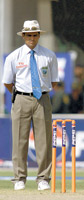 y.
y. wouldn't give up his job voluntarily and was there to stay. The Pakistan
Cricket Board (PCB) is without a chairman for the time being, and the
debate over the merits and demerits of certain candidates for captaincy
is only going to add to the confusion.
wouldn't give up his job voluntarily and was there to stay. The Pakistan
Cricket Board (PCB) is without a chairman for the time being, and the
debate over the merits and demerits of certain candidates for captaincy
is only going to add to the confusion.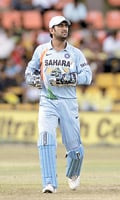 Rahul Dravid stepped down as skipper after the England tour with the
reason that he wanted to concentrate on his batting.
Rahul Dravid stepped down as skipper after the England tour with the
reason that he wanted to concentrate on his batting.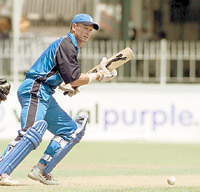 injury, will later this month bring the curtain down on an illustrious
county career that never quite translated to the international stage.
injury, will later this month bring the curtain down on an illustrious
county career that never quite translated to the international stage. to 1966. He then threw down a challenge that if anyone beat him, he
would pay him £500 -- at least £5,000 in today's money. "At the
instigation of a couple of club members, I accepted the challenge,"
recalls Pakistan squash ace Azam Khan of the early decades after
Independence. "The challenge even appeared in the newspapers. But
Talib chickened out, saying that he should be given £1000 before the
match because if he lost he would not be able to face people in Egypt
and would have to settle in another country.
to 1966. He then threw down a challenge that if anyone beat him, he
would pay him £500 -- at least £5,000 in today's money. "At the
instigation of a couple of club members, I accepted the challenge,"
recalls Pakistan squash ace Azam Khan of the early decades after
Independence. "The challenge even appeared in the newspapers. But
Talib chickened out, saying that he should be given £1000 before the
match because if he lost he would not be able to face people in Egypt
and would have to settle in another country. played a match against me and could take only one point in three games.
He was so depressed that he wanted to withdraw from the tournament. But
I knew the prevailing standard and encouraged him to go ahead."
played a match against me and could take only one point in three games.
He was so depressed that he wanted to withdraw from the tournament. But
I knew the prevailing standard and encouraged him to go ahead."