



|
|
|
|
|
 |
 |
   |
education MOOD STREET Town
Talk issue
Khorey
jaani charta ae? What's
up! education It's all Greek to them A large number of students fail in the English compulsory paper in BA. This year was no exception By Fakhar-ul-Islam The Punjab University's
Bachelor of Arts and Science (BA/BSc) annual examinations 2008 results As many as 151,498 candidates had taken English language (compulsory) paper and only 36,110 of them were declared successful while the remaining 115,388 couldn't get their graduation degree due to poor performance in English. Last year, too, more than 100,000 candidates had failed in English (compulsory) in the BA/BSc Annual Examination conducted by the Punjab University. Since the British rule in the subcontinent, the native citizens have been struggling hard to learn the language. Today, English is a dominant language, used in every field of life. Judgements and precedents, orders and instructions, standing procedures and major policy documents of the federal as well as the provincial governments are in English. Technological, economic, sociological and statistical information is available in English. That's why English was included in our national curriculum as a compulsory subject. The pass percentage of BA students in their English Language (compulsory) subject speaks loudly of the level of the language in the first degree of a student's career. Despite studying English as a compulsory subject for fourteen years, students are unable to get passing marks in their graduation examination. In Pakistan, English is being taught in each and every school, college and university, yet the learning and performance is not up to the mark. Most academicians
believe that poor schooling is responsible for the declining standard of
higher Chairman Department of English, Government Islamia College Civil Lines, Syed Hassan Arif Wasti, while commenting on the issue says, "Teachers need to improve themselves, especially at the primary level. Students are not well-prepared when they reach college, therefore they fail to perform well in exams. There is a dire need to appoint skilled and committed teachers in primary schools." Adnan Ali, a senior lecturer at National University of Modern Languages (NUML) Regional Campus Lahore, cited rote learning, exam oriented study and poor educational policy as major reasons for this situation. "Instead of regular study for two years, students take shortcuts to pass the subject. They cram bits of knowledge. They don't want to learn the language but to pass the exam. Resultantly, they neither pass the exam nor do they learn the language," Adnan identifies. "Moreover, there should be synchronisation between teaching and evaluation. A proper paper setting and marking policy should be adopted on the part of the government." Professor Kavita of Government Islamia College for Women Cooper Road Lahore, blames strict marking of paper as the major reason behind this massive failure in English language. "There is a conspiracy theory that government doesn't want to pass a large number of students because of general unemployment in the country. The new graduates will demand jobs." "If the University is awarding 15 grace marks to B.Sc students with Chemistry (new course) subject then what's wrong with compulsory English. Why do they fail the students who secure 61 marks and do not give them 5 grace marks," she argues. She admits that students are weak in English but it's the weak base that needs to be addressed. She says that poor schooling at primary level, especially in government-run schools, is responsible for the deteriorating standard in the said subject. "If the very foundation is weak how does one expect a good structure?" she questions. Another Professor of English at a government college shares the same view that there is no enthusiasm among students to learn English language. "Most of the students just cram for their exams, which in no way develops critical and analytical ability in them," he says. While criticising the teaching style, Muhammad Ali, an English language teacher in Lahore's famous Rana Academy says, "There are many flaws in our teaching methodology, -- traditional method of teaching, non-availability of authentic study material, over-crowded classes and lack of a proper state policy. Latest English language teaching techniques and effective planning is essential to make learning of English more useful and to make its use more practicable," he suggests. There is problem with paper-marking as well, says Ali Shan Rao, a permanent faculty member of a renowned private college of Lahore. "No capable teacher will go for marking as it takes at least half an hour to check a paper with full concentration while university pays Rs. 20 only. It means forty rupees per hour. Now you tell me, why would a teacher go for marking the papers?" he asks. "Then money makers check the papers, who mark hundreds of papers in a few hours to earn handsome money," he says, adding that there is no monitoring by the university about the marking procedure. Students have their own grievances and justification for these poor results. "At the intermediate level, we prepare from guides, helping books, guess papers and notes and get good marks in English whereas in graduation the syllabus is conceptual and lengthy. We do not prepare for such kind of evaluation and assessment throughout our twelve year of education," says Qamar Zaman, a student from Shahdra. "We have never taken a conceptual English paper throughout our academic career. Then why does the University expect us to prepare for one in graduation?" asks Zafar Abbas, a private student from Chiniot. Muhammad Kamran Bhatti, a student of Government Islamia College Civil Lines, says the poor result is due to the dishonesty of teachers. "The college students have to join an academy in the evening as the college teachers do not perform their duty honestly," he says. "The same teacher teaches brilliantly in the academy but not in the college," says Kamran. "I have never been encouraged to learn or speak English. We get home assignments which we manage to do with the help of guides since we are not encouraged to ask questions. Government is not interested in taking any step to improve the situation and formulate a policy in this regard. When contacted, Dr. Jalil Tariq, Director Public Instructions (colleges) Punjab says, "We have not received the detailed result from different colleges. Once we receive the compiled result, we will make a report and submit it to the education department that will take further action in this regard."
MOOD
STREET Sick of finding mindless reality shows on TV about people trying to build and repair cars, houses and even themselves, I recently developed an urge to watch some critically-acclaimed and insightful documentaries. After doing a spot of searching on websites such as IMDB and Wikipedia, I came across a National Geographic's feature titled Aftermath: Population Zero. This piece basically built upon the 'what-if' concept that if all the world's humans were to disappear altogether, how the environment with all of its plants and animal species would react to the sudden change. Yes, of course, of late the climate change pundits have been screaming foul over the severe fallout of green house gas emissions from automobiles and industrial complexes. Animal rights activists have made a whole lot of a hullabaloo from time to time about the millions of cows, sheep, goats and hens that are butchered to cater to the monstrous appetite of human populations. Governments, especially those of the powerful G8 countries, are perpetually locking horns over the stock pile of nuclear weapons and the incidence of their falling into the hands of 'terrorists'. Yes, it truly seems that the human race has become a plague for the fragile planet and, from the latter's perspective, should ideally be exterminated. Yet, rather ironically, the documentary points out that various human societies have so deeply integrated themselves with the world around them that if they were to be taken out from the picture, it shall outrightly have a strong adverse effect. For one, even though the farm animals would not be slaughtered and devoured and domestic pets would not be subjected to the whims of their owners, most of them shall soon perish due to not being fed anymore. Those that do manage to survive, especially dogs, shall form packs within cities and start eating the weaker canines. Another effect of humans being MIA (missing in action) would be the release of massive amounts of radiation from the spent fuel material of nuclear power plants and toxic gases from chemical factories. This deathly onslaught on the environment would be triggered as soon as the supply of electricity that powers the cooling systems fails. The documentary goes on to show that the world, as we know, has suffered a lot of devastation at the hands of humans and shall suffer some more if they are all removed, but will eventually recover and acquire a complete natural order. At so many points in our lives, we wish that some or the other person would just leave us alone or better yet would just cease to exist. For kids wanting to romp around all the time or for rebellious teenagers hell-bent upon leading a rules-free life, parents and guardians are the enemy number one. For guys trying to impress a girl in their class at a college or university or at a party, each one calls upon the powers of fate that the competition would just turn to dust and blow away. And then later when one of the guys does get the fair lass, they just might develop strong differences between themselves and curse each other to rot in hell. Religious fundamentalists, everywhere, hope for all adherents of other faiths to be simply eliminated. The free-living folks in any given society exclude lawbreakers and criminals from the normal society by shutting them up in large holding pens and would rather have them disappear altogether. If all of us had laser guns, we just might keep on blasting away each other till we do have a world without people. But, maybe, we are already doing it albeit in a more detached manner by not clearly thinking through the consequences of our actions. We spend so much time building up hatred and ill-will towards others that we end up destroying ourselves in the process. Sometimes just getting rid of something doesn't solve problems but developing to strike a balance and attempting to work with the problem can actually have a fostering effect. Yes, the overbearing class or school bully picked on and humiliated the crap out of you by pushing you in the puddle of mud or throwing your lunch in the garbage. Yet, you can use the anger as a force to develop inner strength by setting high personal goals and achieving them. Yes, radical thinkers are always ostracised by the mainstream society, yet some use the resentment and ridicule as an impetus to morph more powerful ideas and implement change. There are many things that are out of our control and the miracle cure lies in trying to extract the solution out of the very problem itself. Town Talk • FreeTalk on Reiki on
Monday, Sep 22 at 2pm. For information and registration contact Rukhsana
• Conference of Young Writers on Friday, Sep 26 at Avari Hotel at 5pm. The Pakistan Young Writers Council is organising a youth seminar for promoting new talents. The basic objective is to encourage young writers who write in newspapers and magazines as well as other people who are interested in this field. Contact: 0331-4138719 • Pakistani film is shown at Alhamra, Hall III, The Mall every Thursday at 8pm. • Puppet Show at Alhamra, The Mall every Sunday at 11am. • Talent Hunt Show (singing) every Saturday • Panjabi Sangat is a weekly gathering every Friday and Sunday at Najam Hussain Sayed's house at 7pm where Punjabi classical poetry is readand sung. Any person who visits the Sangat can freely and actively participate in the above mentioned activities. • 'Vasda Lahore' photo exhibition is being organised by Lahore Sudhaar and Urban Resource Centre Lahore. This exhibition will be based on entries submitted by citizens The deadline for submissions is 30th September 2008. Other than photographs, verse and poetry, as well as sound recordings are also welcome. issue What ails doctors Young protesting doctors share their side of the story...
Recently, newspapers have been regularly carrying reports of young doctors
protesting on the roads. Pakistan Medical Association (PMA) has formed an organisation Young Doctors' Association for young doctors, providing them with a platform to put their demands before government and policy-makers. Dr Nasir Abbas of Children Hospital says, "We don't want confrontation with hospital administrations because we want government to resolve our issues." These doctors in the association refuse to accept their ludicrously low salary of Rs15000 per month. Dr Usman of the Association at Services Hospital says, "an intermediate pass nurse gets around Rs14,000 for six hours at work including all the securities and weekly off. A sweeper at a hospital is paid from Rs7000-8000 excluding the tips. They are earning this without any formal education. Compare this to the extensive study doctors have to do for at least six years only to be paid Rs12,000 to 15,000. Not to mention the honorary jobs and indefinite working hours. Is it fair? Dr Zeeshan of Services Hospital, also a member of the Young Doctors' Association, says: "our demands are reasonable including raise in salaries, demand of residency, provision of security, elimination of honorary for permanent job and health facilities for doctors and their families." "Punjab is the only place where doctors are working on contract basis," says Dr Asim Ikram at Children's Hospital. "Last time doctors got a permanent slot was in year 1995. This is very depressing for us."
The Young Doctors' Association is becoming stronger with each passing day
with more than 200 According to these doctors, the senior doctors and professors have established a monopoly in the hospital by 'restraining' young doctors. Young doctors, whom we usually call junior doctors, work outdoors with professors while they are also present in emergencies. They are also assigned night duties, so the burden of work is obviously more on them. An average junior doctor works for 18 to 20 hours in the hospital after which he has to appear for his tough exams. At the end of the day he gets only Rs15,000 which is nothing compared to the work he does. The government does not give residence facility to an officer of even Grade 18 in the education and health sector. "We spend almost 28 to 30 years in education if we go for specialisation. The time a student takes to complete his PhD in any other field is the time we spend on MBBS. Other than that, we have to practice during our training but the reward is zero. All these young doctors say that emergencies are the most important department of any hospital and should be under the observation of seniors. "Sometimes we get into difficult situation and find no one there to help us. It is we who are responsible in emergencies making it easier for us to 'use' them for our demands. But we know the patient would suffer the most in that so we decide to block the roads instead," says Dr Salman. The biggest problem for female doctors is security. Finally Dr Nasir says, "We have all decided that we will not remain quiet anymore. We will fight for our rights and if any hospital administration levels false allegations on any doctor we will protest." The message these doctors want to give to the authorities through this association is the need for good salary package with full security, accommodation, permanent job slot and health entitlement facilities. Dr Usman says, "We are the health providers but we don't have health insurance for our parents even. We deserve this facility." The condition of these doctors on house jobs and postgraduate students desperately need attention. If we continue treating them this way, there is no reason why people should opt for this noble profession. Some of the most competent students go to medical colleges. After spending a handsome amount of money on their education, if they get only Rs15,000 per month their frustration is reasonable. They can't be expected to support their families with this salary. Their condition can be improved only through long term planning by the authorities.
The News on Sunday called Services Hospital several times to get the version of the administration but nobody took the call. A friend remembers Nasim Nasir, a tv playwright who signified dignity, grace, courage, humour and love for others By Durdana Ali Malik Every once in a while
one of us would call and start off with a standard Khorey Jaani Charta ae? I met Nasim Nasir just over a decade ago, through my sister, who was her 'pushto speaking khore', residing in the same neighbourhood in Lahore for a while. Nasim's husband Pervez and my husband Azmat shared an army past as well but I mention these as references only. Our ordinary acquaintance transformed through common interests, plays, writing, music. And as women's friendships go, we were wont to share a lot of personal life angst. This is where the soul of our friendship lay. Anytime one of us grew tearful, the other would scold -- "stop this, enough, change the topic okay, so have you heard" etc. We therefore made a conscious decision to be positive, laugh and see the livelier side of things whenever we met. Anyone watching us must have thought we were a stand up comedy routine. The tears still came, but only because we laughed so much at ourselves, remembering past blunders and the absurdity of some of our aspirations. Most of this year she was travelling to Peshawar to visit her sister who was terminally ill. "Pray for her," she would often tell me. Other times she was busy with her PTV work. Among her well known serials are Chingarian, Mera Ishk Bhi Tu and most recently Doosri Dastak. Nasim Nasir, the playwright, was involved with all production elements. Sometimes when she was out of Lahore for seemingly long periods, I would jokingly scold her, "Nasim I know you're holidaying clandestinely in Bali or somewhere, stop telling me you're slogging for PTV on location in Kohat" -- and the lovely peals of laughter would ring out again. Our most recent meetings were on an assignment I was coordinating, where she was an interpreter for a Korean newspaper covering the hostage crisis in Afghanistan. Despite the poignancy of the situation, Nasim never lost her beautiful manner. Calls after calls had to be made. She spoke in Pushto, she spoke in Farsi, she spoke with compassion and she spoke with the intelligence and insight that only a woman who had known love, sorrow, loss and desperation would be able to deal with. Whether it was the governor of Kandahar or a peon at an office, Nasim's manner was consistently polite and appreciative. She was indebted and apologetic even if she got a wrong number. In her lilting voice she addressed everyone as Rora Jaani (brother dear). Shut up Nasim, I would tease, Rora Jaani might decide to come visit if you don't watch that loving tone. More peals of laughter. Off and on when we met, we talked about mothering and loneliness, about deadline humour and deadly seriousness. I admired her for her ability to tune in on all aspects of life so acutely and communicate her thoughts and feelings so well, with such a profound impact on so many people. She inspired people to have greater strength, endurance, awareness, sensitivity and most importantly, a sense of humanity. And instead of hiding her dreams in the back of her mind, she wrote. What a wonderful mind. While I waited for her return call one morning, I learnt she had suddenly passed away with heart failure. For her lovely children Ahmad, Afiya, Amna, Nazia and Ali she has left a legacy of bearing the challenge to carry on her spirit of dignity, grace, courage, humour, love for others and most especially for family and God. In that way she never really died -- she continues to live. As for me, Nasim, I'm tired of weeping. I'm sorry I broke the pact. Khorey Jaani Charta ae? I could do with your peals of laughter. No teasing this time, I know you're in Heaven.
In the last two minutes,
Hina has checked her cell phone for the 5th time. This tendency has earned "How am I supposed to know what's going on without my phone?" Jane demands, as she furiously types on her phone keypad which screams for mercy with every jab. Keypad, as much as I would love to rescue you, I dare not take the risk." Cell phones have become extension of ourselves; another limb so to say, without which we feel crippled and curtailed, incomplete, handicapped and hindered. What else is there to provide that comforting bulge in our pockets, to fill up that empty space in our hand bags, to be that something we can fiddle with in the dark hours of boredom? Cell phones with cameras, cell phones with walkmans, cell phone cum ipods, cell phones with two sims, cell phone with camcorders, cell phones with mp3 players, cell phone with TVs ,cell phones with sandwich-makers, cell phone with laser beams: These handy little gadgets will get you out of any technological rut. Besides everybody's got one. After all who here has the power to resist Shan's smiling reassuring face, Ali Zafar's dashing dancing moves or Iman Ali's suggestion to 'join us'? And what about the promises of "full time mast, non-stop fun"? It is not just adults and teenagers who suffer from this addiction and lack of resistance -- children also do that, something I discovered while volunteering at a summer camp this year. "The fairy brought me a cell phone when I lost my first tooth," Salman (now 9) says thoughtfully. "My father promised me that I would get his phone when he got an N95," Moiz, 10, told me. So parents do carefully weigh out the pros and cons before buying phones for their young ones. However, my favourite has got to be this one: "For showing off, "Zamin, age 11, declares proudly, checking out his reflection in the deliciously shiny black surface of his Nokia N81, (which, as he later informed me, cost Rs. 35,000). At this, I casually slipped my battered, second hand, woefully inexpensive Sony Ericsson K750, back into my handbag. *Beep* Excuse me while I, err, I mean Hina replies to this sms. --
Humna Bhojani
|
|
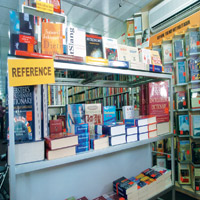 showed that only 24 percent passed in the compulsory subject of English
language, exposing the declining standard of English language at college
level.
showed that only 24 percent passed in the compulsory subject of English
language, exposing the declining standard of English language at college
level.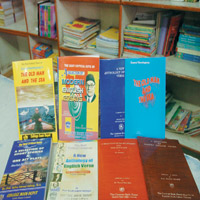 education. They believe that overall standard of English was never good
right from the beginning.
education. They believe that overall standard of English was never good
right from the beginning. Mehmood
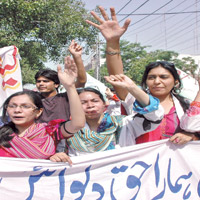 A number of issues have brought them there, most important being the poor pay
structure and unreasonably long working hours.
A number of issues have brought them there, most important being the poor pay
structure and unreasonably long working hours.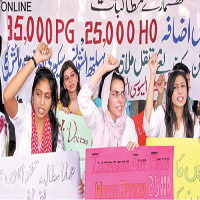 members from each hospital. Talking about the rally held on 5th of this month
Dr Zeeshan says, "the problem started when we went to Services Hospital
for the campaign of our association and enrolled 250 members in two weeks.
This was not acceptable to the administration so they terminated the
membership of one of our members named Dr. Hamid Mukhtar by levelling three
false charges against him," (according to Dr Salman of Mayo Hospital
these allegations included misbehaviour with seniors, harassment of female
colleagues and pressurising the administration). "Among these the most
ridiculous was the harassment of female colleagues. When we asked for
evidence against Dr Hamid they could come up with nothing so we protested
against termination of a doctor on false grounds."
members from each hospital. Talking about the rally held on 5th of this month
Dr Zeeshan says, "the problem started when we went to Services Hospital
for the campaign of our association and enrolled 250 members in two weeks.
This was not acceptable to the administration so they terminated the
membership of one of our members named Dr. Hamid Mukhtar by levelling three
false charges against him," (according to Dr Salman of Mayo Hospital
these allegations included misbehaviour with seniors, harassment of female
colleagues and pressurising the administration). "Among these the most
ridiculous was the harassment of female colleagues. When we asked for
evidence against Dr Hamid they could come up with nothing so we protested
against termination of a doctor on false grounds."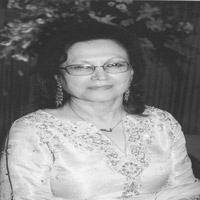 (Sister,dear, where are you). This was immediately followed by infectious
peals of laughter from Nasim. I listened delightedly, as she followed up
with wonderful loving words promising we would meet up as soon as she was
back in Lahore. Her vocabulary of Urdu or Pushto, and tone were like a
sweet rose balm.
(Sister,dear, where are you). This was immediately followed by infectious
peals of laughter from Nasim. I listened delightedly, as she followed up
with wonderful loving words promising we would meet up as soon as she was
back in Lahore. Her vocabulary of Urdu or Pushto, and tone were like a
sweet rose balm. her the much-coveted superlative of "injured from too much
text-messaging" on the social networking site facebook. It is
probably also the reason why she is often heard complaining about the pain
in her fingers.
her the much-coveted superlative of "injured from too much
text-messaging" on the social networking site facebook. It is
probably also the reason why she is often heard complaining about the pain
in her fingers.