



|
|
|
|
 |
 |
   |
Minority
report media laws Ominous
absence
Editorial The news of the killing of two Ahmadis in Mirpurkhas and Nawabshah has come as a shock. One ought to have known
that tackling minorities would always be a tricky subject in the
predominantly Muslim Today, contradictions abound in the country's constitution whose Article 2 declares Islam to be the state religion of Pakistan, Article 2A specifies Objectives Resolution as a substantive part of the constitution and is soon followed by the chapter on fundamental rights including the right to free speech, the right to freedom of assembly, freedom of association and freedom to profess religion and to manage religious institutions for all citizens of the country. Alongside these constitutional guarantees came discriminatory laws. From the anti-Ahmadiya movement of the 1950s, we moved to 1974 whereby the Ahmadis were declared non-Mulsims through a constitutional amendment (Second Amendment) by the most liberal of the country's rulers Zulfikar Ali Bhutto. With all mainstream Islamic parties unanimous in their opposition to the Ahmadis ever since the creation of the country, Gen Ziaul Haq found it rather easy to bring in a law in 1984 that barred Ahmadis from reciting the kalima, from calling their places of worship mosques or from propagating their religion directly or indirectly. What followed was a logical conclusion. Today, the Muslim citizens of this country have to make a declaration, distancing themselves from the Ahmadiya faith, each time they go to get an identity card or a passport. Ziaul Haq also brought in blasphemy laws and Hudood laws, which have been used against Christians, Hindus, Ahmadis and even Muslims. All these laws put paid to the constitutional guarantees of religious freedoms. Ziaul Haq brought back the system of separate electorates to isolate the minorities completely. Once the law of the land decided to penalise or threatened to penalise the minorities through discriminatory laws, the rest followed: the media; the syllabus; the castigation of minorities by the majority on the level of society; discrimination in employment and promotions; and not the least the decision of individuals to take human lives on the basis of their faith. The deaths in Sindh have been attributed to hate speech propagated through the media. We have, therefore, tried to keep the focus of this Special Report on the law and the media. We hope that the political party in power, that claims to work towards a democratic and pluralistic setup in the country, will take serious note of such incidents and correct the myriad anomalies, beginning perhaps with the laws. There should be a standard code of ethics for all media organisations to follow, and it must put emphasis on giving respect to all religious authorities By Shahzada Irfan Ahmed The persecution of
minorities in Pakistan is a longstanding issue that has caught the
attention of human rights It has been observed over the years that it is very easy to brand a non-Muslim a blasphemer, even in the absence of solid evidence, and made to face the wrath of the locality they inhabit. Most of the times, the public reaction is so strong that the official machinery cannot dare to go against the public will and has to budge to its demand. Similarly, there is very little acceptance for religious minorities in the society and their deeds are always seen with suspicion. Christian priests are often charged with attempting to convert Muslims into Christians under the garb of public service and Ahmedis for wrongfully posing themselves to be Muslims and propagating their beliefs. The prevalence of this perception among the majority is due to different factors including the religious education they get at home, the curriculum they read at schools, the religious sermons they hear at mosques and the hate literature they read and so on. However, the most influential in this respect has become the role of the media that can very effectively mould the opinion of the people and make them react within a split second. The murder of an Ahmedi doctor, shortly after a TV host had asked the faithful to kill Ahmedis on sight, shows how effective the role of media can be. A thorough study of the content on minorities carried by the press and the electronic media shows that the media is, to a great extent, responsible for creating anti-minorities' mindset. Though the situation is much better in the English press, the national Urdu and vernacular press (barring a few exceptions) are overwhelmingly biased against the minorities. For example, when a bishop committed suicide to protest against the conviction of a Christian in a blasphemy case, PML-Q leader Ijaz-ul-Haq said that the blasphemy laws would not be changed "even if Pope commits suicide, and even if one billion Christians were killed." This statement was totally uncalled for, but the Urdu press flashed it and portrayed him as a courageous and a true Muslim. Likewise, it has become a regular affair to target a high ranking official or public representative by declaring him an Ahmedi/Qadiani in the press. This is something that has happened even with General (retd) Pervez Musharraf and former prime minister Shaukat Aziz. Such rumours are carried by press in a way that the word 'Qadiani' becomes a curse in itself. In fact, such perceptions are created by the state that are simply taken ahead by the media, says Adnan Rehmat, Country Director, Internews. According to Adnan, when the state brands a considerable number of its citizens as minorities and bars them from holding the highest offices of the state under the Constitution, such mindset is bound to develop subconsciously. He tells TNS that back in 2002, a meeting headed by General (retd) Musharraf decided to discard the use of the word 'minorities' and replace it with 'non-Muslims' in official correspondences. Though the step was aimed to end religious discrimination, the use of word 'non-Muslim' made the situation even worse. Under this decision, 'Muslim' became a standard and every one below that was to be called 'non-Muslim', he adds. An extract from the editorial of a leading English daily, published on Sep 10, 1974, soon after the Ahmedis had been declared non-Muslims through a constitutional amendment, shows how strongly the state line has always been adopted by the media. It goes: "An old controversy which posed a threat to public peace and tranquillity and was not without elements of delicacy and complexity has at last been got out of the way. The resolution of the Qadiani question by the Parliament, in conformity with the sentiments and aspirations of the people of Pakistan, is a matter of historic significance.... Thus when the National Assembly and the Senate passed the Constitution (Second) Amendment Bill declaring that non-believers in the absolute and unqualified Finality of the Prophethood of Muhammad (Peace Be Upon Him) would be excluded from the fold of Islam, not only was a painful chapter of religious controversy closed but a glorious example laid down for future reference and emulation." The worst role in demonising minorities is played by the vernacular press, says Peter Jacob, Executive Secretary of the Catholic bishops' National Commission for Justice and Peace (NCJP). He tells TNS that these papers often display crude prejudice in reporting about minorities and use words such as 'badbakht' and 'maloon' (the cursed) before the names of blasphemy accused on their own. It's a pity that they do not even wait for the legal process to start and the charge proved, he adds. He says there are people who are, in fact, 'hate speech factories'. They are part of organisations bent upon issuing statements against the religious minorities, such as that they will not be allowed to hold key posts. "Governments are even harassed for being Ahmedi-nawaz," he continues, "But the bigger tragedy is that the media becomes a tool and glorifies these statements." Peter says that such statements should be carried with caution and dropped in case they can trigger violence. He goes on to say that such people have a following on the basis of their hate speeches and there is an economic aspect to the whole plan, too. He suggests that the media should play a role of self-evaluation/censorship and discourage those newsmen who try to be holier-than-thou. Mahadev, a resident of Thatta, tells TNS that the stance of Urdu and vernacular press towards religious minorities is biased to a great extent. "We still remember how our press covered the incident of the Babri mosque. In a way, it was due to this coverage that many temples were demolished and Hindus residing there rendered homeless. The media should have told people that Hindus living in Pakistan had got nothing to do with the incident in Ayodhya." He says that one wonders why they carry headlines like "A Hindu girl abducted" or "A Hindu vendor beaten up". They could have put it simply that a girl was abducted or a vendor beaten up. The Ismaili community is also a victim of this onslaught as is obvious from a write-up published on Aug 18, 2003. It mentions that the Aga Khans are bent upon creating a second Israel by setting up an Ismaili state over a region containing Northern Areas of Pakistan, parts of Central Asia and Jammu and Kashmir. The author terms Aga Khani religion as a minority secretive religion that had damaged Islam in the past. The capacity issue haunts the media in this respect since, in words of Adnan Rehmat, the number of trained journalists is dismally low. He says that as per figures provided by the Pakistan Federal Union of Journalists (PFUJ), the number of journalists working for print and electronic media registered with it has risen from 2000 to 14000 and even above since 2002. Most of them have experience of 2-3 years each and know less about the sensitivities involved in reporting minorities' affairs. Adnan suggests that there should be a standard code of ethics that should be adopted by all media organisations and it must emphasise on giving respect to religious authorities. laws Our law-makers have still to prove that Zia-ul-Haq had no right to distort the vision of the Quaid-e-Azam, who wanted minorities to pursue their beliefs and cultures "freely" because they are equal citizens as far as the business of the State is concerned By Saeed Ur Rehman It was the experience of
being a minority in India that compelled the Muslims to demand a separate
homeland for "I cannot emphasise it too much. We should begin to work in that spirit and, in the course of time, all these angularities of the majority and minority communities, the Hindu community and the Muslim community, because even as regards Muslims you have Pathans, Punjabis, Shias, Sunnis and so on, and among the Hindus you have Brahmins, Vashnavas, Khatris, also Bengalis, Madrasis and so on, will vanish. Indeed if you ask me, this has been the biggest hindrance in the way of India to attain the freedom and independence and but for this we would have been free people long long ago. No power can hold another nation, and specially a nation of 400 million souls in subjection; nobody could have conquered you, and even if it had happened, nobody could have continued its hold on you for any length of time, but for this. Therefore, we must learn a lesson from this. You are free; you are free to go to your temples, you are free to go to your mosques or to any other place of worship in this State of Pakistan. You may belong to any religion or caste or creed that has nothing to do with the business of the State. As you know, history shows that in England, conditions, some time ago, were much worse than those prevailing in India today. The Roman Catholics and the Protestants persecuted each other. Even now there are some States in existence where there are discriminations made and bars imposed against a particular class. Thank God, we are not starting in those days. We are starting in the days where there is no discrimination, no distinction between one community and another, no discrimination between one caste or creed and another. We are starting with this fundamental principle that we are all citizens and equal citizens of one State." This speech of the Quaid opened the proverbial Pandora's box. The minorities embraced it and the religious right tried to suppress it. The speech was considered too liberal or secular by the religious right, especially the Jamaat-e-Islami, which initially was against the creation of Pakistan because, at that time, they considered nationalist aspirations for the Muslims of India against the idea of Khilafat and the unified Ummah. Indeed, nationalist aspirations of a religious minority constitute a very complex political ambition. First, a minority has to justify its nationalist ambitions in exclusive terms. Then, after achieving its goal, it has to try to accommodate the minorities within. An erstwhile minority, after attaining majority within a new nation, has to be careful to not produce what Edward Said has called "the victims of the victims and the refugees of the refugees." The minorities of Pakistan were wary of the ways in which the laws of the nation-state were being developed, especially after the death of the Quaid. In 1949, when the Objectives Resolution was passed, the representatives of the minorities tabled a list of amendments. The suggested amendments were rejected in a vote within the Assembly because only ten members favoured the proposed amendments whereas twenty one members voted to reject them. That is another political problem posed by religiously inspired nationalisms. How can minorities have their concerns registered when numbers are not on their side? Before the Objectives Resolution was adopted, Bhupendra Kumar Datta, one of the minority members of the Constituent Assembly, debated its majoritarian nature on March 9, 1949. According to Datta, politics belonged to the domain of reason and religion to the domain of emotions. By mixing the business of the state with the emotions of the majority, argued Datta, the law-makers were paving the way for absolutism because it was difficult to argue against an emotional majority. He suggested that the law-makers should assign sovereignty to the people of Pakistan as citizens of the state and not as religious beings. To support his stance, he referred to the political views of the Quaid: "Were this Resolution to come before this house within the lifetime of the great creator of Pakistan, the Quaid-e-Azam, it would not have come in its present shape." It is one of the ironies of our political history that those voices which wanted the nation to embrace reason were consistently suppressed. After the Objectives Resolution was adopted, the nationalist project of the Muslims of India, essentially a secular project, was vulnerable to populist manipulations and tactics by any ruler. Religion was not safe from the interference of politics and the political sphere was not safe from the incursion of religious emotions. According to K. K. Aziz, only a secular constitution can be an effective safeguard against the misuse of religion by politicians. The later developments in the political history of Pakistan support this thesis. If the Objectives Resolution had envisaged a secular state, populist demagogues would not have encouraged different religious and sectarian agitation movements. This was what the minorities feared in 1949 when they objected to certain specific phrases that only had a populist appeal and did not provide any concrete guidance regarding the business of the state. It was due to this milestone document in our history that one sect fights against the other or one community tries to declare the other non-Muslim. In 2007, M. P. Bhandara tried to undo the damage done by the Objectives Resolution by moving a private bill in the National Assembly to include the Quaid's speech of August 11, 1947, as part of the Constitution of Pakistan. The bill was admitted because the National Assembly could not ignore the Quaid-e-Azam. A similar strategy is needed to combat the American-funded extremism of the era of proxy jihad. Our law-makers have still to prove that Zia-ul-Haq had no right to distort the vision of the Quaid-e-Azam, who wanted minorities to pursue their beliefs and cultures "freely" because they are equal citizens as far as the business of the State is concerned. The killing of the two members of Ahmadi Jamaat in Nawabshah and Mirpurkhas has triggered a fresh debate on the treatment of minorities in the region and is a poor reflection on the role of the authorities in helping matters By Adeel Pathan Sindh is popularly
hailed as the land of sufis and saints like Lal Shahbaz Qalandar, Shah
Abdul Latif Bhittai, Sachal The first victim of religious intolerance (read extremism) who was gunned down in Mirpurkhas -- Dr Abdul Mannan Siddiqui -- was the Sindh chief of Ahmadi Jamaat and ran a medical hospital named Fazal-e-Umar Medical Centre (FUMC). Dr Raj Kumar, who had the chance to work with (late) Dr Siddiqui, talked to TNS about the incident. He said that he had heard of two unknown assailants who waylaid Dr Siddiqui as just as he arrived at the medical centre. "It appears that they (culprits) were lurking around the place, waiting to attack Dr Mannan Siddiqui. They wanted to take no chance and fired 17-odd bullets at him. Dr Siddiqui expired on the spot. It was quarter to two in the afternoon. Dr Siddiqui's guard and two other people were also wounded but they survived." Dr Kumar who has been employed at FUMC for the past seven years, also spoke of Dr Siddiqui's "untiring efforts" in the upkeep of the centre. "For over three decades, it has been providing medical and health facilities to the people of Mirpurkhas and adjoining areas. Today, the centre is a bigger, 60-bed facility." When asked whether the members of the Ahmadi Jamaat protested against the murder of Dr Siddiqui in broad daylight, Dr Kumar said, "No, but the civil society and human rights activists did. Besides, a case was registered by the administrator of the medical centre against the unknown culprits." The Ameer of Ahmadi Jamaat was killed in Mirpurkhas, while the 65-year-old Yusuf succumbed to injuries at a local hospital in Nawabshah, the hometown of President Zardari. According to the report registered by his brother, Yusuf was heading towards his prayer place in Liaqat market, in the centre of the city, when two assailants opened fire at him, killing him there and then, and fled the scene on a motorbike. The case was registered against two unknown culprits in the wake of protests by the people belonging to the Ahmadi Jamaat. The president of Nawabshah Press Club, Anwar Sheikh notes that 400 to 500 people in the city have their affiliations with the Jamaat. Discussing the reasons behind the killing of the 65-year-old, Anwar is categorical, "It is target killing. "Such incidents might've been motivated by some monetary concern, especially considering the fact that the Ahmadi Jamaat is facing several challenges -- internally -- because it gets foreign aid and works like a missionary organisation," he adds. Sanaullah Abbasi, Deputy Inspector General (DIG), Police, Hyderabad region, also spoke to TNS about the incidents. He said, "It is too early to arrive at a conclusion as to who is behind these killings. But one thing is clear that this is an act of terrorism. "In this regard, we have arrested 22 suspects who are associated with the banned jihadi outfits. We are monitoring them and also probing the Nawabshah killing which has its obvious link to the other incident of killing that occurred in Mirpurkhas." In response to a question, Abbasi said that there had been complaints from the Ahmadis living in Badin and Jamshoro district who attributed these incidents to the law-and-order situation. "But I see them as pure terrorist attacks. "We tried to address the issue on a local level," he continued, "After these incidents we have revamped our security network and are guarding the places of worship of the Ahmadis." Abbasi said that the police had taken all necessary preventive measures. He claimed that after they arrested a number of banned jihadi outfits, the police had managed to contain the incidents of target killings. However, he was of the view that different investigation teams had been assigned to investigate the matter and the outfits belonging to banned jihadi organisations had been asked to submit their daily itinerary in the local police stations to keep track of them on a regular basis. "We have been able to restrict the scope of these killings. After the security was tightened around the Ahmadis' places of worship and their residential areas, things are under control." Sarwan Kumar, human rights activist based in Mirpurkhas, informed TNS that the family of the deceased was not willing to speak to the media. He said that those who had killed Dr Mannan Siddiqui had actually killed a generation of people that had benefitted from the services of the deceased's medical centre. He added that there had been a series of protests in Mirpurkhas after Dr Siddiqui's murder and termed the tragic incident as a result of religious extremism. A religious seminary close to the FUMC was also attacked several times. The deceased was the Sindh chief of Ahmadis and his dead body was taken to Rabwah (near Faisalabad) for burial, the rights activist revealed. Despite claims by the authorities, the incidents of target killings continue to haunt the resident minorities that were earlier leading a peaceful co-existence in the province. For its part, the government will have to devise a solid mechanism to avoid any future incident of crime in the region. The religious scholars have already condemned such killings and called for a show of tolerance. TNS tried to get in contact with the media representative of the Ahmadi Jamaat in Mirpurkhas and Nawabshah, but to no avail. The people were not willing to talk to the media. More recently, the issue of the Ahmadi Jamaat being victimised acquired a new significance as Muttahida Qaumi Movement (MQM) chief Altaf Hussain claimed that the killings were linked to the rise of Talibanisation in Sindh. Email:
adeel.pathan@thenews.com.pk
|
|
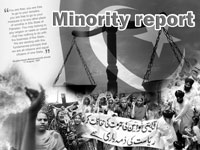 state. With the passage of time, the polity that evolved in the new
country became a bundle of contradictions. Quaid's Aug-11 speech "You
are free to go to your temples..." was rendered meaningless as the
Objectives Resolution assumed primacy in the running of the countryís
affairs.
state. With the passage of time, the polity that evolved in the new
country became a bundle of contradictions. Quaid's Aug-11 speech "You
are free to go to your temples..." was rendered meaningless as the
Objectives Resolution assumed primacy in the running of the countryís
affairs.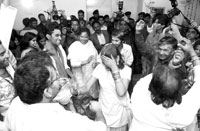 groups within the country as well as abroad. On many an occasion, the
treatment meted out to them becomes barbarous and even leads to the death
of individuals at the hands of enraged crowds mostly on religious grounds.
groups within the country as well as abroad. On many an occasion, the
treatment meted out to them becomes barbarous and even leads to the death
of individuals at the hands of enraged crowds mostly on religious grounds. themselves. If one accepts this logic, then a corollary assumption is
unavoidable: Pakistani Muslims, after attaining the status of a majority
in their own homeland, will not reproduce the social, economic and
cultural conditions which generally compel minorities to be discontented
within the polity. This was the essence of the ideas of the Quaid-e-Azam
Muhammad Ali Jinnah on the status of minorities in Pakistan. He tried to
convey this to the nascent nation in his address to the Constituent
Assembly on the 11th of August, 1947:
themselves. If one accepts this logic, then a corollary assumption is
unavoidable: Pakistani Muslims, after attaining the status of a majority
in their own homeland, will not reproduce the social, economic and
cultural conditions which generally compel minorities to be discontented
within the polity. This was the essence of the ideas of the Quaid-e-Azam
Muhammad Ali Jinnah on the status of minorities in Pakistan. He tried to
convey this to the nascent nation in his address to the Constituent
Assembly on the 11th of August, 1947: Sarmast and Abdullah Shah Ghazi, all of whom spoke of peace and stood for
tolerance before its multi-ethnic, multi-cultural society. Unfortunately,
this very message seems to have become lost on the Sindh that we see
today. Incidents where the people belonging to 'minority' groups have
become victims of 'intolerance' at the hands of the religious extremists
are growing ominously. The recent 'target' killing of two office bearers
of the Ahmedi Jamaat (Qadiani) in interior Sindh is one inglorious case in
point. It has triggered a fresh debate on the treatment of minorities in
the region and is a poor reflection on the role of the authorities in
helping matters.
Sarmast and Abdullah Shah Ghazi, all of whom spoke of peace and stood for
tolerance before its multi-ethnic, multi-cultural society. Unfortunately,
this very message seems to have become lost on the Sindh that we see
today. Incidents where the people belonging to 'minority' groups have
become victims of 'intolerance' at the hands of the religious extremists
are growing ominously. The recent 'target' killing of two office bearers
of the Ahmedi Jamaat (Qadiani) in interior Sindh is one inglorious case in
point. It has triggered a fresh debate on the treatment of minorities in
the region and is a poor reflection on the role of the authorities in
helping matters.