



|
|
|
|
 |
 |
   |
interview Karachi kahani
Zia
Mohyeddin column
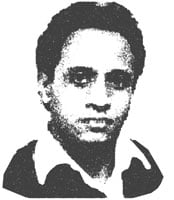
interview The News on Sunday met up with Frank Huzur, a progressive journalist, playwright, and poet from New Delhi, who is writing an Authorised Biography of Imran Khan. Earlier in his career, he wrote controversial plays, such as Hitler in love with Madonna, which earned him fame and notoriety. By Abrar Ahmad The News on Sunday: Tell us
something about your repeated visits to Pakistan in the recent years and
Imran Khan's Frank Huzur: I do visit Pakistan quite frequently. Some of these visits were in connection to newspaper assignments while others, including the present one, is for the forthcoming biography of Imran Khan. I feel honoured to get an opportunity to observe him. Considerning my passionate study of him as a subject, he authorised me to write his biography in January this year. Falcon and Falcon, London is publishing the 500 page biography titled Imran vs Imran: An Untold Story. It is not just a biography of a legendary cricketer but carries predominant shades of a literary masterpiece. So, I consider it a literary work because basic statistics and figures can never sum up the life of a man of his stature. He is not just a celebrated cricketer but a committed democrat too. The book took me to a great number of places including London where I met Jemima Khan, who agreed to share her side of the story. TNS: Your Indian passport carries the name Manoj Mumar. Your first play Hitler in Love with Madonna was written under the name Manoz Khan. Today, you are known as Frank Huzur -- a fiction and non-fiction writer. Why did you choose to change your name not once but thrice? FH: It is a long story. I was named Manoj Kumar by my bureaucrat father. Growing up on the poetry of Keats and Walter Scott and the works of Shakespeare, I thought of playing with my name. Since I was brought up by a Muslim mother and chose to write my first poem under the name Manoz Khan because I wanted Manoj Kumar to be limited only to academic records. Later on in March 1997 when I was a student of Hindu College in Delhi University, I launched a monthly news magazine titledUtopia. I was twenty, and almost on the verge of becoming the youngest Indian editor of a mainstream political magazine. At a time when most of my college mates were busy preparing for their civil cervices examinations, I was fascinated by literature and current affairs. My first play Hitler in Love with Madonna became controversial for a scene dealing with militant Hindutva and the fast crumbling facade of Indian secularism. That scene depicts the rabid round of bloodletting between Hindus and Muslims in the fatremath of the demolition of Badshahi Mosque by the latter. Towards the end of September, the play was banned by the Interior Ministry. The banning of the play was a blow to my artistic endeavour. I had to flee New Delhi to save my life. My studies got disrupted and editing career halted. The Delhi University administration was alarmed over the State's intervention. Later when Etzler and Oz agreed to publish Hitler in Love with Madonna, a minister refused to launch it. The book was also banned. After the ban, I went around like a fugitive being chased by Hindu hardliner groups, mostly right-wing student parties and the BJP. I was in a tight spot. Intellectuals who swarm Delhi streets were also not able to help me. It became a Herculean effort to defeat the establishment. In May 2002 I wrote another avant-grade play Blood is Burning -- equally harsh in its criticism of the ongoing state sponsored massacre of Muslims in Gujarat. The production was muted the morning after its premiere. On July 2, 2002 I decided against burying one of the important vestiges of my past and registered Frank Huzur as my pen name. Thereafter began my new literary and journalistic voyage under the name Frank Huzur. TNS: How did it affect you as a person and a writer? FH: The ban on Hitler in Love with Madonna changed the course of my life. The massive controversy it generated was a lesson in many ways as an individual and as an Indian because I was concerned about the increasing threats of fanatic Hindu groups. They wouldn't allow any writer to question their indiscrepancies. I feel lucky to be among those who raised their voice against this oppression. I was defiant but I had to stay out of New Delhi for nearly three years. TNS: Your involevement in theatre started with Hitler in Love with Madonna or does it have anythign to do with your relationship with actor Fermina Mukta? FH: When I wrote Hitler in Love with Madonna, I was 19. At that time I didn't have any association with Fermina. I met her four years later in 2002. She made her stage debut through my next script Blood in Burning. Later, we started living together. Today, she is a top-notch stage and television actor. Later this year, she will debut in cinema too. TNS: You also participated in the the Rafi Peer World Performing Arts Festival last year? How did you like the festival? FH: Rafi Peer Festival is very popular in India, especially among drama enthusiasts and performing groups. I was proud to be a part of it. I was travelling with Fermina who was invited to perform with her theatre troupe 'The Entertainers.' Every theatre group and art world cognoscenti wants to attend the festival. And I must say I returned with more respect and affection for Pakistani arts and culture. India, despite its huge film and arts industry, still doesn't have anything of this scale. TNS: How do you balance between journalism and literature? As a writer how do you retain interest in journalism? FH: I have been trying to dabble into all genres of literature. Journalism is hurried literature. For almost four years until Febraury this year, I was reporting aggressively for an English paper in India. My area of interest in reporting is Pakistani politics and Indian culture, a unique combination for an Indian writer-journalist. Pakistan politics over the past few years, especially since 9/11, has become a hotbed of breaking news. However, I don't run after breaking news. My intense focus on Pakistan gave me an opportunity to interview the titans of Pakistan politics: Benazir Bhutto, Imran Khan and President Asif Ali Zardari. I reported quite a lot about new trends in Indian theatre and arts world besides Pakistani arts and culture in India. TNS: It is believed your literature reflects anguish and fears of the common man, especially in your poetry. Is it true? FH: I firmly believe if literature, fiction or non-fiction, doesn't talk about the problems of ordinary people, it doesn't qualify to be called literature at all. My poetry is not very different from my plays. In both, I only try to voice the feelings of an average Indian. Ahough I try to write more about socio-political events in my fiction, I draw parallels from global events of monumental significance. When I visited Kathmandu for SAARC Poetry Conference in March of 2007, I was shocked to witness the humiliating condition of young women. The appalling situation inspired me to compose a poem, with the title I Saw Sita on Sale. A number of Indian publishers refused to publish it lest it invite the wrath of Hindu fundamentalists. My contention is hundreds of Hindu girls are selling their sex just in front of Naraynhiti Palace, now no longer abode of Nepalese King. I used Sita to drive home the larger message. TNS: How are you related to Rajendra Yadav? FH: Rejendra Yadav is an institution by himself. Indian, Hindi or Urdu literature wouldn't be complete without his stories and novels. He is one of the finest litterateurs. Despite turning 80 this August, his zeal for pushing his literary struggle for the underprivileged section of society, especially women, Dalits and Muslims, has been exemplary. When I eloped with Fermina, it was Rajendra sahib who gave me shelter. He is my foster father. For the past 25 years, he has been editing Hans, a literary journal which was founded by Premchand. His editorials are scathing in criticism of establishment policies making it impossible to ignore his voice. His literature, to say the least, gives voice to the voiceless. I draw inspiration from him. TNS: What do you have to say about young Indian writers exploring different genres? FH: Quite a good number of young writers in India are emerging on the literary scene. Their work reflects the rhythm of the changing times. For one, Chetan Bhagat, a technology graduate, surprised literary puritans by producing a bestseller out of life and in call centres boys and girls. Chetan is selling more than some established writers, who are reputed for writing in classical genre of fiction and non-fiction. Unfortunately, we have not been able to engage a huge crowd of newspaper readers into book reading. Publishers are still reluctant of pushing and promoting their writers in an aggressive way. The colonial hangover of winning the stamp of approval from a foreign publishing agency is still an entrenched phenomenon. Despite a good number of emerging young English writers, the Indian publishing market is still glutted wih fear and apprehension of dealing with avant-garde literature. Such literature is still the bastion of a handful of committed left-wing, liberal groups and NOGs. At end of the day, Indian publishing is yet to learn to create bestselling and much admired writers who can become a force globally. TNS: Which Pakistani writers are you familiar with? FH: I have highest esteem for Pakistani writers and their literary productions. I grew up with Faiz's verses. I like Mohsin Hamid, Mohammad Hanif, Kishwar Naheed, Intizar Hussain and Mirza Hamid Baig. It is good to see young Pakistani English writers making waves. TNS: How did you attach yourself with Falcon & Falcon? FH: I have signed a contract with Falcon & Falcon, an up-and-coming publishing house in London. They signed me for my forthcoming biography of Imran Khan, Pakistan cricket legend and founder chairman of Pakistan Tehreek-e-Insaf. Falcon is also entering Indian publishing market through Imran vs Imran: the authorised biography. Falcon & Falcon Indian chapter is headed by Ankit Khanna, a young, dynamic journalist-turned-entrepreneur. TNS: Kashmir continues to be the bone of contention between India and Pakistan. Do you see a possibility of reconciliation? FH: Youngsters across the border are craving for peaceful, dialogue driven solution to six-decade-old conflict. I am confident that young Indian leadership of the next decade, headed by Rahul Ghandhi or a commoner, will be bolder in its stand to resolve the dispute. Politicians in India and Pakistan are afraid of making moves on this contentious issue because it involves a lot of risk. In other words, they are afraid of taking risks. I think Imran Khan is the only leader who is courageous enough to take a decisive stand on such issues, be it Kashmir or war on terror. Karachi kahani Tunnel Vision By Shandana Minhas By Zarmeena Mubashir The story is set against
the backdrop of Karachi – a city where the past, present and future battle
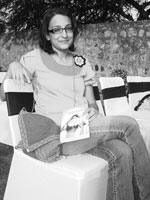
it out on Shandana Minhas writes her first book with a sense of humour which keeps the reader engrossed till the end. The story is narrated by a middle class Pakistani woman 'Ayesha', 31, single working and independent. She tells her ordeal in the comatose stage, which makes the book different. The story is told in the first-person perspective, which brings it closer to readers. The most interesting thing about the book is that Minhas' characters are completely believable. Her choice of material reflects her sense of humour and her love for Karachi. The book is worth mentioning for the character of the mother and her relationship with her only daughter, Ayesha. Both mother and daughter fight for the affection of Aslam, Ayesha's father, who disappears one morning leaving the family to depend on Ammi's brothers. It forces Ayesha to mature faster, and youth and responsibility are intertwined, with a souring relationship with Ammi. Later in life, Ayesha is preoccupied with her mother's lack of concern for her, and unmatchable love for her younger brother. She works restlessly to earn bread and butter for the family of three. Ayesha's attitude is linked to her father's desertion and the burden of endless responsibilities. Ayesha's mother portrays a character quite close to reality. She helplessly struggles with psychological trauma, triggered by post-natal depression after her second child. Ayesha's younger brother is a typical self obsessed child who does not take life seriously. The narrative is powered by a love story between Ayesha and Saad, her boss's son. Then, the narrative ends abruptly. It fails to give the reader a happy or sad ending, and leaves him or her in a perplexed state to figure out the true ending. Saad is from a rich family and Ayesha's infatuation with him makes the story lose its essence. The plot-line is all about gender inequality but other elements in the story make it interesting. Minhas has written what was inside her and it may not be her best work. She told the story as it came to her and not as it would be more pleasing to the readers. Her central character, Ayesha is a complex woman proposing one man, rejecting another, violently reaching to sexual harassment at the workplace, and shouting abuses at street vendors in Khori Gardens. The author did give a realistic outlook of life in the city of Karachi but some illegitimate relationships have been exaggerated a bit too far. Moreover, some unimportant characters have been added unnecessarily, which has made the story weak. Ayesha's continuous bickering sometimes gets irritating. It is paradoxical that Minhas through her story on one hand emphasises male domination and projects feminism on the other. Though the book projects some realities of life, the story does not move on a strong plot and tends to leave the reader asking for more. The male actors are not central to the story because basically the book is about the mother and daughter and their difficult bond. The title of the book 'Tunnel Vision' has been aptly chosen as the protagonist and everyone around her suffers from it. Minhas' distinctive writing created a simple everyday story into a novel. The realism in the book is based on the characters' hatred for the political class and their middle-class norms. Her familiarity with her resident city needs appreciation. She also very well emphasises the bitter fact that the curse of domestic violence is rampant in Pakistan. Another thing which distinguishes Minhas' story from the rest is that it floats between past and the present. One minute she is telling how she lived all her life in spiritual agony and the very next minute she comes back to her present state, which is no better than her past. Transition being witnessed by the country provides a parallel to Ayesha's own angst. Minhas was also short-listed for the Commonwealth Writers' Prize 2008 for Tunnel Vision. Regionally flavoured novels have gained popularity globally. Internationally this book could be viewed as an engaging tale by a modern Pakistani woman stuck in a patriarchal society. The projection of oppressive Pakistani society is true because of the Islamic morals shown by aggressive Jamiat university students beating up male students seen roaming or sitting with a female student. Similarly police demanding marriage certificates from couples driving together also adds to the stereotypical image of Pakistan turning into a home of fundamentalists. References to Jamiat students, popular TV shows and Nikhanamas will strike a chord with readers who grew up in Karachi in the 80s. A lot of readers from South Asia would be able to find a lot in the book that they can relate to. The theme of the story is not an unusual concept but overall it lacks rhythm. The chapter headings (Love to Soil Pakistan), ('Maa ki dua, jannat ki Hawa') give the book colour and piquancy. Despite its shortcomings, the book is still worthy of note because it somehow portrays a true picture of Karachi. She has an easily readable style of writing and engages the reader right through the novel. A refreshing sense of humor and brilliant sense of comic timing sets this book apart. Zia
Mohyeddin column R.K. Narayan's famous novel, 'The Guide,' was adapted for the stage by Harvey Breit and Patricia Rhinehardt (a husband-and-wife team), two Americans who had been so fascinated by the book that they had travelled all the way to India to seek his permission before undertaking the task. They had apparently got on well with the author of the 'Malgudi' tales,' who said, 'Go ahead, if you think it is worth it', with a hearty chuckle. The play, when finished, was sent to various London impresarios, because the authors felt that it had a better chance of being produced in England. Having done the rounds of most London managements, it landed, eventually, at the desk of Frank Hauser, the artistic director of Oxford Playhouse. Frank who had been looking for a vehicle for me - I had just finished a long run in London - grabbed it with both hands and announced that the season of '61 would open with 'The Guide.' As soon as they learned that the play was going into rehearsal, the Breits arrived in England and parked themselves at the Connaught. The Connaught, in Mayfair, was one of the most exclusive hotels in London; it prided itself in changing the bed-sheets (silken in the suite that the Briets occupied) twice a day. Patricia paid the bills. She was an heiress (the Rhinehardts were old money). The two of them entertained in a princely manner. I had my first venison at one of their lavish dinner parties. Harvey Breit was a shambling, amiable, portly little man with hair that seemed to be grizzled with snow. Patricia, exuded an aura of hauteur. She was a slim, tall, beautiful woman with a neck that reminded you of Nefertiti. She may have made some contribution to the adaptation, but it was obvious that Harvey was the brain. He had been the editor of the New York Times Book Review section, but had given up his job after marrying Patricia. The play was directed by the mercurial Frank Hauser. I have had the opportunity to work with many directors of repute, but the time spent with Hauser, one of the wittiest directors, was the fullest in experience that I have had in all my years on the stage. I learnt more from him, about acting - and directing - than from anyone else. He pulled me up when I tried to approach my work too intellectually. Instinct, - and energy - he emphasized, was the most exciting quality of really good acting. Frank had persuaded the distinguished Australian painter and sculptor, Sidney Nolan, to design the play. Nolan created a series of abstract landscapes which were a perfect foil for the rich imagery of Narayan's language. We heard on the grapevine that Narayan was planning to visit England and that he might be present at the opening night, but he didn't make it. The notices for the Oxford production of 'The Guide' were excellent and, personally, I scored my biggest triumph to date. Ken Tynan in the 'Observer' wrote that I was "the new Laurence Olivier in the body of Anthony Quinn" and was now ripe enough to tackle the major Shakespearean roles. I wish I still had that review. (Alas, the trunk that contained this and many other notices disappeared when I moved from one house to another). The Breits were cock-a-hoop; they never imagined that their work would receive such a huge critical success. They wanted to have the play transferred to Broadway, by-passing the West-End. Patricia decided to put her own money into it, but her lawyers in America informed her that her inheritance money could not be used for theatrical ventures. The Rhinehardst had not been Calvinists for nothing. Narayan did arrive in London sometime after the run of the play. Santha Rama Rau, who happened to be in town, invited me over to meet him. I was eagerly looking forward to a meeting with Rasipuram Krishnaswami Ayyar Narayanaswami (I had read somewhere that his publishers thought that a shortened version of his name might look better in English book stores). While preparing for the guide I had read all his 'Malgudi' novels and found them to be delightful. The novelists that I had met, until then, were either naturally taciturn, or loquacious, but they all had an intellectual aura. Not R.K. Narayan. If I didn't know who he was I would have thought he was a physicist, or a horticulturist. He greeted me with a generous smile; his geniality was infectious. The handsome, silver-haired Santha Rama Rau (Narayan called her Shanta), never at a loss for words, spoke glowingly about my performance. (Narayan listened bemused; I cringed). "It's a crying shame you couldn't have been here to see him in the play." She then turned to Narayan and, in the tone of a stern school mistress, told him that he had to look again at the second act which, she felt, was wordy and needed to be tightened. Was 'The Guide' one of his favourite novels? I ventured to ask. "It is one of the longest novels I have ever written", was his enigmatic answer. Was he in the process of writing a new novel? Yes , he said, but at this point in time, he didn't know what it would be about. He spent four hours a day, everyday, (not a penny note) at his desk and he never thought of his work outside these hours. "I am a great believer in words as 'movers'." He didn't believe in preaching or moralising. "The only obligation to which we may hold a novel," he quoted Henry James, "is that it is interesting." Santha Rama Rau again talked of some parts of the Guide which in her view, needed to be re-written. "I am not very good at play-doctoring," he said modesty "Why don't you do it?" he added, as if the idea had just occurred to him. My only other meeting with him was when I shared a taxi ride with him on his way to Bush House where he was to record an interview. He wanted me to come along but I had to catch a train to Oxford. He was beginning to like London less and less. He didn't enjoy the meetings his publishers had lined up in which he was, invariably, asked to give his views on 'the role of the writer in society'. He wrote because it was a compulsion. He just hoped that he didn't bore the readers. As we were approaching Bush House, I asked him if he had tightened the middle act. No, he said, he couldnt work in London. He would do it when he got back. I wanted to know if he was going to re-write it. Oh, "I might..." he said with that genial, disarming, smile, "I might make some minor fundamental changes". It is a remark I have dined on, often.
|
 biography you have been working on.
 billboards, TV and the backs of rickshaws. The narrative revolves around a
young woman's tragic life. It captures the battles of a modern Pakistani
woman. The story has a sentimental angle to it which makes the reader
emotional and the way narrator reveals startling facts about the
protagonist's immediate family, relatives, and friends keeps the reader
involved in the story. Karachi is like a character and has a huge role to
play in the narrative. It has been rightly projected as a metropolis with
traffic jams, filth in public hospitals, rampant corruption, and pollution.
billboards, TV and the backs of rickshaws. The narrative revolves around a
young woman's tragic life. It captures the battles of a modern Pakistani
woman. The story has a sentimental angle to it which makes the reader
emotional and the way narrator reveals startling facts about the
protagonist's immediate family, relatives, and friends keeps the reader
involved in the story. Karachi is like a character and has a huge role to
play in the narrative. It has been rightly projected as a metropolis with
traffic jams, filth in public hospitals, rampant corruption, and pollution.