



|
|
|
|
|
 |
 |
   |
education MOOD STEET Town
Talk issue
'Fast'
diminishing education Preparing for life A school in Lahore's Model Town offers hope to the special children By Naila Inayat As I walk into the
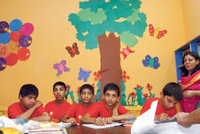
two-storey campus in Model Town's posh F-Block, I get a bit uncomfortable There is a hustle bustle in the entire campus and all the teachers and students are busy in their Ramzan campaign -- making packets with Eid cards and brochures. In the art class 11-year-old Rabia is stitching, don't know exactly what, but a lot of mirror work can be seen. Some of her craft is already on display. A 22-year-old boy, Hussain Subhani sits in a classroom that closely imitates scenes from any ordinary school life -- a superstar for sure, he won a bronze medal for Pakistan at the Shanghai Special World Games in 2007. He flaunts his achievement and is definitely a pride for his own teachers at Sadia Campus. "Subhani is one of the brightest students we have, he epitomises courage and strength," says Nasreen Noor, a senior teacher. Along with Hussain
Subhani there are thirty three other mentally challenged children studying
free of "My mother Sadia Syed initiated this advocacy group back in 1994. She had a child who suffered from the same disability and had known the pain of raising such a child," says Hussain. She struggled to establish a free dispensary which later on culminated into a full-fledged movement. Since its initiation in 1994 hundreds of children have profited from education and training facilities here. The campus provides its students with basic education programme whereby the groups comprising of two to three students each follow a stringent curriculum made by psychologists. Other than that, reading material and uniform is also provided to these special children. Vocational training is one such facility which the administration believes will give the special children an opportunity to choose and realise their goals. It will give them a choice of what to learn, how to live and work. "In the vocational training imparted to them the children learn to make day to day household things such as tea cosies, cushion covers, fancy candles etc. Other than that, the children also practice the craft of knitting, cutting, stitching and embroidery," says Asma Munir, principal Sadia campus. This is a constant feature and an essential part of the services given to children. "We make sure that these children get recreation. For this purpose there is an arrangement for indoor recreation to aid children's mental growth and rehabilitation. We understand that like other children, these special children also get homesick so we regularly arrange trips to zoo, parks, cinema, and stadiums," says Asma. These special children are living like one family which is always there for one another in good and bad times. Few teachers complained that some parents of the children here have a non serious attitude towards them, that they are not bothered about their growth, what they are learning, what improvement they have made or what needs to be done from their side. Even in the summer vacations (which are of 15-20 days) the parents refuse to take their children home. "They make inappropriate excuses for not taking them back, such as we don't want to take him because he would be spoilt and he will forget all his manners," says Asma. Why would the parents leave their own children like this? Is this the best arrangement they could find? Amir sees this phenomenon from a different angle, he says, "We don't need to blame the parents right away, and it is not their fault. At large it is the society that is to be blamed. If you ask me I see the parents in a tight spot, "woh sochtay hain kay humaray dosray bachon nay kaun sa teer maar liya hai…" he laughs. "Parents feel that it is better that their children stay in the campus because when they go home on eid and other festivities their siblings and other relatives start bribing them through various means. For example Mohsin Ashraf, a special child has been exploited the most by this behaviour; every time he does some work he expects to be paid for it whether it is even recitation of the kalmas (which he has recently learned). Similarly, whenever he is at home and goes to the shop the shopkeepers inevitably give him money. May be they are being superstitious," Hussain says. Formed in 1994, the Sadia campus has gone through many ups and downs and the reason as Amir sees, is that his mother never really put in the effort that she was capable of. He says, "there was a consistent downslide and one can say that she was unwell for the last three years before she passed away in 2004. At that time I was not associated with this campus, I was running my own business then. But the major difference I had with her working was that she didn't establish an infrastructure from where we could take the school forward, she had the charisma and the resources to do that. Her advisors believed that to keep the school in a pathetic condition would be more beneficial in terms of getting donations." And one can see the change in the outlook of the campus now. "We are trying our utmost to expand this school; we want to have our own spacious building so that the monthly rents we are paying be utilised in other chores."
By Sarah Sikandar We always like to think
we know a lot. No one likes to be introduced to his ignorance but it
hardly Only recently I was arguing with my friend over something completely mundane when I told her "don't argue with me, I know what I am talking about," which, of course, I didn't. She kept coming up with sound arguments and my head kept oscillating east to west in desperation for a counter argument. I didn't give up. I closed the argument by telling her to read up on it. One of my cousins gets worked up every time someone dares disagree with her. Raising her voice is not the only thing she does to shut people up. She warns them with her you-don't-want-to-hear-the-truth argument, which works every time. She tells them they don't want to hear what she has to say. Only now I know she never has anything to say. So whenever I see her arguing over previous governments' performance, she becomes hilarious for reasons already mentioned. My brother is no better. He robotically starts repeating himself when he sees you are not buying his argument, driving you to a point where you just want to ignore him. They are no better than my two year old niece who tells me I am funny. A smart teacher uses this strategy as plan B. Tell the class you want them to participate and when they do, tell them to come prepared. I have the highest esteem for teachers who admit "It's a good think you brought up, I never thought about it." I once had a teacher who used students' comments to make her point without imposing it on them. For her, everything worked as long as we could prove it and when we couldn't, she told us to think more about it, not that we were wrong. Seniors always use age as the last card. Only if you were born before them, you could have won it. You, in return, can patronise them. By far the best strategy to shut those up who try to make you feel they know more than you is, religion. If people try to reason things out quote something from the Koran and as Ali Azmat once said, "Gal he muk gaye"(the argument is over). It works every time. Since most of the people have either never read Koran and those who have, read it in Arabic, they will never have anything for you. And even if they are really smart, heresy is not an option. Such people should not be allowed to take all the credit. I once met a Harvard graduate who became a prototype for me of those who wouldn't even allow the argument to get any further unless you acknowledge their academic superiority. Since they have read all the books on the planet, they only wish you knew better. Town Talk • FreeTalk on Reiki on Monday, Sep 22 at 2pm. For information and registration contact Rukhsana Mehmood
Tel: 042-5785552-3. Reiki is an Ancient Japanese System of Natural
• Puppet Show at Alhamra, The Mall every Sunday at 11am. • Talent Hunt Show (singing) every Saturday • Panjabi Sangat is a weekly gathering every Friday and Sunday at Najam Hussain Sayed's house at 7pm where Punjabi classical poetry is readand sung. Any person who visits the Sangat can freely and actively participate in the above mentioned activities. • 'Vasda Lahore' photo exhibition is being organised by Lahore Sudhaar and Urban Resource Centre Lahore. This exhibition will be based on entries submitted by citizens The deadline for submissions is 30th September 2008. Other than photographs, verse and poetry, as well as sound recordings are also welcome. Water going waste The water graph is going down quickly due to injudicious use of potable water. This calls for immediate steps to save drinking water but the question is, how By Ahsan Zia
As the water table in Lahore witnesses a quick decrease, experts underline
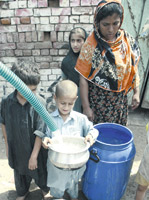
the need for adopting Usage of drinking water for the purpose of washing, cleaning or watering plants at a large scale is the major root-cause of wastage of drinking water, thus causing decrease in the level of water table in the city. The experts fear a drought-like situation in the city if a comprehensive strategy is not devised by the government in time. They say it is high time that government as well as individuals rise to the occasion and play their effective role to overcome this crisis before it assumes alarming proportions. Talking to The News on Sunday, Director Planning and Evaluation Wasa, Syed Zahid Aziz says the water table level in the city is decreasing by five and a half feet per year because a huge amount of drinking water is going waste. Installation of new tube wells in different parts of the city is also adding to the problem. This situation will become grimmer in the near future if we do not bring about a drastic change in our habit particularly with regard to using drinking water for other than drinking purposes, he asserts. "The clock is ticking, that's why I am saying that every body should join hands to solve this problem before it gets too late," says Zahid Aziz, adding that though water in Lahore is still in abundance, extraction of too much water to meet the growing demands of this rapidly expanding city may force us very soon to provide drinking water to the citizens on hourly basis. This pattern is being exercised in many cities of Pakistan and India. Karachi and Indian city of Chundrigarh are among them. Water is also in abundance in Chundrigarh but the authorities there have banned the use of drinking water for other than drinking purposes, anticipating the future problem. Nonetheless, despite the availability of water in abundance, it is being supplied to the dwellers of this city 8 hours a day. In Lahore the situation is altogether different; drinking water is being used to wash cars and other vehicles on a mass scale in the city on commercial basis in the absence of another alternative water pipeline. The same is also being used in chemicals as well as other factories located in and around the city. Trees and plants do not need clean water but Parks and Horticulture Authority (PHA) and some other government departments insanely waste hundreds of gallons of drinking water for watering plants on daily basis, says the Director Wasa. He says government needs to introduce new laws to put an end to this tendency of squandering water among the citizens. Moreover, it should be made mandatory for industries and car wash points in the city to install their own water recycling systems to avoid further wastage of drinking water. Another Wasa official, on condition of anonymity, says in many parts of Lahore such as the walled city the deeper we dig, the brighter the chances of getting water with dangerously high level of arsenic and fluorine. Wasa is being compelled by some politicians to install more tube wells in their constituencies to extract water from rather a deeper level. These politicians are bent upon getting political mileage at the cost of health of the people. As a whole, Wasa will have to install more than a hundred water pumps in various parts of the city on the pressure of these politicians in the days to come. This will definitely aggravate the situation further. Another dangerous aspect of decrease in the level of water table is that the upper surface of the earth is getting weaker. That's why cracks are appearing in several buildings of the walled city. A thorough study needs to be carried out across the city to evaluate the actual repercussions of this phenomenon, says the Wasa official. Hammad Naqi Khan, director at the World Wide Fund for Nature (WWF) says people in Lahore are exposed to high levels of arsenic. An assessment of subsoil water reveals that 85 percent of the samples were unfit for human consumption. More than two million people are drinking polluted water. Consumption of water has increased with increase in the city's population. However, the water supply situation in the city's slums is dismal as water being supplied to these areas is not fit for human consumption. Water-borne diseases like hepatitis are spreading in these areas. Dr Yasmeen Rashid, chairperson of Pani Pakistan, a non government organisation, is of the same view. She says recent investigations have confirmed excessive presence of arsenic in tap water in many cities, including Lahore. She says arsenic is tasteless and odourless. It could be released into the environment from sources like pesticides and industrial waste, especially from petroleum refining industries. Arsenic, Dr. Yasmin further says, could create warts on the human body and increase the risk of lung cancer, skin cancer, tumours of the bladder, kidney, liver and lungs. She says deterioration in groundwater quality is due to disposal of untreated domestic and industrial waste in rivers and canals, especially in Lahore and other main urban towns. She also agrees that the practice of extracting water from deep down the earth should be stopped forthwith. The sawalis or tolis are still heard calling faithfuls to have sehri but they are few and the only ones on the streets. By Shahzada Irfan Ahmed Most of us still
remember how we used to wake up at the time of sehr, during the month of
Ramzan, Sometimes this would happen much before the alarm clocks would go off and on other occasions coincide with the ringing of the clocks. But hardly ever these groups failed to turn up in the streets to perform their self-assigned duty. This they would do in anticipation of getting due reward from the people of the locality towards the end of the month of fasting. Quite often they were rewarded with money, gifts like clothes, sweets etc and edibles to enable them to celebrate Eid-ul-Fitr in a befitting manner. Decades down the road, such groups are still there but in a very small number. Called 'sawalis' or 'tolis', they still move around in the middle of the night but are hardly greeted by anyone in the deserted streets of the city that would once bustle with people. The situation is still better inside the Walled City where people have time and courage to go out in streets at the time of sehr and interact with each other. Whereas in other parts of the city, and especially the ones in the peripheries, the inhabitants literally lock themselves inside their houses mainly due to the dismal law and order situation prevailing all over the country. Anyhow, the people of Lahore have tried to preserve the customs and practices associated with the month of Ramzan and succeeded to some extent. That is why many rituals still exist and have token presence but no doubt the spirit is gone. This is also a case with the 'sawalis' or 'tolis' who have kept on struggling to establish their importance at a time when there are hardly any admirers. Muhammad Bashir, head of a toli tells TNS that in the past they would stand outside a house and keep on singing loud till the time someone opened the door to acknowledge that the housemates had woken up. But now no one bothers to open the door even if they stand there for ages, he says. "That's why we go to all these streets in the day time as well to introduce ourselves to the residents. If they don't know us they will not believe at the end of month that we had been performing our duty diligently," he adds. In months other than Ramzan and Muharram, Bashir accompanies a group of eunuchs to different households, marriages and functions and mostly plays musical instruments. He says the only option left for him in Ramzan is to form a toli as there are no marriages and functions in this month. Guddu Qawaal, a resident of Mughalpura, says it is getting tougher for the tolis to perform at the time of sehr. He says people are increasingly becoming intolerant towards each other and have started seeing everyone with suspicion. "A resident of the locality where my toli performs warned me of dire consequences if I sang loud near his house or stood there for long," Guddu complains. He tells TNS that it's not all; another person even tried to implicate him along with his toli members in a theft case. Their only fault was that the theft had occurred at the time when they used area to awake people for sehr, he adds. For this reason, Guddu says, his team visits streets and markets in daytime and sing na'ats and religious songs to the faithful in reward for small sums of money. An interesting fact is that one can guess what time of Ramzan is going on just by hearing to what these groups are singing. In the beginning of the months the lyrics would be those welcoming Ramzan like "Aya Ramzan mubarak maheena" while towards the end people would hear poignant farewells like "Allah Hafiz ho Ramzan tera, karna phir zindagi mein bhi phera." Haji Javed, a resident of Shadbagh in his late 60s, recalls his memories and tells TNS that these tolis used to be an integral part of the city's culture and were held in high esteem by everyone. He says unlike what is the practice today, people would sleep early, wake up for sehr hours before Fajr 'azan' and throng streets for long. There were no fears of violence, thefts or dacoities at gunpoint and the faithful would sit together in groups and listen to what these tolis sang. This has changed drastically over the years, he says, adding: "The tolis of today, if any, constitute people unknown to the locals and cannot be related with just like that." Javed says nowadays people hardly have time for social interaction and try to finish eating sehri in minutes. He says the presence of microwave ovens and refrigerators in every other household has altogether changed the living habits of the people. Now no one needs to go out to the nearby shop to buy fresh yoghurt or crispy tandoori roti, he says. Similarly, the mobile phones have become the best devices used to wake you up in time. As for tolis, he says the round-the-clock religious TV channels have made them redundant as they have sufficient content to air during Ramzan.
|
|
 because sometimes it isn't easy to communicate with those alike, how could
I manage the other way around.
because sometimes it isn't easy to communicate with those alike, how could
I manage the other way around.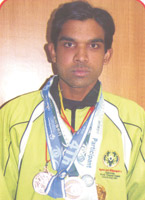 cost at Sadia Campus, including the twelve hostelities. "Sadia Campus
stands for Struggle Against Disability International Association. It is a
non-profit and a non-political charitable institution serving physically
disabled and mentally retarded children," says Syed Amir Hussain,
Administrator Sadia Campus.
cost at Sadia Campus, including the twelve hostelities. "Sadia Campus
stands for Struggle Against Disability International Association. It is a
non-profit and a non-political charitable institution serving physically
disabled and mentally retarded children," says Syed Amir Hussain,
Administrator Sadia Campus. happens that people accommodate your naivety. With me, it never happened.
With time I have been able to learn quite a few tactics to let people know
they don't know anything or that what they are saying means nothing. I
learnt to raise my voice every time I felt threatened by those who can
discern my 'cluelessness.' That was my strategy to lay them off.
happens that people accommodate your naivety. With me, it never happened.
With time I have been able to learn quite a few tactics to let people know
they don't know anything or that what they are saying means nothing. I
learnt to raise my voice every time I felt threatened by those who can
discern my 'cluelessness.' That was my strategy to lay them off. Healing.
 immediate measures to put an end to wastage of drinking water at commercial
as well as industrial levels.
immediate measures to put an end to wastage of drinking water at commercial
as well as industrial levels.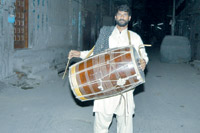 in our childhood. Inspite of alarm clocks lying on our bedsides it would
be the enchanting hymns, songs or na'ats sung by groups of people in
streets that would bring the faithful out of their deep slumber. They
would carry musical instruments of all sorts including dafs, drums, set of
tongs and harmoniums and play them with such force that all except the
dead would jump to their feet.
in our childhood. Inspite of alarm clocks lying on our bedsides it would
be the enchanting hymns, songs or na'ats sung by groups of people in
streets that would bring the faithful out of their deep slumber. They
would carry musical instruments of all sorts including dafs, drums, set of
tongs and harmoniums and play them with such force that all except the
dead would jump to their feet.