



|
|
|
|
 |
 |
   |
Union
confusion preparation Dream
deferred Party
connection interview Union
of thoughts The
State path
Editorial It has been exactly six
months since the prime minister lifted the ban on student unions in his
maiden speech on Six months is long enough to decide whether we want to see a revival of student unions in the country. The party in power made its intent clear in the prime minister's address just as we in TNS did while suggesting the future agenda for the parliament. But the truth is that there is a lot of confusion on the issue. Not many of us realise that in the last twenty-five years -- Gen Ziaul Haq banned the student unions in 1984 for the first time since 1947 -- many generations of students have passed out without actually experiencing being part of a student union or knowing its responsibilities. The new generation may have to go to their grandparents, instead of parents, to ask what exactly did student politics mean. And the parents and grandparents may tell them of some glorious moments associated with student power. They may tell them of a time when student unions meant to cater to the political, cultural and political interests of the students; they even got together on matters concerning international politics and protested in unison with students all over the world. This activism broadened the skills of the would-be leaders. They would also be reminded of the tolerant and democratic culture that a union inculcated among students; a time when the best students -- academically and otherwise -- were the vanguard of union politics. All issues related to education were taken up by the students and the young leadership dealt with the administration and the government together (The mass protests against fee increases during Ayub Khan's tenure eventually ousted him from power). Of course, things started going wrong, with political parties getting involved in student politics and exploiting them in the 1970s. The remedy that was sought in the form of banning unions only worsened matters. A major part of this violence, that forms a part of the collective consciousness now, took place during the days when the unions were banned. One good thing that happened for the administrations of colleges and universities was that they became autonomous during this ban period, which began with becoming financially autonomous. The fees of those once public sector institutions have been raised many times over, with no student union around to protest. As for other institutions that were set up in the private sector, the issue of fee did not exist (the students were admitted here with an undertaking they would not become a part of any union). The parents and teachers were happy in the thought that students were being academically trained to earn good jobs. Education, in the real sense of the word, one that turns the students into responsible, thinking, active citizens did not matter for all those who were in this business. So the recent government's announcement only stirred the calm waters unnecessarily. Or at least that is what the report of the Steering Committee suggests where three provinces out of four have recommended against the revival of student unions. We beg to differ. We support the efforts of students in Punjab trying to revive the erstwhile National Students Federation. We may not be very happy with some political parties flexing their muscles to train armed student wings but we suggest that the government must come up with a proper code of conduct and bring all stakeholders on board. Efforts are under way to lift the ban on student unions, but legal complications are causing a delay By Nadeem Iqbal The 30 years old logic that student unions in educational institutions are conduit to violence has lost its meaning. The new reality is that the absence of unions said to propel violence in the campus has -- during all these years -- deprived millions of higher education students of the fora that could have groomed their leadership qualities. Since March 29 this year when Prime Minister Yousaf Raza Gilani announced the revival of student unions, efforts have been under way to lift the ban but multiple legal complications have delayed the retrieval of the much-needed unions. It is ironic that different laws related to the issue contradict each other, such as Article 51 (2)b of the 1973 Constitution which says that a person shall be entitled to vote if he/she is not less than 18 years of age. Casting their vote itself means they are taking part in the political process. And the students get the right to vote usually at the graduation level but by then they are also forced to submit an affidavit to the campus authorities stating that they will not engage themselves in any political activity. Similarly, Article 153-B of Pakistan Penal Code 1860 holds the act of inciting students to take part in a political activity as an offence. Talking to TNS, Zafarullah Khan, Executive Director, Centre for Civic Education, an NGO, exhorts that the abovementioned legal complication ought to be seen in the context of the establishment's bias against student unions and its considering them as a threat on campus. Zafar, who also teaches civic education to the university students, says that the establishment's fear of student unions goes back to the year 1954 when, during the East Pakistan provincial elections, a student leader namely Abdul Khaliq who belonged to Jugto Front famously defeated Chief Minister Noorul Amin. "We should not confuse student unions with the youth wings of political parties. Zia banned student unions but not the youth wings, and it is also a fact that the ban only led to an increase in violence in the campuses." He regrets the fact that "text books are silent on topics such as the role of the political parties, the constitution and the fundamental rights." Studies show that prior to the ban on student unions -- between the years 1947 and 1984 -- as many as 151 cases of violence were recorded whereas the period of ban on unions (1984 to 2004) saw 525 cases. Similarly, before the ban, 13 students were reported as killed but during the course of the ban 165 were murdered. Before imposing the ban, 284 students were arrested but through the period of ban this figure shot to 7235. Earlier, 110 students were expelled but after the ban, 985 students were rusticated. From 2004 onwards, the figures soared to a terrifying level. The formation of student unions is sanctioned by the university charters and acts that state: "The constitution, function and privileges of the university student union and the matters relating thereto shall be such as may be prescribed by Statutes after taking into consideration any proposal drawn up by the body consisting of the president of the students union of the constituent colleges and Teaching Departments." It was the Martial Law Regulation issued on July 5, 1977, that prohibited strikes, agitation and the political activities in all educational institutions. However, a complete ban on the student unions throughout the country was imposed in 1983-84 by the federal as well as the provincial governments. In 1988, the then prime minister Benazir Bhutto announced lifting of the ban. In compliance, the Punjab government promulgated an ordinance that repealed the earlier ordinance. However, the ban remained intact in the rest of the country. In 1990, the lifting of the ban on student unions was challenged in the Supreme Court of Pakistan through a constitutional petition under the plea that the students who indulged politics in the educational institutions served to violate the fundamental rights of a vast majority of students, their parents and guardians, and also of those who were otherwise directly or indirectly linked or connected. The SC treated this as a case of public interest litigation but did not restore the student unions in its ruling of March 10, 1993. However, the court observed, "As we did not envisage in the interim order the total prohibition of union activities in educational institutions, after hearing all concerned including the vice chancellors of some universities, we feel satisfied that in the meanwhile, classical union activities, exclusively relatable to the campus, could be permissible. Such educational needs, of course, would include general education also through extracurricular activity. We are not directing the formal formation of the classical 'Union'. Instead, it should, as is the pith and substance of the present exercise, be also left to circumstance that should devise and name it; as also its purpose, procedures, practices, ideas, aims, standards, moral and otherwise, for the formation of students groups under an appropriate umbrella." Presently, a government committee which has been deliberating on the implementation of the Prime Minister's orders for the revival of student bodies notes that legislation is required for the revival of student unions since the ban is protected by the 8th amendment which gave legal protection to all acts of Ziaul Haq in 1985, including the ban on unions. The committee has recommended that the federal government should repeal the Martial Law regulation of 1984 by promulgating an ordinance. Or, alternately, a bill may be introduced in the parliament for repealing the said regulation. "Likewise the provincial governments, for their part, may also repeal the MLOs through ordinance or acts (of the provincial assemblies)." In addition, it is recommended that the federal government through legislation may provide for a code of conduct to be observed by the student unions. The tripartite Commission comprising representatives from the federal government, educational institutions and students was formed by the Ministry of Education in pursuance of the Cabinet Divisions Memorandum dated April 11, 2008. The Tripartite Commission held three meeting in June this year and, after detailed deliberation on the issue, prepared a draft bill that contained the code of conduct and recommendations covering the legal aspect for the revival of the student unions. The draft code bars contesting students from identifying themselves with any ethnic, religious, sectarian or political party etc. The student unions and their office-bearers are bound to extend full cooperation in protecting life, dignity and honour of the fellow students, faculty and administration as environment for higher education and research. No member of the student unions shall stage, entice or participate in walkout strikes or create problems for educational institutions which can affect their smooth functioning. No office-bearer of a student union or any other student body shall keep or carry weapons, narcotics, immoral or subversive literature or use abusive language, resort to violence against fellow students/employees of the university or any other contesting election person. The draft law has also set the eligibility criteria for office-bearers of a student union which, among others, include the contesting candidates having a good academic standing and he/she should not have failed in any subject course in a previous class. And that he/she shall submit written consent of a parent to contest elections. Students in Punjab are trying to revive the National Students Federation along with its progressive spirit There was a time in Pakistan's history when students not only held independent opinions on the kind of education they were receiving but also had the moral audacity to agitate for the changes they wanted to see in the educational system. The students' movements at that time were not known for hostel-parasitism, petty violence or political banditry. Rather, the focus was on the problems faced by the students in their schools, colleges and universities. Students faced grave problems immediately after the partition. Karachi, the federal capital at the time, found itself bustling with youthful immigrants for whom the high costs and poor standards of public education were unacceptable. However, the response of students was not passive cynicism but a progressive belief in change through social mobilisation. The student organisation that led this movement through most of the 1950s and 1960s was the National Students Federation. Since the NSF was a continuation of Democratic Students Federation (DSF), it becomes important to look at the latter's history as well. The DSF was formed in 1950 by half a dozen students at the Dow Medical College (DMC) in Karachi. According to Dr Haroon, one of the founding members of DSF, these students were inspired to act by progressive-Marxist ideas of change but their agenda was to address specific issues faced by the students. Hectic efforts to mobilise students at other educational institutions produced sweeping electoral results for DSF in 1952. A year later, DSF was also the leading representative of students' agitation for reduced tuition fees, better libraries and classrooms and a proper university campus. Not surprisingly, the protesting students were baton-charged, tear-gassed, injured and arrested, and, on Jan 8, 1953, six of them were killed when police opened fire at a rally. However, the students did not relent and put up such a show of democratic strength as to compel the education minister Fazlur Rehman to resign and the recently inducted Prime Minister Mohammad Ali Bogra to order the construction of Karachi University campus. In the general crackdown against leftist organisation in 1954, the DSF was banned, along with the Communist Party of Pakistan, the Progressive Writers Association and the labour unions. However, in 1955-56, new students picked up the old threads and revived the DSF under the name of the National Students Federation. The NSF prevailed in the electoral politics at campuses throughout the 1960s (not through a culture of fear as is the case with IJT, but through a culture of constructive debates). It was also the main mobilising force during protests in 1962-63 against the three-year degree course and in 1968-69 against the dictatorship of President Ayub Khan. The issue-based approach of the DSF and the NSF during the 50s and early 60s kept them quite open to diverse progressive ideologies. A liberal Sindhi could get nominated by the mohajir-dominated DSF for union elections in DMC, and a woman could contest the post of the NSF joint secretary in the Karachi University. However, from 1965 onwards, the NSF suffered one split after another due to differences of opinion in ideological debates. The first split, for example, took place on the China-or-Moscow question. These splits shifted the organisational approach of the NSF from the issues in education to the issues in politics. The progressive students' movement didn't die during the 70s and 80s and was fairly active in crucial democratic movements, however, misdirected -- and sometimes misinformed -- focus on ideological issues became its perennial ailment. After the decision of the present government to restore the student unions, some students in Punjab are trying to revive the NSF along with its progressive spirit. Students from Islamabad, Lahore and Faisalabad met in August in the city and decided to "resurrect the NSF as a non-partisan group while trying to keep all the parties of the Left in confidence". These students have since been trying to reach out to students in different parts of the province. While prevailing circumstances often affect the fate of a political movement, NSF's history shows that organisational viability can only be ensured by consistent hard work and a ready-to-listen ideology. During the political events of the last two years, many students have become politically active and many others are yearning to find an agreeable platform for change. However, a lot of work needs to be done to convince these students for collective action through a progressive forum. It is very important for the student leaders to realise that their audience is their fellow students, who may have slightly different notions of the ideal but pretty much the same plans of action. Indeed, it would be quite unfortunate if the large reservoir of politicised youth was left to decay in various isolated ideals. As the debate on the revival of student unions catches fire, the political parties are yet to relaunch their youth and student wings By Waqar Gillani No concrete step has
been taken to revive student unions in educational institutions, despite
Prime Minister Syed A steering committee of the vice chancellors of different universities of Pakistan was formed on the instructions of the PM. The committee, which has met twice so far, submitted its recommendations to the federal government. TNS learnt from reliable sources that within the steering committee itself, all provinces -- with the exception of Sindh -- showed their reservations. They feared that the revival of student unions could translate into violence on campus and spoil the academic environment. The nominee of Sindh alone spoke for a 'conditional' revival of unions. On the other hand, the political parties are not yet prepared to reactivate their student wings. Organisations like Islami Jamiat Talaba (IJT) and Imamia Students Organisation (ISO) and new groups like Democratic Students Federation (DSF) and National Students Federation (NSF) have also re-emerged on the scene in different varsities. A clash between a bunch of outsiders claiming to be members of PML-Q's Muslim Students Federation (MSF) and MSF, MAO College, occurred recently after which the police force was deployed on the college gate. MAO College is quite infamous for such incidents of violence. There have been reports of clashes in Punjab University and Karachi University also. The committee constituted by the Prime Minister's Task Force on Higher Education was chaired by Prof Dr Mujahid Kamran, Vice Chancellor, Punjab University. It comprised Prof Dr Mujahid Kamran -- Vice Chancellor PU; Prof Dr Muhammad Zafarullah -- VC Bahauddin Zakaria University Multan; Prof Dr M Siddique Kalhoro -- nominee of VC Sindh University; and Prof Dr Ajmal Khan -- nominee of VC Peshawar University. Dr Mujahid Ali Mansoori was the general secretary of the forum. Official sources tell TNS that the recommendations sent to the federal government strongly indicate that the revival of student unions would open the floodgates for interference of political forces and lead to unrest on campus and destabilisation of educational institutions. Such a scenario would largely affect the quality of teaching and research and progress that was made in the past few years. The representative of the Sindh University was insistent that student unions could be useful. The participants of the committee commonly felt that the past governments had, in general, showed very limited capacity for handling law and order situations and in dealing with any miscreants in educational institutions. They also maintained that the situation was not likely to change in the future and that the administration of different educational institutions would be left on their own when dealing with a law and order situation. It was suggested that the revival of student unions could not be made possible without an appropriate legislation at the national/provincial levels. Such a legislation is required especially at the university level, in view of the decision of the Supreme Court of Pakistan, in order to regularise the activities of student unions. The steering committee further recommended a gradual, phase-wise revival of unions. It was decided that old-style unions that acted like a parallel administration must not be allowed to come up. Until an atmosphere conducive to setting up a fully representative student body is brought about, a student council may be constituted in the educational institutions. The government must devise a detailed and appropriate format of student unions, but this could only be achieved after wide consultations with stakeholders like parents, teachers and students of all higher education institutions. The committee approved a primary code of conduct for student representatives in order to prevent the involvement of political parties in universities and other educational institutions. The code, defined by the steering committee of VCs, lays down that the students, particularly the elected student leaders... •Must not belong to any political/religious party or group •Shall not engage in violence •Shall not inflame political or religious passions •Shall not show disrespect to teachers •Shall maintain their attendance in classes with good academic record •Shall not call for boycott of a class •Shall not disturb classes •Shall not carry any firearm for violent purposes •Shall not engage in any illegal activity •Shall show respect to students and fellows •Shall not involve in teachers' issues Rana Muhammad Arshad, MPA, PML-N, and the central president of Muslim Students Federation (MSF) told TNS that student bodies were being constituted at the city and higher educational institutions. "We are for a positive beginning of student unions, a proper code of conduct, and against illegal and criminal activities." He claimed that the PML-N would never support any kind of criminal, illegal or violent activity of the union. Interestingly, Khawaja Saad Rafique, MNA of PML-N and former federal minister for youth affairs avoided any comment on the issue. Chaudhry Ghulam Abbas, General Secretary PPP Punjab, told TNS that no one had been assigned to activate PSF yet. "We want an independent and a positive role for student unions. We don't want the rule of unruly elements." He added that PSF was an ideological youth wing of students that had been rendered impoverished in the Musharraf regime. PSF must have a target move, he insisted, "but so far there are no particular or even general preparations under way." It is important to mention here that PML-Q abandoned its youth and student wing -- MSF -- in August 2004. The party is yet to restore MSF. Moreover, Muttahida Qaumi Movement also discarded its All Pakistan Muttahida Students Organisation, a few years back, and announced to reorganise it. The 'reorganisation' is yet to take place. Of all student organisations, Islami Jamiat Talaba (IJT), the youth wing of Jamaat-e-Islami, a religio-political party, is seen as the most active. Qaisar Sharif, Central Secretary General (Information), IJT, told TNS that the lifting of ban on student unions was the result of IJT's 24-year-long struggle. He said that IJT had demanded an immediate holding of union elections. The group also recently held a workshop in which representatives of all student organisations were invited and they all agreed to form a violence-free code of conduct. "More than 35 student organisations participated in the workshop arranged by IJT." The Imamia Students Organisation is waiting for any further policy or action on the issue of student unions. "We may go for an alliance against any seat in the union," he said. TNS also learnt that the youth and student wings of Pakistan Tehrik-e-Insaf -- called Insaf Students Federation (ISF) -- had formally started functioning in educational institutions. There is no formal constitution of PML-N's MSF or PPP's PSF so far. Different groups of outsiders or those protected by certain political forces are also found claiming to be representatives of either student group.
interview BARGAD, a youth-serving NGO has recently launched a groundbreaking study 'National Survey on Student Politics, 2008'. It is the largest ever consultative study on student politics in Pakistan. Iqbal Haider Butt, lead researcher and author, talks to the TNS. By Saeed Ur Rehman The News on Sunday: Why was this study done? Why do you think it was needed? Iqbal Haider Butt: There
were three reasons behind the idea to undertake this study. The first was
that there is a Secondly, the immediate concern was that the prime minister declared lifting ban on student politics and unions. It has not been yet formally notified. We were apprehensive that there would be no consultation with the students, who are end-users and primary beneficiaries, while forming policy on of the student politics and unions. We have seen in the past that except for one educational national policy (Hamood ur Rehman Commission on Student Problems and Welfare, 1966), students' views have never been included. Through the National Survey on Student Politics 2008, we have collected and presented students' voice before the nation. The third and very practical issue was we wanted to ensure that the prospective student politics contributes to peace-building and women leadership development in campuses. It is encouraging that the present-day students of higher education support both the aims. The study has provided detailed recommendations on regulating student politics in favour of peace-loving, friendly and discrimination-free university environment. We are hopeful that the government and higher education authorities will certainly take advantage of this large-scale work and formulate regulatory mechanism and code of conduct according to the wishes of the majority of students. Our message is: listen to what THEY are saying. TNS: What is the scale of the study? IHB: Our sample size is five percent students of all 23 general education public universities of Pakistan. We have collected views of 909 students according to a stratified random sample technique. In that sense, it is not just an opinion poll (as frequently used by media) which may indicate to a problem but cannot scientifically represent the concerned population. The National Survey on Student Politics, 2008, has been designed and implemented using social research techniques. That's why it gives us full confidence that its results show aspirations of all the students of general education public universities of the country. The best thing however is that the BARGAD's volunteer students themselves have collected research data after necessary guidance on how to do it. That is also true for data entry. So in the process of producing this survey, we have also given select students an opportunity to demonstrate practical skills that they can use in their future professional lives. TNS: What has been the key message of students about campus politics? IHB: All in all, the message has been that YOU CANNOT CONTINUE POLITICS AS YOU HAVE DONE IN THE PAST. The ordinary students want a new politics based on the issues of quality and access to education. This has been missing in the history of student politics. TNS: What in your opinion are the factors that shape views of the present-day students? IHB: I think that today's students clearly sense that cost of higher education is a huge burden on their parents. There is high competition for jobs. Students cannot afford to indulge in any activity that may disrupt their studies. They have little faith in politicians and student groups affiliated with these politicians. Then different disciplines are developing in Pakistan and now people do not explain things only by ideologies, which they were largely dependent upon in the past. The ratio of girl students and their visibility in universities has tremendously increased. There has been an enhanced process of urbanisation and far reaching changes in media and communication technologies. The contemporary student of higher education is linked by the net and can interact with fellow students through mobile phones. So there has been a great virtual space for them to freely communicate with each other. On the other hand, the dominant student groups relied upon physical surveillance and policing in campuses in the past with the help of authoritarian regimes, so they could intimidate anyone. But now you cannot physically check mutual communication and mobility of students. For example, see how they have created their groups (Okut, etc.) and blogs on the internet and are posting videos on the Youtube. Anything that happens in a campus would be communicated to not only the students but also to millions of people connected. We have seen this in the case of students' uprising this year in Punjab University, Lahore, against a dominant student group. You cannot hide the truth. There is a whole lot of student activism going on through the internet. TNS: Have you also addressed the history of student politics in Pakistan? IHB: Yes, but that it was not the main thrust of our study. It is not an historical analysis. However, in sections on background, theoretical approach and literature review I have taken on the past activism mainly pursued by the Democratic Student Federation (DSF), National Student Federation (NSF) and Islami Jamiat Talaba (IJT). This illustrates that irrespective of their ideological loyalties all these groups gave little attention to educational issues. These were ideologically driven entities, working for some kind of a revolution, taking campuses as the instrument to achieve their perceived missions. They also resembled in their rhetoric. I have specifically mentioned years' long alliances of these 'opposing' groups when it comes to fighting educational policies; howsoever sane and having the potential to split them apart. Till late sixties, I am also skeptical over the scale of student politics which was limited to three big cities. Both ideological groups also had little contacts with their 'comrades' and 'beradars' in the East Pakistan. The era of 1980's has also been addressed when the dominant student group facilitated the regime in a recruitment campaign for Afghan jehad (which eventually deprived them of cadres), while the government ruthlessly persecuted its opponents and started to gradually withdraw responsibility of education under the Structural Adjustment Programme (SAP), but the education was not an issue! Nevertheless, I would say that the study is not a historical review anyway. It is a survey research on what present-day students are thinking about campus politics and what measures can be taken to redefine a new politics. I hope its results can wake up our old guards. TNS: Will the results of the National Survey on Student Politics, 2008, have an impact upon government's policy on student politics? IHB: I wish it does. There has been a very positive response from university VCs and politicians on the launching ceremony held in Islamabad on 12 August. Politicians of many shades and the educationists are however sharply divided over student politics. The former is for open party politicization of campuses, while the latter stand for limiting scope of such politics. One thing still binds them: Their wishes and apprehensions come from a historical legacy. They both are living in the past, while the (political and social) reality of students has radically changed. They frankly disassociate themselves with ghosts of the previous eras. Many veteran student leaders, presently politicians, would also now vote for this new thinking for a new student politics. The National Survey on Student Politics, 2008, has provided a meeting and negotiating place for politicians, educationists, students and concerned citizens and provided practical solution to legitimately regulate student politics in a way that does not hinder constitutional rights of free association. I believe our study will encourage further research and debates in the country. We also anticipate that government, NGOs, think-tanks, political parties, student organizations and institutes will invest more on similar researches on aspects of youth, which has a massive potential to change Pakistan in phenomenal terms. According to national estimates, 61 percent of our population is under 25 years of age. International analysts are growingly alarmed over this "Youth Bulge" and see its intrinsic link with internal strive and insecurity. It will take some time before our policy makers and politicians seriously take note of this youth factor. The corporate sector and the commercial advertisers have however realized this emerging reality of Pakistan.
Union
of thoughts With preparations on to
revive student unions in educational institutions all over the country,
different The parents of students, faculty members and heads of different educational institutions and the students themselves have not taken too kindly to this announcement. Though they do not find fault with the very concept of having student unions, they foresee a repeat of what had happened in educational institutions in the decade of 1980s and the early years of 1990s. These were the times when educational institutions had become safe havens for hardened criminals and their administrations hostage to the leaders of student unions. Pre-empting this threat the government has called for the preparation of a code of conduct meant to govern the working of student unions and minimise the chances of their involvement in negative activities of any sort. While efforts are being made at the government level to come out with this code, several civil society organisations and student groups are also floating suggestions in this regard. For example, Pakistan Institute of Legislative Development and Transparency (PILDAT) and the Students Action Committee (SAC), a group of student activists hailing from different educational institutions, have drafted their own codes and suggested the government to incorporate their suggestions into their main document. While these deliberations are on, TNS feels it should also come out with a likely code of conduct to regulate the activities of student unions once they are reformed. Based on different surveys on the issues and inputs received from myriad sources including the two mentioned above, the TNS code of conduct has been drafted carefully and tailed below for the interest of the readers. The student unions must not limit themselves to a particular religion, caste or creed, as has happened in the past. It is no secret that organisations have been formed on this basis in the path resulting in the spread of ethnic/sectarian violence inside the educational institutions and beyond. All student panels planning to contest elections should be required to submit a copy of their basic manifestos in which student-specific issues must be outlined. If the manifesto includes a mention of national-level political issues, it must make clear how these issues are related to students' concerns. It is common knowledge that students have been systematically alienated from politics over the past two decades, and the presence of unrepresentative 'student' organisations mentioned above has added to the contempt of politics. Therefore, non-students be barred from student politics and not allowed to occupy hostels. It is a fact that many of the student organisations have been run by ex-students, and have had very limited support from within the existing student body. The new code shall not have any role for ex-students. Explicit steps should be taken to ensure that no student organisation be allowed to import members, guns or money from outside campuses. This is imperative keeping in view the fact that student unions have been able to generate considerable financial and other resources from outside the campus, mainly with the help of the mainstream political parties. The leaders of student unions must have representation in the statutory bodies of their educational institutions like the senate, syndicate and disciplinary committee. This way they will be able to have their say in important issues pertaining to the students community in a democratic way. The practice in the past was that the student leaders were hardly taken into confidence over important issues. Once unilateral decisions were taken they had to announce strikes to register their protests. No student shall be allowed to threaten, disrupt, obstruct or adversely affect any activity organised by the institution or by any of its faculties, schools and departments. Similarly, no one in the student unions shall usurp the right of other persons to carry on with their legitimate activities, to speak or to associate with others. No student shall possess a firearm or other weapon on the premises. If this is allowed, different rival groups will start piling up their arsenals, ultimately leading to a deadly clash among them. The members of student unions shall not be immune from the laws regulating the affairs of the institution. They shall also be made accountable to their electors and other appropriate bodies in case they are not able to stick to the agendas that they have professed during the elections. It is also suggested that the union leaders shall not be given any relaxation in case they are short of lectures. These steps will go a long way in helping them discipline themselves and realise that they are not at all super humans. No student shall assault others, threaten them with bodily harm or actually cause bodily harm. On many college and university campuses, teachers and the administration have been known to be partial to one or the other existing organisation. In some cases, teachers explicitly promote the agenda of their favourite organisation and even try and compel students to join the organisation. Therefore, it suggested that the teachers and the administration shall in no way influence student politics and ensure holding of impartial and fair elections of student unions. It has been experienced in the past that many student leaders developed commercial interests and received gratifications from contractors or suppliers of goods and services to their particular institution. In return they allowed them to work smoothly and charge whatever they wanted. This practice should be discouraged and such contracts be awarded purely on merit through open tenders. Student unions, in their true spirit, be allowed to function in all public and private educational institutions imparting higher education. There are admittedly some military-run educational institutions in which 'national security' concerns mandate restrictions on student unions. Many of them take an undertaking from the students not to get involved in political activities and student unions. These practices should be done away with. Female students be encouraged to participate in student politics. To achieve this end, special seats for women shall be created in the student unions, making it mandatory for each panel standing for student union elections to include female candidates.
Students have been commonly used as pawns in a larger game of political interests in the region One of the biggest
reasons for the degeneration of student politics as well as educational
institutions in the In 1954, following the ban on the communist party of Pakistan, the government launched a brutal crackdown on the Democratic Student Federation (DSF), the student wing of CPP. During the 60s, the government of Ayub Khan had a tense relationship with student groups, particularly the National Students Federation (NSF). For the first time, tear-gas and fire were liberally used against students protesting against government policies. Following the death of a student leader, Abdul Hameed, the student revolt intensified and eventually forced Ayub to resign from office. However, the State kept on treating student groups as a 'national security' threat. This ridiculous stance on student politics eventually lead to the massacre of students in East Pakistan. Soon after the military operation began on March 25, 1971, the military high command saw students as the number one enemy of the Pakistani State as many students had joined the Mukti Bahni. In an unprecedented event in contemporary history, the Pakistan army launched a military operation in Dhaka university in order to wipe out the intellect behind the insurgency. Hundreds of students were killed and many remain missing to this date. Bangladesh marks a day every year to commemorate the students who were killed during this conflict. The bloodbath in Dhaka was not enough to knock some sense in the heads of those at the helms of affairs. The Bhutto government launched another operation against the NAP governments in Balochistan and NWFP in 1974. Once again, students were in the forefront of the struggle with universities providing fodder for the rebellion. This time, the Balochis were joined by Pakhtoons and Punjabis (including Ahmad Rashid, Rashid Rahman and Najam Sethi) in order to fight the might of the State. Scores were killed before the operation was brought to end in 1977 by Ziaul Haq. Zia's tenure saw the worst exploitation of youth in general, and the students in particular. The State had declared war against the Soviet-backed Afghan government. However, this was not supposed to be a war fought by the 'jawans' of the army. Instead, students from religious seminaries were armed and trained to accomplish the tasks of the 'Jihad'. Many new madrassas (read training camps) were set up during this time-period with the prime purpose of winning the war in Afghanistan. These students were brainwashed into spending their lives fighting for the cause of Islam. From now onwards, the section of society viewed as a 'national security threat' was transformed into the State's 'first line of defence'. After the Afghan war, the madrassa students were sent to Kashmir, this time to fight the oppression of the Indian army. More than a hundred thousand 'insurgents' have died in Kashmir ever since and many of them had roots in the Madrassa system of Pakistan. This militant student activism was in full swing in the 80s and the 90s, when there was a complete ban on student politics in mainstream educational institutions, proving the hypocrisy of the establishment. There are few countries in the world that would have used teenagers in the brutal manner that our state did. All this time, students were used as pawns in a larger game of political interests in the region, giving a 'strategic depth' to Pakistan. Then came 9/11 and in a characteristic manner, the Pakistan government took a U-turn on its Afghan policy and once again declared these students as a 'national security threat'. This time hundreds of students, most of whom were brainwashed by our secret agencies, were arrested from throughout the country. The Taliban (students, who were sponsored by the ISI) were hunted down on the orders of the US and many Madrassas were bombed during various military operations. The handling of the Lal Masjid crisis further showed the blowback effect of the ISI's support to these religious schools and the merciless reaction of the armed forces if anyone tried stepping out of line. Today, a military operation has been ordered against the Taliban by the PPP government. One should remember that it was the PPP that backed the Taliban in its second tenure. Today, the deadly trio of the US, ISI and political parties have combined to tame the beast they themselves created. The current situation in Balochistan and Sindh is also worrying for students. The Baloch Students Organisation (BSO) has been actively taking part in the movement for greater autonomy for Balochistan. Many have joined the Baloch Liberation Army (BLA) that was being led by the slain Balach Marri. Again hundreds have been killed the operation while dozens of students belonging to nationalist student organisations are missing in Sindh and Balochistan. As usual, the State is looking at these youngsters as trouble makers instead of engaging with them on their grievances. Punjab has seen its own share of the State's interference. General Zia supported Jamiat Taliba Islam in order to build his hegemony in educational institutions. During the 90s both the PPP and PML supported their respective student wings. The University of Engineering and Technology (UET) became the centre for conflict between the PSF and MSF. As the government changed in 1999, most students belonging to these groups were expelled, registering another chapter when students were used for short-term gains and were later conveniently thrown away by the State. The Pakistani State has consistently viewed students as either 'potential threats' or as fodder that can be used to pursue a policy goal. This approach has destroyed thousands of lives and has created a high degree of mistrust against the State amongst the youth, especially of smaller provinces. It is difficult to forsee progress in the education sector when the establishment is ready to twist the educational infrastructure for its short-sighted gains, in the process ending or ruining the lives of many. The current government has stated that it wants healthy politics to take place on campuses. However, for that to happen, we must make sure that the State does not interfere in student politics, nor does it use students or student groups in order to advance its own goals. The government should also avoid looking at students as 'national security threats' and should allow open and unhindered debate on campuses without favouring those who are close to the government. By enhancing a culture of debate and discussion on campuses, the government will take one step in the direction of eliminating the frustration that many youngsters feel towards the state. In addition, if the government can stop 'arming' students for conflicts in or outside Pakistan, we might see a reduction in the violence amongst student organisations. This strategy would be better both for our national security and the student body at large. If we don't learn from our past mistakes, we might see ourselves stuck in the same crisis in the future as we are in today.
|
|
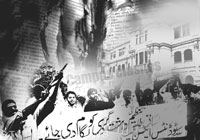 March 29 that was supposed to set the agenda for the next hundred days of
the new government. The unions have not been revived so far nor has there
been a call for elections; the government forwarded the matter to a
steering committee comprising vice-chancellors and academics to give its
recommendations on the issue.
March 29 that was supposed to set the agenda for the next hundred days of
the new government. The unions have not been revived so far nor has there
been a call for elections; the government forwarded the matter to a
steering committee comprising vice-chancellors and academics to give its
recommendations on the issue.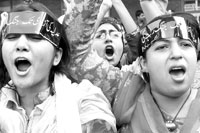 Yousuf Raza Gilani's announcement, in his maiden speech to the National
Assembly, on March 29, 2008, that this was a part of the new government's
100-day agenda.
Yousuf Raza Gilani's announcement, in his maiden speech to the National
Assembly, on March 29, 2008, that this was a part of the new government's
100-day agenda. widespread belief that the youth are apathetic to collective social action
and reject politics. Like many notions in our state and society, we have
occasionally based our thinking on tested data and empirical evidence.
Rather there is a general tendency to promote hearsay and unexamined
statements. Our survey shows that the conventional idea of youth apathy is
incorrect, at least in students' perception and theory. It reveals that
Pakistani students are not against politics per se. They reject a certain
kind of politics. They thoroughly welcome student unions and see that
student politics should serve the objective of quality education in the
country.
widespread belief that the youth are apathetic to collective social action
and reject politics. Like many notions in our state and society, we have
occasionally based our thinking on tested data and empirical evidence.
Rather there is a general tendency to promote hearsay and unexamined
statements. Our survey shows that the conventional idea of youth apathy is
incorrect, at least in students' perception and theory. It reveals that
Pakistani students are not against politics per se. They reject a certain
kind of politics. They thoroughly welcome student unions and see that
student politics should serve the objective of quality education in the
country.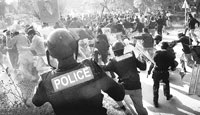 stakeholders are worried about the negative fallout of the whole plan.
What worries them the most is the fear that violence will once again make
way to the educational institutions and turn them into camp
offices/recruitment self of political parties.
stakeholders are worried about the negative fallout of the whole plan.
What worries them the most is the fear that violence will once again make
way to the educational institutions and turn them into camp
offices/recruitment self of political parties.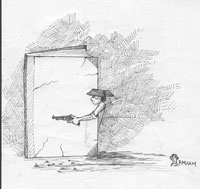 country has been the negative involvement of the State in student affairs.
Throughout our chequered history, we have witnessed many instances where
successive governments have used students for their own petty interests.
On other occasions, we also witnessed the burtality of the State against
student groups that either step out of line or fall out of favour.
country has been the negative involvement of the State in student affairs.
Throughout our chequered history, we have witnessed many instances where
successive governments have used students for their own petty interests.
On other occasions, we also witnessed the burtality of the State against
student groups that either step out of line or fall out of favour.