


|
|
|
|
 |
 |
   |
eid expenditures Tight
Eid gifts with a light
budget Fashions
of recession Indus Wactch More direct forms of oppression… Wajid Leghari of Naujwan Samaji Sangat (NSS) and Kanjee Bheel Advocate from the Human Rights Commission of Pakistan (HRCP) were recently arrested by the Nawabshah police while they were on their way to appear before a judicial magistrate in Tando Adam, Sanghar. By Veerji Kohli A landlord allegedly beat up peasants who worked for him, kicked them out of their houses, and is now refusing to pay them the compensation that he owes them.
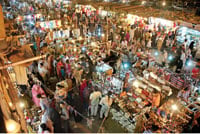
The big squeeze before Eid The overall rise in prices has significantly changed the pattern of Eid expenditures. Kolachi takes a look at the effects of inflation on the Eid shopping of middle income consumers this year By Farhan Zaheer Middle-income groups in Karachi seemed to have braved the
brute impact of recession, albeit barely, the impending Eid has hit home the
reality of how stretched home budgets really are during these times. Making
space for Eid expenditures has taken a toll on many middle-class families,
with homemakers trying to manage multiple spending at the same time. Hina Mumtaz is one such homemaker. Mumtaz, who lives in a rented three-room apartment with her four school-going children and husband, told Kolachi that inflation is the single most serious threat to the common citizen, particularly with reference to rising tensions in the societal fabric. "With high food prices and an overall surge in the cost of living, middle and lower income groups have come to the threshold of severe economic and social crises," she said. "It was the last week of Ramazan, and I was jotting down grocery and other expenses. Suddenly an important question jolted my mind: how was I going to cut my budget to complete Eid shopping? The price of food items have surged two-folds, and our monthly ration bill has doubled from Rs2,500 to Rs5,000 in year or so. In such a scenario, the mere thought of preparing for Eid is nightmarish," Mumtaz maintained. Despite her constraints, Mumtaz has already spent over
Rs7,000 on Eid shopping this year, as Mumtaz maintained, however, that many shop owners were earning heavy profits this year on the pretext of high inflation in the country. "The cost of children's clothes dramatically increased in no time. Clothes which cost Rs195 a month ago are now being sold in the range of Rs300 to Rs350. "I tried to reduce the expenditure by buying local garments for my five-year-old instead of imported ones. An average imported children's garment was available between Rs8,00 and Rs1,200, but a good quality local-made children's garment was in the range of Rs300 to Rs6,00. "Similarly, I purchased unstitched fabric for my
daughters rather than buying readymade suits. I later realized that stitching
rates had also drastically increased, as tailors are now charging Rs 600 per
outfit instead of the Rs350 they charged last year. In fact, the cost of
getting three dresses of the same quality last year was under Rs3,000,
but this year, it has risen to Rs4,000. This shows you an increase of
25 per cent in costs and of course our expenditures," she said. Zareen Fatima, another middle-income homemaker, told Kolachi that many shops in the city offer sales up to 50 per cent from the first to the third week of Ramazan – something that tends to ease the pressure on consumers. "I bought some unstitched fabrics which are otherwise very expensive, but these sales helped me purchase something I really wanted to buy," she said. Fatima said that some shop owners explained to her that
the rise in the prices of some goods was due to the Pak rupee's depreciation
against the dollar, which had left all imported items dearer. "They
(shopkeepers) said that the prices of imported children's clothing had
surged, because these were mostly imported from Thailand, Indonesia and
China." Abdul Sattar, who runs a popular garments store at Zamzama, told Kolachi that purchasing power in Pakistan had immensely reduced over a period of five to six years. "Nowadays, only a few people buy three to four outfits on Eid, but it was only a couple of years ago that people would buy seven to eight pieces. I have been working for over 35 years now, but the considerable decline in purchasing power has forced us to offer sales for an extended period of time during the Eid season."
--The News photos by Naqeeb-ur-Rehman
with a light budget
By Samina Wahid Perozani With recession still a cause for distress for many
people in the city, this yearís Eid shopping will be on a much tighter
budget than before. Still, there are ways to get around it and with a
little bit of economising, you will find that you can stretch your
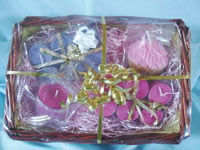
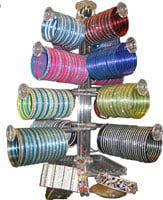
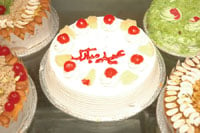
budget just a wee bit more. • Edibles – On most other occasions, it is customary to offer one food item or the other (preferably, something sweet) to friends and acquaintances. Eid is no different. That is why cakes, brownies, ice cream, Mithai (for those who prefer something a little more traditional) and chocolates remain popular gifts for Eid. • Razzle dazzle – What is Eid without bling? And what better way to say that than by giving bangles to your friends. Though Hyderabad's Resham Galli is famous for bangles, there is no shortage of Choori Walas in Karachi too. • Waxen beauty – No, not Paris Hilton scented
candles. The candles available at various supermarkets and gift shops of
the city could be nice for Eid token, especially if you are not looking
to spend too much. Get an assortment of candles, put them in a cane
basket and wrap it up, and here you are with a fine Eid gift. • Go green – A small indoor plant, for example, cactus, may seem like an odd choice for a gift to some, but it is just the thing to give to someone who is a plant person but doesn't have the time or space to fuss over their garden. • Picture perfect – all you have to do is to just find old pictures of people you care about, make a collage out of them and get it framed. That is sure to bring back some memories and make for an engaging Eid. • Bookish tendencies – For those who like to spend their Eid catching up on their reading, getting that coffee table book can just be the thing they have been paining for.
As shoppers surf malls and markets this Eid, each of them searches for what their recession-hit budgets can afford in fashion. Kolachi explores how fashions have altered in the wake of the global economic depression over this year By Samia Saleem While recessionary pressures have imposed financial
constraints upon common folk, many from the middle and upper-middle classes
refuse to hold back in their Eid preparations. Conscious of modern fashions,
this section of society has turned to local Karigars to ensure that their
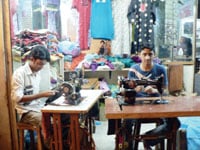
fashion statement remains uncompromised. The sheer volume of business for Karigars may have increased this Eid, with shopkeepers acting as willing and happy accomplices in the face of increased demand. "Most of our customers come with magazines, asking us to copy a particular design for them" said a Karigar at Qurtuba market. Tailors however complain that the number of dresses each customer ordered has decreased. "People seem to have cut down on their Eid expenses in clothes. I used to get orders of two or three dresses per client, but this time round, it is just one or two," Shahbaz, a tailor at Qurtuba market told Kolachi. "However they want those two dresses to be perfectly in sync with contemporary fashion." Shahbaz's observation is not without logic. The middle and
upper-middle classes who shop from areas such as Tariq Road, Gulshan, Gulf
and Bahadurabad constitute of families who try and escape the limitations
placed by recession, with some even arguing that spending extra money during
the Eid season is justified. Rahat, a young woman in her twenties who was shopping in Gulf, explained to Kolachi that many turn towards Karigars and tailors because they cannot afford the original designer clothes and yet want to look in style. "I am imitating a design from a famous boutique for my Eid dress. The price of the original dress was beyond my budget, and so I'm getting it embroidered locally and then stitched according to the design," she said. Areeba, a shopper at Tariq Road, agreed with Rahat's reasoning. "People have cut down on the number of dresses, but not in terms of the fashions they follow. This Eid, I have made only two dresses because of the high rates in the market, whereas last year I had made three dresses with the same budget," she said. In contrast, for the low-income groups in Karachi – those most affected by the waves of recession –, there seems to be no concept of fashion, or rather that fashion was a remote luxury. A market survey of Liaquatabad, a society of the low-income group, revealed that people there are more concerned about meeting the expenses of Eid from their strict hand to mouth budgets rather than looks and style. Many felt that not only is meeting basic living expenses for a family of seven more important, but it was difficult to save up for an occasion such as Eid without multiple sources of income. A good ladies dress in Liaquatabad cost between Rs500-800
on an average, an amount which is equal to the price of lace for someone in
the middle or elite class group. Men's wear in this socio-economic group
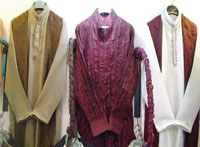
constitutes of a simple Shalwar Kameez for Eid prayers. "For poverty stricken people, who can't even afford to eat two times a day, making one new dress is an occasion and a luxury, so they do not have many demands" said a shopkeeper at the main market. "People are ordering simple Shalwar Kameez which costs around Rs. 200-250 maximum per dress" said Zahid, a tailor at the same market. "And since the fabric is already a selected one for Eid, they hardly ask for any designs," he added. Compared to the Rs600-900 that the low-income households spend on dresses, shoes and accessories (including bangles and jewellery, if any), the cost of a good ladies dress for the upper classes ranges between Rs9,000 and Rs15,000. The elite obviously choose to decide between ready-made or designed on order, but there are many designers and high-end shops in posh localities of the city that make fashion readily available for this class. The high-income households are also more amenableto the idea of experimenting with different styles -- baggy pants, airline shirts, Kurta pyjamas, and heavily-embroidered fabrics. Similar is the case with fabric as well as stitching styles, peko and dying, to complement to the fad and fashions of their main dress. A male designer Shalwar Kameez also costs somewhere between Rs3,000-4,500, which is usually readymade.
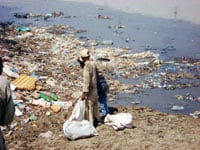
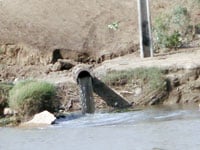
Indus Wactch Poverty in districts Thatta, Badin linked to water pollution About 1.2 million people in district Thatta and around two million in district Badin suffer from various diseases, mainly cancer, according to a recent study. Jan Khaskheli reports on how these diseases have been linked to polluted water which is used in these areas for agriculture, and for consumption by human beings and cattle Environmentalists and researchers link the rise in poverty
in the tail-end districts of Thatta and Badin with environmental degradation;
people are forced to spend higher amounts to purchase medicines instead of
safe food. Population pressure and unchecked industrialisation are also the
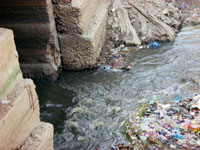
main causes of environmental degradation in these areas, they said. Polluted water canals Residents of these areas are getting contaminated water through canals, increasing the incidence of cancer and other deadly diseases. About 1.2 million people in district Thatta and around two million in district Badin are suffer from diseases, mainly cancer, said Mohammed Ismail Kumbhar, the author of a recently-conducted research on Phuleli Canal. He also teaches at the Agriculture University, Tando Jam. Dr Kumbhar said that the journey of the Phuleli Canal started with the Kotri Barrage in 1955. It begins from the River Indus near Hyderabad and receives urban waste though 140 sewerage drains, clothes-washing places and industrial effluent, all of which is mixed in the water which is supplied to hundreds of families. The Phuleli Canal carries 3,000 cusecs of water, loaded
with poisonous industrial and municipal waste, and feeds Hyderabad, Matli,
Talhar and other towns of district Badin. Dr Kumbhar said that people have to spend more money on medicines and from medical treatment than they spend on food and other essential items. "Children do not have proper nutrition, and therefore have weak eyesight due to vitamin deficiencies. Around 250,000 children die due to various diseases linked to contaminated water," he said. Industrial effluent in water for agriculture Kotri Barrage, Kalri Baghar Feeder, Akram Wah and Piniari canals carry industrial and urban waste from various areas. These sources recharge underground water, thus polluting it and spreading disease. "We need to conduct proper assessments regarding the impact that this polluted water has on the livestock, agriculture and fish sectors," Dr Kumbhar said. Moreover, he said, agriculture needs treated water to
benefit crops. The currently fertile land of these areas will also eventually
become barren if it continues to receive polluted water through these canals. Impact on food Milk production has declined at an alarming level in cattle which drink this water and eat vegetation which has been grown using the same source, he said, adding that if ignored, this will create further problems in the future. Fish is an important food item for communities living near these canals. Dr Kumbhar said that Phuleli was rich in wildlife around 20 years ago. People would catch fish for free and thus have access to a balanced diet. With rising pollution, the fish population in Phuleli Canal has declined, depriving people of an important food source. Other victims Human residents of the tail-end districts of Thatta and Badin are not the only victims of this contaminated water. Wildlife and the entire agriculture sector of these areas are under threat because of the degradation of soil and water resources, Dr Kumbhar said. The increase in pollution and the poisoning of the major Ramsar sites and freshwater bodies have also led to a decline in the population of migratory birds which visit water bodies in Sindh in the winter. Ramsar sites of Keenjhar, Haleji, Nureri, Jubbo and others in Badin and Thatta districts have become poisonous, and one can now find nothing more than small populations of birds, reptiles and animals in these areas. Regional flora is also in a shocking state. Impact on Karachi The Kalri Baghar Feeder is the main water supply source for the industrial hub of Karachi. It carries industrial waste from all industrial units in Kotri, creating threats for human life. Severed tidal links, sea erosion, dire future Another reason for the increasing pollution in major lakes in district Badin may be the broken tidal links, Dr Kumbhar said, adding however, that canals carrying waste and poison have contributed more to pollute the fresh water bodies. UNDP GEF Small Grants Programme National Coordinator Masood Lohar predicts that if this situation continues unchecked, there will be no safe water in Hyderabad in the next 10 years. He said that Pakistan has already been declared among the top countries facing food shortage, and cited recent reports which speak about the effects of sea intrusion in district Tando Allah Yar, the most fertile agricultural zone of the region. These reports show how fast sea erosion is polluting an extremely wide area, so much so that it has reached Tando Allah Yar, he said, adding that now is the time for civil society organizations, politicians and legislators representing Sindh to come out of "de-motivation and frustration," understand problems, and take initiative to resolve them. What is the government doing? Lohar said that he had personally held meetings with owners of sugar mills, as well as government officials, to install treatment plants in their vicinities, but they refused to pay the costs for these plants. He said that despite frequent meetings with the authorities concerned, he could not achieve the target. The water from these canals is neither fit for human consumption, nor should it be used for agriculture, he said, adding however that people are compelled to use this water and risk their lives. The government and other funding institutions, which are spending money ostensibly to alleviate poverty, should launch projects to avert losses due to environmental pollution, which is the main cause of increasing poverty, Lohar maintained. A larger issue Researchers from major universities in Sindh have warned that the precious lives of millions of people residing in districts Karachi, Hyderabad, Badin, Thatta and Tando Mohammed Khan are under threat because they receive water through irrigation canals and tributaries which carry municipal, agriculture and urban waste. Nasir Panhwar of the World Wildlife Fund Indus For All Programme said that the River Indus is the lifeline of the people of Sindh. "Agriculture, livestock and fishery are all main sources of livelihood in the province, and all of them are under threat due to water pollution," he said. "Pesticides and fertilizer, which were earlier expected to bring a 'green revolution,' have instead polluted water sources." There are 34 sugar mills in Sindh, out of which only two have treatment plants within their premises; the rest are all contributing to the "murder of water bodies and human beings, wildlife and marine life," Panhwar said.
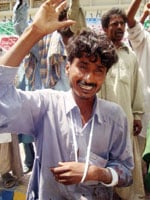
More direct forms of oppression… Struggle against bonded labour lands activists in jail Wajid Leghari of Naujwan Samaji Sangat (NSS) and Kanjee Bheel Advocate from the Human Rights Commission of Pakistan (HRCP) were recently arrested by the Nawabshah police while they were on their way to appear before a judicial magistrate in Tando Adam, Sanghar. Both activists were later shifted to an infamous and isolated police station in Jam Datar Town, district Shaheed Benazirabad (formerly Nawabshah). The police station where the two leaders were taken has been set up outside Jam Datar Town, and is said to run under an influential landlord named Thakur Nazir Baig. Who is Thakur Nazir Baig? Baig belongs to Tando Allah Yar, and is considered by peasants as one of the cruellest landlords in the province. "His brother is a serving major-general in the Army," activists close to Leghari told Indus Watch. Landless peasants who have had to deal with Baig allege that he offers loans to them to help out with their debts, but then holds them hostage for years. Baig had lodged three FIRs against Leghari and Bheel at different police stations, and had further threatened to lodge FIRs against them in every district of Sindh if they did not agree to "conciliatory measures". A police station beyond the purview of the law Local activists allege that the Jam Datar police station is controlled by Thakur Nazir Baig, and many people who refuse to "obey" him are incarcerated here. The condition of the "police station" is such that there is no electricity for up to 18 hours a day, while inmates are caged in small lockups. A local activist told Indus Watch that the police station is near a local shrine, where dwellers fasten their loved ones to trees with chains in order to "heal" them. According to him, the people being locked up at the station are also believed to lose their senses after staying here for a few days. Policemen deployed at the Jam Datar police station told Indus Watch that department officials occupied the discarded building in 1974, and police personnel are transferred here to punish them, and to repent their "mistakes". Previous run-ins with Baig Leghari has a history of run-ins with Baig, as part of the movement against slavery and bonded labour. A young female activist from the group, Marvi Bheel, had died during a three-day hunger strike at a camp in Mirpurkhas. Last year, due to the efforts of these activists, the superior courts took suo moto notice of Baig's actions and instructed the police to recover 78 people, including women and children, out of a total of 140, from the landlord's custody. Subsequently, in November 2008, the police were forced to take action and retrieve the prisoners from near Naoabad Town, district Sanghar. About 62 people, however, are still said to be under the private custody of the landlord, and activists have concerns about their safety. Peasants revolt Leghari and Bheel told Indus Watch that when they were arrested outside Tando Adam Town, Baig brought peasant women whose children were under his custody, and warned them not to speak against him before the magistrate. However, hundreds of Haaris (landless peasants) and activists from Khipro and Mirpurkhas visited the lock-up to express their support to Leghari and Bheel, and vowed to continue the struggle. South Asia Partnership Pakistan (SAP-PK) Provincial Coordinator (Sindh) Zulfiqar Shah told Indus Watch that they were struggling against the all kinds of slavery and would continue to support the movement. At the time, Shah was trying to make arrangements to bring Leghari and Bheel out of lockup. What happened next? On Wednesday, both activists were released on bail. Their legal battles, including the current one with Baig, continue, but their friends and supporters, as well as the hundreds of peasants who the two activists have worked for, celebrated their return. For one night, they forgot their own problems, and rejoiced in the fact that their leaders were among them once more. -- By Jan Khaskheli
By Veerji Kohli A landlord allegedly beat up peasants who worked for him,
kicked them out of their houses, and is now refusing to pay them the
compensation that he owes them. The landlord, identified as Samaro Waheed Kaim Khani, along with his henchmen, Mazhar Shar, Arzo Shar and Dur Mohammad, went to survey his fields last week. Mazhar Shar, Arzo Shar and Dur Mohammad were armed with sticks and axes. The 'missing' peasant Lal Chand, Kama Jagdesh, Mohan, Lakhman, Sobho, Amario, Shiri mati Sita baai, Samjho Baai, Lajwanti and others, who are bonded to Khani via debt, were working on the lands at the time. All of these peasants belong to the Kohli community. Khani noticed that one of the peasants, a very old man, was missing. He asked the others about the missing peasant's whereabouts. They told him that he had taken a boy to the hospital because the child was extremely sick. 'How dare he!' "Hearing this, the landlord went mad," eyewitnesses said. "He raged about how any of 'his people' could dare leave his fields without his permissions. He ordered his henchmen to beat us up to teach us a lesson." In the ensuing violence, not just men, but also women, were beaten up indiscriminately, and kicked. "They beat us up inhumanely. Ten people were injured. One man ended up with a fractured arm, and a woman was hit on the head with an axe," the peasants told Indus Watch later. The group was then kicked out of their houses. They came to Hyderabad where they protested in front of the press club. They demanded that the landlord and his henchmen be arrested, their debts be cleared, and security be provided to them. Backdoor negotiations The protesting peasants were joined by various organisations and activists, including Sindh Hari Porhiat Council (SHPC) chief Punhal Sario. These activists told media personnel that if the landlord were not arrested by September 17, daily protests will be organised in front of the Hyderabad Press Club, and an FIR will be registered against him through the court. Meanwhile, on September 16, Khani met with the peasants at the office of the SHPC, and attempted to negotiate a settlement. The terrified peasants agreed to drop the matter if Khani stopped harassing them about the money that they owed to him. In return, Khani will not pay them for the work that they had performed on his lands. The landlord agreed, and the peasants were supposed to return home on Thursday, pick their things up, and leave Khani's lands. When they went to pick their things on Thursday, however, Khani denied having made any deals with them, and told them that they could not leave until they had paid up the money that they owed him. Nothing was said about the wages that he owed them. The peasants called up activists in Hyderabad, who will now take the matter up legally. -- The writer is the Hyderabad coordinator for Mehrgarh.
|
|
 compared to Rs5,500 last year. A big chunk of this money, she claimed, was
spent on children's clothes and shoes. "Eid is a festival in which every
parent tries their best to buy all that their children wish for. As Eid comes
closer, we start finalising shopping lists for all family members, but
ultimately, children always get top priority when it comes to shopping. Only
after they have been made happy can we parents buy anything for
ourselves," she said.
compared to Rs5,500 last year. A big chunk of this money, she claimed, was
spent on children's clothes and shoes. "Eid is a festival in which every
parent tries their best to buy all that their children wish for. As Eid comes
closer, we start finalising shopping lists for all family members, but
ultimately, children always get top priority when it comes to shopping. Only
after they have been made happy can we parents buy anything for
ourselves," she said.