


|
|
|
|
|
 |
 |
|
analysis labour mother Localising
development goals profile
Give them incentives!
analysis Moving beyond laments While there is no denying that Bugti’s assassination was a significant moment in history of contemporary Balochistan, particularly vis-à-vis the radicalisation visible in Baloch society today, such laments have misleading implications By Alia Amirali The sixth death
anniversary of Nawab Akbar Bugti elicited the ritualised lament from the
state and the media. The only notable difference this time was that the
statement most highlighted by the media was that of the Chief Justice
rather than government representatives, which warrants a separate
discussion. In its content, the
Chief Justice’s statement was similar to the one made every year on the
occasion: i.e., Bugti’s assassination was the state’s biggest mistake
in Balochistan to date, and the government’s failure to hold the killers
accountable is at the root of the current turbulence in the province.
These statements of lament ignore — deliberately or otherwise — the
structural basis of the feeling of enslavement that has coalesced among
the Baloch people over time. While there is no
denying that Bugti’s assassination was a significant moment in history
of contemporary Balochistan, particularly vis-à-vis the radicalisation
visible in Baloch society today, such laments have misleading
implications. One of these
implications is that Bugti’s killers- i.e., General Musharraf and his
cronies- are solely responsible for the unrest in Balochistan. The other
implication is that had Bugti been alive, or if Musharraf had not ruled
the roost for as long as he did, or if the incumbent PPP government had
punished at least some of the culprits, Balochistan would have been
considerably less volatile. Each of these
implications are inaccurate, if not exactly incorrect. They are inaccurate
because they attempt to put the current unrest down to ‘bad
governance’, whether Musharraf’s or the PPP’s, while ignoring the
structural basis of Balochistan’s exploitation and the perennial nature
of Baloch resistance. The first thing to note
is that Baloch resistance did not begin with Bugti’s assassination.
Baloch resistance is as old as Pakistan itself, and has undergone
considerable change in both its sociological, technological, and
ideological character over the course of the last six and a half decades.
Even if we are to speak of the most recent phase of Baloch resistance, it
begins not with Bugti’s assassination in 2006 but rather in the year
2000, in response to the state’s aggressive neoliberal expansion and
attempts to hasten its exploitation of Balochistan’s natural resources. Second, singling out
General Musharraf and ‘dictatorship’ for the unrest in Balochistan
conveniently side-steps the fact that the coercive, militarised
“development” of Balochistan which began under ‘dictatorship’,
(i.e. in the Musharraf period) has been continued uninterrupted — even
hailed — by the ‘democratic’ setup that followed it. Politicians like Nawaz
Sharif who decry ‘dictatorship’ as the source of all our woes vis-à-vis
Balochistan, when in power, will surely promote (not merely defend) the
very same exploitative, and inherently violent “development” which has
exacerbated feelings of deprivation and enslavement amongst the Baloch
people. Like all
‘peripheries’ in the world capitalist system, Balochistan has been
brought into the fold of the market and forcibly “developed” by both
civil-democratic and military-authoritarian regimes into a source of raw
materials and energy resources for the Pakistani domestic economy as well
as for foreign markets. Exploration and
extraction work is carried out — under the barrel of FC/Army guns — by
private and semi-private corporations, both domestic and multi-national.
Virtually nothing (except a few scraps to pay off the local elites)
accrues to the people who live on Balochistani soil. Similarly, the much
trumpeted “development funds” for Balochistan are allocated
predominantly for federally-owned infrastructure-related megaprojects
rather than for serving the needs of the Balochistani people. Gwadar Port and Kachhi
canal, both federally-owned mega projects, together account for 86 percent
of the total allocation for Balochistan’s development (see Buddhani
& Mallah’s 2007 report on Balochistan’s megaprojects). In terms of
improving basic service provision for citizens and fulfilling people’s
needs for water, gas, electricity, schools, roads, hospitals, drainage,
etc., the few projects that have been initiated are limited to Quetta
city, the seat of the provincial government. The coastline, home to
some of the oldest indigenous fishing communities in the region, has been
taken over almost entirely by the Navy and the FC for “security
purposes”. The much trumped up ‘development’ of Balochistan —
ostensibly to ‘free’ the people from the clutches of the sardars by
modernizing them — has only increased the gap between rich and poor (see
the World Bank/ADB 2008 report on Balochistan), and benefited only the
ruling elites at each level- international, national, and local (though
again unequally). Recognising this reality
as the basis of Baloch resistance is crucial in order to move away from
the usual mud-slinging that comprises the current media narrative on
Balochistan. The last thing to note
regarding the annual 26 August lament is that Bugti is hailed by both the
state and the nationalists as “their man”. On the one hand we have
Nawaz Sharif’s presentation of Bugti as one of the most ardent defenders
of the “national interest” and opponents of “dictatorship”, and on
the other hand we have the nationalists’ version of Bugti purely as a
Baloch nationalist leader who died defending the Baloch motherland against
the Pakistani occupation army, neither of which are compatible with
Bugti’s political history. If we are to understand
the resentment of the Baloch people as a consequence of structural
exploitation, Bugti’s political position, whatever it may have been
today, would have been important in its own right but the roots of Baloch
resistance would remain unchanged. The author is a
researcher on the Baloch national movement.
Local
solutions After four years
of inaction the ruling coalition led by the Pakistan People’s Party
(PPP) has delivered a local government law for Pakistan’s financial hub
Karachi along with other cities of the Sindh province. This development
has finally come through serious political pressure exerted by the
coalition partner Muttahida Qaumi Movement (MQM) which has been an ardent
supporter of a local government system given its strong political roots in
the urban areas of Sindh province. Throughout in Pakistan,
local governments remain disbanded since the last 4 years denoting the
grave governance crisis in the country, which keeps on manifesting itself
in the form of weak service delivery and growing lack of trust in the
state. The governments of
Khyber Pakhtunkhwa and Balochistan to their credit have enacted laws for
local government system but their impact in the absence of local bodies’
elections has been negligible. Sindh has been locked in a serious debate
while Punjab has a draft law awaiting political action in the provincial
assembly. The net result of this
policy paralysis has been that the democratic governments for all their
achievements have failed the people at the grassroots levels for holding
the state accountable. The latest scheme is the
People’s Metropolitan Ordinance 2012 which covers five districts of the
Sindh province, namely Karachi‚ Hyderabad‚ Sukkur‚ Larkana and
Mirpurkhas. These cities have been declared metropolitan corporations.
Other than these urban areas, the rest of districts will be managed
through eighteen district councils. The PPP has conceded to
the demand of MQM by allowing for mayors and deputy mayors who would head
the metropolitan corporations. Under the new ordinance, Karachi will have
eighteen towns, thereby restoring in part the Musharraf’s devolution
plan of 2001 which remained operative until 2008. At the same time, five
administrative districts of Karachi will also remain operative thus adding
more layers and diluting responsibility of the local managers. Under the Sindh
Ordinance, chief metropolitan officers would also be appointed who will
share the powers with commissioners in the metropolitan city, while
commissioners and deputy commissioners would continue looking after the
revenue and law order situation. The new law says that
mayors would not have police powers which will vest with the provincial
government. This makes the new system close to what is being practised in
India where the office of district magistrate exists in urban centres
while all the development and service delivery is largely carried out by
elected officials. According to media
reports, political administrators might be appointed in all the towns and
metropolitan cities who may perform the role of mayors till the local
government elections are held. The new Ordinance like
other local government systems introduced by the elected governments
revives the so-called ‘rural-urban’ divide that existed in the 1979
model ironically introduced by the military dictator General Musharraf.
Thus, in Sindh it has been proposed that there will be Town Councils under
the District Council while in rural areas there would Taluqa Councils
under them. In the Punjab’s draft
law, separate councils for urban and rural areas have been envisaged as
well. In rural areas, the structure of Local Government comprises district
councils and union councils whereas in urban areas, it will comprise
Metropolis, Metropolitan, Municipal Corporation, Municipal Committee and
Town Committee. While there was merit in
the earlier merger of urban and rural jurisdictions there was a concern
that rural areas services were not addressed. Currently, there is an
institutional vacuum for the provision of municipal functions in rural
areas. The growing number of squatter settlements, public health issues;
and conflicts related to land-use are exacerbated in the peri-urban
localities, where change is taking place at a much faster pace. The fact that the Sindh
scheme has come as an Ordinance is a worrying aspect of local government
debate. The process of settling the rural and urban governance issues is
something that can be best decided through the democratic processes of
parliamentary debate, negotiation and consensus. Similarly, in the Punjab
it would be difficult to ascertain if the bureaucratic vision of
rural-urban divide is a goal shared by local leaders and their voters. This brings us to the
most vital area of local reform: Strengthening the foundations of
party-based democracy and forging linkages between local communities and
political parties. In the absence of effective state institutions,
non-state actors have been filling the ‘vaccuum’ by setting up
alternative dispute resolution systems (Swat, South Punjab for instance). Furthermore, local
political system can create political mobility for local leaders, enabling
them to rise to serve in higher tier legislatures based on their
performance in the lower tiers. The possibility of political mobility
would incentivize local party leaders to invest in developing a reputation
for effective governance and service delivery. Thereby stronger local
political system results in broadening the base of local leadership within
political parties. Such a mode of operation at local levels also provides
political parties necessary information about the reputation of local
leaders and helps select local leaders based on performance and voice of
local voters. Similarly, there are
several ways where the voting patterns can also be improved for greater
participation and democracy at the local levels. One option is to settle
for proportional representation at the local level under a party-based
system or following other innovations from the world. This is where our
elected governments are yet to focus. Pakistan also needs to
institute municipal courts in the rural and urban areas where petty
disputes can be settled at a low cost without involving expensive lawyers
and a corrupt legal system. In urban areas such courts are also important
given the growing lawlessness. Municipal courts can adjudicate upon
matters which are within the purview of Reconciliation Courts and also act
as Rent and Ejectment Controllers. Appeals from the decision of Urban
Municipal Courts should lie with the District Judge. Karachi and Lahore’s
experience also suggest that social regulation by the municipal
authorities require functional municipal policing systems. Where most of
the police is either busy giving protocol services or fighting terrorism,
municipal issues receive little or no attention. This urban, and more
importantly, unarmed force can be hired by the urban councils on
contractual basis and the members can be retained subject to performance.
Services such as enforcement of local and special regulation, traffic
control can improve tremendously if the municipal corporations have the
requisite capacity in complex environments such as Karachi. Even in the rural areas,
especially at the Union Council a community based policing model can be
piloted in several districts. The local rural should be an un-armed force
and built upon the traditional ‘chowkidara’ system which has either
decayed or become extant. Rural Police could become an adjunct to the
local courts and undertake watch and ward duties. It is unclear if local
government elections will be held at all. Our courts have been taking
cognizance of this matter but nothing has become of their orders and
notices. It is surprising that the most critical area of citizen welfare
— local accountability — has been brushed under the carpet by the
political executive as well as the judiciary, despite their claims of
serving people’s interest and ‘representing’ them. Soon, Pakistan will
enter into a national and provincial electoral contest and it is likely
that local government elections will be left for the incoming governments
to handle. The developments in Sindh are more likely to share the
patronage of ‘administrators’ with the political allies. This is why
the Awami National Party has rejected the Sindh Ordinance. It is time for
the political parties to move beyond the ‘immediate’ and think of the
future of a populous country, which is becoming ungovernable. Holding of local
government elections may just be a good exercise of political parties to
organise themselves at the local level and test their cadres. There is no
reason why the local governments in three out of the four provinces cannot
be elected and installed. Delay will only exacerbate the crisis of citizen
confidence in the state. The writer is Director
Policy at Jinnah Institute. The views expressed are his own. His writings
are archived at www.razarumi.com
labour Waning
livelihood opportunities in the rural economy, disasters, lack of
education and dearth of skill development avenues are leaving a bigger
number of children in rural Sindh as unpaid family workers. According to Pakistan
Labour Force Survey, 2010-11, Sindh has a significant number of people —
around 8 million — as rural workforce a large chunk of whom is employed
in the agriculture sector. However, working
conditions for a majority of tenants and their children in agriculture are
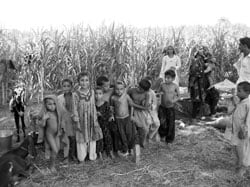
exploitative. Children in the agriculture sector serve as unpaid family
workers and the practice leaves deep imprints on their lives. Employment in
agriculture sector is mostly through share-cropping (50-50 percent and
25-75 percent) contract followed by daily wages on verbal agreements.
However, the system is faulty, specifically for the tenants who take
advance loans as it is called in the local context from landlords and
engage their entire families in the farming thus ignoring that their
children will be the ultimate victims as their future would be
compromised. In the process not only
basic and constitutional rights of these children are compromised but
their entire life is ruined in the whirlwind of deep rooted social system
based on injustice and dominance of powerful. It is noteworthy that
the worst outcome of unpaid family workers comes in the form of cases of
bonded labour extracted from the tenants — children both male and female
fall prey to the menace and are trapped in bondage for generations. According Labour Force
Survey 2010-11, the number of unpaid family contributors in the country is
27.8 percent with girls being two thirds of total contributing workers. Discussions with the
farming communities and their children reveal that people do not have
other opportunities and resources for the livelihoods. They blame the
prevailing socio-economic paradigms for their problems where the majority
is pushed to the wall and resources are concentrated in few hands. The ILO describes that
“poverty is the main cause of child labour in the agriculture sector,
together with limited access to quality education, inadequate agricultural
technology and access to adult labour, high hazards and risks, and
traditional attitudes towards children’s participation in agricultural
activities”. “We engage entire
families, including children in working arrangements because of our
economic conditions”, says Sadoro, an agriculture worker from Khipro,
Sanghar. “We do not have enough resources to enroll them in schools,
however, we also want our children to get education and become responsible
members of society,” he adds. Sadoro has an
eight-member family with three daughters and four sons. His 12-year old
son Walidad works with him as daily wage worker. “I have to work with my
father in agriculture fields because that is the only source of income for
us”, he says. “Why not; we also like to get education”, he says. The farming community
longs for a better and improved life but the system of oppression and
indifference to the issue of the marginalised is deep rooted. The level of poverty in
Sindh, which is one of the main reasons behind child labour in general and
unpaid family workers in particular, can be gauged from the fact that out
of every five people in Sindh two are living below the poverty line. Two floods in 2010 and
2011 have further deteriorated the economic conditions of the working
class in rural Sindh, especially those connected with the agriculture. Not
only their livelihood opportunities diminished but debts amassed upon them
which usually they pay by providing labour and in the process their whole
families, including children fall victims to the working arrangement. According to the
Pakistan Social and Living Standards Measurement Survey, 2010-11 in rural
Sindh 29.61 percent households reported worse economic situation while
51.36 percent had no change in their conditions from previous year. It is
because of increasing poverty that agriculture workers have been putting
future of their children at stake. Article 11 (3) of the
Constitution of Pakistan prohibits employment of children below 14 years
of age. Also, article 37 (e) of the Constitution maintains that state
shall “make provision for securing just and humane conditions of work,
ensuring that children and women are not employed in vocations unsuited to
their age or sex, and for maternity benefits for women in employment”. The national legislation
exclusively dealing with child labour is Employment of Children Act 1991;
in addition to that Bonded Labour System Abolition Act 1992 also calls for
eradicating child labour from the country. Moreover, Pakistan has
ratified a number of United Nations and International Labour Organization,
ILO conventions dealing with eliminating child labour from the country.
The biggest paradox is that implementation of national laws and
international conventions remains to be a distant reality. “Child labour in rural
Sindh particularly in agriculture is increasing”, says Suleman G Abro,
Chief Executive, Sindh Agriculture Workers Coordinating Organization,
SAFWCO. He says that diminishing resources for livelihood and indifference
of government to implement the child labour laws is giving impetus to
practice of engaging children in work as un-paid family workers. “I want to get
education but have to work with my father in the fields on daily wages
because one family member cannot feed the entire family”, says 14 year
old Sonu. He says increasing shift from sharecropping pattern to wage work
is also hitting the farming communities hard and due to that they have to
make children work to earn more to feed the families. His father, Raju, also
has the same argument for children doing work despite the fact that they
have school in their area. “We have family having more than 10 members
and I alone cannot feed them, because of that we engage children and our
female members in the workforce”. Education is universally
recognised as one of the most fundamental building blocks for human
development and poverty reduction. Nevertheless, it is an anomaly that
persistently Sindh has been lagging behind in education due to the neglect
of policy makers and public representatives and the lack of interest of
people in particular. According to a UNESCO
report, 2.6 million children between 5-9 years old are out of schools in
Sindh. That supplements the argument that a substantial number of out of
school children in rural area are working as unpaid family workers. “Schools are not
functional in the rural areas because of lack of interest of the
government, so, parents send their children to fields”, says Dr. Ghulam
Haider, Executive Director of Green Rural Development Organisation. He blames poverty for
multiplying the number of unpaid family workers. “It is a fact that the
number of unpaid family workers is increasing and every child in can be
considered as unpaid family worker”, he adds. The government should
take serious measures to improve living conditions of the poor and the
downtrodden and also implement in letter and spirit the laws and
conventions dealing with the eradication of child labour.
Re-imagining
the national flag I am a patriotic
Pakistani. I love the white, the green, the crescent, and the star of my
country’s national flag. But, on the 65th Independence Day I am
compelled to reflect on its symbolism. Is it possible to re-imagine this
important national symbol in a way which is more patriotic and closer to
the idea of Pakistan? Symbols, such as the
national flag, influence our collective sub-consciousness in a subtle and
profound manner. These symbols can be invisible, such as a street name
after a national hero, or quite visible, such as a replica of Ghauri
missile in a public square. They shape our understanding of who we are. So
does the Pakistani flag, as one such symbol, together with the narrative
around it. And we are often unaware of it. Re-imagining the national flag
is, therefore, tricky and of consequence because it can help forge a
different understanding of what we Pakistanis stands for. But why am I interested
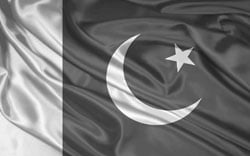
in this re-imagination? Let us look at the official narrative. According
to the Ministry of Information1, the white bar on the left represents
minorities. The green represents Muslim majority. The crescent represents
progress and the star represents light and knowledge. “The flag
symbolizes Pakistan’s profound commitment to Islam, the Islamic world,
and the rights of religious minorities.” This is the official identity
of Pakistan and Pakistanis in it simplest form. My larger concern is how
the Pakistani society is imagined on the whole as a reflection of this
symbol and how this symbol influences the behaviour of Pakistani people.
However, my particular concern here is how religious minorities are
located vis-à-vis the Muslim majority in the flag. The way it is
conceived now, it is more problematic than beneficial. Imagine the flag – a
piece of cloth - representing the fabric of Pakistani society which should
be united under its banner. The symbolism fails to achieve this unity. The
flag “divides” the fabric of the society into two groups. A larger
green of Muslim majority occupies a prominent space. And a smaller
“marginalized” religious minority occupies a white space on one side.
While it does reflect the true demographics the flag is not the place to
assert this. First problem is that
the minorities are clearly marked and separated using different colours
giving a sense of two peoples who cannot be brought together and shall
remain disengaged. Second problem is that this minority group stands on
one side of the flag. Using the analogy of the fabric of the society, this
group is marginalized, literally. It simply serves as a margin – a base
– from which more important elements begin: the green, the crescent, and
the star. The white base is limited to hoisting the flag only. No other
recognition is given to it. This marginalization is also reflected in our
national rhetoric and poetry: sabz hilali parcham,
parcham-e-sitarah-o-hilal. I cannot recall any national song where the
white is romanticised, much less, recognised. The resulting official
narrative is hollow because the commitment to Islam and protection of
minorities’ rights are independent events in the flag. These need to be
interlinked. The narrative also does not connect various elements of the
flag into one story. This leaves considerable space to manipulate the
symbolism. For example, during General Zia’s time the slogan Pakistan ka
matlab kya? La ilaaha illallah became quite popular. While it resonates
with many Pakistanis, it does not resonate with all. It is a twist on the
official narrative of the flag whereby non-adherents of this declaration
have been washed away from the national fabric. In other words, the green
has gradually replaced the white paving the way for persecution of
minorities. The end result is further deterioration of the fabric of
Pakistani society. This design and the
ever-evolving narrative around it have partially influenced the collective
sub-consciousness of the Pakistani people for 65 years. I said partially because
a simple piece of cloth cannot be attributed entirely for the problems
faced by minorities in Pakistan. However, here I am concerned only with
one bit of this multi-faceted issue. Giving religious minorities due
recognition requires, only as one such effort, a re-imagination of the
meanings of various elements and their relationship with each other. Therefore, instead of
minorities, I want to re-imagine the white bar to symbolize purity of
intention and action, guided by the light of education and knowledge.
Instead of Islam and Muslim majority, I want to see green as representing
life: human and other, where it signifies happiness, growth and
prosperity. White crescent and white star can respectively symbolize
Islam/Muslim majority and religious minorities. Here, the minorities are
brought to the centre of focus along with the Muslim majority. A crescent
almost embracing the star symbolizes an engaging and interdependent
relationship where the Muslim majority must protect religious minorities
because of the state’s commitment to Islamic ideals. The resulting overall
narrative thus becomes: The Pakistani society is based on the purity of
intention and action informed by knowledge and education to achieve
happiness and progress for its inhabitants. The state’s commitment to
Islamic principles and values is as firm as a source of wisdom, as its
commitment to a society where Muslim majority and religious minorities
live together in harmony in a just, peaceful, and egalitarian society. This is just one way of
making the sabz hilaali parcham more patriotic and closer to the idea of
original Pakistan. The writer is a faculty
member at LUMS
mother Evidence shows
that the status of health for women in Pakistan, especially that of
mothers and adolescent girls is a neglected area in the backdrop of
deteriorating statistics and stagnating indicators. Consider three different
women in three different scenarios. Scenario 1: Shahida, a
native of Sindh, mother of five, thinks that her family is complete and
wishes to seek family planning advice and products. The nearest Basic
Health Unit (BHU) is 10 kilometers away and her husband won’t let her
commute un-chaperoned. He is busy in the harvest season and asks her to
wait. Shahida counts days,
fearing she might conceive and end up with another unwanted pregnancy.
When she finally reaches the BHU accompanied by her brother in law and
mother in law she finds that it has been abandoned and turned in to a
cowshed. She gathers courage and persuades her companions to travel with
her to the Rural Health Centre (RHC) a few more kilometers ahead. After
waiting for the transport for an hour in the excruciating heat they get to
the facility and meet the lady doctor just in time before she leaves. The doctor prescribes
family planning tablets which Shahida has to buy privately as the
government owned facility is out of stock. However, it’s difficult for
her to regularly procure the tablets and eventually ends up conceiving. She tries numerous
home-based methods to terminate her pregnancy but to no avail. She carries
the pregnancy to term with difficulty as she is anemic, over loaded with
work at home and in the fields and has had no antenatal care. During her
delivery she experiences bleeding complications (post partum hemorrhage)
and ends up losing her life. A young life is wasted away and five children
lose their mothers. Scenario 2: Bina, from
Punjab, an unmarried teenager is unwittingly seduced by an older married
man and becomes pregnant. He abandons her as soon as he finds out about
her pregnancy. Bina, a sister of four brothers is scared for her life and
does not even confide to her mother. She tries to find ways of aborting
pregnancy experimenting with traditional recipes and having failed ends up
in the hands of a traditional birth attendant. Bina starts to bleed
profusely after two days and her mother rushes her to the nearest health
facility where her uterus is evacuated under anesthesia. Soon afterwards
her mother arranges her wedding with a mentally handicapped person who is
much older to her. Bina yearns to have children but the doctor tells her
that she will never be able to have children. Scenario 3: Perveen, a
thirteen year old is given in exchange for her brother’s bride in Khyber
Pakhtunkhwa. Perveen wished to continue studying and hates the forty year
old man she is married to. No one listens to her protests. Soon after
marriage she gets pregnant but suffers a miscarriage. Over the next two years
she suffers from two more miscarriages. Her husband thinks that she is
useless and being the youngest in the family she has no say in the power
dynamics around her. She becomes a victim of domestic violence and severe
depression and attempts suicide multiple times and eventually succeeds. On
her death bed she blames her parents and her early marriage for her tragic
end. Readers might think that
the above case studies are fictitious and represent only the worst case
scenarios but, unfortunately, they are all derived from real life stories
and it’s only the names of the women that are fictitious. These stories were
revealed to the author during a research undertaken by Shirkat Gah
Women’s Resource Centre to monitor the Millennium Development Goal 5
(pertaining to maternal and reproductive health) initiatives in the
country and to explore the issues of early age marriages. In order to
understand the similarities and connections in the above three scenarios
we need to go back to look at the statistics and figures around maternal
and reproductive health in Pakistan. Pakistan is currently
the fifth most populous country in the world, being home to over 166
million people. The population increases by one million every three months
and is expected to reach 295 million by 2050 if efforts are not made to
control the rate of growth (Population Reference Bureau: 2007 World
Population Datasheet). In Pakistan, the
extremely high rate of growth is driven by many factors, including a lack
of knowledge of family planning, lack of institutions to provide knowledge
and assistance, early age marriage and a denial of Sexual and Reproductive
Health and Rights (SRHR) in general, that includes allowing a woman to
make decisions about her own body. While statistics
comparing SRHR issues in the South Asia region indicate that Pakistan has
not been doing too bad in terms of Maternal Mortality Ratio (MMR) than
some of its neighbours (267 per 100,000 live births as compared to 230 in
India, 320 in Bangladesh, and 380 in Nepal: source, Asia Pacific Resource
and Research Centre for Women), in other areas, especially those
pertaining to MDG b_ achieving universal access to reproductive health,
the view is not as promising and although family planning has been given
more focus than other SRHR issues, there is still a need to do more even
in this area. Also in the absence of a
National Policy on Adolescent health and a comprehensive curriculum that
include Life Skills Based Education, adolescent girls remain unaware about
their health rights and choices. Two other major problems
are the prevalence of induced abortions and at some levels denials of it
and early age marriages. It has recently been found that 890,000 women
have self-induced abortions throughout the country, which is hazardous and
life threatening. It has been seen that in Sindh, where early age marriage
is far more common and girls as young as 11 and 12 often fall prey to
crimes such as exchange marriages, and given in debt, MMR is far higher
than the rest of the country. To complicate the matter
further, Pakistan is a disaster prone country and what needs to be
explored is the huge dimensions of RH and FP issues that arise during
disasters and other humanitarian conditions, specifically the escalation
in gender based violence under such situations. Women’s empowerment is
both an issue of rights, as also an essential requisite of achieving
development, physical and mental wellbeing, opportunities and prosperity. Despite various national
and international commitments women in Pakistan remain disadvantaged and
subject to violence and marginalisation. The view of women as
dependents and their general invisibility is rooted in patriarchal
structures and customary practices and often reinforced both by law as
well as the lack of attention and sensitivity of policy makers. Even when policies and
commitments are in place no tangible results are visible pointing to the
need to unravel bottlenecks and obstructions especially as political and
economic situations undergo change. Access to RH and FP
services for a woman is tightly interwoven with the socio-political
factors and unless these determinants are taken into account long term
progress will remain a farfetched possibility. A possible key step
towards providing a comprehensive health package to the women is to
approach the problem with an integrated set of efforts and to understand
the linkage of maternal and reproductive health with other aspects of
life. Secondary education for
girls is associated with positive health outcomes and higher age of
marriage. Development of skills and provision of livelihood options are
also a positive social determinant of health and that is where the civil
society sees the role of women’s development department. Also, health and
population departments need to develop more synergy to ensure that no
woman returns home without complete healthcare and family planning
counselling. It is a slow process but
if various departments, civil society, media and the public join hands
then it is a goal that is still achievable despite the grim statistics and
there is yet hope for women like Shahida, Bina and Perveen. The writer is Human
rights activist and Manager Reproductive Health, Shirkat Gah Localising
development goals Realisation of
the Millennium Development Goals (MDGs) at the national and provincial
levels has become a dream for policy makers due to largely missing out
targets. However, evidence suggests that some of the sub-indicators of the
MDGs might have been achieved in few of the districts in the provinces. The provincial MDGs
reports have highlighted the missing targets with margins and show blatant
failure of the provincial governments. However, the significant historic
events of 18th amendment and 7th NFC award have changed the dynamics of
policy frame at the provincial levels due to greater local ownership and
federal financial pouring into the provincial exchequer. It is now the
responsibility of the provincial policy makers to repair the already
developed dents in the achievements of the MDGs. Punjab, being the
largest province may affect the overall national progress which is quite
evident from its modest showcase in achieving the MDGs. Extreme poverty and
hunger targets may not be met as FSA 2009 report has showed increase in
the food insecure districts. The occurrence of under-weight children below
the national figures also indicate towards low nutrition levels in
province. Universal primary
education targets are unlikely to be met as Net Primary Enrollments stood
at 61 percent, still above the national targets, but below the 100 percent
target. The hope comes on
meeting the gender equality and women empowerment which may be achieved
partially as Average GPIs for public schools ranged from 0.86 for high
schools to 0.90 for primary schools. Immunisation targets may
be met while child mortality rate may not be met. Improving maternal
health, MDG-6 targets are also unlikely to be met due to its slow
progress, however, substantial improvements have been observed in the last
few years. On MDG-6, combating
HIV/AIDS, Malaria, and Other Diseases, progress is obscure due to data
limitations. The partial success is recorded in MDG-7 and population
having access to improved source of drinking water have already crossed
the target. Khyber Pakhtunkhwa,
severely crisis torn region has also shown modest improvements over the
last decade. However, the progress has been varied on different MDGs. The target envisioned in
the CDS of extreme poverty and hunger may not be achieved amidst ongoing
crisis in the province. Female literacy is far behind the national average
by 14 percentage points showing widening of gap in the province. Again, the achievement
of MDG-2 at this pace seems a day dream for the provincial policy makers
as nearly all targets are missed. However, there are very few districts
which may achieve the target by 2015. Under MDG-3, the average
GPI of primary schools were estimated around 0.78 as against the target of
1.0 by 2015. Similarly, the youth GPI is quite disturbing while comparing
with Punjab where the parity target may likely be achieved in coming
years. It is encouraging that
four out of 26 districts in KP have achieved the MDG target of
immunisation of children of 12-23 months. Infant mortality and Under-5
mortality rate has shown deterioration, however, definite statement may
not be passed due to paucity of data at the provincial level. MDG-5, improving
maternal mortality may not likely to meet due to missing of all targets.
Data on MDG-6 is not comprehensible enough to make a definitive statement.
The state of access to improved water sources have increased over the
years, but the target is unlikely to achieve. However, the province’s
progress on wildlife and fisheries has already surpassed the MDG-7
targets. Balochistan being the
neglected region has also shown the commitment to achieve MDGs by 2015.
However, the commitments never fill in the long awaited provincial
development deficits as envisioned by the provincial government; however,
it might make a difference in dealing the MDGs, so that common people may
reap maximum benefits from this development mantra. Poverty has increased
despite depleting financial resources feeding into the provincial
exchequer. Literacy rate is also well below the national average, however,
the enrollment rates have increased by 7 percentage points between 2004/05
to 2008/09. The GPIs of primary
education also recorded below national parity performance in the province;
however, few districts have outperformed and already achieved the MDG
target. The immunisation target
has lowered from 62 percent in 2003/04 to 43 percent in 2008/09. Infant
and Under-5 mortality rates also record poor show and unlikely that these
targets may achieve. The province has
observed exorbitant achievement in declining maternal mortality rate from
758/1000 in 2006/07 to 140/1000 in 2008/09. Similarly, the population
having access to improved drinking water has also increased to 74.6
percent in 2009/10 from 61 percent in 2008/09. The Millennium
Development Goals (MDGs) in the districts may be met if the provincial
policy makers rethink its policy to keep these goals provincialised. The secret lies in
localising these goals and target specific districts for achieving the
selected MDGs. The people should manage their local priories and transform
the resources more effectively into tangible outcomes. This reality has already
been debated by major donors in Pakistan and evolved strategies aimed at
enhancing and strengthening citizens’ voice and demanding public
accountability. These programmes will
affect the service delivery levels, both in direct and indirect ways
through strengthening voice, improving participation, ensuring empowerment
of the marginalised segments and holding public officials accountable. Enhancing participation
may lead to greater accountability on the part of public institutions. It
is assumed that focusing on enhancing participation will definitely make
public institutions more responsive to citizens’ needs. This is the most
direct way to deal with multidimensional nature of poverty. The writer is the
founding member of Strengthening Voice Organization (formerly SAAP) and
may be reached at gulbazali@gmail.com profile Many of us have
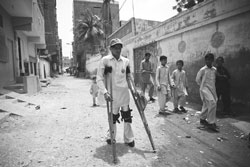
seen a confident-looking young man with crutches appearing in a TV
advertisement of a newly-launched campaign for the eradication of polio. The advertisement
asks, ‘To what extent would you go to save your children from
polio’. The 25-year old Abrar Khan who ended up being a polio victim at
the age of three belongs to a poor Pakhtun family from Karachi. Khan has become a
celebrity and a symbol of anti-polio drive starting from September 10.
Huge hoardings containing anti-polio slogans and his pictures can be seen
in all major cities. He is being projected on TV, Radio and newspaper as
well. A commerce graduate,
Khan joined Unicef in March this year as community mobiliser. He is the
only community mobiliser out of more than 1000 working with Unicef who is
a polio victim as well. It is not an easy journey for him. He vividly remembers his
bedridden childhood, problems his parents faced because of his illness and
his struggle to get out of the trauma and to become a productive member of
the society. “It is too hard to
live in a society like us with some kind of physical disability,
especially with polio. Everybody reminds you one way or the other that you
are crippled”, he tells The News on Sunday. Khan was in Islamabad
last week as part of his awareness campaign about polio. “I just want to
tell parents that polio is not just childhood disease, children with polio
have to live with it the rest of their life.” It was not easy for him
to get education. At first, no school in his neighbourhood was ready to
give him admission. “My father made a lot of effort to convince a
teacher to get me admitted in a local school at the age of 7”. He was not a very bright
student. “One day one of my teachers told me that I better quit school
for good. I tried to become a tailor but realised one needed to use his
legs to operate machines. I told myself that education could be the only
thing I should get. I started going school again and was the only student
from my school that year who passed matriculation with an A grade,” he
says proudly. Khan has done his BCom
as a private student from Karachi University because it was too expensive
for him to join university as a regular student. He was teaching at a
local school when he came to spot an advertisement announcing a community
mobiliser‘s job in Unicef. “I know it works for
polio eradication. I requested them to hire me because I hate polio. I
want to use all my energies against this menace.” He is also offered alms
at times and has been facing derogatory remarks, “Some people in my
family used to say that I was attacked by polio as a repercussion of some
sin committed by my parents. Several people still name me as ‘lame’
instead of calling my original name. It really hurts,” he says looking
at the floor. “I do not want this to happen to other children. It is too
easy to avoid this dangerous illness these days.” Now he can start a
conversation with the locals easily but ‘it takes a lot of energy to
convince them’. So far, he has a very good record in tackling the people
who refuse to take his advice. When he started working in March 2012,
there were more than hundred instances in which people did not take his
advice seriously. It is a big
neighbourhood and while Abrar’s mobility is limited, he does his best to
cover as much area as possible with braces and crutches to reach every
household. “Since March, I have been able to convince 70 out of 100
parents to vaccinate their children against polio.” “A
lot of people think it is part of a Western conspiracy against Pakistanis.
They talk about Shakeel Afridi. I take help of the local prayer leader to
convince them. Only a few of them help me while most of them reject my
requests”, he says. Pakistan has the largest
number of polio cases in the world. With 198 cases confirmed in 2011, the
country accounted for almost 60 percent of the global cases. “Unfortunately, an
overwhelming majority of these polio victims belong to Pakhtun community
whether it is in Balochistan, KP, Fata or Karachi. There are five people,
for instance, affected by polio living in two streets of our locality.
Most people in my locality take it as the will of God. Some of them get
offended when I tell them that it is only because of ignorance of the
parents. All the people can easily be saved from polio. Those who deny
polio vaccination to their children are in fact the worst enemies of their
children”, he says, adding it
is always easy to convince women than men. He always offers himself
as an example to explain them the repercussions of this disease. “Life
is too tough to live with this disease. I want to eliminate it from my
country”, he says. “I strongly wish I could walk, I could run. I would
have been possible if my parents had got me vaccinated during my
childhood”, he says. His colleagues see him
as a real hero. “When I think about Abrar, a real fighter’s images
comes to my mind. His story is inspiring and gives the message that
parents should not make the same mistake which his parents made. “He is a huge
advantage to our campaign and a great advocate”, one of his female
colleagues at Unicef tells TNS. “Nobody can understand and explain this
problem more than him. When he speaks, people listen. His passion and
honesty creates a ripple effect”, she says. A mother of two kids,
who was sitting next to us, comes and says, “I have never taken this
vaccination campaign seriously in the past. But after seeing him and
overhearing his story I would make sure that my two sons are administered
polio vaccination”, she tells Abrar while introducing her two sons.
Give
them incentives! There is a
consensus that in order to overcome its fiscal and economic woes, Pakistan
needs to strive hard to achieve a reasonable tax-to-GDP ratio between 15
percent to 20 percent — it is presently only 8.4 percent, which is one
of the lowest in the world. There are, however,
serious differences amongst experts on how to achieve this goal. Those
once affiliated with IMF-World Bank or still are, strongly advocate
imposition of Value Added Tax (VAT). They believe unless it is done, no
substantial increase in taxes is possible. The critics of IMF and
the World Bank say this prescription is not suitable for Pakistan. They
argue for radical changes, namely, more tax from the rich, reduction in
the exorbitant sales tax rate, introduction of equitable tax base, simpler
and fairer tax procedures. According to them,
economic policies aimed at rapid growth and investment should be the first
priority — taxes will automatically increase with higher growth but
collecting more taxes in an already ailing economy is not only
counterproductive but can lead to total collapse and civic commotion.
Every political party on paper and in public claims that efficient
collection of taxes, coupled with rapid industrial and business growth, is
its main agenda, but in reality the rich and mighty controlling them would
never allow to happen it. The debate about
economic reforms and strategy to take Pakistan out of fiscal mess has
assumed renewed interest in the wake of announcement of policy by Pakistan
Tahreek-e-Insaf (PTI) on 23 August 2012. Most of the economists,
even those claiming to be sympathisers of PTI, have rejected it, using
jargons such as “flawed, tried-and failed” [The News, September 3,
2012]. Zealots of PTI, however, are of the view that it is workable and
would enable Pakistan to take a great leap towards economic progress with
equality. We are all aware about
massive sales tax evasion coupled with under-reporting and non-reporting
of incomes in Pakistan. The challenge is how to bridge the tax gap of
billions of rupees. The issue of
documentation is lingering on for years. In the fives budgets of the
present regime, no action was taken to check leakages in tax collection.
On the contrary, unprecedented amnesties and concessions were given to tax
evaders and looters of national wealth. It has simply never been
the intention of any government since General Ziaul Haq, to crack down on
tax evaders and combat generation of dirty money — the result is the
present grave crisis of governance, corruption, resource mobilisation,
debt burden and mounting inflation. The only way to check
massive evasion in customs, income tax and sales tax is implementing an
integrated Tax Intelligence System (TIS), which is capable of recording,
storing and cross-matching all inflows and outflows. For collecting taxes,
the following measures are inevitable: All in-bound and
out-bound containers should be scanned/x-rayed to check evasion of customs
duties and determine inflows. Encouraging, rather
forcing, payments by credit cards/cross cheques for business purchases
exceeding Rs. 25,000, and giving incentive for reporting transactions to
Federal Board of Revenue (FBR) — at least 10 percent as refund of the
amount paid as VAT. The procedure for claiming refund should be simple,
i.e. payer should email evidence to the Central Tax and Refund Depository,
which authorises refund directly to the credit card/bank account used
after verification of genuineness of the invoice (by checking sellers’
registration number; or alternately; Any person who pays and
reports VAT may be allowed to claim against income tax liability 10% of
total amount. In this scheme, the
people may choose not to claim full credit of VAT paid since they might
not be able to justify the sources of their expenses. For broadening of
tax base, the government can announce immunity for 3 years from scrutiny
of expenses declared through VAT invoices alone — it would go a long way
to document the economy yielding more and more revenues in the coming
years under income tax regime. This scheme would
encourage people to obtain VAT invoice for each transaction, which is
presently not being insisted upon. Evasion of sales tax is mutually
beneficial. If VAT payers are given the above incentive, they will insist
on invoice and the government without expending any money or making extra
efforts would be able to substantially expand the tax net. Such schemes were
successfully implemented in Taiwan, Turkey and Venezuela. In India, the
government of Kerala introduced 5% sales tax for all retail sales with
incentives to both the shopkeepers and buyers. The shopkeepers got a 10
percent-15 percent refund of tax collected and paid to the government and
the buyer retrieved coupon of Rs 5 for every purchase of Rs 100. Every
week a draw was held and coupon-holders won lucrative prizes. This scheme
boosted retail sales of shopkeepers who were willing to get registered
with the government. There has been tremendous increase in government
revenues with the introduction of this scheme. In Pakistan’s peculiar
milieu, innovative measures would have to be employed to restructure the
tax system and restore public confidence in tax officials. A State that
has miserably failed to protect the life and property of the citizens,
people say, lacks moral authority to collect taxes. Thus, even a good tax
system will not work unless the prevalent situation — restoration of
writ of state — is not established. This is prerequisite for all reforms
PTI or others are talking about. The Parliament, first of
all, should introduce Taxpayers’ Bill of Rights assuring that money
collected from citizens is spent on their welfare and not for the benefit
of a few. Secondly, there should be taxation of all incomes irrespective
of their source (agricultural or non-agricultural). Thirdly, broad-based
and harmonised VAT, covering all goods and services, at a low rate of 8
percent to 10 percent should be implemented. Tax collection and
compliance cannot be improved without the implementation of integrated Tax
Intelligence System that can correlate VAT collections with income tax
returns and monitor all transactions. It should be coupled with a speedy
refund system, which is fair and transparent — while enforcement should
be strict and stringent, refunds should be paid expeditiously. There must be no sacred
cows. The tax base cannot be broadened unless all the goods and services
— barring a few essential eatables, books, children’s garments,
education tools — are brought into the VAT net and all persons having
income of Rs. 500,000 or more are taxed and forced to file returns
electronically with declaration of assets and liabilities. Law should be passed
requiring FBR to publish directory of taxpayers every year so it can be
seen how much tax is paid by high-ranking civil-military officials,
judges, politicians, public office holders, rich professionals and
businessmen and how much wealth is owned by them. The existing taxes,
sales tax at exorbitant rate of 16 percent to 19.5 percent with lots of
exemptions, excessive withholding taxes, presumptive and minimum taxes and
non-taxation of agricultural income has created distortions — the system
has failed to create equity, besides not being able to generate the
desired tax-to-GDP ratio. To improve the
tax-to-GDP ratio, all kinds of exemptions and concessions must be
withdrawn. All persons earning income of Rs 500,000 or more — from
whatever source— should be taxed. FBR should be made an
autonomous body insulated from outside political, financial and
administrative pressures. Parliament should devise, through a democratic
process, a rational and consensual tax policy after taking input from all
the stakeholders and experts in the field. This alone can help in
broadening the tax base and improving tax-to-GDP ratio in the country to a
respectable level — India and Iran have achieved the level of 17 percent
and 16 percent respectively by adopting the same measures in recent times. It is by no means an
easy task in Pakistan. But now the public is becoming increasingly
critical of political motives behind so-called ‘reform agendas’ and
getting better informed about the impact of undisciplined public finance.
Unless all of us start paying our taxes honestly and diligently, rather
than just criticizing, nothing will change. After fulfilling this
obligation, masses must demand that the revenues collected should be spent
for the welfare of the masses and not for the luxuries of the rulers and
the civil-military bureaucrats—their perks and privileges should be
monetized forthwith. The ruling elites—political and
bureaucratic—should be compelled to live like ordinary mortals rather
than thriving on taxpayers’ money shielding behind iron curtains in
palatial houses. The writers, tax
lawyers, are Adjunct Professors at Lahore University of Management
Sciences (LUMS)
|
|