



|
|
|
|
|
 |
 |
  |
kiteflying MOOD STREET Demanding the very basic By Arshad Shafiq ‘Right to Pee’ is a campaign launched in India by a social group for clean and free public toilets. The group says women are charged for using public toilets, but not men. This they hold is blatant discrimination against women — the government must provide women with clean, free toilets. Consider Lahore. Men are free to relieve themselves anywhere they so desire, despite the warnings on the wall: “Urinating here is prohibited. Violator will be handed over to police” or “Look a dog is peeing”. Women on the other hand have no such option. Think of them looking for a toilet at a public place with no sign of it in sight. How frustrating and scary that can be. A colleague, who lives close to a place in the city from where buses leave for south Punjab, keeps receiving women with request to let them use the toilet. Sometimes they have children with them. At all times they are extremely grateful for letting them use the facility. theatre The
best for everyone Tailor
on walkway
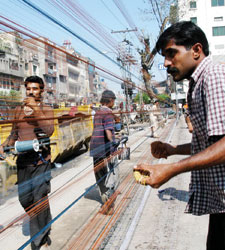
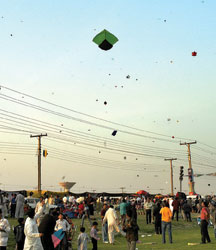
kiteflying Ban or bane An industry, a hobby, people’s livelihood remain suspended just because of malpracices in string-preparations By Saadia Salahuddin Akbar Shah, once
a seasoned kite-maker, is now a fruit vendor. He sells fruits on rehri. 20
women used to work with him. “Now they are out of work. One woman wed
her seven daughters from this earning,” says Shah. Syed Aftab Ali Shah
alias Baboo Shah, another known kite-maker, was in this business with his
whole family. He has all daughters. The skill runs in the family for
generations. “My mother, who died last year at the age of 96, was adept
at kite-making,” says Babboo Shah. Like Babboo Shah Abdul
Latif has all girls; all made kites. Naseeruddin alias Ustad Shera, who
would make extraordinarily big kites, has nothing to do. The economic
crunch in families who were associated with kite-making and selling is
huge. Hundreds of families
engaged in it are living hand to mouth. A large number of women who made
kites at home have been particularly affected as a result of ban on
kite-flying. Most of them are living below the poverty line, The News on
Sunday learnt from kite-makers in the city that have taken up odd jobs in
the absence of work. When a water pipe gets
clogged, we have to clean it for water to flow smoothly. We cannot put it
aside because it is like a lifeline. Likewise, an industry that provides
livelihood to hundreds of thousands of people cannot be closed for good if
something goes awfully wrong there. While all of us are
clear that no sport can be allowed at the cost of life, we have also seen
that people in this region have been flying kites for hundreds of years
peacefully and incidents of cutting of throats is quite recent. Something
went wrong along the way. That something has to be identified and
corrected instead of banning the sport for good. “All that is needed is
political will,” says Malik Javed Ali while sitting in a group. Others
agreed with him. Boys have been falling
from rooftops while flying but now that different segments of society have
reflected on it and are determined to prevent it, it’s certainly a good
augury. The provincial leadership has apparently shown more respect for
human life by putting a ban on kite-flying but there are thousands of
people who have been deprived of their livelihood and no leader ever took
this into account. Does this not amount to disrespect for life also? How nations cope with
challenges says something about them. Instead of solving the problem,
rectifying the wrong, we have succumbed to it. According to workers, the
ban was first imposed in the year 2003. A group of skilled
kite-makers and dealers have suggestions as to how to revive kite-flying
that wouldn’t cut throats. Zahid Butt, once a kite dealer and maker,
says all the problems occur due to malpractices in kite string (dor)
preparation. Malik Javed Ali and Muhammad Nasir alias Billu Shah second
this and suggest making four departments – that of dor makers, kite
manufacturers, kite dealers and kite-flyers. They suggest forming a union
that would include representatives of all these sectors. The union should
then be responsible for giving license to all in this business because
they will know the people in the profession in and out, they say. “If manufacturing and
sale of bullet can be seen through till the end, why can’t kite-string
be inspected in the same manner. Both kill. Celebratory firing is still
there and people die from it. Have people stopped taking alcohol with ban
on kite-flying?” Kite-makers and dealers are bitter about the ban. They demand dialogue
with the government. “Every time we go to the DCO and talk about lifting
of ban on kites, we are asked, ‘who will give guarantee that nobody will
die’. Who can give such a guarantee? The dialogue never starts. MPAs
don’t give us time,” they say. The craftsmen insist on
defining what is safe and what is unsafe namely the kite with two rods (2
teeli wali) and four rods (4 teeli wali). Thick kite-string is most
dangerous because the thicker the string the more glass coating it will
need. The people in the kite-industry termed this ‘criminal’ and
responsible for the ban on kite-flying and the destruction of the
industry. “Kite-flyers are very
much responsible for an end to this game in the city. Contests have
damaged the game the most. The demand for string that wouldn’t break led
to eventually breaking up of the whole industry. While only an ustad could
cut 12 kites from one string, now even a child would cut 15 kites with
one. Kite-flying no more remains an art but the wrong practices can be
checked,” one kite-maker from a group says. “Only 5-6 parties are
preparing hazardous kite-strings while there is only one industry that
makes thread used in kites. The malpractices can be checked and right
practices ensured. The government can control dor making easily. In Kasur
all the dangerous dor making addas were destroyed a few years back. All
that is needed is political will,” the craftsmen and kite-dealers have
an agreement here. Festival to bring
prosperity “Basant
brought 8 billion rupees in two days the last time it was celebrated in
Lahore,” says Khalid Malik, a third generation kite-flyer, teacher and
writer who is very passionate about kite-flying. “You ban it in your
country; others take over. Basant is being observed in Dubai for the last
six years where thousands go every year. It is attracting the world
community. In our country there is no political will to make it happen and
that is very important.” “When Kite-flying Act
was being prepared by the Punjab Government there was no stakeholder
involved; none from Lahore. Then a commission was made in which Yusuf
Salahuddin, Zulfikar Khosa were members,” says Malik. He says kite industry
needs to be registered as an industry. “Pakistan Tobacco Company is
paying sixty million in tax a day to the government. Government can ensure
right practices in the kite industry. It is no big deal for them. This too
will bring the government big rewards.” “Thirty lakh people
are associated with this business. There are 25 industries related to the
kite industry. Whole families are doing this work. There is economic
murder of so many people but nobody listens to them. They get no hearing
with the DCO or Rana Sanaullah,” say Malik. It seems everybody wants
kite-flying to open but the chief minister is against it because as, Malik
says, “the kite associations at no time put in effort to correct the
practices in dor-making.” “Ever since this
ordinace was promulgated in 2003, it has been renewed every year. The
people in the kite industry did get a chance to correct themselves,” he
says. Well, now there is will.
The old kite-makers and dealers see a way out. “Educating the public
is important too,” stresses Malik. He says he was in Brazil at carnival
time and the education of the public that was going on television was
remarkable. At this time kites and
dors are being made in Karachi and Quetta and major export is to
Afghanistan but certainly to Dubai, the UK and UAE — wherever there are
Lahoris who are flying kites in Dubai, Riaz and London, to name a few
places. “In Dubai they fly
kites at Maliha Interchange, in Riyadh at Al Khubar Interchange, In New
York at Floyd Bennet Park, in London its Lennon Park where the kite-flyers
have been told not to fly beyond a certain height and they observe that.
We too can specify zones for kite-flying and, to begin with, open Pakistan
for this sport for two days. Ban bikes for these two days,” he suggests.
“India observes kite-flying festival ‘Makar Sankranti’ (Indian
basant) on 14th January.” Basant will bring in
prosperity along with festivity only if we are determined to establish
right practices. It is a purely cultural festival and nobody should be
allowed to give it a religious colour. — SS ‘Right to
Pee’ is a campaign launched in India by a social group for clean and
free public toilets. The group says women are charged for using public
toilets, but not men. This they hold is blatant discrimination against
women — the government must provide women with clean, free toilets. Consider Lahore. Men are
free to relieve themselves anywhere they so desire, despite the warnings
on the wall: “Urinating here is prohibited. Violator will be handed over
to police” or “Look a dog is peeing”. Women on the other hand
have no such option. Think of them looking for a toilet at a public place
with no sign of it in sight. How frustrating and scary that can be. A
colleague, who lives close to a place in the city from where buses leave
for south Punjab, keeps receiving women with request to let them use the
toilet. Sometimes they have children with them. At all times they are
extremely grateful for letting them use the facility. Lahore sadly seems
far-removed from the ‘Right to Pee’ campaign. Does the district
government need to include public toilets in the Clean Lahore Project? I
think, no. Because the government does things on people’s demands and,
to my knowledge at least, a demand for clean toilets has not come from the
people as yet. It’s no wonder that these places are dirty and dark —
where desperate users are prone to urinary infections. According to
doctors, a dirty toilet causes bladder infections among its users. We need to look around
us, and think, if we can be charged a parking fee at government hospitals,
why can’t we be charged a urinating fee at public loos. Makes sense. It
can be as nominal as Rs 10. But for many among us money matters a great
deal, not health. Almost all want to avoid the contractor that demands a
charge for using the facility, saying “Give me Rs 10 not Rs 5. How do I
know what you used the toilet for.” We must realise this is
not a frivolous issue, this is a big problem for both men and women, so we
must demand clean toilet facilities free of charge. It should be made part
of the Clean Lahore Project. Nobody should be allowed to answer the call
of nature by roadsides and on footpaths as it emits awful smell and makes
walking unbearable. In the absence of a toilet close at hand men should
use those in mosques. But what about women?
Should they not drink water before leaving home? What if she has problems
controlling her bladder? What if she cannot afford the fee? Well, there are public
toilets at places but they are certainly few, such as in parks. What about
markets? A place mostly visited by women. Also, the fast food spots in
markets attract a good number of women, some of them only women. There is
a suggestion that they can also be asked to provide toilet facility for
women. The slogan ‘Right to
Pee’ is indeed catchy. It’s thought-provoking too. Would it be
sacrilegious to suggest we adopt a similar campaign, to urge the district
government to provide this necessary public facility free of charge? Now is perhaps a good
time to place such a demand before the district government. It has
recently made parking outside government hospitals and entry into public
parks free of charge. It seems to be in a generous mood. shafiqnizami@yahoo.com
There has been a welcome
change in the Lahore theatre scene over the past couple of years. Leaving
aside the weekly, often best-forgotten stage dramas, quite a number of
decent plays that could be watched with the family, have been put up by
emerging production houses. But the challenges they face in terms of
finance and other logistic issues, plus a lack of support from art
institutions like Alhamra, and the society in general, have caused many of
them to stop pursuing this wonderful art form. Logistically, one of the
biggest issues that these production houses face is the acquisition of a
good Urdu script. Unfortunately, the trend today is that most good
productions perform English scripts or adapt English plays to Urdu. A
dearth of good Urdu scripts is a very strong reason for the current
pathetic state of theatre in Lahore and the Arts Council, which is
responsible for these scripts and plays, has stopped investing in good
writers. The stage dramas, which are the only regular scheduled theatre
shows, are usually written, produced and directed by one person. In fact,
most of the dialogues are written during rehearsals as actors are given a
brief outline and told to improvise. So the concept of script writing is
more or less absent from these productions. The script is the
backbone of any theatrical enterprise. Without a strong script, a play
seems lacking no matter how strong the acting. The great plays of
yesteryear have mostly been forgotten and so have their writers. Muneer
Raj, an Urdu playwright and author of the brilliant period comedy, Nizam
Saqqa, is an unknown name to even the most ardent theatre goers. Yet there
are writers who command respect and whose plays people do come and watch.
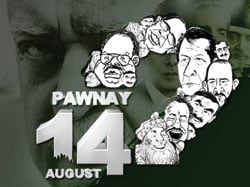
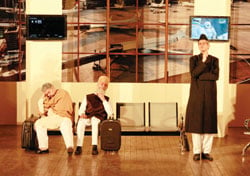
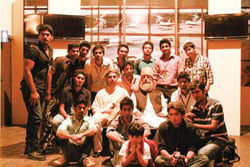
The most recent example of such a play was “Pawnay 14 August” penned
by the great Anwar Maqsood. The strength and depth of Anwar Sahib’s
dialogue was the reason for the play’s success and the audience, who
have loved his work over the years, did indeed come and watch the play in
great numbers. So, there is still a market for a good theatre play in
Lahore. But, as mentioned earlier, the reason for the play’s success was
the script. The question then
becomes; where have all the brilliant scripts gone, and even more
pertinent, where have all the good stage writers gone? According to
Alhamra employees, the institution does not reproduce any of its previous
plays. The plays are still there in the Alhamra building stored in a
library. Unfortunately, it’s more like a store room. Since there is no
proper cataloguing system in the library, it is almost impossible to look
for plays by author names or titles. Coupled with the Art Council’s
policy of not producing any previous productions, most of the plays of the
past whither away into obscurity. Brilliant stage writers
like Anwar Maqsood and Dr Enver Sajjad expanded their careers and moved
onto television. The theatre scene obviously suffered a great deal as a
result. New emerging writers
also started working for television as, ironically, theatre was slowly
pushed backstage. The Alhamra Arts Council was not able to woo budding
writers to write for their productions, since they had no incentive to
offer. All the money was in television and good quality theatre slowly
faded out from the picture. Over the last couple of
years there has been a positive change in the theater scene, especially at
school level, where there are now proper dramatic clubs and numerous
dramatic competitions. More and more youngsters are getting involved in
theater as a result and, hopefully, in the coming years, this translates
into a revival for the theater business in Lahore.
The best for everyone Marriage is the
marking of a new beginning. For most people it is one of the most
important steps in their lives one that is planned and dreamt about for
ages and possibly decades. The two people engaging in wedlock would
obviously then want their day to be a prominently special one a day of
celebration, colour, and extravagance. From the macro-arrangements like
the food and venue, to the micro like the groom’s ‘khusaas’ and ‘pagree’,
everything is made to look picture perfect, and almost impeccable
according to one’s standards. The queen of every
marriage is undeniably the bride, and the trademark of the bride being her
clothes. A symbol of exalted beauty, hair neatly tucked under her
sparkling dupatta, projecting out into the most graceful profile. Face
painted with the best available make-up, barren arms and neck now filled
with jewellery and embellishments, and cultural exotic clothes
overpowering all the colours in the background. Regardless of what
socio-economic class the bride belongs to, the factors contributing to the
beauty of the bride are never compromised. The biggest factor is the
bride’s garments. With the arrival of
signs of pleasant weather has come the much awaited wedding season. Amidst
all the excitement and gushing activity, I spent the last week
interviewing the makers, sellers, buyers, and designers of bridal wear.
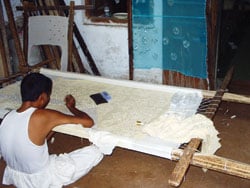
Starting off with the makers; a dead silence pervaded the atmosphere and a
staleness emanated from the room as I entered an adae waalae ki dukaan.
Crooked shirtless figures, with sweat glistening on their bare shoulders,
were seen absorbed in monotonous work on the floor. The static element in
the scene was as much felt as the freshness of activity in a wedding, and
in an instance I thought, ‘how ironic’. Bead being knit with another
on the adda, was producing nothing less than a masterpiece a must-buy for
any profligate consumer. Requirements and orders of hundreds of people
were being met in that one room. These hard-working men worked tirelessly
to satisfy a lady who waits impatiently for the the day of her dreams, but
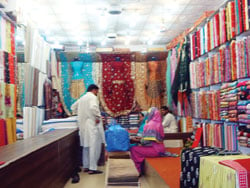
then who provides for the worker and his wife-to-be? My next destination was
Sadar bazaar where there is a line of different lehnga houses that cater
to the delicate maidens belonging to a more self-made and less affluent
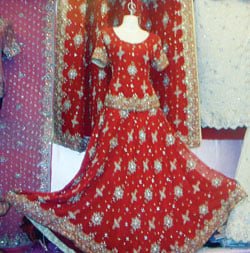
household. Vibrant colours lit up the room, and the reflections of
stylishly cut bridals and the embellishments on them dazzled in my eyes. Beauty, as I have
already mentioned, is never compromised when a wedding is at hand. As
beauty is subjective and varies from not only class to class, but person
to person, to say that these garments are substandard or any less fine in
comparison to works produced by prolific ‘high-class’ designers is a
mere complacent conjecture. For the convenience of the buyer I found that
there are rentals as well as second-hand bridals available at these busy
and packed shops. “Kai log aa k apne
puraane shaadi k jore de jaate hain. Un ko hum dry-clean karte hain, phir
steam-press karte hain, aur yahaan khubsoorti se saja dete hain. Phir
bachiyaan yahaan aati hain, apni pasand se khushi k aalam mein apni shaadi
ka jora le jaati hain” (Many people come to us with their old wedding
dresses. We get them dry cleaned and steam pressed and put them on display
in a beautiful manner. Girls come here and happily take away the dress of
their choice from among these), exclaimed Salaam, the gregarious owner of
one of the numerous shops in Sadar. Salaam was making the
dream day for the not so privileged, possible. There is a thirty to sixty
percent price cut on second-hand attire. Dresses on rent are available at
an even more nominal cost that will make many to smile and shine this
season. Every girl deserves to be a satisfied bride, regardless of her
background or upbringing, as this right is inherent and equal for all.
These shops may not be as glamorous as the office of an international
suave designer, they are still of immense importance in our society. Where
more than half the population is poverty-stricken, anything that can
brighten someone’s life should be given due recognition. Another growing trend, a
modus operandi of arranging for a bridal is by making use of ancestral
clothing economically feasible, a fashionable idea, and a decent way to
attract family appreciation. With minor creative alterations, in order to
bring the dress up-to-date and put your own innovation at test, one
revitalises memories of those most dear to them, and invites
self-satisfaction by making best use of objects of immense sentimental
value. Private boutiques are vanguards of this business, applying
techniques like patchwork etc to produce a slightly modified finely
attractive dress. What could bring more happiness to a grandmother than
viewing her beloved grand daughter clothed in one of her most prized
possessions. One that she has salvaged for years, in the hope that it will
arouse feelings of happiness and enthralling satisfaction in another
bride, just as she had felt in her golden days. The picturesque view of
a bride finely ornamented produces the same effect as when an artist views
his painting. There is a tale behind each dress. The gloss on her
expressions, the subtle smile on her slightly bent face, the shyness and
grace in her posture, and most of all the intricacy of her clothing say so
much more than any article or picture can capture.
*4th Lahore International Children's Film Festival from September 17-22 at Ali Auditorium. The Lahore International Children's Film Festival is project of the little art. It's an annual event to showcase the best of local international films made by, for or about children. 86 films from 33 countries will be shown in the festival. *Solo exhibition at drawing room art gallery by Karen Frank from Sept 11-18. On exhibit are large-scale plastic tableaus that offer strange insights and envoke all madness and drama of the people of Pakistan. *Lecture on Anarchism, religion and resistance at Cafe Bol on Tuesday, Sept 11 at 7:30 pm. Photo walk through the royal tall on Saturday, Sept 29 at 05:30 am. Walk to start from Delhi Gate.
|
|

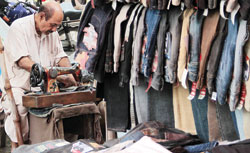
 Tailor
on walkway
Tailor
on walkway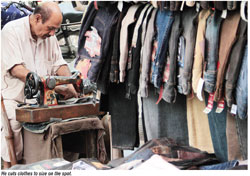
 Town
Talk
Town
Talk
